wheel SAAB 9-3 2006 Owner's Manual
[x] Cancel search | Manufacturer: SAAB, Model Year: 2006, Model line: 9-3, Model: SAAB 9-3 2006Pages: 318, PDF Size: 28.05 MB
Page 106 of 318
106 Instruments and controlsPriority of audible informationSound from various functions in the car,
such as the direction indicators, parking
assistance and seatbelt reminders, come
from the same sound source: the car’s
sound system. If two or more of these func-
tions are active simultaneously, the most
important function at that time will be priori-
tized.
If, for example, the direction indicators are
active when you engage reverse, the park-
ing assistance (if fitted) will be heard instead
of the direction indicators. When reverse is
disengaged, the direction indicators will be
heard, if they are still active.
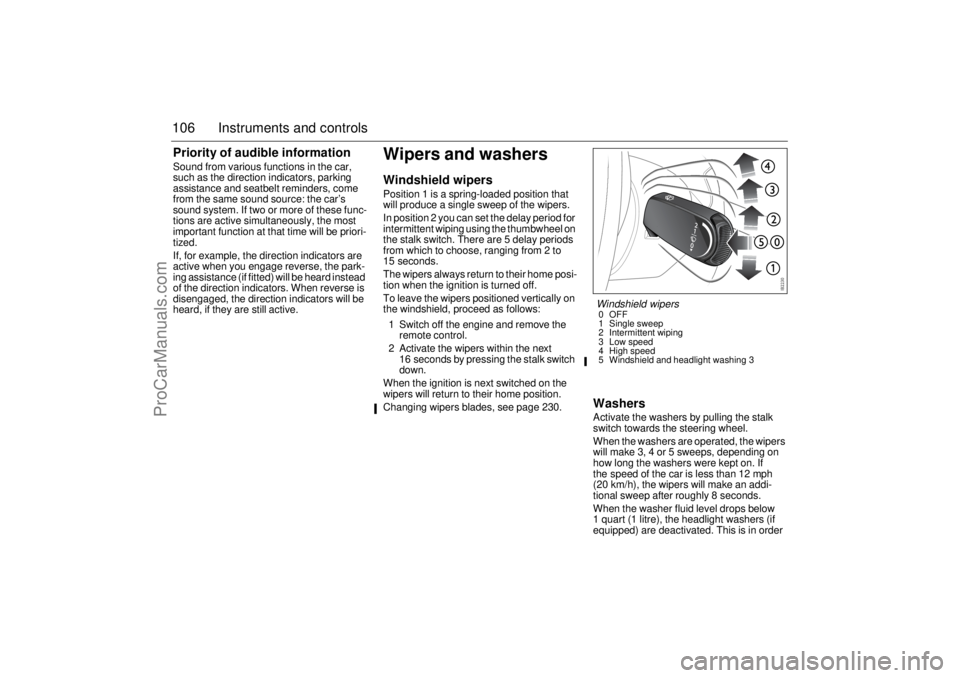
Wipers and washersWindshield wipersPosition 1 is a spring-loaded position that
will produce a single sweep of the wipers.
In position 2 you can set the delay period for
intermittent wiping using the thumbwheel on
the stalk switch. There are 5 delay periods
from which to choose, ranging from 2 to
15 seconds.
The wipers always return to their home posi-
tion when the ignition is turned off.
To leave the wipers positioned vertically on
the windshield, proceed as follows:
1 Switch off the engine and remove the
remote control.
2 Activate the wipers within the next
16 seconds by pressing the stalk switch
down.
When the ignition is next switched on the
wipers will return to their home position.
Changing wipers blades, see page 230.
WashersActivate the washers by pulling the stalk
switch towards the steering wheel.
When the washers are operated, the wipers
will make 3, 4 or 5 sweeps, depending on
how long the washers were kept on. If
the speed of the car is less than 12 mph
(20 km/h), the wipers will make an addi-
tional sweep after roughly 8 seconds.
When the washer fluid level drops below
1 quart (1 litre), the headlight washers (if
equipped) are deactivated. This is in order Windshield wipers0OFF
1 Single sweep
2 Intermittent wiping
3 Low speed
4 High speed
5 Windshield and headlight washing3
93U S M 06.book Page 106 Friday, February 18, 2005 1:15 PM
ProCarManuals.com
Page 127 of 318
127 Interior equipment
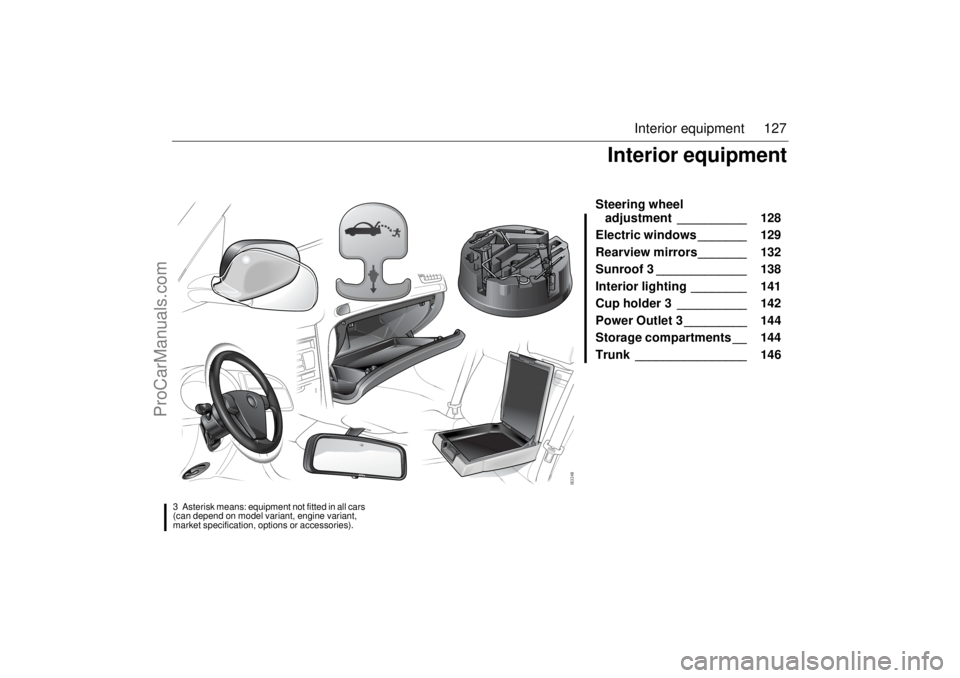
Steering wheel
adjustment __________ 128
Electric windows _______ 129
Rearview mirrors_______ 132
Sunroof 3 _____________ 138
Interior lighting ________ 141
Cup holder 3 __________ 142
Power Outlet 3 _________ 144
Storage compartments __ 144
Trunk ________________ 146
Interior equipment
3Asterisk means: equipment not fitted in all cars
(can depend on model variant, engine variant,
market specification, options or accessories).93U S M 06.book Page 127 Friday, February 18, 2005 1:15 PM
ProCarManuals.com
Page 128 of 318
128 Interior equipmentSteering wheel
adjustmentThe height and reach of the steering wheel
can be adjusted.
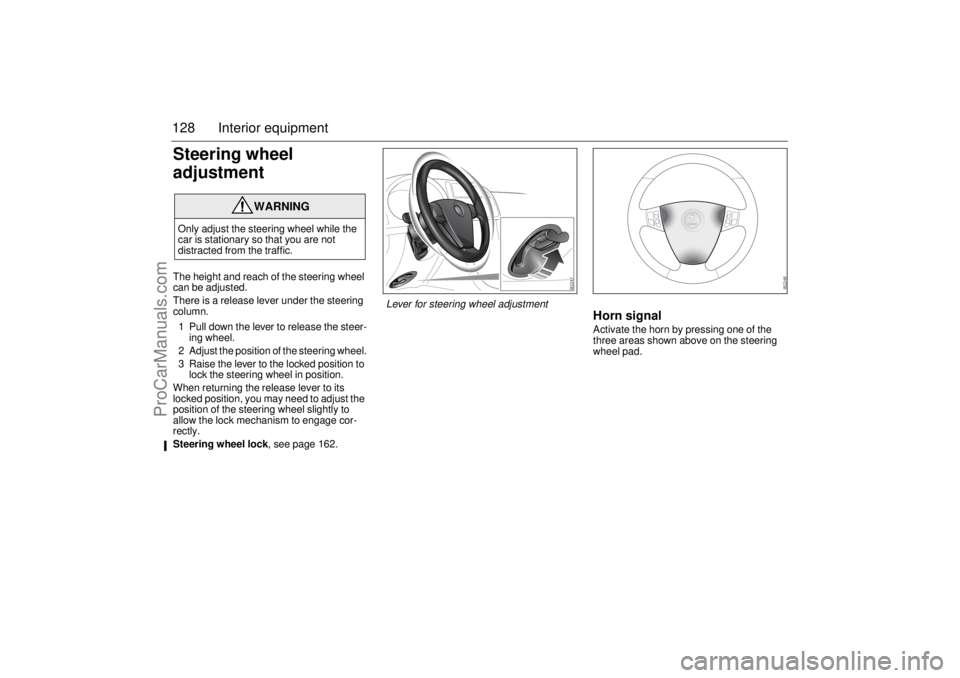
There is a release lever under the steering
column.
1 Pull down the lever to release the steer-
ing wheel.
2 Adjust the position of the steering wheel.
3 Raise the lever to the locked position to
lock the steering wheel in position.
When returning the release lever to its
locked position, you may need to adjust the
position of the steering wheel slightly to
allow the lock mechanism to engage cor-
rectly.
Steering wheel lock, see page 162.
Horn signalActivate the horn by pressing one of the
three areas shown above on the steering
wheel pad.
WARNING
Only adjust the steering wheel while the
car is stationary so that you are not
distracted from the traffic.
Lever for steering wheel adjustment
93U S M 06.book Page 128 Friday, February 18, 2005 1:15 PM
ProCarManuals.com
Page 150 of 318
150 Interior equipment
Trunk lightingOn the underside of the parcel shelf is a light
that is switched on and off when the trunk is
opened and closed.
If the trunk lid is left open, the lighting will be
switched off automatically after 20 minutes
to prevent the battery from running flat.
Emergency opening of the
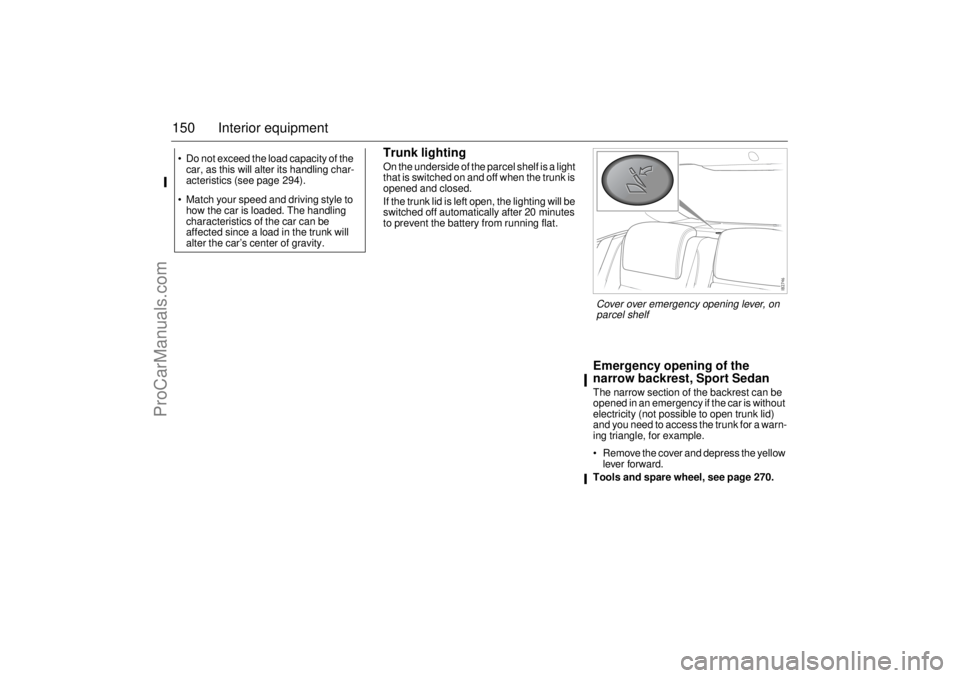
narrow backrest, Sport SedanThe narrow section of the backrest can be
opened in an emergency if the car is without
electricity (not possible to open trunk lid)
and you need to access the trunk for a warn-
ing triangle, for example.
Remove the cover and depress the yellow
lever forward.
Tools and spare wheel, see page 270. Do not exceed the load capacity of the
car, as this will alter its handling char-
acteristics (see page 294).
Match your speed and driving style to
how the car is loaded. The handling
characteristics of the car can be
affected since a load in the trunk will
alter the car’s center of gravity.Cover over emergency opening lever, on
parcel shelf
93U S M 06.book Page 150 Friday, February 18, 2005 1:15 PM
ProCarManuals.com
Page 159 of 318

159 Starting and driving
Ignition switch ________ 160
Steering wheel lock ____ 162
Starting the engine ____ 162
Important considerations
for driving __________ 164
Refueling ____________ 167
Engine Break-in Period _ 171
Manual transmission___ 172
Automatic
transmission 3 ______ 173
Cruise control ________ 179
Braking ______________ 180
Traction Control System
(TCS) ______________ 183
Electronic Stability
Program (ESP) 3 _____ 185
Parking brake_________ 187
Parking ______________ 187
Saab Parking
Assistance 3 ________ 190 Economical driving _____ 193
Driving in cold weather__ 195
Driving in hot climates __ 197
Towing a trailer 3_______ 198
Driving with a roof rack
load ________________ 202
Driving with a load _____ 204
Driving with the trunk lid
open________________ 204
Driving in deep water ___ 204
Driving at night ________ 205
Towing the car _________ 205
Driving with the compact
spare tire ____________ 208
Jump starting _________ 208
For long trips __________ 211
Starting and driving
3Asterisk means: equipment not fitted in all cars
(can depend on model variant, engine variant,
market specification, options or accessories).93U S M 06.book Page 159 Friday, February 18, 2005 1:15 PM
ProCarManuals.com
Page 160 of 318
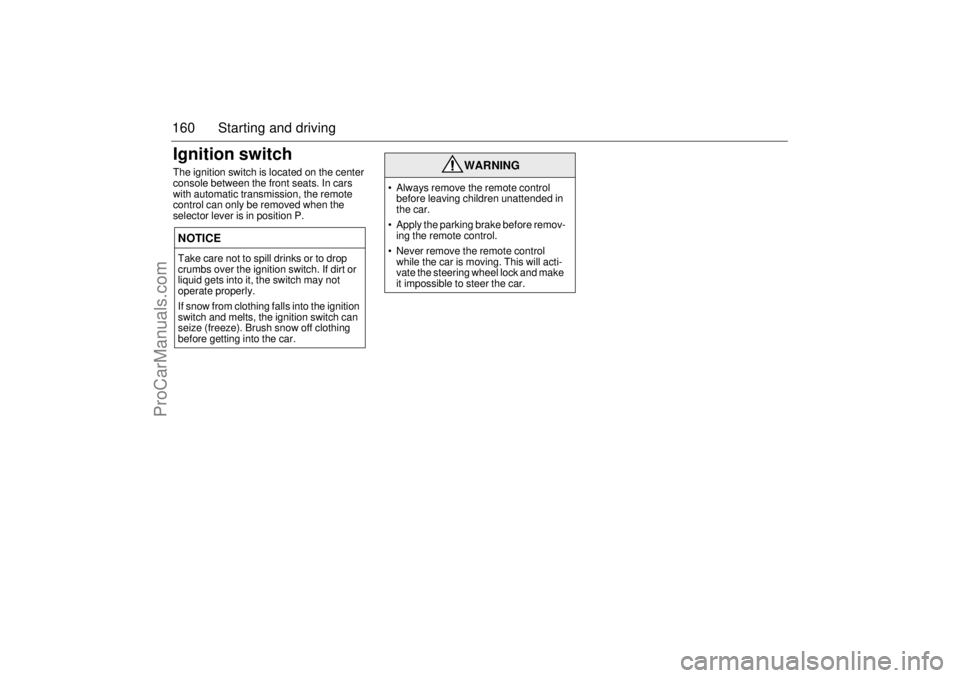
160 Starting and drivingIgnition switchThe ignition switch is located on the center
console between the front seats. In cars
with automatic transmission, the remote
control can only be removed when the
selector lever is in position P.NOTICETake care not to spill drinks or to drop
crumbs over the ignition switch. If dirt or
liquid gets into it, the switch may not
operate properly.
If snow from clothing falls into the ignition
switch and melts, the ignition switch can
seize (freeze). Brush snow off clothing
before getting into the car.
WARNING
Always remove the remote control
before leaving children unattended in
the car.
Apply the parking brake before remov-
ing the remote control.
Never remove the remote control
while the car is moving. This will acti-
vate the steering wheel lock and make
it impossible to steer the car.
93U S M 06.book Page 160 Friday, February 18, 2005 1:15 PM
ProCarManuals.com
Page 162 of 318
162 Starting and drivingSteering wheel lockThe steering wheel lock is electronic. The
lock engages when the remote control is
removed from the ignition and unlocks when
the remote control is inserted. A click can be
heard when the steering wheel lock locks
and unlocks.
If the car is parked with one front wheel
touching the curb, for example, you may
need to turn the steering wheel slightly
when you insert the remote control to allow
the steering wheel lock to unlock. If you do
not succeed on first attempt you must
remove the remote control before trying
again. Turn the steering wheel and insert
the remote control into the ignition switch.
If the steering wheel lock does not disen-
gage it will not be possible to turn the remote
control in the ignition switch.
The following message is shown on the SID:If a fault arises affecting the steering wheel
lock, the following message will be
displayed on the SID:
If the steering wheel lock malfunctions while
the remote control is in the ignition switch,
this may prevent the removal of the remote
control or prevent the car from being
restarted once the engine has been
switched off.
If you have to leave the car, lock the car by
pressing down the lock buttons on the
doors. Lock the front left door from outside
with the traditional key (see page 52). The
car is now locked but the alarm is inactive.
Starting the engine
Steering wheel locked.
Pull out key, turn steering
wheel. Try again.
Steering lock malfunc.
Make a safe stop.
Contact Saab dealer.
WARNING
When starting the engine:
- Sit down in the driver’s seat.
- Depress the clutch pedal fully (M/T). If
the gear lever is not in the neutral posi-
tion, the clutch pedal must be fully
depressed or the car will jump
forwards or backwards, which may
cause a crash.
- Never start the car from outside the
vehicle, e.g. through a window that is
down. This could lead to serious
personal injury.
Cars with automatic transmission:
select position P to remove the ignition
key. The key can only be removed in
this gear position.
Carbon monoxide (CO) is a colorless,
odorless, poisonous gas. Be alert to
the danger of CO – always open the
garage doors before starting the
engine in the garage.
Do not rest or sleep in the car when
parked with the engine running. There
is a risk of depressing the accelerator
which could lead to engine damage.
There is also a danger of CO poison-
ing if the exhaust system is leaking.
93U S M 06.book Page 162 Friday, February 18, 2005 1:15 PM
ProCarManuals.com
Page 178 of 318
178 Starting and driving
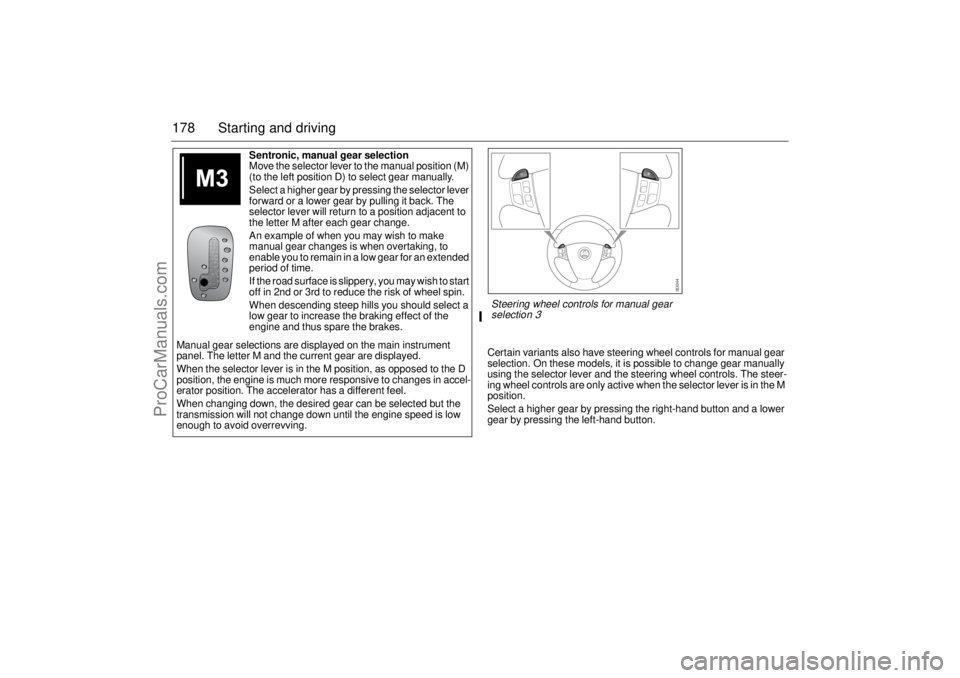
Certain variants also have steering wheel controls for manual gear
selection. On these models, it is possible to change gear manually
using the selector lever and the steering wheel controls. The steer-
ing wheel controls are only active when the selector lever is in the M
position.
Select a higher gear by pressing the right-hand button and a lower
gear by pressing the left-hand button. Sentronic, manual gear selection
Move the selector lever to the manual position (M)
(to the left position D) to select gear manually.
Select a higher gear by pressing the selector lever
forward or a lower gear by pulling it back. The
selector lever will return to a position adjacent to
the letter M after each gear change.
An example of when you may wish to make
manual gear changes is when overtaking, to
enable you to remain in a low gear for an extended
period of time.
If the road surface is slippery, you may wish to start
off in 2nd or 3rd to reduce the risk of wheel spin.
When descending steep hills you should select a
low gear to increase the braking effect of the
engine and thus spare the brakes.
Manual gear selections are displayed on the main instrument
panel. The letter M and the current gear are displayed.
When the selector lever is in the M position, as opposed to the D
position, the engine is much more responsive to changes in accel-
erator position. The accelerator has a different feel.
When changing down, the desired gear can be selected but the
transmission will not change down until the engine speed is low
enough to avoid overrevving.Steering wheel controls for manual gear
selection
3
93U S M 06.book Page 178 Friday, February 18, 2005 1:15 PM
ProCarManuals.com
Page 179 of 318
179 Starting and driving
Cruise control(Cruise control system)
For safety reasons (brake system func-
tion), the brakes must be applied once
when the engine has started, before the
cruise control system can be activated.
The following message is shown on the SID:
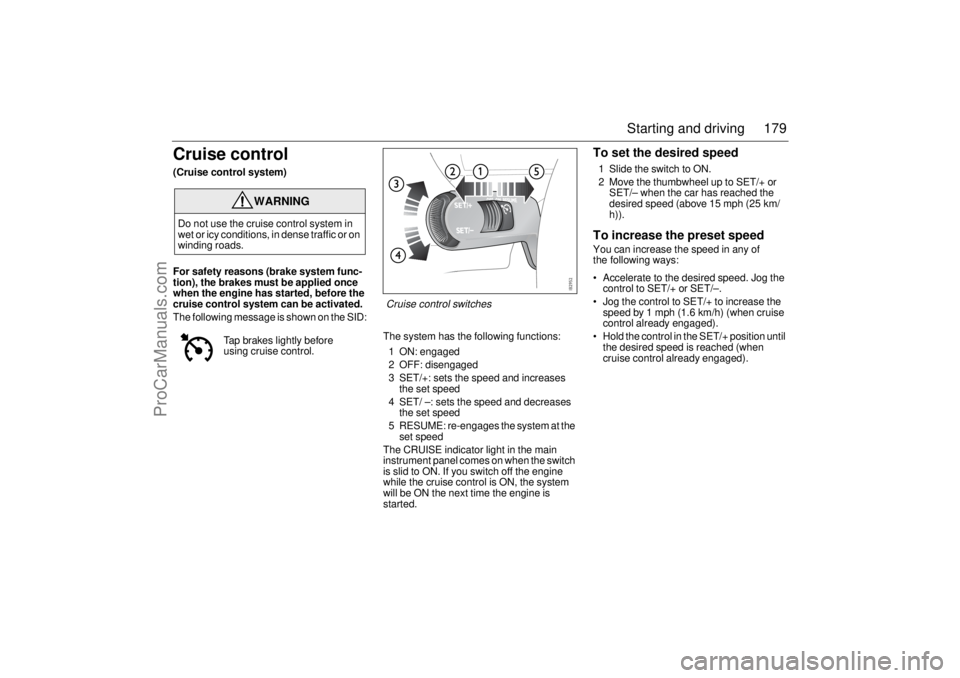
The system has the following functions:
1 ON: engaged
2 OFF: disengaged
3 SET/+: sets the speed and increases
the set speed
4 SET/ –: sets the speed and decreases
the set speed
5 RESUME: re-engages the system at the
set speed
The CRUISE indicator light in the main
instrument panel comes on when the switch
is slid to ON. If you switch off the engine
while the cruise control is ON, the system
will be ON the next time the engine is
started.
To set the desired speed1 Slide the switch to ON.
2 Move the thumbwheel up to SET/+ or
SET/– when the car has reached the
desired speed (above 15 mph (25 km/
h)).To increase the preset speedYou can increase the speed in any of
the following ways:
Accelerate to the desired speed. Jog the
control to SET/+ or SET/–.
Jog the control to SET/+ to increase the
speed by 1 mph (1.6 km/h) (when cruise
control already engaged).
Hold the control in the SET/+ position until
the desired speed is reached (when
cruise control already engaged).
WARNING
Do not use the cruise control system in
wet or icy conditions, in dense traffic or on
winding roads.
Tap brakes lightly before
using cruise control.
Cruise control switches
93U S M 06.book Page 179 Friday, February 18, 2005 1:15 PM
ProCarManuals.com
Page 181 of 318
181 Starting and driving
ABS brakesThe Antilock Braking System (ABS) modu-
lates the brake pressure to each wheel. The
pressure is automatically reduced just
before the wheel locks up and then
increases again to the point at which the
wheel is just about to lock. The wheel sen-
sors send information to the brake system’s
electronic control module for every 4 or so
inches (decimetre) that the car rolls. This
information is processed continuously to
ensure that the adjustment of the brake
pressure will be as exact as possible.
Adjustment takes place up to 12 times per
second.The brake system provides Electronic
Brakeforce Distribution (EBD). This distri-
butes the brake pressure between the front
and rear wheels, in such a way as to achieve
optimum braking performance irrespective
of the car’s speed or load.
The ABS has a built-in diagnostics function
which will switch on the ABS warning light
if a fault is detected in the system (see
page 84).
The following message will appear on the
SID (and corresponding symbol on main
instrument unit) if a fault is detected:
WARNING
It is prudent to try your brakes from
time to time, especially when driving in
heavy rain, through water collected on
the road, in snow, on a wet road
surface or in salty slush. In such condi-
tions, the brakes may take longer than
normal to take effect. To rectify this,
touch the brake pedal periodically to
dry the brakes out.
The same applies after the car has
been washed or when the weather is
very humid.
Avoid parking the car with wet brakes.
Before parking, and if the traffic condi-
tions allow, brake quite heavily so that
the brake discs and pads warm up and
dry.
The brakes are power assisted and it
should be kept in mind that the servo
unit only provides the power assis-
tance when the engine is running.
The brake pressure required when the
engine is off, (e.g. when the car is
being towed) is roughly four times the
normal pedal force required. The
pedal also feels hard and unrespon-
sive.
Overheating can cause the brakes to
fade!
WARNING
The additional safety afforded by the
ABS system is not designed to allow
drivers to drive faster but to make
normal driving safer.
To stop as quickly as possible, without
loss of directional stability, whether
the road surface is dry, wet or slippery,
press the brake pedal down hard
without letting up (do not pump the
pedal), declutching simulta-
neously, and steer the car to safety.
Antilock brake malfunction.
Contact Saab dealer.
93U S M 06.book Page 181 Friday, February 18, 2005 1:15 PM
ProCarManuals.com