light SAAB 9-3 2006 Service Manual
[x] Cancel search | Manufacturer: SAAB, Model Year: 2006, Model line: 9-3, Model: SAAB 9-3 2006Pages: 318, PDF Size: 28.05 MB
Page 107 of 318
107 Instruments and controls
to prioritize the windshield. The following
message is displayed on the SID:
To prevent the smell of washer fluid from
entering the car, recirculation can be acti-
vated automatically while the windshield is
washed. The recirculation symbol will how-
ever not light up. This function is optional;
contact a workshop. We recommend that
you contact a Saab dealer. This automatic
recirculation is the factory default setting as
long as the system is working in full "AUTO"
mode with no customized settings.
Headlight washers3The headlights are washed at the same time
as the windshield if the headlights are on.
The headlights are washed every fifth time
the windshield washers are used or if two
(2) minutes have elapsed since the wind-
shield was last washed.
The headlight washers are not activated at
speeds in excess of 125 mph (200 km/h).
Rain sensor3The rain sensor automatically controls the
windshield wipers. The sensor is located on
the windshield beside the rearview mirror.
The system varies the frequency of wiping
between single sweeps and continuous
wiping, depending on the amount of pre-
cipitation.
Activate the rain sensor by lifting the stalk
switch to the AUTO position. The wipers
make one sweep for reference to see how
much water is on the windshield. In the
future, the sensor compares the amount of
water on the windshield with this reference
value. Washer fluid level low.
Refill.
WARNING
Turn the rain sensor off if the ignition is
ON to avoid personal injury when clearing
snow and ice from the windshield.NOTICETurn the rain sensor off before washing
the car in an automatic carwash, to avoid
damaging the windshield wipers.
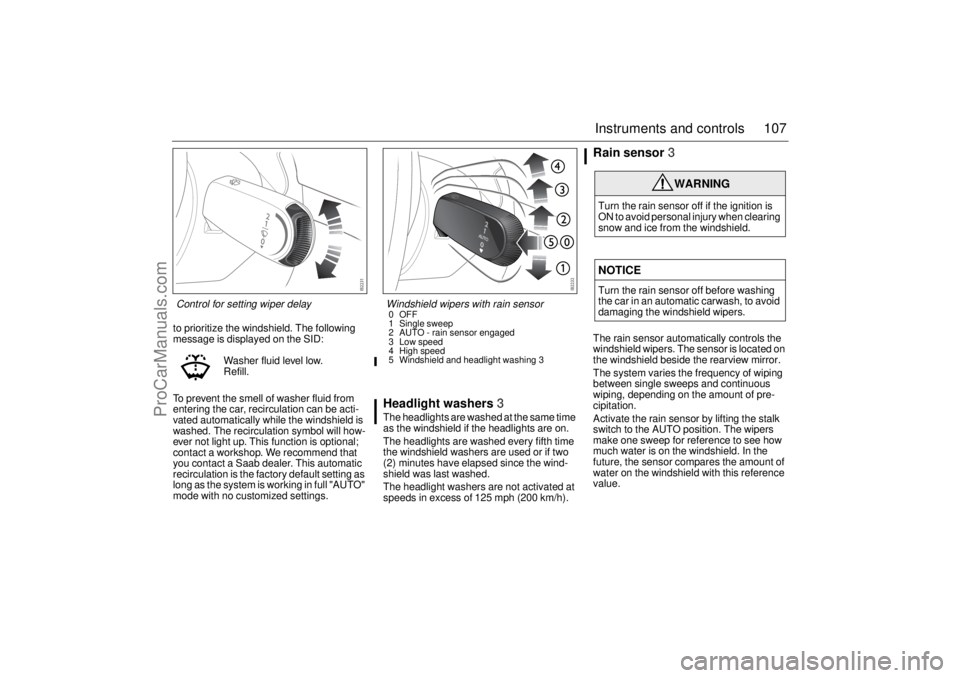
Control for setting wiper delay
Windshield wipers with rain sensor0OFF
1 Single sweep
2 AUTO - rain sensor engaged
3 Low speed
4 High speed
5 Windshield and headlight washing3
93U S M 06.book Page 107 Friday, February 18, 2005 1:15 PM
ProCarManuals.com
Page 108 of 318
108 Instruments and controlsIf the stalk switch is left in the AUTO position
when the engine is switched off, when the
engine is next started it must first be moved
to the 0 or 3 position and then back to AUTO
to reactivate the sensor.
If the system malfunctions, the wipers will
operate at low speed when the stalk switch
is set to the AUTO position.Adjusting sensitivity
The sensitivity of the rain sensor can be
adjusted under Profiler. If you increase the
sensitivity, the wipers will make one sweep
for reference.
1 Press the CUSTOMIZE button to go to
Profiler.
2 Select Rain Sensor using the INFO dial.
3 Press in the INFO dial.
4 Select the sensitivity by turning the dial.
5 Confirm this selection by pressing the
INFO dial.
The sensitivity of the sensor is also affected
by the amount of daylight. The sensor is
somewhat more sensitive at night. This
adjustment is automatic.Explanation of sensor sensitivity.
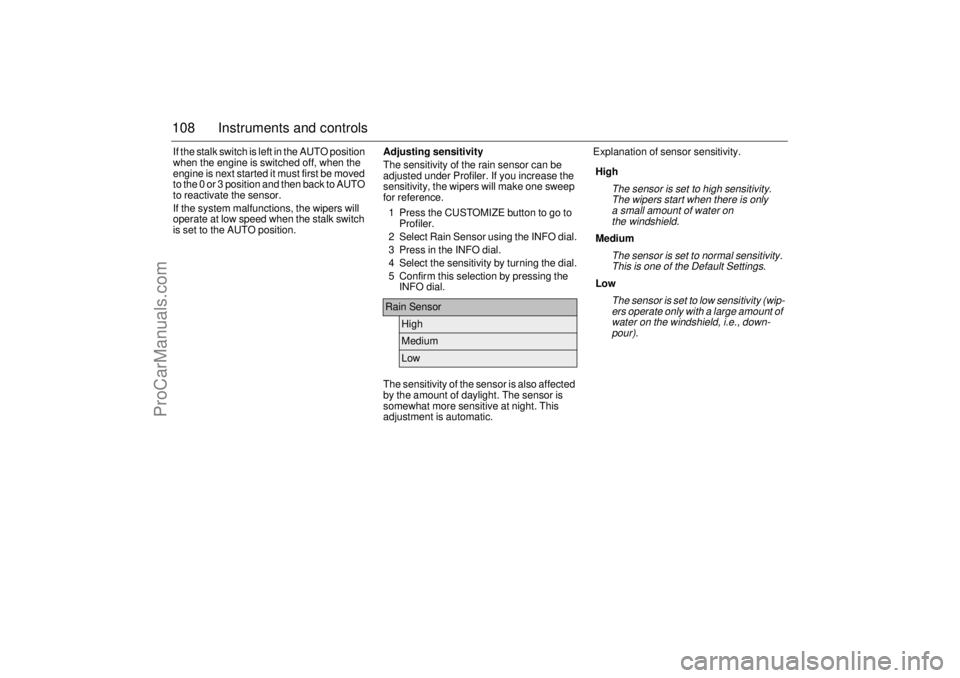
Rain Sensor
HighMediumLow
High
The sensor is set to high sensitivity.
The wipers start when there is only
a small amount of water on
the windshield.
Medium
The sensor is set to normal sensitivity.
This is one of the Default Settings.
Low
The sensor is set to low sensitivity (wip-
ers operate only with a large amount of
water on the windshield, i.e., down-
pour).
93U S M 06.book Page 108 Friday, February 18, 2005 1:15 PM
ProCarManuals.com
Page 110 of 318
110 Instruments and controlsManual climate-control
system3Fresh air for the cabin is drawn in through an
inlet grille at the bottom edge of the wind-
shield. It passes through a filter before
reaching the climate control system and
delivery into the cabin. The air is evacuated
via openings in the parcel shelf. It is then led
through outlets on either side of the car
behind the rear bumper.
The incoming air is treated in three stages:
first it passes through a filter; it is then dehu-
midified and cooled; and finally, if required,
it is heated.
To optimize the performance of the A/C sys-
tem, all windows and the sunroof should be
shut.
To reduce potential misting on the insides of
the windows, the glass should be cleaned
with a quality glass cleaner. How often this
will need to be done depends on how clean
the air is - if there are smokers in the car, the
windows will need to be cleaned more fre-
quently.
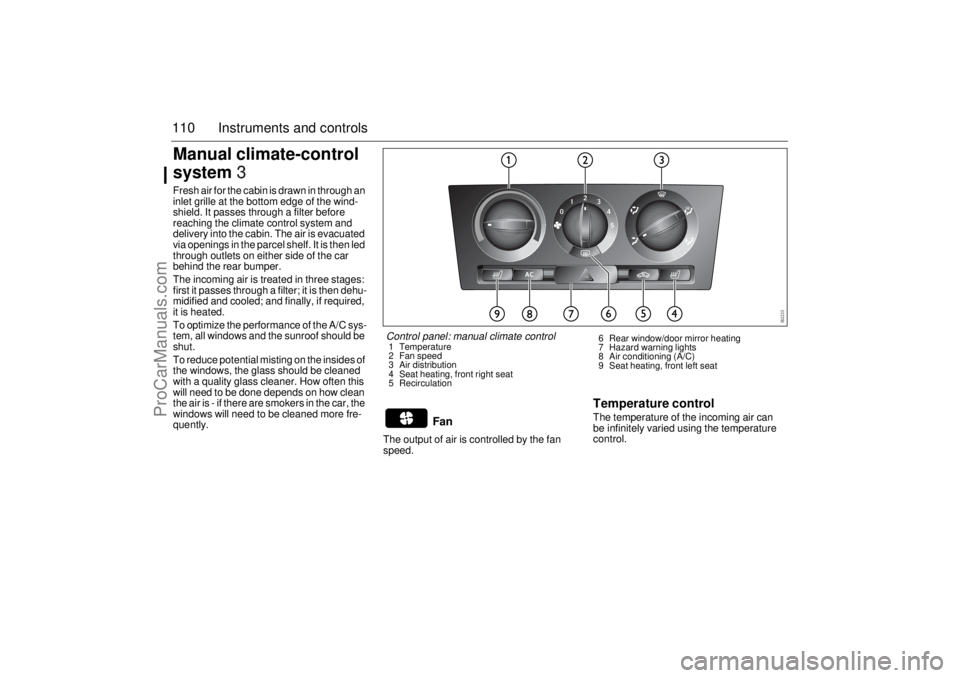
The output of air is controlled by the fan
speed.
Temperature controlThe temperature of the incoming air can
be infinitely varied using the temperature
control.
Fan
Control panel: manual climate control1 Temperature
2 Fan speed
3 Air distribution
4 Seat heating, front right seat
5 Recirculation6 Rear window/door mirror heating
7 Hazard warning lights
8 Air conditioning (A/C)
9 Seat heating, front left seat
93U S M 06.book Page 110 Friday, February 18, 2005 1:15 PM
ProCarManuals.com
Page 115 of 318
115 Instruments and controls
Automatic climate-
control system (ACC)Fresh air for the cabin is drawn in through an
inlet at the bottom edge of the windshield. It
passes through an effective filter before
reaching the climate control system and
delivery into the cabin. The air is evacuated
via openings in the parcel shelf. It is then led
through outlets on either side of the car
behind the rear bumper.
The Automatic Climate-Control system
(ACC) automatically maintains the desired
cabin temperature, regardless of the
weather outside.
The system will achieve the desired temper-
ature in the quickest possible way.
Note that heating or cooling is not
speeded up by setting the temperature
higher or lower than the final tempera-
ture you desire.
To optimize the performance of the air con-
ditioning system, all windows and the sun-
roof should be shut. The air vents in the
fascia must be open.
The incoming air is treated in three stages:
first it passes through a filter; it is then dehu-
midified and cooled; and finally, if required,
it is heated.To reduce potential misting on the insides of
the windows, the glass should be cleaned
with a quality glass cleaner. How often this
will need to be done depends on how clean
the air is - if there are smokers in the car, the
windows will need to be cleaned more
frequently.
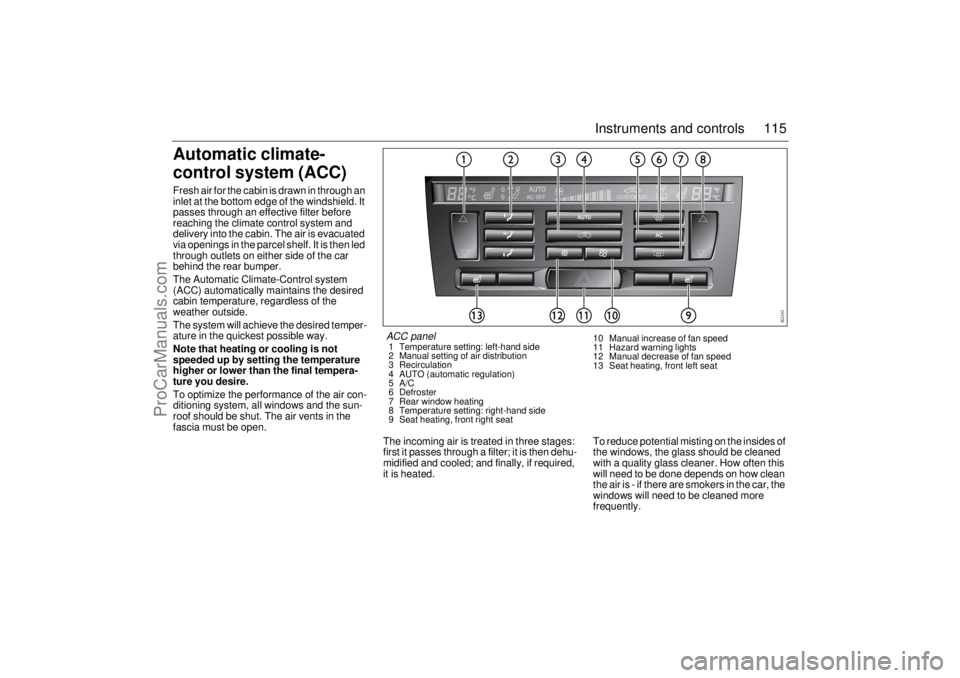
ACC panel1 Temperature setting: left-hand side
2 Manual setting of air distribution
3 Recirculation
4 AUTO (automatic regulation)
5A/C
6 Defroster
7 Rear window heating
8 Temperature setting: right-hand side
9 Seat heating, front right seat10 Manual increase of fan speed
11 Hazard warning lights
12 Manual decrease of fan speed
13 Seat heating, front left seat
93U S M 06.book Page 115 Friday, February 18, 2005 1:15 PM
ProCarManuals.com
Page 123 of 318

123 Instruments and controls
The seat cushions and backrests of the front
seats are heated.
Heating is thermostatically controlled.
Heating is controlled manually but can also
be automatic. Refer to Profiler on page 124.
Three heating levels are available. Pressing
the button once will turn the heating on at full
power. Pressing the button a total of 4 times
will turn the heating off.
= full.
= medium.
= low.
CalibrationCalibration is performed automatically
every fifth time the car is started after having
been switched off for more than 2 hours or
if the battery has been disconnected.ProgrammingA number of functions can be customized
under Profiler (see page 124). Further cus-
tomizations can be made at a workshop. We
recommend that you contact a Saab dealer.Tips(before contacting a workshop. We recom-
mend that you contact a Saab dealer)
If you feel that the ACC system is not func-
tioning satisfactorily, select "Default
Settings" under Profiler (see page 124.
To prevent the smell of washer fluid from
entering the car, recirculation can be acti-
vated automatically while the windshield
is washed. The recirculation symbol will
however not light up. This function is
optional; contact a workshop. We recom-
mend that you contact a Saab dealer. This
automatic recirculation is the factory
default setting as long as the system is
working in full "AUTO" model with no
customized settings.
Electric heating, front
seats3
93U S M 06.book Page 123 Friday, February 18, 2005 1:15 PM
ProCarManuals.com
Page 126 of 318

126 Instruments and controlsFan Settings
High speed:
This selection give a slightly higher
fan speed than Medium speed
though with continued automatic
regulation.
Medium speed:
Normal automatic fan speed. This is
one of the Default Settings.
Low speed:
This selection give a slightly lower
fan speed than Medium speed
though with continued automatic
regulation.
Convertible: Fan speed is not regulated
automatically when the soft top is open.
Air Distribution
Auto:
The ACC system adapts air tem-
perature and distribution to the pre-
vailing conditions. This is one of the
Default Settings
.
Manual:
Windshield:
The ACC system directs almost
all air to the windshield.
Panel:
The ACC system directs almost
all air to air vents in the fascia.
Floor:
The ACC system directs almost
all air to the floor.
A/C Mode
Auto:
Automatic engagement and disen-
gagement of the A/C. This is one of
the Default Settings.
A/C off:
A/C compressor OFF (see also
page 118). The A/C compressor
can be activated temporarily by
pressing the AC or AUTO button
while on the road and if the outside
temperature is above 41°F (+5°C).
The A/C will be off the next time the
engine is started, if the engine has
been switched off for more than
2hours.
Convertible: The A/C compressor is
switched off when the soft top is folded
down.
Further customizations to this function can
be made at a workshop. We recommend
taht you contact a Saab dealer.
The A/C compressor can be on even
when the soft top is folded down.
The A/C compressor can be set to
operate as when the soft top was last
folded down.Dual/Single Zone
Dual zone:
Individual temperature setting for
each zone (see page 116). The sys-
tem saves the settings when the
engine is switched off. This is one of
the Default Settings.
Single zone:
Common temperature setting when
the engine is started. If the temper-
ature setting for the passenger zone
is changed, the system will switch to
Dual zone control. Single zone con-
trol will return the next time the
engine is started having been
switched off for more than 2 hours.
93U S M 06.book Page 126 Friday, February 18, 2005 1:15 PM
ProCarManuals.com
Page 127 of 318
127 Interior equipment
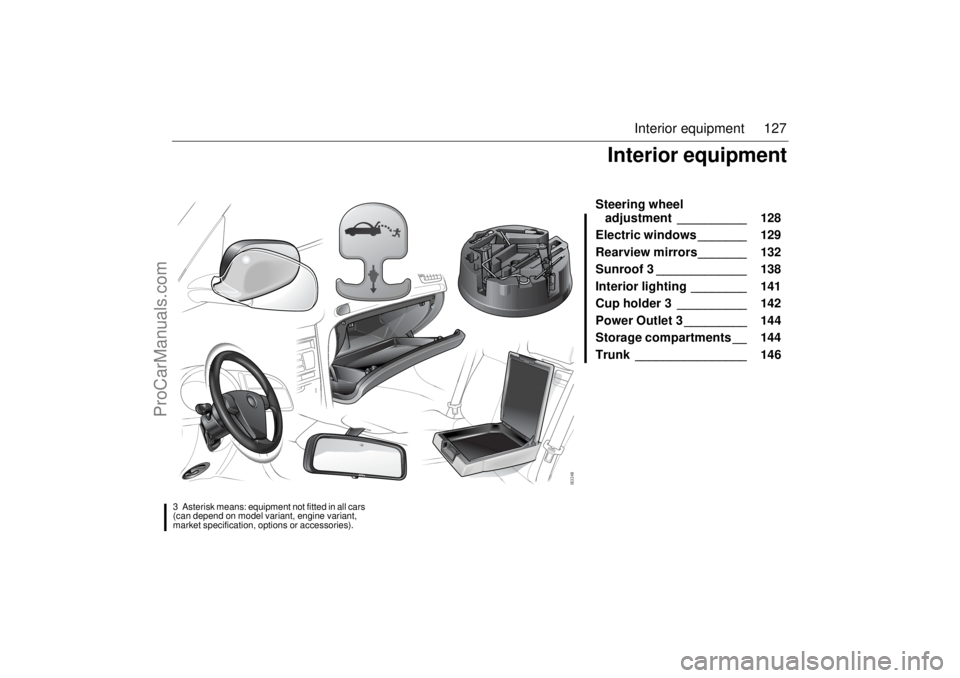
Steering wheel
adjustment __________ 128
Electric windows _______ 129
Rearview mirrors_______ 132
Sunroof 3 _____________ 138
Interior lighting ________ 141
Cup holder 3 __________ 142
Power Outlet 3 _________ 144
Storage compartments __ 144
Trunk ________________ 146
Interior equipment
3Asterisk means: equipment not fitted in all cars
(can depend on model variant, engine variant,
market specification, options or accessories).93U S M 06.book Page 127 Friday, February 18, 2005 1:15 PM
ProCarManuals.com
Page 128 of 318
128 Interior equipmentSteering wheel
adjustmentThe height and reach of the steering wheel
can be adjusted.
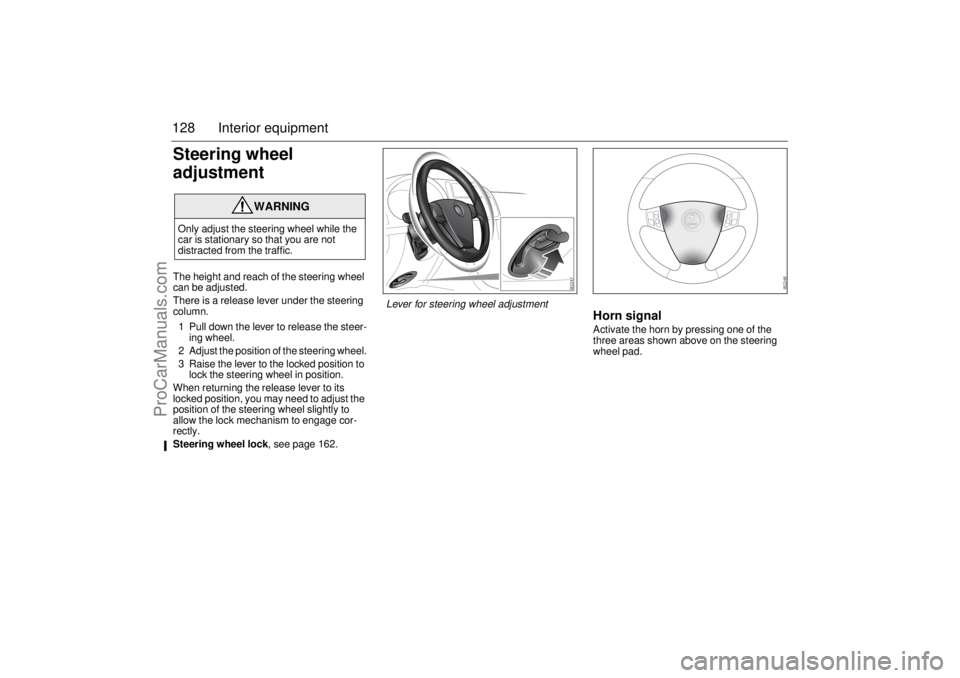
There is a release lever under the steering
column.
1 Pull down the lever to release the steer-
ing wheel.
2 Adjust the position of the steering wheel.
3 Raise the lever to the locked position to
lock the steering wheel in position.
When returning the release lever to its
locked position, you may need to adjust the
position of the steering wheel slightly to
allow the lock mechanism to engage cor-
rectly.
Steering wheel lock, see page 162.
Horn signalActivate the horn by pressing one of the
three areas shown above on the steering
wheel pad.
WARNING
Only adjust the steering wheel while the
car is stationary so that you are not
distracted from the traffic.
Lever for steering wheel adjustment
93U S M 06.book Page 128 Friday, February 18, 2005 1:15 PM
ProCarManuals.com
Page 130 of 318
130 Interior equipmentTo closeRaise the front edge of the button one step.
The window will stop when it is fully closed
or when the button is released.
Automatic closing3: Raise the button all
the way and release it. If the window does
not close automatically, refer to Calibration
on page 131.
Pinch protection3On certain model variants, the front electric
windows are equipped with pinch protec-
tion. This is activated if something gets
trapped between the window pane and door
frame when the window is closed. The
window will stop and lower slightly.
Temporary overriding the pinch protec-
tion
If dirt, ice or similar create so much resis-
tance that the pinch protection cuts in (the
window cannot be closed), the pinch protec-
tion can be temporarily disengaged and the
window closed.
1 Make sure the ignition is ON.
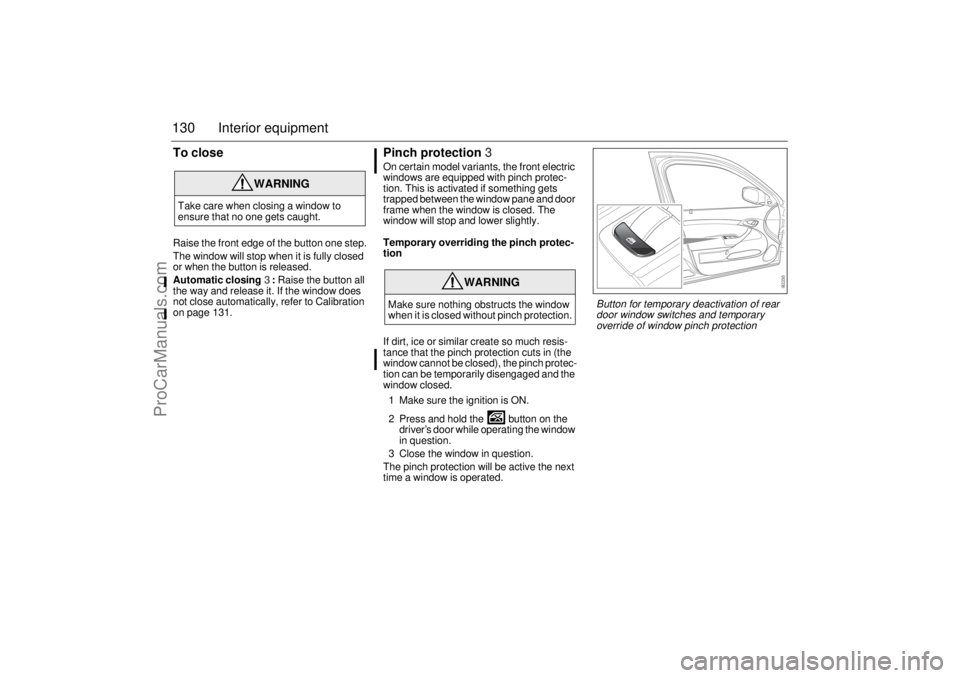
2 Press and hold the button on the
driver’s door while operating the window
in question.
3 Close the window in question.
The pinch protection will be active the next
time a window is operated.
WARNING
Take care when closing a window to
ensure that no one gets caught.
WARNING
Make sure nothing obstructs the window
when it is closed without pinch protection.
Button for temporary deactivation of rear
door window switches and temporary
override of window pinch protection
93U S M 06.book Page 130 Friday, February 18, 2005 1:15 PM
ProCarManuals.com
Page 133 of 318
133 Interior equipment
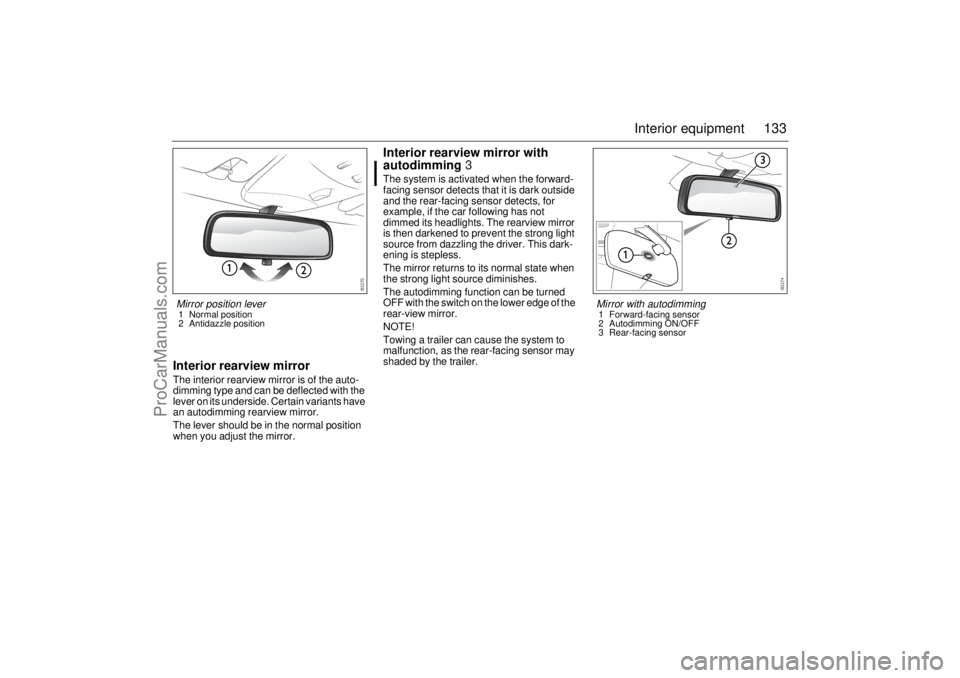
Interior rearview mirrorThe interior rearview mirror is of the auto-
dimming type and can be deflected with the
lever on its underside. Certain variants have
an autodimming rearview mirror.
The lever should be in the normal position
when you adjust the mirror.
Interior rearview mirror with
autodimming3The system is activated when the forward-
facing sensor detects that it is dark outside
and the rear-facing sensor detects, for
example, if the car following has not
dimmed its headlights. The rearview mirror
is then darkened to prevent the strong light
source from dazzling the driver. This dark-
ening is stepless.
The mirror returns to its normal state when
the strong light source diminishes.
The autodimming function can be turned
OFF with the switch on the lower edge of the
rear-view mirror.
NOTE!
Towing a trailer can cause the system to
malfunction, as the rear-facing sensor may
shaded by the trailer.
Mirror position lever1 Normal position
2 Antidazzle position
Mirror with autodimming1 Forward-facing sensor
2 Autodimming ON/OFF
3 Rear-facing sensor
93U S M 06.book Page 133 Friday, February 18, 2005 1:15 PM
ProCarManuals.com