warning light SAAB 9-3 2006 Workshop Manual
[x] Cancel search | Manufacturer: SAAB, Model Year: 2006, Model line: 9-3, Model: SAAB 9-3 2006Pages: 318, PDF Size: 28.05 MB
Page 204 of 318
204 Starting and drivingDriving with a loadThe handling characteristics are affected by
how the car is loaded.
Driving with the trunk lid
openIf you must drive with the trunk lid open,
close all windows and the sunroof (if
equipped) and set the cabin fan to its high-
est speed setting.
Driving in deep water
NOTICE Place the heaviest load as far forward
and as low as possible in the trunk.
Secure the load to the lashing eyes
(see page 149).
Heavy loads mean that the car’s
center of gravity is further back. As a
result, the car will sway more during
evasive steering.
Never exceed the permissible load of
the roof box, even if there is room for
more.
Ensure that the tire pressure is correct
– slight overinflation is preferable to
underinflation.
The braking distance of a loaded car is
always greater. Keep your distance
from the vehicle in front.
Do not exceed the car’s permissible
gross vehicle weight or axle load (see
page 294).
Roof loads can negatively affect tele-
communication.
For further information on tires see
page 256.
WARNING
Avoid driving with the trunk lid partly or
fully open, since exhaust fumes can be
drawn into the cabin.
NOTICEDo not drive in puddles or water deeper
than 7 in. (20 cm) and do not drive faster
than 3–4 mph. Water can otherwise be
sucked into the engine. The engine will be
seriously damaged if water enters the
intake system.
93U S M 06.book Page 204 Friday, February 18, 2005 1:15 PM
ProCarManuals.com
Page 205 of 318
205 Starting and driving
Driving at nightBear in mind the following points, especially
when driving at night:
Nighttime driving requires your full
concentration
Do not rush. Count on your journey taking
slightly longer.
The number of drivers under the influence
of drugs is likely to be greater at night than
during the day.
Do not stare at the headlights of oncom-
ing vehicles.
Avoid driving at night if you have poor
eyesight. Night vision deteriorates with
age.
Keep your car’s headlights, windows and
mirrors clean. Also, if you wear glasses,
make sure they are clean.
Make sure you are well rested before
starting a long journey. Take a break every
other hour.
Only eat light meals. Heavy meals have a
tendency to induce tiredness.
Wild animals prefer to move at dusk and
dawn.
Check the headlight levelling setting (see
page 102).
Towing the car
Front towing eye
WARNING
Remember that the brake servo does
not operate when the engine is off.
Much greater pressure than normal
will therefore be required to operate
the brake pedal.
Nor does the steering servo operate
when the engine is off. The steering
will therefore be much heavier than
usual.
The towing vehicle should always be
heavier than the vehicle on tow.
Never allow passengers to ride in the
car when it is on tow.
Always seek professional help if the
car needs to be recovered.
The ignition switch must be in the ON
position if the car is moved with the
engine not running.
The steering wheel lock must be
disengaged before towing the car.
The steering wheel lock disengages
when the remote control is inserted
into the ignition switch, if the battery
has sufficient charge.
WARNING
Make sure that the towing eye is
screwed in tightly. It has a left-hand
thread!
The towing eye is only designed for
towing the car on roads. It must not
be used to pull the car out of a ditch,
for example.
Make sure that all bystanders keep a
suitable distance, in case the towing
eye or tow rope should snap. The
towing eye or tow rope could catapult
off and cause seriously injury.
Never drive with the towing eye fitted
to the front bumper. Return it to its
designated storage space.
93U S M 06.book Page 205 Friday, February 18, 2005 1:15 PM
ProCarManuals.com
Page 208 of 318
208 Starting and drivingDriving with the
compact spare tireObserve the following when the compact
spare tire is fitted:
The compact spare is light and easy to
handle when changing a tire.
Do not drive further than necessary with
the compact spare fitted - the maximum
life of the tire is only just over 2,000 miles
(approx. 3,500 km).
Refit the standard tire as soon as possi-
ble.Important considerations when driving with
a compact spare tire:
The car’s ground clearance is reduced.
The car must not be driven with more than
one compact spare tire at a time.
Avoid driving against the curb.
Do not use snow chains.
Do not fit the wheel cover - this would
conceal the warning text.
Jump starting
WARNING
Do not exceed 50 mph (80 km/h). The
tire can overheat affecting the car’s
roadholding.
Tire pressure: refer to page 304.
The spare tire or punctured tire must
be stowed under the trunk floor, and
secured in place with the retaining nut.
NOTICETo avoid damaging a alloy wheel of a
punctured tire, this can be temporarily
placed outside up in the spare wheel well
but only while driving to the closest work-
shop.
As a general rule, all heavy loads must be
well secured in the trunk (see page 149).
WARNING
When working on the battery, highly
explosive gas can build up. A spark
could ignite this gas that collects
around the battery. Therefore, always
avoid sparks and open flames in the
vicinity of the battery.
The battery contains corrosive sulphu-
ric acid. Always wear a face mask or
goggles when working on the battery.
If battery acid gets into the eyes or
splashes onto skin or clothing, wash
the affected area liberally with water. If
acid gets into the eyes or a large quan-
tity makes contact with the skin, seek
medical help.
93U S M 06.book Page 208 Friday, February 18, 2005 1:15 PM
ProCarManuals.com
Page 209 of 318
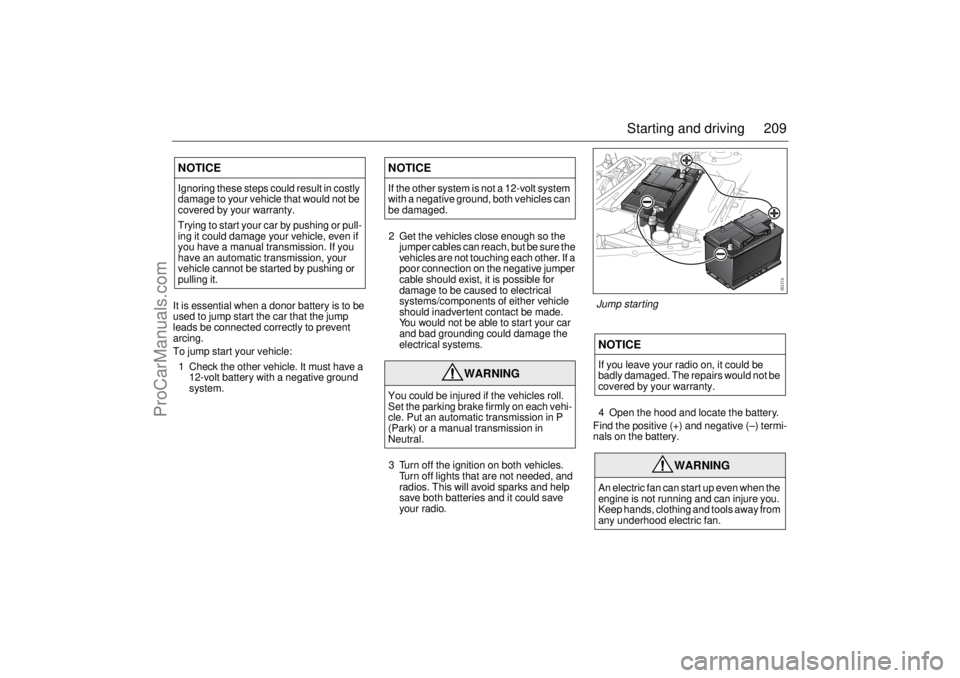
209 Starting and driving
It is essential when a donor battery is to be
used to jump start the car that the jump
leads be connected correctly to prevent
arcing.
To jump start your vehicle:
1 Check the other vehicle. It must have a
12-volt battery with a negative ground
system.2 Get the vehicles close enough so the
jumper cables can reach, but be sure the
vehicles are not touching each other. If a
poor connection on the negative jumper
cable should exist, it is possible for
damage to be caused to electrical
systems/components of either vehicle
should inadvertent contact be made.
You would not be able to start your car
and bad grounding could damage the
electrical systems.
3 Turn off the ignition on both vehicles.
Turn off lights that are not needed, and
radios. This will avoid sparks and help
save both batteries and it could save
your radio.4 Open the hood and locate the battery.
Find the positive (+) and negative (–) termi-
nals on the battery.NOTICEIgnoring these steps could result in costly
damage to your vehicle that would not be
covered by your warranty.
Trying to start your car by pushing or pull-
ing it could damage your vehicle, even if
you have a manual transmission. If you
have an automatic transmission, your
vehicle cannot be started by pushing or
pulling it.
NOTICEIf the other system is not a 12-volt system
with a negative ground, both vehicles can
be damaged.
WARNING
You could be injured if the vehicles roll.
Set the parking brake firmly on each vehi-
cle. Put an automatic transmission in P
(Park) or a manual transmission in
Neutral.
NOTICEIf you leave your radio on, it could be
badly damaged. The repairs would not be
covered by your warranty.
WARNING
An electric fan can start up even when the
engine is not running and can injure you.
Keep hands, clothing and tools away from
any underhood electric fan.Jump starting
93U S M 06.book Page 209 Friday, February 18, 2005 1:15 PM
ProCarManuals.com
Page 210 of 318
210 Starting and driving5 Check that the jumper cables do not
have loose or missing insulation. If they
do, you could get a shock and also the
vehicles could be damaged.
Before you connect the cables, here are
some basic things you should know.
Positive (+) will go to positive (+) and
negative (–) will go to negative (–). Do
not connect (+) to (–) or you will get a
short that could injure you or would
damage the battery and maybe other
parts as well.
6 Connect the red positive (+) cable to the
positive (+) terminal of the vehicle with
the discharged battery.7 Do not let the other end touch metal.
Connect it to the positive (+) terminal of
the good battery. Use a remote positive
(+) terminal if the vehicle has one.
8 Now connect the negative (–) cable to
the good battery’s negative terminal.
9 Attach the cable to the discharged
battery’s negative terminal.
10 Start the vehicle with the good battery
and run the engine for a while.
11 Try to start the vehicle with the
discharged battery. If it does not start
after a few tries, it probably needs
service.
Note. If the current in the low battery is
too low it might be necessary to wait
several minutes with the cables
connected before you can start the
engine with the low battery.
12 Remove the cables in reverse order to
prevent electrical shorting. Take care
that they do not touch each other or any
other metal.
Using a battery charger3/starter
unitTo avoid damaging the car’s electrical
system and electronics, the following rules
must be followed when charging the battery
or jump starting the car.
If the charger or starter unit can be set to
different voltages (6V/12V/18V/24V), 12V
must be selected.
Follow the manufacturer’s instructions
supplied with the charger or starter unit.
No other apparatus that are grounded or
connected to the mains must be
connected to the car during charging or
jump starting.
The charger or starter unit must under no
conditions produce a voltage greater
than:
16V continuous
18V for 60 min.
If you are unsure about the charge rating of
the unit, disconnect the battery clamp from
the positive terminal before connecting the
unit to the battery.
WARNING
Using a match or flame of any kind near a
battery can cause battery gas to explode.
You can suffer burns or be blinded. Use a
flashlight if you need more light.
Be sure the electrolyte in the battery is not
frozen. Discharged batteries will freeze.
When connecting jumper cables to a
frozen battery, gas from the chemical
reaction inside the battery can build up
under the ice and cause an explosion.
Battery fluid contains acid that can burn
you. Do not get it on you. If you acciden-
tally get it in your eyes or on your skin,
flush the area with water and get medical
help immediately.93U S M 06.book Page 210 Friday, February 18, 2005 1:15 PM
ProCarManuals.com
Page 226 of 318
226 Car careBattery
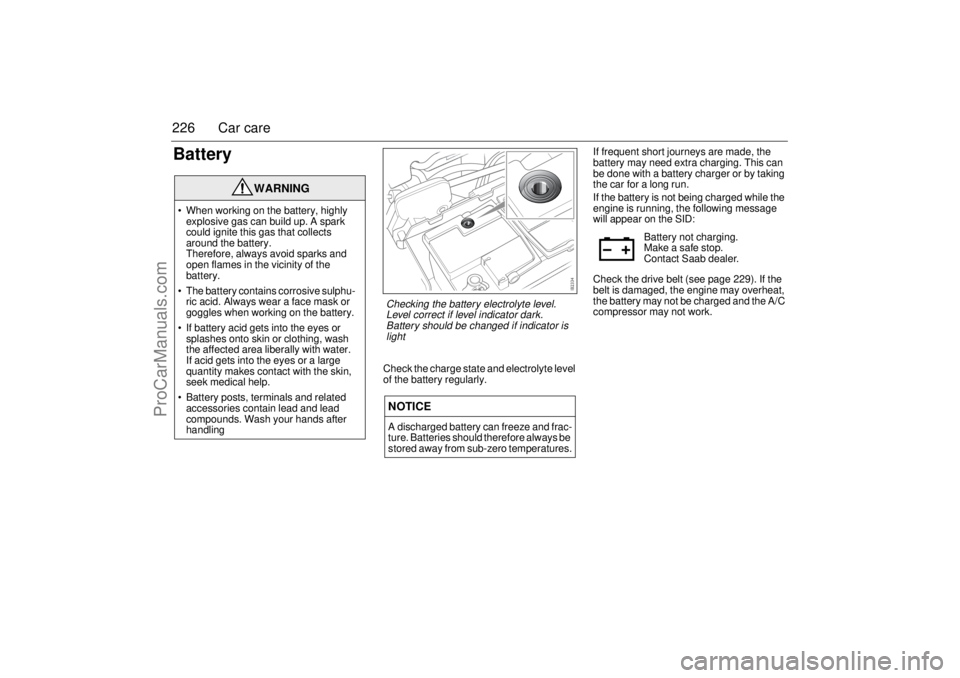
Check the charge state and electrolyte level
of the battery regularly.If frequent short journeys are made, the
battery may need extra charging. This can
be done with a battery charger or by taking
the car for a long run.
If the battery is not being charged while the
engine is running, the following message
will appear on the SID:
Check the drive belt (see page 229). If the
belt is damaged, the engine may overheat,
the battery may not be charged and the A/C
compressor may not work.
WARNING
When working on the battery, highly
explosive gas can build up. A spark
could ignite this gas that collects
around the battery.
Therefore, always avoid sparks and
open flames in the vicinity of the
battery.
The battery contains corrosive sulphu-
ric acid. Always wear a face mask or
goggles when working on the battery.
If battery acid gets into the eyes or
splashes onto skin or clothing, wash
the affected area liberally with water.
If acid gets into the eyes or a large
quantity makes contact with the skin,
seek medical help.
Battery posts, terminals and related
accessories contain lead and lead
compounds. Wash your hands after
handling
NOTICEA discharged battery can freeze and frac-
ture. Batteries should therefore always be
stored away from sub-zero temperatures.
Battery not charging.
Make a safe stop.
Contact Saab dealer.
Checking the battery electrolyte level.
Level correct if level indicator dark.
Battery should be changed if indicator is
light
93U S M 06.book Page 226 Friday, February 18, 2005 1:15 PM
ProCarManuals.com
Page 231 of 318
231 Car care
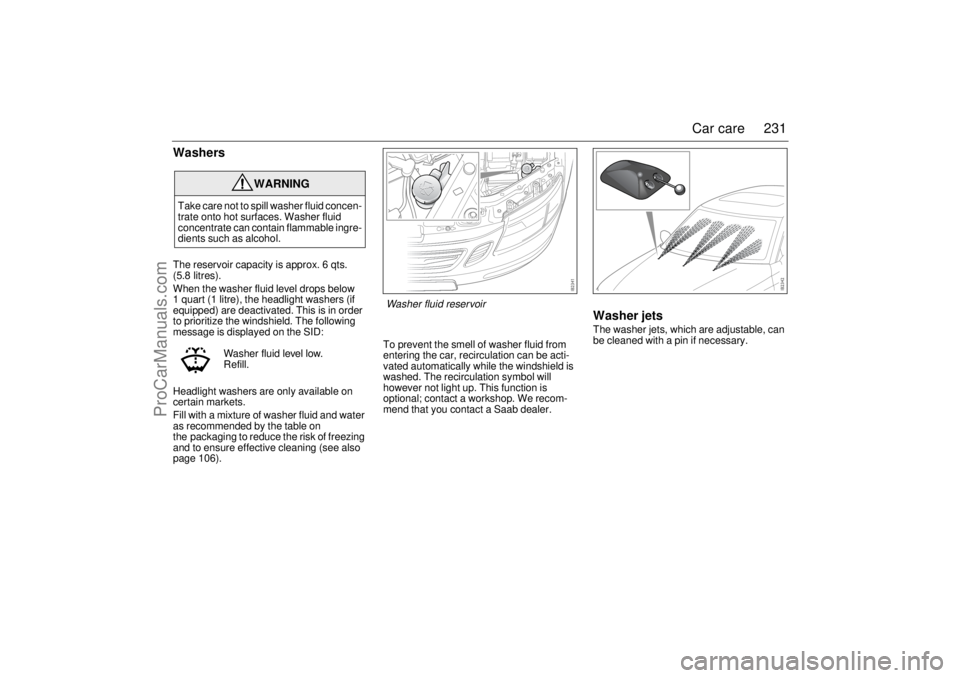
WashersThe reservoir capacity is approx. 6 qts.
(5.8 litres).
When the washer fluid level drops below
1 quart (1 litre), the headlight washers (if
equipped) are deactivated. This is in order
to prioritize the windshield. The following
message is displayed on the SID:
Headlight washers are only available on
certain markets.
Fill with a mixture of washer fluid and water
as recommended by the table on
the packaging to reduce the risk of freezing
and to ensure effective cleaning (see also
page 106).To prevent the smell of washer fluid from
entering the car, recirculation can be acti-
vated automatically while the windshield is
washed. The recirculation symbol will
however not light up. This function is
optional; contact a workshop. We recom-
mend that you contact a Saab dealer.
Washer jetsThe washer jets, which are adjustable, can
be cleaned with a pin if necessary.
WARNING
Take care not to spill washer fluid concen-
trate onto hot surfaces. Washer fluid
concentrate can contain flammable ingre-
dients such as alcohol.
Washer fluid level low.
Refill.
Washer fluid reservoir
93U S M 06.book Page 231 Friday, February 18, 2005 1:15 PM
ProCarManuals.com
Page 232 of 318

232 Car care
Changing bulbsAutochecking of lightsThe bulbs that are most important from the point of view of traffic
safety are monitored by the car’s electrical system. If one of these
bulbs should fail, a message will be displayed on the SID.
Example of SID message:
The following bulbs are not checked: parking lights, front fog lights,
reversing lights, license plate lighting, side marker lights and side
direction indicators.
SportCombi
The tail lights and brake lights consist of LEDs. If approx. 3/4 of the
LEDs on one side are broken then this is indicated in the SID.If a stop light bulb fails
Sport Sedan: If a stop light bulb fails, the adjacent taillight will act
as a stop light to ensure traffic safety. Change the broken bulb when
possible.
All rear light bulbs are of the same type and rated 21 W, with the
exception of the license plate lighting which is rated 5 W.
Wrong bulb fitted
If a dipped or main beam bulb of too high a rating is fitted, a bulb
failure message will be shown on the SID (a too high wattage bulb
can damage the reflector).
If the following message is displayed but the bulb shines, it is most
likely that an incorrect bulb has been fitted.
Note:
When changing bulbs, fit the same type of bulb (e.g. Long-Life)
as that removed.
Headlight aiming, page 283.
WARNING
Before changing a bulb in the engine bay, switch off the engine
to avoid the danger of fingers and hands being injured by moving
parts.
The radiator fan can cut in even when the engine is switched off.NOTICESwitch off the ignition before changing a bulb, to avoid possible
short-circuiting.
Left low beam failure.
Right high beam failure.
93U S M 06.book Page 232 Friday, February 18, 2005 1:15 PM
ProCarManuals.com
Page 233 of 318
233 Car careXenon headlight, dipped beam3Xenon headlights produce roughly two times as much light as halo-
gen bulbs and have a significantly longer service life.
The lamp units consist of a gas discharge lamp containing xenon.
When the lights are switched on a very high voltage activates the
xenon gas. The lamps soon reach full intensity.
Cars with xenon headlights have automatic levelling. The levelling
system is comprised of two sensors, one on the front suspension
and one on the rear suspension, and a control unit by the engine bay
fuse box. Headlight alignment is adjusted automatically to the car’s
load to prevent dazzling drivers in oncoming traffic.
If a fault is detected in the system, the following message will be dis-
played on the SID:
WARNING
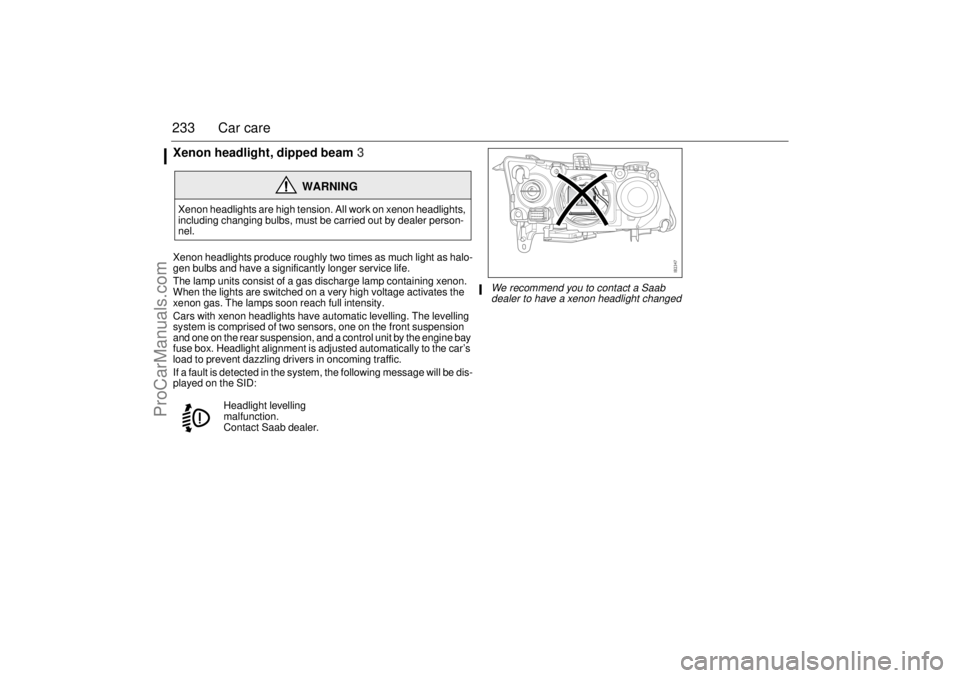
Xenon headlights are high tension. All work on xenon headlights,
including changing bulbs, must be carried out by dealer person-
nel.
Headlight levelling
malfunction.
Contact Saab dealer.
We recommend you to contact a Saab
dealer to have a xenon headlight changed
93U S M 06.book Page 233 Friday, February 18, 2005 1:15 PM
ProCarManuals.com
Page 238 of 318
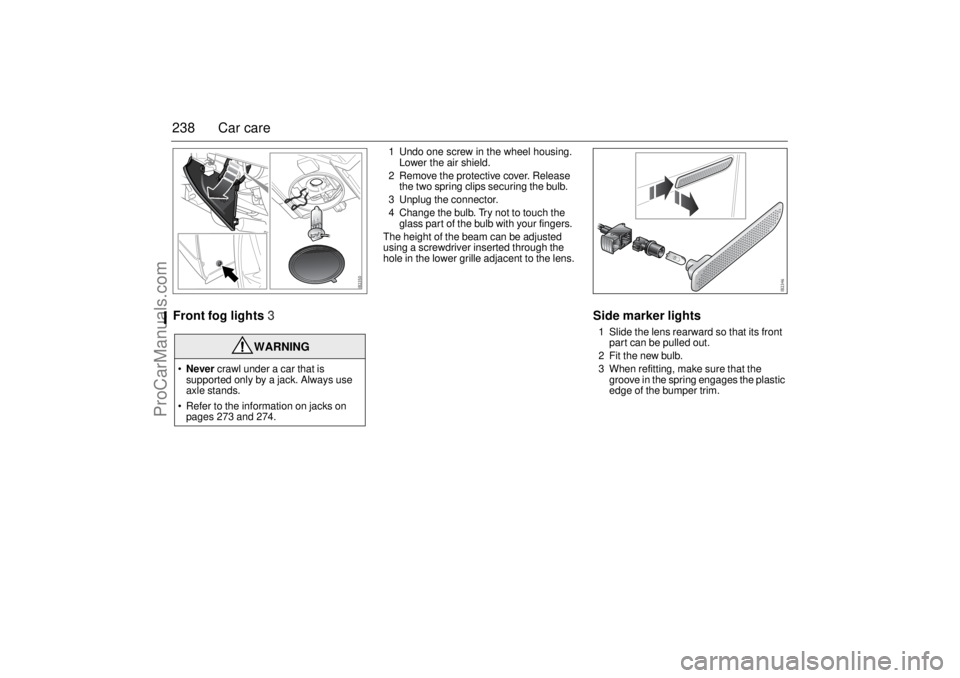
238 Car careFront fog lights3
1 Undo one screw in the wheel housing.
Lower the air shield.
2 Remove the protective cover. Release
the two spring clips securing the bulb.
3 Unplug the connector.
4 Change the bulb. Try not to touch the
glass part of the bulb with your fingers.
The height of the beam can be adjusted
using a screwdriver inserted through the
hole in the lower grille adjacent to the lens.
Side marker lights1 Slide the lens rearward so that its front
part can be pulled out.
2 Fit the new bulb.
3 When refitting, make sure that the
groove in the spring engages the plastic
edge of the bumper trim.
WARNING
Never crawl under a car that is
supported only by a jack. Always use
axle stands.
Refer to the information on jacks on
pages 273 and 274.93U S M 06.book Page 238 Friday, February 18, 2005 1:15 PM
ProCarManuals.com