wheel SAAB 9-3 2006 Manual PDF
[x] Cancel search | Manufacturer: SAAB, Model Year: 2006, Model line: 9-3, Model: SAAB 9-3 2006Pages: 318, PDF Size: 28.05 MB
Page 276 of 318
276 Car care
Safety beltsCheck the function of the safety belts regu-
larly as follows:
Hold the diagonal strap and pull it sharply.
The safety belt should lock and it should
not be possible to withdraw it further.
Check the anchorage points in the floor.
They must not have suffered rust damage.
If a belt is worn or has any fraying edges, it
should be replaced.
Safety belts must not come into contact with
substances such as polishes, oil or chemi-
cals. If the belts get dirty, wash them with
warm water and a detergent or have them
replaced.
Upholstery and trimTo remove fluff and hairs from the seats,
door armrests and headlining, use a
vacuum cleaner, a moist lint-free cloth, or a
clothes brush. Remove spots and dirt using
a cloth moistened with lukewarm soapy
water.
When using a stain remover, always work
from the outside towards the centre to avoid
leaving a ring. If a soiled ring or spot should
remain, it can usually be removed using
lukewarm soapy water or water alone.
Spots left by liquids, such as soft drinks or
thin oil, must be removed at once with an
absorbent material, such as kitchen towel-
ling. Then clean with a stain remover.
White spirit is recommended for removing
grease and oil stains. A medium stiff brush
may also be used.
WARNING
If the car is involved in a crash, the safety
belts, belt pretensioners and other asso-
ciated components must be inspected.
We recommend that you contact a Saab
dealer.
Never make any alterations or repairs to
the safety belts yourself. We recommend
that you contact a Saab dealer dealer.
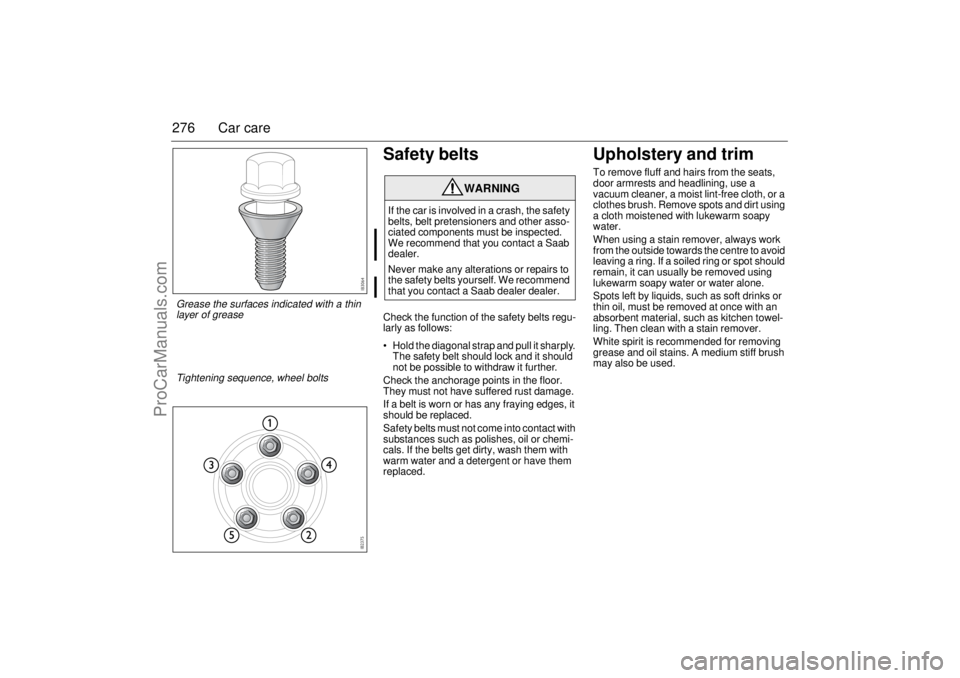
Tightening sequence, wheel boltsGrease the surfaces indicated with a thin
layer of grease93U S M 06.book Page 276 Friday, February 18, 2005 1:15 PM
ProCarManuals.com
Page 280 of 318

280 Car careAnti-corrosion
treatmentThe entire car undergoes a series of anti-
corrosion processes during production.
These include electrophoretic priming,
PVC-based coating to protect against stone
chip damage and corrosion, and treatment
of body cavities and members with thin,
penetrating rustproofing oil.
In addition, most body panels, such as the
hood, doors and floor pan are galvanized.
The anti-corrosion treatment on some parts
of the car is constantly exposed to wear and
prone to damage. This applies particularly
to the underside of the car and inside the
wheel arches, where grit, road salt and the
like that are thrown up can give rise to cor-
rosion where the underseal has worn away.
The extent of this obviously depends on the
conditions in which the car is used.
Accordingly, make it a habit to hose the
underside of the car often and to inspect the
condition of the underseal. The anti-corro-
sion warranty does not relieve the car owner
of the need to carry out normal maintenance
to the rustproofing and to make good any
damage.Use a hose to clean the underside of the car
thoroughly. After it has dried, use a brush or
spray to apply a viscous anti-corrosion
agent to any worn or damaged areas, to
prevent the onset of corrosion.
Even after the anti-corrosion warranty has
expired, it makes good sense to continue to
maintain the rustproofing.
Seams in the body, especially those in the
doors and trunk lid, are particularly vulnera-
ble to corrosion from the outside, caused by
grit and salt thrown up from the road, and to
corrosion from the inside, largely as a result
of condensation. Keep the seams clean and
at the first sign of any rust, apply a thin, pen-
etrating, anti-corrosion oil. Your Saab
dealer will be pleased to give you further
advice.
What causes rust?Steel body panels of automobiles are sub-
ject to rusting whenever air and moisture
manage to penetrate the protective finish.
Body panels may rust through if the process
is unchecked. Rusting can occur wherever
water is trapped or where the car’s panels
are continuously damp.
Damage to paint and undercoating by
stones, gravel and minor crashes immedi-
ately exposes metal to air and moisture.
Road salts used for de-icing will collect on
the bottom of the car and promote rusting.
Areas of the country with high humidity have
a greater potential for rust problems, espe-
cially where salt is used on roads or there is
moist sea air. Industrial pollution (fallout)
may also damage paint and promote rust-
ing.
93U S M 06.book Page 280 Friday, February 18, 2005 1:15 PM
ProCarManuals.com
Page 281 of 318

281 Car care
Preventive maintenanceThe following procedures are necessary to
help protect against rusting. Refer also to
the terms and conditions of the Performa-
tion Limited Warranty described in the war-
ranty booklet.
1Wash the car frequently, and wax at
least twice a year. Under adverse
conditions, where there is a rapid
buildup of dirt, sand or road salt, wash
your car at least once a week. After
extreme exposure to salted snow or
slush, evidenced by a white film on the
car, wash the car immediately. Frequent
washing will prevent paint damage from
acid rain and other airborne contami-
nants such as tree sap and bird drop-
pings. If any of these contaminants are
noticed on the car the finish should be
washed immediately.
Begin washing by rinsing the entire car
with water to loosen and flush off heavy
concentrations of dirt (include the
underbody).
Sponge the car with a solution of either
a good quality car soap or mild general
purpose (dish washing) detergent and
water.
Rinse car thoroughly with clean water.
After washing, check and clear all
drains in doors and body panels.
Wipe the car dry, preferably using a
chamois.2Clean the underside of the car during
the winter. Use high pressure water to
clean the car’s underside (floor panels,
wheel wells) at least at mid-winter and in
the spring.
3Inspect the car frequently for leaks or
damage, and arrange for needed
repairs promptly. After washing or after
heavy rain, check for leaks. When wash-
ing the car inspect body surfaces for
paint damage. While checking for leaks,
lift the floor mats and check underneath
them. Water can collect in these areas
and remain for prolonged periods. Dry
any wet areas including the floor mats.
Have leaks repaired as soon as possi-
ble.
Use touch-up paint to repair small
scratches or minor finish damage. Areas
where metal is exposed will rust quickly
and MUST be repaired immediately by
touch-up or professional repainting.
Rust must be removed, the bare metal
primed and painted. Major body
damage should be repaired immediately
and new panels or exposed areas
should be undercoated with anti- corro-
sion material.
Repairs of this type are the owner’s
responsibility and are not covered under
warranty.Inspect the undercoating and touch up if
necessary. Pay particular attention to the
fenders and wheel housings, which are
exposed to abrasion by flying gravel, etc. If
the composition has worn or flaked off, the
steel must be thoroughly cleaned and dried
before a fresh coat is applied. The cleaning
is best done with a scraper and a steel wire
brush, followed by washing with solvent.
Apply the new coating thinly, otherwise it
may run off or fall off when dry.93U S M 06.book Page 281 Friday, February 18, 2005 1:15 PM
ProCarManuals.com
Page 284 of 318
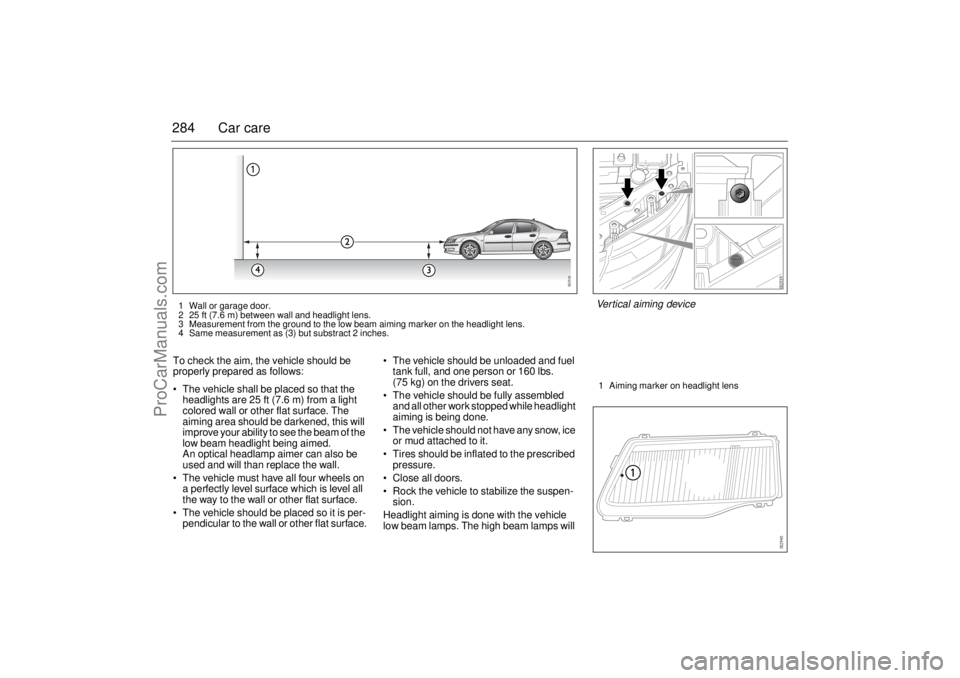
284 Car careTo check the aim, the vehicle should be
properly prepared as follows:
The vehicle shall be placed so that the
headlights are 25 ft (7.6 m) from a light
colored wall or other flat surface. The
aiming area should be darkened, this will
improve your ability to see the beam of the
low beam headlight being aimed.
An optical headlamp aimer can also be
used and will than replace the wall.
The vehicle must have all four wheels on
a perfectly level surface which is level all
the way to the wall or other flat surface.
The vehicle should be placed so it is per-
pendicular to the wall or other flat surface. The vehicle should be unloaded and fuel
tank full, and one person or 160 lbs.
(75 kg) on the drivers seat.
The vehicle should be fully assembled
and all other work stopped while headlight
aiming is being done.
The vehicle should not have any snow, ice
or mud attached to it.
Tires should be inflated to the prescribed
pressure.
Close all doors.
Rock the vehicle to stabilize the suspen-
sion.
Headlight aiming is done with the vehicle
low beam lamps. The high beam lamps will 1 Wall or garage door.
2 25 ft (7.6 m) between wall and headlight lens.
3 Measurement from the ground to the low beam aiming marker on the headlight lens.
4 Same measurement as (3) but substract 2 inches.
Vertical aiming device1 Aiming marker on headlight lens
93U S M 06.book Page 284 Friday, February 18, 2005 1:15 PM
ProCarManuals.com
Page 292 of 318

292 Customer Assistance and InformationVehicle Data Collection and
Event Data RecordersYour vehicle, like other modern motor vehi-
cles, has a number of sophisticated com-
puter systems that monitor and control sev-
eral aspects of the vehicle’s performance.
Your vehicle uses on-board vehicle comput-
ers to monitor emission control components
to optimize fuel economy, to monitor condi-
tions for air bag deployment and, if so
equipped, to provide anti-lock braking and
to help the driver control the vehicle in diffi-
cult driving situations. Some information
may be stored during regular operations to
facilitate repair of detected malfunctions;
other information is stored only in a crash
event by computer systems commonly
called event data recorders (EDR).
In a crash event, computer systems, such
as the Air Bag Sensing and Diagnostic
Module (SDM) in your vehicle may record
information about the condition of the vehi-
cle and how it was operated, such as data
related to engine speed, brake application,
throttle position, vehicle speed, steering
wheel angle, lateral acceleration, safety belt
usage, air bag readiness, air bag perfor-
mance, and the severity of a collision. This
information has been used to improve vehi-
cle crash performance and may be used to
improve crash performance of future vehi-
cles and driving safety. Unlike the data
recorders on many airplanes, these on-
board systems do not record sounds, such
as conversation of vehicle occupants.To read this information, special equipment
is needed and access to the vehicle or the
SDM is required.
Saab will not access information about a
crash event or share it with others other than
with the consent of the vehicle owner or, if
the vehicle is leased, with the consent of
the lessee,
in response to an official request of police
or similar government office,
as part of Saab’s defense of litigation
through the discovery process, or
as required by law.
In addition, once Saab collects or receives
data, Saab may
use the data for Saab research needs,
make it available for research where
appropriate confidentiality is to be main-
tained and need is shown, or
share summary data which is not tied to a
specific vehicle with non-Saab organiza-
tions for research purposes.
Others, such as law enforcement, may have
access to the special equipment that can
read the information if they have access to
the vehicle or SDM.
If your vehicle is equipped with OnStar®,
please check the OnStar® subscription ser-
vice agreement or manual for information
on its operations and data collection.93U S M 06.book Page 292 Friday, February 18, 2005 1:15 PM
ProCarManuals.com
Page 293 of 318
293 Technical data
General data __________ 294
Engine _______________ 297
Engine oil _____________ 298
Fuel__________________ 299
Engines ______________ 300
Electrical system_______ 300
Drive belt _____________ 301
Manual transmission ___ 301
Automatic transmission _ 302
Suspension ___________ 302
Steering ______________ 302
Brake system__________ 303
Wheels and tires _______ 304
Plates and labels _______ 307
Technical data
3Asterisk means: equipment not fitted in all cars
(can depend on model variant, engine variant,
market specification, options or accessories).93U S M 06.book Page 293 Friday, February 18, 2005 1:15 PM
ProCarManuals.com
Page 294 of 318
294 Technical dataGeneral dataOverall length, including bumpers: ___
Sport Sedan and Convertible _________ 182.5'' (4635 mm)
SportCombi_______________________ 183.2'' (4654 mm)
Overall width, including door mirrors __ 80.2'' (2038 mm)
Maximum height _________________ 60.6'' (1539 mm)
Wheelbase _____________________ 105.3'' (2675 mm)
Tr a c k :
Front ____________________________ 59.8'' (1524 mm)
Rear ____________________________ 59.3'' (1506 mm)
Ground clearance at GVW _________ approx. 120 mm
Number of seats (incl. driver):
Sport Sedan and SportCombi ________ 5
Convertible _______________________ 4
Turning circle:
Measured at vehicle extremities _______ 37.4 ft. (11.4 m)
cars with V6 engine ________________ 40.0 ft. (12.2 m)
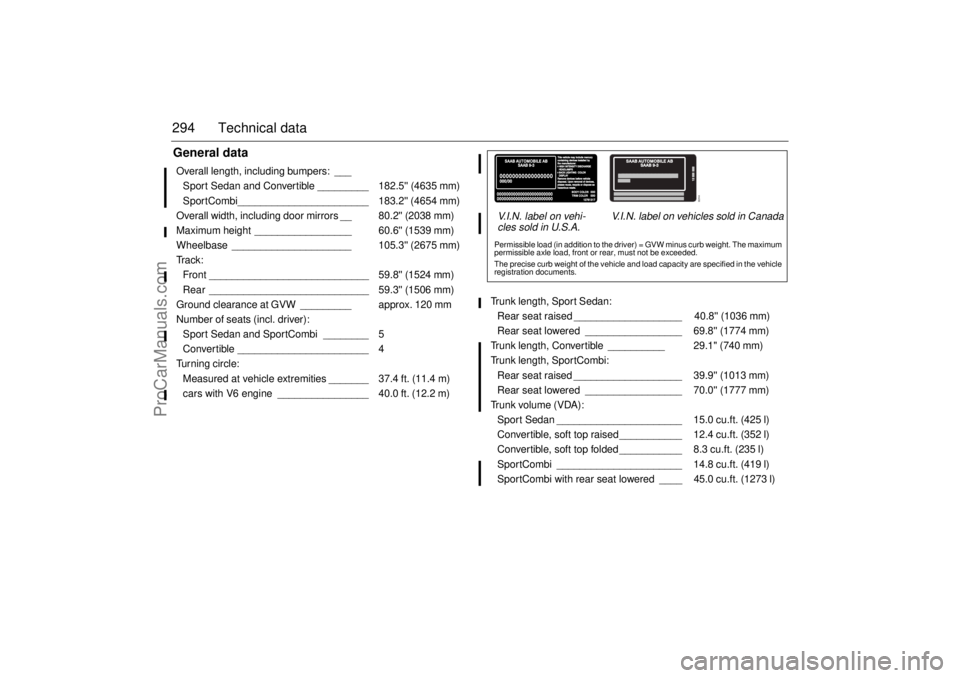
V.I.N. label on vehi-
cles sold in U.S.A.V.I.N. label on vehicles sold in CanadaPermissible load (in addition to the driver) = GVW minus curb weight. The maximum
permissible axle load, front or rear, must not be exceeded.
The precise curb weight of the vehicle and load capacity are specified in the vehicle
registration documents.Trunk length, Sport Sedan:
Rear seat raised ___________________ 40.8'' (1036 mm)
Rear seat lowered _________________ 69.8'' (1774 mm)
Trunk length, Convertible __________ 29.1" (740 mm)
Trunk length, SportCombi:
Rear seat raised ___________________ 39.9'' (1013 mm)
Rear seat lowered _________________ 70.0'' (1777 mm)
Trunk volume (VDA):
Sport Sedan ______________________ 15.0 cu.ft. (425 l)
Convertible, soft top raised ___________ 12.4 cu.ft. (352 l)
Convertible, soft top folded ___________ 8.3 cu.ft. (235 l)
SportCombi ______________________ 14.8 cu.ft. (419 l)
SportCombi with rear seat lowered ____ 45.0 cu.ft. (1273 l)
93U S M 06.book Page 294 Friday, February 18, 2005 1:15 PM
ProCarManuals.com
Page 295 of 318

295 Technical data
Curb weight
(i.e. with full fuel tank, full washer fluid res-
ervoir, standard tools and spare wheel):
Sport Sedan ______________________ 3200–3420 lbs.
(1450–1550 kg)
Convertible _______________________ 3570–3700 lbs.
(1620–1680 kg)
SportCombi_______________________ xx
Gross vehicle weight (GVW):
Sport Sedan ______________________ 4120–4340 lbs.
(1870–1970 kg)
Convertible _______________________ 4460–4520 lbs.
(2025–2050 kg)
SportCombi_______________________ xx
Maximum axle load:
Sport Sedan, front _________________ 2480 lbs. (1125 kg)
Sport Sedan, rear __________________ 2230 lbs. (1010 kg)
Convertible, front __________________ 2540 lbs. (1150 kg)
Convertible, rear ___________________ 2310 lbs. (1050 kg)
SportCombi_______________________ xx
SportCombi_______________________ xx
Weight distribution:
Curb weight + driver (150 lbs. (68 kg)),
front/rear, Sport Sedan and SportCombi approx. 60/40 %
GVW, front/rear, Sport Sedan and Sport-
Combi ___________________________ approx. 50/50 %Maximum roof load, Sport Sedan and Sport-
Combi ________________________ 220 lbs. (100 kg)
Maximum load in trunk, Sport Sedan, Con-
vertible and SportCombi __________ 175 lbs. (80 kg)
The combined weight of occupants and
cargo should never exceed:
Sport Sedan and SportCombi ________ 925 lbs. (420 kg)
Convertible _______________________ 775 lbs. (352 kg)
Maximum combined weight of driver and
passengers ___________________
Sport Sedan and SportCombi
(5x150 lbs.)_______________________ 750 lbs. (340 kg)
Convertible (4x150 lbs.) _____________ 600 lbs. (272 kg)93U S M 06.book Page 295 Friday, February 18, 2005 1:15 PM
ProCarManuals.com
Page 297 of 318

297 Technical data
EngineTy p e :
Petrol engine, 4-cyl. ________________ Four cylinders,
double overhead
camshafts,
16 valves, two
balancer shafts
Petrol engine, V6 __________________ Six cylinders,
4 overhead cam-
shafts, 24 valves,
the angle between
the cylinder rows is
60°
Cylinder bore:
Petrol engine, 4-cyl. ________________ 3.386'' (86 mm)
Petrol engine, V6 __________________ 3.504'' (89 mm)
Stroke:
Petrol engine, 4-cyl. ________________ 3.386'' (86 mm)
Petrol engine, V6 __________________ 2.945'' (74.8 mm)
Swept volume:
Petrol engine, 4-cyl. ________________ 122 cu.in. (1.998 l)
Petrol engine, V6 __________________ 170 cu.in. (2.792 l)Idling speed ____________________ 720 rpm.
When the engine
load increases, e.g.
the steering wheel
is turned, the idling
speed is raised to
900 rpm.
Antifreeze ______________________ Saab-approved
antifreeze
Coolant capacity:
Petrol engine, 4-cyl. ________________ 7.5 qts. (7.1 l)
Petrol engine, V6 __________________ 9.5 qts. (9.0 l)93U S M 06.book Page 297 Friday, February 18, 2005 1:15 PM
ProCarManuals.com
Page 303 of 318

303 Technical data
Brake system
Hydraulic unit for soft top, ConvertibleFoot brake (ABS)____________________ Hydraulic disc
brakes with vacuum
servo unit. Diago-
nally split circuits;
ventilated discs on
front wheels (some
variants also have
ventilated rear
discs). EBD function
(see page 181).
Park brake _________________________ Acts on rear wheels
Brake fluid _________________________ To DOT 4.
Do not use DOT 5.Disc diameter:
Front ____________________________ 11.22 in.
(285 mm) **)
Fr o nt3 *) ________________________ 11.81 in.
(300 mm) **)
Rear ____________________________ 10.94 in. (278 mm)
Rear3 *) ________________________ 11.42 in.
(290 mm) **)
Total friction area of brake pads:
Front ____________________________ 9.30 in.² (60 cm²)
Fr o nt3__________________________ 9.61 in.² (62 cm²)
Rear ____________________________ 4.96 in.² (32 cm²)
*)15" wheels and 16" aluminium wheels
must not be fitted to these variants since
the diameter of the brake discs does not
allow this.
**) ventilated
Oil capacity _______________________ 0.6 qt. (0.6 l)
Oil type __________________________ CHF 11S93U S M 06.book Page 303 Friday, February 18, 2005 1:15 PM
ProCarManuals.com