antifreeze SAAB 9-3 2006 Owners Manual
[x] Cancel search | Manufacturer: SAAB, Model Year: 2006, Model line: 9-3, Model: SAAB 9-3 2006Pages: 318, PDF Size: 28.05 MB
Page 195 of 318
195 Starting and driving
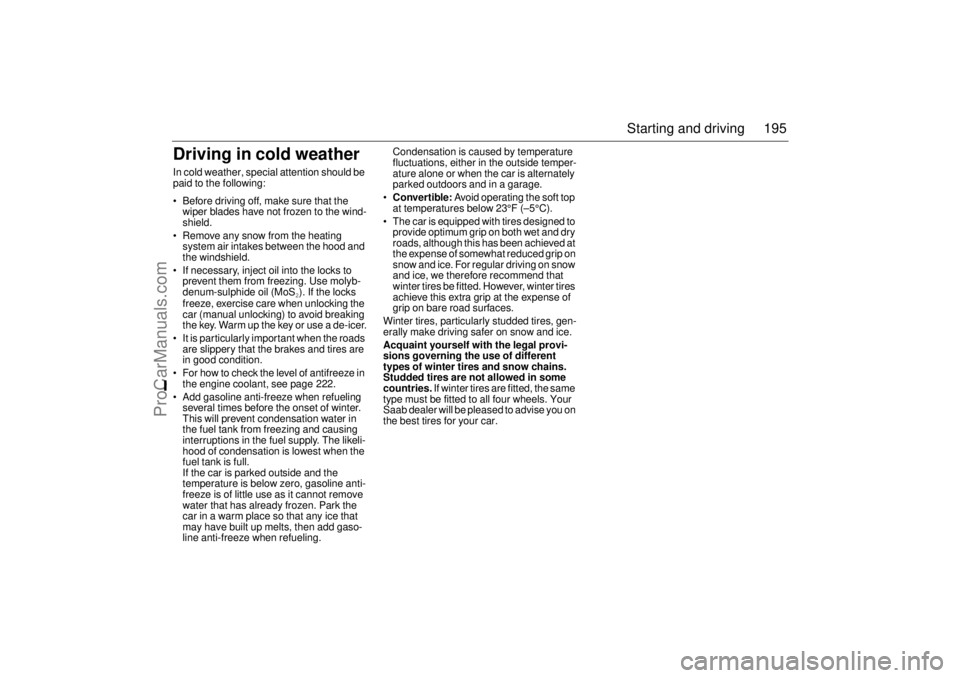
Driving in cold weatherIn cold weather, special attention should be
paid to the following:
Before driving off, make sure that the
wiper blades have not frozen to the wind-
shield.
Remove any snow from the heating
system air intakes between the hood and
the windshield.
If necessary, inject oil into the locks to
prevent them from freezing. Use molyb-
denum-sulphide oil (MoS
2). If the locks
freeze, exercise care when unlocking the
car (manual unlocking) to avoid breaking
the key. Warm up the key or use a de-icer.
It is particularly important when the roads
are slippery that the brakes and tires are
in good condition.
For how to check the level of antifreeze in
the engine coolant, see page 222.
Add gasoline anti-freeze when refueling
several times before the onset of winter.
This will prevent condensation water in
the fuel tank from freezing and causing
interruptions in the fuel supply. The likeli-
hood of condensation is lowest when the
fuel tank is full.
If the car is parked outside and the
temperature is below zero, gasoline anti-
freeze is of little use as it cannot remove
water that has already frozen. Park the
car in a warm place so that any ice that
may have built up melts, then add gaso-
line anti-freeze when refueling.Condensation is caused by temperature
fluctuations, either in the outside temper-
ature alone or when the car is alternately
parked outdoors and in a garage.
Convertible: Avoid operating the soft top
at temperatures below 23°F (–5°C).
The car is equipped with tires designed to
provide optimum grip on both wet and dry
roads, although this has been achieved at
the expense of somewhat reduced grip on
snow and ice. For regular driving on snow
and ice, we therefore recommend that
winter tires be fitted. However, winter tires
achieve this extra grip at the expense of
grip on bare road surfaces.
Winter tires, particularly studded tires, gen-
erally make driving safer on snow and ice.
Acquaint yourself with the legal provi-
sions governing the use of different
types of winter tires and snow chains.
Studded tires are not allowed in some
countries. If winter tires are fitted, the same
type must be fitted to all four wheels. Your
Saab dealer will be pleased to advise you on
the best tires for your car.
93U S M 06.book Page 195 Friday, February 18, 2005 1:15 PM
ProCarManuals.com
Page 197 of 318
197 Starting and driving
Driving in hot climatesAlways check the coolant level before start-
ing a journey. When the engine is cold, the
coolant must not lie above the KALT/COLD
mark on the expansion tank (boundary
between the upper and lower sections of the
tank).
At the end of a journey, allow the engine to
idle for 2–3 minutes before switching it off.
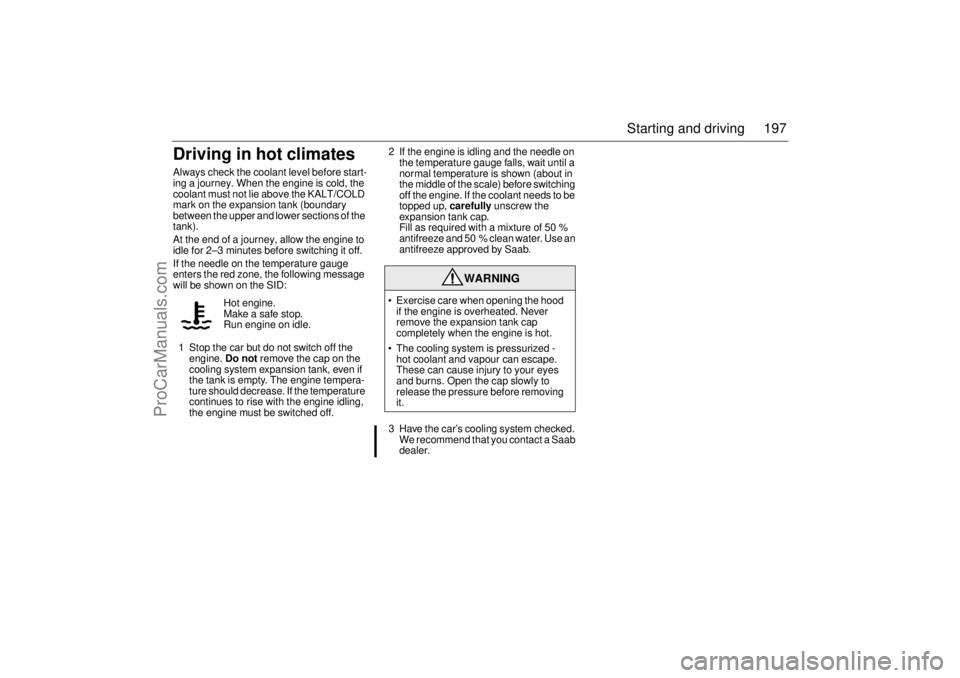
If the needle on the temperature gauge
enters the red zone, the following message
will be shown on the SID:
1 Stop the car but do not switch off the
engine. Do not remove the cap on the
cooling system expansion tank, even if
the tank is empty. The engine tempera-
ture should decrease. If the temperature
continues to rise with the engine idling,
the engine must be switched off.2 If the engine is idling and the needle on
the temperature gauge falls, wait until a
normal temperature is shown (about in
the middle of the scale) before switching
off the engine. If the coolant needs to be
topped up, carefully unscrew the
expansion tank cap.
Fill as required with a mixture of 50 %
antifreeze and 50 % clean water. Use an
antifreeze approved by Saab.
3 Have the car’s cooling system checked.
We recommend that you contact a Saab
dealer. Hot engine.
Make a safe stop.
Run engine on idle.
WARNING
Exercise care when opening the hood
if the engine is overheated. Never
remove the expansion tank cap
completely when the engine is hot.
The cooling system is pressurized -
hot coolant and vapour can escape.
These can cause injury to your eyes
and burns. Open the cap slowly to
release the pressure before removing
it.
93U S M 06.book Page 197 Friday, February 18, 2005 1:15 PM
ProCarManuals.com
Page 222 of 318

222 Car careAir filter
Transmission fluidManual transmission
Check and top up the oil in accordance with
the service program.
Automatic transmission
Check and top up the oil in accordance with
the service program.
CoolantIf the coolant level drops too low, the follow-
ing message appears on the SID:
The properties of the coolant are retained
for the entire service life of the car. There-
fore, it is not necessary to change the cool-
ant.The coolant contains 45 % antifreeze and
anti-corrosion fluid. This ratio gives the best
cooling effect. Lower concentrations should
be avoided, in view of the corrosion risk.
Other brands of antifreeze can damage the
engine and cooling system.
Note:
If incorrect coolant is used or added, the life-
time properties will be affected. Even if the
coolant is flushed from the system and
replaced with life-time coolant, life-time
properties are no longer retained and the
coolant must then be drained and replaced
at regular intervals.
WARNING
To ensure reliable operation, only use
an air filter recommended by Saab
Automobile AB.
WARNING
Proceed with caution if the radiator is
boiling when you open the hood.
Never remove the expansion-tank
filler cap when the radiator is boiling.
The cooling system is pressurized –
hot coolant and vapor can escape
when the filler cap is released. These
can cause injury to your eyes and
burns. Loosen the cap carefully, and
let the engine cool before removing
the cap.
Exercise care when adding coolant.
Coolant on hot surfaces constitutes a
fire risk.
Coolant level low.
Refill.
NOTICEIf the cooling system needs topping up,
mix the antifreeze with the appropriate
quantity of drinking water or distilled
water before adding it to the system.
If undiluted antifreeze is added, the
engine could still freeze and be damaged.
This is because the antifreeze will not mix
properly with the coolant before the ther-
mostat has opened to allow full circula-
tion.
93U S M 06.book Page 222 Friday, February 18, 2005 1:15 PM
ProCarManuals.com
Page 297 of 318
297 Technical data
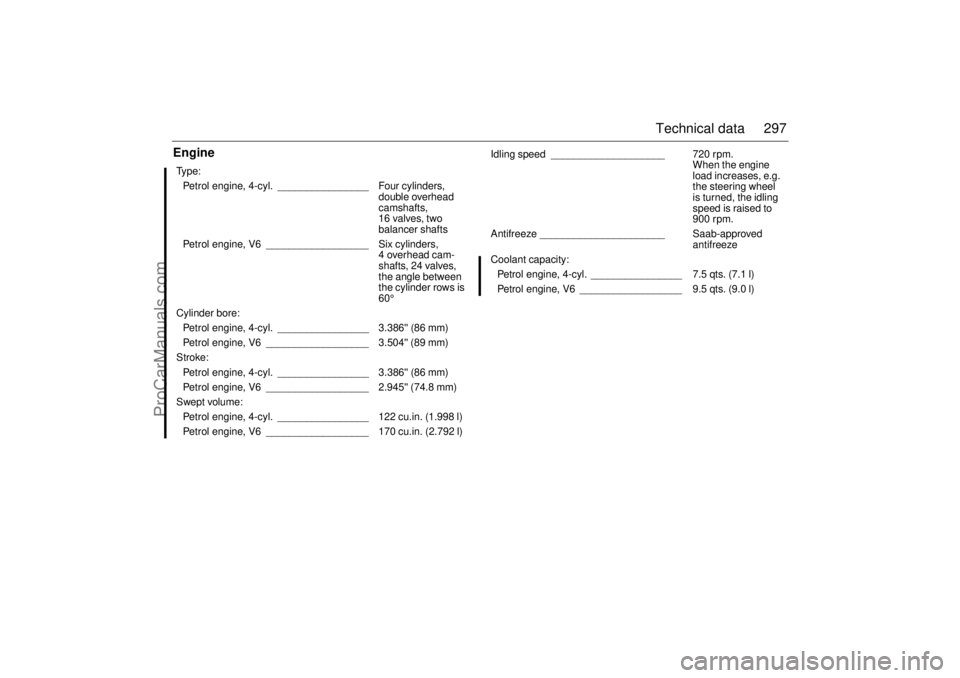
EngineTy p e :
Petrol engine, 4-cyl. ________________ Four cylinders,
double overhead
camshafts,
16 valves, two
balancer shafts
Petrol engine, V6 __________________ Six cylinders,
4 overhead cam-
shafts, 24 valves,
the angle between
the cylinder rows is
60°
Cylinder bore:
Petrol engine, 4-cyl. ________________ 3.386'' (86 mm)
Petrol engine, V6 __________________ 3.504'' (89 mm)
Stroke:
Petrol engine, 4-cyl. ________________ 3.386'' (86 mm)
Petrol engine, V6 __________________ 2.945'' (74.8 mm)
Swept volume:
Petrol engine, 4-cyl. ________________ 122 cu.in. (1.998 l)
Petrol engine, V6 __________________ 170 cu.in. (2.792 l)Idling speed ____________________ 720 rpm.
When the engine
load increases, e.g.
the steering wheel
is turned, the idling
speed is raised to
900 rpm.
Antifreeze ______________________ Saab-approved
antifreeze
Coolant capacity:
Petrol engine, 4-cyl. ________________ 7.5 qts. (7.1 l)
Petrol engine, V6 __________________ 9.5 qts. (9.0 l)93U S M 06.book Page 297 Friday, February 18, 2005 1:15 PM
ProCarManuals.com