jump start SAAB 9-3 2006 Owners Manual
[x] Cancel search | Manufacturer: SAAB, Model Year: 2006, Model line: 9-3, Model: SAAB 9-3 2006Pages: 318, PDF Size: 28.05 MB
Page 6 of 318
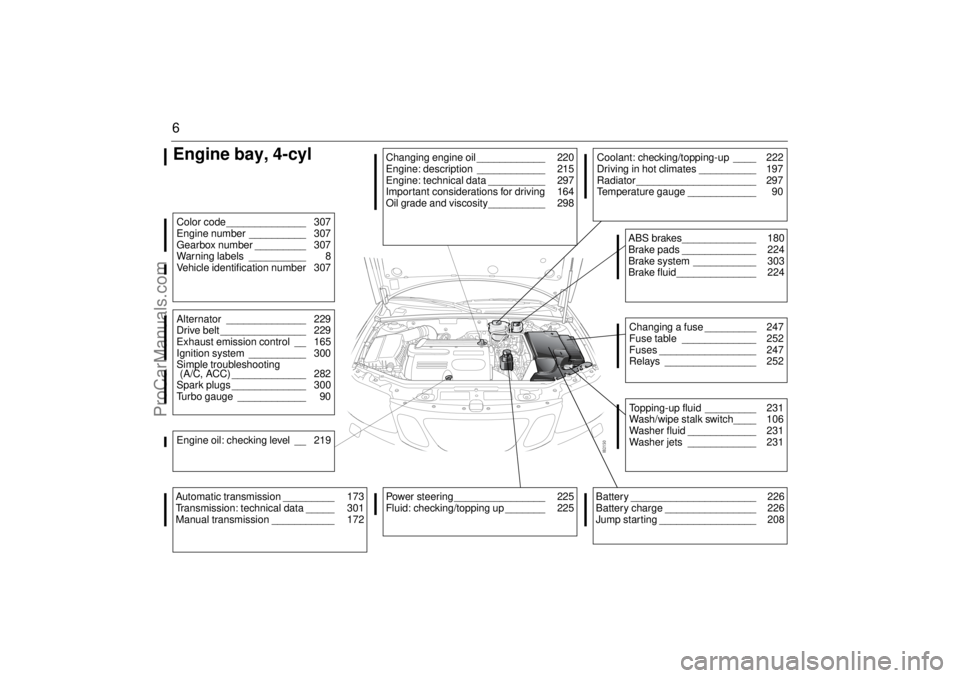
6Engine bay, 4-cylColor code______________ 307
Engine number __________ 307
Gearbox number _________ 307
Warning labels __________ 8
Vehicle identification number 307Alternator ______________ 229
Drive belt _______________ 229
Exhaust emission control __ 165
Ignition system __________ 300
Simple troubleshooting
(A/C, ACC) _____________ 282
Spark plugs _____________ 300
Turbo gauge ____________ 90Engine oil: checking level __ 219Automatic transmission _________ 173
Transmission: technical data _____ 301
Manual transmission ___________ 172
Battery ______________________ 226
Battery charge ________________ 226
Jump starting _________________ 208
Changing engine oil ____________ 220
Engine: description ____________ 215
Engine: technical data __________ 297
Important considerations for driving 164
Oil grade and viscosity__________ 298
Topping-up fluid _________ 231
Wash/wipe stalk switch____ 106
Washer fluid ____________ 231
Washer jets ____________ 231
Power steering ________________ 225
Fluid: checking/topping up _______ 225
Coolant: checking/topping-up ____ 222
Driving in hot climates __________ 197
Radiator _____________________ 297
Temperature gauge ____________ 90
Changing a fuse _________ 247
Fuse table _____________ 252
Fuses _________________ 247
Relays ________________ 252ABS brakes_____________ 180
Brake pads _____________ 224
Brake system ___________ 303
Brake fluid______________ 224
93U S M 06.book Page 6 Friday, February 18, 2005 1:15 PM
ProCarManuals.com
Page 7 of 318
7
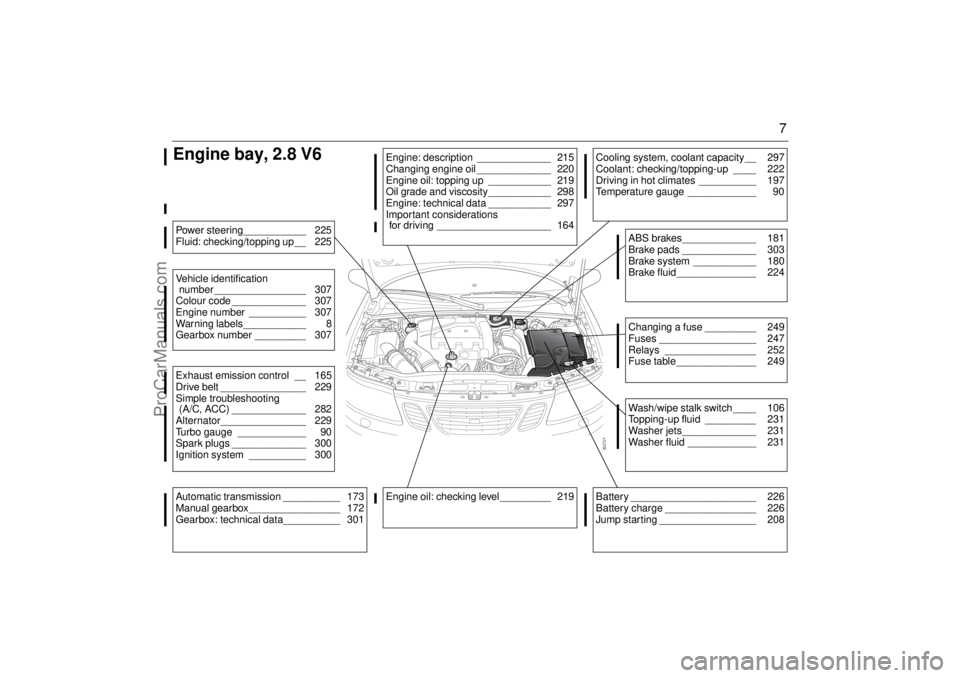
Engine bay, 2.8 V6Power steering___________ 225
Fluid: checking/topping up__ 225Vehicle identification
number ________________ 307
Colour code _____________ 307
Engine number __________ 307
Warning labels___________ 8
Gearbox number _________ 307Exhaust emission control __ 165
Drive belt _______________ 229
Simple troubleshooting
(A/C, ACC) _____________ 282
Alternator_______________ 229
Turbo gauge ____________ 90
Spark plugs _____________ 300
Ignition system __________ 300Automatic transmission __________ 173
Manual gearbox________________ 172
Gearbox: technical data__________ 301
Engine: description _____________ 215
Changing engine oil _____________ 220
Engine oil: topping up ___________ 219
Oil grade and viscosity___________ 298
Engine: technical data ___________ 297
Important considerations
for driving ____________________ 164Engine oil: checking level_________ 219
Battery ______________________ 226
Battery charge ________________ 226
Jump starting _________________ 208
Wash/wipe stalk switch ____ 106
Topping-up fluid _________ 231
Washer jets_____________ 231
Washer fluid ____________ 231Changing a fuse _________ 249
Fuses _________________ 247
Relays ________________ 252
Fuse table ______________ 249ABS brakes_____________ 181
Brake pads _____________ 303
Brake system ___________ 180
Brake fluid______________ 224
Cooling system, coolant capacity__ 297
Coolant: checking/topping-up ____ 222
Driving in hot climates __________ 197
Temperature gauge ____________ 90
93U S M 06.book Page 7 Friday, February 18, 2005 1:15 PM
ProCarManuals.com
Page 159 of 318

159 Starting and driving
Ignition switch ________ 160
Steering wheel lock ____ 162
Starting the engine ____ 162
Important considerations
for driving __________ 164
Refueling ____________ 167
Engine Break-in Period _ 171
Manual transmission___ 172
Automatic
transmission 3 ______ 173
Cruise control ________ 179
Braking ______________ 180
Traction Control System
(TCS) ______________ 183
Electronic Stability
Program (ESP) 3 _____ 185
Parking brake_________ 187
Parking ______________ 187
Saab Parking
Assistance 3 ________ 190 Economical driving _____ 193
Driving in cold weather__ 195
Driving in hot climates __ 197
Towing a trailer 3_______ 198
Driving with a roof rack
load ________________ 202
Driving with a load _____ 204
Driving with the trunk lid
open________________ 204
Driving in deep water ___ 204
Driving at night ________ 205
Towing the car _________ 205
Driving with the compact
spare tire ____________ 208
Jump starting _________ 208
For long trips __________ 211
Starting and driving
3Asterisk means: equipment not fitted in all cars
(can depend on model variant, engine variant,
market specification, options or accessories).93U S M 06.book Page 159 Friday, February 18, 2005 1:15 PM
ProCarManuals.com
Page 162 of 318
162 Starting and drivingSteering wheel lockThe steering wheel lock is electronic. The
lock engages when the remote control is
removed from the ignition and unlocks when
the remote control is inserted. A click can be
heard when the steering wheel lock locks
and unlocks.
If the car is parked with one front wheel
touching the curb, for example, you may
need to turn the steering wheel slightly
when you insert the remote control to allow
the steering wheel lock to unlock. If you do
not succeed on first attempt you must
remove the remote control before trying
again. Turn the steering wheel and insert
the remote control into the ignition switch.
If the steering wheel lock does not disen-
gage it will not be possible to turn the remote
control in the ignition switch.
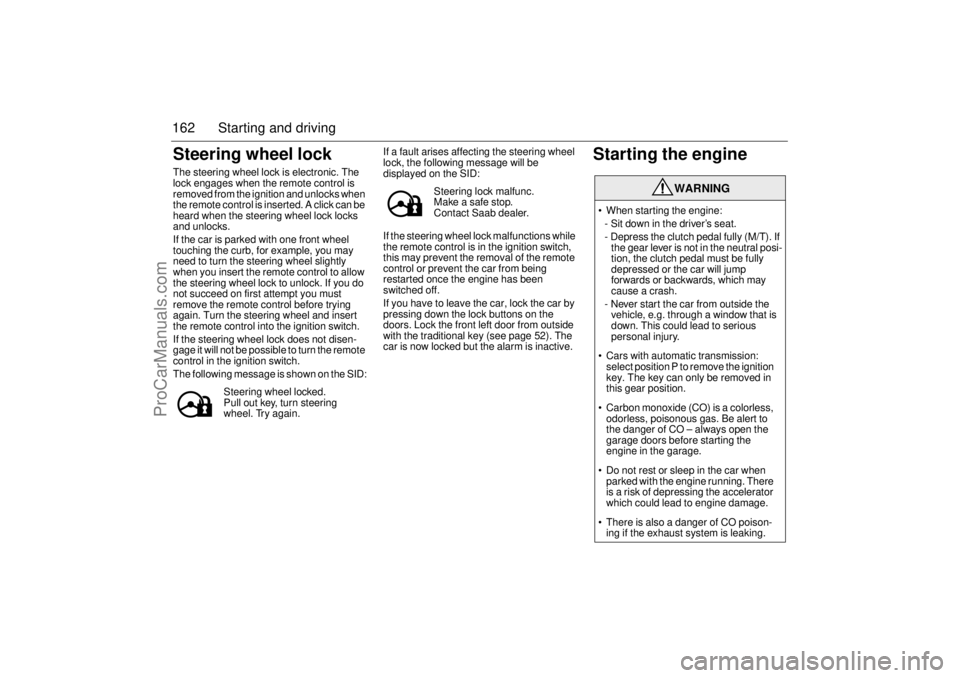
The following message is shown on the SID:If a fault arises affecting the steering wheel
lock, the following message will be
displayed on the SID:
If the steering wheel lock malfunctions while
the remote control is in the ignition switch,
this may prevent the removal of the remote
control or prevent the car from being
restarted once the engine has been
switched off.
If you have to leave the car, lock the car by
pressing down the lock buttons on the
doors. Lock the front left door from outside
with the traditional key (see page 52). The
car is now locked but the alarm is inactive.
Starting the engine
Steering wheel locked.
Pull out key, turn steering
wheel. Try again.
Steering lock malfunc.
Make a safe stop.
Contact Saab dealer.
WARNING
When starting the engine:
- Sit down in the driver’s seat.
- Depress the clutch pedal fully (M/T). If
the gear lever is not in the neutral posi-
tion, the clutch pedal must be fully
depressed or the car will jump
forwards or backwards, which may
cause a crash.
- Never start the car from outside the
vehicle, e.g. through a window that is
down. This could lead to serious
personal injury.
Cars with automatic transmission:
select position P to remove the ignition
key. The key can only be removed in
this gear position.
Carbon monoxide (CO) is a colorless,
odorless, poisonous gas. Be alert to
the danger of CO – always open the
garage doors before starting the
engine in the garage.
Do not rest or sleep in the car when
parked with the engine running. There
is a risk of depressing the accelerator
which could lead to engine damage.
There is also a danger of CO poison-
ing if the exhaust system is leaking.
93U S M 06.book Page 162 Friday, February 18, 2005 1:15 PM
ProCarManuals.com
Page 165 of 318

165 Starting and driving
If the diagnosis function detects a fault in the
engine management system, the light
"Engine malfunction (CHECK ENGINE)" in
the instrument panel will come on (see
page 85). Have the car checked at a work-
shop as soon as possible. We recommend
that you contact a Saab dealer.
Important considerations with
catalytic convertersThe catalytic converter is an emission con-
trol device incorporated in the car’s exhaust
system. It consists of a metal canister with a
honeycomb insert, the cells of which have
walls coated in a catalytic layer (precious
metal alloy).
To ensure that the catalytic converter con-
tinues to function properly, and also to avoid
damage to the converter and its associated
components, the following points must be
observed: Have the car serviced regularly in accor-
dance with the service program.
Always be alert to any misfiring of the
engine (not running on all cylinders) and
any loss of power or performance. At the
first sign of a malfunction, reduce speed
and take the car to a workshop. We
recommend that you contact a Saab
dealer.
If the engine fails to start (in severe cold or
if the battery is flat), the car can be bump
started (manual transmission only) or
started using jump leads to a donor
battery. However, as soon as you have
started the engine, it is important that it
runs on all cylinders. If it is misfiring, allow
it to idle for up to 5 minutes to give it time
to settle and run smoothly. If, after this
time, the engine still fails to run properly,
switch off the engine to avoid serious
damage to the catalytic converter. We
recommend that you contact a Saab
dealer for advice.
NOTICEIf "Engine malfunction (CHECK
ENGINE)" warning light starts to flash
(indicating that the engine is misfiring and
the catalytic converter can be damaged),
ease off the accelerator slightly. The light
should go out or start to shine constantly.
If the light continues to flash despite
easing off the accelerator, you may
continue to drive the car but at the mini-
mum throttle permitted by the current traf-
fic situation. Have the car checked as
soon as possible. We recommend that
you contact a Saab dealer.
NOTICEUse only unleaded gasoline. Leaded
gasoline is detrimental to the catalyst and
oxygen sensor and will seriously impair
the function of the catalytic converter.
93U S M 06.book Page 165 Friday, February 18, 2005 1:15 PM
ProCarManuals.com
Page 207 of 318
207 Starting and driving
Always try to keep the towrope taut by
gently applying the brake of the car on tow,
as necessary. This will avoid the towrope
being jerked violently.
Cars with automatic transmission:
Always observe the speed limit for vehicles
on tow. Whatever the speed limit, the car
must not be towed at speeds exceeding
30 mph (50 km/h) nor for a distance of more
than 30 miles (50 km). If the car needs to be
transported over a longer distance, a tow
truck or flatbed truck must be called out.
The engine cannot be started by towing or
pushing the car. In an emergency, the
engine can be started as described under
"Jump starting" on page 208.
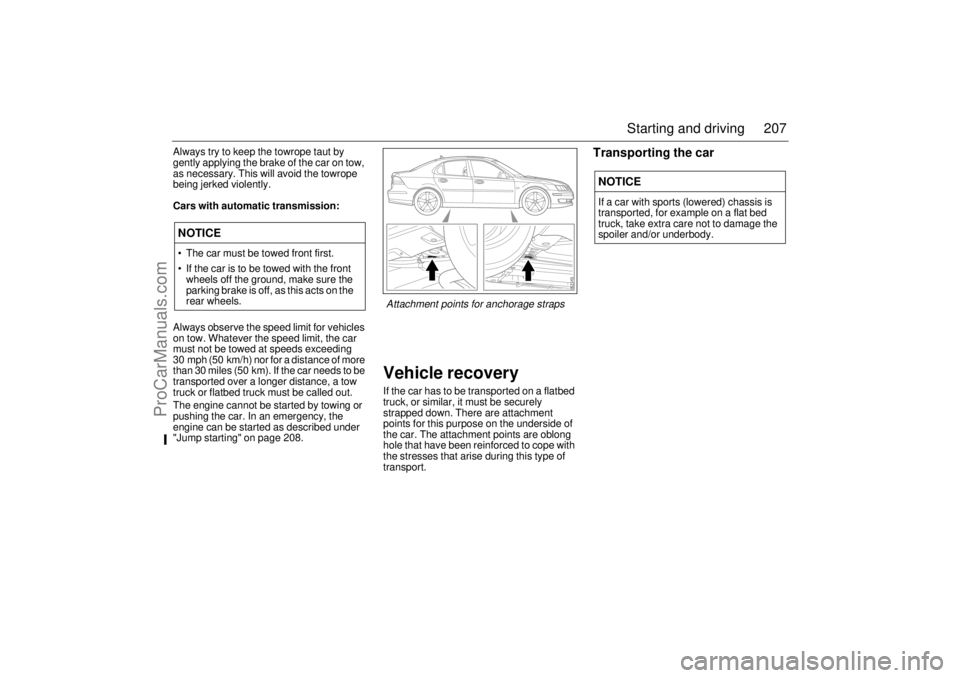
Vehicle recoveryIf the car has to be transported on a flatbed
truck, or similar, it must be securely
strapped down. There are attachment
points for this purpose on the underside of
the car. The attachment points are oblong
hole that have been reinforced to cope with
the stresses that arise during this type of
transport.
Transporting the car
NOTICE The car must be towed front first.
If the car is to be towed with the front
wheels off the ground, make sure the
parking brake is off, as this acts on the
rear wheels.
NOTICEIf a car with sports (lowered) chassis is
transported, for example on a flat bed
truck, take extra care not to damage the
spoiler and/or underbody.
Attachment points for anchorage straps
93U S M 06.book Page 207 Friday, February 18, 2005 1:15 PM
ProCarManuals.com
Page 208 of 318
208 Starting and drivingDriving with the
compact spare tireObserve the following when the compact
spare tire is fitted:
The compact spare is light and easy to
handle when changing a tire.
Do not drive further than necessary with
the compact spare fitted - the maximum
life of the tire is only just over 2,000 miles
(approx. 3,500 km).
Refit the standard tire as soon as possi-
ble.Important considerations when driving with
a compact spare tire:
The car’s ground clearance is reduced.
The car must not be driven with more than
one compact spare tire at a time.
Avoid driving against the curb.
Do not use snow chains.
Do not fit the wheel cover - this would
conceal the warning text.
Jump starting
WARNING
Do not exceed 50 mph (80 km/h). The
tire can overheat affecting the car’s
roadholding.
Tire pressure: refer to page 304.
The spare tire or punctured tire must
be stowed under the trunk floor, and
secured in place with the retaining nut.
NOTICETo avoid damaging a alloy wheel of a
punctured tire, this can be temporarily
placed outside up in the spare wheel well
but only while driving to the closest work-
shop.
As a general rule, all heavy loads must be
well secured in the trunk (see page 149).
WARNING
When working on the battery, highly
explosive gas can build up. A spark
could ignite this gas that collects
around the battery. Therefore, always
avoid sparks and open flames in the
vicinity of the battery.
The battery contains corrosive sulphu-
ric acid. Always wear a face mask or
goggles when working on the battery.
If battery acid gets into the eyes or
splashes onto skin or clothing, wash
the affected area liberally with water. If
acid gets into the eyes or a large quan-
tity makes contact with the skin, seek
medical help.
93U S M 06.book Page 208 Friday, February 18, 2005 1:15 PM
ProCarManuals.com
Page 209 of 318
209 Starting and driving
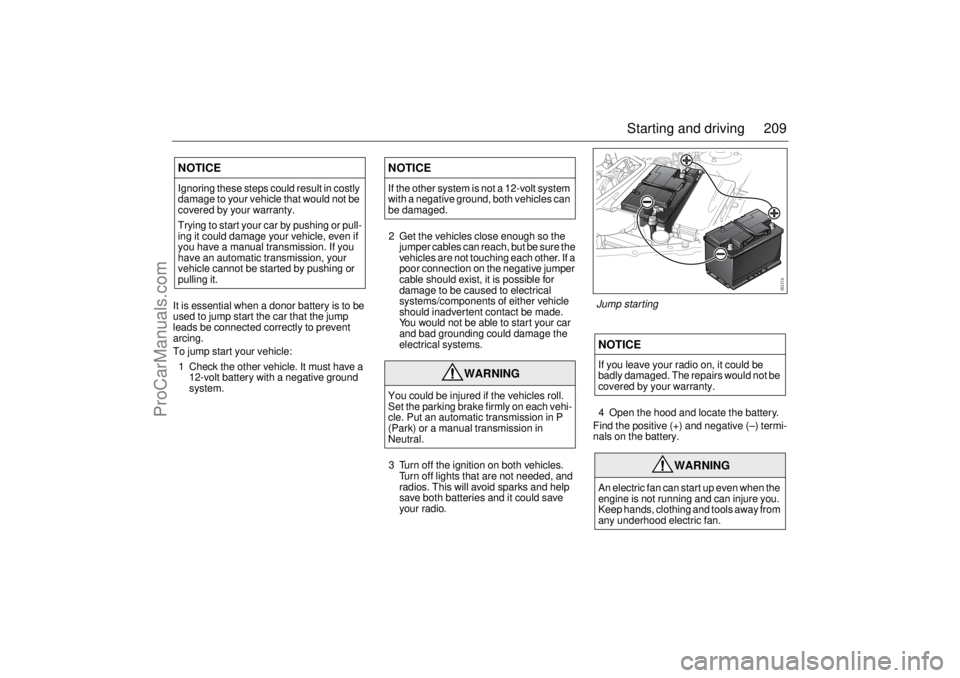
It is essential when a donor battery is to be
used to jump start the car that the jump
leads be connected correctly to prevent
arcing.
To jump start your vehicle:
1 Check the other vehicle. It must have a
12-volt battery with a negative ground
system.2 Get the vehicles close enough so the
jumper cables can reach, but be sure the
vehicles are not touching each other. If a
poor connection on the negative jumper
cable should exist, it is possible for
damage to be caused to electrical
systems/components of either vehicle
should inadvertent contact be made.
You would not be able to start your car
and bad grounding could damage the
electrical systems.
3 Turn off the ignition on both vehicles.
Turn off lights that are not needed, and
radios. This will avoid sparks and help
save both batteries and it could save
your radio.4 Open the hood and locate the battery.
Find the positive (+) and negative (–) termi-
nals on the battery.NOTICEIgnoring these steps could result in costly
damage to your vehicle that would not be
covered by your warranty.
Trying to start your car by pushing or pull-
ing it could damage your vehicle, even if
you have a manual transmission. If you
have an automatic transmission, your
vehicle cannot be started by pushing or
pulling it.
NOTICEIf the other system is not a 12-volt system
with a negative ground, both vehicles can
be damaged.
WARNING
You could be injured if the vehicles roll.
Set the parking brake firmly on each vehi-
cle. Put an automatic transmission in P
(Park) or a manual transmission in
Neutral.
NOTICEIf you leave your radio on, it could be
badly damaged. The repairs would not be
covered by your warranty.
WARNING
An electric fan can start up even when the
engine is not running and can injure you.
Keep hands, clothing and tools away from
any underhood electric fan.Jump starting
93U S M 06.book Page 209 Friday, February 18, 2005 1:15 PM
ProCarManuals.com
Page 210 of 318

210 Starting and driving5 Check that the jumper cables do not
have loose or missing insulation. If they
do, you could get a shock and also the
vehicles could be damaged.
Before you connect the cables, here are
some basic things you should know.
Positive (+) will go to positive (+) and
negative (–) will go to negative (–). Do
not connect (+) to (–) or you will get a
short that could injure you or would
damage the battery and maybe other
parts as well.
6 Connect the red positive (+) cable to the
positive (+) terminal of the vehicle with
the discharged battery.7 Do not let the other end touch metal.
Connect it to the positive (+) terminal of
the good battery. Use a remote positive
(+) terminal if the vehicle has one.
8 Now connect the negative (–) cable to
the good battery’s negative terminal.
9 Attach the cable to the discharged
battery’s negative terminal.
10 Start the vehicle with the good battery
and run the engine for a while.
11 Try to start the vehicle with the
discharged battery. If it does not start
after a few tries, it probably needs
service.
Note. If the current in the low battery is
too low it might be necessary to wait
several minutes with the cables
connected before you can start the
engine with the low battery.
12 Remove the cables in reverse order to
prevent electrical shorting. Take care
that they do not touch each other or any
other metal.
Using a battery charger3/starter
unitTo avoid damaging the car’s electrical
system and electronics, the following rules
must be followed when charging the battery
or jump starting the car.
If the charger or starter unit can be set to
different voltages (6V/12V/18V/24V), 12V
must be selected.
Follow the manufacturer’s instructions
supplied with the charger or starter unit.
No other apparatus that are grounded or
connected to the mains must be
connected to the car during charging or
jump starting.
The charger or starter unit must under no
conditions produce a voltage greater
than:
16V continuous
18V for 60 min.
If you are unsure about the charge rating of
the unit, disconnect the battery clamp from
the positive terminal before connecting the
unit to the battery.
WARNING
Using a match or flame of any kind near a
battery can cause battery gas to explode.
You can suffer burns or be blinded. Use a
flashlight if you need more light.
Be sure the electrolyte in the battery is not
frozen. Discharged batteries will freeze.
When connecting jumper cables to a
frozen battery, gas from the chemical
reaction inside the battery can build up
under the ice and cause an explosion.
Battery fluid contains acid that can burn
you. Do not get it on you. If you acciden-
tally get it in your eyes or on your skin,
flush the area with water and get medical
help immediately.93U S M 06.book Page 210 Friday, February 18, 2005 1:15 PM
ProCarManuals.com
Page 315 of 318

315 Index
Important considerations for driving
_ 164
Important information, petrol-engined
cars with catalytic converters
_____ 165
Indicator lights
___________________ 84
Inflation, tires __________________ 257
Information about fuel
____________ 169
Instrument illumination, adjusting
___ 103
Interior lighting
_________________ 141
Interior lighting, Convertible
________ 80
Interior rearview mirror
___________ 133
Intermittent malfunctioning, central
locking
_______________________ 52
JJump starting
__________________ 208
KKey
___________________________ 50
Kick-down
_____________________ 175
LLabeling, tire sidewall
____________ 264
Labels and plates, location
________ 307
Lashing eyes
___________________ 149
Laying the car up
_______________ 189
Leather upholstery, cleaning
_______ 277Lighting in luggage compartment,
Convertible
____________________ 81
Limp-home
____________________ 164
Limp-home, automatic transmission
_175
Load carriers, roof
_______________ 202
Load indices, tires _______________ 266
Loading your vehicle _____________ 267
Load-through hatch ______________ 148
Locking a car with flat battery
_______ 53
Locks
__________________________ 50
Long-term parking
_______________ 189
Luggage compartment
___________ 146
Luggage compartment lighting
_ 142
, 150
Luggage compartment lighting,
changing
_____________________ 244
Luggage compartment lighting,
Convertible ____________________ 81
LATCH (child safety)
______________ 25
MMain instrument panel
_____________ 84
Main/dipped beam
______________ 103
Maintenance schedule ___________ 288
Manual climate control ___________ 110
Manual gear selection ____________ 178
Manual gearbox
________________ 172
Manual tripping of car alarm
________ 60
Materials used in the car, reclamation
282
Memory, driver’s seat
_____________ 21
Messages on SID, Convertible
______ 73Milometer
_______________________ 89
Mug holder ____________________ 142
MAXI fuses ____________________ 248
NNew tires, buying
________________ 260
Night driving
___________________ 205
Number plate lighting, changing
____ 244
OOil capacity, engine
______________ 299
Opening handles
_________________ 50
Opening the soft top, Convertible
____ 66
Outside mirrors
_________________ 132
Owner assistance _______________ 290
ORVR
________________________ 216
PPanic function, car alarm
___________ 60
Park Brake Shift Lock
____________ 174
Park Brake Shift Lock, temporary
override
______________________ 176
Parking
_______________________ 187
Parking aid ____________________ 190
Parking brake __________________ 187
Parking on a hill _________________ 188
93U S M 06.book Page 315 Friday, February 18, 2005 1:15 PM
ProCarManuals.com