transmission oil SAAB 9-3 2006 Owners Manual
[x] Cancel search | Manufacturer: SAAB, Model Year: 2006, Model line: 9-3, Model: SAAB 9-3 2006Pages: 318, PDF Size: 28.05 MB
Page 6 of 318
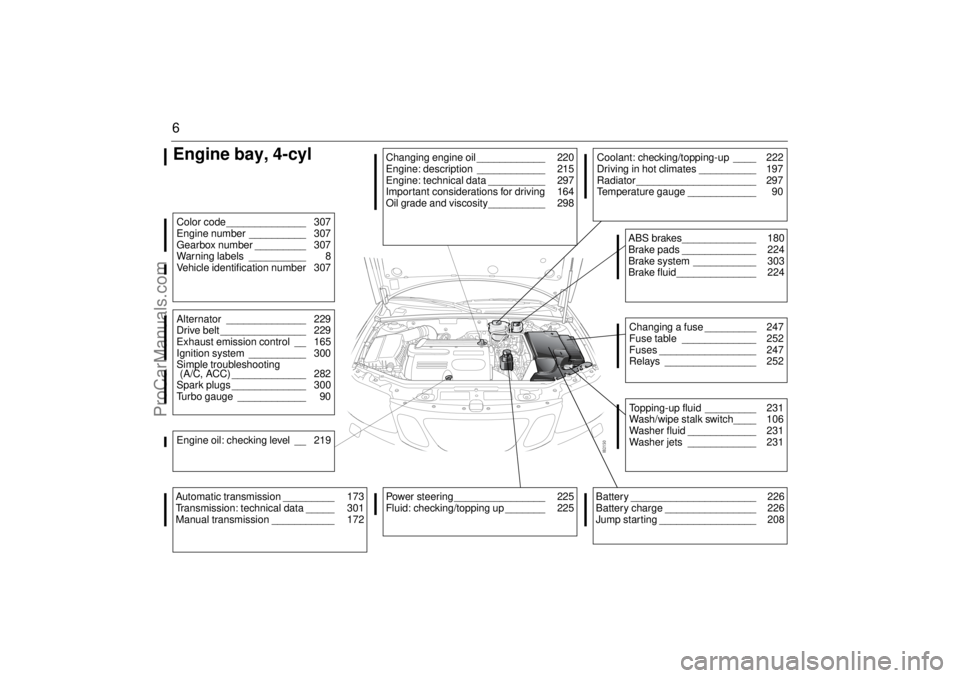
6Engine bay, 4-cylColor code______________ 307
Engine number __________ 307
Gearbox number _________ 307
Warning labels __________ 8
Vehicle identification number 307Alternator ______________ 229
Drive belt _______________ 229
Exhaust emission control __ 165
Ignition system __________ 300
Simple troubleshooting
(A/C, ACC) _____________ 282
Spark plugs _____________ 300
Turbo gauge ____________ 90Engine oil: checking level __ 219Automatic transmission _________ 173
Transmission: technical data _____ 301
Manual transmission ___________ 172
Battery ______________________ 226
Battery charge ________________ 226
Jump starting _________________ 208
Changing engine oil ____________ 220
Engine: description ____________ 215
Engine: technical data __________ 297
Important considerations for driving 164
Oil grade and viscosity__________ 298
Topping-up fluid _________ 231
Wash/wipe stalk switch____ 106
Washer fluid ____________ 231
Washer jets ____________ 231
Power steering ________________ 225
Fluid: checking/topping up _______ 225
Coolant: checking/topping-up ____ 222
Driving in hot climates __________ 197
Radiator _____________________ 297
Temperature gauge ____________ 90
Changing a fuse _________ 247
Fuse table _____________ 252
Fuses _________________ 247
Relays ________________ 252ABS brakes_____________ 180
Brake pads _____________ 224
Brake system ___________ 303
Brake fluid______________ 224
93U S M 06.book Page 6 Friday, February 18, 2005 1:15 PM
ProCarManuals.com
Page 7 of 318
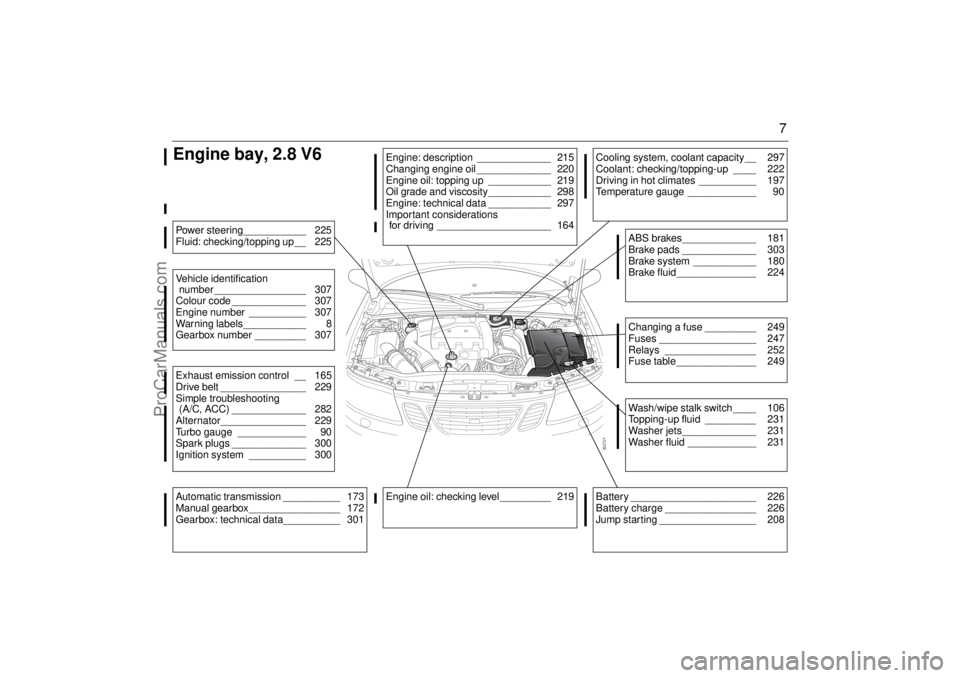
7
Engine bay, 2.8 V6Power steering___________ 225
Fluid: checking/topping up__ 225Vehicle identification
number ________________ 307
Colour code _____________ 307
Engine number __________ 307
Warning labels___________ 8
Gearbox number _________ 307Exhaust emission control __ 165
Drive belt _______________ 229
Simple troubleshooting
(A/C, ACC) _____________ 282
Alternator_______________ 229
Turbo gauge ____________ 90
Spark plugs _____________ 300
Ignition system __________ 300Automatic transmission __________ 173
Manual gearbox________________ 172
Gearbox: technical data__________ 301
Engine: description _____________ 215
Changing engine oil _____________ 220
Engine oil: topping up ___________ 219
Oil grade and viscosity___________ 298
Engine: technical data ___________ 297
Important considerations
for driving ____________________ 164Engine oil: checking level_________ 219
Battery ______________________ 226
Battery charge ________________ 226
Jump starting _________________ 208
Wash/wipe stalk switch ____ 106
Topping-up fluid _________ 231
Washer jets_____________ 231
Washer fluid ____________ 231Changing a fuse _________ 249
Fuses _________________ 247
Relays ________________ 252
Fuse table ______________ 249ABS brakes_____________ 181
Brake pads _____________ 303
Brake system ___________ 180
Brake fluid______________ 224
Cooling system, coolant capacity__ 297
Coolant: checking/topping-up ____ 222
Driving in hot climates __________ 197
Temperature gauge ____________ 90
93U S M 06.book Page 7 Friday, February 18, 2005 1:15 PM
ProCarManuals.com
Page 175 of 318
175 Starting and driving
Lock-upThe transmission’s torque converter has a
lock-up function. This can lock the torque
converter, thus reducing the engine speed
and fuel consumption.Kick-downWhen the accelerator is pressed down fully,
a down change is made to optimize acceler-
ation, e.g. for overtaking.
Following this, the next higher gear will be
selected at the optimum engine speed,
unless you ease off the accelerator before
reaching this.Driving in hilly country with a
heavy loadThe transmission fluid can overheat when
the gearbox is strained, for example, when
driving with a trailer on hilly roads. To avoid
the transmission fluid overheating, always
drive with the selector lever in the D posi-
tion. The adaptive gear change patterns are
then active.
High air temperatures or a faulty oil cooler
can also cause the transmission fluid to
overheat. Overheating reduces the service
life of the fluid.
TowingTowing of cars with automatic transmission,
see page 205.Descending hillsIf the speed of the car increases while
descending a steep hill, despite the acceler-
ator being released, the control module will
change down. If you desire more powerful
engine braking, manually select a lower
gear (see page 178).
Limp-homeIf the transmission malfunctions, the control
module will activate limp-home mode. Driv-
ability will be affected to varying degrees.
The following message is shown on the SID:
In this mode, only 2nd and 5th gears are
available. Select 2nd gear when driving at
low speeds and 5th gear at higher speeds.
2nd gear must be selected manually. Select
5th gear manually or move the selector
lever to D (see page 178).
Cars with 5-speed transmission
In this mode, only 2nd and 5th gears are
available. Select 2nd gear when driving at
low speeds and 5th gear at higher speeds.
2nd gear must be selected manually. Select
5th gear manually or move the selector
lever to D, see page 178.
Cars with 6-speed transmission3
The car may be totally powerless. If this is
case, have the car transported to a work-
shop to have the problem rectified.
WARNING
Remember to use the braking effect of the
engine (1st, 2nd or 3rd gear) when you
are descending long or steep hills to
spare the brakes.
Overheating can cause the brakes to
fade!
NOTICEDo not tow a trailer if limp-home mode is
engaged.
Gearbox malfunction.
Limited performance.
Contact Saab dealer.
93U S M 06.book Page 175 Friday, February 18, 2005 1:15 PM
ProCarManuals.com
Page 207 of 318
207 Starting and driving
Always try to keep the towrope taut by
gently applying the brake of the car on tow,
as necessary. This will avoid the towrope
being jerked violently.
Cars with automatic transmission:
Always observe the speed limit for vehicles
on tow. Whatever the speed limit, the car
must not be towed at speeds exceeding
30 mph (50 km/h) nor for a distance of more
than 30 miles (50 km). If the car needs to be
transported over a longer distance, a tow
truck or flatbed truck must be called out.
The engine cannot be started by towing or
pushing the car. In an emergency, the
engine can be started as described under
"Jump starting" on page 208.
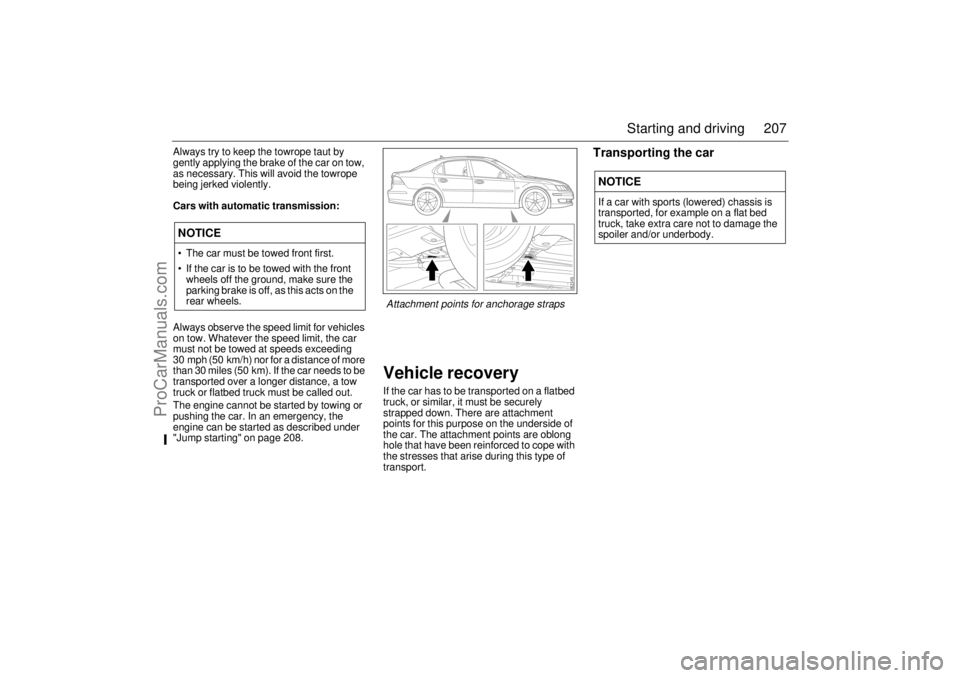
Vehicle recoveryIf the car has to be transported on a flatbed
truck, or similar, it must be securely
strapped down. There are attachment
points for this purpose on the underside of
the car. The attachment points are oblong
hole that have been reinforced to cope with
the stresses that arise during this type of
transport.
Transporting the car
NOTICE The car must be towed front first.
If the car is to be towed with the front
wheels off the ground, make sure the
parking brake is off, as this acts on the
rear wheels.
NOTICEIf a car with sports (lowered) chassis is
transported, for example on a flat bed
truck, take extra care not to damage the
spoiler and/or underbody.
Attachment points for anchorage straps
93U S M 06.book Page 207 Friday, February 18, 2005 1:15 PM
ProCarManuals.com
Page 211 of 318

211 Starting and driving
For long tripsBefore starting off on a long journey, it is
advisable to have your car inspected by
your Saab dealer.
Obtain a few important items to take along
on your journey, such as spare bulbs, wiper
blades, fuses, a drive belt (poly-V-belt) and
the like.
You can check some points yourself before-
hand:
Check that no oil or fuel leaks out of the
engine or gearbox/transmission.
Check the coolant and power steering
fluid levels. Check also for leaks.
Inspect the drive belt (poly-V-belt) and
replace if it shows any signs of wear.
Check the battery charge.
Check the tires for tread pattern and air
pressure, including the compact spare
tire.
Take an extra remote control and keep it
separate.
Check the brakes.
Check all bulbs.
Check for the presence of the tool kit and
jack in the car.93U S M 06.book Page 211 Friday, February 18, 2005 1:15 PM
ProCarManuals.com
Page 213 of 318
213 Car care
Hood ________________ 214
Engine ______________ 215
Engine bay, 4-cyl engine 217
Engine oil ____________ 219
Air filter______________ 222
Transmission fluid ____ 222
Coolant ______________ 222
Brake/clutch fluid and
brake pads__________ 224
Power steering________ 225
Battery ______________ 226
Drive belt ____________ 229
Wipers and washers ___ 230
Wiper blades _________ 230
Changing bulbs _______ 232 Fuses ________________ 247
Automatic tire pressure
monitoring3_________ 254
Tires _________________ 256
Compact spare ________ 270
Changing a tire ________ 273
Safety belts ___________ 276
Upholstery and trim ____ 276
Textile carpeting _______ 277
Engine bay ____________ 277
Washing ______________ 277
Waxing and polishing ___ 279
Touching up the paint___ 279
Anti-corrosion treatment 280
Recovery and/or
recycling of automotive
materials ____________ 282
Air conditioning (A/C) ___ 282
Car care
3Asterisk means: equipment not fitted in all cars
(can depend on model variant, engine variant,
market specification, options or accessories).93U S M 06.book Page 213 Friday, February 18, 2005 1:15 PM
ProCarManuals.com
Page 222 of 318

222 Car careAir filter
Transmission fluidManual transmission
Check and top up the oil in accordance with
the service program.
Automatic transmission
Check and top up the oil in accordance with
the service program.
CoolantIf the coolant level drops too low, the follow-
ing message appears on the SID:
The properties of the coolant are retained
for the entire service life of the car. There-
fore, it is not necessary to change the cool-
ant.The coolant contains 45 % antifreeze and
anti-corrosion fluid. This ratio gives the best
cooling effect. Lower concentrations should
be avoided, in view of the corrosion risk.
Other brands of antifreeze can damage the
engine and cooling system.
Note:
If incorrect coolant is used or added, the life-
time properties will be affected. Even if the
coolant is flushed from the system and
replaced with life-time coolant, life-time
properties are no longer retained and the
coolant must then be drained and replaced
at regular intervals.
WARNING
To ensure reliable operation, only use
an air filter recommended by Saab
Automobile AB.
WARNING
Proceed with caution if the radiator is
boiling when you open the hood.
Never remove the expansion-tank
filler cap when the radiator is boiling.
The cooling system is pressurized –
hot coolant and vapor can escape
when the filler cap is released. These
can cause injury to your eyes and
burns. Loosen the cap carefully, and
let the engine cool before removing
the cap.
Exercise care when adding coolant.
Coolant on hot surfaces constitutes a
fire risk.
Coolant level low.
Refill.
NOTICEIf the cooling system needs topping up,
mix the antifreeze with the appropriate
quantity of drinking water or distilled
water before adding it to the system.
If undiluted antifreeze is added, the
engine could still freeze and be damaged.
This is because the antifreeze will not mix
properly with the coolant before the ther-
mostat has opened to allow full circula-
tion.
93U S M 06.book Page 222 Friday, February 18, 2005 1:15 PM
ProCarManuals.com
Page 267 of 318
267 Car care
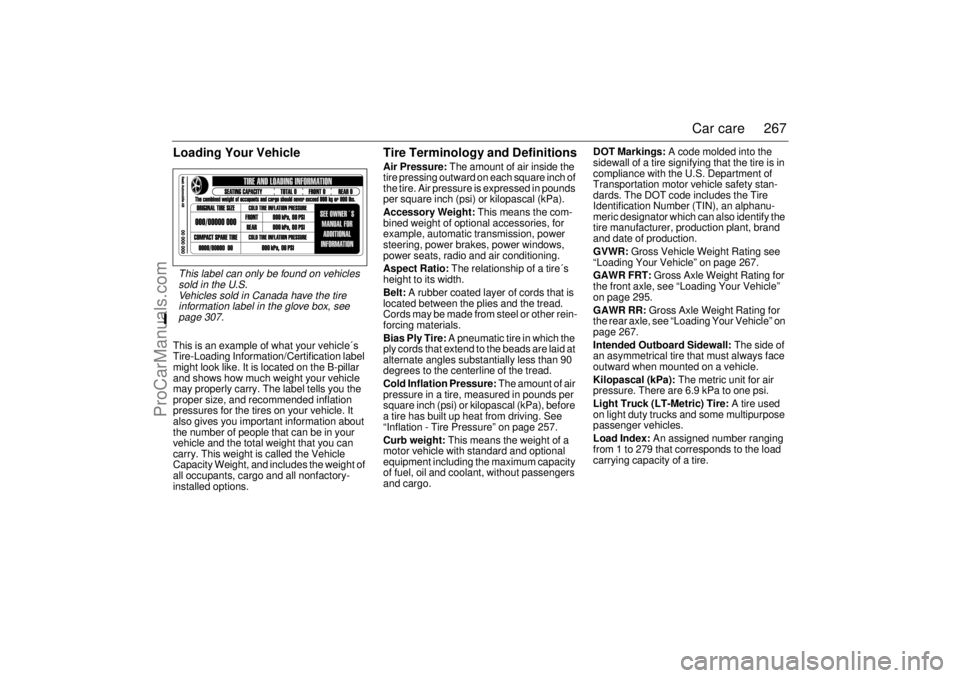
Loading Your VehicleThis is an example of what your vehicle´s
Tire-Loading Information/Certification label
might look like. It is located on the B-pillar
and shows how much weight your vehicle
may properly carry. The label tells you the
proper size, and recommended inflation
pressures for the tires on your vehicle. It
also gives you important information about
the number of people that can be in your
vehicle and the total weight that you can
carry. This weight is called the Vehicle
Capacity Weight, and includes the weight of
all occupants, cargo and all nonfactory-
installed options.
Tire Terminology and DefinitionsAir Pressure: The amount of air inside the
tire pressing outward on each square inch of
the tire. Air pressure is expressed in pounds
per square inch (psi) or kilopascal (kPa).
Accessory Weight: This means the com-
bined weight of optional accessories, for
example, automatic transmission, power
steering, power brakes, power windows,
power seats, radio and air conditioning.
Aspect Ratio: The relationship of a tire´s
height to its width.
Belt: A rubber coated layer of cords that is
located between the plies and the tread.
Cords may be made from steel or other rein-
forcing materials.
Bias Ply Tire: A pneumatic tire in which the
ply cords that extend to the beads are laid at
alternate angles substantially less than 90
degrees to the centerline of the tread.
Cold Inflation Pressure: The amount of air
pressure in a tire, measured in pounds per
square inch (psi) or kilopascal (kPa), before
a tire has built up heat from driving. See
“Inflation - Tire Pressure” on page 257.
Curb weight: This means the weight of a
motor vehicle with standard and optional
equipment including the maximum capacity
of fuel, oil and coolant, without passengers
and cargo.DOT Markings: A code molded into the
sidewall of a tire signifying that the tire is in
compliance with the U.S. Department of
Transportation motor vehicle safety stan-
dards. The DOT code includes the Tire
Identification Number (TIN), an alphanu-
meric designator which can also identify the
tire manufacturer, production plant, brand
and date of production.
GVWR: Gross Vehicle Weight Rating see
“Loading Your Vehicle” on page 267.
GAWR FRT: Gross Axle Weight Rating for
the front axle, see “Loading Your Vehicle”
on page 295.
GAWR RR: Gross Axle Weight Rating for
the rear axle, see “Loading Your Vehicle” on
page 267.
Intended Outboard Sidewall: The side of
an asymmetrical tire that must always face
outward when mounted on a vehicle.
Kilopascal (kPa): The metric unit for air
pressure. There are 6.9 kPa to one psi.
Light Truck (LT-Metric) Tire: A tire used
on light duty trucks and some multipurpose
passenger vehicles.
Load Index: An assigned number ranging
from 1 to 279 that corresponds to the load
carrying capacity of a tire.
This label can only be found on vehicles
sold in the U.S.
Vehicles sold in Canada have the tire
information label in the glove box, see
page 307.93U S M 06.book Page 267 Friday, February 18, 2005 1:15 PM
ProCarManuals.com
Page 289 of 318

289 Customer Assistance and Information
Engine oil and filter changesChanging the engine oil and filter is required
at every service point. Use only a Saab
approved long-life oil filter and engine oils
meeting the SAE viscosity ratings and API
service classifications stated in the “Techni-
cal data” section of this Owner’s Manual.
The use of extra additives in the oil is not
necessary and is not recommended, and
may be harmful to turbochargers.
More frequent oil changes are recom-
mended if your vehicle is operated under
any of the following conditions:
Most trips are less than 5–10 miles (8–
16 km). This is particularly important
when outside temperatures are below
freezing.
Most trips include extensive idling
(frequent stop-and-go traffic).
Most trips are through dusty areas (such
as construction zones).
If the vehicle is used for delivery service,
police, taxi or other commercial applica-
tions.
If your driving habits match this description,
have the engine oil and filter changed in-
between normal services. These conditions
cause the engine oil to break down faster.
The Warranties and Service Record Book-
let has provisions to record extra oil
changes.
Service record retentionIt is the owner’s responsibility to retain ser-
vice records. If possible, you should keep
copies of all shop work orders for all service
and repairs, whenever performed. As indi-
cated in the new car and emission control
system warranties, it is important to docu-
ment that all necessary maintenance has
been done.
HOW THE SERVICE RECORD IS ORGA-
NIZED
The service record is comprised of a series
of coupons on which to record services as
they are performed. There are additional
coupons for documenting extra engine oil
and filter changes, extra automatic trans-
mission fluid services necessary for severe
service conditions, and brake fluid changes.
HOW TO USE THE SERVICE RECORD
COUPONS
When the car is brought to a Saab dealer for
scheduled maintenance, present the War-
ranties & Service Record Booklet to the ser-
vice manager. When the technician has
completed the service, the technician will
sign the maintenance record. The person
responsible for quality assurance at the
dealership will also sign and stamp the
record with the dealer identification stamp.
Service costsDealer pricing practices and labor for ser-
vice work vary. Saab’s recommended ser-
vice times for each service point do not
include the labor required to replace wear
items, such as wiper blades, brake pads or
tires. Nor is labor to perform other service or
repairs found to be necessary as a result of
the inspections included in these times.
Additional labor and parts will be charged
for such work when necessary, except as
covered under an applicable Saab warranty
or any optional extended service contract.
Transmission fluid changes or suspension
alignment, when necessary, are also addi-
tional.
Dealer charges for general shop material,
regulated hazardous waste removal, recy-
cling expenses or other operation costs may
also be applied to service and repair
invoices and are apt to vary by dealer and
location.
93U S M 06.book Page 289 Friday, February 18, 2005 1:15 PM
ProCarManuals.com
Page 293 of 318
293 Technical data
General data __________ 294
Engine _______________ 297
Engine oil _____________ 298
Fuel__________________ 299
Engines ______________ 300
Electrical system_______ 300
Drive belt _____________ 301
Manual transmission ___ 301
Automatic transmission _ 302
Suspension ___________ 302
Steering ______________ 302
Brake system__________ 303
Wheels and tires _______ 304
Plates and labels _______ 307
Technical data
3Asterisk means: equipment not fitted in all cars
(can depend on model variant, engine variant,
market specification, options or accessories).93U S M 06.book Page 293 Friday, February 18, 2005 1:15 PM
ProCarManuals.com