height SAAB 9-3 2008 User Guide
[x] Cancel search | Manufacturer: SAAB, Model Year: 2008, Model line: 9-3, Model: SAAB 9-3 2008Pages: 320, PDF Size: 56.39 MB
Page 143 of 320
143 Interior equipment
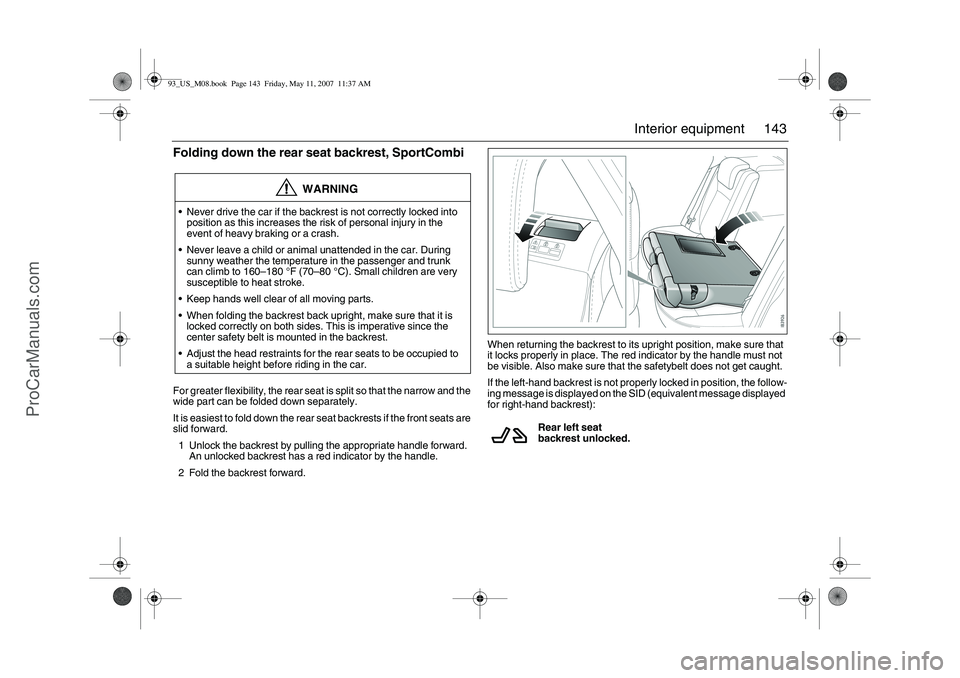
Folding down the rear seat backrest, SportCombiFor greater flexibility, the rear seat is split so that the narrow and the
wide part can be folded down separately.
It is easiest to fold down the rear seat backrests if the front seats are
slid forward.
1 Unlock the backrest by pulling the appropriate handle forward.
An unlocked backrest has a red indicator by the handle.
2 Fold the backrest forward.When returning the backrest to its upright position, make sure that
it locks properly in place. The red indicator by the handle must not
be visible. Also make sure that the safetybelt does not get caught.
If the left-hand backrest is not properly locked in position, the follow-
ing message is displayed on the SID (equivalent message displayed
for right-hand backrest):
WARNING
Never drive the car if the backrest is not correctly locked into
position as this increases the risk of personal injury in the
event of heavy braking or a crash.
Never leave a child or animal unattended in the car. During
sunny weather the temperature in the passenger and trunk
can climb to 160–180°F (70–80°C). Small children are very
susceptible to heat stroke.
Keep hands well clear of all moving parts.
When folding the backrest back upright, make sure that it is
locked correctly on both sides. This is imperative since the
center safety belt is mounted in the backrest.
Adjust the head restraints for the rear seats to be occupied to
a suitable height before riding in the car.
Rear left seat
backrest unlocked.
93_US_M08.book Page 143 Friday, May 11, 2007 11:37 AM
ProCarManuals.com
Page 204 of 320
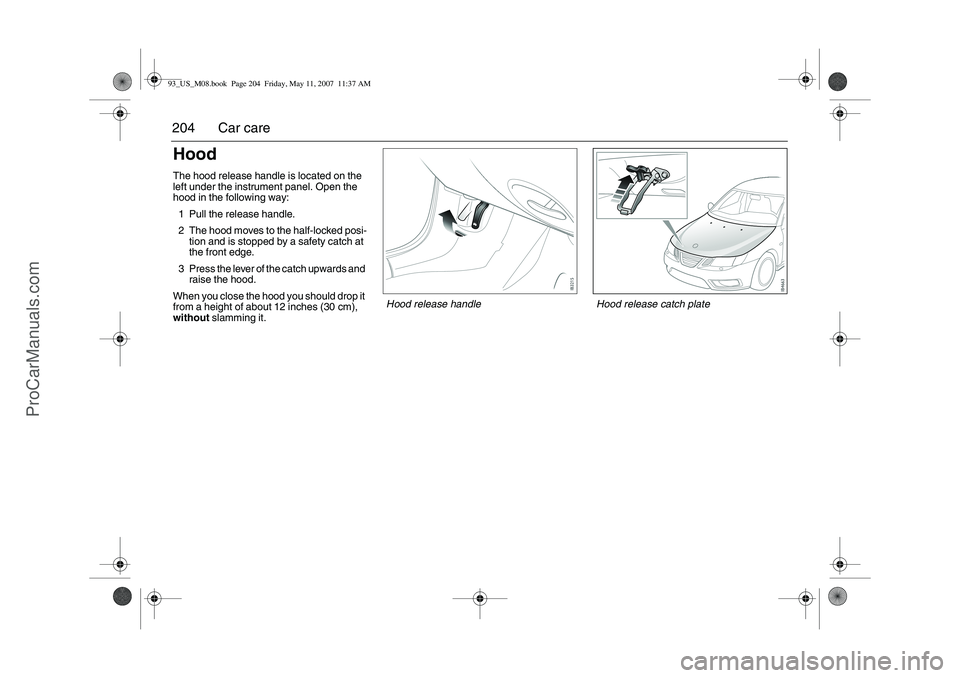
204 Car careHoodThe hood release handle is located on the
left under the instrument panel. Open the
hood in the following way:
1 Pull the release handle.
2 The hood moves to the half-locked posi-
tion and is stopped by a safety catch at
the front edge.
3 Press the lever of the catch upwards and
raise the hood.
When you close the hood you should drop it
from a height of about 12 inches (30 cm),
without slamming it.
Hood release catch plate
Hood release handle
93_US_M08.book Page 204 Friday, May 11, 2007 11:37 AM
ProCarManuals.com
Page 228 of 320
228 Car careFront fog lights3
33 3
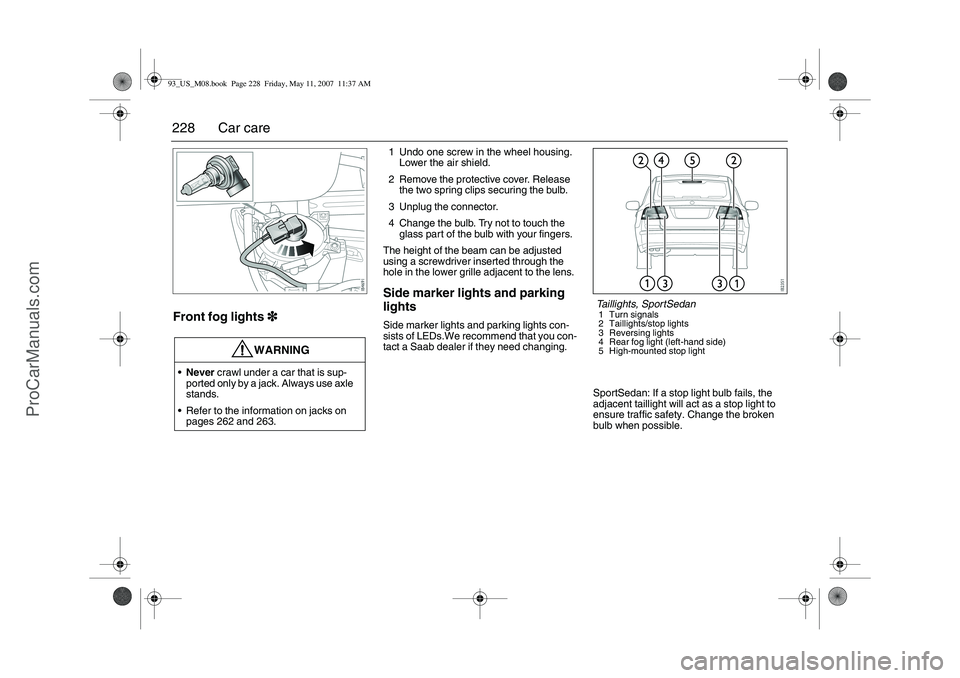
1 Undo one screw in the wheel housing.
Lower the air shield.
2 Remove the protective cover. Release
the two spring clips securing the bulb.
3 Unplug the connector.
4 Change the bulb. Try not to touch the
glass part of the bulb with your fingers.
The height of the beam can be adjusted
using a screwdriver inserted through the
hole in the lower grille adjacent to the lens.Side marker lights and parking
lightsSide marker lights and parking lights con-
sists of LEDs.We recommend that you con-
tact a Saab dealer if they need changing.
SportSedan: If a stop light bulb fails, the
adjacent taillight will act as a stop light to
ensure traffic safety. Change the broken
bulb when possible.
WARNING
Never crawl under a car that is sup-
ported only by a jack. Always use axle
stands.
Refer to the information on jacks on
pages 262 and 263.
Taillights, SportSedan1 Turn signals
2 Taillights/stop lights
3 Reversing lights
4 Rear fog light (left-hand side)
5 High-mounted stop light
93_US_M08.book Page 228 Friday, May 11, 2007 11:37 AM
ProCarManuals.com
Page 250 of 320

250 Car careWheel ReplacementReplace any wheel that is bent, cracked or
badly rusted or corroded. If wheel nuts keep
coming loose, the wheel, wheel bolts and
wheel nuts should be replaced. If the wheel
leaks air, replace it (except some aluminum
wheels, which can sometimes be repaired).
See your dealer if any of these conditions
exist.
Your dealer will know the kind of wheel you
need.
Each new wheel should have the same
load-carrying capacity, diameter, width,
offset and be mounted the same way as the
one it replaces.
If you need to replace any of your wheels,
wheel bolts or wheel nuts, replace them only
with new Saab original equipment parts.
This way, you will be sure to have the right
wheel, wheel bolts and wheel nuts for your
vehicle.Notice: The wrong wheel can also cause
problems with bearing life, brake cool-
ing, speedometer or odometer calibra-
tion, headlamp aim, bumper height, vehi-
cle ground clearance and tire or tire
chain clearance to the body and chassis.
See “Changing a tire” on page 262.Used Replacement Wheels
WARNING
Using the wrong replacement wheels,
wheel bolts or wheel nuts on your vehicle
can be dangerous. It could affect the
braking and handling of your vehicle,
make your tires lose air and make you
lose control. You could have a collision in
which you or others could be injured.
Always use the correct wheel, wheel bolts
and wheel nuts for replacement.
WARNING
When fitting just one new pair of tires,
these should be fitted to the rear wheels,
as these are more critical to the direc-
tional stability of the car (e.g. on braking
or in a skid). The existing rear wheels
should therefore be moved to the front.
WARNING
Putting a used wheel on your vehicle is
dangerous. You can’t know how it’s been
used or how far it’s been driven. It could
fail suddenly and cause a crash. If you
have to replace a wheel, use a new GM
original equipment wheel.
93_US_M08.book Page 250 Friday, May 11, 2007 11:37 AM
ProCarManuals.com
Page 252 of 320

252 Car careTire Sidewall LabelingUseful information about a tire is molded
into it´s sidewall.
Tire size: The tire size ia a combination of
letters and numbers used to define a partic-
ular tire´s width, height, aspect ratio, con-
struction type and service description.
Department of Transportation (DOT):
The Department of Transportation (DOT)
code indicates that the tire is in compliance
with the U.S. Department of Transportation
Motor Vehicle Safety standards.
Tire Identification Number (TIN): The let-
ters and numbers following DOT code are
the Tire Identification Number (TIN). The
TIN shows the manufacturer and plant
code, tire size, and date the tire was manu-
factured. The TIN is molded onto both sides
of the tire.
Tire Ply Material: The type of cord and
number of plies in the sidewall and under
the tread.Uniform Tire Quality Grading (UTQG):
Tire manufacturers are required to grade
tires based on the performance factors:
treadwear, traction and temperature resis-
tance. For more information see “Uniform
Tire Quality Grading” on page 248.
Maximum Cold Inflation Load Limit: Max-
imum load that can be carried and the max-
imum pressure needed to support that load.
For information on recommended tire pres-
sure see “Recommended lowest tire pres-
sure, cold tires” on page 296 and “Loading
Your Vehicle” on page 254.
Tire SizeThe following illustration shows an example
of a typical passenger car tire size.
Tire Width: The three-digit number indi-
cates the tire section width in millimeters
from sidewall to sidewall.215/55 R 16 93 H
||||||
abcdef
aTire Width
b Aspect Ratio
c Belt Rating
d Rim diameter
e Load range
f Speed rating
93_US_M08.book Page 252 Friday, May 11, 2007 11:37 AM
ProCarManuals.com
Page 253 of 320

253 Car care
Aspect ratio: A two-digit number that indi-
cates the tire height-to-width measure-
ments. For example, if the tire size aspect
ratio is “55”, as shown in item “C” of the illus-
tration, it would mean that the tire´s sidewall
is 55% as high as it is wide.
Belt Rating: A letter code is used to indicate
the type of ply construction in the tire. The
letter “R” means radial ply construction; the
letter “D” means diagonal or bias ply con-
struction; and the letter “B” means
belted-bias ply construction.
Rim Diameter: Diameter of the wheel in
inches.
Load range: The load range represents the
load carry capacity a tire is certified to carry.
Speed Rating: The maximum speed that a
tire is certified to carry a load. Speed ratings
range from “A” to “Z”.
Tire markingsAn example of the meaning of the different
markings in a tire size is given below for a
tire size of 225/45 R17 94H:
225 Tire section width, mm
45Aspect ratio, i.e. the section height
as a percentage of the section
width
R Radial ply
17Wheel rim diameter 17 in at bead
seats
94 Tire load index
H Speed rating
Tire load indices
91Tire approved for max. 1355 lbs.
(615 kg)
93 Max. 1433 lbs. (650 kg)
94 Max. 1477 lbs. (670 kg)
95 Max. 1521 lbs. (690 kg)
97 Max. 1609 lbs. (730 kg)Speed ratings
QTire approved for speeds up to
100 mph (160 km/h)
S Max. 112 mph (180 km/h)
T Max. 118 mph (190 km/h)
H Max. 130 mph (210 km/h)
V Max. 149 mph (240 km/h)
W Max. 168 mph (270 km/h)
Y Max. 186 mph (300 km/h)
93_US_M08.book Page 253 Friday, May 11, 2007 11:37 AM
ProCarManuals.com
Page 254 of 320
254 Car care
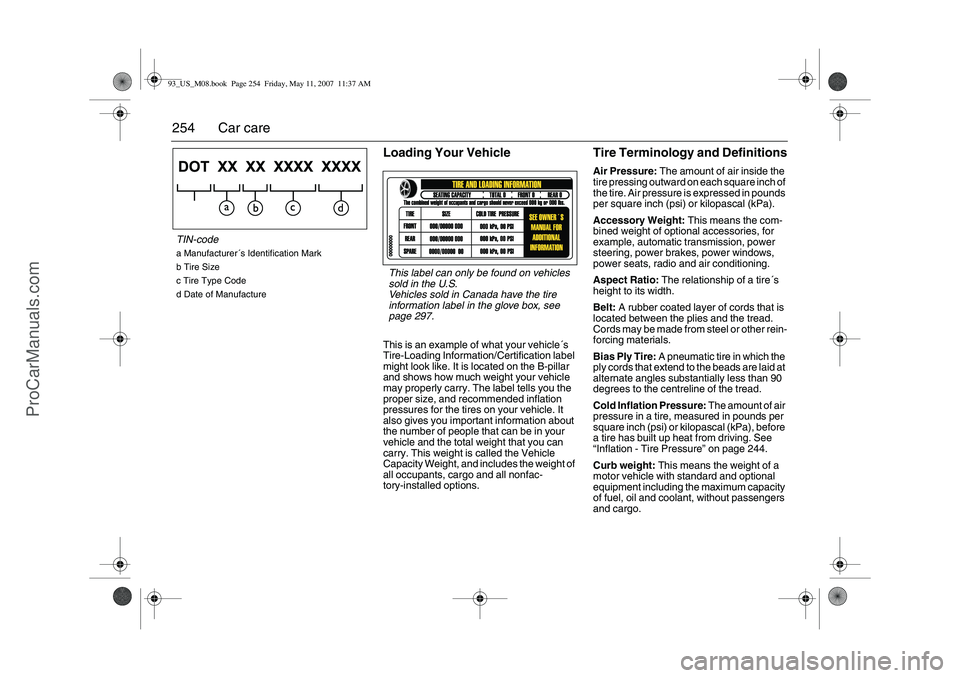
Loading Your VehicleThis is an example of what your vehicle´s
Tire-Loading Information/Certification label
might look like. It is located on the B-pillar
and shows how much weight your vehicle
may properly carry. The label tells you the
proper size, and recommended inflation
pressures for the tires on your vehicle. It
also gives you important information about
the number of people that can be in your
vehicle and the total weight that you can
carry. This weight is called the Vehicle
Capacity Weight, and includes the weight of
all occupants, cargo and all nonfac-
tory-installed options.
Tire Terminology and DefinitionsAir Pressure: The amount of air inside the
tire pressing outward on each square inch of
the tire. Air pressure is expressed in pounds
per square inch (psi) or kilopascal (kPa).
Accessory Weight: This means the com-
bined weight of optional accessories, for
example, automatic transmission, power
steering, power brakes, power windows,
power seats, radio and air conditioning.
Aspect Ratio: The relationship of a tire´s
height to its width.
Belt: A rubber coated layer of cords that is
located between the plies and the tread.
Cords may be made from steel or other rein-
forcing materials.
Bias Ply Tire: A pneumatic tire in which the
ply cords that extend to the beads are laid at
alternate angles substantially less than 90
degrees to the centreline of the tread.
Cold Inflation Pressure: The amount of air
pressure in a tire, measured in pounds per
square inch (psi) or kilopascal (kPa), before
a tire has built up heat from driving. See
“Inflation - Tire Pressure” on page 244.
Curb weight: This means the weight of a
motor vehicle with standard and optional
equipment including the maximum capacity
of fuel, oil and coolant, without passengers
and cargo. This label can only be found on vehicles
sold in the U.S.
Vehicles sold in Canada have the tire
information label in the glove box, see
page 297.
TIN-codea Manufacturer´s Identification Mark
b Tire Size
c Tire Type Code
d Date of Manufacture93_US_M08.book Page 254 Friday, May 11, 2007 11:37 AM
ProCarManuals.com
Page 264 of 320
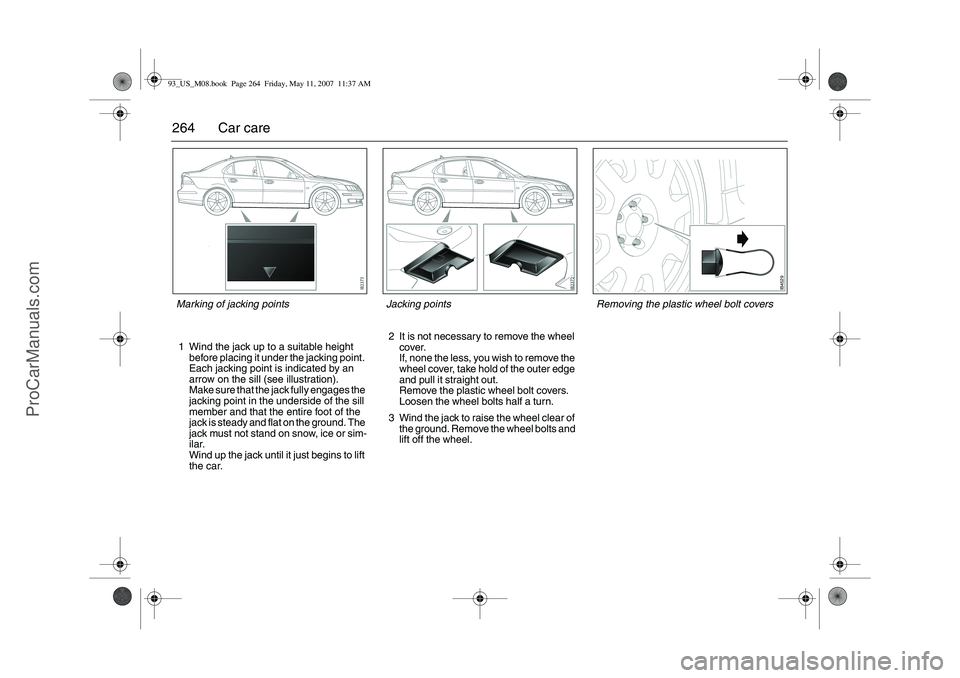
264 Car care1 Wind the jack up to a suitable height
before placing it under the jacking point.
Each jacking point is indicated by an
arrow on the sill (see illustration).
Make sure that the jack fully engages the
jacking point in the underside of the sill
member and that the entire foot of the
jack is steady and flat on the ground. The
jack must not stand on snow, ice or sim-
ilar.
Wind up the jack until it just begins to lift
the car.2 It is not necessary to remove the wheel
cover.
If, none the less, you wish to remove the
wheel cover, take hold of the outer edge
and pull it straight out.
Remove the plastic wheel bolt covers.
Loosen the wheel bolts half a turn.
3 Wind the jack to raise the wheel clear of
the ground. Remove the wheel bolts and
lift off the wheel.
Jacking points
Marking of jacking points
IB4529
Removing the plastic wheel bolt covers
93_US_M08.book Page 264 Friday, May 11, 2007 11:37 AM
ProCarManuals.com
Page 286 of 320
286 Technical dataGeneral dataOverall length, including bumpers:
SportSedan and Convertible _________ 182.9'' (4647 mm)
SportCombi_______________________ 183.8'' (4670 mm)
Overall width, including door mirrors _____ 80.2'' (2038 mm)
Maximum height ____________________ 60.7'' (1543 mm)
Wheelbase ________________________ 105.3'' (2675 mm)
Tr a c k :
Front ____________________________ 59.8'' (1524 mm)
Re ar ____________________________ 59.3'' (1506 mm)
Ground clearance at GVW ____________ approx. 4.7''
(120 mm)
Number of seats (incl. driver):
SportSedan and SportCombi _________ 5
Convertible _______________________ 4
Turning circle:
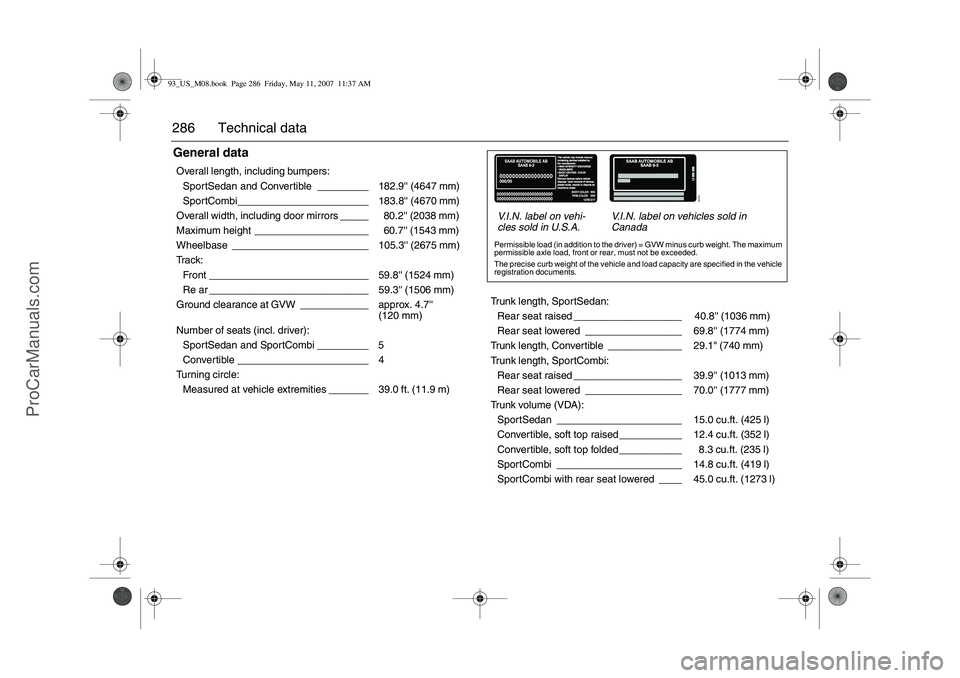
Measured at vehicle extremities _______ 39.0 ft. (11.9 m)V.I.N. label on vehi-
cles sold in U.S.A.V.I.N. label on vehicles sold in
Canada
Permissible load (in addition to the driver) = GVW minus curb weight. The maximum
permissible axle load, front or rear, must not be exceeded.
The precise curb weight of the vehicle and load capacity are specified in the vehicle
registration documents.Trunk length, SportSedan:
Rear seat raised ___________________ 40.8'' (1036 mm)
Rear seat lowered _________________ 69.8'' (1774 mm)
Trunk length, Convertible _____________ 29.1" (740 mm)
Trunk length, SportCombi:
Rear seat raised ___________________ 39.9'' (1013 mm)
Rear seat lowered _________________ 70.0'' (1777 mm)
Trunk volume (VDA):
SportSedan ______________________ 15.0 cu.ft. (425 l)
Convertible, soft top raised ___________ 12.4 cu.ft. (352 l)
Convertible, soft top folded ___________ 8.3 cu.ft. (235 l)
SportCombi ______________________ 14.8 cu.ft. (419 l)
SportCombi with rear seat lowered ____ 45.0 cu.ft. (1273 l)
93_US_M08.book Page 286 Friday, May 11, 2007 11:37 AM
ProCarManuals.com
Page 303 of 320
303 Index
Index
AABS brakes
____________________ 173
ACC
_________________________ 108
Adjustment, steering wheel
________ 120
Air filter
_______________________ 211
Airbag
_________________________ 32
Anchorage eyes, SportSedan
______ 141
Anti-corrosion treatment
__________ 271
Antilock braking system __________ 173
Anti-spin
______________________ 175
Ashtrays ______________________ 136
Autochecking of lights, warning and
indicator lights
__________________ 87
Autodimming
_______________ 125
, 126
Automatic climate control (ACC)
____ 108
Automatic closing of moonroof
_____ 131
Automatic closing of windows, SportSedan
and SportCombi
_______________ 122
Automatic transmission
___________ 165
Automatic transmission, sport mode
_167
BBattery
_______________________ 216
Bedding-in of new brake pads
_____ 163
Before towing a trailer
____________ 193
Belt height, SportSedan and
SportCombi
____________________ 14Brake fluid, grade
_______________ 295
Brakes
________________________ 172
Braking _______________________ 172
Bulb changing
__________________ 222
Bulb table
_____________________ 236
Buying new tires
________________ 247
CCabin lighting, Convertible
_________ 78
Cabin lighting, SportSedan and
SportCombi
___________________ 133
Calibrating front electric windows with
pinch protection
________________ 78
Calibration of windows, SportSedan and
SportCombi
___________________ 123
Car alarm
______________________ 56
Car transport ___________________ 199
Care of air conditioning
___________ 274
Cargo guard
___________________ 150
Cargo guard, SportWagon
________ 150
Cargo net, SportCombi
___________ 147
Change of address notification
_____ 282
Changing a tire
_________________ 262
Changing bulbs _________________ 222
Changing the battery, remote control
_54
Changing wiper blades
___________ 220
Checking the number of remote
controls
_______________________ 53
Checks before towing a trailer
_____ 193
Child safety
_____________________ 24
Child safety locks, rear doors
_______ 52Child seats
______________________ 24
Cigarette lighter
_________________ 136
Cleaning the engine bay
__________ 267
Cleaning upholstery
______________ 266
Closing the soft top manually,
Convertible
____________________ 68
Closing the soft top, Convertible
_____ 64
Clutch interlock
_________________ 164
Comfort opening of moonroof
______ 131
Comfort opening of windows,
SportSedan and SportCombi _____ 121
Compact spare
_________________ 260
Compact spare wheel fitted, driving
with
_________________________ 260
Compass
______________________ 129
Convertible _____________________ 61
Convertible, washing
_____________ 268
Coolant
_______________________ 212
Cornering headlights
______________ 99
Crash memory, see EDR
_________ 284
Cruise control
__________________ 171
Cup holder
_____________________ 134
DDate codes, tires
________________ 257
Deactivating rear windows,
SportSedan and SportCombi
_____ 123
Deactivating the passenger door
window button, Convertible
________ 77
Deactivating the rear window
switches
_____________________ 123
93_US_M08.book Page 303 Friday, May 11, 2007 11:37 AM
ProCarManuals.com