warning SAAB 9-3 2008 User Guide
[x] Cancel search | Manufacturer: SAAB, Model Year: 2008, Model line: 9-3, Model: SAAB 9-3 2008Pages: 320, PDF Size: 56.39 MB
Page 19 of 320
19 Safety
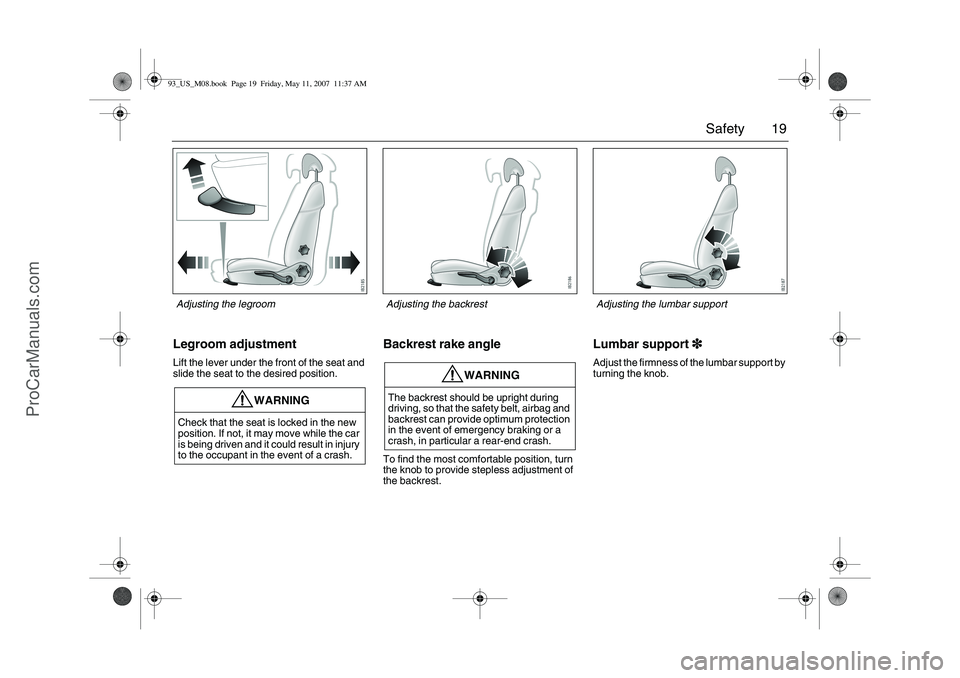
Legroom adjustmentLift the lever under the front of the seat and
slide the seat to the desired position.
Backrest rake angleTo find the most comfortable position, turn
the knob to provide stepless adjustment of
the backrest.
Lumbar support3
33 3Adjust the firmness of the lumbar support by
turning the knob.
WARNING
Check that the seat is locked in the new
position. If not, it may move while the car
is being driven and it could result in injury
to the occupant in the event of a crash.
WARNING
The backrest should be upright during
driving, so that the safety belt, airbag and
backrest can provide optimum protection
in the event of emergency braking or a
crash, in particular a rear-end crash.Adjusting the backrest
Adjusting the legroom Adjusting the lumbar support93_US_M08.book Page 19 Friday, May 11, 2007 11:37 AM
ProCarManuals.com
Page 20 of 320
20 SafetyElectrically adjustable front
seats3
33 3With the doors closed the seats can only be
adjusted when the ignition is ON.
However, there are two exceptions:
To facilitate getting into the car, both seats
can be adjusted when either of the front
doors is open.
The seats can be adjusted up to
2 minutes after both doors have been
closed (applicable only to cars without
window and sunroof pinch protection).
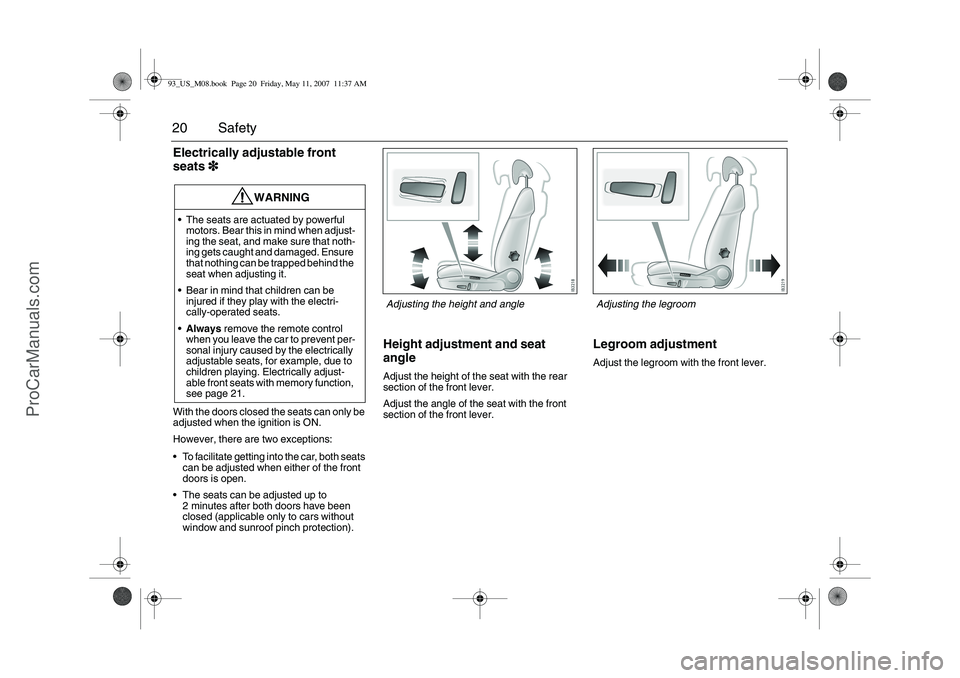
Height adjustment and seat
angleAdjust the height of the seat with the rear
section of the front lever.
Adjust the angle of the seat with the front
section of the front lever.
Legroom adjustmentAdjust the legroom with the front lever.
WARNING
The seats are actuated by powerful
motors. Bear this in mind when adjust-
ing the seat, and make sure that noth-
ing gets caught and damaged. Ensure
that nothing can be trapped behind the
seat when adjusting it.
Bear in mind that children can be
injured if they play with the electri-
cally-operated seats.
Always remove the remote control
when you leave the car to prevent per-
sonal injury caused by the electrically
adjustable seats, for example, due to
children playing. Electrically adjust-
able front seats with memory function,
see page 21.
Adjusting the height and angle Adjusting the legroom
93_US_M08.book Page 20 Friday, May 11, 2007 11:37 AM
ProCarManuals.com
Page 21 of 320
21 Safety
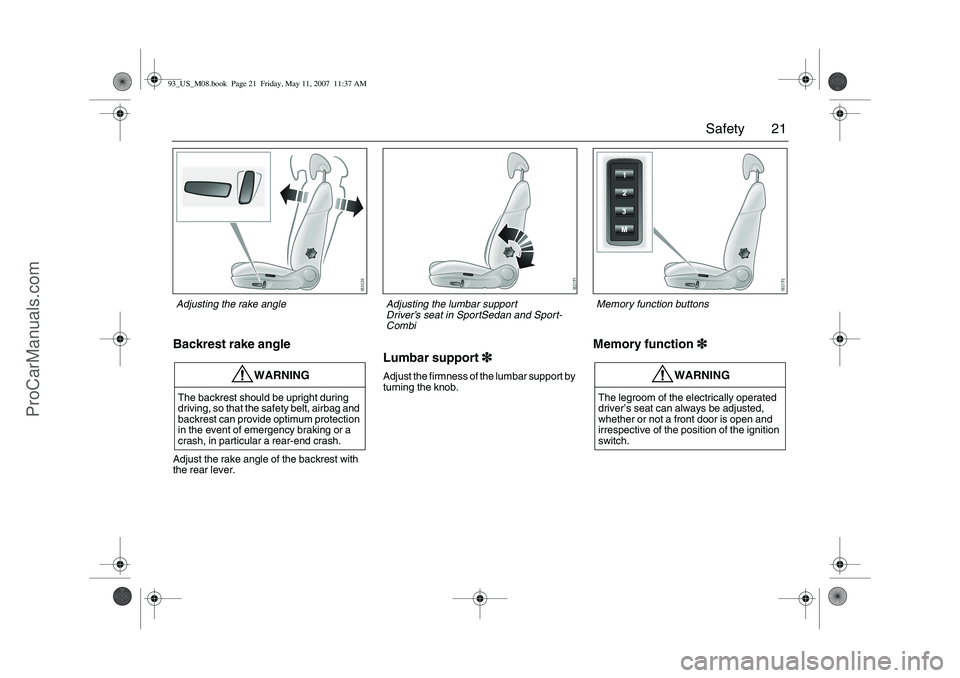
Backrest rake angleAdjust the rake angle of the backrest with
the rear lever.
Lumbar support3
33 3Adjust the firmness of the lumbar support by
turning the knob.
Memory function3
33 3
WARNING
The backrest should be upright during
driving, so that the safety belt, airbag and
backrest can provide optimum protection
in the event of emergency braking or a
crash, in particular a rear-end crash.
WARNING
The legroom of the electrically operated
driver’s seat can always be adjusted,
whether or not a front door is open and
irrespective of the position of the ignition
switch.
Adjusting the rake angle Adjusting the lumbar support
Driver’s seat in SportSedan and Sport-
CombiMemory function buttons93_US_M08.book Page 21 Friday, May 11, 2007 11:37 AM
ProCarManuals.com
Page 23 of 320
23 Safety
Head restraintsSportSedan and SportCombi
Head restraint, Convertible, see page 74.
The front seats are equipped with Saab
Active Head Restraints (SAHRs). These are
designed to reduce the risk of neck injury if
the car is hit from behind.
The SAHR is a mechanical system, actu-
ated by body weight. The mechanism is built
into the top of the backrest, where it is con-
nected to the head restraint.In the event of a rear-end crash, the body is
forced back against the backrest. This, in
turn, causes the mechanism to press the
head restraint forward and upward, thus
limiting the backward movement of the
head.
Therefore, the SAHR does not normally
need to be replaced or repaired after a
rear-end crash.
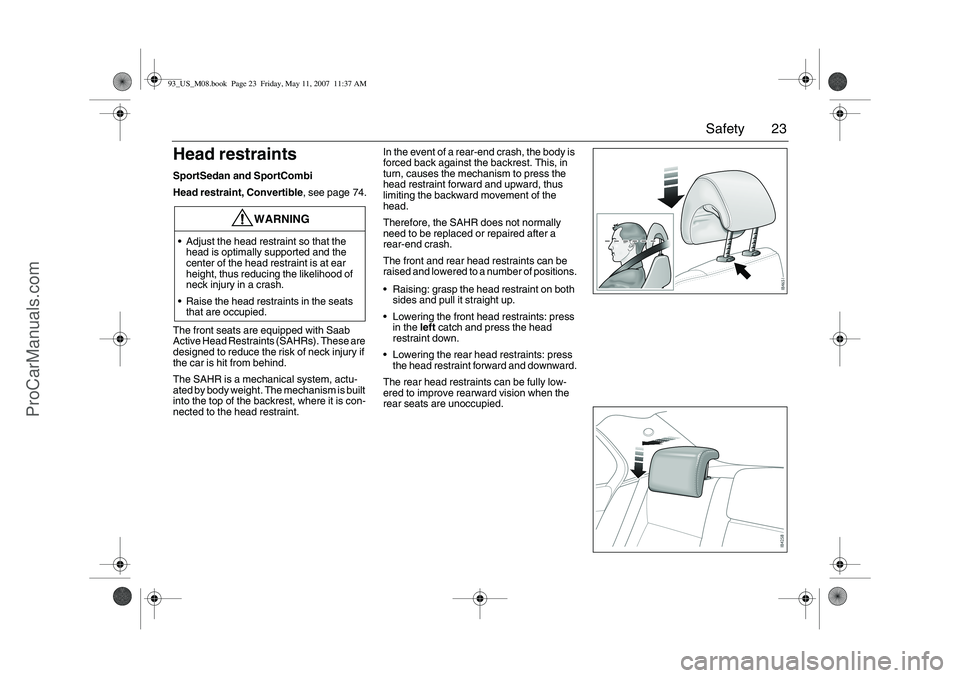
The front and rear head restraints can be
raised and lowered to a number of positions.
Raising: grasp the head restraint on both
sides and pull it straight up.
Lowering the front head restraints: press
in the left catch and press the head
restraint down.
Lowering the rear head restraints: press
the head restraint forward and downward.
The rear head restraints can be fully low-
ered to improve rearward vision when the
rear seats are unoccupied.
WARNING
Adjust the head restraint so that the
head is optimally supported and the
center of the head restraint is at ear
height, thus reducing the likelihood of
neck injury in a crash.
Raise the head restraints in the seats
that are occupied.93_US_M08.book Page 23 Friday, May 11, 2007 11:37 AM
ProCarManuals.com
Page 24 of 320
24 SafetyChild safety
Car safety tips
For Trunk Release Handle information see
page 53 and 141.
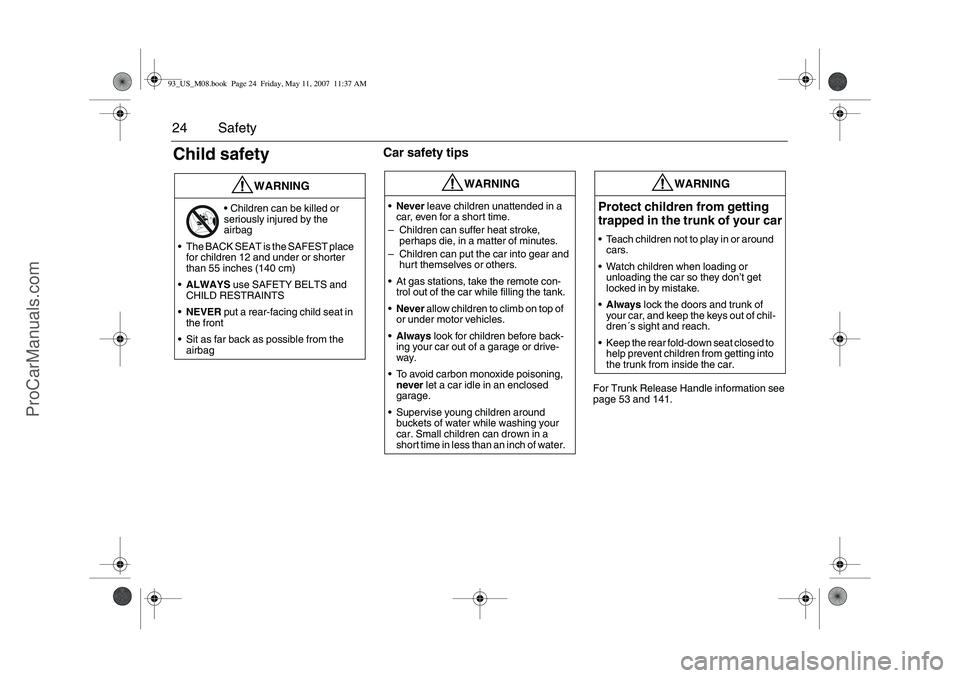
WARNING
Children can be killed or
seriously injured by the
airbag
The BACK SEAT is the SAFEST place
for children 12 and under or shorter
than 55 inches (140 cm)
ALWAYS use SAFETY BELTS and
CHILD RESTRAINTS
NEVER put a rear-facing child seat in
the front
Sit as far back as possible from the
airbag
WARNING
Never leave children unattended in a
car, even for a short time.
–Children can suffer heat stroke,
perhaps die, in a matter of minutes.
–Children can put the car into gear and
hurt themselves or others.
At gas stations, take the remote con-
trol out of the car while filling the tank.
Never allow children to climb on top of
or under motor vehicles.
Always look for children before back-
ing your car out of a garage or drive-
way.
To avoid carbon monoxide poisoning,
never let a car idle in an enclosed
garage.
Supervise young children around
buckets of water while washing your
car. Small children can drown in a
short time in less than an inch of water.
WARNING
Protect children from getting
trapped in the trunk of your carTeach children not to play in or around
cars.
Watch children when loading or
unloading the car so they don’t get
locked in by mistake.
Always lock the doors and trunk of
your car, and keep the keys out of chil-
dren´s sight and reach.
Keep the rear fold-down seat closed to
help prevent children from getting into
the trunk from inside the car.
93_US_M08.book Page 24 Friday, May 11, 2007 11:37 AM
ProCarManuals.com
Page 25 of 320
25 Safety
General information on child
safetyThe same attention must be given to child
safety in the car as is given to adults.
Children travel most safely when properly
restrained. However, the type of restraint
must be appropriate for the size of the child.
We recommend that you always consult
your Saab dealer before fitting a child seat,
child restraint or booster cushion.
The backseat is the safest place for chil-
dren.
Make sure you are acquainted with the
legal requirements for seating children
in the car.
When fitting child restraints in cars you
must always read the instructions sup-
plied by the child restraint manufacturer.
Make sure that it is possible to fit a child
restraint in accordance with the manufac-
turer’s child restraint instructions.
Saab recommends the use of a rear-fac-
ing child seat for as long as this is possi-
ble - for all children under 18 kg (40 lbs.)
as a minimum. Use a child seat approved
for the weight of the child.
Saab recommends the use of a booster seat
for children up to the length of 140 cm
(55 in.) or the weight of 36 kg (80 lbs.).
LATCHLATCH (Lower Anchorages & Top tethers
for CHildren) is a US/Canadian safety stan-
dard for a uniform method of fitting child
restraints without using the standard safety
belts. Only certain child restraints are
equipped to utilize the LATCH system.
The LATCH system is installed in the car to
facilitate proper fitting of child restraints
designed for and equipped with LATCH
attachments.
The LATCH system consists of top tether
and lower anchorages. In this vehicle,
LATCH is installed at the two outboard seat-
ing positions in the rear seat, and there is a
top tether on the rear center position (not
Convertible).
The top tethers are located on top of the
parcel shelf (SportSedan), see page 28, on
the back of the rear seat (SportCombi), see
page 29 and behind the head restraints
(Convertible) see page 30.
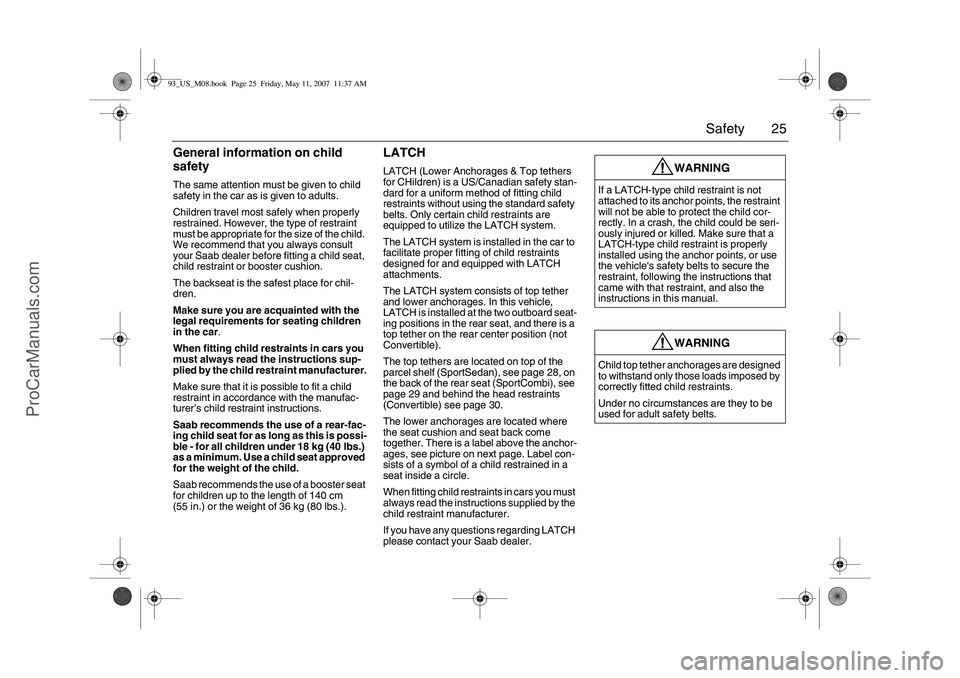
The lower anchorages are located where
the seat cushion and seat back come
together. There is a label above the anchor-
ages, see picture on next page. Label con-
sists of a symbol of a child restrained in a
seat inside a circle.
When fitting child restraints in cars you must
always read the instructions supplied by the
child restraint manufacturer.
If you have any questions regarding LATCH
please contact your Saab dealer.
WARNING
If a LATCH-type child restraint is not
attached to its anchor points, the restraint
will not be able to protect the child cor-
rectly. In a crash, the child could be seri-
ously injured or killed. Make sure that a
LATCH-type child restraint is properly
installed using the anchor points, or use
the vehicle's safety belts to secure the
restraint, following the instructions that
came with that restraint, and also the
instructions in this manual.
WARNING
Child top tether anchorages are designed
to withstand only those loads imposed by
correctly fitted child restraints.
Under no circumstances are they to be
used for adult safety belts.
93_US_M08.book Page 25 Friday, May 11, 2007 11:37 AM
ProCarManuals.com
Page 28 of 320
28 SafetyChild top tether anchorages for
forward facing child seatsSportSedan
Child restraints with a tether strap must be
attached according to Canadian and U.S.
safety standards.
If you have any questions regarding child
anchorages please contact your Saab
dealer.
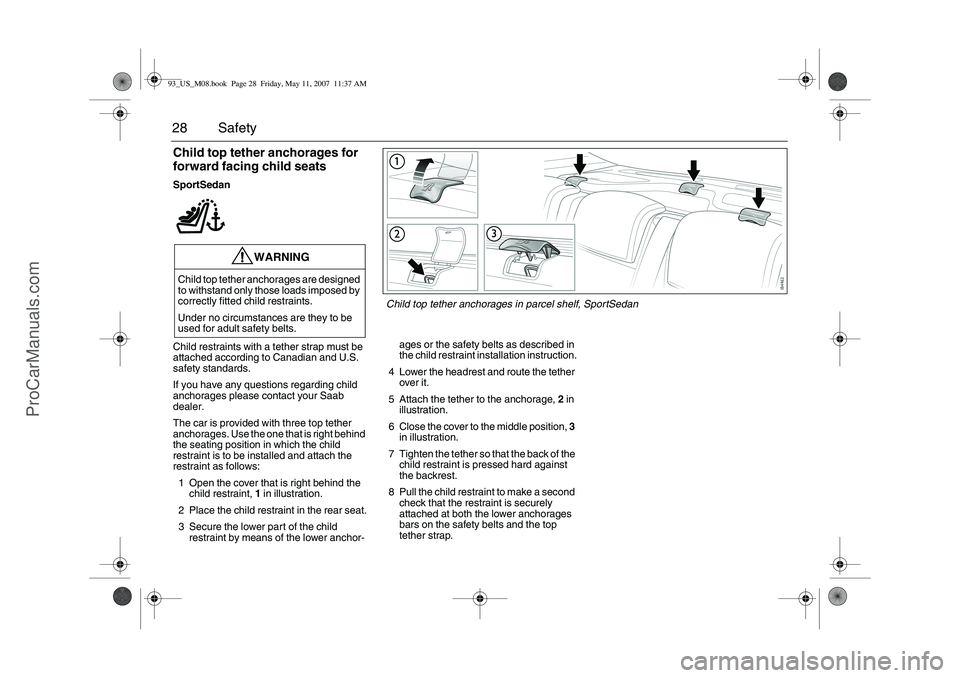
The car is provided with three top tether
anchorages. Use the one that is right behind
the seating position in which the child
restraint is to be installed and attach the
restraint as follows:
1 Open the cover that is right behind the
child restraint, 1 in illustration.
2 Place the child restraint in the rear seat.
3 Secure the lower part of the child
restraint by means of the lower anchor-ages or the safety belts as described in
the child restraint installation instruction.
4 Lower the headrest and route the tether
over it.
5 Attach the tether to the anchorage, 2 in
illustration.
6 Close the cover to the middle position, 3
in illustration.
7 Tighten the tether so that the back of the
child restraint is pressed hard against
the backrest.
8 Pull the child restraint to make a second
check that the restraint is securely
attached at both the lower anchorages
bars on the safety belts and the top
tether strap.
WARNING
Child top tether anchorages are designed
to withstand only those loads imposed by
correctly fitted child restraints.
Under no circumstances are they to be
used for adult safety belts.
Child top tether anchorages in parcel shelf, SportSedan
93_US_M08.book Page 28 Friday, May 11, 2007 11:37 AM
ProCarManuals.com
Page 29 of 320
29 Safety
Child top tether anchorages for
forward facing child seatsSportCombi
Child restraints with a tether strap must be
attached according to Canadian and U.S.
safety standards.
If you have any questions regarding child
anchorages please contact your Saab
dealer.
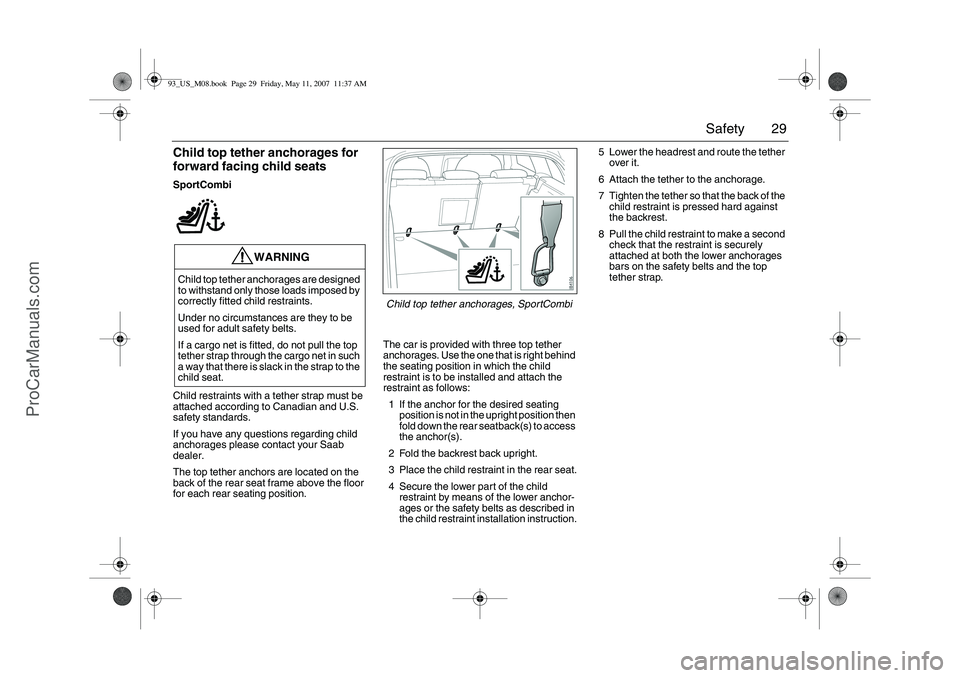
The top tether anchors are located on the
back of the rear seat frame above the floor
for each rear seating position.The car is provided with three top tether
anchorages. Use the one that is right behind
the seating position in which the child
restraint is to be installed and attach the
restraint as follows:
1 If the anchor for the desired seating
position is not in the upright position then
fold down the rear seatback(s) to access
the anchor(s).
2 Fold the backrest back upright.
3 Place the child restraint in the rear seat.
4 Secure the lower part of the child
restraint by means of the lower anchor-
ages or the safety belts as described in
the child restraint installation instruction.5 Lower the headrest and route the tether
over it.
6 Attach the tether to the anchorage.
7 Tighten the tether so that the back of the
child restraint is pressed hard against
the backrest.
8 Pull the child restraint to make a second
check that the restraint is securely
attached at both the lower anchorages
bars on the safety belts and the top
tether strap.
WARNING
Child top tether anchorages are designed
to withstand only those loads imposed by
correctly fitted child restraints.
Under no circumstances are they to be
used for adult safety belts.
If a cargo net is fitted, do not pull the top
tether strap through the cargo net in such
a way that there is slack in the strap to the
child seat.
Child top tether anchorages, SportCombi
93_US_M08.book Page 29 Friday, May 11, 2007 11:37 AM
ProCarManuals.com
Page 30 of 320
30 SafetyChild top tether anchorages for
forward facing child seatsConvertible
Child restraints with a tether strap must be
attached according to Canadian and U.S.
safety standards.
If you have any questions regarding child
anchorages please contact your Saab
dealer.
The car is provided with two top tether
anchorages. Use the one that is right behind
the seating position in which the child
restraint is to be installed and attach the
restraint as follows:
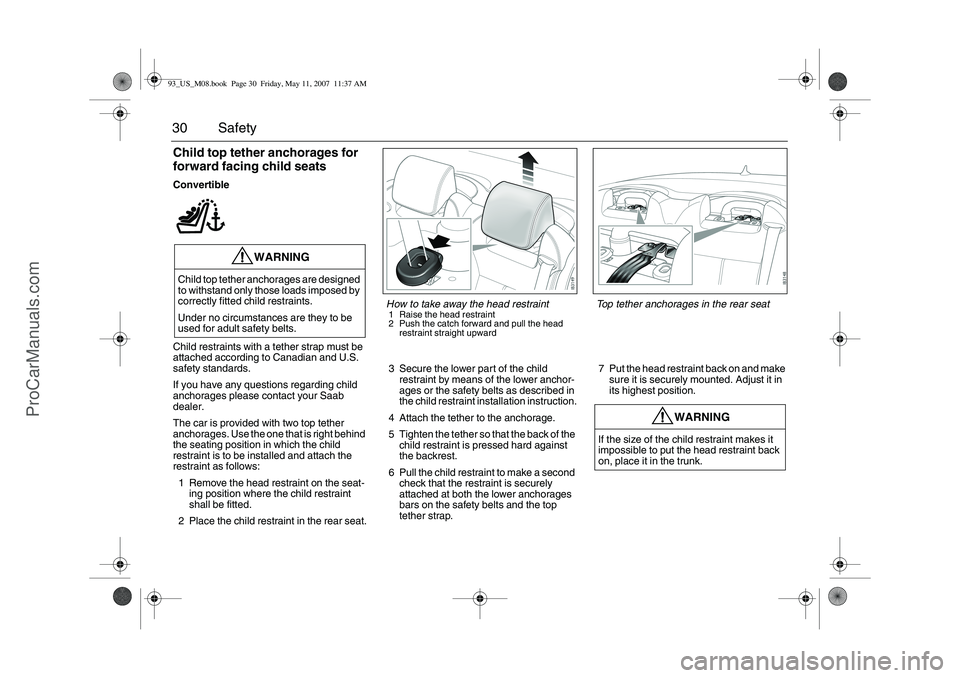
1 Remove the head restraint on the seat-
ing position where the child restraint
shall be fitted.
2 Place the child restraint in the rear seat.3 Secure the lower part of the child
restraint by means of the lower anchor-
ages or the safety belts as described in
the child restraint installation instruction.
4 Attach the tether to the anchorage.
5 Tighten the tether so that the back of the
child restraint is pressed hard against
the backrest.
6 Pull the child restraint to make a second
check that the restraint is securely
attached at both the lower anchorages
bars on the safety belts and the top
tether strap.7 Put the head restraint back on and make
sure it is securely mounted. Adjust it in
its highest position.
WARNING
Child top tether anchorages are designed
to withstand only those loads imposed by
correctly fitted child restraints.
Under no circumstances are they to be
used for adult safety belts.
WARNING
If the size of the child restraint makes it
impossible to put the head restraint back
on, place it in the trunk.
How to take away the head restraint1 Raise the head restraint
2 Push the catch forward and pull the head
restraint straight upward
Top tether anchorages in the rear seat
93_US_M08.book Page 30 Friday, May 11, 2007 11:37 AM
ProCarManuals.com
Page 31 of 320
31 Safety
Installation of child restraint
using the standard safety beltChild restraints that are approved for rear-
ward facing installation in the rear seat can
be positioned in any of the three rear places.
Make sure that it is possible to fit it in accor-
dance with the manufacturer’s instructions.
When fitting child restraints in cars you
must always read the instructions sup-
plied by the child restraint manufacturer.If fitting a child restraint that is intended to be
secured in position by the standard safety
belt, make use of the locking function of the
belt.
Locking the belt lessens the risk that the
seat will work loose while the car is in
motion.
1 Position the child restraint in the back
seat.
2 Route the belt in the restraint according
to the installation instruction of the
restraint.
3 Pull out the belt completely until it stops.
Then let the belt slowly pull in the slack.
Clicking sound indicates that the lock
function is in work.
4 Pull the shoulder belt tight to secure the
child restraint in position.
5 Check for correct locking function by
pulling on the belt. The belt must not
unreel.The safety belt locking function will be deac-
tivated when the safety belt is retracted.
1 Disengage the safety belt latch from the
buckle.
2 Disengage the safety belt from the child
restraint, according to the instructions
from the child restraint manufacturer.
3 Let the safety belt retract until the click-
ing sound ceases.
WARNING
Failure to follow all the manufacturer’s
instructions on the use of child restraint
systems can cause your child to strike the
vehicle´s interior during a sudden stop or
crash.93_US_M08.book Page 31 Friday, May 11, 2007 11:37 AM
ProCarManuals.com