tires SAAB 9-3 2008 Owner's Manual
[x] Cancel search | Manufacturer: SAAB, Model Year: 2008, Model line: 9-3, Model: SAAB 9-3 2008Pages: 320, PDF Size: 56.39 MB
Page 255 of 320

255 Car care
DOT Markings: A code molded into the
sidewall of a tire signifying that the tire is in
compliance with the U.S. Department of
Transportation motor vehicle safety stan-
dards. The DOT code includes the Tire
Identification Number (TIN), an alphanu-
meric designator which can also identify the
tire manufacturer, production plant, brand
and date of production.
GVWR: Gross Vehicle Weight Rating see
page 287.
GAWR FRT: Gross Axle Weight Rating for
the front axle, see page 287.
GAWR RR: Gross Axle Weight Rating for
the rear axle, see page 287.
Intended Outboard Sidewall: The side of
an asymmetrical tire that must always face
outward when mounted on a vehicle.
Kilopascal (kPa): The metric unit for air
pressure. There are 6.9 kPa to one psi.
Light Truck (LT-Metric) Tire: A tire used
on light duty trucks and some multipurpose
passenger vehicles.
Load Index: An assigned number ranging
from 1 to 279 that corresponds to the load
carrying capacity of a tire.Maximum Load rating: The load rating for
a tire at the maximum permissible inflation
pressure for that tire.
Maximum Loaded Vehicle Weight: The
sum of curb weight; accessory weight; vehi-
cle capacity weight; and production options
weight.
Maximum Permissible Inflation Pres-
sure: The maximum cold inflation pressure
to which a tire may be inflated.
Normal occupant weight: The number of
occupants a vehicle is designed to seat mul-
tipled by 150 pounds (68 kg). See “Loading
Your Vehicle” on page 254.
Occupant Distribution: Designated seat-
ing positions.
Outward Facing Sidewall: The side of a
asymmetrical tire that has a particular side
that faces outward when mounted on a vehi-
cle. The side of the tire that contains a white-
wall bears white lettering or bears manufac-
turer, brand and or model name molding on
the other sidewall of the tire.
Passenger (P-Metric) Tire: A tire used on
passenger cars and some light duty trucks
and multipurpose vehicles.Recommended Inflation Pressure: Vehi-
cle manufacturer´s recommended tire infla-
tion pressure shown on the tire placard, see
“Inflation - Tire Pressure” on page 244 and
“Loading Your Vehicle” on page 254.
Radial Ply Tire: A pneumatic tire in which
the ply cords that extend to the beads are
laid at substantially 90 degrees to the cen-
treline of the tread.
Rim: A metal support for a tire or a tire and
tube assembly upon which the tire beads
are seated.
Sidewall: The portion of a tire between the
tread and the bead.
Speed rating: An alphanumeric code
assigned to a tire indicating the maximum
speed at which a tire can operate.
Traction: The friction between the tire and
the road surface. The amount of grip pro-
vided.
Treadwear Indicators: Narrow bands,
sometimes called “wear bars”, that show
across the tread of a tire when only
2/32 inch of tread remains. See “When It Is
Time for New Tires” on page 246.93_US_M08.book Page 255 Friday, May 11, 2007 11:37 AM
ProCarManuals.com
Page 257 of 320

257 Car care
Winter tiresWinter (snow) tires are recommended for
winter climates where the majority of your
driving will be done on snow and ice. Winter
tires should be fitted to all four wheels to
maintain a proper balance. Your Saab
dealer can advise you of to the correct size
tire for your car (if different from the original
size) and also supply Saab approved winter
tires pre-mounted on steel or alloy rims.
Winter tires normally use a different speed
rating compared to summer/all season tires.
Make sure not to exceed the stated speed
rating on the tires you use.
Make sure that wheels with sensors for tire
pressure monitoring are fitted during
replacement if the car has automatic tire
pressure monitoring.Tire date codeTires should be regarded as perishable
goods. As the tires age, the rubber becomes
progressively harder, and the roadholding
ability of the tires diminishes. This is partic-
ularly true on winter tires.
Tires have a code that specifies their date of
manufacture. The first two digits denote the
week number and the last two digits the year
followed by a filled triangle.
Automatic tire pressure
monitoring systemThe system consists of a sensor in each
wheel and a receiver. The sensors are
located inside the tire in direct connection
with the air pressure valves.
Make sure that wheels with sensors for tire
pressure monitoring are fitted during
replacement if the car has automatic tire
pressure monitoring.Tire pressure information is transmitted
wirelessly to the receiver.
The system checks the tire pressures when
speed exceeds 19 mph (30 km/h).
The system is self-programming which
means that the wheels can be shifted
around without any need for adjustment.
The spare wheel has no sensor. The system
will trigger a warning/alarm because of that.
The sensor batteries last for 10 years or
around 160 000 km. The battery cannot be
replaced. The whole sensor must be
replaced.
WARNING
The system is an aid to the driver. The
driver always has the responsibility that
the tires have the correct air pressure.
For optimum safety, economy and com-
fort tire pressures should be checked reg-
ularly even if the automatic tire pressure
monitoring has not alarmed.
NOTETire replacement must take place with
great care to avoid damaging the sensors
that are built together with the valves.
Remove the rear side first.
Start to remove the tire opposite the
valve.
During removal the tire machine must
not come closer than ±10° from the
valve.
During fitting, start 20° after the valve
and finish 20° before the valve.
Do not inflate the tire with pressure
higher than 102 psi (700 kPa).
93_US_M08.book Page 257 Friday, May 11, 2007 11:37 AM
ProCarManuals.com
Page 258 of 320

258 Car careThe system does not warn if the tire pres-
sure is too high.If the tire pressure decreasesIf the tire pressure decreases to 6 psi
(41 kPa) below the recommended pressure
then a warning is shown on the SID as to
which tires are affected.
Adjust the pressure as soon as possible.
If the tire pressure continues to decrease
then an alarm is shown on the SID when the
pressure has decreased to 23 psi (159 kPa)
which is the lowest permitted pressure for
the tire.An alarm is also received when leakage is
greater than 3 psi/min. (20 kPa/min.).
Reduce speed (avoid heavy braking and
significant steering wheel movement) and
stop the car as soon as possible at a suita-
ble location. Replace the defective wheel.
The fault message can remain for up to
10 minutes after restarting the car. Then it
disappears if the tire pressure is correct.
Check/adjust the pressure in the other tires
when a fault message is shown.
Note that the tire pressure can decrease
without a puncture. The pressure could
decrease around 3 psi (20 kPa) during a three month period. The outside tempera-
ture could also affect tire pressure.
If the system has triggered a low pressure
warning or alarm then the tire pressure must
be adjusted to the recommended pressure
in order to put out the warning or alarm.
For further information on tire air pres-
sure, see page 244.
Allow 10 minutes for the system to recog-
nize the wheel/sensors positions after fitting
a new set of tires. During this period no low
pressure warning or alarm can be triggered.
Tire pressure low,
front right. Check tires.
Low tire pressure rear
left. Make a safe stop.
Valve with sensor
Valve without sensor
93_US_M08.book Page 258 Friday, May 11, 2007 11:37 AM
ProCarManuals.com
Page 275 of 320
275 Car care
Other than in extremely cold weather, do not
screen the radiator, e.g. with netting, as this
will greatly diminish its cooling capacity.
Applicable to the manual climate control
system - During cold months the air condi-
tioning should be switched on once or
twice a month and run for 5–10 minutes
during highway driving once the engine is
warm.
This action saves the gaskets in the
compressor from being spoiled. The
compressor uses a lubricant that circu-
lates with the coolant.
Note
The A/C system cannot be switched on
when the outside temperature is below 32°F
(0°C). Turn on the A/C system when the car
is standing in a warm place. Simplest is to
always have the A/C button pressed in. The
A/C system will then cut in automatically
when the outside temperature is high
enough.
Headlight aimingThe vehicle has a visual optical headlight
aiming system equipped with vertical
aiming device. The aim has been preset at
the factory and should normally not need
further adjustments.
If your headlights are damaged in a crash,
the headlight aim may be affected. If you
believe your headlights need to be
re-aimed, we recommend that you take it to
your Saab dealer for service. However, it is
possible for you to re-aim your headlights as
described in the following procedure.To check the aim, the vehicle should be
properly prepared as follows:
The vehicle shall be placed so that the
headlights are 25 ft (7.6 m) from a light
colored wall or other flat surface. The
aiming area should be darkened, this will
improve your ability to see the beam of the
low beam headlight being aimed.
An optical headlamp aimer can also be
used and will than replace the wall.
The vehicle must have all four wheels on
a perfectly level surface which is level all
the way to the wall or other flat surface.
The vehicle should be placed so it is
perpendicular to the wall or other flat
surface.
The vehicle should be unloaded and fuel
tank full, and one person or 160 lbs.
(75 kg) on the drivers seat.
The vehicle should be fully assembled
and all other work stopped while headlight
aiming is being done.
The vehicle should not have any snow, ice
or mud attached to it.
Tires should be inflated to the prescribed
pressure.
Close all doors.
Rock the vehicle to stabilize the suspen-
sion.
Headlight aiming is done with the vehicle
low beam lamps. The high beam lamps will
WARNING
Before checking/adjusting the headlight
aiming, switch off the engine to avoid
danger of fingers and hands being injured
by moving parts.
The radiator fan can start up even when
the engine is switched off.NOTETo make sure that your headlights are
aimed properly read all instructions
before beginning. Failure to follow these
instructions could cause damage to
headlight parts or a not correctly aimed
headlight.
93_US_M08.book Page 275 Friday, May 11, 2007 11:37 AM
ProCarManuals.com
Page 281 of 320
281 Customer Assistance and Information
Engine oil and filter changesChanging the engine oil and filter is required
at every service point. Use only a Saab
approved long-life oil filter and engine oils
meeting the SAE viscosity ratings and API
service classifications stated in the “Techni-
cal data” section of this Owner’s Manual.
The use of extra additives in the oil is not
necessary and is not recommended, and
may be harmful to turbochargers.
More frequent oil changes are recom-
mended if your vehicle is operated under
any of the following conditions:
Most trips are less than 5–10 miles (8–
16 km). This is particularly important
when outside temperatures are below
freezing.
Most trips include extensive idling
(frequent stop-and-go traffic).
Most trips are through dusty areas (such
as construction zones).
If the vehicle is used for delivery service,
police, taxi or other commercial applica-
tions.
If your driving habits match this description,
have the engine oil and filter changed in-
between normal services. These conditions
cause the engine oil to break down faster.
The Warranties and Service Record Book-
let has provisions to record extra oil
changes.
Service record retentionIt is the owner’s responsibility to retain ser-
vice records. If possible, you should keep
copies of all shop work orders for all service
and repairs, whenever performed. As indi-
cated in the new car and emission control
system warranties, it is important to docu-
ment that all necessary maintenance has
been done.
HOW THE SERVICE RECORD IS ORGA-
NIZED
The service record is comprised of a series
of coupons on which to record services as
they are performed. There are additional
coupons for documenting extra engine oil
and filter changes, extra automatic trans-
mission fluid services necessary for severe
service conditions, and brake fluid changes.
HOW TO USE THE SERVICE RECORD
COUPONS
When the car is brought to a Saab dealer for
scheduled maintenance, present the War-
ranties & Service Record Booklet to the ser-
vice manager. When the technician has
completed the service, the technician will
sign the maintenance record. The person
responsible for quality assurance at the
dealership will also sign and stamp the
record with the dealer identification stamp.
Service costsDealer pricing practices and labor for ser-
vice work vary. Saab’s recommended ser-
vice times for each service point do not
include the labor required to replace wear
items, such as wiper blades, brake pads or
tires. Nor is labor to perform other service or
repairs found to be necessary as a result of
the inspections included in these times.
Additional labor and parts will be charged
for such work when necessary, except as
covered under an applicable Saab warranty
or any optional extended service contract.
Transmission fluid changes or suspension
alignment, when necessary, are also addi-
tional.
Dealer charges for general shop material,
regulated hazardous waste removal, recy-
cling expenses or other operation costs may
also be applied to service and repair
invoices and are apt to vary by dealer and
location.
93_US_M08.book Page 281 Friday, May 11, 2007 11:37 AM
ProCarManuals.com
Page 285 of 320
285 Technical data
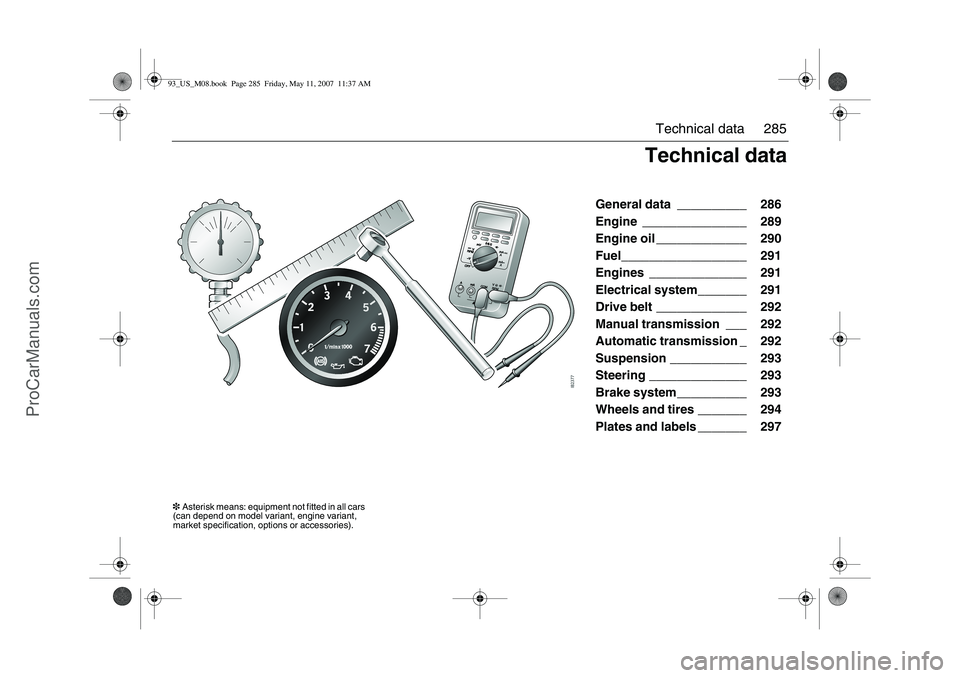
General data __________ 286
Engine _______________ 289
Engine oil _____________ 290
Fuel__________________ 291
Engines ______________ 291
Electrical system_______ 291
Drive belt _____________ 292
Manual transmission ___ 292
Automatic transmission _ 292
Suspension ___________ 293
Steering ______________ 293
Brake system__________ 293
Wheels and tires _______ 294
Plates and labels _______ 297
Technical data
3Asterisk means: equipment not fitted in all cars
(can depend on model variant, engine variant,
market specification, options or accessories).93_US_M08.book Page 285 Friday, May 11, 2007 11:37 AM
ProCarManuals.com
Page 288 of 320
288 Technical data
WARNING
The GVW and maximum axle loads must not be exceeded.
Note that if some accessories (e.g. towbar, CD changer) are
fitted, the available load capacity is reduced by the weight of
these.
When carrying a load in the trunk, make sure that it is lashed
down securely, particularly when part or all of the rear seat is
folded down.
Trailer
Trailer with brakes ___________________ Max. 3500 lbs.
(1588 kg)
Trailer without brakes ________________ Max. 1000 lbs.
(450 kg)
Recommended towball load ___________ 110–165 lbs.
(50–75 kg)
See also page 192.
Maximum theoretical towing speed, trailer
with brakes _______________________ 60 mph (100 km/h)
Maximum theoretical towing speed, trailer
without brakes ____________________National restrictions
apply
When towing a trailer, increase the pressure
of the rear tires by 20 kPa (3 psi).
The above speed and weight restrictions are those specified by
Saab Automobile AB.
Note that national restrictions may apply to trailer speeds and
weights (see page 190).
93_US_M08.book Page 288 Friday, May 11, 2007 11:37 AM
ProCarManuals.com
Page 294 of 320
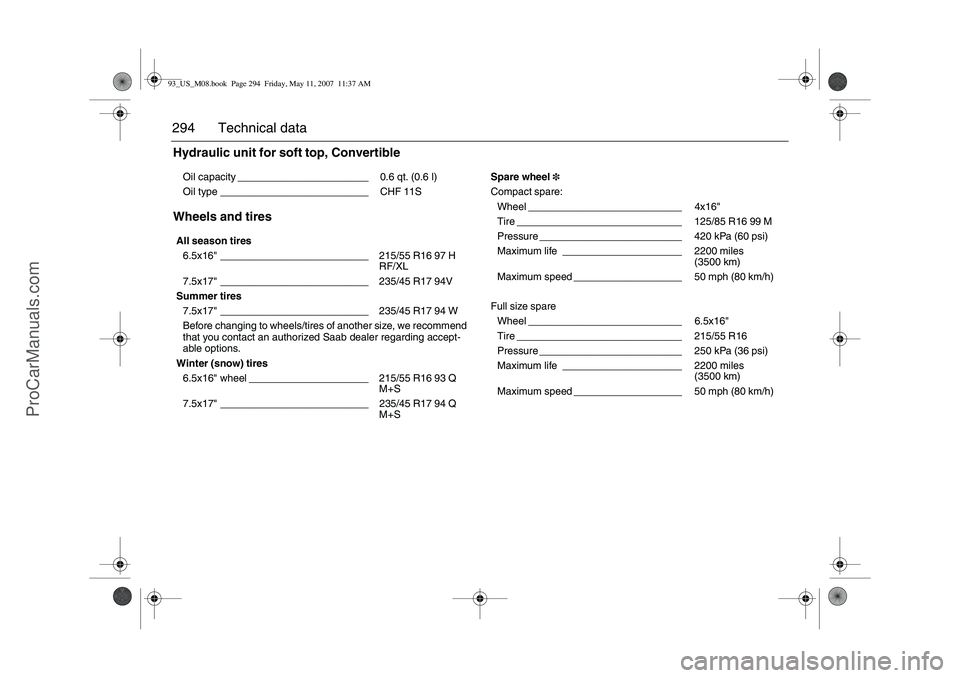
294 Technical dataHydraulic unit for soft top, Convertible
Wheels and tiresOil capacity _______________________ 0.6 qt. (0.6 l)
Oil type __________________________ CHF 11S
All season tires
6.5x16" __________________________ 215/55 R16 97 H
RF/XL
7.5x17" __________________________ 235/45 R17 94V
Summer tires
7.5x17" __________________________ 235/45 R17 94 W
Before changing to wheels/tires of another size, we recommend
that you contact an authorized Saab dealer regarding accept-
able options.
Winter (snow) tires
6.5x16" wheel _____________________ 215/55 R16 93 Q
M+S
7.5x17" __________________________ 235/45 R17 94 Q
M+SSpare wheel
3
Compact spare:
Wheel ___________________________ 4x16"
Tire _____________________________ 125/85 R16 99 M
Pressure _________________________ 420 kPa (60 psi)
Maximum life _____________________ 2200 miles
(3500 km)
Maximum speed ___________________ 50 mph (80 km/h)
Full size spare
Wheel ___________________________ 6.5x16"
Tire _____________________________ 215/55 R16
Pressure _________________________ 250 kPa (36 psi)
Maximum life _____________________ 2200 miles
(3500 km)
Maximum speed ___________________ 50 mph (80 km/h)
93_US_M08.book Page 294 Friday, May 11, 2007 11:37 AM
ProCarManuals.com
Page 295 of 320
295 Technical data
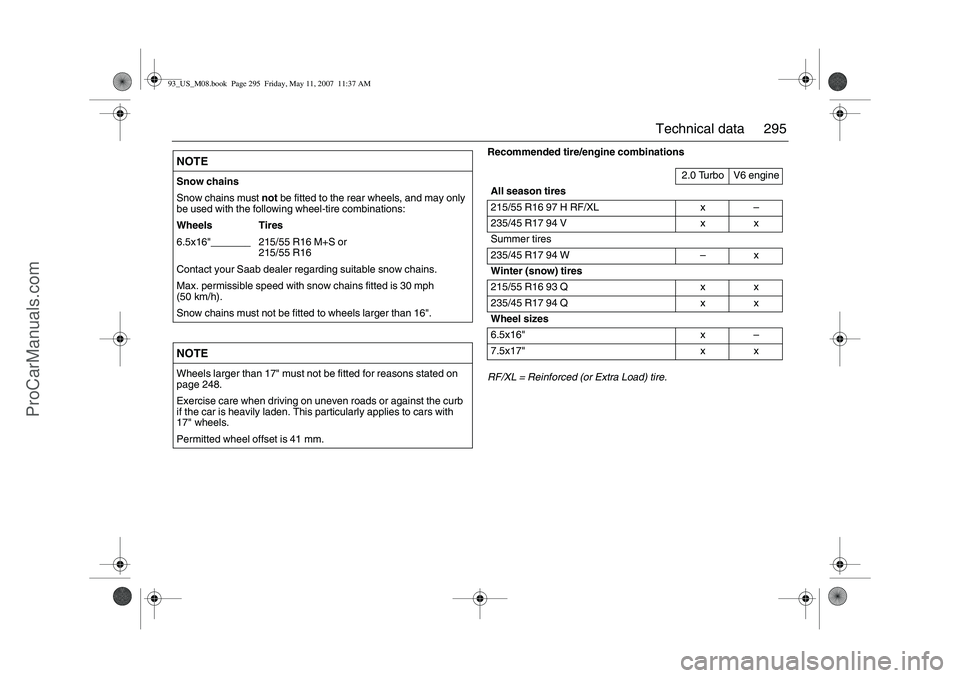
Recommended tire/engine combinations
RF/XL = Reinforced (or Extra Load) tire.
NOTESnow chains
Snow chains must not be fitted to the rear wheels, and may only
be used with the following wheel-tire combinations:
Wheels Tires
6.5x16"_______ 215/55 R16 M+S or
215/55 R16
Contact your Saab dealer regarding suitable snow chains.
Max. permissible speed with snow chains fitted is 30 mph
(50 km/h).
Snow chains must not be fitted to wheels larger than 16".NOTEWheels larger than 17" must not be fitted for reasons stated on
page 248.
Exercise care when driving on uneven roads or against the curb
if the car is heavily laden. This particularly applies to cars with
17" wheels.
Permitted wheel offset is 41 mm.
2.0 Turbo V6 engine
All season tires
215/55 R16 97 H RF/XL x–
235/45 R17 94 V x x
Summer tires
235/45 R17 94 W–x
Winter (snow) tires
215/55 R16 93 Q x x
235/45 R17 94 Q x x
Wheel sizes
6.5x16" x–
7.5x17" x x
93_US_M08.book Page 295 Friday, May 11, 2007 11:37 AM
ProCarManuals.com
Page 296 of 320
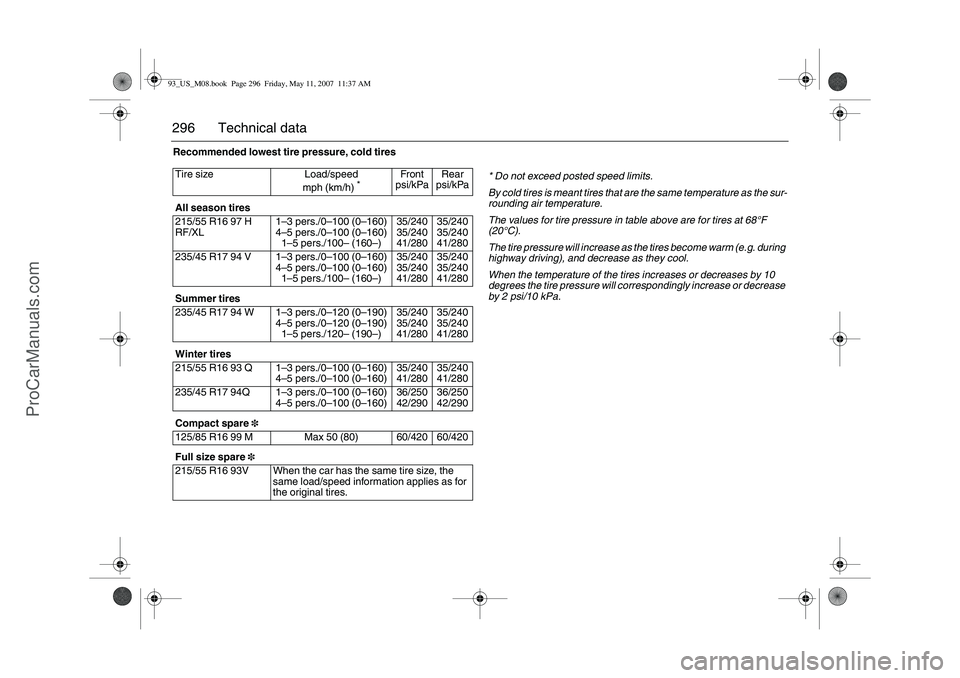
296 Technical dataRecommended lowest tire pressure, cold tires
Tire size Load/speed
mph (km/h)
*
Front
psi/kPaRear
psi/kPa
All season tires
215/55 R16 97 H
RF/XL1–3 pers./0–100 (0–160)
4–5 pers./0–100 (0–160)
1–5 pers./100– (160–)35/240
35/240
41/28035/240
35/240
41/280
235/45 R17 94 V 1–3 pers./0–100 (0–160)
4–5 pers./0–100 (0–160)
1–5 pers./100– (160–)35/240
35/240
41/28035/240
35/240
41/280
Summer tires
235/45 R17 94 W 1–3 pers./0–120 (0–190)
4–5 pers./0–120 (0–190)
1–5 pers./120– (190–)35/240
35/240
41/28035/240
35/240
41/280
Winter tires
215/55 R16 93 Q 1–3 pers./0–100 (0–160)
4–5 pers./0–100 (0–160)35/240
41/28035/240
41/280
235/45 R17 94Q 1–3 pers./0–100 (0–160)
4–5 pers./0–100 (0–160)36/250
42/29036/250
42/290
Compact spare
3
125/85 R16 99 M Max 50 (80) 60/420 60/420
Full size spare
3
215/55 R16 93V When the car has the same tire size, the
same load/speed information applies as for
the original tires.
* Do not exceed posted speed limits.
By cold tires is meant tires that are the same temperature as the sur-
rounding air temperature.
The values for tire pressure in table above are for tires at 68°F
(20°C).
The tire pressure will increase as the tires become warm (e.g. during
highway driving), and decrease as they cool.
When the temperature of the tires increases or decreases by 10
degrees the tire pressure will correspondingly increase or decrease
by 2psi/10kPa.
93_US_M08.book Page 296 Friday, May 11, 2007 11:37 AM
ProCarManuals.com