trunk SAAB 9-3 2008 Owner's Guide
[x] Cancel search | Manufacturer: SAAB, Model Year: 2008, Model line: 9-3, Model: SAAB 9-3 2008Pages: 320, PDF Size: 56.39 MB
Page 161 of 320
161 Starting and driving
Refer to page 187 for information regarding
gasoline anti-freeze.
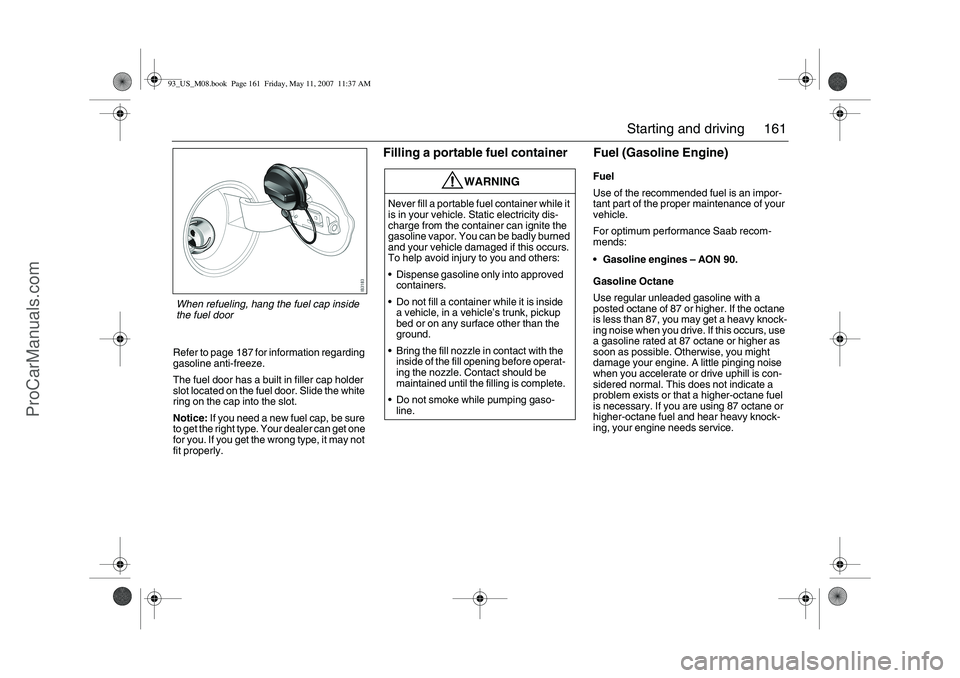
The fuel door has a built in filler cap holder
slot located on the fuel door. Slide the white
ring on the cap into the slot.
Notice: If you need a new fuel cap, be sure
to get the right type. Your dealer can get one
for you. If you get the wrong type, it may not
fit properly.
Filling a portable fuel container Fuel (Gasoline Engine)
Fuel
Use of the recommended fuel is an impor-
tant part of the proper maintenance of your
vehicle.
For optimum performance Saab recom-
mends:
Gasoline engines – AON 90.
Gasoline Octane
Use regular unleaded gasoline with a
posted octane of 87 or higher. If the octane
is less than 87, you may get a heavy knock-
ing noise when you drive. If this occurs, use
a gasoline rated at 87 octane or higher as
soon as possible. Otherwise, you might
damage your engine. A little pinging noise
when you accelerate or drive uphill is con-
sidered normal. This does not indicate a
problem exists or that a higher-octane fuel
is necessary. If you are using 87 octane or
higher-octane fuel and hear heavy knock-
ing, your engine needs service.
WARNING
Never fill a portable fuel container while it
is in your vehicle. Static electricity dis-
charge from the container can ignite the
gasoline vapor. You can be badly burned
and your vehicle damaged if this occurs.
To help avoid injury to you and others:
Dispense gasoline only into approved
containers.
Do not fill a container while it is inside
a vehicle, in a vehicle’s trunk, pickup
bed or on any surface other than the
ground.
Bring the fill nozzle in contact with the
inside of the fill opening before operat-
ing the nozzle. Contact should be
maintained until the filling is complete.
Do not smoke while pumping gaso-
line.
When refueling, hang the fuel cap inside
the fuel door93_US_M08.book Page 161 Friday, May 11, 2007 11:37 AM
ProCarManuals.com
Page 181 of 320
181 Starting and driving
Long-term parkingIf the car is not going to be used for some
time, e.g. three to four months, the following
steps are recommended:
Drain the washer fluid reservoir and
hoses.
Wash and wax the car. Clean the rubber
seals on the hood, trunk lid and doors,
and lubricate them with glycerol
(glycerine).
After washing the car, dry the brake discs
to avoid corrosion by taking the car out on
the road and applying the brakes a few
times.
Fill the fuel tank to prevent condensation
forming in it.
Top up the coolant and check the anti-
freeze before the onset of winter.Park the car in a dry, covered and
well-ventilated building. Leave the park-
ing brake OFF!
Convertible: If the car is stored, the soft
top should be closed.
If necessary, use wheel chocks and leave
the parking brake off.
Disconnect the negative (–) battery lead.
If frost is likely to occur during the storage
period, remove the battery and store it in
a frost-free place.
If it is not possible to stand the car on axle
stands, increase the tire pressure to
43 psi (3 bar).
Leave all the door windows open a crack
and cover the car with a non-plastic
tarpaulin – not one made of plastic which will
not breath.93_US_M08.book Page 181 Friday, May 11, 2007 11:37 AM
ProCarManuals.com
Page 183 of 320
183 Starting and driving
increases as the car comes closer to the
object.
If you stop the car with reverse gear
engaged, the sound pulse will stop after
2 seconds. The sound pulses will return if
you continue to reverse. If the car rolls for-
ward while reverse is engaged, the system
is silenced.
When the distance to the object is less
than 1 ft. (30 cm), a continuous tone will
be heard.
When an object is approximately 3 ft.
(90 cm) from the car, the sound pulses
change character markedly (frequency
increases). A distance of about 3 ft. (90 cm)
is suitable if you wish to load or unload the
trunk.
If the distance between an object and a
corner sensor does not change for
3 seconds, for example if you are reversing
alongside a wall, the system will switch to
monitoring straight back. The system indi-
cates if the distance to the wall decreases
again.
If a trailer is hitched up and correctly con-
nected to the trailer contact by the tow bar,
the system is automatically deactivated.Reversing alongside a wall
If the distance between an object and a
corner sensor does not change for
2 seconds, for example if you are reversing
alongside a wall, the system will switch to
monitoring straight back. The system indi-
cates if the distance to the wall decreases
again.Cars with trailer hitch
If the car has a trailer hitch and its wiring is
correctly connected to the car’s electrical
system, the Saab Parking Assistance auto-
matically compensates for the protrusion of
the tow bar.
If a camper or trailer is hitched up and the
trailer hitch wiring is correctly connected to
the car’s electrics, the system is automati-
cally deactivated.
You can temporarily deactivate the Saab
Parking Assistance as follows:
Engage reverse and press the CLR
button on the SID control panel.
The system will be reactivated the next time
you engage reverse.
NOTEThe sensors must be kept clean to func-
tion well. Ice, snow and dirt can affect
their sensitivity.
Large quantities of snow or dirt covering
the sensors can prevent the parking
assistance system from detecting any
objects.
Do not spray the sensors with a pressure
washer, as this can damage them.
93_US_M08.book Page 183 Friday, May 11, 2007 11:37 AM
ProCarManuals.com
Page 186 of 320
186 Starting and drivingto reach its optimum temperature, and
engine wear is at its greatest during this
period. Drive off as soon as possible after
starting the engine and avoid high engine
speeds.
Drive as smoothly and thoughtfully as
possible. Match your driving to the prevail-
ing traffic conditions.
Driving in a low gear gives rise to higher
fuel consumption than driving in a high
gear because of the higher engine speed
for any given road speed. Always shift up
as soon as traffic conditions allow and
drive in the highest gear as much as
possible.
Check the tire pressure once a month.
Incorrect tire pressure increases tire
wear. It is preferable for the tire pressure
to be slightly high than too low. Under-
pressure increases fuel consumption.Check the fuel consumption regularly.
Increased fuel consumption can indicate
that something is wrong and that the car
needs to be checked. We recommend
that you contact a Saab dealer.
Practical road tests have demonstrated that
substantial savings in fuel consumption can
be made if the above advice is followed.
Road conditionsWet roads increase fuel consumption, as do
unpaved roads and driving in hilly country
(the amount of fuel saved driving downhill is
less than the additional amount required to
climb the hill).
Engine block heater3
33 3The following are just some of the benefits
to the car and the environment of using an
engine block heater:
Lower fuel consumption.
Reduced wear on the engine.
Inside of car warms up faster.
Exhaust emissions substantially reduced
over short runs.
The engine heater is effective at outside
temperatures up to 60–70°F (+15 –
+20°C). The warmer it is outside, the
shorter the time the engine heater needs to
be connected. Longer than 1.5 hours is
unnecessary.
If the car is equipped with a removable,
electric cabin heater that is not in use, store
this in the trunk.
WARNING
Never switch off the engine while driving
as the effect of the brakes and power
steering will be greatly reduced.
93_US_M08.book Page 186 Friday, May 11, 2007 11:37 AM
ProCarManuals.com
Page 192 of 320
192 Starting and drivingWhen continuing your journey, manually
select a low gear in which the engine speed
is about 3,500 rpm until the incline eases
(see page 170).
Recommendations for cars with
manual transmissionRises in coolant temperature are indicated
by the temperature gauge in the main instru-
ment panel.
When the needle is just outside the red
zone, the A/C compressor will be switched
off and, on certain engine variants, the max-
imum engine torque will be limited.
When continuing your journey, select a low
gear in which the engine speed is about
3,500 rpm until the incline eases.
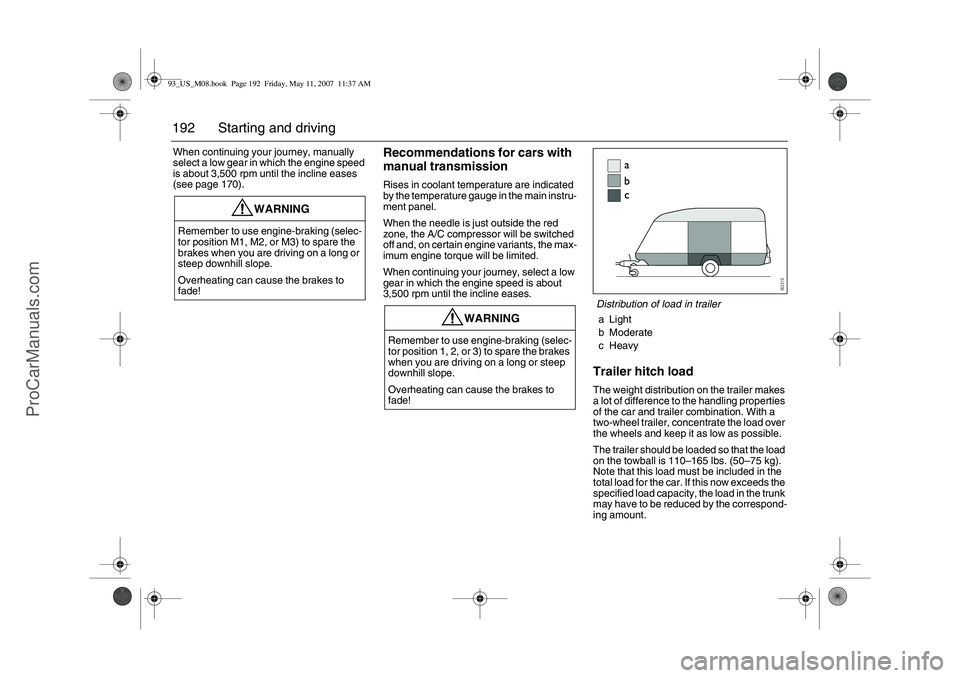
Trailer hitch loadThe weight distribution on the trailer makes
a lot of difference to the handling properties
of the car and trailer combination. With a
two-wheel trailer, concentrate the load over
the wheels and keep it as low as possible.
The trailer should be loaded so that the load
on the towball is 110–165 lbs. (50–75 kg).
Note that this load must be included in the
total load for the car. If this now exceeds the
specified load capacity, the load in the trunk
may have to be reduced by the correspond-
ing amount.
WARNING
Remember to use engine-braking (selec-
tor position M1, M2, or M3) to spare the
brakes when you are driving on a long or
steep downhill slope.
Overheating can cause the brakes to
fade!
WARNING
Remember to use engine-braking (selec-
tor position 1, 2, or 3) to spare the brakes
when you are driving on a long or steep
downhill slope.
Overheating can cause the brakes to
fade!
Distribution of load in trailer
aLight
b Moderate
c Heavy
93_US_M08.book Page 192 Friday, May 11, 2007 11:37 AM
ProCarManuals.com
Page 196 of 320
196 Starting and drivingDriving with a loadThe handling characteristics are affected by
how the car is loaded.
Driving with the trunk lid
openIf you must drive with the trunk lid open,
close all windows and the moonroof (if
equipped) and set the cabin fan to its high-
est speed setting.
Driving in deep water
NOTEPlace the heaviest load as far forward
and as low as possible in the trunk.
Secure the load to the lashing eyes
(see page 141).
Heavy loads mean that the car’s
center of gravity is further back. As a
result, the car will sway more during
evasive steering.
Never exceed the permissible load of
the roof box, even if there is room for
more.
Ensure that the tire pressure is correct
– slight overinflation is preferable to
underinflation.
The braking distance of a loaded car is
always greater. Keep your distance
from the vehicle in front.
Do not exceed the car’s permissible
gross vehicle weight or axle load (see
page 286).
Roof loads can negatively affect tele-
communication.
For further information on tires see
page 244.
WARNING
Avoid driving with the trunk lid partly or
fully open, since exhaust fumes can be
drawn into the cabin.
NOTEDo not drive in puddles or water deeper
than 7 in. (20 cm) and do not drive faster
than 3–4 mph. Water can otherwise be
sucked into the engine. The engine will be
seriously damaged if water enters the
intake system.
93_US_M08.book Page 196 Friday, May 11, 2007 11:37 AM
ProCarManuals.com
Page 230 of 320
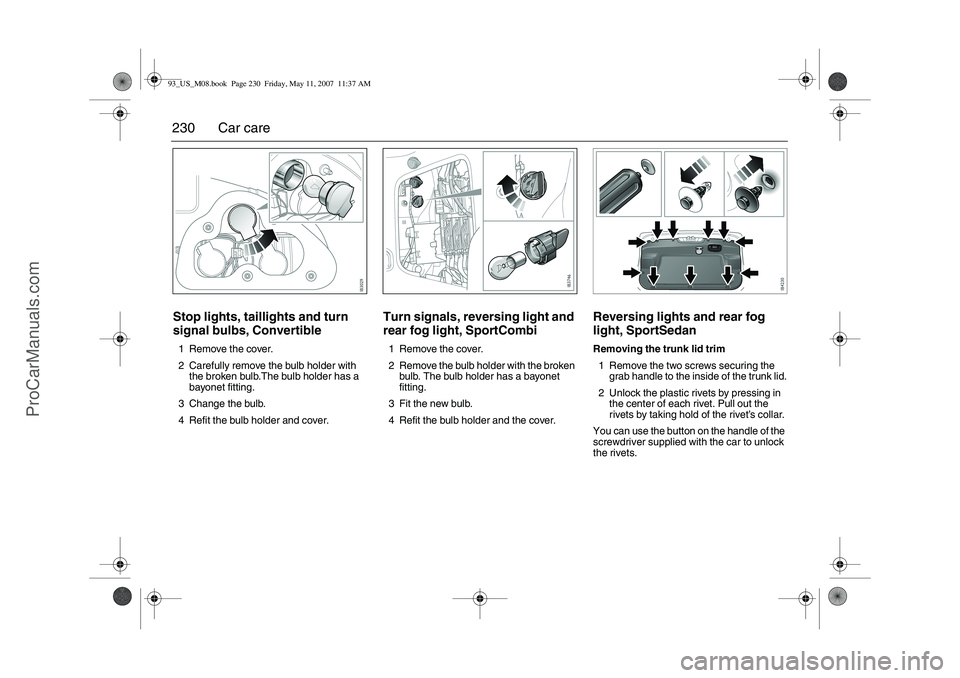
230 Car careStop lights, taillights and turn
signal bulbs, Convertible1 Remove the cover.
2 Carefully remove the bulb holder with
the broken bulb.The bulb holder has a
bayonet fitting.
3 Change the bulb.
4 Refit the bulb holder and cover.
Turn signals, reversing light and
rear fog light, SportCombi1 Remove the cover.
2 Remove the bulb holder with the broken
bulb. The bulb holder has a bayonet
fitting.
3 Fit the new bulb.
4 Refit the bulb holder and the cover.
Reversing lights and rear fog
light, SportSedanRemoving the trunk lid trim
1 Remove the two screws securing the
grab handle to the inside of the trunk lid.
2 Unlock the plastic rivets by pressing in
the center of each rivet. Pull out the
rivets by taking hold of the rivet’s collar.
You can use the button on the handle of the
screwdriver supplied with the car to unlock
the rivets.
93_US_M08.book Page 230 Friday, May 11, 2007 11:37 AM
ProCarManuals.com
Page 231 of 320

231 Car care
Changing bulbs
1 Press down the plastic lug on the bulb
holder.
2 Carefully remove the entire bulb holder
unit from the lamp housing. Change the
bulb.
3 Refit the bulb holder. Press the lug so
that it snaps into place.
To refit the trunk lid trim
1 Withdraw the center of the rivets.
2 Fit the trim in place on the trunk lid.
3 Fit the rivets. Lock the rivets in place by
pressing the center buttons in until flush
with the collar.
Reversing lights and rear fog
lights, ConvertibleRemoving the trunk lid trim
1 Unlock the plastic rivets by pressing in
the center of each rivet no more than
3 mm. Pull out the rivets by taking hold
of the rivet’s collar.
You can use the button on the handle of the
screwdriver supplied with the car to unlock
the rivets.Changing bulbs
1 Carefully remove the bulb holder with
the broken bulb. The bulb holder has a
bayonet fitting.
2 Fit the new bulb.
3 Refit the bulb holder.
To refit the trunk lid trim
1 Withdraw the center of the rivets.
2 Fit the trim in place on the trunk lid.
3 Fit the rivets. Lock the rivets in place by
pressing the center buttons in until flush
with the collar.
93_US_M08.book Page 231 Friday, May 11, 2007 11:37 AM
ProCarManuals.com
Page 234 of 320

234 Car careTrunk lighting, SportSedanThe lamp fitting is located under the parcel
shelf.
1 Remove the lamp fitting by pulling down
one end.
2 The baffle must be removed before the
bulb can be replaced. Point the baffle’s
tab up with a small screwdriver.
3 Fit the new bulb.
4 Refit the baffle by first fitting its tab in its
bracket between the contact plates.
Hold it in place and move the other side
down.
5 Insert the connector side first when refit-
ting the lamp.
Trunk lighting, Convertible1 Remove the lamp in the rear end first.
2 Change the bulb.
3 Insert the connector side first when refit-
ting the lamp.
93_US_M08.book Page 234 Friday, May 11, 2007 11:37 AM
ProCarManuals.com
Page 235 of 320

235 Car care
Trunk lighting, SportCombi1 Pull the lamp housing forward slightly
and lift it out at the rear. Use a thin and
wide tool.
2 Fit the new bulb. The bulb is secured in
the holder.
3 Start by inserting in the front edge of the
lamp housing and then pressing in the
rear edge.
Courtesy/floor lighting3
33 31 Release one edge of the lamp fitting
using a screwdriver.
2 Fit the new bulb.
3 Insert the connector side first when refit-
ting the lamp.
Other bulbsIf any other bulbs need changing, we rec-
ommend that you visit a Saab dealer.
93_US_M08.book Page 235 Friday, May 11, 2007 11:37 AM
ProCarManuals.com