brake pads SAAB 9-3 2008 Owners Manual
[x] Cancel search | Manufacturer: SAAB, Model Year: 2008, Model line: 9-3, Model: SAAB 9-3 2008Pages: 320, PDF Size: 56.39 MB
Page 6 of 320
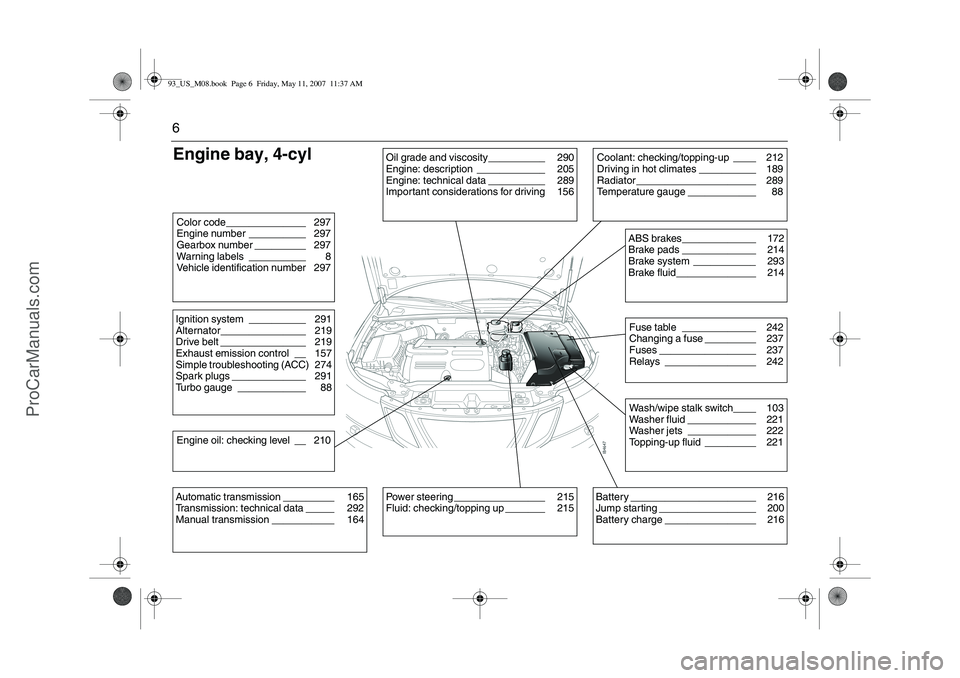
6Engine bay, 4-cylColor code______________ 297
Engine number __________ 297
Gearbox number _________ 297
Warning labels __________ 8
Vehicle identification number 297Ignition system __________ 291
Alternator_______________ 219
Drive belt _______________ 219
Exhaust emission control __ 157
Simple troubleshooting (ACC) 274
Spark plugs _____________ 291
Turbo gauge ____________ 88Engine oil: checking level __ 210Automatic transmission _________ 165
Transmission: technical data _____ 292
Manual transmission ___________ 164
Battery ______________________ 216
Jump starting _________________ 200
Battery charge ________________ 216
Oil grade and viscosity__________ 290
Engine: description ____________ 205
Engine: technical data __________ 289
Important considerations for driving 156
Wash/wipe stalk switch____ 103
Washer fluid ____________ 221
Washer jets ____________ 222
Topping-up fluid _________ 221
Power steering ________________ 215
Fluid: checking/topping up _______ 215
Coolant: checking/topping-up ____ 212
Driving in hot climates __________ 189
Radiator _____________________ 289
Temperature gauge ____________ 88
Fuse table _____________ 242
Changing a fuse _________ 237
Fuses _________________ 237
Relays ________________ 242ABS brakes_____________ 172
Brake pads _____________ 214
Brake system ___________ 293
Brake fluid______________ 214
93_US_M08.book Page 6 Friday, May 11, 2007 11:37 AM
ProCarManuals.com
Page 7 of 320
7
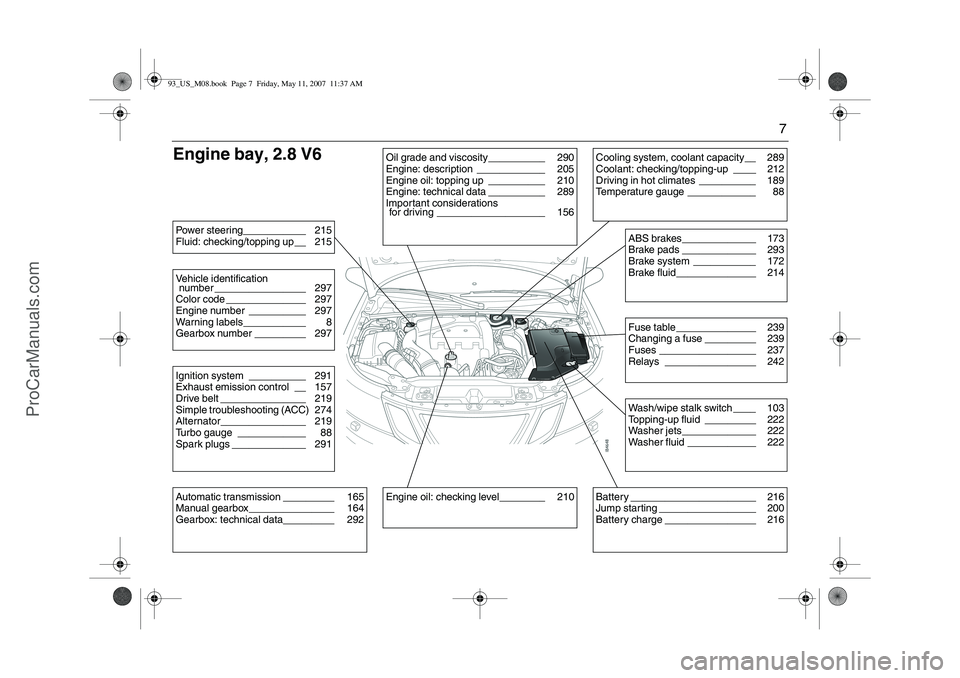
Engine bay, 2.8 V6Power steering___________ 215
Fluid: checking/topping up__ 215Vehicle identification
number ________________ 297
Color code ______________ 297
Engine number __________ 297
Warning labels___________ 8
Gearbox number _________ 297Ignition system __________ 291
Exhaust emission control __ 157
Drive belt _______________ 219
Simple troubleshooting (ACC) 274
Alternator_______________ 219
Turbo gauge ____________ 88
Spark plugs _____________ 291Automatic transmission _________ 165
Manual gearbox_______________ 164
Gearbox: technical data_________ 292
Oil grade and viscosity__________ 290
Engine: description ____________ 205
Engine oil: topping up __________ 210
Engine: technical data __________ 289
Important considerations
for driving ___________________ 156Engine oil: checking level________ 210
Battery ______________________ 216
Jump starting _________________ 200
Battery charge ________________ 216
Wash/wipe stalk switch ____ 103
Topping-up fluid _________ 222
Washer jets_____________ 222
Washer fluid ____________ 222Fuse table ______________ 239
Changing a fuse _________ 239
Fuses _________________ 237
Relays ________________ 242ABS brakes_____________ 173
Brake pads _____________ 293
Brake system ___________ 172
Brake fluid______________ 214
Cooling system, coolant capacity__ 289
Coolant: checking/topping-up ____ 212
Driving in hot climates __________ 189
Temperature gauge ____________ 88
93_US_M08.book Page 7 Friday, May 11, 2007 11:37 AM
ProCarManuals.com
Page 163 of 320
163 Starting and driving
gasoline whether the fuel contains MMT.
Saab does not recommend the use of such
gasolines.
Fuels containing MMT can reduce the life of
spark plugs and the performance of the
emission control system may be affected.
The malfunction indicator lamp may turn on.
If this occurs, return to your authorized Saab
dealer for service.
Fuels in Foreign Countries
If you plan on driving in another country out-
side the United States or Canada, the
proper fuel may be hard to find. Never use
leaded gasoline or any other fuel not recom-
mended in the previous text on fuel. Costly
repairs caused by use of improper fuel
would not be covered by your warranty.
To check the fuel availability, ask an auto
club, or contact a major oil company that
does business in the country where you will
be driving.
Engine Break-in PeriodPistons, cylinder bores and bearings need
time to obtain uniform, wear-resistant
surfaces.
If a new engine is driven too hard, this grad-
ual process of bedding-in will not be possi-
ble and the life of the engine will be short-
ened.
During the first 1,200 miles (2,000 km),
do not exceed 5,000 rpm.
In addition, refrain from driving the car at full
throttle, other than for brief instances,
during the first 1,800 miles (3,000 km).
Wearing in new brake padsNew brake pads take time to bed in, about
90 miles (150 km) if the car is driven largely
under stop-and-go conditions or about
300 miles (500 km) of highway driving.
To extend the useful life of the pads, avoid
hard braking as much as possible.
93_US_M08.book Page 163 Friday, May 11, 2007 11:37 AM
ProCarManuals.com
Page 173 of 320
173 Starting and driving
ABS brakesThe Antilock Braking System (ABS) modu-
lates the brake pressure to each wheel. The
pressure is automatically reduced just
before the wheel locks up and then
increases again to the point at which the
wheel is just about to lock. The wheel sen-
sors send information to the brake system’s
electronic control module for every 4 or so
inches (decimetre) that the car rolls. This
information is processed continuously to
ensure that the adjustment of the brake
pressure will be as exact as possible.
Adjustment takes place up to 12 times per
second.The brake system provides Electronic
Brakeforce Distribution (EBD). This distri-
butes the brake pressure between the front
and rear wheels, in such a way as to achieve
optimum braking performance irrespective
of the car’s speed or load.
The ABS has a built-in diagnostics function
which will switch on the ABS warning light
if a fault is detected in the system (see
page 82).
The following message will appear on the
SID (and corresponding symbol on main
instrument unit) if a fault is detected:
WARNING
It is prudent to try your brakes from
time to time, especially when driving in
heavy rain, through water collected on
the road, in snow, on a wet road sur-
face or in salty slush. In such condi-
tions, the brakes may take longer than
normal to take effect. To rectify this,
touch the brake pedal periodically to
dry the brakes out.
The same applies after the car has
been washed or when the weather is
very humid.
Avoid parking the car with wet brakes.
Before parking, and if the traffic condi-
tions allow, brake quite heavily so that
the brake discs and pads warm up and
dry.
The brakes are power assisted and it
should be kept in mind that the servo
unit only provides the power assis-
tance when the engine is running.
The brake pressure required when the
engine is off, (e.g. when the car is
being towed) is roughly four times the
normal pedal force required. The
pedal also feels hard and unrespon-
sive.
Overheating can cause the brakes to
fade!
WARNING
The additional safety afforded by the
ABS system is not designed to allow
drivers to drive faster but to make
normal driving safer.
To stop as quickly as possible, without
loss of directional stability, whether
the road surface is dry, wet or slippery,
press the brake pedal down hard
without letting up (do not pump the
pedal), declutching simulta-
neously, and steer the car to safety.
Antilock brake malfunc.
Contact service.
93_US_M08.book Page 173 Friday, May 11, 2007 11:37 AM
ProCarManuals.com
Page 203 of 320
203 Car care
Hood ________________ 204
Engine ______________ 205
Engine bay, 4-cyl engine 208
Engine bay, V6 engine _ 209
Engine oil ____________ 210
Air filter______________ 211
Transmission fluid ____ 212
Coolant ______________ 212
Brake/clutch fluid and
brake pads__________ 214
Power steering________ 215
Battery ______________ 216
Drive belt ____________ 219
Wipers and washers ___ 220
Wiper blades _________ 220
Changing bulbs _______ 222
Fuses _______________ 237 Tires _________________ 244
Automatic tire pressure
monitoring system ____ 257
Compact spare ________ 260
Changing a tire ________ 262
Safety belts ___________ 266
Upholstery and trim ____ 266
Textile carpeting _______ 267
Engine bay ____________ 267
Washing ______________ 267
Waxing and polishing ___ 270
Touching up the paint___ 270
Anti-corrosion treatment 271
Recovery and/or
recycling of automotive
materials ____________ 273
Air conditioning (A/C) ___ 274
Car care
3Asterisk means: equipment not fitted in all cars
(can depend on model variant, engine variant,
market specification, options or accessories).93_US_M08.book Page 203 Friday, May 11, 2007 11:37 AM
ProCarManuals.com
Page 214 of 320
214 Car careBrake/clutch fluid and
brake padsCheckingBrake fluid should be changed according to
the service program. Refer to the Warranty
and Service Book.
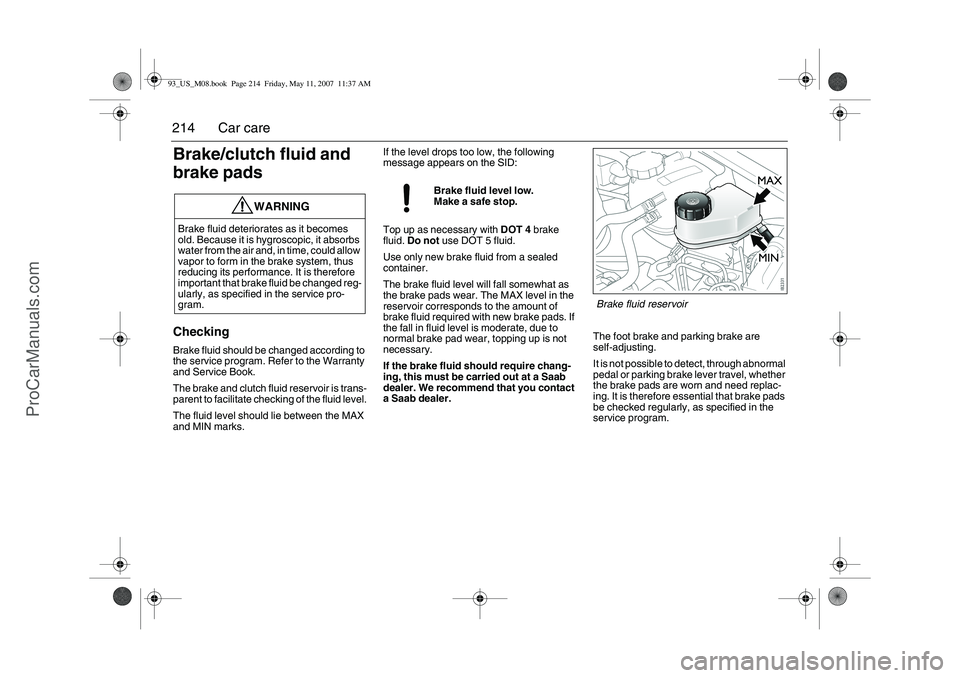
The brake and clutch fluid reservoir is trans-
parent to facilitate checking of the fluid level.
The fluid level should lie between the MAX
and MIN marks.If the level drops too low, the following
message appears on the SID:
Top up as necessary with DOT 4 brake
fluid. Do not use DOT 5 fluid.
Use only new brake fluid from a sealed
container.
The brake fluid level will fall somewhat as
the brake pads wear. The MAX level in the
reservoir corresponds to the amount of
brake fluid required with new brake pads. If
the fall in fluid level is moderate, due to
normal brake pad wear, topping up is not
necessary.
If the brake fluid should require chang-
ing, this must be carried out at a Saab
dealer. We recommend that you contact
a Saab dealer.The foot brake and parking brake are
self-adjusting.
It is not possible to detect, through abnormal
pedal or parking brake lever travel, whether
the brake pads are worn and need replac-
ing. It is therefore essential that brake pads
be checked regularly, as specified in the
service program.
WARNING
Brake fluid deteriorates as it becomes
old. Because it is hygroscopic, it absorbs
water from the air and, in time, could allow
vapor to form in the brake system, thus
reducing its performance. It is therefore
important that brake fluid be changed reg-
ularly, as specified in the service pro-
gram.
Brake fluid level low.
Make a safe stop.
Brake fluid reservoir
93_US_M08.book Page 214 Friday, May 11, 2007 11:37 AM
ProCarManuals.com
Page 215 of 320
215 Car care
Brake pads should only be changed at a
workshop. We recommend that you con-
tact a Saab dealer.
Power steeringCheck the level of the power steering fluid in
the reservoir regularly, in accordance with
the service program.
The wheels should point directly forwards
during this check.
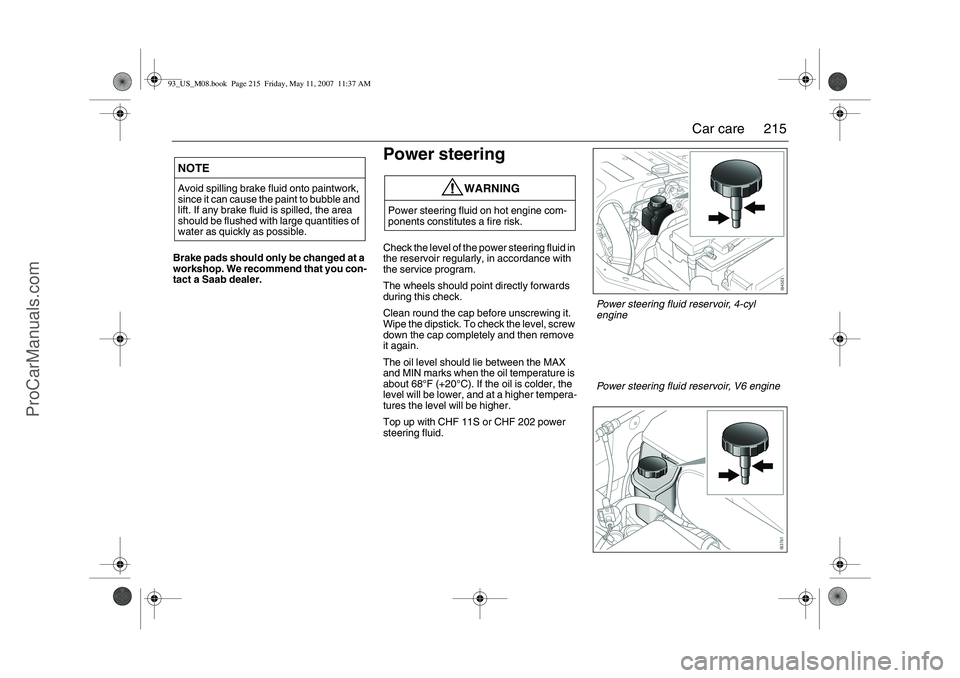
Clean round the cap before unscrewing it.
Wipe the dipstick. To check the level, screw
down the cap completely and then remove
it again.
The oil level should lie between the MAX
and MIN marks when the oil temperature is
about 68°F (+20°C). If the oil is colder, the
level will be lower, and at a higher tempera-
tures the level will be higher.
Top up with CHF 11S or CHF 202 power
steering fluid.
NOTEAvoid spilling brake fluid onto paintwork,
since it can cause the paint to bubble and
lift. If any brake fluid is spilled, the area
should be flushed with large quantities of
water as quickly as possible.
WARNING
Power steering fluid on hot engine com-
ponents constitutes a fire risk.
Power steering fluid reservoir, 4-cyl
enginePower steering fluid reservoir, V6 engine
93_US_M08.book Page 215 Friday, May 11, 2007 11:37 AM
ProCarManuals.com
Page 281 of 320
281 Customer Assistance and Information
Engine oil and filter changesChanging the engine oil and filter is required
at every service point. Use only a Saab
approved long-life oil filter and engine oils
meeting the SAE viscosity ratings and API
service classifications stated in the “Techni-
cal data” section of this Owner’s Manual.
The use of extra additives in the oil is not
necessary and is not recommended, and
may be harmful to turbochargers.
More frequent oil changes are recom-
mended if your vehicle is operated under
any of the following conditions:
Most trips are less than 5–10 miles (8–
16 km). This is particularly important
when outside temperatures are below
freezing.
Most trips include extensive idling
(frequent stop-and-go traffic).
Most trips are through dusty areas (such
as construction zones).
If the vehicle is used for delivery service,
police, taxi or other commercial applica-
tions.
If your driving habits match this description,
have the engine oil and filter changed in-
between normal services. These conditions
cause the engine oil to break down faster.
The Warranties and Service Record Book-
let has provisions to record extra oil
changes.
Service record retentionIt is the owner’s responsibility to retain ser-
vice records. If possible, you should keep
copies of all shop work orders for all service
and repairs, whenever performed. As indi-
cated in the new car and emission control
system warranties, it is important to docu-
ment that all necessary maintenance has
been done.
HOW THE SERVICE RECORD IS ORGA-
NIZED
The service record is comprised of a series
of coupons on which to record services as
they are performed. There are additional
coupons for documenting extra engine oil
and filter changes, extra automatic trans-
mission fluid services necessary for severe
service conditions, and brake fluid changes.
HOW TO USE THE SERVICE RECORD
COUPONS
When the car is brought to a Saab dealer for
scheduled maintenance, present the War-
ranties & Service Record Booklet to the ser-
vice manager. When the technician has
completed the service, the technician will
sign the maintenance record. The person
responsible for quality assurance at the
dealership will also sign and stamp the
record with the dealer identification stamp.
Service costsDealer pricing practices and labor for ser-
vice work vary. Saab’s recommended ser-
vice times for each service point do not
include the labor required to replace wear
items, such as wiper blades, brake pads or
tires. Nor is labor to perform other service or
repairs found to be necessary as a result of
the inspections included in these times.
Additional labor and parts will be charged
for such work when necessary, except as
covered under an applicable Saab warranty
or any optional extended service contract.
Transmission fluid changes or suspension
alignment, when necessary, are also addi-
tional.
Dealer charges for general shop material,
regulated hazardous waste removal, recy-
cling expenses or other operation costs may
also be applied to service and repair
invoices and are apt to vary by dealer and
location.
93_US_M08.book Page 281 Friday, May 11, 2007 11:37 AM
ProCarManuals.com
Page 293 of 320
293 Technical data
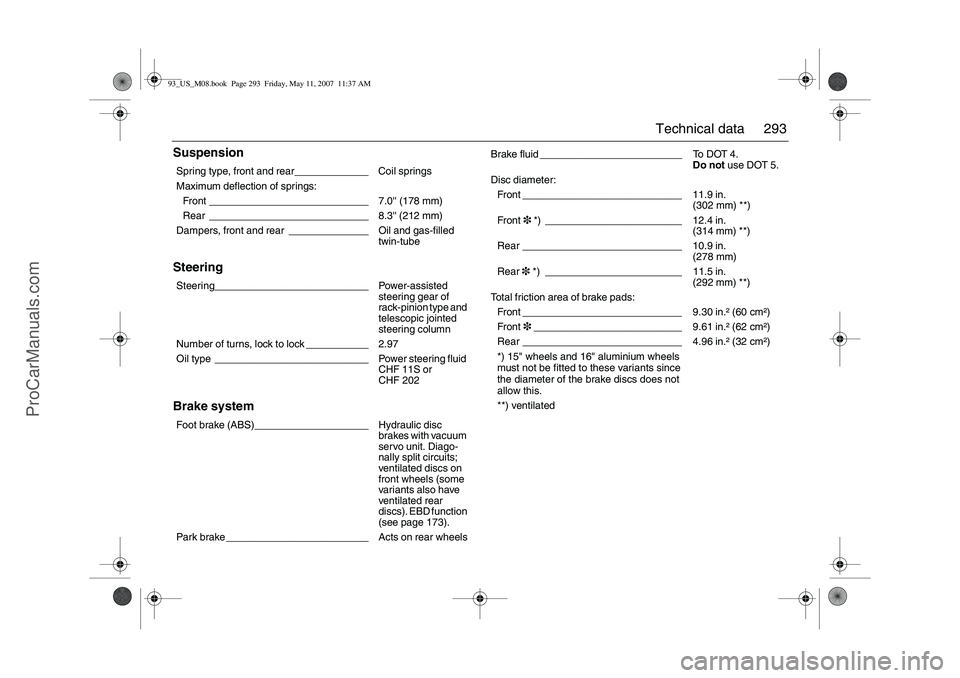
Suspension
Steering
Brake systemSpring type, front and rear_____________ Coil springs
Maximum deflection of springs:
Front ____________________________ 7.0'' (178 mm)
Rear ____________________________ 8.3'' (212 mm)
Dampers, front and rear ______________ Oil and gas-filled
twin-tube
Steering___________________________ Power-assisted
steering gear of
rack-pinion type and
telescopic jointed
steering column
Number of turns, lock to lock ___________ 2.97
Oil type ___________________________ Power steering fluid
CHF 11S or
CHF 202
Foot brake (ABS)____________________ Hydraulic disc
brakes with vacuum
servo unit. Diago-
nally split circuits;
ventilated discs on
front wheels (some
variants also have
ventilated rear
discs). EBD function
(see page 173).
Park brake _________________________ Acts on rear wheelsBrake fluid _________________________ To DOT 4.
Do not use DOT 5.
Disc diameter:
Front ____________________________ 11.9 in.
(302 mm) **)
Front3 *) ________________________ 12.4 in.
(314 mm) **)
Rear ____________________________ 10.9 in.
(278 mm)
Rear3 *) ________________________ 11.5 in.
(292 mm) **)
Total friction area of brake pads:
Front ____________________________ 9.30 in.² (60 cm²)
Front3__________________________ 9.61 in.² (62 cm²)
Rear ____________________________ 4.96 in.² (32 cm²)
*) 15" wheels and 16" aluminium wheels
must not be fitted to these variants since
the diameter of the brake discs does not
allow this.
**) ventilated93_US_M08.book Page 293 Friday, May 11, 2007 11:37 AM
ProCarManuals.com
Page 303 of 320
303 Index
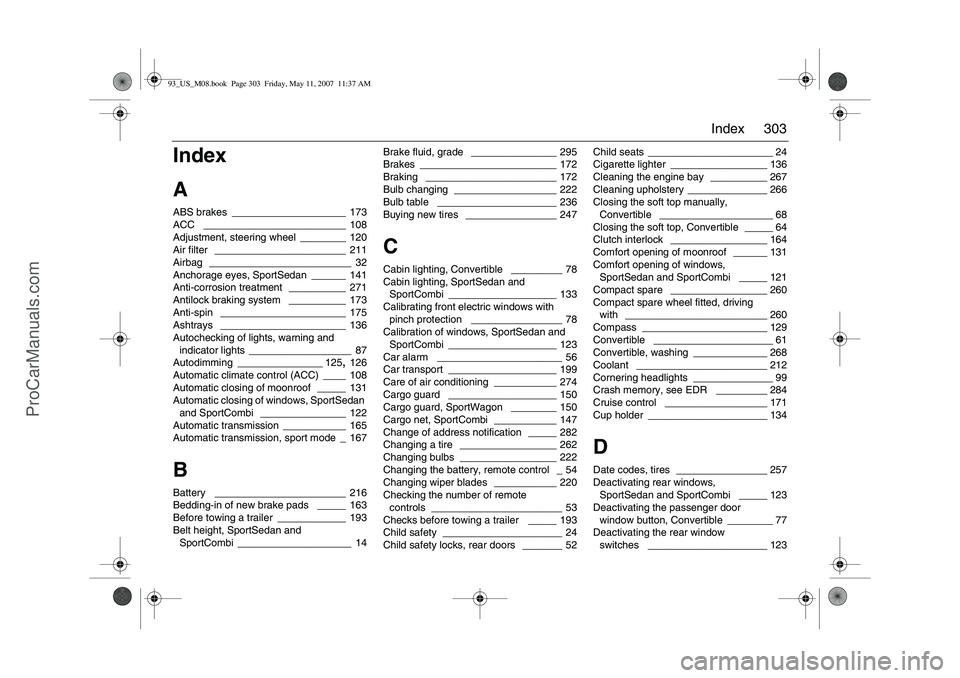
Index
AABS brakes
____________________ 173
ACC
_________________________ 108
Adjustment, steering wheel
________ 120
Air filter
_______________________ 211
Airbag
_________________________ 32
Anchorage eyes, SportSedan
______ 141
Anti-corrosion treatment
__________ 271
Antilock braking system __________ 173
Anti-spin
______________________ 175
Ashtrays ______________________ 136
Autochecking of lights, warning and
indicator lights
__________________ 87
Autodimming
_______________ 125
, 126
Automatic climate control (ACC)
____ 108
Automatic closing of moonroof
_____ 131
Automatic closing of windows, SportSedan
and SportCombi
_______________ 122
Automatic transmission
___________ 165
Automatic transmission, sport mode
_167
BBattery
_______________________ 216
Bedding-in of new brake pads
_____ 163
Before towing a trailer
____________ 193
Belt height, SportSedan and
SportCombi
____________________ 14Brake fluid, grade
_______________ 295
Brakes
________________________ 172
Braking _______________________ 172
Bulb changing
__________________ 222
Bulb table
_____________________ 236
Buying new tires
________________ 247
CCabin lighting, Convertible
_________ 78
Cabin lighting, SportSedan and
SportCombi
___________________ 133
Calibrating front electric windows with
pinch protection
________________ 78
Calibration of windows, SportSedan and
SportCombi
___________________ 123
Car alarm
______________________ 56
Car transport ___________________ 199
Care of air conditioning
___________ 274
Cargo guard
___________________ 150
Cargo guard, SportWagon
________ 150
Cargo net, SportCombi
___________ 147
Change of address notification
_____ 282
Changing a tire
_________________ 262
Changing bulbs _________________ 222
Changing the battery, remote control
_54
Changing wiper blades
___________ 220
Checking the number of remote
controls
_______________________ 53
Checks before towing a trailer
_____ 193
Child safety
_____________________ 24
Child safety locks, rear doors
_______ 52Child seats
______________________ 24
Cigarette lighter
_________________ 136
Cleaning the engine bay
__________ 267
Cleaning upholstery
______________ 266
Closing the soft top manually,
Convertible
____________________ 68
Closing the soft top, Convertible
_____ 64
Clutch interlock
_________________ 164
Comfort opening of moonroof
______ 131
Comfort opening of windows,
SportSedan and SportCombi _____ 121
Compact spare
_________________ 260
Compact spare wheel fitted, driving
with
_________________________ 260
Compass
______________________ 129
Convertible _____________________ 61
Convertible, washing
_____________ 268
Coolant
_______________________ 212
Cornering headlights
______________ 99
Crash memory, see EDR
_________ 284
Cruise control
__________________ 171
Cup holder
_____________________ 134
DDate codes, tires
________________ 257
Deactivating rear windows,
SportSedan and SportCombi
_____ 123
Deactivating the passenger door
window button, Convertible
________ 77
Deactivating the rear window
switches
_____________________ 123
93_US_M08.book Page 303 Friday, May 11, 2007 11:37 AM
ProCarManuals.com