change wheel SAAB 9-3 2008 Owners Manual
[x] Cancel search | Manufacturer: SAAB, Model Year: 2008, Model line: 9-3, Model: SAAB 9-3 2008Pages: 320, PDF Size: 56.39 MB
Page 101 of 320
101 Instruments and controls
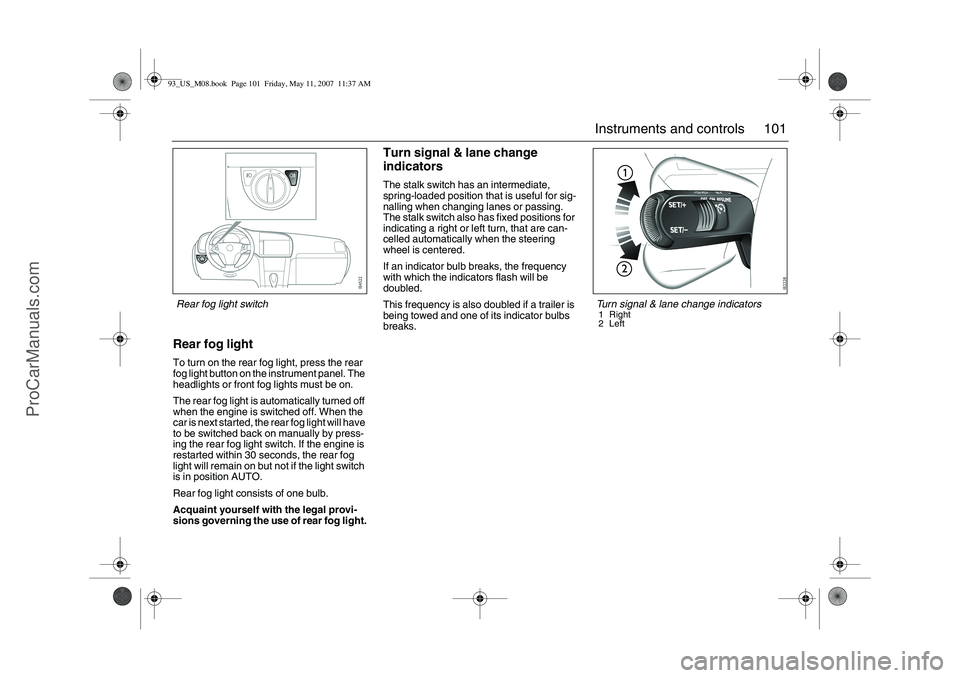
Rear fog lightTo turn on the rear fog light, press the rear
fog light button on the instrument panel. The
headlights or front fog lights must be on.
The rear fog light is automatically turned off
when the engine is switched off. When the
car is next started, the rear fog light will have
to be switched back on manually by press-
ing the rear fog light switch. If the engine is
restarted within 30 seconds, the rear fog
light will remain on but not if the light switch
is in position AUTO.
Rear fog light consists of one bulb.
Acquaint yourself with the legal provi-
sions governing the use of rear fog light.
Turn signal & lane change
indicatorsThe stalk switch has an intermediate,
spring-loaded position that is useful for sig-
nalling when changing lanes or passing.
The stalk switch also has fixed positions for
indicating a right or left turn, that are can-
celled automatically when the steering
wheel is centered.
If an indicator bulb breaks, the frequency
with which the indicators flash will be
doubled.
This frequency is also doubled if a trailer is
being towed and one of its indicator bulbs
breaks.
Turn signal & lane change indicators1 Right
2Left
Rear fog light switch93_US_M08.book Page 101 Friday, May 11, 2007 11:37 AM
ProCarManuals.com
Page 115 of 320
115 Instruments and controls
ACC- ConvertibleWhen the soft top is folded, several func-
tions in the ACC-system is effected.
The system adjusts itself as follows:
the sensitivity of the temperature knob
changes
air distribution and fan speed can only be
adjusted manually
Recirculation and rear window heating
are cut out.
The A/C compressor is switched off
(manual activation is possible by pressing
the AC OFF button).
All manual selections are possible with the
exception of rear window heating and
defroster function.
When the soft top is raised, the system
reverts to the AUTO mode and the set tem-
perature.
Note: When the soft top or all the windows
are open in a hot, humid climate, turning the
air conditioning on manually can cause con-
densation to form on cold surfaces, such as
the air ducts.
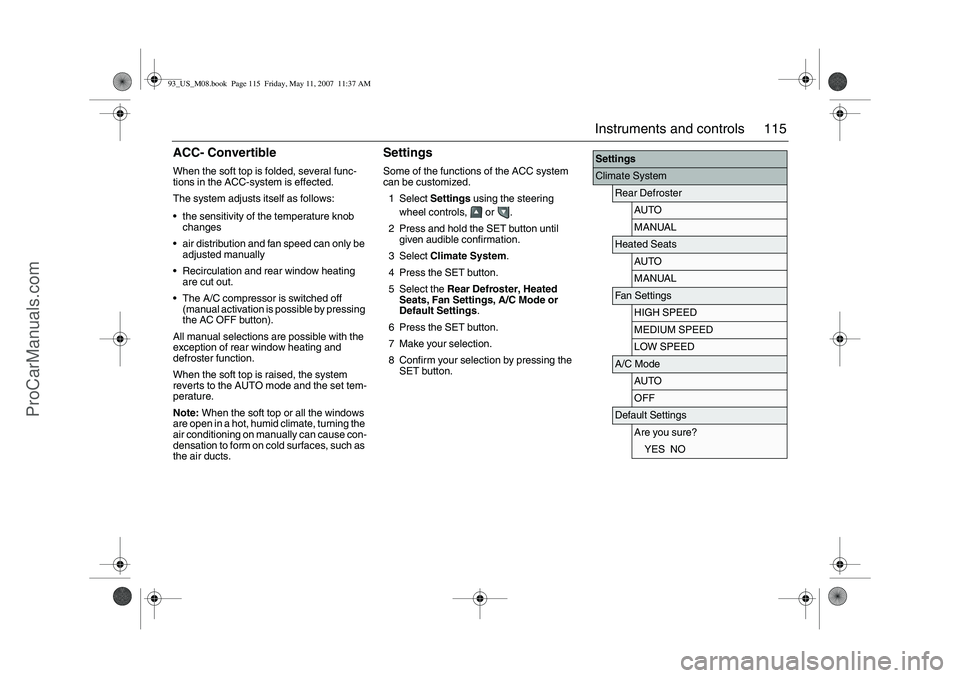
SettingsSome of the functions of the ACC system
can be customized.
1Select Settings using the steering
wheel controls, or .
2 Press and hold the SET button until
given audible confirmation.
3Select Climate System.
4 Press the SET button.
5 Select the Rear Defroster, Heated
Seats, Fan Settings, A/C Mode or
Default Settings.
6 Press the SET button.
7 Make your selection.
8 Confirm your selection by pressing the
SET button.
SettingsClimate System
Rear Defroster
AUTOMANUAL
Heated Seats
AUTOMANUAL
Fan Settings
HIGH SPEEDMEDIUM SPEEDLOW SPEED
A/C Mode
AUTOOFF
Default Settings
Are you sure?YES NO
93_US_M08.book Page 115 Friday, May 11, 2007 11:37 AM
ProCarManuals.com
Page 170 of 320
170 Starting and driving
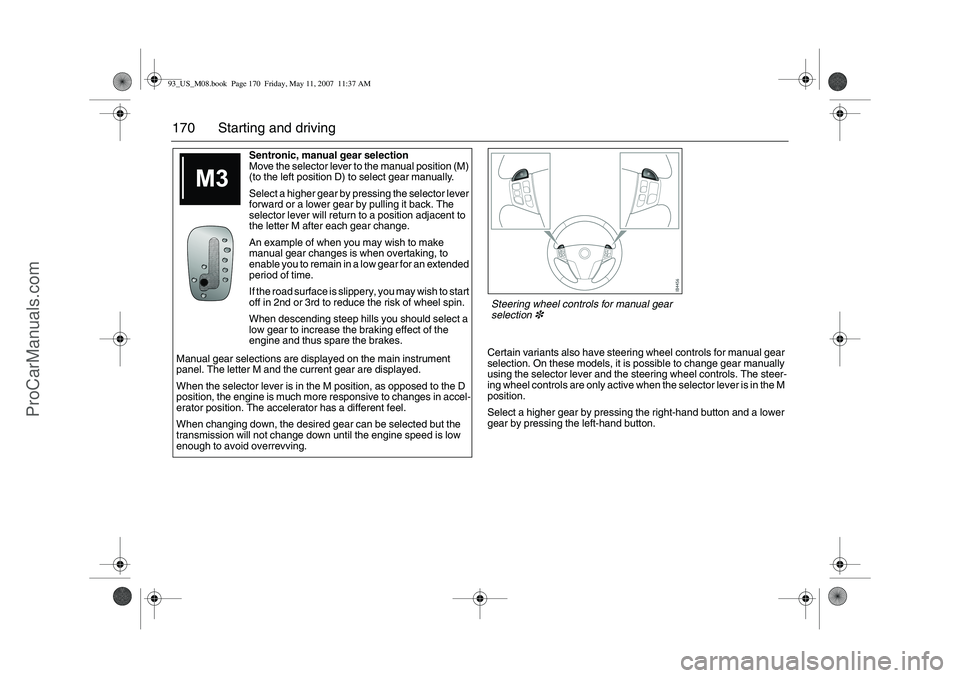
Certain variants also have steering wheel controls for manual gear
selection. On these models, it is possible to change gear manually
using the selector lever and the steering wheel controls. The steer-
ing wheel controls are only active when the selector lever is in the M
position.
Select a higher gear by pressing the right-hand button and a lower
gear by pressing the left-hand button. Sentronic, manual gear selection
Move the selector lever to the manual position (M)
(to the left position D) to select gear manually.
Select a higher gear by pressing the selector lever
forward or a lower gear by pulling it back. The
selector lever will return to a position adjacent to
the letter M after each gear change.
An example of when you may wish to make
manual gear changes is when overtaking, to
enable you to remain in a low gear for an extended
period of time.
If the road surface is slippery, you may wish to start
off in 2nd or 3rd to reduce the risk of wheel spin.
When descending steep hills you should select a
low gear to increase the braking effect of the
engine and thus spare the brakes.
Manual gear selections are displayed on the main instrument
panel. The letter M and the current gear are displayed.
When the selector lever is in the M position, as opposed to the D
position, the engine is much more responsive to changes in accel-
erator position. The accelerator has a different feel.
When changing down, the desired gear can be selected but the
transmission will not change down until the engine speed is low
enough to avoid overrevving.Steering wheel controls for manual gear
selection
3
93_US_M08.book Page 170 Friday, May 11, 2007 11:37 AM
ProCarManuals.com
Page 178 of 320
178 Starting and drivingESP
® system OFF
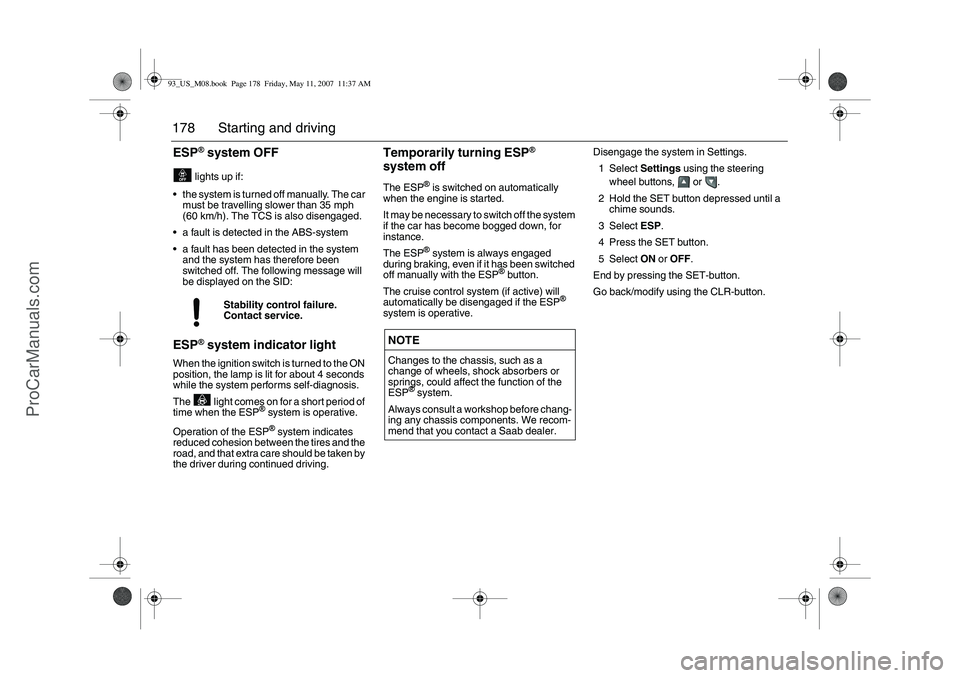
lights up if:
the system is turned off manually. The car
must be travelling slower than 35 mph
(60 km/h). The TCS is also disengaged.
a fault is detected in the ABS-system
a fault has been detected in the system
and the system has therefore been
switched off. The following message will
be displayed on the SID:
ESP
® system indicator light
When the ignition switch is turned to the ON
position, the lamp is lit for about 4 seconds
while the system performs self-diagnosis.
The light comes on for a short period of
time when the ESP
® system is operative.
Operation of the ESP® system indicates
reduced cohesion between the tires and the
road, and that extra care should be taken by
the driver during continued driving.
Temporarily turning ESP
®
system off
The ESP
® is switched on automatically
when the engine is started.
It may be necessary to switch off the system
if the car has become bogged down, for
instance.
The ESP® system is always engaged
during braking, even if it has been switched
off manually with the ESP
® button.
The cruise control system (if active) will
automatically be disengaged if the ESP
®
system is operative.Disengage the system in Settings.
1Select Settings using the steering
wheel buttons, or .
2 Hold the SET button depressed until a
chime sounds.
3Select ESP.
4 Press the SET button.
5Select ON or OFF.
End by pressing the SET-button.
Go back/modify using the CLR-button.
Stability control failure.
Contact service.
NOTEChanges to the chassis, such as a
change of wheels, shock absorbers or
springs, could affect the function of the
ESP
® system.
Always consult a workshop before chang-
ing any chassis components. We recom-
mend that you contact a Saab dealer.
93_US_M08.book Page 178 Friday, May 11, 2007 11:37 AM
ProCarManuals.com
Page 188 of 320
188 Starting and drivingRemember that tires age: it may therefore
be necessary to change winter tires before
they reach the legal wear limit, as they grad-
ually lose their friction properties with age.
If you get into a front wheel skid and the car
has a manual transmission, the best
response is to freewheel, which means
declutching so that the wheels neither drive
nor brake, and to cautiously steer in the
desired direction.
If the car has automatic transmission, ease
off the accelerator slightly and steer cau-
tiously in the desired direction.
If you get into a rear wheel skid, steer in the
same direction as the movement of the rear
of the car.
Driving with tire chains3
33 3Snow chains must only be fitted to the wheel
and tire dimensions that Saab recommends
in "Technical data" on page 285.
We recommend that you contact a Saab
dealer regarding approved tire chains. See
also page 251.
WARNING
Do not drive at speeds above 30 mph
(50 km/h) when tire chains are fitted.
Tire chains can reduce directional sta-
bility.
Do not fit tire chains to the car’s rear
wheels.
NOTECheck the links frequently for wear.
Check that the chains do not foul the
wheel arch liner at full lock.
Refer to the "Technical data" section
on page 285, for information on wheel
and tire dimensions approved for the
fitting of tire chains.
93_US_M08.book Page 188 Friday, May 11, 2007 11:37 AM
ProCarManuals.com
Page 191 of 320
191 Starting and driving
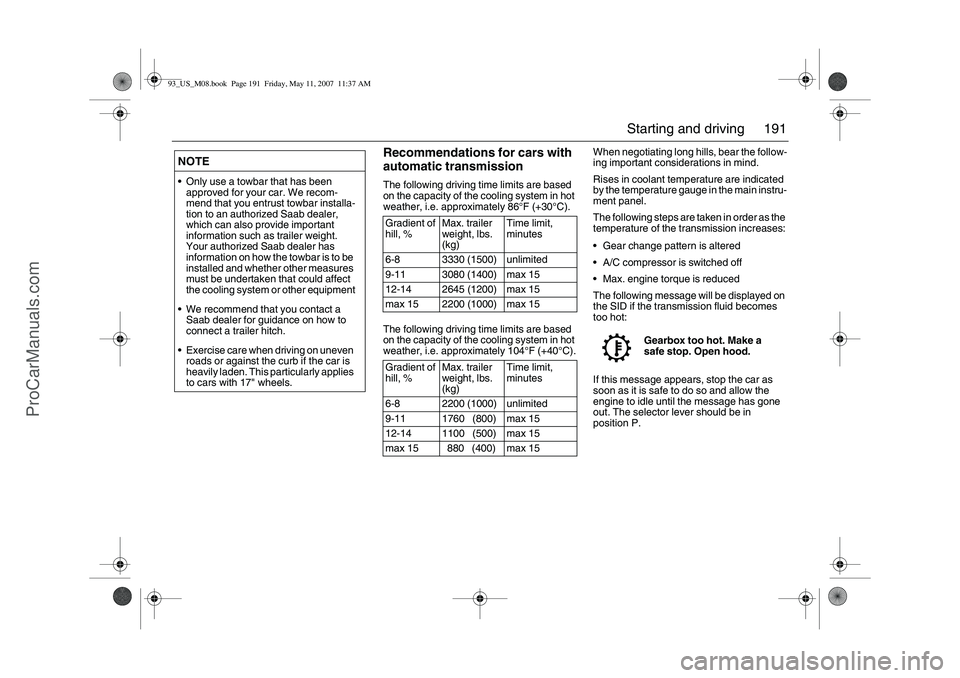
Recommendations for cars with
automatic transmissionThe following driving time limits are based
on the capacity of the cooling system in hot
weather, i.e. approximately 86°F (+30°C).
The following driving time limits are based
on the capacity of the cooling system in hot
weather, i.e. approximately 104°F (+40°C).When negotiating long hills, bear the follow-
ing important considerations in mind.
Rises in coolant temperature are indicated
by the temperature gauge in the main instru-
ment panel.
The following steps are taken in order as the
temperature of the transmission increases:
Gear change pattern is altered
A/C compressor is switched off
Max. engine torque is reduced
The following message will be displayed on
the SID if the transmission fluid becomes
too hot:
If this message appears, stop the car as
soon as it is safe to do so and allow the
engine to idle until the message has gone
out. The selector lever should be in
position P.
NOTEOnly use a towbar that has been
approved for your car. We recom-
mend that you entrust towbar installa-
tion to an authorized Saab dealer,
which can also provide important
information such as trailer weight.
Your authorized Saab dealer has
information on how the towbar is to be
installed and whether other measures
must be undertaken that could affect
the cooling system or other equipment
We recommend that you contact a
Saab dealer for guidance on how to
connect a trailer hitch.
Exercise care when driving on uneven
roads or against the curb if the car is
heavily laden. This particularly applies
to cars with 17" wheels.
Gradient of
hill, %Max. trailer
weight, lbs.
(kg)Time limit,
minutes
6-8 3330 (1500) unlimited
9-11 3080 (1400) max 15
12-14 2645 (1200) max 15
max 15 2200 (1000) max 15
Gradient of
hill, %Max. trailer
weight, lbs.
(kg)Time limit,
minutes
6-8 2200 (1000) unlimited
9-11 1760 (800) max 15
12-14 1100 (500) max 15
max 15 880 (400) max 15
Gearbox too hot. Make a
safe stop. Open hood.
93_US_M08.book Page 191 Friday, May 11, 2007 11:37 AM
ProCarManuals.com
Page 215 of 320
215 Car care
Brake pads should only be changed at a
workshop. We recommend that you con-
tact a Saab dealer.
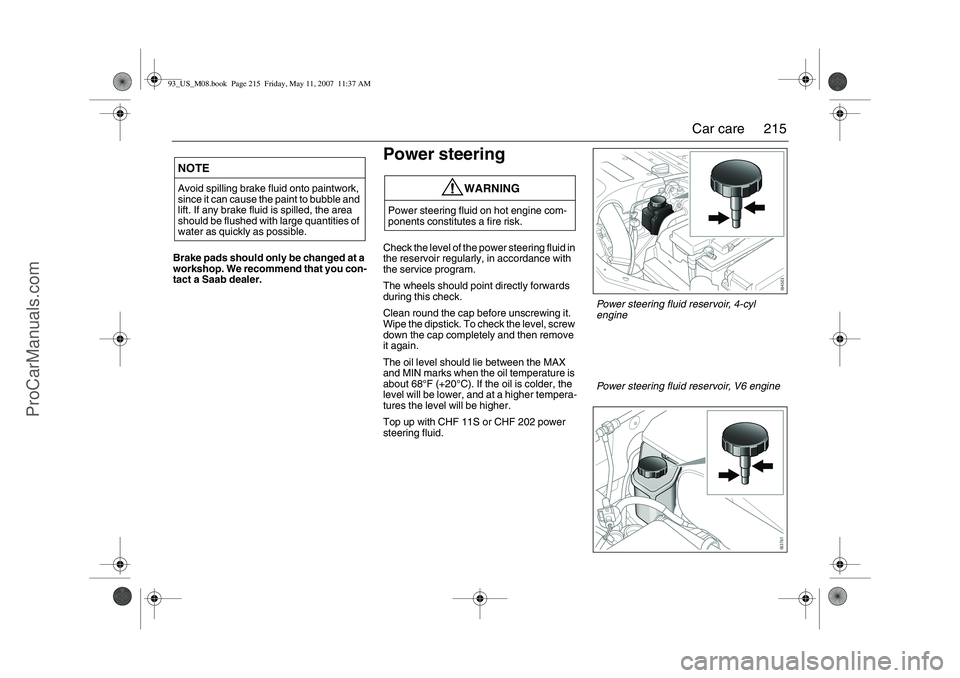
Power steeringCheck the level of the power steering fluid in
the reservoir regularly, in accordance with
the service program.
The wheels should point directly forwards
during this check.
Clean round the cap before unscrewing it.
Wipe the dipstick. To check the level, screw
down the cap completely and then remove
it again.
The oil level should lie between the MAX
and MIN marks when the oil temperature is
about 68°F (+20°C). If the oil is colder, the
level will be lower, and at a higher tempera-
tures the level will be higher.
Top up with CHF 11S or CHF 202 power
steering fluid.
NOTEAvoid spilling brake fluid onto paintwork,
since it can cause the paint to bubble and
lift. If any brake fluid is spilled, the area
should be flushed with large quantities of
water as quickly as possible.
WARNING
Power steering fluid on hot engine com-
ponents constitutes a fire risk.
Power steering fluid reservoir, 4-cyl
enginePower steering fluid reservoir, V6 engine
93_US_M08.book Page 215 Friday, May 11, 2007 11:37 AM
ProCarManuals.com
Page 228 of 320
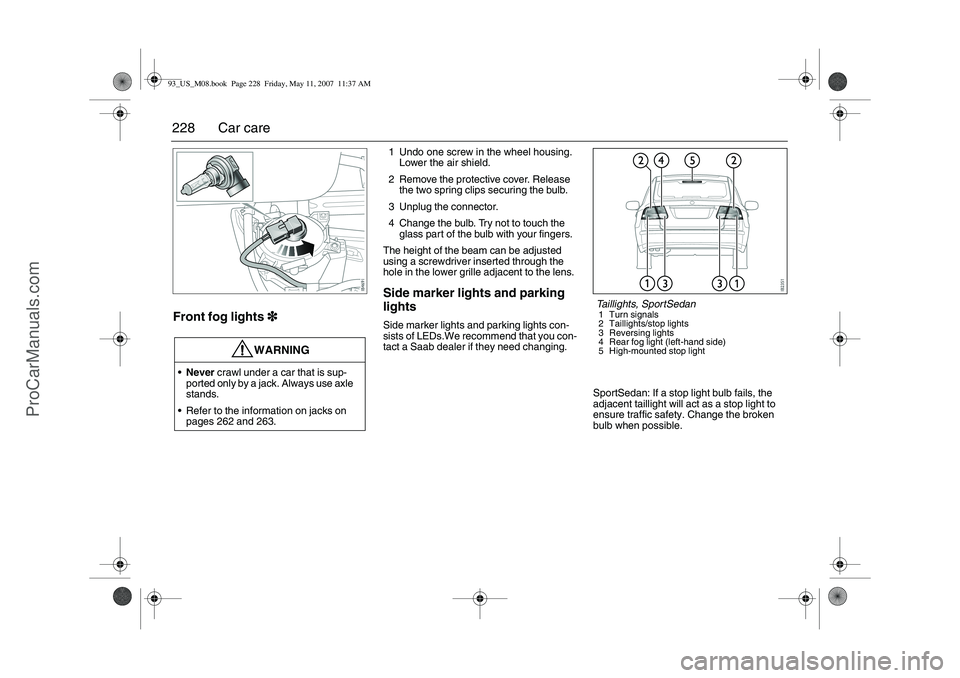
228 Car careFront fog lights3
33 3
1 Undo one screw in the wheel housing.
Lower the air shield.
2 Remove the protective cover. Release
the two spring clips securing the bulb.
3 Unplug the connector.
4 Change the bulb. Try not to touch the
glass part of the bulb with your fingers.
The height of the beam can be adjusted
using a screwdriver inserted through the
hole in the lower grille adjacent to the lens.Side marker lights and parking
lightsSide marker lights and parking lights con-
sists of LEDs.We recommend that you con-
tact a Saab dealer if they need changing.
SportSedan: If a stop light bulb fails, the
adjacent taillight will act as a stop light to
ensure traffic safety. Change the broken
bulb when possible.
WARNING
Never crawl under a car that is sup-
ported only by a jack. Always use axle
stands.
Refer to the information on jacks on
pages 262 and 263.
Taillights, SportSedan1 Turn signals
2 Taillights/stop lights
3 Reversing lights
4 Rear fog light (left-hand side)
5 High-mounted stop light
93_US_M08.book Page 228 Friday, May 11, 2007 11:37 AM
ProCarManuals.com
Page 246 of 320

246 Car carecertain that all wheel nuts are properly tight-
ened. See page 265.
Flat spottingAll tires get hot, especially on long journeys
or when the car is driven hard. After the car
has been parked with hot tires and the tires
have cooled down, a flat spot can form in the
tire, where it is in contact with the ground.
The same can occur if the car has not been
moved for a long time.
Flat spots can cause vibration that can be
felt through the steering wheel, similar to
that experienced when the wheels need bal-
ancing.
Flat spots of this type disappear once the
tires get hot again, usually after 10–15 miles
(20–25 km) of driving at cruising speed. If
the outdoor temperature is low it takes a
longer distance.
When It Is Time for New TiresOne way to tell when it’s time for new tires is
to check the treadwear indicators, which will
appear when your tires have only 1/16 inch
(1.6 mm) or less of tread remaining.
You need a new tire if any of the following
statements are true:
You can see the indicators at three or
more places around the tire.
You can see cord or fabric showing
through the tire’s rubber.
The tread or sidewall is cracked, cut or
snagged deep enough to show cord or
fabric.
The tire has a bump, bulge or split.
The tire has a puncture, cut or other
damage that can’t be repaired well
because of the size or location of the
damage.
WARNING
Rust or dirt on a wheel, or on the parts to
which it is fastened, can make wheel nuts
become loose after a time. The wheel
could come off and cause an accident.
When you change a wheel, remove any
rust or dirt from places where the wheel
attaches to the vehicle. In an emergency,
you can use a cloth or a paper towel to do
this; but be sure to use a scraper or wire
brush later, if you need to, to get all the
rust or dirt off. See “Changing a tire” on
page 262.93_US_M08.book Page 246 Friday, May 11, 2007 11:37 AM
ProCarManuals.com
Page 251 of 320

251 Car care
Tire Chains
Notice: If your vehicle does not have
235/45R17 size tires, use tire chains only
where legal and only when you must.
Contact your Saab dealer regarding suit-
able snow chains. Install them on the
front tires and tighten them as tightly as
possible with the ends securely
fastened. Drive slowly and follow the
chain manufacturer’s instructions. If you
can hear the chains contacting your
vehicle, stop and retighten them. If the
contact continues, slow down until it
stops. Driving too fast or spinning the
wheels with chains on will damage your
vehicle.
If a Tire Goes FlatIt’s unusual for a tire to “blowout” while
you’re driving, especially if you maintain
your tires properly. If air goes out of a tire,
it’s much more likely to leak out slowly. But
if you should ever have a “blowout”, here are
a few tips about what to expect and what to
do:
If a front tire fails, the flat tire will create a
drag that pulls the vehicle toward that side.
Take your foot off the accelerator pedal and
grip the steering wheel firmly. Steer to main-
tain lane position, and then gently brake to
a stop well out of the traffic lane.
A rear blowout, particularly on a curve, acts
much like a skid and may require the same
correction you’d use in a skid. In any rear
blowout, remove your foot from the acceler-
ator pedal. Get the vehicle under control by
steering the way you want the vehicle to go.
It may be very bumpy and noisy, but you can
still steer. Gently brake to a stop – well off
the road if possible.
If a tire goes flat, the next part shows how to
use your jacking equipment to change a flat
tire safely.
WARNING
If your vehicle has 235/45 R17 size tires,
don’t use tire chains, there’s not enough
clearance.
Tire chains used on a vehicle without the
proper amount of clearance can cause
damage to the brakes, suspension or
other vehicle parts. The area damaged by
the tire chains could cause you to lose
control of your vehicle and you or others
may be injured in a crash.
Use another type of traction device only if
its manufacturer recommends it for use
on your vehicle and tire size combination
and road conditions. Follow that manu-
facturer’s instructions. To help avoid
damage to your vehicle, drive slowly,
readjust or remove the device if it’s con-
tacting your vehicle, and don’t spin your
wheels.
If you do find traction devices that will fit,
install them on the front tires.93_US_M08.book Page 251 Friday, May 11, 2007 11:37 AM
ProCarManuals.com