cooling SAAB 9-3 2008 Owners Manual
[x] Cancel search | Manufacturer: SAAB, Model Year: 2008, Model line: 9-3, Model: SAAB 9-3 2008Pages: 320, PDF Size: 56.39 MB
Page 7 of 320
7
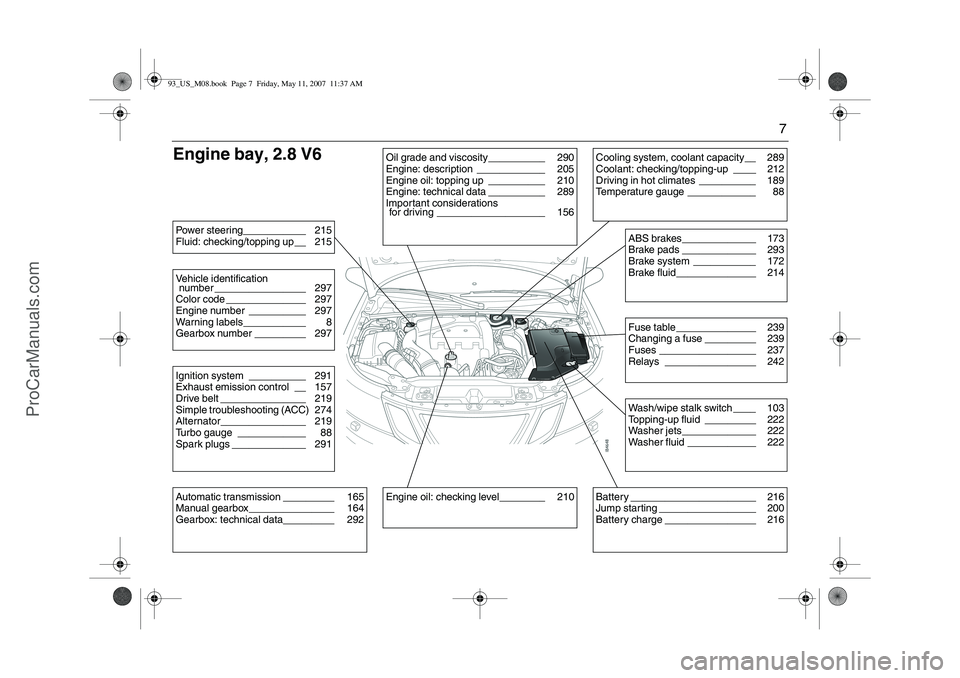
Engine bay, 2.8 V6Power steering___________ 215
Fluid: checking/topping up__ 215Vehicle identification
number ________________ 297
Color code ______________ 297
Engine number __________ 297
Warning labels___________ 8
Gearbox number _________ 297Ignition system __________ 291
Exhaust emission control __ 157
Drive belt _______________ 219
Simple troubleshooting (ACC) 274
Alternator_______________ 219
Turbo gauge ____________ 88
Spark plugs _____________ 291Automatic transmission _________ 165
Manual gearbox_______________ 164
Gearbox: technical data_________ 292
Oil grade and viscosity__________ 290
Engine: description ____________ 205
Engine oil: topping up __________ 210
Engine: technical data __________ 289
Important considerations
for driving ___________________ 156Engine oil: checking level________ 210
Battery ______________________ 216
Jump starting _________________ 200
Battery charge ________________ 216
Wash/wipe stalk switch ____ 103
Topping-up fluid _________ 222
Washer jets_____________ 222
Washer fluid ____________ 222Fuse table ______________ 239
Changing a fuse _________ 239
Fuses _________________ 237
Relays ________________ 242ABS brakes_____________ 173
Brake pads _____________ 293
Brake system ___________ 172
Brake fluid______________ 214
Cooling system, coolant capacity__ 289
Coolant: checking/topping-up ____ 212
Driving in hot climates __________ 189
Temperature gauge ____________ 88
93_US_M08.book Page 7 Friday, May 11, 2007 11:37 AM
ProCarManuals.com
Page 107 of 320
107 Instruments and controls
Automatic climate-
control system (ACC)Fresh air for the cabin is drawn in through an
inlet at the bottom edge of the windshield. It
passes through an effective filter before
reaching the climate control system and
delivery into the cabin. The air is evacuated
via openings in the parcel shelf. It is then led
through outlets on either side of the car
behind the rear bumper.
The Automatic Climate-Control system
(ACC) automatically maintains the desired
cabin temperature, regardless of the
weather outside.
The system will achieve the desired temper-
ature in the quickest possible way.
Note that heating or cooling is not more
rapid by setting the temperature higher
or lower than the final temperature you
desire.
To optimize the performance of the air con-
ditioning system, all windows and the
moonroof3 should be shut. The air vents in
the fascia must be open.The incoming air is treated in three stages:
first it passes through a filter; it is then dehu-
midified and cooled; and finally, if required,
it is heated.
The filter is a combined particle and char-
coal filter. It is so efficient that levels of nox-
ious substances such as benzene and tolu-
ene are also reduced.To reduce potential misting on the insides of
the windows, the glass should be cleaned
with a quality glass cleaner. How often this
will need to be done depends on how clean
the air is - if there are smokers in the car, the
windows will need to be cleaned more
frequently.
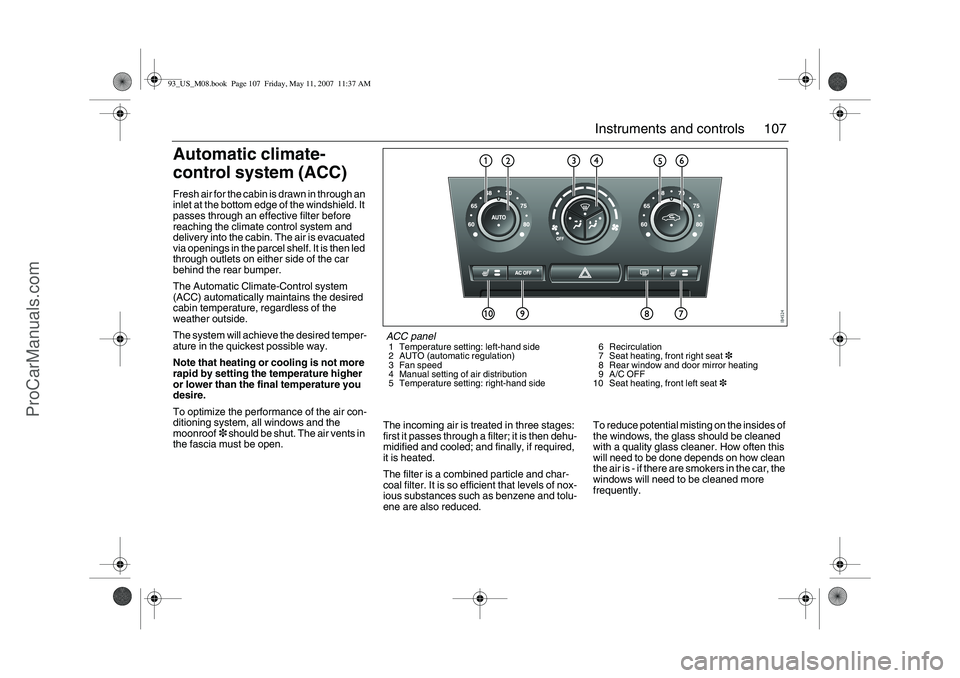
ACC panel1 Temperature setting: left-hand side
2 AUTO (automatic regulation)
3 Fan speed
4 Manual setting of air distribution
5 Temperature setting: right-hand side6 Recirculation
7 Seat heating, front right seat3
8 Rear window and door mirror heating
9A/C OFF
10 Seat heating, front left seat3
93_US_M08.book Page 107 Friday, May 11, 2007 11:37 AM
ProCarManuals.com
Page 110 of 320
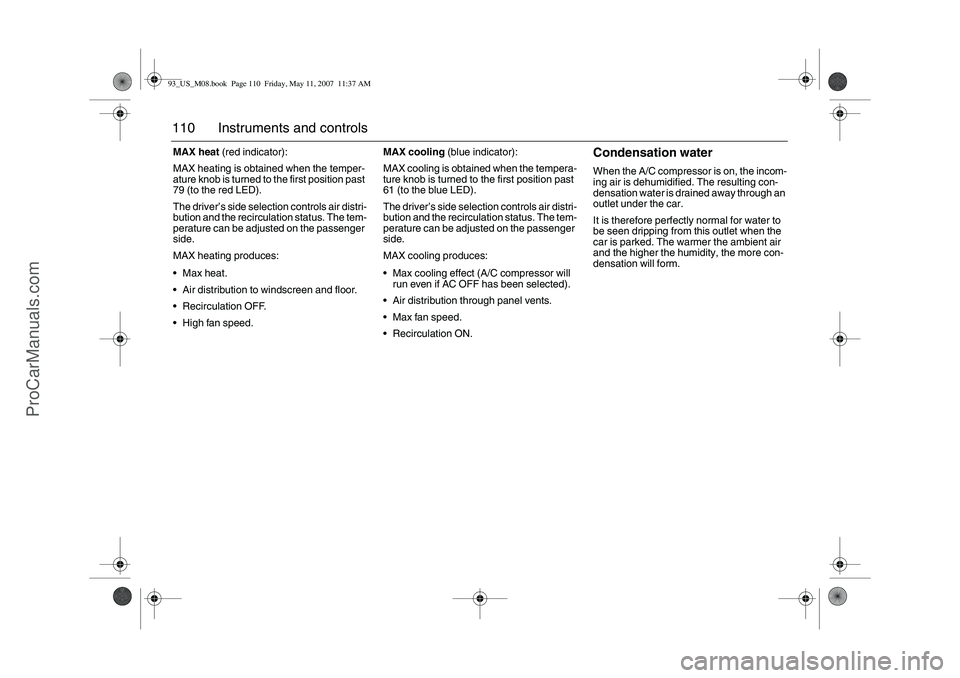
110 Instruments and controlsMAX heat (red indicator):
MAX heating is obtained when the temper-
ature knob is turned to the first position past
79 (to the red LED).
The driver’s side selection controls air distri-
bution and the recirculation status. The tem-
perature can be adjusted on the passenger
side.
MAX heating produces:
Max heat.
Air distribution to windscreen and floor.
Recirculation OFF.
High fan speed.MAX cooling (blue indicator):
MAX cooling is obtained when the tempera-
ture knob is turned to the first position past
61 (to the blue LED).
The driver’s side selection controls air distri-
bution and the recirculation status. The tem-
perature can be adjusted on the passenger
side.
MAX cooling produces:
Max cooling effect (A/C compressor will
run even if AC OFF has been selected).
Air distribution through panel vents.
Max fan speed.
Recirculation ON.
Condensation waterWhen the A/C compressor is on, the incom-
ing air is dehumidified. The resulting con-
densation water is drained away through an
outlet under the car.
It is therefore perfectly normal for water to
be seen dripping from this outlet when the
car is parked. The warmer the ambient air
and the higher the humidity, the more con-
densation will form.
93_US_M08.book Page 110 Friday, May 11, 2007 11:37 AM
ProCarManuals.com
Page 111 of 320
111 Instruments and controls
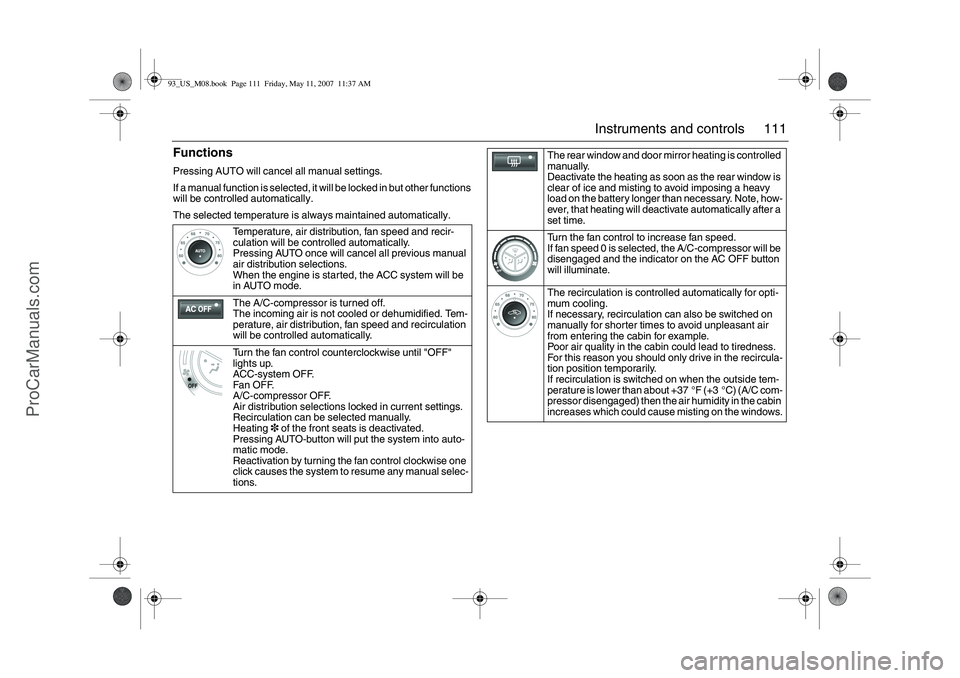
FunctionsPressing AUTO will cancel all manual settings.
If a manual function is selected, it will be locked in but other functions
will be controlled automatically.
The selected temperature is always maintained automatically.
Temperature, air distribution, fan speed and recir-
culation will be controlled automatically.
Pressing AUTO once will cancel all previous manual
air distribution selections.
When the engine is started, the ACC system will be
in AUTO mode.
The A/C-compressor is turned off.
The incoming air is not cooled or dehumidified. Tem-
perature, air distribution, fan speed and recirculation
will be controlled automatically.
Turn the fan control counterclockwise until "OFF"
lights up.
ACC-system OFF.
Fan OFF.
A/C-compressor OFF.
Air distribution selections locked in current settings.
Recirculation can be selected manually.
Heating3 of the front seats is deactivated.
Pressing AUTO-button will put the system into auto-
matic mode.
Reactivation by turning the fan control clockwise one
click causes the system to resume any manual selec-
tions.
The rear window and door mirror heating is controlled
manually.
Deactivate the heating as soon as the rear window is
clear of ice and misting to avoid imposing a heavy
load on the battery longer than necessary. Note, how-
ever, that heating will deactivate automatically after a
set time.
Turn the fan control to increase fan speed.
If fan speed 0 is selected, the A/C-compressor will be
disengaged and the indicator on the AC OFF button
will illuminate.
The recirculation is controlled automatically for opti-
mum cooling.
If necessary, recirculation can also be switched on
manually for shorter times to avoid unpleasant air
from entering the cabin for example.
Poor air quality in the cabin could lead to tiredness.
For this reason you should only drive in the recircula-
tion position temporarily.
If recirculation is switched on when the outside tem-
perature is lower than about +37°F (+3°C) (A/C com-
pressor disengaged) then the air humidity in the cabin
increases which could cause misting on the windows.
93_US_M08.book Page 111 Friday, May 11, 2007 11:37 AM
ProCarManuals.com
Page 158 of 320
158 Starting and drivingHave the car serviced regularly in accor-
dance with the service program.
Always be alert to any misfiring of the
engine (not running on all cylinders) and
any loss of power or performance. At the
first sign of a malfunction, reduce speed
and take the car to a workshop. We
recommend that you contact a Saab
dealer.
If the engine fails to start (in severe cold or
if the battery is flat), the car can be bump
started (manual transmission only) or
started using jump leads to a donor
battery. However, as soon as you have
started the engine, it is important that it
runs on all cylinders. If it is misfiring, allow
it to idle for up to 5 minutes to give it time
to settle and run smoothly. If, after this
time, the engine still fails to run properly,
switch off the engine to avoid serious
damage to the catalytic converter. We
recommend that you contact a Saab
dealer for advice.Never park the car on dry grass or other
combustible material. The catalytic
converter gets very hot and could there-
fore start a fire.
Never drive off if the engine is misfiring.
If you bump start the car when the engine
is already at normal working temperature,
the engine must start to run on all cylin-
ders. Abort bump starting if the engine
fails to start immediately.
Failure to strictly follow these instructions
can result in damage to the catalytic con-
verter and associated components, and
could represent a breach of the warranty
conditions.
NOTEIf the car runs out of gas, air may be drawn
in with the fuel, which, in turn, can cause
the catalytic converter to be damaged by
overheating.
WARNING
If the engine is being run with the car on a
rolling road or dynamometer, to ensure
adequate cooling, air must be blown into
the engine compartment and under the
car at a rate equivalent to the ram-air
effect that would obtain at the corre-
sponding road speed.
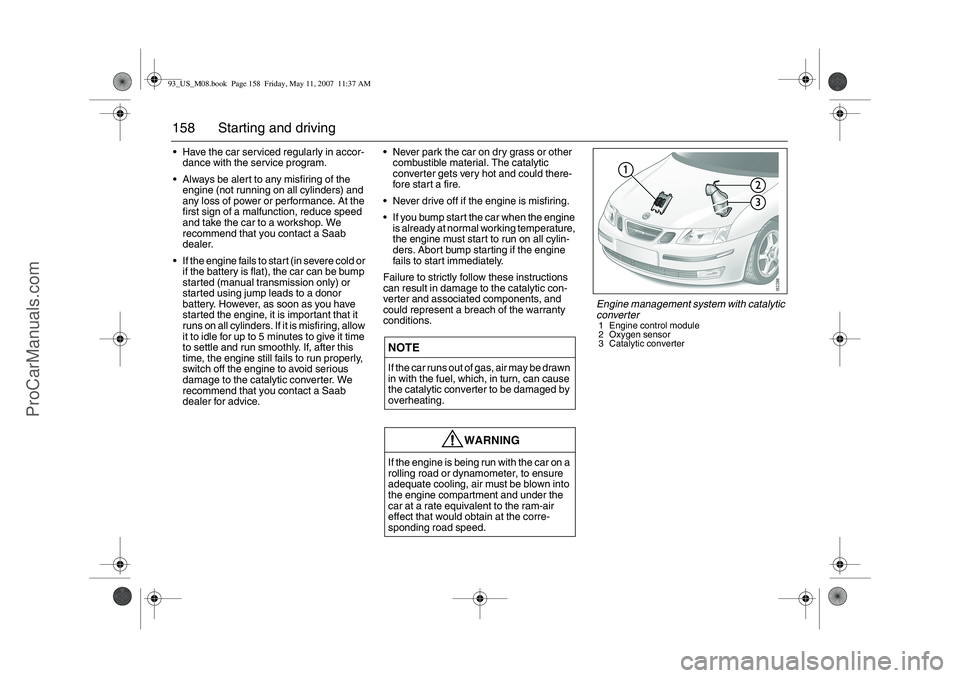
Engine management system with catalytic
converter1 Engine control module
2 Oxygen sensor
3 Catalytic converter
93_US_M08.book Page 158 Friday, May 11, 2007 11:37 AM
ProCarManuals.com
Page 189 of 320
189 Starting and driving
Driving in hot climatesAlways check the coolant level before start-
ing a journey. When the engine is cold, the
coolant shall lie on or just above the
KALT/COLD mark on the expansion tank
(boundary between the upper and lower
sections of the tank).
At the end of a journey, allow the engine to
idle for 2–3 minutes before switching it off.
If the needle on the temperature gauge
enters the red zone, the following message
will be shown on the SID:
1 Stop the car but do not switch off the
engine. Do not remove the cap on the
cooling system expansion tank, even if
the tank is empty. The engine tempera-
ture should decrease. If the temperature
continues to rise with the engine idling,
the engine must be switched off.2 If the engine is idling and the needle on
the temperature gauge falls, wait until a
normal temperature is shown (about in
the middle of the scale) before switching
off the engine. If the coolant needs to be
topped up, carefully unscrew the
expansion tank cap.
Fill as required with a mixture of 50 %
antifreeze and 50 % clean water. Use an
antifreeze approved by Saab.
3 Have the car’s cooling system checked.
We recommend that you contact a Saab
dealer. Hot engine. Make a
safe stop. Idle engine.
WARNING
Exercise care when opening the hood
if the engine is overheated. Never
remove the expansion tank cap com-
pletely when the engine is hot.
The cooling system is pressurized -
hot coolant and vapour can escape.
These can cause injury to your eyes
and burns. Open the cap slowly to
release the pressure before removing
it.
93_US_M08.book Page 189 Friday, May 11, 2007 11:37 AM
ProCarManuals.com
Page 191 of 320
191 Starting and driving
Recommendations for cars with
automatic transmissionThe following driving time limits are based
on the capacity of the cooling system in hot
weather, i.e. approximately 86°F (+30°C).
The following driving time limits are based
on the capacity of the cooling system in hot
weather, i.e. approximately 104°F (+40°C).When negotiating long hills, bear the follow-
ing important considerations in mind.
Rises in coolant temperature are indicated
by the temperature gauge in the main instru-
ment panel.
The following steps are taken in order as the
temperature of the transmission increases:
Gear change pattern is altered
A/C compressor is switched off
Max. engine torque is reduced
The following message will be displayed on
the SID if the transmission fluid becomes
too hot:
If this message appears, stop the car as
soon as it is safe to do so and allow the
engine to idle until the message has gone
out. The selector lever should be in
position P.
NOTEOnly use a towbar that has been
approved for your car. We recom-
mend that you entrust towbar installa-
tion to an authorized Saab dealer,
which can also provide important
information such as trailer weight.
Your authorized Saab dealer has
information on how the towbar is to be
installed and whether other measures
must be undertaken that could affect
the cooling system or other equipment
We recommend that you contact a
Saab dealer for guidance on how to
connect a trailer hitch.
Exercise care when driving on uneven
roads or against the curb if the car is
heavily laden. This particularly applies
to cars with 17" wheels.
Gradient of
hill, %Max. trailer
weight, lbs.
(kg)Time limit,
minutes
6-8 3330 (1500) unlimited
9-11 3080 (1400) max 15
12-14 2645 (1200) max 15
max 15 2200 (1000) max 15
Gradient of
hill, %Max. trailer
weight, lbs.
(kg)Time limit,
minutes
6-8 2200 (1000) unlimited
9-11 1760 (800) max 15
12-14 1100 (500) max 15
max 15 880 (400) max 15
Gearbox too hot. Make a
safe stop. Open hood.
93_US_M08.book Page 191 Friday, May 11, 2007 11:37 AM
ProCarManuals.com
Page 212 of 320
212 Car careTransmission fluidManual transmission
Check and top up the oil in accordance with
the service program.
Automatic transmission
Check and top up the oil in accordance with
the service program.Coolant
There is an overpressure in the cooling
system. Coolant temperatures can some-
times exceed 212° F (100° C).
If the coolant level drops too low, the follow-
ing message appears on the SID:
The properties of the coolant are retained
for the entire service life of the car. There-
fore, it is not necessary to change the cool-
ant.
The coolant contains 45 % antifreeze and
anti-corrosion fluid. This ratio gives the best
cooling effect. Lower concentrations should
be avoided, in view of the corrosion risk.
Coolants of a different brand could damage
the engine or cooling system. We therefore
recommend strict use of coolants that have
been approved by Saab.Note
If incorrect coolant is used or added, the
life-time properties will be affected. Even if
the coolant is flushed from the system and
replaced with life-time coolant, life-time
properties are no longer retained and the
coolant must then be drained and replaced
at regular intervals.
WARNING
Proceed with caution if the radiator is
boiling when you open the hood.
Never remove the expansion-tank
filler cap when the radiator is boiling.
The cooling system is pressurized –
hot coolant and vapor can escape
when the filler cap is released. These
can cause injury to your eyes and
burns. Loosen the cap carefully, and
let the engine cool before removing
the cap.
Exercise care when adding coolant.
Coolant on hot surfaces constitutes a
fire risk.
Coolant level low.
Refill.
NOTEIf the cooling system needs topping up,
mix the antifreeze with the appropriate
quantity of drinking water or distilled
water before adding it to the system.
If undiluted antifreeze is added, the
engine could still freeze and be damaged.
This is because the antifreeze will not mix
properly with the coolant before the ther-
mostat has opened to allow full circula-
tion.
93_US_M08.book Page 212 Friday, May 11, 2007 11:37 AM
ProCarManuals.com
Page 274 of 320
274 Car careAir conditioning (A/C)
TroubleshootingIf a fault occurs in the A/C system, there are
a number of checks you can perform your-
self. If the fault persists, however, have the
system checked at a workshop. We recom-
mend that you contact a Saab dealer.
Note
When the A/C system is running, the intake
air is dehumidified. The resultant condensa-
tion that forms on the evaporator is drained
off under the car. When the car is parked,
this may result in a small puddle forming on
the ground. The warmer the air and the
higher the relative humidity, the more con-
densation will be produced.Inadequate coolinga Check that the condenser (in front of the
radiator) has not become clogged with
dirt and insects.
b Make sure that the compressor drive
belt does not slip (see page 219).
c Check the fuses for the ventilation fans
and compressor (see page 239).
MaintenanceThe compressor drive belt should be
inspected under the regular service
program.
Clean away dirt and insects from the
condenser and radiator to prevent clog-
ging. When washing the car, use the hose
to spray the radiator and condenser
(located in front of the radiator) from both
sides (both from the front of the car and
from inside the engine bay). Do not use a
pressure washer.
Caution: Do not hose down the radia-
tor and condenser while the engine is
hot.
WARNING
All repairs and adjustments to the A/C
system must be carried out at a Saab
dealer authorized for this kind of work.
The A/C system is pressurized. Do not
break any connections or undo A/C
system components.
Escaping gas can cause eye injury or
other personal injury.NOTEThe A/C system is designed for use
with R134a refrigerant.
Refrigerant handling requires special
equipment and special procedures for
charging and draining the system.
Never mix R 134a with other refriger-
ants.
NOTEDo not use a pressure washer when
cleaning the condenser or radiator due to
the risk of damage.
93_US_M08.book Page 274 Friday, May 11, 2007 11:37 AM
ProCarManuals.com
Page 275 of 320
275 Car care
Other than in extremely cold weather, do not
screen the radiator, e.g. with netting, as this
will greatly diminish its cooling capacity.
Applicable to the manual climate control
system - During cold months the air condi-
tioning should be switched on once or
twice a month and run for 5–10 minutes
during highway driving once the engine is
warm.
This action saves the gaskets in the
compressor from being spoiled. The
compressor uses a lubricant that circu-
lates with the coolant.
Note
The A/C system cannot be switched on
when the outside temperature is below 32°F
(0°C). Turn on the A/C system when the car
is standing in a warm place. Simplest is to
always have the A/C button pressed in. The
A/C system will then cut in automatically
when the outside temperature is high
enough.
Headlight aimingThe vehicle has a visual optical headlight
aiming system equipped with vertical
aiming device. The aim has been preset at
the factory and should normally not need
further adjustments.
If your headlights are damaged in a crash,
the headlight aim may be affected. If you
believe your headlights need to be
re-aimed, we recommend that you take it to
your Saab dealer for service. However, it is
possible for you to re-aim your headlights as
described in the following procedure.To check the aim, the vehicle should be
properly prepared as follows:
The vehicle shall be placed so that the
headlights are 25 ft (7.6 m) from a light
colored wall or other flat surface. The
aiming area should be darkened, this will
improve your ability to see the beam of the
low beam headlight being aimed.
An optical headlamp aimer can also be
used and will than replace the wall.
The vehicle must have all four wheels on
a perfectly level surface which is level all
the way to the wall or other flat surface.
The vehicle should be placed so it is
perpendicular to the wall or other flat
surface.
The vehicle should be unloaded and fuel
tank full, and one person or 160 lbs.
(75 kg) on the drivers seat.
The vehicle should be fully assembled
and all other work stopped while headlight
aiming is being done.
The vehicle should not have any snow, ice
or mud attached to it.
Tires should be inflated to the prescribed
pressure.
Close all doors.
Rock the vehicle to stabilize the suspen-
sion.
Headlight aiming is done with the vehicle
low beam lamps. The high beam lamps will
WARNING
Before checking/adjusting the headlight
aiming, switch off the engine to avoid
danger of fingers and hands being injured
by moving parts.
The radiator fan can start up even when
the engine is switched off.NOTETo make sure that your headlights are
aimed properly read all instructions
before beginning. Failure to follow these
instructions could cause damage to
headlight parts or a not correctly aimed
headlight.
93_US_M08.book Page 275 Friday, May 11, 2007 11:37 AM
ProCarManuals.com