cruise control SAAB 9-3 2008 Owners Manual
[x] Cancel search | Manufacturer: SAAB, Model Year: 2008, Model line: 9-3, Model: SAAB 9-3 2008Pages: 320, PDF Size: 56.39 MB
Page 3 of 320
3
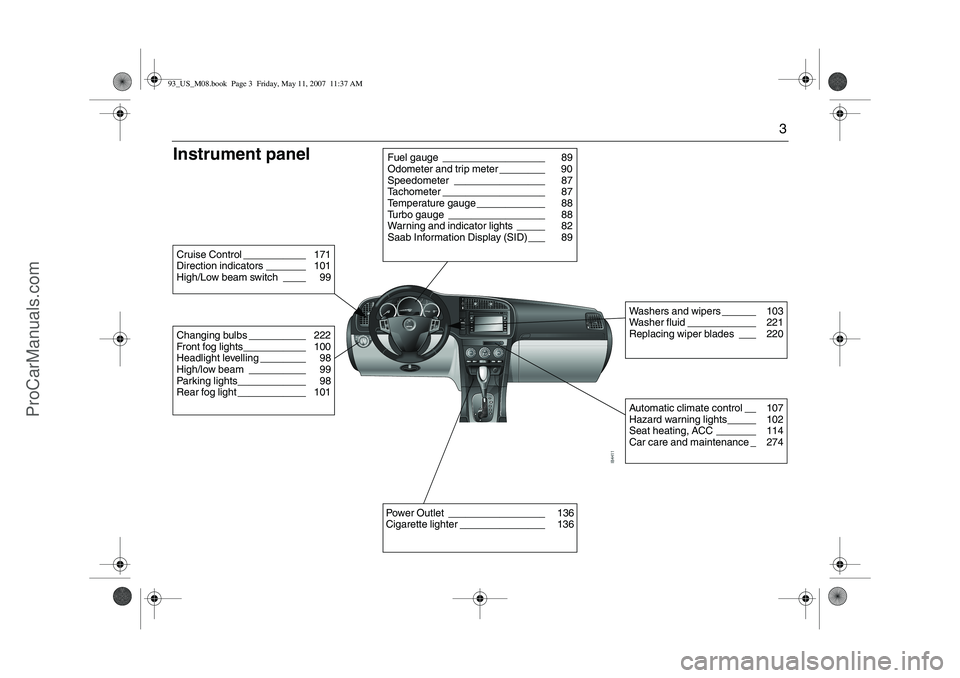
Instrument panelChanging bulbs __________ 222
Front fog lights___________ 100
Headlight levelling ________ 98
High/low beam __________ 99
Parking lights____________ 98
Rear fog light ____________ 101Cruise Control ___________ 171
Direction indicators _______ 101
High/Low beam switch ____ 99
Fuel gauge __________________ 89
Odometer and trip meter ________ 90
Speedometer ________________ 87
Tachometer __________________ 87
Temperature gauge ____________ 88
Turbo gauge _________________ 88
Warning and indicator lights _____ 82
Saab Information Display (SID) ___ 89Power Outlet _________________ 136
Cigarette lighter _______________ 136
Washers and wipers ______ 103
Washer fluid ____________ 221
Replacing wiper blades ___ 220Automatic climate control __ 107
Hazard warning lights_____ 102
Seat heating, ACC _______ 114
Car care and maintenance _ 274
93_US_M08.book Page 3 Friday, May 11, 2007 11:37 AM
ProCarManuals.com
Page 86 of 320
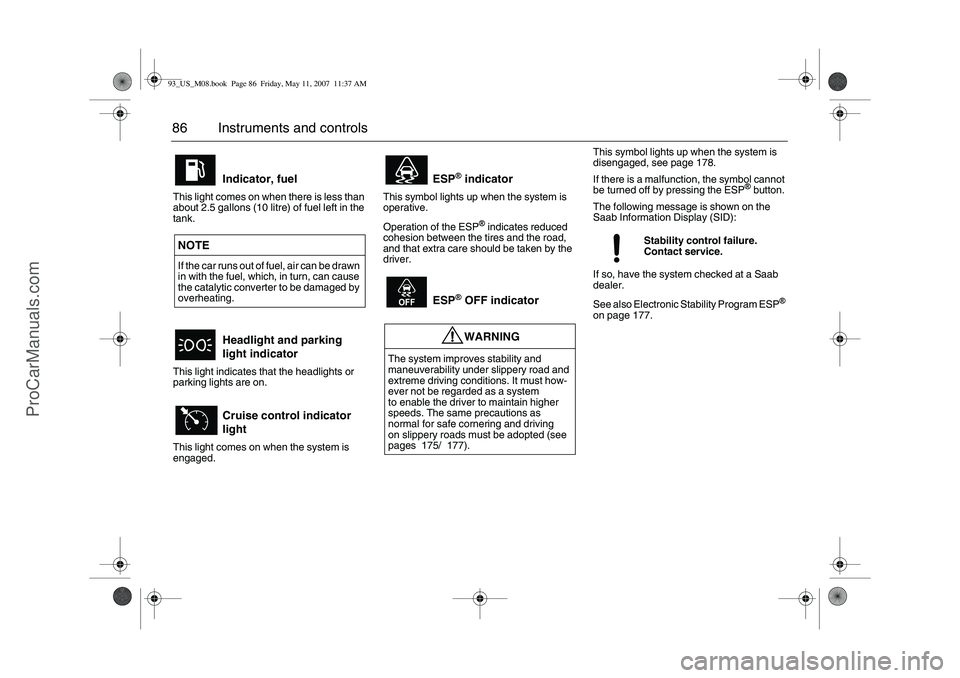
86 Instruments and controlsThis light comes on when there is less than
about 2.5 gallons (10 litre) of fuel left in the
tank.
This light indicates that the headlights or
parking lights are on.
This light comes on when the system is
engaged.This symbol lights up when the system is
operative.
Operation of the ESP
® indicates reduced
cohesion between the tires and the road,
and that extra care should be taken by the
driver.This symbol lights up when the system is
disengaged, see page 178.
If there is a malfunction, the symbol cannot
be turned off by pressing the ESP
® button.
The following message is shown on the
Saab Information Display (SID):
If so, have the system checked at a Saab
dealer.
See also Electronic Stability Program ESP
®
on page 177.
Indicator, fuel
NOTE
If the car runs out of fuel, air can be drawn
in with the fuel, which, in turn, can cause
the catalytic converter to be damaged by
overheating.
Headlight and parking
light indicator
Cruise control indicator
light
ESP
® indicator
ESP® OFF indicatorWARNING
The system improves stability and
maneuverability under slippery road and
extreme driving conditions. It must how-
ever not be regarded as a system
to enable the driver to maintain higher
speeds. The same precautions as
normal for safe cornering and driving
on slippery roads must be adopted (see
pages 175/ 177).
Stability control failure.
Contact service.
93_US_M08.book Page 86 Friday, May 11, 2007 11:37 AM
ProCarManuals.com
Page 151 of 320

151 Starting and driving
Ignition switch ________ 152
Steering wheel lock ____ 154
Starting the engine ____ 154
Important considerations
for driving __________ 156
Refueling ____________ 159
Engine Break-in Period _ 163
Manual transmission___ 164
Automatic
transmission3
33 3______ 165
Cruise control ________ 171
Braking ______________ 172
Traction Control System
(TCS) ______________ 175
Electronic Stability
Program ESP
®
______ 177
Parking brake_________ 179
Parking ______________ 179
Saab Parking
Assistance3
33 3________ 182 Economical driving _____ 185
Driving in cold weather__ 187
Driving in hot climates __ 189
Towing a trailer3
33 3______ 190
Driving with a roof rack
load ________________ 194
Driving with a load _____ 196
Driving with the trunk lid
open________________ 196
Driving in deep water ___ 196
Driving at night ________ 197
Towing the car _________ 197
Jump starting _________ 200
For long trips __________ 202
Starting and driving
3Asterisk means: equipment not fitted in all cars
(can depend on model variant, engine variant,
market specification, options or accessories).93_US_M08.book Page 151 Friday, May 11, 2007 11:37 AM
ProCarManuals.com
Page 157 of 320

157 Starting and driving
Limp-homeThe engine management system has a
diagnostic feature that checks a number of
internal functions. If a fault is detected in the
throttle valve, the engine management
system will set the throttle system to the
limp-home mode. This means:
idling control will be poor (uneven idling
since regulated by ignition and fuel
supply)
engine performance will be reduced
the cruise control will not function
the capacity of the A/C compressor will be
limited.
If the diagnosis function detects a fault in the
engine management system, the light
"Engine malfunction (CHECK ENGINE)" in
the instrument panel will come on (see
page 83). Have the car checked at a work-
shop as soon as possible. We recommend
that you contact a Saab dealer.
Important considerations with
catalytic convertersThe catalytic converter is an emission con-
trol device incorporated in the car’s exhaust
system. It consists of a metal canister with a
honeycomb insert, the cells of which have
walls coated in a catalytic layer (precious
metal alloy).
To ensure that the catalytic converter con-
tinues to function properly, and also to avoid
damage to the converter and its associated
components, the following points must be
observed:
NOTEIf "Engine malfunction (CHECK
ENGINE)" warning light starts to flash
(indicating that the engine is misfiring and
the catalytic converter can be damaged),
ease off the accelerator slightly. The light
should go out or start to shine constantly.
If the light continues to flash despite
easing off the accelerator, you may con-
tinue to drive the car but at the minimum
throttle permitted by the current traffic sit-
uation. Have the car checked as soon as
possible. We recommend that you con-
tact a Saab dealer.
NOTEUse only unleaded gasoline. Leaded gas-
oline is detrimental to the catalyst and
oxygen sensor and will seriously impair
the function of the catalytic converter.
93_US_M08.book Page 157 Friday, May 11, 2007 11:37 AM
ProCarManuals.com
Page 171 of 320
171 Starting and driving
Cruise control(Cruise control system)
For safety reasons (brake system func-
tion), the brakes must be applied once
when the engine has started, before the
cruise control system can be activated.
The following message is shown on the SID:
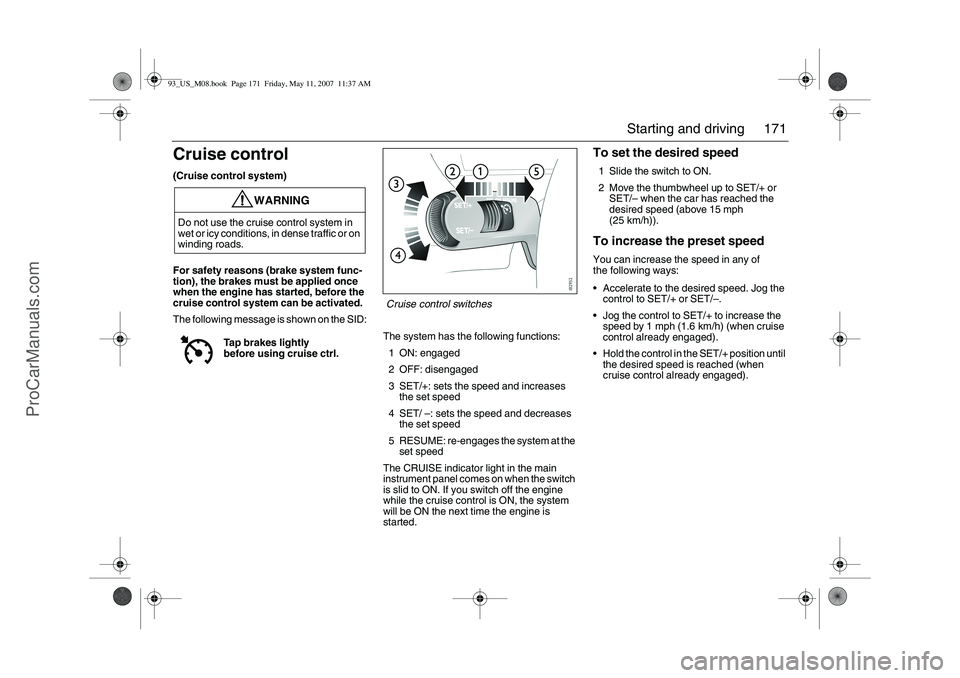
The system has the following functions:
1 ON: engaged
2 OFF: disengaged
3 SET/+: sets the speed and increases
the set speed
4 SET/ –: sets the speed and decreases
the set speed
5 RESUME: re-engages the system at the
set speed
The CRUISE indicator light in the main
instrument panel comes on when the switch
is slid to ON. If you switch off the engine
while the cruise control is ON, the system
will be ON the next time the engine is
started.
To set the desired speed1 Slide the switch to ON.
2 Move the thumbwheel up to SET/+ or
SET/– when the car has reached the
desired speed (above 15 mph
(25 km/h)).To increase the preset speedYou can increase the speed in any of
the following ways:
Accelerate to the desired speed. Jog the
control to SET/+ or SET/–.
Jog the control to SET/+ to increase the
speed by 1 mph (1.6 km/h) (when cruise
control already engaged).
Hold the control in the SET/+ position until
the desired speed is reached (when
cruise control already engaged).
WARNING
Do not use the cruise control system in
wet or icy conditions, in dense traffic or on
winding roads.
Tap brakes lightly
before using cruise ctrl.
Cruise control switches
93_US_M08.book Page 171 Friday, May 11, 2007 11:37 AM
ProCarManuals.com
Page 172 of 320
172 Starting and drivingTo reduce the preset speedYou can reduce speed in any of the follow-
ing ways:
Brake to the desired speed. Jog the
control to SET/+ or SET/–.
Jog the control to SET/– to reduce the
speed by 1 mph (1.6 km/h).
Hold the control in the SET/– position until
the desired speed is reached.Temporary increase in speedAccelerate, without shifting down (manual
transmission), to exceed the set speed such
as for overtaking. When you release the
accelerator, the car will return to the set
speed.To disengage the system
temporarilySlide the switch to the left towards OFF, but
only as far as to disengage the cruise con-
trol. Allow the switch to spring back.
To re-engage the systemSlide the switch to RESUME. The car will
return to the previously set speed. Vehicle
speed must exceed 15 mph (25 km/h).To disengage the systemThe system will be disengaged:
As soon as the brake or clutch pedal is
depressed (cars with manual transmis-
sion).
When the switch is slid towards OFF. See
also heading "To disengage the system
temporarily".
When the switch is slid to OFF.
When the TCS/ESP
® system is operative.
When position N is selected (cars with
automatic transmission).
BrakingIt is good practice to try your brakes period-
ically while driving. This is particularly
important when driving in heavy rain, on
roads with a lot of surface water, in snow or
in salty slush. In such conditions a slight
delay in the braking effect may be noticed.
To minimize this delay, dry the brakes by
applying them lightly now and again. This
should also be done after the car has been
washed, and in extremely damp weather.
To avoid the brakes becoming overheated,
such as when negotiating long descents
with a drop of several hundred yards (hun-
dred metres), select a low gear to utilize the
braking effect of the engine. If the car has
automatic transmission, select 1st or 2nd
gear.
You can help to prolong the life of the brakes
by thinking ahead and braking harder over
short periods, rather than braking more
moderately over long stretches.
93_US_M08.book Page 172 Friday, May 11, 2007 11:37 AM
ProCarManuals.com
Page 176 of 320
176 Starting and drivingTCS indicatorWhen the ignition switch is turned to the ON
position, the lamp is lit for about 4 seconds
while the system performs self-diagnosis.
The light comes on when the TCS is
operative, that is when one of the wheels
has lost its grip.
The fact that the TCS is operative indicates
that the limit for grip has been exceeded and
that the driver must exercise greater care.
Temporarily turning the TCS offThe TCS is switched on automatically when
the engine is started.
It may be necessary to switch off the system
if the car has become bogged down, for
instance.
If a fault is detected in the ABS, the TCS will
be switched off automatically.
The cruise control system (if active) will
automatically be disengaged if the TCS is
operative.Disengage the system in Settings.
1Select Settings using the steering
wheel buttons, or .
2 Hold the SET button depressed until a
chime sounds.
3Select TCS.
4 Press the SET button.
5Select ON or OFF.
End by pressing the SET-button.
Go back/undo using the CLR-button.
93_US_M08.book Page 176 Friday, May 11, 2007 11:37 AM
ProCarManuals.com
Page 178 of 320
178 Starting and drivingESP
® system OFF
lights up if:
the system is turned off manually. The car
must be travelling slower than 35 mph
(60 km/h). The TCS is also disengaged.
a fault is detected in the ABS-system
a fault has been detected in the system
and the system has therefore been
switched off. The following message will
be displayed on the SID:
ESP
® system indicator light
When the ignition switch is turned to the ON
position, the lamp is lit for about 4 seconds
while the system performs self-diagnosis.
The light comes on for a short period of
time when the ESP
® system is operative.
Operation of the ESP® system indicates
reduced cohesion between the tires and the
road, and that extra care should be taken by
the driver during continued driving.
Temporarily turning ESP
®
system off
The ESP
® is switched on automatically
when the engine is started.
It may be necessary to switch off the system
if the car has become bogged down, for
instance.
The ESP® system is always engaged
during braking, even if it has been switched
off manually with the ESP
® button.
The cruise control system (if active) will
automatically be disengaged if the ESP
®
system is operative.Disengage the system in Settings.
1Select Settings using the steering
wheel buttons, or .
2 Hold the SET button depressed until a
chime sounds.
3Select ESP.
4 Press the SET button.
5Select ON or OFF.
End by pressing the SET-button.
Go back/modify using the CLR-button.
Stability control failure.
Contact service.
NOTEChanges to the chassis, such as a
change of wheels, shock absorbers or
springs, could affect the function of the
ESP
® system.
Always consult a workshop before chang-
ing any chassis components. We recom-
mend that you contact a Saab dealer.
93_US_M08.book Page 178 Friday, May 11, 2007 11:37 AM
ProCarManuals.com
Page 300 of 320
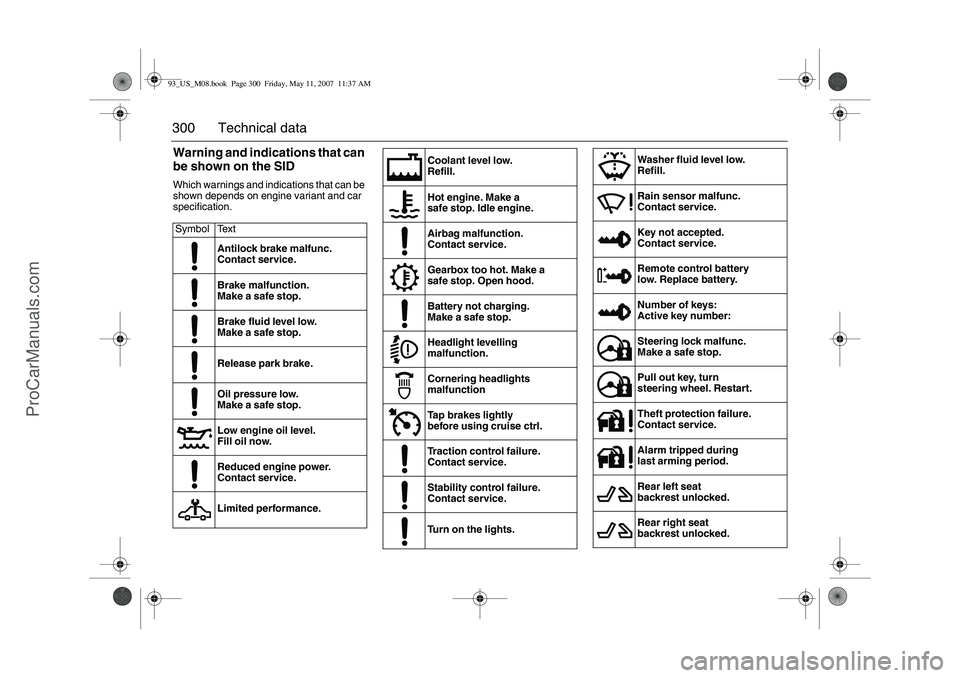
300 Technical dataWarning and indications that can
be shown on the SIDWhich warnings and indications that can be
shown depends on engine variant and car
specification.
Symbol Text
Antilock brake malfunc.
Contact service.
Brake malfunction.
Make a safe stop.
Brake fluid level low.
Make a safe stop.
Release park brake.
Oil pressure low.
Make a safe stop.
Low engine oil level.
Fill oil now.
Reduced engine power.
Contact service.
Limited performance.
Coolant level low.
Refill.
Hot engine. Make a
safe stop. Idle engine.
Airbag malfunction.
Contact service.
Gearbox too hot. Make a
safe stop. Open hood.
Battery not charging.
Make a safe stop.
Headlight levelling
malfunction.
Cornering headlights
malfunction
Tap brakes lightly
before using cruise ctrl.
Traction control failure.
Contact service.
Stability control failure.
Contact service.
Turn on the lights.
Washer fluid level low.
Refill.
Rain sensor malfunc.
Contact service.
Key not accepted.
Contact service.
Remote control battery
low. Replace battery.
Number of keys:
Active key number:
Steering lock malfunc.
Make a safe stop.
Pull out key, turn
steering wheel. Restart.
Theft protection failure.
Contact service.
Alarm tripped during
last arming period.
Rear left seat
backrest unlocked.
Rear right seat
backrest unlocked.
93_US_M08.book Page 300 Friday, May 11, 2007 11:37 AM
ProCarManuals.com
Page 303 of 320
303 Index
Index
AABS brakes
____________________ 173
ACC
_________________________ 108
Adjustment, steering wheel
________ 120
Air filter
_______________________ 211
Airbag
_________________________ 32
Anchorage eyes, SportSedan
______ 141
Anti-corrosion treatment
__________ 271
Antilock braking system __________ 173
Anti-spin
______________________ 175
Ashtrays ______________________ 136
Autochecking of lights, warning and
indicator lights
__________________ 87
Autodimming
_______________ 125
, 126
Automatic climate control (ACC)
____ 108
Automatic closing of moonroof
_____ 131
Automatic closing of windows, SportSedan
and SportCombi
_______________ 122
Automatic transmission
___________ 165
Automatic transmission, sport mode
_167
BBattery
_______________________ 216
Bedding-in of new brake pads
_____ 163
Before towing a trailer
____________ 193
Belt height, SportSedan and
SportCombi
____________________ 14Brake fluid, grade
_______________ 295
Brakes
________________________ 172
Braking _______________________ 172
Bulb changing
__________________ 222
Bulb table
_____________________ 236
Buying new tires
________________ 247
CCabin lighting, Convertible
_________ 78
Cabin lighting, SportSedan and
SportCombi
___________________ 133
Calibrating front electric windows with
pinch protection
________________ 78
Calibration of windows, SportSedan and
SportCombi
___________________ 123
Car alarm
______________________ 56
Car transport ___________________ 199
Care of air conditioning
___________ 274
Cargo guard
___________________ 150
Cargo guard, SportWagon
________ 150
Cargo net, SportCombi
___________ 147
Change of address notification
_____ 282
Changing a tire
_________________ 262
Changing bulbs _________________ 222
Changing the battery, remote control
_54
Changing wiper blades
___________ 220
Checking the number of remote
controls
_______________________ 53
Checks before towing a trailer
_____ 193
Child safety
_____________________ 24
Child safety locks, rear doors
_______ 52Child seats
______________________ 24
Cigarette lighter
_________________ 136
Cleaning the engine bay
__________ 267
Cleaning upholstery
______________ 266
Closing the soft top manually,
Convertible
____________________ 68
Closing the soft top, Convertible
_____ 64
Clutch interlock
_________________ 164
Comfort opening of moonroof
______ 131
Comfort opening of windows,
SportSedan and SportCombi _____ 121
Compact spare
_________________ 260
Compact spare wheel fitted, driving
with
_________________________ 260
Compass
______________________ 129
Convertible _____________________ 61
Convertible, washing
_____________ 268
Coolant
_______________________ 212
Cornering headlights
______________ 99
Crash memory, see EDR
_________ 284
Cruise control
__________________ 171
Cup holder
_____________________ 134
DDate codes, tires
________________ 257
Deactivating rear windows,
SportSedan and SportCombi
_____ 123
Deactivating the passenger door
window button, Convertible
________ 77
Deactivating the rear window
switches
_____________________ 123
93_US_M08.book Page 303 Friday, May 11, 2007 11:37 AM
ProCarManuals.com