fuel cap SAAB 9-3 2008 Owners Manual
[x] Cancel search | Manufacturer: SAAB, Model Year: 2008, Model line: 9-3, Model: SAAB 9-3 2008Pages: 320, PDF Size: 56.39 MB
Page 83 of 320
83 Instruments and controls
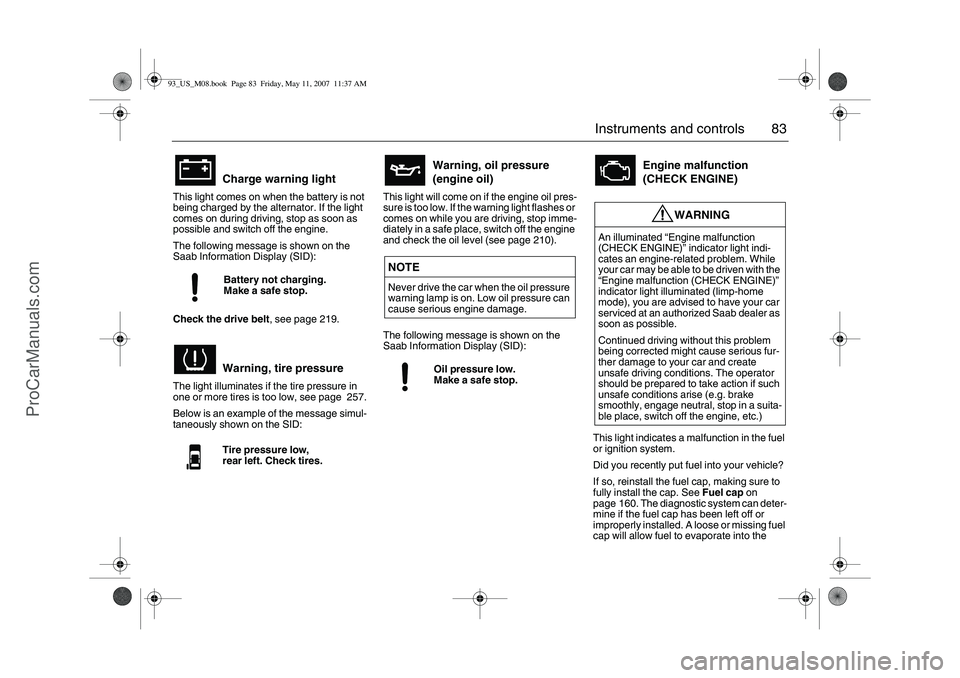
This light comes on when the battery is not
being charged by the alternator. If the light
comes on during driving, stop as soon as
possible and switch off the engine.
The following message is shown on the
Saab Information Display (SID):
Check the drive belt, see page 219.
The light illuminates if the tire pressure in
one or more tires is too low, see page 257.
Below is an example of the message simul-
taneously shown on the SID:This light will come on if the engine oil pres-
sure is too low. If the warning light flashes or
comes on while you are driving, stop imme-
diately in a safe place, switch off the engine
and check the oil level (see page 210).
The following message is shown on the
Saab Information Display (SID):
This light indicates a malfunction in the fuel
or ignition system.
Did you recently put fuel into your vehicle?
If so, reinstall the fuel cap, making sure to
fully install the cap. See Fuel cap on
page 160. The diagnostic system can deter-
mine if the fuel cap has been left off or
improperly installed. A loose or missing fuel
cap will allow fuel to evaporate into the
Charge warning lightBattery not charging.
Make a safe stop.Warning, tire pressureTire pressure low,
rear left. Check tires.
Warning, oil pressure
(engine oil)
NOTE
Never drive the car when the oil pressure
warning lamp is on. Low oil pressure can
cause serious engine damage.
Oil pressure low.
Make a safe stop.
Engine malfunction
(CHECK ENGINE)
WARNING
An illuminated “Engine malfunction
(CHECK ENGINE)” indicator light indi-
cates an engine-related problem. While
your car may be able to be driven with the
“Engine malfunction (CHECK ENGINE)”
indicator light illuminated (limp-home
mode), you are advised to have your car
serviced at an authorized Saab dealer as
soon as possible.
Continued driving without this problem
being corrected might cause serious fur-
ther damage to your car and create
unsafe driving conditions. The operator
should be prepared to take action if such
unsafe conditions arise (e.g. brake
smoothly, engage neutral, stop in a suita-
ble place, switch off the engine, etc.)
93_US_M08.book Page 83 Friday, May 11, 2007 11:37 AM
ProCarManuals.com
Page 157 of 320

157 Starting and driving
Limp-homeThe engine management system has a
diagnostic feature that checks a number of
internal functions. If a fault is detected in the
throttle valve, the engine management
system will set the throttle system to the
limp-home mode. This means:
idling control will be poor (uneven idling
since regulated by ignition and fuel
supply)
engine performance will be reduced
the cruise control will not function
the capacity of the A/C compressor will be
limited.
If the diagnosis function detects a fault in the
engine management system, the light
"Engine malfunction (CHECK ENGINE)" in
the instrument panel will come on (see
page 83). Have the car checked at a work-
shop as soon as possible. We recommend
that you contact a Saab dealer.
Important considerations with
catalytic convertersThe catalytic converter is an emission con-
trol device incorporated in the car’s exhaust
system. It consists of a metal canister with a
honeycomb insert, the cells of which have
walls coated in a catalytic layer (precious
metal alloy).
To ensure that the catalytic converter con-
tinues to function properly, and also to avoid
damage to the converter and its associated
components, the following points must be
observed:
NOTEIf "Engine malfunction (CHECK
ENGINE)" warning light starts to flash
(indicating that the engine is misfiring and
the catalytic converter can be damaged),
ease off the accelerator slightly. The light
should go out or start to shine constantly.
If the light continues to flash despite
easing off the accelerator, you may con-
tinue to drive the car but at the minimum
throttle permitted by the current traffic sit-
uation. Have the car checked as soon as
possible. We recommend that you con-
tact a Saab dealer.
NOTEUse only unleaded gasoline. Leaded gas-
oline is detrimental to the catalyst and
oxygen sensor and will seriously impair
the function of the catalytic converter.
93_US_M08.book Page 157 Friday, May 11, 2007 11:37 AM
ProCarManuals.com
Page 159 of 320

159 Starting and driving
Refueling
WARNING
If you spill fuel and then something ignites
it, you could be badly burned. Fuel can
spray out on you if you open the fuel cap
too quickly. This spray can happen if your
tank is nearly full, and is more likely in hot
weather. Open the fuel cap slowly and
wait for any “hiss” noise to stop. Then
unscrew the cap all the way.
Gasoline fumes are highly explosive.
Therefore:
never smoke while refueling.
never use gasoline for any purpose
other than as engine fuel.
gasoline is extremely flammable and
can cause severe burns. No open or
exposed flames near gasoline.
do not use a mobile phone at the
same time as refueling.
If a fire starts while you are refueling, do
not remove the nozzle. Shut off the flow of
fuel by shutting off the pump or by notify-
ing the station attendant. Leave the area
immediately.
NOTEDo not overfill. Fuel should not come
right up the filler pipe as room for
expansion is needed for when the
temperature rises.
The use of fuel with too low an octane
rating can cause serious engine dam-
age.
Clean fuel from painted surfaces as
soon as possible.
NOTEThe engine control module (ECM) moni-
toring the engine parameters also stores
fault codes.
Under certain circumstances, this may
cause constant illumination of the Engine
malfunction (CHECK ENGINE) lamp
, thus indicating a fault that must be
checked by your Saab dealer, see
page 83.
NOTE: always observe the following two
measures:
Make sure that the fuel filler cap is
screwed on correctly before the
engine is started. Screw on the fuel
filler cap until you hear three clicks.
Avoid driving with the fuel low level
indicator illuminated. The symbol illu-
minates when less than approximately
2.5 gallons (10 litres) of fuel remains
in the tank.
93_US_M08.book Page 159 Friday, May 11, 2007 11:37 AM
ProCarManuals.com
Page 160 of 320
160 Starting and drivingRefueling1 Switch off the engine.
2 Open the fuel cap, located in the
right-hand rear fender.
3 Insert the fuel pump nozzle beyond the
flange on the filler pipe and let the first
mark (a ring, a pimple or the first
spring-coil) rest on the flange. Do not
withdraw the nozzle while filling is in
progress.
4 Cease refueling the first time the pump
stops, and wait a few seconds after
you’ve finished pumping before you
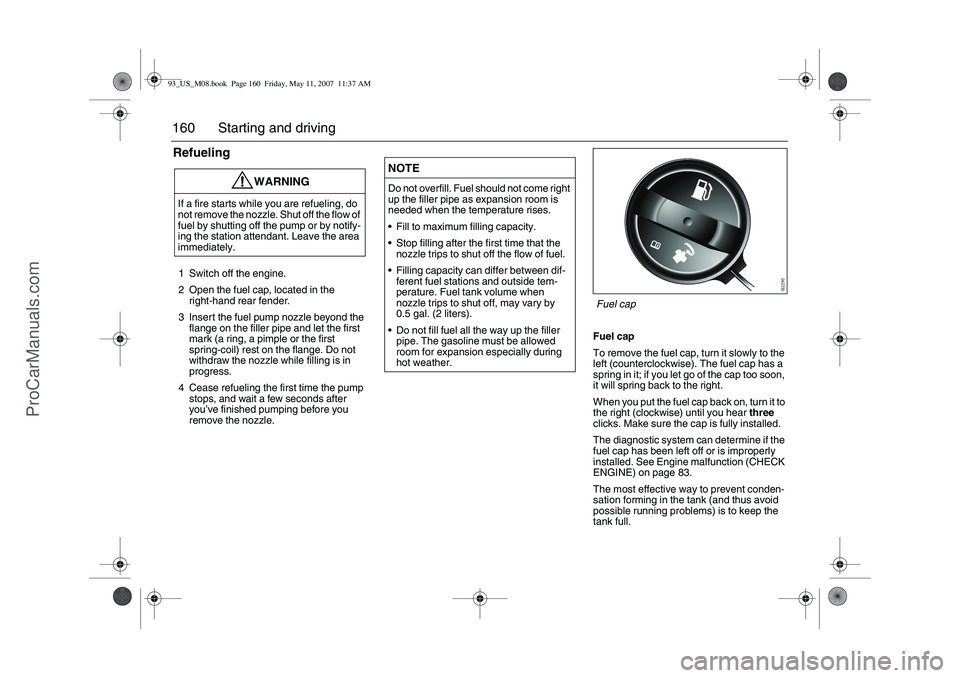
remove the nozzle.Fuel cap
To remove the fuel cap, turn it slowly to the
left (counterclockwise). The fuel cap has a
spring in it; if you let go of the cap too soon,
it will spring back to the right.
When you put the fuel cap back on, turn it to
the right (clockwise) until you hear three
clicks. Make sure the cap is fully installed.
The diagnostic system can determine if the
fuel cap has been left off or is improperly
installed. See Engine malfunction (CHECK
ENGINE) on page 83.
The most effective way to prevent conden-
sation forming in the tank (and thus avoid
possible running problems) is to keep the
tank full.
WARNING
If a fire starts while you are refueling, do
not remove the nozzle. Shut off the flow of
fuel by shutting off the pump or by notify-
ing the station attendant. Leave the area
immediately.
NOTEDo not overfill. Fuel should not come right
up the filler pipe as expansion room is
needed when the temperature rises.
Fill to maximum filling capacity.
Stop filling after the first time that the
nozzle trips to shut off the flow of fuel.
Filling capacity can differ between dif-
ferent fuel stations and outside tem-
perature. Fuel tank volume when
nozzle trips to shut off, may vary by
0.5 gal. (2 liters).
Do not fill fuel all the way up the filler
pipe. The gasoline must be allowed
room for expansion especially during
hot weather.
Fuel cap
93_US_M08.book Page 160 Friday, May 11, 2007 11:37 AM
ProCarManuals.com
Page 161 of 320
161 Starting and driving
Refer to page 187 for information regarding
gasoline anti-freeze.
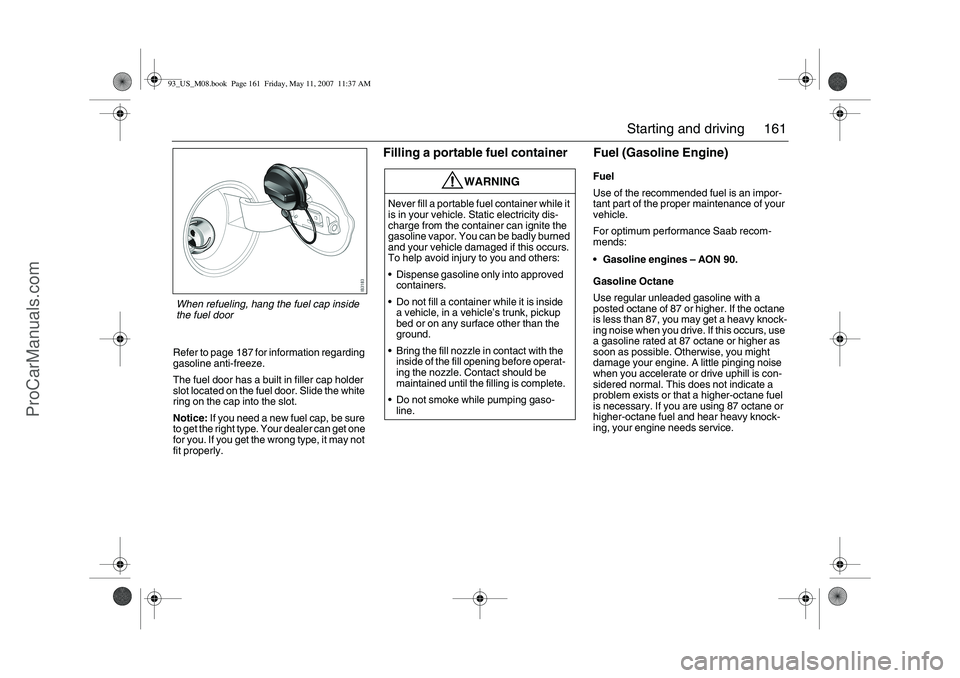
The fuel door has a built in filler cap holder
slot located on the fuel door. Slide the white
ring on the cap into the slot.
Notice: If you need a new fuel cap, be sure
to get the right type. Your dealer can get one
for you. If you get the wrong type, it may not
fit properly.
Filling a portable fuel container Fuel (Gasoline Engine)
Fuel
Use of the recommended fuel is an impor-
tant part of the proper maintenance of your
vehicle.
For optimum performance Saab recom-
mends:
Gasoline engines – AON 90.
Gasoline Octane
Use regular unleaded gasoline with a
posted octane of 87 or higher. If the octane
is less than 87, you may get a heavy knock-
ing noise when you drive. If this occurs, use
a gasoline rated at 87 octane or higher as
soon as possible. Otherwise, you might
damage your engine. A little pinging noise
when you accelerate or drive uphill is con-
sidered normal. This does not indicate a
problem exists or that a higher-octane fuel
is necessary. If you are using 87 octane or
higher-octane fuel and hear heavy knock-
ing, your engine needs service.
WARNING
Never fill a portable fuel container while it
is in your vehicle. Static electricity dis-
charge from the container can ignite the
gasoline vapor. You can be badly burned
and your vehicle damaged if this occurs.
To help avoid injury to you and others:
Dispense gasoline only into approved
containers.
Do not fill a container while it is inside
a vehicle, in a vehicle’s trunk, pickup
bed or on any surface other than the
ground.
Bring the fill nozzle in contact with the
inside of the fill opening before operat-
ing the nozzle. Contact should be
maintained until the filling is complete.
Do not smoke while pumping gaso-
line.
When refueling, hang the fuel cap inside
the fuel door93_US_M08.book Page 161 Friday, May 11, 2007 11:37 AM
ProCarManuals.com
Page 206 of 320
206 Car careEmission control
systemsThe systems for controlling emissions to the
atmosphere require regular checking and
adjustment at the intervals specified in the
service program.
In addition to meeting the exhaust emission
regulations and thereby helping to keep the
environment clean, a correctly tuned engine
will also give maximum fuel economy.
Saab Trionic engine
management system, 4-cyl
engineThe Saab Trionic engine management
system is a unique Saab development that
combines sequential multiport fuel injection,
electronic distributorless ignition and turbo-
charger boost pressure control into one sys-
tem.
The Trionic engine control module (ECM)
monitors many different engine parameters
such as:
Intake manifold pressure.
Intake air temperature.
Crankshaft position.
Engine coolant temperature.
Throttle position.
The oxygen content of the exhaust gases.
The ECM receives information regarding
engine knocking from a sophisticated feed-
back function in the ignition discharge unit.
By processing all of this information, the Tri-
onic system can control fuel injector open-
ing duration, ignition timing and turbo-
charger boost pressure to provide excellent
engine performance while maintaining low
emissions and fuel consumption.
WARNING
Engine exhaust, some of its constituents,
and certain vehicle components contain
or emit chemicals known to the State of
California to cause cancer and birth
defects and reproductive harm. In addi-
tion, certain fluids contained in vehicles
and certain products of component wear
contain or emit chemicals known to the
State of California to cause cancer and
birth defects or other reproductive harm.
NOTEThe Trionic engine management system
continuously monitors the operation of
these systems and has on-board diag-
nostic capabilities (OBD II). If the Engine
malfunction (CHECK ENGINE) light in
the main instrument illuminates, the Tri-
onic ECM has detected a problem. The
car will continue to operate, but perfor-
mance may be diminished. You should
have your car checked by a workshop as
soon as possible. We recommend that
you contact a Saab dealer.
93_US_M08.book Page 206 Friday, May 11, 2007 11:37 AM
ProCarManuals.com
Page 207 of 320
207 Car care
Bosch ME9 engine management
system, V6 engineThe Bosch ME9 engine management
system is a system that combines sequen-
tial multiport fuel injection, electronic distrib-
utorless ignition and turbocharger boost
pressure control into one system and intake
camshaft phasing control.
The ME9 engine control module (ECM)
monitors many different engine parameters
such as:
Charge air pressure.
Intake air temperature.
Crankshaft position.
Engine coolant temperature.
Throttle position.
The oxygen content of the exhaust gases.
By processing all of this information, the
ME9 system can control fuel injector open-
ing duration, ignition timing, intake camshaft
phasing and turbocharger boost pressure to
provide excellent engine performance while
maintaining low emissions and fuel con-
sumption.
ORVR (Onboard Refueling Vapor
Recovery)All hydrocarbons formed when refueling will
be recovered by the car and not released
into the atmosphere. The hydrocarbons are
absorbed in an evaporative emission canis-
ter. When the engine is subsequently
started, the evaporative emission canister is
gradually purged as air is sucked into it
through a shut-off valve. The hydrocar-
bon/air mixture passes through the evap
canister purge valve and into the engine
where it is burned. “Refueling”, see
page 159.
When refueling, make sure you screw the
filler cap on and keep turning until it has
clicked 3 times.
NOTEThe ME9 engine management system
continuously monitors the operation of
these systems and has on-board diag-
nostic capabilities (OBD II). If the Engine
malfunction (CHECK ENGINE) light in
the main instrument illuminates, the ME9
ECM has detected a problem. The car will
continue to operate, but performance
may be diminished. You should have your
car checked by a workshop as soon as
possible. We recommend that you con-
tact a Saab dealer.
93_US_M08.book Page 207 Friday, May 11, 2007 11:37 AM
ProCarManuals.com
Page 254 of 320
254 Car care
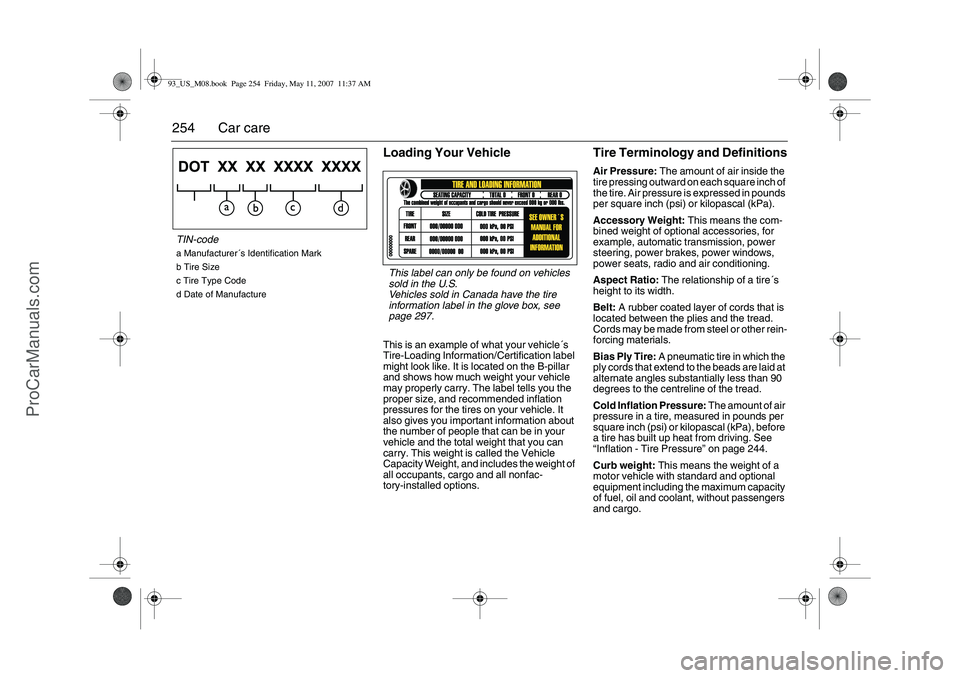
Loading Your VehicleThis is an example of what your vehicle´s
Tire-Loading Information/Certification label
might look like. It is located on the B-pillar
and shows how much weight your vehicle
may properly carry. The label tells you the
proper size, and recommended inflation
pressures for the tires on your vehicle. It
also gives you important information about
the number of people that can be in your
vehicle and the total weight that you can
carry. This weight is called the Vehicle
Capacity Weight, and includes the weight of
all occupants, cargo and all nonfac-
tory-installed options.
Tire Terminology and DefinitionsAir Pressure: The amount of air inside the
tire pressing outward on each square inch of
the tire. Air pressure is expressed in pounds
per square inch (psi) or kilopascal (kPa).
Accessory Weight: This means the com-
bined weight of optional accessories, for
example, automatic transmission, power
steering, power brakes, power windows,
power seats, radio and air conditioning.
Aspect Ratio: The relationship of a tire´s
height to its width.
Belt: A rubber coated layer of cords that is
located between the plies and the tread.
Cords may be made from steel or other rein-
forcing materials.
Bias Ply Tire: A pneumatic tire in which the
ply cords that extend to the beads are laid at
alternate angles substantially less than 90
degrees to the centreline of the tread.
Cold Inflation Pressure: The amount of air
pressure in a tire, measured in pounds per
square inch (psi) or kilopascal (kPa), before
a tire has built up heat from driving. See
“Inflation - Tire Pressure” on page 244.
Curb weight: This means the weight of a
motor vehicle with standard and optional
equipment including the maximum capacity
of fuel, oil and coolant, without passengers
and cargo. This label can only be found on vehicles
sold in the U.S.
Vehicles sold in Canada have the tire
information label in the glove box, see
page 297.
TIN-codea Manufacturer´s Identification Mark
b Tire Size
c Tire Type Code
d Date of Manufacture93_US_M08.book Page 254 Friday, May 11, 2007 11:37 AM
ProCarManuals.com
Page 275 of 320
275 Car care
Other than in extremely cold weather, do not
screen the radiator, e.g. with netting, as this
will greatly diminish its cooling capacity.
Applicable to the manual climate control
system - During cold months the air condi-
tioning should be switched on once or
twice a month and run for 5–10 minutes
during highway driving once the engine is
warm.
This action saves the gaskets in the
compressor from being spoiled. The
compressor uses a lubricant that circu-
lates with the coolant.
Note
The A/C system cannot be switched on
when the outside temperature is below 32°F
(0°C). Turn on the A/C system when the car
is standing in a warm place. Simplest is to
always have the A/C button pressed in. The
A/C system will then cut in automatically
when the outside temperature is high
enough.
Headlight aimingThe vehicle has a visual optical headlight
aiming system equipped with vertical
aiming device. The aim has been preset at
the factory and should normally not need
further adjustments.
If your headlights are damaged in a crash,
the headlight aim may be affected. If you
believe your headlights need to be
re-aimed, we recommend that you take it to
your Saab dealer for service. However, it is
possible for you to re-aim your headlights as
described in the following procedure.To check the aim, the vehicle should be
properly prepared as follows:
The vehicle shall be placed so that the
headlights are 25 ft (7.6 m) from a light
colored wall or other flat surface. The
aiming area should be darkened, this will
improve your ability to see the beam of the
low beam headlight being aimed.
An optical headlamp aimer can also be
used and will than replace the wall.
The vehicle must have all four wheels on
a perfectly level surface which is level all
the way to the wall or other flat surface.
The vehicle should be placed so it is
perpendicular to the wall or other flat
surface.
The vehicle should be unloaded and fuel
tank full, and one person or 160 lbs.
(75 kg) on the drivers seat.
The vehicle should be fully assembled
and all other work stopped while headlight
aiming is being done.
The vehicle should not have any snow, ice
or mud attached to it.
Tires should be inflated to the prescribed
pressure.
Close all doors.
Rock the vehicle to stabilize the suspen-
sion.
Headlight aiming is done with the vehicle
low beam lamps. The high beam lamps will
WARNING
Before checking/adjusting the headlight
aiming, switch off the engine to avoid
danger of fingers and hands being injured
by moving parts.
The radiator fan can start up even when
the engine is switched off.NOTETo make sure that your headlights are
aimed properly read all instructions
before beginning. Failure to follow these
instructions could cause damage to
headlight parts or a not correctly aimed
headlight.
93_US_M08.book Page 275 Friday, May 11, 2007 11:37 AM
ProCarManuals.com
Page 290 of 320
290 Technical dataEngine oilTo meet demands in Saab's extended service intervals all en-
gines are filled with specially designed synthetic factory fill oils.
Long service intervals, fuel economy and environmental issues
are the base for our choice of oil. By using oils approved by
Saab you minimize the tendencies for oil sludge build, by that
protecting the engine from harmful, wear increasing, deposits.
Approved oils
For all gasoline engines - synthetic engine oil - approved
against the GM-LL-A-025 specification. To benefit from Saab´s
specified service intervals, pleasure ensure to select a synthetic
engine oil approved against GM-LL-A-025.
For optimum performance Saab recommends the use of Saab
Long Life Turbo Oil SAE 0W-30, 0W-40, 5W-30 or 5W-40.
Servicing/Oil changes
To be able to use recommended service intervals the need to
use only approved engine oils is vital. Use only engine oils ap-
proved for your engine. Service should be done according to
the recommended service intervals to optimize your engine's
function through out its entire life. Saab Automobile AB will not
take responsibility for any damage that might occur due to ne-
glecting to meet above mentioned requirements.
At your Saab dealers you can find Saab and GM Genuine en-
gine oils. Among those there are oils specially designed to meet
your engines specific needs. We recommend that you, with the
help of our skilled service personnel, choose your oil from that
selection.
Other oil companies also offer engine oils approved against GM
specifications. Oils meeting these standards may be marked as
synthetic. However, not all synthetic engine oils will meet your
engines specific requirements. Please ensure only to use syn-
thetic oils approved against your engines specific requirements,
i.e. GM-LL-A-025.Extra engine oil additives
Don't add anything to your oil. The recommended oils are all
you will need for good engine performance and protection.
When to change engine oil
Your vehicle has a display (SID) where time for service will be
shown. Based not only on mileage but also on driving condi-
tions the mileage at which a service will be indicated can vary
considerably.
For this service system to work it is of outmost importance that
the right engine oil is used.
When the message for service is displayed you need to have
the required service done as soon as possible.
After the service your service personnel will reset the service in-
dicator. It is important to reset the service indicator in order to
optimize the time to the next service.
Oil capacity, including filter (oil change) __
4-cyl engine ______________________ 6.3 qts. (6.0 l)
V6 engine ________________________ 6.3 qts. (6.0 l)
93_US_M08.book Page 290 Friday, May 11, 2007 11:37 AM
ProCarManuals.com