technical data SAAB 9-3 2008 Owners Manual
[x] Cancel search | Manufacturer: SAAB, Model Year: 2008, Model line: 9-3, Model: SAAB 9-3 2008Pages: 320, PDF Size: 56.39 MB
Page 1 of 320
1
Owner’s Manual
Saab 9-3 M2008
© Saab Automobile AB 2007Service Readiness, Saab Automobile AB, Trollhättan, Sweden
Printed in Sweden
Safety 11
Security 47
9-3 Convertible 61
Instruments and controls 81
Interior equipment 119
Starting and driving 151
Car care 203
Customer Assistance and Information 279
Technical data 285
Index 303
93_US_M08.book Page 1 Friday, May 11, 2007 11:37 AM
ProCarManuals.com
Page 6 of 320
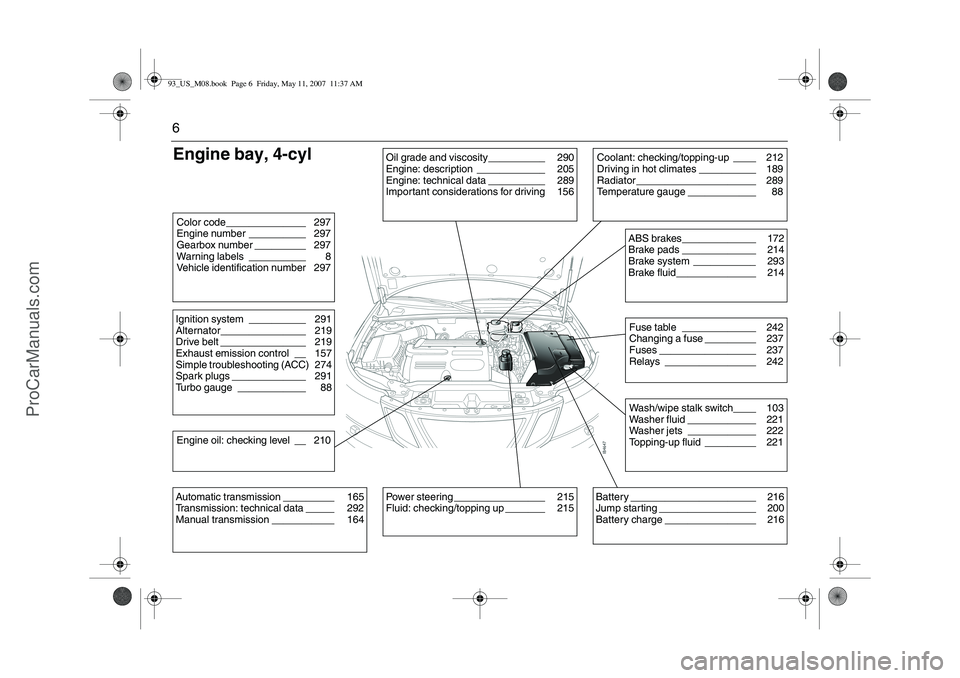
6Engine bay, 4-cylColor code______________ 297
Engine number __________ 297
Gearbox number _________ 297
Warning labels __________ 8
Vehicle identification number 297Ignition system __________ 291
Alternator_______________ 219
Drive belt _______________ 219
Exhaust emission control __ 157
Simple troubleshooting (ACC) 274
Spark plugs _____________ 291
Turbo gauge ____________ 88Engine oil: checking level __ 210Automatic transmission _________ 165
Transmission: technical data _____ 292
Manual transmission ___________ 164
Battery ______________________ 216
Jump starting _________________ 200
Battery charge ________________ 216
Oil grade and viscosity__________ 290
Engine: description ____________ 205
Engine: technical data __________ 289
Important considerations for driving 156
Wash/wipe stalk switch____ 103
Washer fluid ____________ 221
Washer jets ____________ 222
Topping-up fluid _________ 221
Power steering ________________ 215
Fluid: checking/topping up _______ 215
Coolant: checking/topping-up ____ 212
Driving in hot climates __________ 189
Radiator _____________________ 289
Temperature gauge ____________ 88
Fuse table _____________ 242
Changing a fuse _________ 237
Fuses _________________ 237
Relays ________________ 242ABS brakes_____________ 172
Brake pads _____________ 214
Brake system ___________ 293
Brake fluid______________ 214
93_US_M08.book Page 6 Friday, May 11, 2007 11:37 AM
ProCarManuals.com
Page 7 of 320
7
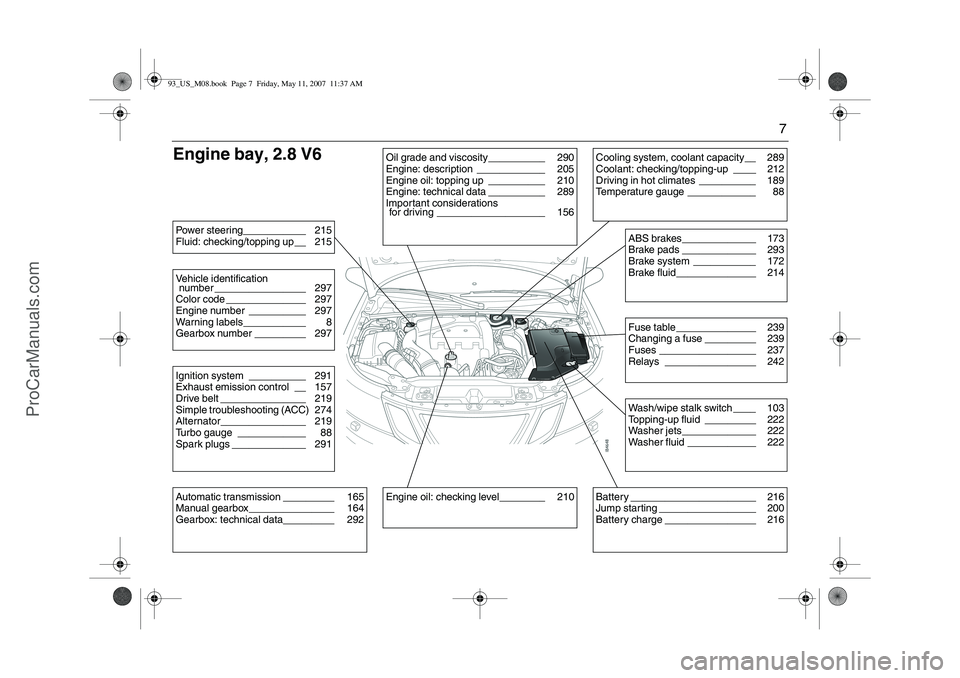
Engine bay, 2.8 V6Power steering___________ 215
Fluid: checking/topping up__ 215Vehicle identification
number ________________ 297
Color code ______________ 297
Engine number __________ 297
Warning labels___________ 8
Gearbox number _________ 297Ignition system __________ 291
Exhaust emission control __ 157
Drive belt _______________ 219
Simple troubleshooting (ACC) 274
Alternator_______________ 219
Turbo gauge ____________ 88
Spark plugs _____________ 291Automatic transmission _________ 165
Manual gearbox_______________ 164
Gearbox: technical data_________ 292
Oil grade and viscosity__________ 290
Engine: description ____________ 205
Engine oil: topping up __________ 210
Engine: technical data __________ 289
Important considerations
for driving ___________________ 156Engine oil: checking level________ 210
Battery ______________________ 216
Jump starting _________________ 200
Battery charge ________________ 216
Wash/wipe stalk switch ____ 103
Topping-up fluid _________ 222
Washer jets_____________ 222
Washer fluid ____________ 222Fuse table ______________ 239
Changing a fuse _________ 239
Fuses _________________ 237
Relays ________________ 242ABS brakes_____________ 173
Brake pads _____________ 293
Brake system ___________ 172
Brake fluid______________ 214
Cooling system, coolant capacity__ 289
Coolant: checking/topping-up ____ 212
Driving in hot climates __________ 189
Temperature gauge ____________ 88
93_US_M08.book Page 7 Friday, May 11, 2007 11:37 AM
ProCarManuals.com
Page 188 of 320
188 Starting and drivingRemember that tires age: it may therefore
be necessary to change winter tires before
they reach the legal wear limit, as they grad-
ually lose their friction properties with age.
If you get into a front wheel skid and the car
has a manual transmission, the best
response is to freewheel, which means
declutching so that the wheels neither drive
nor brake, and to cautiously steer in the
desired direction.
If the car has automatic transmission, ease
off the accelerator slightly and steer cau-
tiously in the desired direction.
If you get into a rear wheel skid, steer in the
same direction as the movement of the rear
of the car.
Driving with tire chains3
33 3Snow chains must only be fitted to the wheel
and tire dimensions that Saab recommends
in "Technical data" on page 285.
We recommend that you contact a Saab
dealer regarding approved tire chains. See
also page 251.
WARNING
Do not drive at speeds above 30 mph
(50 km/h) when tire chains are fitted.
Tire chains can reduce directional sta-
bility.
Do not fit tire chains to the car’s rear
wheels.
NOTECheck the links frequently for wear.
Check that the chains do not foul the
wheel arch liner at full lock.
Refer to the "Technical data" section
on page 285, for information on wheel
and tire dimensions approved for the
fitting of tire chains.
93_US_M08.book Page 188 Friday, May 11, 2007 11:37 AM
ProCarManuals.com
Page 285 of 320
285 Technical data
General data __________ 286
Engine _______________ 289
Engine oil _____________ 290
Fuel__________________ 291
Engines ______________ 291
Electrical system_______ 291
Drive belt _____________ 292
Manual transmission ___ 292
Automatic transmission _ 292
Suspension ___________ 293
Steering ______________ 293
Brake system__________ 293
Wheels and tires _______ 294
Plates and labels _______ 297
Technical data
3Asterisk means: equipment not fitted in all cars
(can depend on model variant, engine variant,
market specification, options or accessories).93_US_M08.book Page 285 Friday, May 11, 2007 11:37 AM
ProCarManuals.com
Page 286 of 320
286 Technical dataGeneral dataOverall length, including bumpers:
SportSedan and Convertible _________ 182.9'' (4647 mm)
SportCombi_______________________ 183.8'' (4670 mm)
Overall width, including door mirrors _____ 80.2'' (2038 mm)
Maximum height ____________________ 60.7'' (1543 mm)
Wheelbase ________________________ 105.3'' (2675 mm)
Tr a c k :
Front ____________________________ 59.8'' (1524 mm)
Re ar ____________________________ 59.3'' (1506 mm)
Ground clearance at GVW ____________ approx. 4.7''
(120 mm)
Number of seats (incl. driver):
SportSedan and SportCombi _________ 5
Convertible _______________________ 4
Turning circle:
Measured at vehicle extremities _______ 39.0 ft. (11.9 m)V.I.N. label on vehi-
cles sold in U.S.A.V.I.N. label on vehicles sold in
Canada
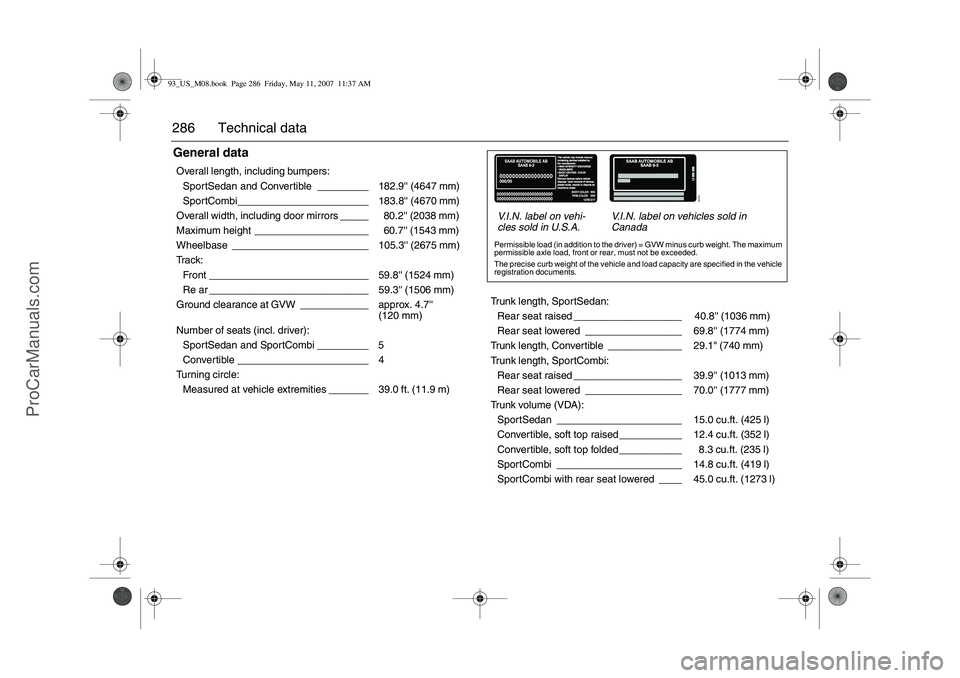
Permissible load (in addition to the driver) = GVW minus curb weight. The maximum
permissible axle load, front or rear, must not be exceeded.
The precise curb weight of the vehicle and load capacity are specified in the vehicle
registration documents.Trunk length, SportSedan:
Rear seat raised ___________________ 40.8'' (1036 mm)
Rear seat lowered _________________ 69.8'' (1774 mm)
Trunk length, Convertible _____________ 29.1" (740 mm)
Trunk length, SportCombi:
Rear seat raised ___________________ 39.9'' (1013 mm)
Rear seat lowered _________________ 70.0'' (1777 mm)
Trunk volume (VDA):
SportSedan ______________________ 15.0 cu.ft. (425 l)
Convertible, soft top raised ___________ 12.4 cu.ft. (352 l)
Convertible, soft top folded ___________ 8.3 cu.ft. (235 l)
SportCombi ______________________ 14.8 cu.ft. (419 l)
SportCombi with rear seat lowered ____ 45.0 cu.ft. (1273 l)
93_US_M08.book Page 286 Friday, May 11, 2007 11:37 AM
ProCarManuals.com
Page 287 of 320
287 Technical data
Curb weight
(i.e. with full fuel tank, full washer fluid res-
ervoir, standard tools and spare wheel):
SportSedan_______________________ 3210–3600 lbs.
(1455–1635 kg)
Convertible _______________________ 3520–3880 lbs.
(1595–1760 kg)
SportCombi_______________________ 3310–3730 lbs.
(1500–1690 kg)
Gross vehicle weight (GVW):
SportSedan_______________________ 4140–4540 lbs.
(1880–2060 kg)
Convertible _______________________ 4420–4660 lbs.
(2005–2115 kg)
SportCombi_______________________ 4240–4660 lbs.
(1925–2115 kg)
Maximum axle load:
SportSedan, front __________________ 2440 lbs. (1150 kg)
SportSedan, rear __________________ 2230 lbs. (1010 kg)
Convertible, front __________________ 2560 lbs. (1160 kg)
Convertible, rear ___________________ 2310 lbs. (1050 kg)
SportCombi, front __________________ 2540 lbs. (1150 kg)
SportCombi, rear __________________ 2430 lbs. (1100 kg)Weight distribution:
Curb weight + driver (150 lbs. (68 kg)),
front/rear, SportSedan and SportCombi_ approx. 60/40 %
GVW, front/rear, SportSedan and Sport-
Combi ___________________________ approx. 50/50 %
Maximum roof load, SportSedan and Sport-
Combi ___________________________ 220 lbs. (100 kg)
Maximum load in trunk, SportSedan, Con-
vertible and SportCombi _____________ 175 lbs. (80 kg)
The combined weight of occupants and
cargo should never exceed:
SportSedan and SportCombi _________ 926 lbs. (420 kg)
Convertible _______________________ 776 lbs. (352 kg)
Maximum combined weight of driver and
passengers ______________________
SportSedan and SportCombi (5x150 lbs.) 750 lbs. (340 kg)
Convertible (4x150 lbs.) _____________ 600 lbs. (272 kg)93_US_M08.book Page 287 Friday, May 11, 2007 11:37 AM
ProCarManuals.com
Page 288 of 320
288 Technical data
WARNING
The GVW and maximum axle loads must not be exceeded.
Note that if some accessories (e.g. towbar, CD changer) are
fitted, the available load capacity is reduced by the weight of
these.
When carrying a load in the trunk, make sure that it is lashed
down securely, particularly when part or all of the rear seat is
folded down.
Trailer
Trailer with brakes ___________________ Max. 3500 lbs.
(1588 kg)
Trailer without brakes ________________ Max. 1000 lbs.
(450 kg)
Recommended towball load ___________ 110–165 lbs.
(50–75 kg)
See also page 192.
Maximum theoretical towing speed, trailer
with brakes _______________________ 60 mph (100 km/h)
Maximum theoretical towing speed, trailer
without brakes ____________________National restrictions
apply
When towing a trailer, increase the pressure
of the rear tires by 20 kPa (3 psi).
The above speed and weight restrictions are those specified by
Saab Automobile AB.
Note that national restrictions may apply to trailer speeds and
weights (see page 190).
93_US_M08.book Page 288 Friday, May 11, 2007 11:37 AM
ProCarManuals.com
Page 289 of 320
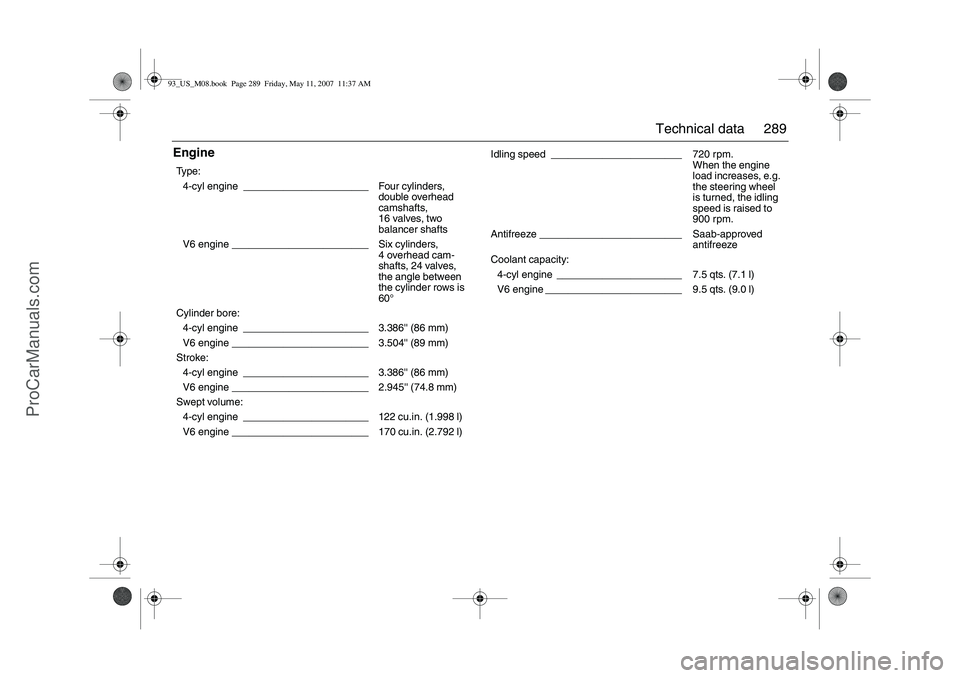
289 Technical data
EngineType:
4-cyl engine ______________________ Four cylinders,
double overhead
camshafts,
16 valves, two
balancer shafts
V6 engine ________________________ Six cylinders,
4 overhead cam-
shafts, 24 valves,
the angle between
the cylinder rows is
60°
Cylinder bore:
4-cyl engine ______________________ 3.386'' (86 mm)
V6 engine ________________________ 3.504'' (89 mm)
Stroke:
4-cyl engine ______________________ 3.386'' (86 mm)
V6 engine ________________________ 2.945'' (74.8 mm)
Swept volume:
4-cyl engine ______________________ 122 cu.in. (1.998 l)
V6 engine ________________________ 170 cu.in. (2.792 l)Idling speed _______________________ 720 rpm.
When the engine
load increases, e.g.
the steering wheel
is turned, the idling
speed is raised to
900 rpm.
Antifreeze _________________________ Saab-approved
antifreeze
Coolant capacity:
4-cyl engine ______________________ 7.5 qts. (7.1 l)
V6 engine ________________________ 9.5 qts. (9.0 l)93_US_M08.book Page 289 Friday, May 11, 2007 11:37 AM
ProCarManuals.com
Page 290 of 320
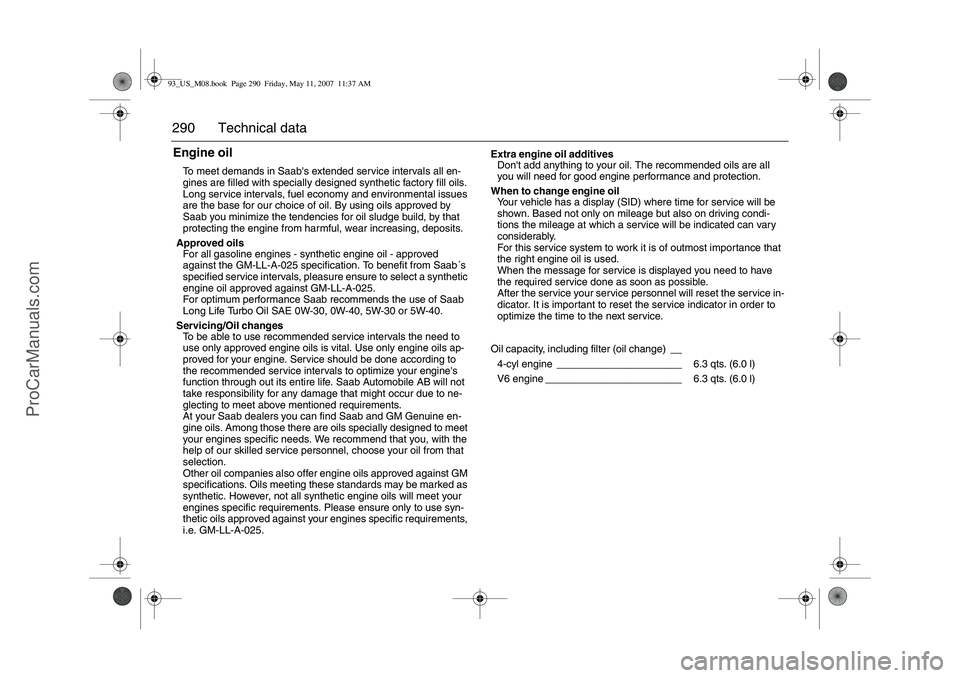
290 Technical dataEngine oilTo meet demands in Saab's extended service intervals all en-
gines are filled with specially designed synthetic factory fill oils.
Long service intervals, fuel economy and environmental issues
are the base for our choice of oil. By using oils approved by
Saab you minimize the tendencies for oil sludge build, by that
protecting the engine from harmful, wear increasing, deposits.
Approved oils
For all gasoline engines - synthetic engine oil - approved
against the GM-LL-A-025 specification. To benefit from Saab´s
specified service intervals, pleasure ensure to select a synthetic
engine oil approved against GM-LL-A-025.
For optimum performance Saab recommends the use of Saab
Long Life Turbo Oil SAE 0W-30, 0W-40, 5W-30 or 5W-40.
Servicing/Oil changes
To be able to use recommended service intervals the need to
use only approved engine oils is vital. Use only engine oils ap-
proved for your engine. Service should be done according to
the recommended service intervals to optimize your engine's
function through out its entire life. Saab Automobile AB will not
take responsibility for any damage that might occur due to ne-
glecting to meet above mentioned requirements.
At your Saab dealers you can find Saab and GM Genuine en-
gine oils. Among those there are oils specially designed to meet
your engines specific needs. We recommend that you, with the
help of our skilled service personnel, choose your oil from that
selection.
Other oil companies also offer engine oils approved against GM
specifications. Oils meeting these standards may be marked as
synthetic. However, not all synthetic engine oils will meet your
engines specific requirements. Please ensure only to use syn-
thetic oils approved against your engines specific requirements,
i.e. GM-LL-A-025.Extra engine oil additives
Don't add anything to your oil. The recommended oils are all
you will need for good engine performance and protection.
When to change engine oil
Your vehicle has a display (SID) where time for service will be
shown. Based not only on mileage but also on driving condi-
tions the mileage at which a service will be indicated can vary
considerably.
For this service system to work it is of outmost importance that
the right engine oil is used.
When the message for service is displayed you need to have
the required service done as soon as possible.
After the service your service personnel will reset the service in-
dicator. It is important to reset the service indicator in order to
optimize the time to the next service.
Oil capacity, including filter (oil change) __
4-cyl engine ______________________ 6.3 qts. (6.0 l)
V6 engine ________________________ 6.3 qts. (6.0 l)
93_US_M08.book Page 290 Friday, May 11, 2007 11:37 AM
ProCarManuals.com