trailer SAAB 9-5 2000 User Guide
[x] Cancel search | Manufacturer: SAAB, Model Year: 2000, Model line: 9-5, Model: SAAB 9-5 2000Pages: 256, PDF Size: 14.24 MB
Page 172 of 256
172 Car care and technical informationOil changingThe engine oil must be changed in accor-
dance with the service program, see page
218.
Oil volume and grade, see page 229.
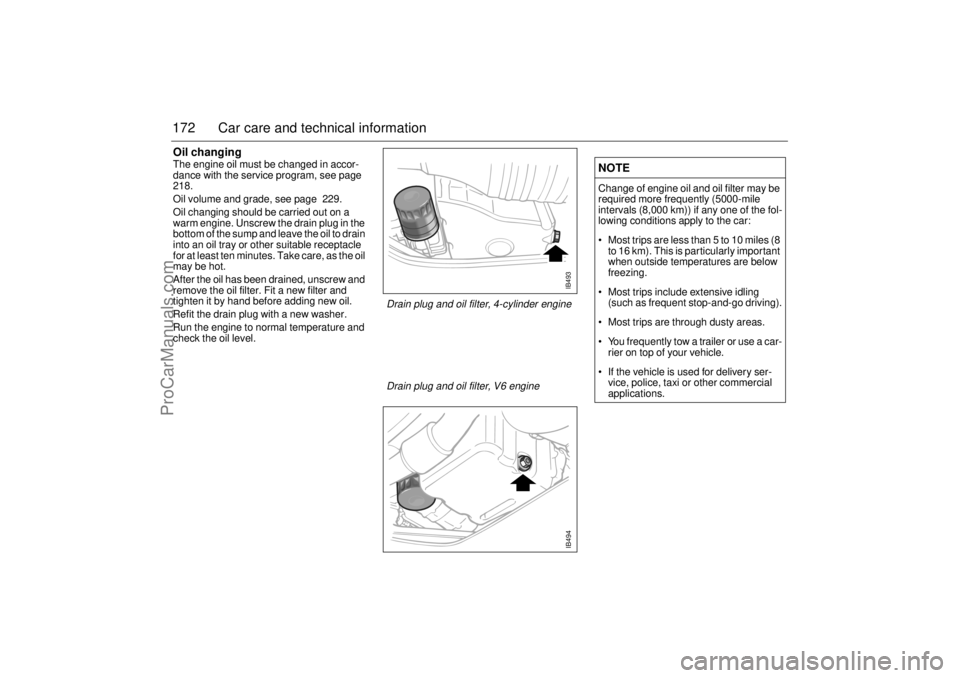
Oil changing should be carried out on a
warm engine. Unscrew the drain plug in the
bottom of the sump and leave the oil to drain
into an oil tray or other suitable receptacle
for at least ten minutes. Take care, as the oil
may be hot.
After the oil has been drained, unscrew and
remove the oil filter. Fit a new filter and
tighten it by hand before adding new oil.
Refit the drain plug with a new washer.
Run the engine to normal temperature and
check the oil level.
NOTEChange of engine oil and oil filter may be
required more frequently (5000-mile
intervals (8,000 km)) if any one of the fol-
lowing conditions apply to the car:
Most trips are less than 5 to 10 miles (8
to 16 km). This is particularly important
when outside temperatures are below
freezing.
Most trips include extensive idling
(such as frequent stop-and-go driving).
Most trips are through dusty areas.
You frequently tow a trailer or use a car-
rier on top of your vehicle.
If the vehicle is used for delivery ser-
vice, police, taxi or other commercial
applications.
IB493
Drain plug and oil filter, 4-cylinder engine
IB494
Drain plug and oil filter, V6 engine
ProCarManuals.com
Page 194 of 256
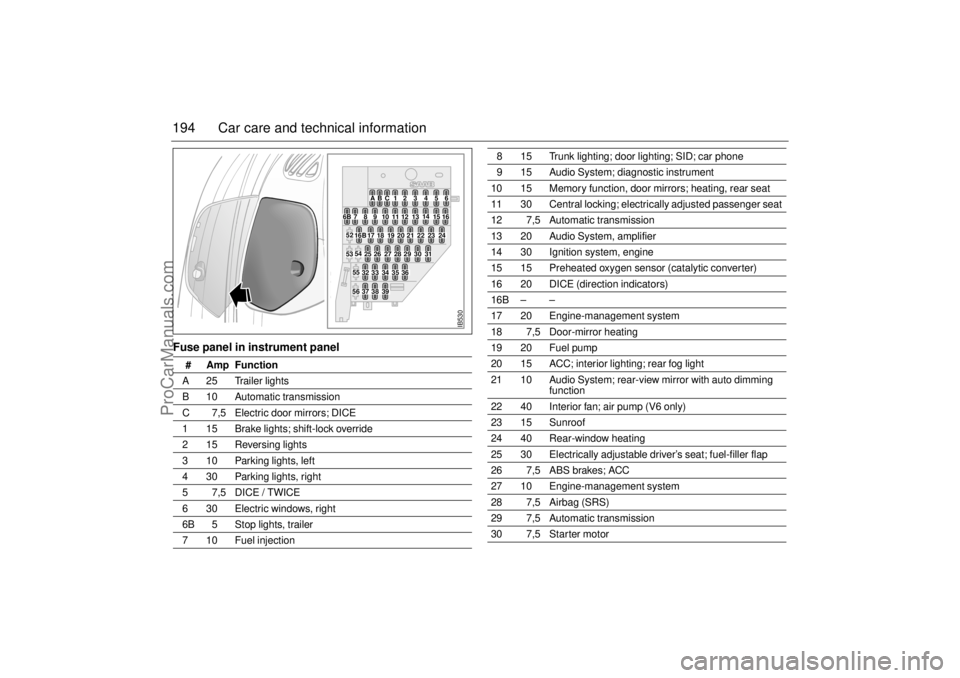
194 Car care and technical informationFuse panel in instrument panel
# Amp Function
A 25 Trailer lights
B 10 Automatic transmission
C 7,5 Electric door mirrors; DICE
1 15 Brake lights; shift-lock override
2 15 Reversing lights
3 10 Parking lights, left
4 30 Parking lights, right
5 7,5 DICE / TWICE
6 30 Electric windows, right
6B 5 Stop lights, trailer
7 10 Fuel injection
8 15 Trunk lighting; door lighting; SID; car phone
9 15 Audio System; diagnostic instrument
10 15 Memory function, door mirrors; heating, rear seat
11 30 Central locking; electrically adjusted passenger seat
12 7,5 Automatic transmission
13 20 Audio System, amplifier
14 30 Ignition system, engine
15 15 Preheated oxygen sensor (catalytic converter)
16 20 DICE (direction indicators)
16B – –
17 20 Engine-management system
18 7,5 Door-mirror heating
19 20 Fuel pump
20 15 ACC; interior lighting; rear fog light
21 10 Audio System; rear-view mirror with auto dimming
function
22 40 Interior fan; air pump (V6 only)
23 15 Sunroof
24 40 Rear-window heating
25 30 Electrically adjustable driver’s seat; fuel-filler flap
26 7,5 ABS brakes; ACC
27 10 Engine-management system
28 7,5 Airbag (SRS)
29 7,5 Automatic transmission
30 7,5 Starter motor
IB530
BC123456 A
14
121110987
13
6B
1516
2324
222120191817
16B
5425262728293031
3635343332
39383755525356
ProCarManuals.com
Page 204 of 256
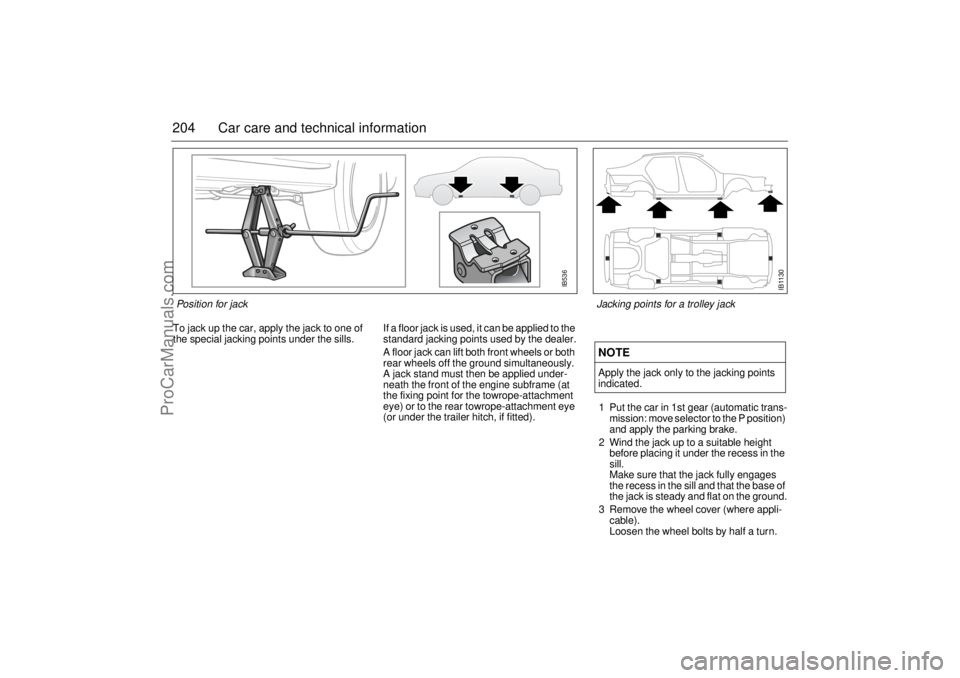
204 Car care and technical informationTo jack up the car, apply the jack to one of
the special jacking points under the sills.If a floor jack is used, it can be applied to the
standard jacking points used by the dealer.
A floor jack can lift both front wheels or both
rear wheels off the ground simultaneously.
A jack stand must then be applied under-
neath the front of the engine subframe (at
the fixing point for the towrope-attachment
eye) or to the rear towrope-attachment eye
(or under the trailer hitch, if fitted).1 Put the car in 1st gear (automatic trans-
mission: move selector to the P position)
and apply the parking brake.
2 Wind the jack up to a suitable height
before placing it under the recess in the
sill.
Make sure that the jack fully engages
the recess in the sill and that the base of
the jack is steady and flat on the ground.
3 Remove the wheel cover (where appli-
cable).
Loosen the wheel bolts by half a turn.
NOTEApply the jack only to the jacking points
indicated.
Pos i ti o n for j ack
IB1130
Jacking points for a trolley jack
IB536
ProCarManuals.com
Page 222 of 256

222 Maintenance and owner assistance* These are the minimum required Emission Control System maintenance steps. Saab urges that all recommended maintenance procedures be performed
according to this program.
(b.) Change automatic transmission fluid at more frequent intervals (20,000; 50,000; 80,000 miles, etc.) if car is driven in dense city traffic where the outside
temperature regularly reach 90°F or higher, or if car is used in a mountainous/high altitude area or for trailer towing.
Service Intervals **
Miles = U.S. Cars
Kilometers = Canadian Cars
1,000
(1,600 km)
10,000
(16,000 km)
20,000
(32,000 km)
30,000
(48,000 km)
40,000
(64,000 km)
50,000
(80,000 km)
60,000
(96,000 km)
70,000
(112,000 km)
80,000
(128,000 km)
90,000
(144,000 km)
100,000
(160,000 km)
Service #
1234567891011
Engine and engine compartment (cont.)
E Evaporative emission system including filler cap, vapor
lines, EVAP canister and canister purge valve"
R Fuel system: leaks and damage""""""""""
E Fuel filter!
E Engine air cleaner element!
*
!*
!*
R Exhaust system and mountings; leaks and condition""""""""""
Electrical
R Battery: state of charge and electrolyte level; clean termi-
nals if necessary"""""""""""
R Head, fog, brake, tail, turn signal, warning lights instru-
ment panel, backup and marker lamps"""""""""""
Transmission
R Automatic transmission fluid change (b.)!!!
R Automatic gearbox oil level"""""""""""
R Manual gearbox oil level"""
R Outer and inner driver joint boots""""""""""
ProCarManuals.com
Page 226 of 256
226 SpecificationsGeneral Overall length, including bumpers:
9-5 Sedan _______________________ 189.2 in (4805 mm)
9-5 Wagon ______________________ 189.3 in (4808 mm)
Overall width, including door mirrors ____ 80.4 in (2042 mm)
Maximum height:
9-5 Sedan _______________________ 57.0 in (1449 mm)
9-5 Wagon ______________________ 58.9 in (1497 mm)
Wheelbase _______________________ 106.4 in (2703 mm)
Ground clearance __________________ approx. 6.6 in
(167 mm)
Tr a c k :
Front __________________________ 59.9 in (1522 mm) *)
Rear ___________________________ 59.9 in (1522 mm) *)
Turning circle (curb to curb) ___________ 35.4 ft (10.8 m)
Turning circle (measured at vehicle extrem-
ities) ___________________________ 37.4 ft (11.4 m)
Number of seats (incl. driver) _________ 5
*) Specified track applies to wheel sizes:
6 x 15 & 6.5 x 16
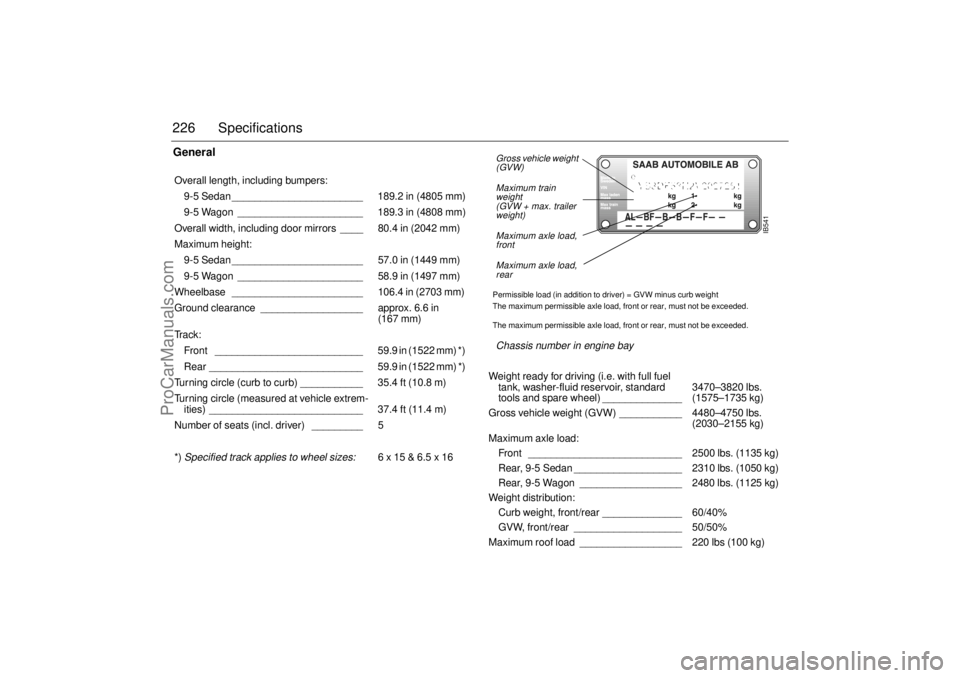
Gross vehicle weight
(GVW)
Maximum train
weight
(GVW + max. trailer
weight)
Maximum axle load,
front
Maximum axle load,
rear Permissible load (in addition to driver) = GVW minus curb weight
The maximum permissible axle load, front or rear, must not be exceeded.
The maximum permissible axle load, front or rear, must not be exceeded. Chassis number in engine bay Weight ready for driving (i.e. with full fuel
tank, washer-fluid reservoir, standard
tools and spare wheel) ______________ 3470–3820 lbs.
(1575–1735 kg)
Gross vehicle weight (GVW) ___________ 4480–4750 lbs.
(2030–2155 kg)
Maximum axle load:
Front ___________________________ 2500 lbs. (1135 kg)
Rear, 9-5 Sedan ___________________ 2310 lbs. (1050 kg)
Rear, 9-5 Wagon __________________ 2480 lbs. (1125 kg)
Weight distribution:
Curb weight, front/rear ______________ 60/40%
GVW, front/rear ___________________ 50/50%
Maximum roof load __________________ 220 lbs (100 kg)
IB541
ProCarManuals.com
Page 227 of 256
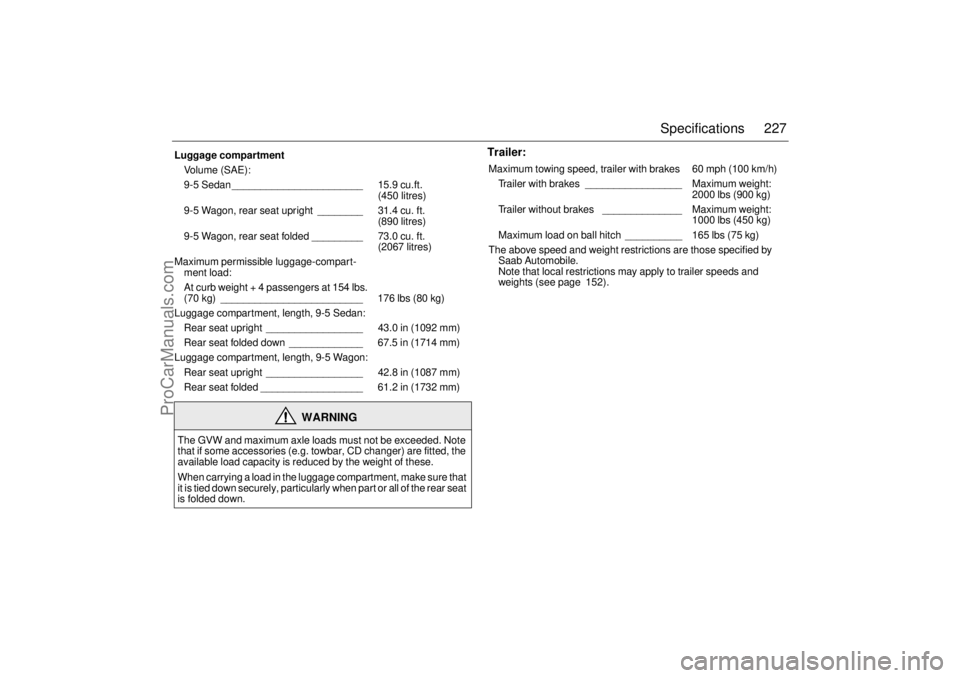
227 Specifications
Trailer:
Luggage compartment
Volume (SAE):
9-5 Sedan _______________________ 15.9 cu.ft.
(450 litres)
9-5 Wagon, rear seat upright ________ 31.4 cu. ft.
(890 litres)
9-5 Wagon, rear seat folded _________ 73.0 cu. ft.
(2067 litres)
Maximum permissible luggage-compart-
ment load:
At curb weight + 4 passengers at 154 lbs.
(70 kg) _________________________ 176 lbs (80 kg)
Luggage compartment, length, 9-5 Sedan:
Rear seat upright _________________ 43.0 in (1092 mm)
Rear seat folded down _____________ 67.5 in (1714 mm)
Luggage compartment, length, 9-5 Wagon:
Rear seat upright _________________ 42.8 in (1087 mm)
Rear seat folded __________________ 61.2 in (1732 mm)
WARNING
The GVW and maximum axle loads must not be exceeded. Note
that if some accessories (e.g. towbar, CD changer) are fitted, the
available load capacity is reduced by the weight of these.
When carrying a load in the luggage compartment, make sure that
it is tied down securely, particularly when part or all of the rear seat
is folded down.
Maximum towing speed, trailer with brakes 60 mph (100 km/h)
Trailer with brakes _________________ Maximum weight:
2000 lbs (900 kg)
Trailer without brakes ______________ Maximum weight:
1000 lbs (450 kg)
Maximum load on ball hitch __________ 165 lbs (75 kg)
The above speed and weight restrictions are those specified by
Saab Automobile.
Note that local restrictions may apply to trailer speeds and
weights (see page 152).
ProCarManuals.com
Page 244 of 256

244 IndexStarting in cold weather, ACC _______ 73
Starting in hot weather, ACC ________ 73
Steering wheel adjustment ________ 107
Steering, technical data ___________ 232
Stone-chip damage, repairing ______ 210
Storage compartments ___________ 113
Sun visors _____________________ 112
Sunroof _______________________ 111
Suspension ____________________ 232
Suspension, technical data ________ 232
Switches _______________________ 61
Systems, adjustment _____________ 237TTCS OFF _______________________ 51
Table of fuses __________________ 194
Tachometer _____________________ 52
Tailgate, opening _________________ 36
Tank gauge _____________________ 53
Technical data __________________ 225
Temperature control, ACC _________ 69
Temperature gauge, engine ________ 53
Temperature zones, ACC __________ 69
Textile carpeting ________________ 208
Through-load hatch ______________ 118
Tie Downs _____________________ 118
Tightening torque, wheel studs _____ 203
Tire markings ______________ 198, 199
Tire pressure _______________ 157, 198
Tires _____________________ 198, 233
Tools _________________________ 126Touching-in the paintwork _________ 210
Towbar attachment ______________ 152
Towbar load ____________________ 153
Towing the car __________________ 158
Towing, automatics ______________ 158
Traction _______________________ 147
Trailer weights __________________ 227
Trionic ________________________ 169
Trip computer ___________________ 54
Trip meter ______________________ 52
Trunk _________________________ 116
Trunk lid, opening ________________ 36
Turbo, points to note _____________ 132
UUnder the hood, 4-cyl ____________ 167
Under the hood, 6-cyl ____________ 168
Upholstery and trim ______________ 208
Upholstery and trim, care of _______ 208
Useful tips, ACC _________________ 75VVanity mirrors __________________ 112
Ventilated front seats _____________ 105
Viscosity, engine oil ______________ 228
WWarning labels ____________________ 8
Warning light, AIR BAG ____________ 26
Warning lights ___________________ 46
Washers ______________________ 180
Washers, windshield _____________ 181
Washing the car _________________ 209
Waxing and polishing ____________ 209
Wear indicators, tires _____________ 200
Wheels and tires ____________ 198, 233
Wheels and tires, sizes ___________ 233
Window-glass sensor, car alarm _____ 39
Windshield washers _______________ 65
Windshield wipers ________________ 65
Wiper blades, headlamp __________ 180
Wiper blades, replacing ___________ 180
Wipers and washers __________ 65, 180
ProCarManuals.com