washer fluid SAAB 9-5 2000 User Guide
[x] Cancel search | Manufacturer: SAAB, Model Year: 2000, Model line: 9-5, Model: SAAB 9-5 2000Pages: 256, PDF Size: 14.24 MB
Page 180 of 256
180 Car care and technical informationWipers and washersCheck and clean all wiper blades regularly.
We recommend Saab washer fluid for
cleaning.
If poor wiper performance is experienced,
clean the windshield with Saab washer fluid.
This is particularly important if the car has
been through an automatic car wash, as
these sometimes leave a wax coating on the
windshield.
If wiper performance is still unsatisfactory,
fit new blades.
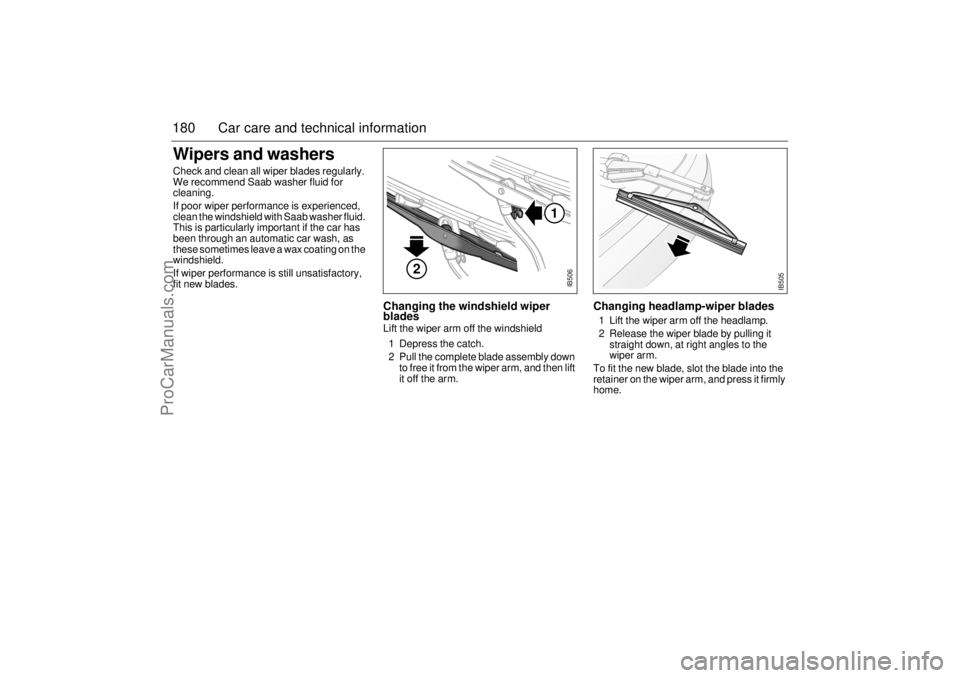
Changing the windshield wiper
bladesLift the wiper arm off the windshield
1 Depress the catch.
2 Pull the complete blade assembly down
to free it from the wiper arm, and then lift
it off the arm.
Changing headlamp-wiper blades 1 Lift the wiper arm off the headlamp.
2 Release the wiper blade by pulling it
straight down, at right angles to the
wiper arm.
To fit the new blade, slot the blade into the
retainer on the wiper arm, and press it firmly
home.
IB506
2
1
IB505
ProCarManuals.com
Page 181 of 256

181 Car care and technical information
WashersThe washer-fluid reservoir holds 6.4 quarts
(6 liters). When "WASHER FLUID LEVEL
LOW" comes up on the SID, the reservoir is
down to about 1 quart (1 liter) of fluid. Add
at least 50% of washer- fluid to water to pre-
vent freezing and for effective cleaning.Washer jets The washer jets can be adjusted and, if
necessary, unclogged by means of a pin.
IB507
Washer-fluid filler cap
IB1126
Cleaning/adjusting the washer jets
ProCarManuals.com
Page 213 of 256

213 Car care and technical information
For long tripsBefore setting off on a long journey, it is
advisable to have your car checked over by
your Saab dealer.
Obtain a few important items to take along
on your journey such as spare bulbs, wiper
blades, fuses, a Poly-Vee-belt and the like.
You can check some points yourself before-
hand:
Make sure that the engine is in good con-
dition.
Check that no oil or gasoline leaks out of
the engine or gearbox/transmission.
Inspect the Poly-Vee-belt and replace it if
it shows any signs of hard wear.
Check the battery charge.
Check the tires for tread pattern and air
pressure, including the compact spare
wheel.
Check the brakes.
Check all bulbs.
Check for the presence of the tool kit and
the jack in the car.
Recovery and/or
recycling of automotive
materialsA typical car consists of metals (65–75%),
plastics (10–14%), rubber (5%) and small
quantities of glass, wood, paper and tex-
tiles.
Some of these materials can be recycled,
while others can be recovered in chemical
processes for reuse in new products or as a
source of energy.
While the Saab 9-5 was still at the draw-
ing-board stage, Saab engineers were
giving serious consideration to how the
maximum quantity of materials could be
reclaimed from the car on its eventual
scrapping. To facilitate sorting, plastic parts,
for instance, have been marked to identify
the precise nature of the plastic.
Approximately 90% of the materials in the
car can be recycled or recovered, where
facilities exist.
Before the car is scrapped, all the oils and
other fluids that could pollute the environ-
ment should be recovered from the car. It
may be of interest in this context to learn that
the refrigerant used in the Saab 9-5’s A/C
and ACC systems (R134a) contains neither
CFCs nor any other chlorine compounds.
1 A-pillar trim: PP, PP/EPDM
2 Windshield trim: PP, PP/EPDM
3 Seals: EPDM
4 C-pillar trim: PP
5 Rear light cluster: PMMA
6 Corner infill panel: PPO/PA
7 Rear bumper, cellular core: expanded PP;
sheathing: PP/EPDM
8 Side-window casing: PP/EPDM
9 Fuel tank: PE
10 Side trim: PVC
11 A-pillar upholstery trim: PC/ABS, textile
12 Rearview mirror: ABS
13 Sill scuff plate: PP/EPDM
14 Wheel-arch liner: PP
15 Wheel cover: PA
16 Direction-indicator lamp lens: PMMA
17 Washer-fluid reservoir: PE
18 Front spoiler: PP/EPDM
19 Front bumper, cellular core: expanded PP;
sheathing: PP/EPDM
20 Fan shroud: PP
21 Radiator grille: ABS
22 Scuttle panel finisher: PC/ASA
ProCarManuals.com
Page 226 of 256
226 SpecificationsGeneral Overall length, including bumpers:
9-5 Sedan _______________________ 189.2 in (4805 mm)
9-5 Wagon ______________________ 189.3 in (4808 mm)
Overall width, including door mirrors ____ 80.4 in (2042 mm)
Maximum height:
9-5 Sedan _______________________ 57.0 in (1449 mm)
9-5 Wagon ______________________ 58.9 in (1497 mm)
Wheelbase _______________________ 106.4 in (2703 mm)
Ground clearance __________________ approx. 6.6 in
(167 mm)
Tr a c k :
Front __________________________ 59.9 in (1522 mm) *)
Rear ___________________________ 59.9 in (1522 mm) *)
Turning circle (curb to curb) ___________ 35.4 ft (10.8 m)
Turning circle (measured at vehicle extrem-
ities) ___________________________ 37.4 ft (11.4 m)
Number of seats (incl. driver) _________ 5
*) Specified track applies to wheel sizes:
6 x 15 & 6.5 x 16
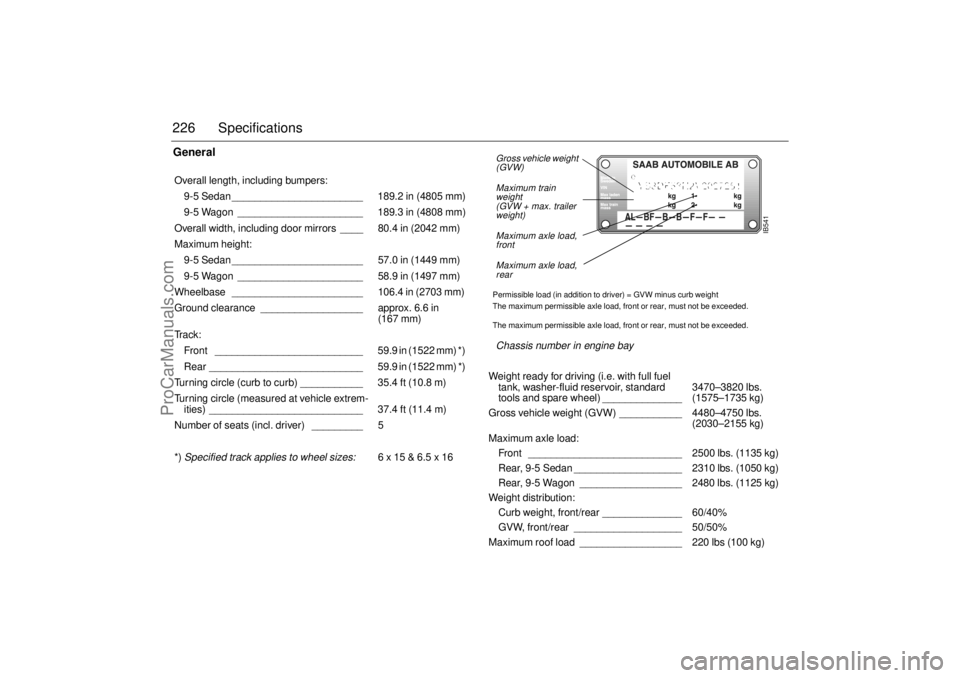
Gross vehicle weight
(GVW)
Maximum train
weight
(GVW + max. trailer
weight)
Maximum axle load,
front
Maximum axle load,
rear Permissible load (in addition to driver) = GVW minus curb weight
The maximum permissible axle load, front or rear, must not be exceeded.
The maximum permissible axle load, front or rear, must not be exceeded. Chassis number in engine bay Weight ready for driving (i.e. with full fuel
tank, washer-fluid reservoir, standard
tools and spare wheel) ______________ 3470–3820 lbs.
(1575–1735 kg)
Gross vehicle weight (GVW) ___________ 4480–4750 lbs.
(2030–2155 kg)
Maximum axle load:
Front ___________________________ 2500 lbs. (1135 kg)
Rear, 9-5 Sedan ___________________ 2310 lbs. (1050 kg)
Rear, 9-5 Wagon __________________ 2480 lbs. (1125 kg)
Weight distribution:
Curb weight, front/rear ______________ 60/40%
GVW, front/rear ___________________ 50/50%
Maximum roof load __________________ 220 lbs (100 kg)
IB541
ProCarManuals.com