battery SAAB 9-5 2000 Owner's Manual
[x] Cancel search | Manufacturer: SAAB, Model Year: 2000, Model line: 9-5, Model: SAAB 9-5 2000Pages: 256, PDF Size: 14.24 MB
Page 161 of 256

161 Starting and driving
5 Check that the jumper cables do not
have loose or missing insulation. If they
do, you could get a shock and also the
vehicles could be damaged.
Before you connect the cables, here are
some basic things you should know.
Positive (+) will go to positive (+) and
negative (-) will go to negative (-) or a
major metal engine part with a good
ground. Do not connect (+) to (-) or you
will get a short that could injure you or
would damage the battery and maybe
other parts as well.
6 Connect the red positive (+) cable to the
positive (+) terminal of the vehicle with
the discharged battery.
7 Do not let the other end touch metal.
Connect it to the positive (+) terminal of
the good battery. Use a remote positive
(+) terminal if the vehicle has one.8 Now connect the black negative (-)
cable to the good battery’s negative ter-
minal.
Do not let the other end touch anything
until the next step. The other end of the
negative cable does not go to the dead
battery. It goes to a major metal part with
a good ground on the engine of the vehi-
cle with the discharged battery.
9 Attach the cable at least 18 inches
(45 cm) away from the discharged bat-
tery, but not near engine parts that
move. The electrical connection is just
as good there, but the chance of sparks
getting back to the battery is much less.
10 Start the vehicle with the good battery
and run the engine for a while.
11 Try to start the vehicle with the dis-
charged battery. If it does not start after
a few tries, it probably needs service.
12 Remove the cables in reverse order to
prevent electrical shorting. Take care
that they do not touch each other or any
other metal.
WARNING
An electric fan can start up even when the
engine is not running and can injure you.
Keep hands, clothing and tools away from
any underhood electric fan.
WARNING
Using a match or flame of any kind near a
battery can cause battery gas to explode.
You can suffer burns or be blinded. Use a
flashlight if you need more light.
Be sure the battery has enough water.
The battery installed in your new Saab
has filler caps. Be sure the right amount
of water is there. Add distilled or boiled
water if the level is too low. If you don’t,
explosive gas could be present.
Be sure the electrolyte in the battery is not
frozen. Discharged batteries will freeze.
When connecting jumper cables to a
frozen battery, gas from the chemical
reaction inside the battery can build up
under the ice and cause an explosion.
Battery fluid contains acid that can burn
you. Do not get it on you. If you acciden-
tally get it in your eyes or on your skin,
flush the area with water and get medical
help immediately.
ProCarManuals.com
Page 163 of 256
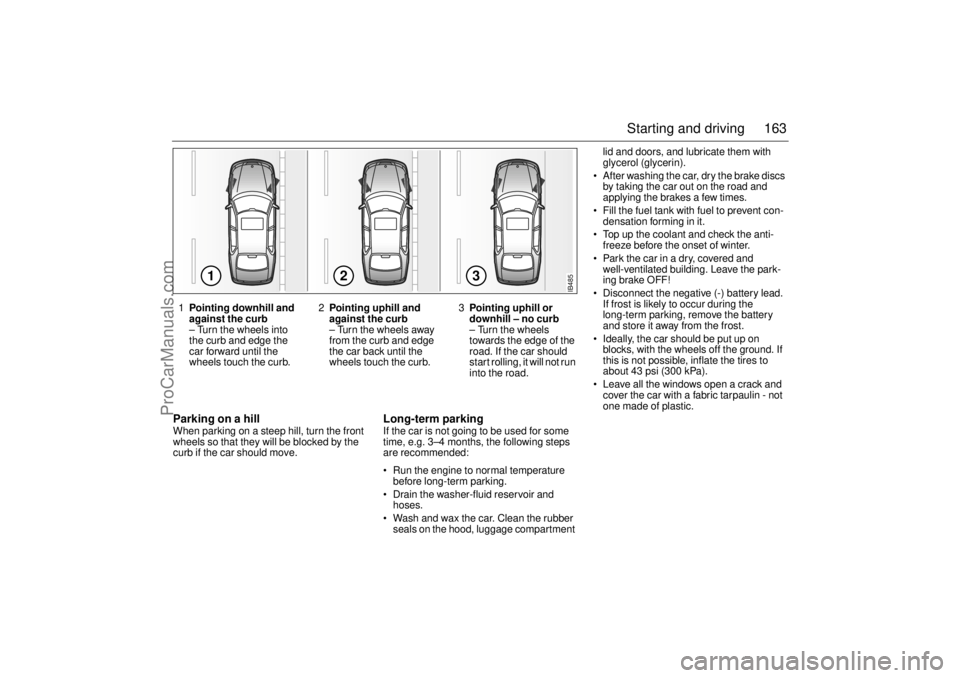
163 Starting and driving
Parking on a hillWhen parking on a steep hill, turn the front
wheels so that they will be blocked by the
curb if the car should move.
Long-term parkingIf the car is not going to be used for some
time, e.g. 3–4 months, the following steps
are recommended:
Run the engine to normal temperature
before long-term parking.
Drain the washer-fluid reservoir and
hoses.
Wash and wax the car. Clean the rubber
seals on the hood, luggage compartment lid and doors, and lubricate them with
glycerol (glycerin).
After washing the car, dry the brake discs
by taking the car out on the road and
applying the brakes a few times.
Fill the fuel tank with fuel to prevent con-
densation forming in it.
Top up the coolant and check the anti-
freeze before the onset of winter.
Park the car in a dry, covered and
well-ventilated building. Leave the park-
ing brake OFF!
Disconnect the negative (-) battery lead.
If frost is likely to occur during the
long-term parking, remove the battery
and store it away from the frost.
Ideally, the car should be put up on
blocks, with the wheels off the ground. If
this is not possible, inflate the tires to
about 43 psi (300 kPa).
Leave all the windows open a crack and
cover the car with a fabric tarpaulin - not
one made of plastic.
123
IB485
1Pointing downhill and
against the curb
– Turn the wheels into
the curb and edge the
car forward until the
wheels touch the curb.2Pointing uphill and
against the curb
– Turn the wheels away
from the curb and edge
the car back until the
wheels touch the curb.3Pointing uphill or
downhill – no curb
– Turn the wheels
towards the edge of the
road. If the car should
start rolling, it will not run
into the road.
ProCarManuals.com
Page 165 of 256
165 Car care and technical information
Car care and
technical
information
Hood release handle ....... 166
Engine compartment,
4-cyl. engine ................... 167
Engine compartment,
6-cyl. engine ................... 168
Emission control systems 169
Engine............................... 170
Engine oil ......................... 171
Transmission fluid........... 173
Coolant ............................. 174
Brake and clutch fluid ..... 175
Power steering fluid ........ 176
Battery .............................. 177 Drive belts ........................ 179
Wipers and washers ....... 180
Changing bulbs ............... 182
Fuses ................................ 192
Wheels .............................. 198
Compact spare wheel ..... 202
Flat spotting..................... 206
Air conditioning (A/C
system) ........................... 206
Safety belts ...................... 207
Upholstery and trim ........ 208
Textile carpeting.............. 208
Washing the car .............. 209 Waxing and polishing ...... 209
Engine compartment ....... 210
Touching up the paint ..... 210
Anticorrosion treatment .. 211
For long trips .................... 213
Recovery and/or recycling
of automotive materials. 213
Headlamp aiming ............. 214
ProCarManuals.com
Page 167 of 256
167 Car care and technical information
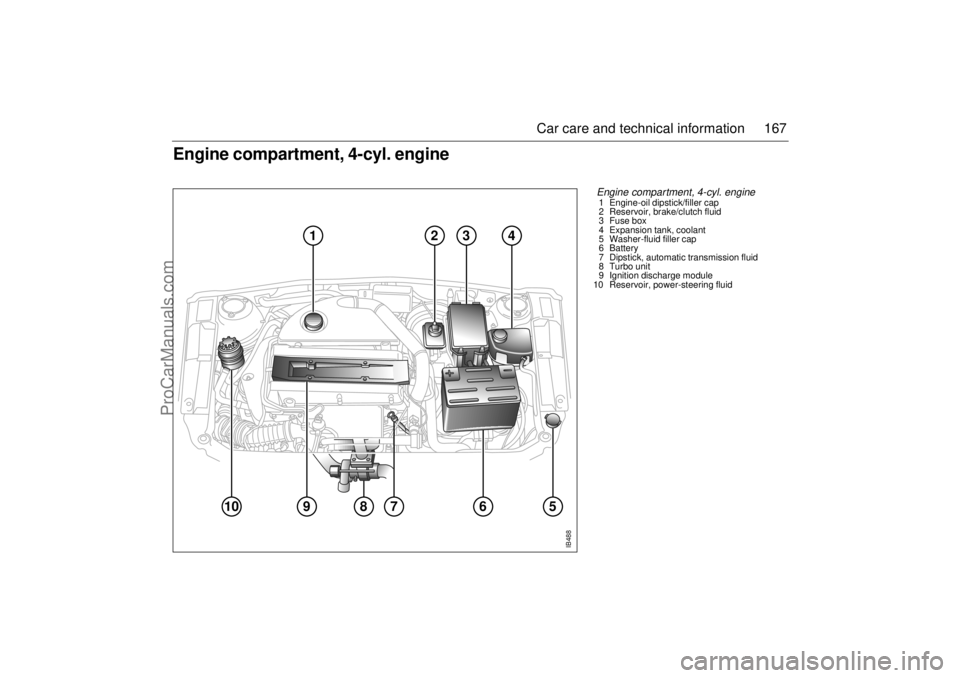
Engine compartment, 4-cyl. engine
8
7
9
10
6
2
4
3
5
IB488
1
Engine compartment, 4-cyl. engine 1 Engine-oil dipstick/filler cap
2 Reservoir, brake/clutch fluid
3 Fuse box
4 Expansion tank, coolant
5 Washer-fluid filler cap
6Battery
7 Dipstick, automatic transmission fluid
8 Turbo unit
9 Ignition discharge module
10 Reservoir, power-steering fluid
ProCarManuals.com
Page 168 of 256
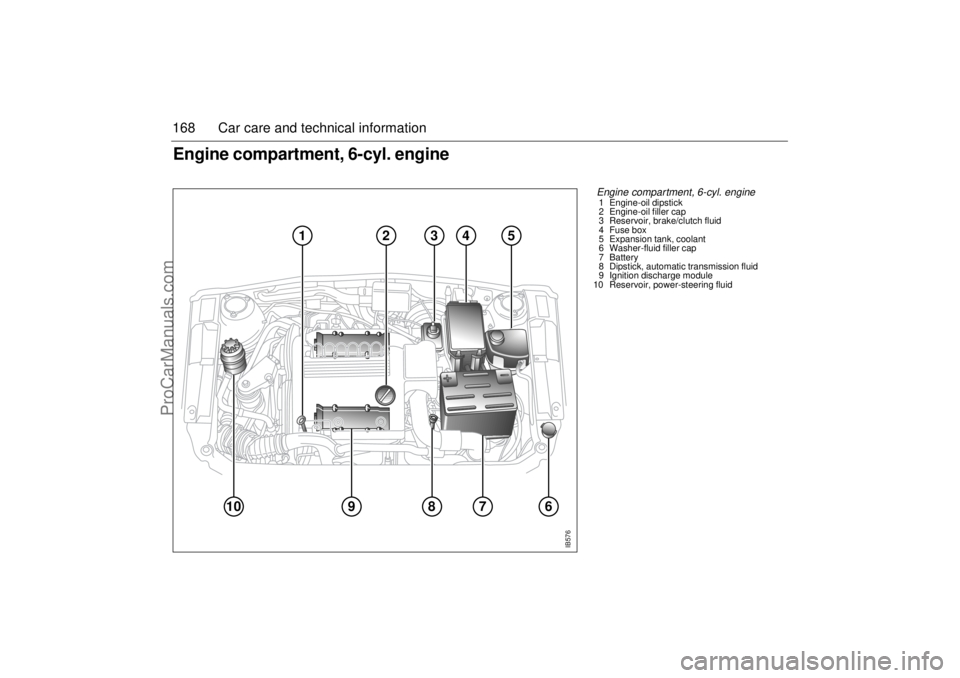
168 Car care and technical informationEngine compartment, 6-cyl. engine
10
7
9
8
1
3
2
5
4
6
IB576
Engine compartment, 6-cyl. engine 1 Engine-oil dipstick
2 Engine-oil filler cap
3 Reservoir, brake/clutch fluid
4 Fuse box
5 Expansion tank, coolant
6 Washer-fluid filler cap
7Battery
8 Dipstick, automatic transmission fluid
9 Ignition discharge module
10 Reservoir, power-steering fluid
ProCarManuals.com
Page 177 of 256
177 Car care and technical information
Battery
The battery is provided with a cover to pro-
tect it from radiated heat. If the battery is
exposed to high temperatures, its life will be
shortened. To remove the cover, pry out the
edge a little, located at the rear of the cover.
The cover fits the standard battery installed
in the car. If a new battery is to be fitted,
make sure that its dimensions are the same
as the standard one.
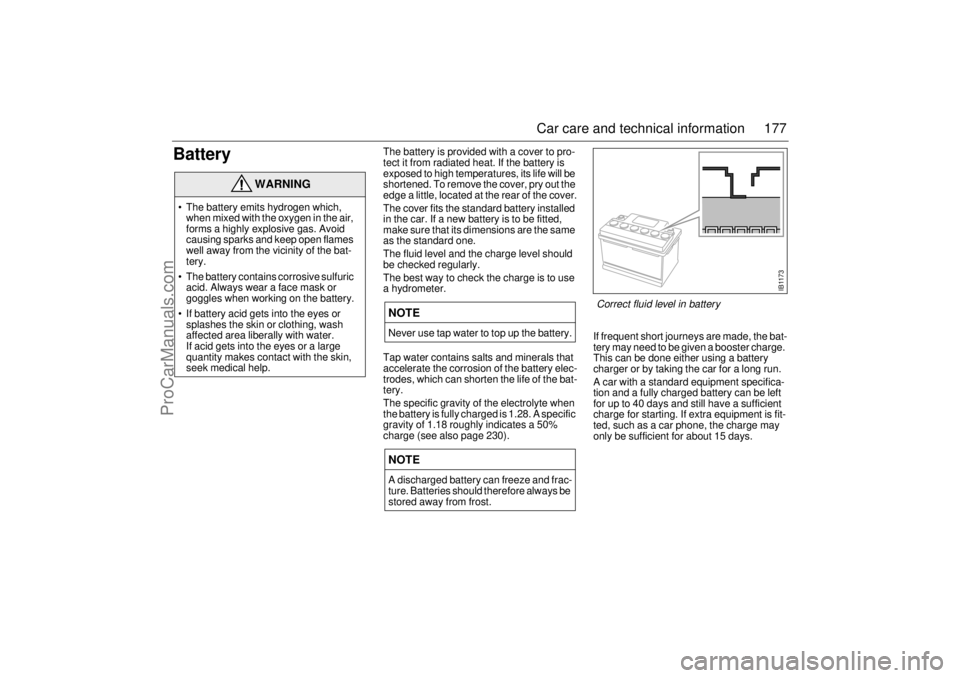
The fluid level and the charge level should
be checked regularly.
The best way to check the charge is to use
a hydrometer.
Tap water contains salts and minerals that
accelerate the corrosion of the battery elec-
trodes, which can shorten the life of the bat-
tery.
The specific gravity of the electrolyte when
the battery is fully charged is 1.28. A specific
gravity of 1.18 roughly indicates a 50%
charge (see also page 230). If frequent short journeys are made, the bat-
tery may need to be given a booster charge.
This can be done either using a battery
charger or by taking the car for a long run.
A car with a standard equipment specifica-
tion and a fully charged battery can be left
for up to 40 days and still have a sufficient
charge for starting. If extra equipment is fit-
ted, such as a car phone, the charge may
only be sufficient for about 15 days.
WARNING
The battery emits hydrogen which,
when mixed with the oxygen in the air,
forms a highly explosive gas. Avoid
causing sparks and keep open flames
well away from the vicinity of the bat-
tery.
The battery contains corrosive sulfuric
acid. Always wear a face mask or
goggles when working on the battery.
If battery acid gets into the eyes or
splashes the skin or clothing, wash
affected area liberally with water.
If acid gets into the eyes or a large
quantity makes contact with the skin,
seek medical help.
NOTENever use tap water to top up the battery.NOTEA discharged battery can freeze and frac-
ture. Batteries should therefore always be
stored away from frost.
IB1173
Correct fluid level in battery
ProCarManuals.com
Page 178 of 256
178 Car care and technical informationCharging/replacing the batteryConnect the positive lead to the positive (+)
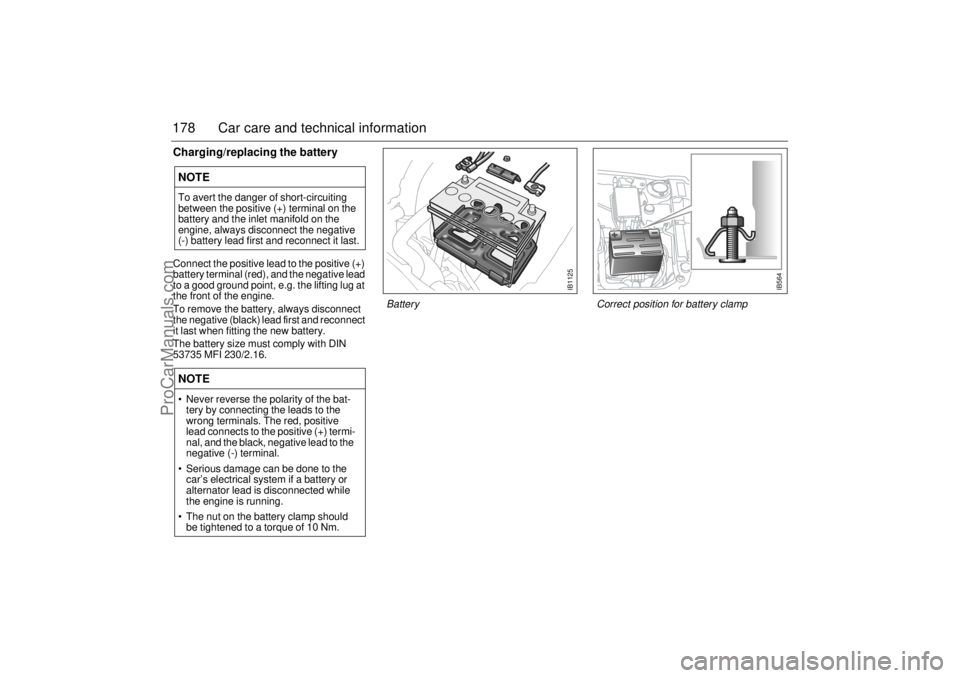
battery terminal (red), and the negative lead
to a good ground point, e.g. the lifting lug at
the front of the engine.
To remove the battery, always disconnect
the negative (black) lead first and reconnect
it last when fitting the new battery.
The battery size must comply with DIN
53735 MFI 230/2.16. NOTETo avert the danger of short-circuiting
between the positive (+) terminal on the
battery and the inlet manifold on the
engine, always disconnect the negative
(-) battery lead first and reconnect it last.NOTE Never reverse the polarity of the bat-
tery by connecting the leads to the
wrong terminals. The red, positive
lead connects to the positive (+) termi-
nal, and the black, negative lead to the
negative (-) terminal.
Serious damage can be done to the
car’s electrical system if a battery or
alternator lead is disconnected while
the engine is running.
The nut on the battery clamp should
be tightened to a torque of 10 Nm.
IB564
Correct position for battery clamp
IB1125
Battery
ProCarManuals.com
Page 213 of 256

213 Car care and technical information
For long tripsBefore setting off on a long journey, it is
advisable to have your car checked over by
your Saab dealer.
Obtain a few important items to take along
on your journey such as spare bulbs, wiper
blades, fuses, a Poly-Vee-belt and the like.
You can check some points yourself before-
hand:
Make sure that the engine is in good con-
dition.
Check that no oil or gasoline leaks out of
the engine or gearbox/transmission.
Inspect the Poly-Vee-belt and replace it if
it shows any signs of hard wear.
Check the battery charge.
Check the tires for tread pattern and air
pressure, including the compact spare
wheel.
Check the brakes.
Check all bulbs.
Check for the presence of the tool kit and
the jack in the car.
Recovery and/or
recycling of automotive
materialsA typical car consists of metals (65–75%),
plastics (10–14%), rubber (5%) and small
quantities of glass, wood, paper and tex-
tiles.
Some of these materials can be recycled,
while others can be recovered in chemical
processes for reuse in new products or as a
source of energy.
While the Saab 9-5 was still at the draw-
ing-board stage, Saab engineers were
giving serious consideration to how the
maximum quantity of materials could be
reclaimed from the car on its eventual
scrapping. To facilitate sorting, plastic parts,
for instance, have been marked to identify
the precise nature of the plastic.
Approximately 90% of the materials in the
car can be recycled or recovered, where
facilities exist.
Before the car is scrapped, all the oils and
other fluids that could pollute the environ-
ment should be recovered from the car. It
may be of interest in this context to learn that
the refrigerant used in the Saab 9-5’s A/C
and ACC systems (R134a) contains neither
CFCs nor any other chlorine compounds.
1 A-pillar trim: PP, PP/EPDM
2 Windshield trim: PP, PP/EPDM
3 Seals: EPDM
4 C-pillar trim: PP
5 Rear light cluster: PMMA
6 Corner infill panel: PPO/PA
7 Rear bumper, cellular core: expanded PP;
sheathing: PP/EPDM
8 Side-window casing: PP/EPDM
9 Fuel tank: PE
10 Side trim: PVC
11 A-pillar upholstery trim: PC/ABS, textile
12 Rearview mirror: ABS
13 Sill scuff plate: PP/EPDM
14 Wheel-arch liner: PP
15 Wheel cover: PA
16 Direction-indicator lamp lens: PMMA
17 Washer-fluid reservoir: PE
18 Front spoiler: PP/EPDM
19 Front bumper, cellular core: expanded PP;
sheathing: PP/EPDM
20 Fan shroud: PP
21 Radiator grille: ABS
22 Scuttle panel finisher: PC/ASA
ProCarManuals.com
Page 222 of 256

222 Maintenance and owner assistance* These are the minimum required Emission Control System maintenance steps. Saab urges that all recommended maintenance procedures be performed
according to this program.
(b.) Change automatic transmission fluid at more frequent intervals (20,000; 50,000; 80,000 miles, etc.) if car is driven in dense city traffic where the outside
temperature regularly reach 90°F or higher, or if car is used in a mountainous/high altitude area or for trailer towing.
Service Intervals **
Miles = U.S. Cars
Kilometers = Canadian Cars
1,000
(1,600 km)
10,000
(16,000 km)
20,000
(32,000 km)
30,000
(48,000 km)
40,000
(64,000 km)
50,000
(80,000 km)
60,000
(96,000 km)
70,000
(112,000 km)
80,000
(128,000 km)
90,000
(144,000 km)
100,000
(160,000 km)
Service #
1234567891011
Engine and engine compartment (cont.)
E Evaporative emission system including filler cap, vapor
lines, EVAP canister and canister purge valve"
R Fuel system: leaks and damage""""""""""
E Fuel filter!
E Engine air cleaner element!
*
!*
!*
R Exhaust system and mountings; leaks and condition""""""""""
Electrical
R Battery: state of charge and electrolyte level; clean termi-
nals if necessary"""""""""""
R Head, fog, brake, tail, turn signal, warning lights instru-
ment panel, backup and marker lamps"""""""""""
Transmission
R Automatic transmission fluid change (b.)!!!
R Automatic gearbox oil level"""""""""""
R Manual gearbox oil level"""
R Outer and inner driver joint boots""""""""""
ProCarManuals.com
Page 230 of 256

230 SpecificationsEngine variants Electrical system2.3t Ecopower Rating, EEC at 5500 rpm ___________ 170 hp (125 kW)
Maximum torque, EEC at 1800 rpm ___ 207.2 ft.lb
(280 Nm)
Compression ratio ________________ 9.35:1 2.3 Turbo Ecopower (“Aero“ model engine),
manual transmissionRating, EEC at 5500 rpm ___________ 230 hp (169 kW)
Maximum torque, EEC at 1900 rpm 259.0 ft.lb.
(350 Nm)
Compression ratio ________________ 9.3:12.3 Turbo Ecopower, (“Aero“ model engine)
automatic transmissionRating, EEC at 5500 rpm ___________ 230 hp (169 kW)
Maximum torque, EEC at 1900 rpm 244.2 ft.lb.
(330 Nm)
Compression ratio ________________ 9.3:13.0t Ecopower Rating, EEC at 5000 rpm ___________ 200 hp (147 kW)
Maximum torque, EEC at 2100 rpm ___ 229.4 ft.lb
(310 Nm)
Compression ratio ________________ 9.5:1 Voltage ___________________________ 12 V
Battery capacity ____________________ 60 Ah or 70 Ah
Starter motor ______________________ 1.4 kW
Alternator rating ____________________ 130 A/14 V
Firing order:
4-cylinder ________________________ 1-3-4-2
6-cylinder ________________________ 1-2-3-4-5-6
Spark plugs:
2.3t ____________________________ NGK
BCPR 6ES-11
2.3 Turbo ________________________ NGK
PFR 7H-10
6-cylinder ________________________ NGK
BKR 7ES-11
Electrode gap ______________________ 0.0394 +0.00394 in
(1.0+0.1 mm)
ProCarManuals.com