air condition SAAB 9-5 2000 Owners Manual
[x] Cancel search | Manufacturer: SAAB, Model Year: 2000, Model line: 9-5, Model: SAAB 9-5 2000Pages: 256, PDF Size: 14.24 MB
Page 3 of 256
3
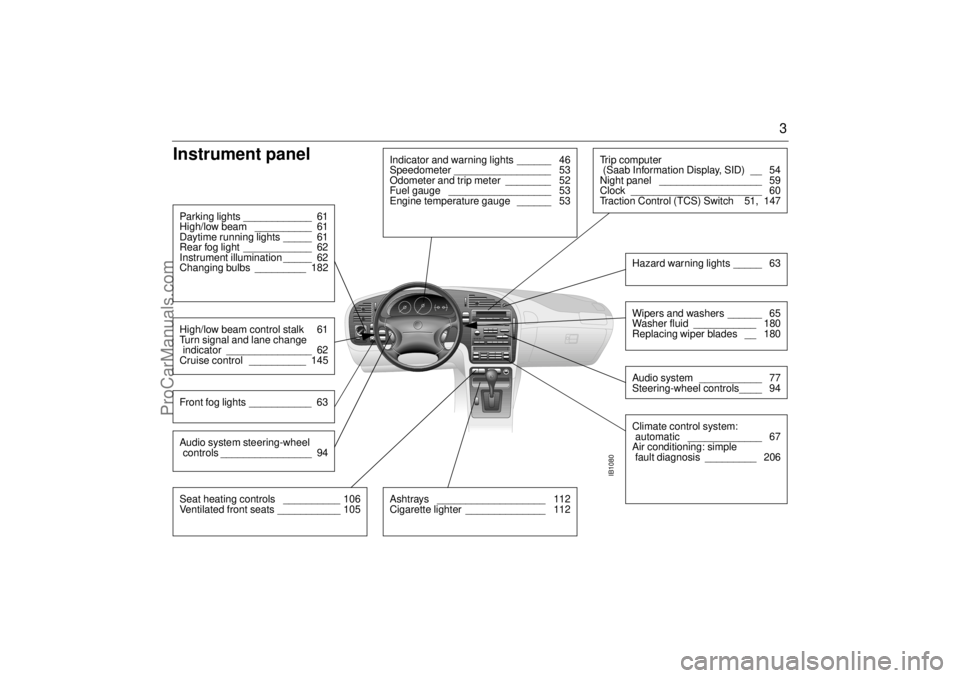
Instrument panel
IB1080
Indicator and warning lights ______ 46
Speedometer _________________ 53
Odometer and trip meter ________ 52
Fuel gauge __________________ 53
Engine temperature gauge ______ 53
Parking lights ____________ 61
High/low beam __________ 61
Daytime running lights _____ 61
Rear fog light ____________ 62
Instrument illumination _____ 62
Changing bulbs _________ 182High/low beam control stalk 61
Turn signal and lane change
indicator _______________ 62
Cruise control __________ 145Front fog lights ___________ 63
Ashtrays ___________________ 112
Cigarette lighter ______________ 112
Tr i p c o m p u t e r
(Saab Information Display, SID) __ 54
Night panel __________________ 59
Clock _______________________ 60
Traction Control (TCS) Switch 51, 147
Wipers and washers ______ 65
Washer fluid ___________ 180
Replacing wiper blades __ 180Audio system ___________ 77
Steering-wheel controls____ 94Hazard warning lights _____ 63Climate control system:
automatic _____________ 67
Air conditioning: simple
fault diagnosis _________ 206
Seat heating controls __________ 106
Ventilated front seats ___________ 105Audio system steering-wheel
controls ________________ 94
ProCarManuals.com
Page 27 of 256

27 Safety
How do I position the seat to leave room for
the airbag to inflate?Don’t have your seat too far forward.
Recline the seat back to increase the dis-
tance between you and the airbag. For short
drivers, special accessory pedal extensions
are available through your Saab dealer.
Airbags inflate extremely rapidly and with
great force - to be fast enough to protect an
adult in the seat. When do the front airbags inflate? The airbag will only be inflated under certain
predetermined conditions in a moderate to
severe frontal, or near-frontal collision,
depending on such factors as the force and
angle of the impact, the speed of the car on
impact, and the resistance to deformation of
the impacting object.
The airbag can only be activated once in the
same incident.
Do not attempt to drive the car after an
airbag has been inflated, even if it is possi-
ble.
What won’t trigger the front airbags? The airbag will not be activated in all
front-end collisions. For instance, if the car
has hit something relatively soft and yielding
(e.g. a snow drift or a hedge) or a solid
object at a low impact speed, the airbag will
not necessarily be triggered. How loud is the inflation? The noise of the inflation is certainly loud,
but it is very short-lived and will not damage
your hearing. For a short time afterwards
you could experience a buzzing noise in
your ears.
Most people who have experienced it
cannot remember the noise of the inflation
at all - all they remember is the noise of the
crash.
Can you still use a child seat in the front if a
passenger airbag is installed? Definitely not!
Children 12 and under can be injured or
killed by the airbag.
The BACK SEAT is the SAFEST place for
children.
NEVER put a child seat in the front.Are the smoke and fumes given off when the
airbag operates at all harmful? Most people who have remained in a car
with little or no ventilation for several min-
utes complained only of minor irritation of
the throat and eyes. Avoid as far as possible
getting dust on your skin as there is a risk of
skin irritation.
If this trouble persists, you should consult a
doctor.
If you suffer from asthma, the incident may
bring on an attack, in which case you should
follow the normal procedure advised by
your doctor. It is advisable to consult a
doctor afterwards.
ProCarManuals.com
Page 28 of 256
28 SafetyWhat should I do if the AIR-BAG warning
light comes on? If the warning light is on, it means that a fault
has been detected in the system. The
airbag cannot be relied on to operate as
intended and it might even be activated
erroneously. You should therefore take the
car to an authorized Saab dealer as soon as
possible.
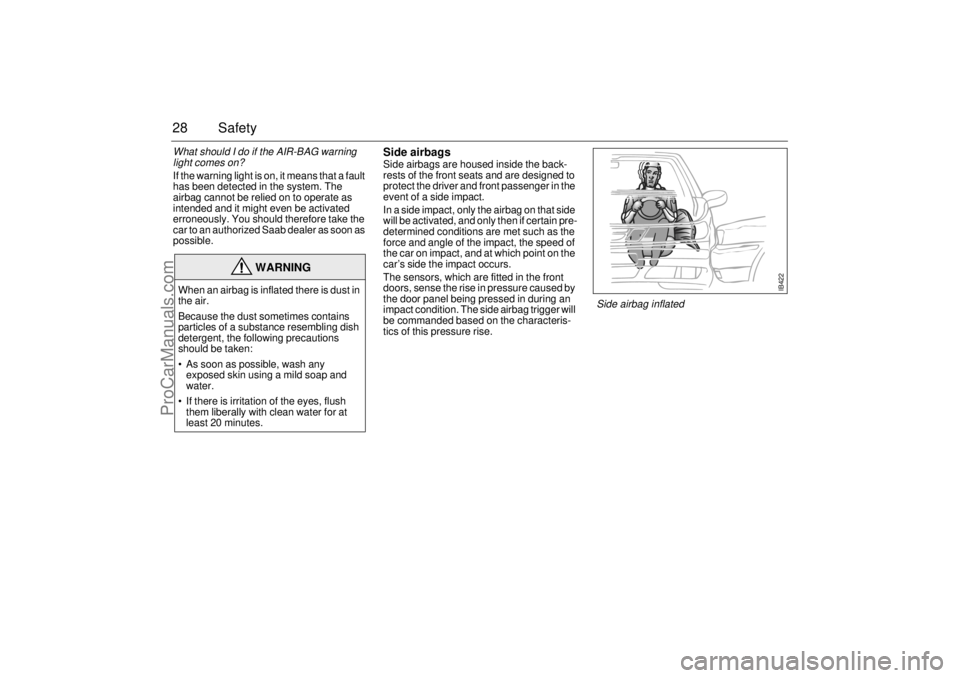
Side airbags Side airbags are housed inside the back-
rests of the front seats and are designed to
protect the driver and front passenger in the
event of a side impact.
In a side impact, only the airbag on that side
will be activated, and only then if certain pre-
determined conditions are met such as the
force and angle of the impact, the speed of
the car on impact, and at which point on the
car’s side the impact occurs.
The sensors, which are fitted in the front
doors, sense the rise in pressure caused by
the door panel being pressed in during an
impact condition. The side airbag trigger will
be commanded based on the characteris-
tics of this pressure rise.
WARNING
When an airbag is inflated there is dust in
the air.
Because the dust sometimes contains
particles of a substance resembling dish
detergent, the following precautions
should be taken:
As soon as possible, wash any
exposed skin using a mild soap and
water.
If there is irritation of the eyes, flush
them liberally with clean water for at
least 20 minutes.
IB422
Side airbag inflated
ProCarManuals.com
Page 49 of 256
49 Instruments and controls
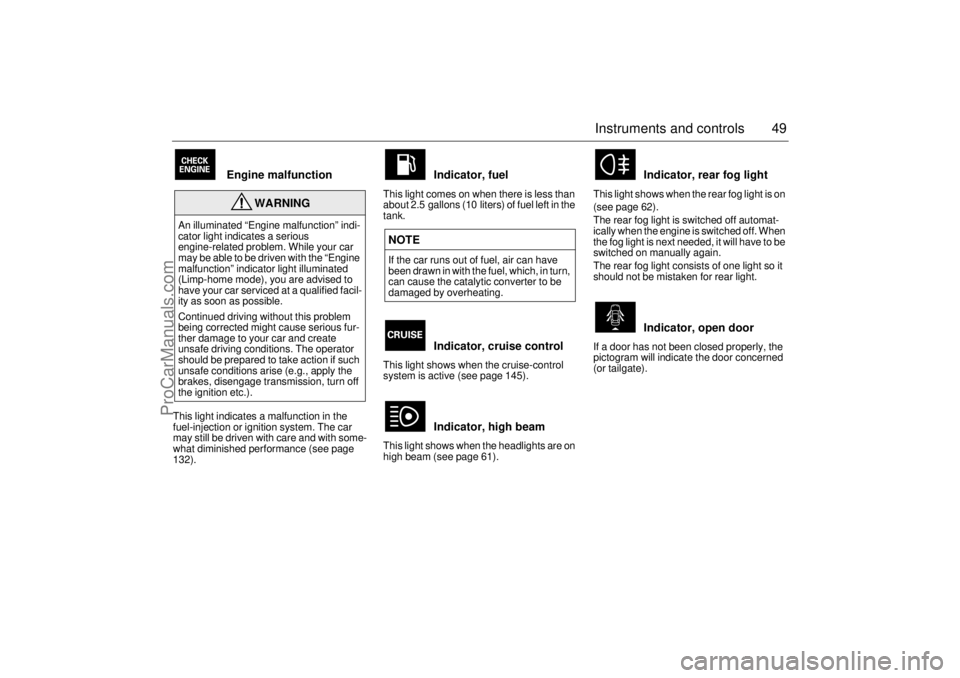
Engine malfunction
This light indicates a malfunction in the
fuel-injection or ignition system. The car
may still be driven with care and with some-
what diminished performance (see page
132).
Indicator, fuel
This light comes on when there is less than
about 2.5 gallons (10 liters) of fuel left in the
tank.
Indicator, cruise control
This light shows when the cruise-control
system is active (see page 145).
Indicator, high beam
This light shows when the headlights are on
high beam (see page 61).
Indicator, rear fog light
This light shows when the rear fog light is on
(see page 62).
The rear fog light is switched off automat-
ically when the engine is switched off. When
the fog light is next needed, it will have to be
switched on manually again.
The rear fog light consists of one light so it
should not be mistaken for rear light.
Indicator, open door
If a door has not been closed properly, the
pictogram will indicate the door concerned
(or tailgate).
WARNING
An illuminated “Engine malfunction” indi-
cator light indicates a serious
engine-related problem. While your car
may be able to be driven with the “Engine
malfunction” indicator light illuminated
(Limp-home mode), you are advised to
have your car serviced at a qualified facil-
ity as soon as possible.
Continued driving without this problem
being corrected might cause serious fur-
ther damage to your car and create
unsafe driving conditions. The operator
should be prepared to take action if such
unsafe conditions arise (e.g., apply the
brakes, disengage transmission, turn off
the ignition etc.).
NOTEIf the car runs out of fuel, air can have
been drawn in with the fuel, which, in turn,
can cause the catalytic converter to be
damaged by overheating.
ProCarManuals.com
Page 76 of 256

76 Instruments and controlsCondensation When the A/C system is running, the intake
air is dehumidified, and the resultant con-
densation is drained off through two outlets
underneath the floor of the car, in the vicinity
of the front doors.
It is therefore perfectly normal for water to
be seen dripping from these outlets when
the car is parked. Greater amounts of con-
densation will result in warmer, more humid
ambient air.
Formation of ice and mist in
extremes of weather It is only in the most extreme conditions that
icing and misting of window glass are likely
to be a problem, e.g. in torrential rain or
severe cold coupled with high relative
humidity, or when passengers are perspir-
ing heavily or wearing wet clothes.
The following measures are recommended
if such problems should occur:
1 Select AUTO and 70
°F (21°C) for both
temperature zones.
2 Select Defroster.
If this is not enough...
3 Increase the fan speed.
If this is not enough...
4 Select a higher temperature.
The following measures are recommended
if the occupants feel that it is cold and drafty
in the car:
1 Make sure that all the air vents are fully
open, including the center rear vent.
If this is not enough...
2 Direct the air flow away from the body.
If this is not enough...
3 Raise the temperature setting a degree
or two. If this is not enough...
4 Lower the fan speed.
Fault diagnosis and maintenance,
see page 206.
ProCarManuals.com
Page 113 of 256
113 Interior equipment and trunk
To refit, line up the slots on either side and
slide it closed.
Rear ashtrays
Open the lid to use ashtray.
To remove the ashtray, fully open the lid and
lift the ashtray straight out.
To refit the ashtray, make sure it engages
the two square recesses in the door trim.
The cigarette lighter sockets can also be
used for accessories (e.g. to charge a
mobile phone) when the ignition is ON.
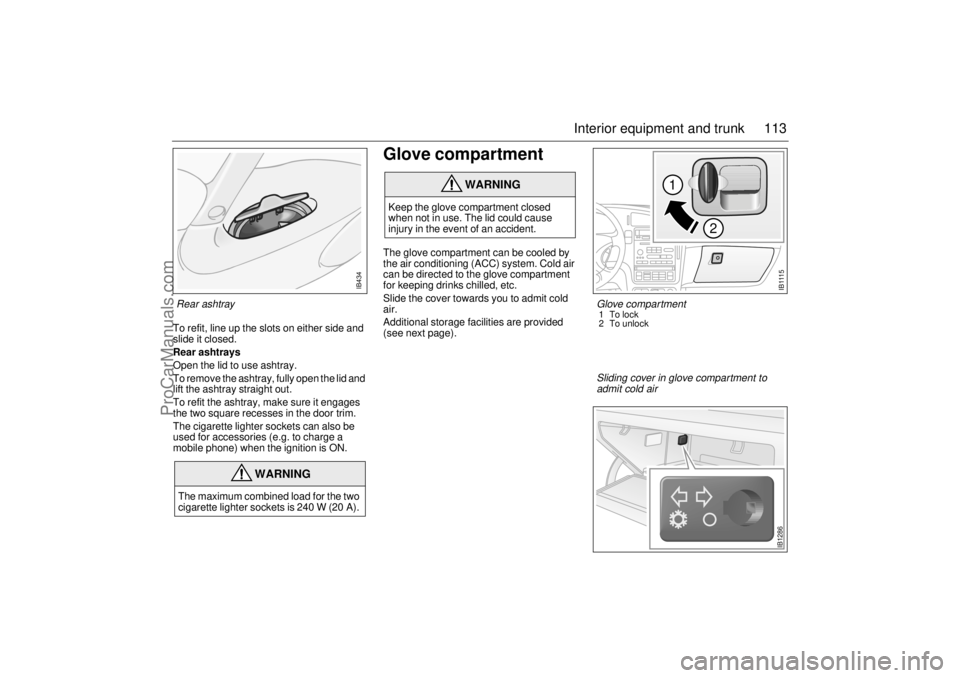
Glove compartment The glove compartment can be cooled by
the air conditioning (ACC) system. Cold air
can be directed to the glove compartment
for keeping drinks chilled, etc.
Slide the cover towards you to admit cold
air.
Additional storage facilities are provided
(see next page).
WARNING
The maximum combined load for the two
cigarette lighter sockets is 240 W (20 A).
WARNING
Keep the glove compartment closed
when not in use. The lid could cause
injury in the event of an accident.
I B 111 5
1
2
Glove compartment 1To lock
2 To unlock
IB434
Rear ashtray
IB1286
Sliding cover in glove compartment to
admit cold air
ProCarManuals.com
Page 132 of 256

132 Starting and drivingUseful tips on cold climate starting If the engine has failed to start after several
attempts in very cold weather, press and
hold the accelerator down to the floor and
run the starter for 5–10 seconds. This will
prevent the engine being flooded (exces-
sively rich fuel-air mixture).
Now start the engine in the normal way – do
not touch the accelerator.
If the engine stalls immediately after starting
(e.g. if the clutch was released too quickly),
do not touch the accelerator when restarting
the engine.
Limp-home modeThe car’s engine-management system
includes a diagnostic function that checks
numerous internal functions after the
engine has been shut off. If a fault is
detected in the throttle system, the
engine-management system puts the throt-
tle system into the limp-home mode. This
limits idling control, disables the cruise-con-
trol system and limits the capacity of the A/C
compressor.
If the limp-home mode is in operation
(“Engine malfunction” light on, see below)
and the outside temperature is close to or
below freezing, you may need to use some
throttle on starting (some pressure on the
accelerator).
If the diagnostic system has detected a fault
in the engine-management system, the
“Engine malfunction” light on the main
instrument panel will come on (see page
49), indicating that you should have the car
checked as soon as possible by an autho-
rized Saab dealer.
Important
considerations for
drivingThe engine-management system in the
Saab 9-5 is called Saab Trionic T7. The
system manages the ignition, fuel injection
and turbo boost pressure.
The Trionic T7 system developed by Saab
is an intelligent engine-management
system designed to achieve optimum driv-
ability under differing driving conditions.
The system makes adjustments automati-
cally, for instance, if the car is being driven
at altitude (oxygen-deficient air), for differ-
ent grades of fuel (AON 87–93) and for dif-
ferent load conditions.
1 Starting and driving
Refrain from using full throttle before
the engine has warmed up (before
needle in mid-range on temperature
gauge).
A safety function prevents the engine
from revving faster than 6,000 rpm by
limiting the induction air.
2 Stopping the engine
Do not rev the engine immediately
before switching it off - stop the engine
when it is idling.
3 Regulating the boost pressure
The system is optimized for fuel with an
octane rating of AON 90. One of the
ProCarManuals.com
Page 134 of 256

134 Starting and drivingTo ensure that the catalytic converter con-
tinues to function properly, and also to avoid
damage to the converter and its associated
components, the following points must be
observed:
Have the car serviced regularly in accor-
dance with the service program. The fuel
and ignition systems are particularly
important in this context.
Always be alert to any misfiring of the
engine (not running on all cylinders) and
any loss of power or performance. At the
first sign of a malfunction, reduce speed
and take the car to an authorized Saab
dealer as soon as possible.
If the engine fails to start (in very cold
weather or if the battery is flat), the car can
be jump started (manual gearbox only) or
started using jump leads to a donor bat-
tery. However, as soon as you have
started the engine, it is important that it
runs on all cylinders. If it is misfiring, allow
i t t o i d l e f o r u p t o f i v e m i n u t e s t o g i v e i t t i m e
to settle and run smoothly. If, after this
time, the engine still fails to run properly,
turn off the engine and get in touch with an
authorized Saab dealer for advice. Never park the car on dry grass or other
combustible material. The catalytic con-
verter gets very hot and could therefore
start a fire.
Never drive off if the engine is misfiring.
If you jump start the car when the engine
is already up to normal temperature, the
engine must start to run on all cylinders.
Stop jump-starting if the engine fails to
start immediately.
Failure to follow these directions could
result in the catalytic converter and associ-
ated components being damaged, and
could represent a breach of the warranty
conditions.
V6 engine: When starting the engine from
cold an electrical pump is activated. This
pump pumps air into the exhaust system so
that the catalytic converter will reach its
normal operating temperature more rapidly.
The pump is active for 30-60 seconds.
RefuelingAlways use the correct grade of fuel:
unleaded AON 87-93.
Saab recommends:
AON 90 for 4-cylinder engines
AON 93 for V6-engines and 2.3 Aero,
(see page 228).
If fuel containing a mixture of alcohol is
used, the following restrictions apply:
Methanol: max. 5% by volume.
Ethanol: max. 10% by volume.
MTBE: max. 15% by volume.
The fuel filler cap is located in the right rear
quarter panel.
Switch off engine.
Open fuel door
Insert the fuel-pump nozzle beyond the
flange on the filler pipe. Do not withdraw the
nozzle while filling is in progress.
Cease refuelling the first time the pump
stops.
Fuel-tank capacity: 18.5 US gal. (70 liters)
Screw on the filler cap and keep turning until
it has clicked at least three times.
The most effective way to prevent conden-
sation forming in the tank (and thus avoid
NOTEIf the car runs out of fuel, it is possible for
air to get into the fuel system. If this
happens, the catalytic converter may
overheat and be damaged.
NOTEDo not overfill. Fuel should not come right
up the filler pipe as expansion room is
needed.
ProCarManuals.com
Page 150 of 256

150 Starting and drivingIf idling, it will take much longer before the
engine becomes hot. Engine wear is
greatest during this warming-up phase.
Therefore drive away as soon as possible
after the engine is started and avoid high
revving.
Driving in a low gear results in higher fuel
consumption than in a high gear because
of the higher engine speed for a given
road speed. Always change up to a higher
gear as soon as traffic conditions allow
and use the highest gear as much as pos-
sible.
Check the air pressure in the tires once a
month. Incorrect pressures increase tire
wear. It is better to have slightly higher
pressure than lower.
Check fuel consumption regularly.
Increased consumption can indicate that
something is wrong and that the car
needs to be checked by an authorized
Saab dealer.
Practical trials on the roads have demon-
strated that substantial savings in fuel con-
sumption can be made if the above advice
is heeded.
Road conditions Wet roads increase fuel consumption, as do
unpaved roads and driving in hilly country
(the amount of fuel saved driving downhill is
less than the additional amount required to
climb the hill). Engine block heater (standard
equipment in Canada, accessory in
U.S.)The following are just some of the benefits
to the car and the environment of using an
engine block heater:
Lower fuel consumption.
Reduced wear on the engine.
Inside of car warms up faster.
Exhaust emissions substantially reduced
over short runs.
The engine heater is effective at outside
temperatures up to +15-20°C. The warmer
it is outside, the shorter the time the engine
heater needs to be connected. Longer than
1.5 hours is unnecessary.
If the car is equipped with a removable,
electrical cabin heater that is not in use, this
should be stored in the luggage compart-
ment.
Driving in winterBefore starting a journey in cold weather,
check that the wiper blades have not
become frozen to the glass. Brush any snow
away from the air intake for the heater
system (opening between hood and wind-
shield).
Periodically during the winter, add gasoline
anti-freeze to the fuel to dispel any conden-
sation in the fuel tank which could freeze
and cause problems in the system. Keep
the tank well filled to reduce the risk of con-
densation forming.
If the car is parked outside in freezing
weather, fuel additives (gasoline
anti-freeze) will not do any good as any con-
densation in the fuel tank will freeze. Con-
densation is caused by changes in the out-
door temperature or by the car being parked
alternately in a garage and outside.
It is particularly important when the roads
are slippery that the brakes and tires be in
good condition.
The car is equipped with tires designed to
provide optimum grip on both wet and dry
roads, although this has been achieved at
the expense of somewhat reduced grip on
snow and ice. For regular driving on snow
and ice, we therefore recommend that
winter (snow) tires be fitted.
Winter (snow) tires, particularly studded
tires (where use is legally permitted), gener-
ally make driving safer on snow and ice.
If winter tires are fitted, the same type must
be fitted on all wheels. Your Saab dealer will
ProCarManuals.com
Page 165 of 256
165 Car care and technical information
Car care and
technical
information
Hood release handle ....... 166
Engine compartment,
4-cyl. engine ................... 167
Engine compartment,
6-cyl. engine ................... 168
Emission control systems 169
Engine............................... 170
Engine oil ......................... 171
Transmission fluid........... 173
Coolant ............................. 174
Brake and clutch fluid ..... 175
Power steering fluid ........ 176
Battery .............................. 177 Drive belts ........................ 179
Wipers and washers ....... 180
Changing bulbs ............... 182
Fuses ................................ 192
Wheels .............................. 198
Compact spare wheel ..... 202
Flat spotting..................... 206
Air conditioning (A/C
system) ........................... 206
Safety belts ...................... 207
Upholstery and trim ........ 208
Textile carpeting.............. 208
Washing the car .............. 209 Waxing and polishing ...... 209
Engine compartment ....... 210
Touching up the paint ..... 210
Anticorrosion treatment .. 211
For long trips .................... 213
Recovery and/or recycling
of automotive materials. 213
Headlamp aiming ............. 214
ProCarManuals.com