cruise control SAAB 9-5 2000 Owners Manual
[x] Cancel search | Manufacturer: SAAB, Model Year: 2000, Model line: 9-5, Model: SAAB 9-5 2000Pages: 256, PDF Size: 14.24 MB
Page 3 of 256
3
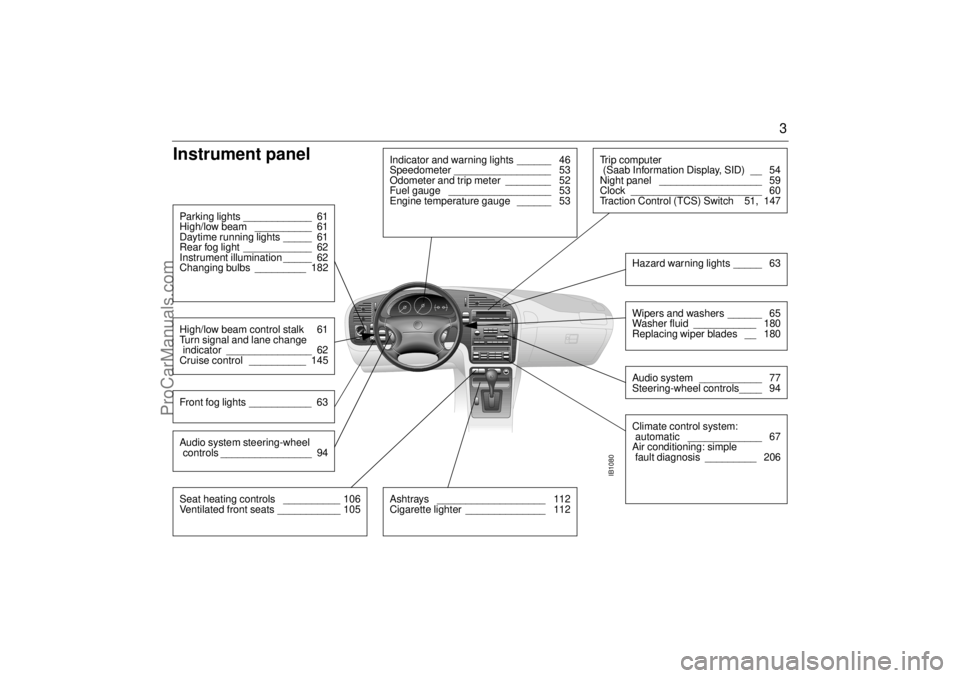
Instrument panel
IB1080
Indicator and warning lights ______ 46
Speedometer _________________ 53
Odometer and trip meter ________ 52
Fuel gauge __________________ 53
Engine temperature gauge ______ 53
Parking lights ____________ 61
High/low beam __________ 61
Daytime running lights _____ 61
Rear fog light ____________ 62
Instrument illumination _____ 62
Changing bulbs _________ 182High/low beam control stalk 61
Turn signal and lane change
indicator _______________ 62
Cruise control __________ 145Front fog lights ___________ 63
Ashtrays ___________________ 112
Cigarette lighter ______________ 112
Tr i p c o m p u t e r
(Saab Information Display, SID) __ 54
Night panel __________________ 59
Clock _______________________ 60
Traction Control (TCS) Switch 51, 147
Wipers and washers ______ 65
Washer fluid ___________ 180
Replacing wiper blades __ 180Audio system ___________ 77
Steering-wheel controls____ 94Hazard warning lights _____ 63Climate control system:
automatic _____________ 67
Air conditioning: simple
fault diagnosis _________ 206
Seat heating controls __________ 106
Ventilated front seats ___________ 105Audio system steering-wheel
controls ________________ 94
ProCarManuals.com
Page 49 of 256
49 Instruments and controls
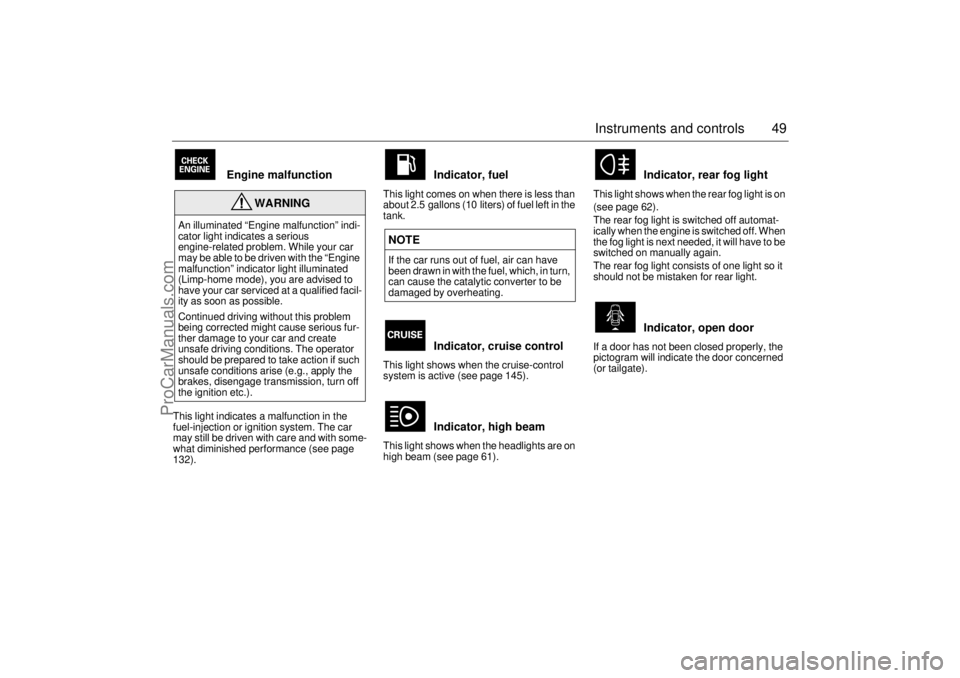
Engine malfunction
This light indicates a malfunction in the
fuel-injection or ignition system. The car
may still be driven with care and with some-
what diminished performance (see page
132).
Indicator, fuel
This light comes on when there is less than
about 2.5 gallons (10 liters) of fuel left in the
tank.
Indicator, cruise control
This light shows when the cruise-control
system is active (see page 145).
Indicator, high beam
This light shows when the headlights are on
high beam (see page 61).
Indicator, rear fog light
This light shows when the rear fog light is on
(see page 62).
The rear fog light is switched off automat-
ically when the engine is switched off. When
the fog light is next needed, it will have to be
switched on manually again.
The rear fog light consists of one light so it
should not be mistaken for rear light.
Indicator, open door
If a door has not been closed properly, the
pictogram will indicate the door concerned
(or tailgate).
WARNING
An illuminated “Engine malfunction” indi-
cator light indicates a serious
engine-related problem. While your car
may be able to be driven with the “Engine
malfunction” indicator light illuminated
(Limp-home mode), you are advised to
have your car serviced at a qualified facil-
ity as soon as possible.
Continued driving without this problem
being corrected might cause serious fur-
ther damage to your car and create
unsafe driving conditions. The operator
should be prepared to take action if such
unsafe conditions arise (e.g., apply the
brakes, disengage transmission, turn off
the ignition etc.).
NOTEIf the car runs out of fuel, air can have
been drawn in with the fuel, which, in turn,
can cause the catalytic converter to be
damaged by overheating.
ProCarManuals.com
Page 129 of 256

129 Starting and driving
Starting and driving
IB597
Ignition switch ................. 130
Starting the engine .......... 131
Important considerations
for driving ....................... 132
Refueling .......................... 134
Engine Break-In Period ... 137
Gear changing ................. 137
Cruise control .................. 145
Braking ............................. 146
Traction Control System . 147
Economical motoring ...... 149
Driving in winter .............. 150 Driving in hot weather .... 151
Towing a trailer ................ 152
Driving considerations
with compact spare
wheel/tire fitted .............. 154
Driving with the trunk
lid/tailgate open ............. 154
Driving with a roof rack
load ................................. 155
Driving with a load .......... 157
Towing the car ................. 158
Jump starting .................. 160 Parking brake ................... 162
Parking .............................. 162
ProCarManuals.com
Page 132 of 256

132 Starting and drivingUseful tips on cold climate starting If the engine has failed to start after several
attempts in very cold weather, press and
hold the accelerator down to the floor and
run the starter for 5–10 seconds. This will
prevent the engine being flooded (exces-
sively rich fuel-air mixture).
Now start the engine in the normal way – do
not touch the accelerator.
If the engine stalls immediately after starting
(e.g. if the clutch was released too quickly),
do not touch the accelerator when restarting
the engine.
Limp-home modeThe car’s engine-management system
includes a diagnostic function that checks
numerous internal functions after the
engine has been shut off. If a fault is
detected in the throttle system, the
engine-management system puts the throt-
tle system into the limp-home mode. This
limits idling control, disables the cruise-con-
trol system and limits the capacity of the A/C
compressor.
If the limp-home mode is in operation
(“Engine malfunction” light on, see below)
and the outside temperature is close to or
below freezing, you may need to use some
throttle on starting (some pressure on the
accelerator).
If the diagnostic system has detected a fault
in the engine-management system, the
“Engine malfunction” light on the main
instrument panel will come on (see page
49), indicating that you should have the car
checked as soon as possible by an autho-
rized Saab dealer.
Important
considerations for
drivingThe engine-management system in the
Saab 9-5 is called Saab Trionic T7. The
system manages the ignition, fuel injection
and turbo boost pressure.
The Trionic T7 system developed by Saab
is an intelligent engine-management
system designed to achieve optimum driv-
ability under differing driving conditions.
The system makes adjustments automati-
cally, for instance, if the car is being driven
at altitude (oxygen-deficient air), for differ-
ent grades of fuel (AON 87–93) and for dif-
ferent load conditions.
1 Starting and driving
Refrain from using full throttle before
the engine has warmed up (before
needle in mid-range on temperature
gauge).
A safety function prevents the engine
from revving faster than 6,000 rpm by
limiting the induction air.
2 Stopping the engine
Do not rev the engine immediately
before switching it off - stop the engine
when it is idling.
3 Regulating the boost pressure
The system is optimized for fuel with an
octane rating of AON 90. One of the
ProCarManuals.com
Page 145 of 256
145 Starting and driving
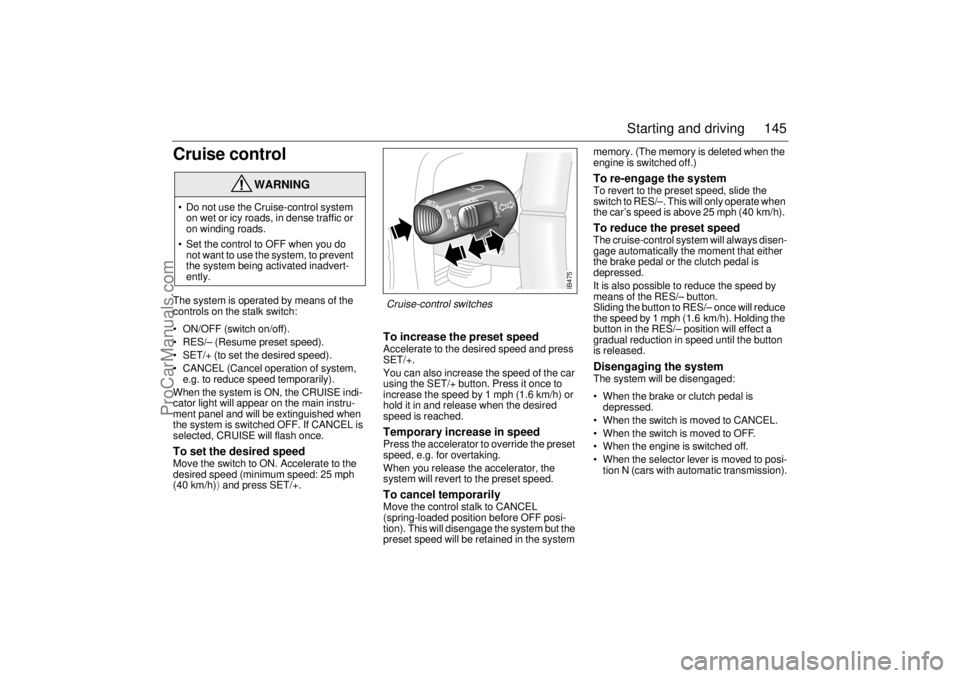
Cruise controlThe system is operated by means of the
controls on the stalk switch:
ON/OFF (switch on/off).
RES/– (Resume preset speed).
SET/+ (to set the desired speed).
CANCEL (Cancel operation of system,
e.g. to reduce speed temporarily).
When the system is ON, the CRUISE indi-
cator light will appear on the main instru-
ment panel and will be extinguished when
the system is switched OFF. If CANCEL is
selected, CRUISE will flash once. To set the desired speed Move the switch to ON. Accelerate to the
desired speed (minimum speed: 25 mph
(40 km/h)) and press SET/+.
To increase the preset speed Accelerate to the desired speed and press
SET/+.
You can also increase the speed of the car
using the SET/+ button. Press it once to
increase the speed by 1 mph (1.6 km/h) or
hold it in and release when the desired
speed is reached. Temporary increase in speed Press the accelerator to override the preset
speed, e.g. for overtaking.
When you release the accelerator, the
system will revert to the preset speed. To cancel temporarily Move the control stalk to CANCEL
(spring-loaded position before OFF posi-
tion). This will disengage the system but the
preset speed will be retained in the system memory. (The memory is deleted when the
engine is switched off.)
To re-engage the system To revert to the preset speed, slide the
switch to RES/–. This will only operate when
the car’s speed is above 25 mph (40 km/h). To reduce the preset speedThe cruise-control system will always disen-
gage automatically the moment that either
the brake pedal or the clutch pedal is
depressed.
It is also possible to reduce the speed by
means of the RES/– button.
Sliding the button to RES/– once will reduce
the speed by 1 mph (1.6 km/h). Holding the
button in the RES/– position will effect a
gradual reduction in speed until the button
is released. Disengaging the system The system will be disengaged:
When the brake or clutch pedal is
depressed.
When the switch is moved to CANCEL.
When the switch is moved to OFF.
When the engine is switched off.
When the selector lever is moved to posi-
tion N (cars with automatic transmission).
WARNING
Do not use the Cruise-control system
on wet or icy roads, in dense traffic or
on winding roads.
Set the control to OFF when you do
not want to use the system, to prevent
the system being activated inadvert-
ently.
IB475
Cruise-control switches
ProCarManuals.com
Page 148 of 256

148 Starting and drivingTCS eliminates wheelspin. The same
applies when the car is reversing.
On cornering, if there is a tendency for the
inner front wheel to rotate faster than the
other wheels.
On overtaking.
TCS OFF The TCS OFF indicator on the main instru-
ment panel will come on:
If a fault has been detected and the
system has therefore been switched off.
If there is a fault in the ABS system.
If the system has been switched off man-
ually.
The indicator light will also come on for
4 seconds when the ignition key is turned to
ON, while an internal system check is per-
formed. TCS indicator The indicator light will come on for
4 seconds when the ignition key is turned to
ON, while an internal system check is per-
formed.
The TCS light in the tachometer comes on
when the system is operative, i.e. when the
wheels are not rotating at the same speed.
The fact that the TCS system is operative
indicates that the limit for grip has been
exceeded and that the driver must exert
greater care.
Turning the TCS off The TCS is switched on automatically when
the engine is started.
The system can be switched off manually by
the TCS button, whereupon TCS OFF on
the main instrument panel will come on. The
TCS system cannot be switched off if the car
is travelling faster than 35 mph (60 km/h).
It may be necessary to switch off the system
if the car has become bogged down, for
instance. Press TCS to switch it on again.
If a fault is detected in the ABS system, the
TCS will be switched off automatically.
The cruise-control system will automatically
be disengaged after one second if it is active
when the TCS starts to operate.
WARNING
In normal driving, the TCS system
enhances the safety of the car, but it does
not mean that the car can be driven faster.
The same care and prudence normally
applied should be displayed on cornering
and when driving on slippery roads.
IB478
ProCarManuals.com
Page 195 of 256
195 Car care and technical information
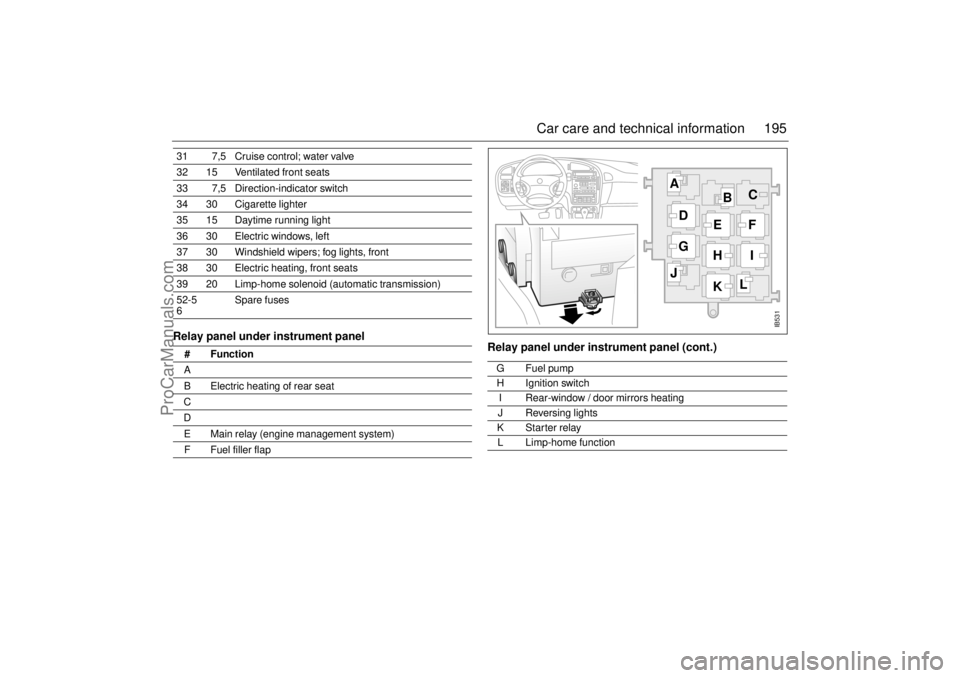
Relay panel under instrument panel
Relay panel under instrument panel (cont.)31 7,5 Cruise control; water valve
32 15 Ventilated front seats
33 7,5 Direction-indicator switch
34 30 Cigarette lighter
35 15 Daytime running light
36 30 Electric windows, left
37 30 Windshield wipers; fog lights, front
38 30 Electric heating, front seats
39 20 Limp-home solenoid (automatic transmission)
52-5
6Spare fuses
# Function
A
B Electric heating of rear seat
C
D
E Main relay (engine management system)
F Fuel filler flap
G Fuel pump
H Ignition switch
I Rear-window / door mirrors heating
J Reversing lights
KStarter relay
L Limp-home function
IB531
A
BC
D
GEF
HI
KL J
ProCarManuals.com
Page 224 of 256

224 Maintenance and owner assistance
Service Intervals **
Miles = U.S. Cars
Kilometers = Canadian Cars
1,000
(1,600 km)
10,000
(16,000 km)
20,000
(32,000 km)
30,000
(48,000 km)
40,000
(64,000 km)
50,000
(80,000 km)
60,000
(96,000 km)
70,000
(112,000 km)
80,000
(128,000 km)
90,000
(144,000 km)
100,000
(160,000 km)
Service #
1234567891011
Chassis (cont.)
RToe-in"""
R Cabin air filter!!!
R Cabin air absorptive filter!
R Door hinges, stops and locks###
R Airbag system, SRS warning lamps, visual inspection"""""""""""
R Safety belts; operation and visual inspection of belt for
tears and fraying"""""""""""
RWipers"""""""""""
R Washer system: check and top-up"""""""""""
R Reset service indicator""""""""""
Customer programming
R Carry out systems programming per customer request"
Road test
R Check performance of drive train, steering and brakes
and verify tire balance.
Check function of instruments and controls, including
horn, windshield wipers, cruise control and climate sys-
tem.
Note any noises or problems for correction."""""""""""
ProCarManuals.com
Page 241 of 256

241 Index
IndexAA/C system, fault diagnosis ________ 206
A/C system, maintenance _________ 206
ABS brakes ____________________ 146
ACC ___________________________ 67
ACC functions ___________________ 70
ACC, automatic climate control ______ 67
ACC, calibration _________________ 75
ACC, condensation _______________ 76
ACC, programming _______________ 73
ACC, useful tips _________________ 75
Adjusting the steering wheel _______ 107
Adjustment, seats _______________ 102
Afterheater, V6-engine cars _______ 239
Air conditioning (A/C),
fault diagnosis and maintenance __ 206
Air distribution, ACC ______________ 72
Airbag _________________________ 23
Alarm __________________________ 38
Alarm functions __________________ 41
Alarm signals _________________ 38, 41
Alternator ______________________ 179
Alternator drive belt __________ 179, 231
Alternator rating _________________ 230
Anticorrosion treatment ___________ 211
Antidazzle rear-view mirror ________ 109
Ashtrays ______________________ 112
Audio System ___________________ 77Audio System, quick guide _________ 79
Autochecking of lights on starting ____ 52
Automatic climate control (ACC) _____ 67
Automatic transmission,
technical data _________________ 232
BBattery ________________________ 177
Battery charging/replacing _________ 178
Battery, boost starting ____________ 160
Belt guide ______________________ 12
Boost starting using jump leads ____ 160
Booster cushion __________________ 21
Brake and clutch fluid ____________ 175
Brake-fluid reservoir _____________ 175
Brakes, technical data ____________ 233
Bulbs, changing _________________ 182
Bulbs, table of __________________ 191CCD changer _____________________ 89
CD player ______________________ 87
CHECK messages _______________ 58
CHECKING _____________________ 58
Calibration, ACC _________________ 75
Cancelling the programmed settings __ 73
Car alarm _______________________ 38
Car care _______________________ 165
Car phone, installation _____________ 98
Cargo net, 9-5 Wagon ____________ 123Carpeting, care of _______________ 208
Cassette player __________________ 84
Catalytic converter,
important considerations _________ 133
Central locking ___________________ 32
Change language in SID ___________ 60
Change of address notification _____ 220
Changing a wheel _______________ 203
Changing bulbs _________________ 182
Changing the coolant _____________ 175
Changing the wheels round ________ 199
Changing wiper blades ___________ 180
Chassis number _________________ 235
Chassis number, key to ___________ 236
Child safety _____________________ 18
Child safety locks, rear doors _______ 35
Child seat, integral ________________ 21
Cleaning, engine bay _____________ 210
Clock _______________________ 59, 60
Colour code, body _______________ 235
Colour code, trim ________________ 235
Compact spare wheel ____________ 202
Condensation, ACC _______________ 76
Coolant _______________________ 174
Coolant, changing _______________ 175
Cruise control __________________ 145
Cup holder _____________________ 115
DDICE/TWICE ___________________ 193
Dampers ______________________ 232
ProCarManuals.com