engine oil SAAB 9-5 2000 Owners Manual
[x] Cancel search | Manufacturer: SAAB, Model Year: 2000, Model line: 9-5, Model: SAAB 9-5 2000Pages: 256, PDF Size: 14.24 MB
Page 6 of 256
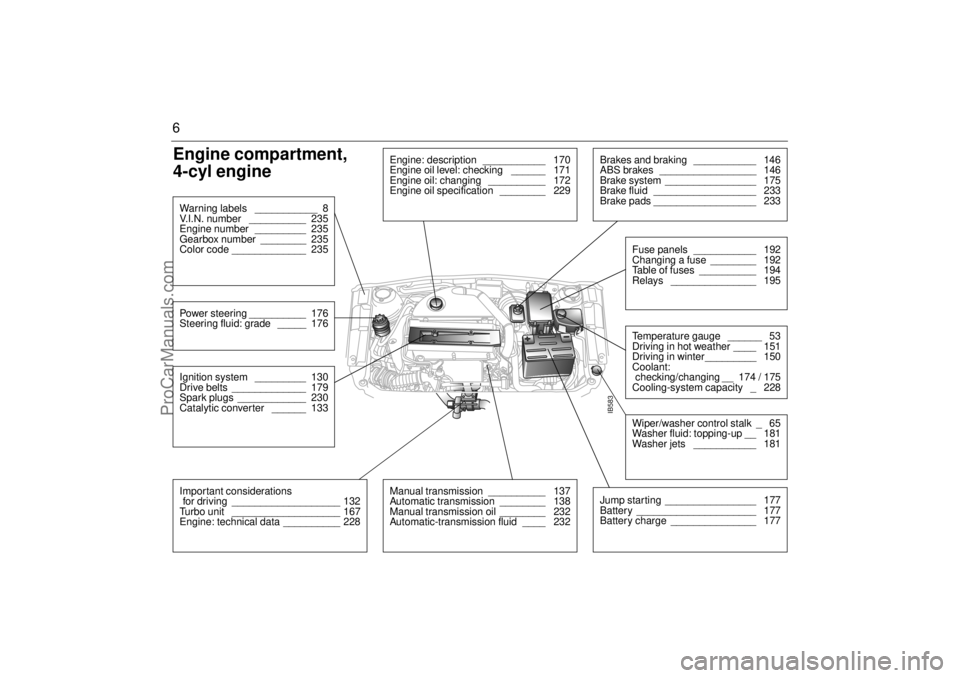
6Engine compartment,
4-cyl engine
IB583
Engine: description ___________ 170
Engine oil level: checking ______ 171
Engine oil: changing __________ 172
Engine oil specification ________ 229
Brakes and braking ___________ 146
ABS brakes _________________ 146
Brake system ________________ 175
Brake fluid __________________ 233
Brake pads __________________ 233
Fuse panels ___________ 192
Changing a fuse ________ 192
Table of fuses __________ 194
Relays _______________ 195Temperature gauge ______ 53
Driving in hot weather ____ 151
Driving in winter_________ 150
Coolant:
checking/changing __ 174 / 175
Cooling-system capacity _ 228
Power steering __________ 176
Steering fluid: grade _____ 176
Wiper/washer control stalk _ 65
Washer fluid: topping-up __ 181
Washer jets ___________ 181
Jump starting ________________ 177
Battery _____________________ 177
Battery charge _______________ 177
Manual transmission __________ 137
Automatic transmission ________ 138
Manual transmission oil ________ 232
Automatic-transmission fluid ____ 232
Important considerations
for driving ___________________ 132
Turbo unit ___________________ 167
Engine: technical data __________ 228Ignition system _________ 130
Drive belts _____________ 179
Spark plugs ____________ 230
Catalytic converter ______ 133Warning labels ___________ 8
V.I.N. number __________ 235
Engine number _________ 235
Gearbox number ________ 235
Color code _____________ 235
ProCarManuals.com
Page 7 of 256
7
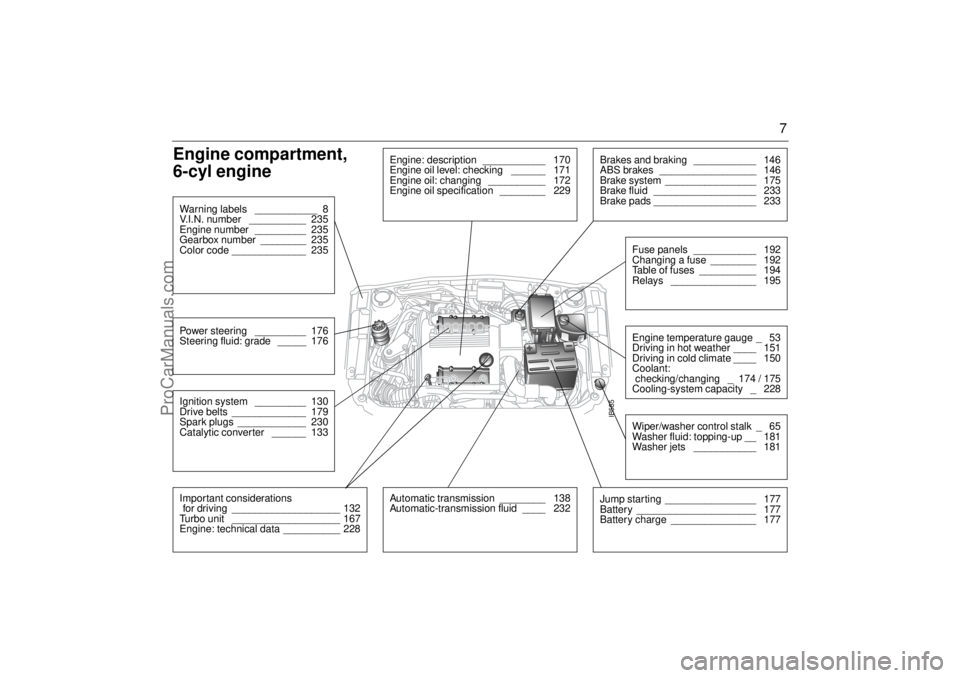
Engine compartment,
6-cyl engine
IB585
Warning labels ___________ 8
V.I.N. number __________ 235
Engine number _________ 235
Gearbox number ________ 235
Color code _____________ 235Ignition system _________ 130
Drive belts _____________ 179
Spark plugs ____________ 230
Catalytic converter ______ 133Important considerations
for driving ___________________ 132
Turbo unit ___________________ 167
Engine: technical data __________ 228
Automatic transmission ________ 138
Automatic-transmission fluid ____ 232
Brakes and braking ___________ 146
ABS brakes _________________ 146
Brake system ________________ 175
Brake fluid __________________ 233
Brake pads __________________ 233Jump starting ________________ 177
Battery _____________________ 177
Battery charge _______________ 177
Fuse panels ___________ 192
Changing a fuse ________ 192
Table of fuses __________ 194
Relays _______________ 195Engine temperature gauge _ 53
Driving in hot weather ____ 151
Driving in cold climate ____ 150
Coolant:
checking/changing _ 174 / 175
Cooling-system capacity _ 228
Power steering _________ 176
Steering fluid: grade _____ 176
Wiper/washer control stalk _ 65
Washer fluid: topping-up __ 181
Washer jets ___________ 181
Engine: description ___________ 170
Engine oil level: checking ______ 171
Engine oil: changing __________ 172
Engine oil specification ________ 229
ProCarManuals.com
Page 8 of 256
8
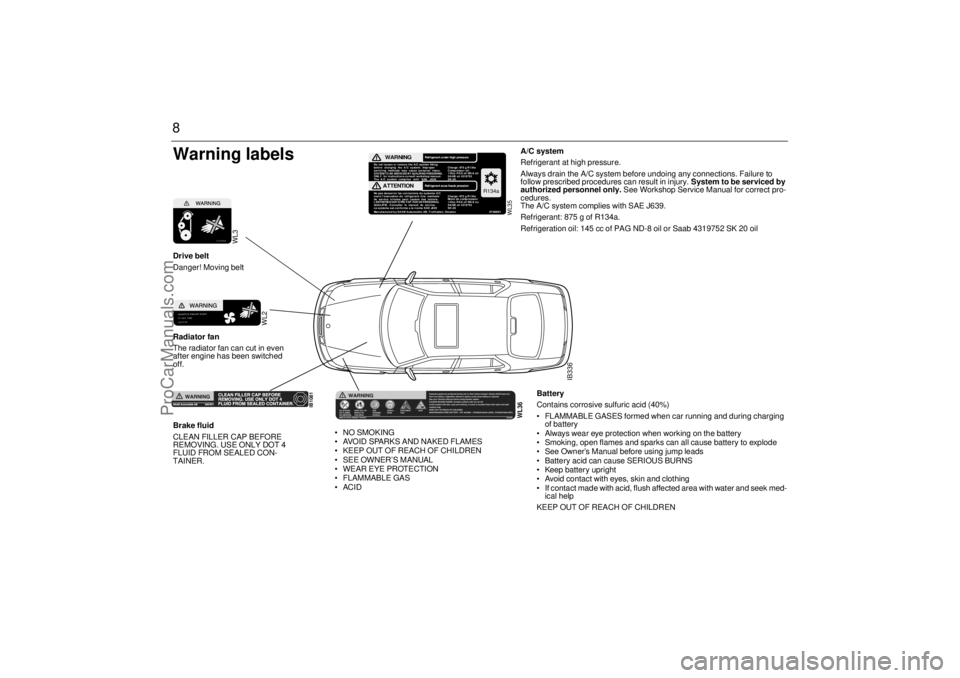
Battery
Contains corrosive sulfuric acid (40%)
FLAMMABLE GASES formed when car running and during charging
of battery
Always wear eye protection when working on the battery
Smoking, open flames and sparks can all cause battery to explode
See Owner’s Manual before using jump leads
Battery acid can cause SERIOUS BURNS
Keep battery upright
Avoid contact with eyes, skin and clothing
If contact made with acid, flush affected area with water and seek med-
ical help
KEEP OUT OF REACH OF CHILDREN Brake fluid
CLEAN FILLER CAP BEFORE
REMOVING. USE ONLY DOT 4
FLUID FROM SEALED CON-
TAINER. Radiator fan
The radiator fan can cut in even
after engine has been switched
off.
WL2
IB336
Drive belt
Danger! Moving belt
WL3
A/C system
Refrigerant at high pressure.
Always drain the A/C system before undoing any connections. Failure to
follow prescribed procedures can result in injury. System to be serviced by
authorized personnel only. See Workshop Service Manual for correct pro-
cedures.
The A/C system complies with SAE J639.
Refrigerant: 875 g of R134a.
Refrigeration oil: 145 cc of PAG ND-8 oil or Saab 4319752 SK 20 oil
Warning labels
IB1081
WL35
Do not loosen or remove the A/C system fitting
before charging the A/C system. Improper
servicing methods may cause personal injury.SYSTEM TO BE SERVICED BY QUALIFIED PERSONNELONLY. for instructions consult workshop manual.
The A/C system complies with SAE J639
Ne pas desserrer les connexions du systeme A/C
avant l’evacuation du refrigerant. Une methode
de service erronee peut causes des lesions.L’ENTRETIEN DOIT ETRE FAIT PAR UN PERSONNALQUALIFIE. Consulter le manuel de service.
ca systeme eat conforme a la norme SAE J639
Manufactured by SAAB Automobile AB, Trollhatten, Sweden
4756961
Charge: 875 g R134a
Compressor oil:
145cc PAG oil ND-8 alt
SAAB oil 4319752
SK-20
Charge: 875 g R134a
Muile de compresseur
145cc PAG oil ND-8 ou
SAAB oil 4319752
SK-20
R134a
WARNING
Refrigerant under high pressure
ATTENTION
Refrigerant sous haute pression
WL36
NO SMOKING
AVOID SPARKS AND NAKED FLAMES
KEEP OUT OF REACH OF CHILDREN
SEE OWNER’S MANUAL
WEAR EYE PROTECTION
FLAMMABLE GAS
ACID
ProCarManuals.com
Page 46 of 256

46 Instruments and controls
Indicator and warning
lights A number of indicator and warning lights will
come on when the ignition is switched on
prior to starting. Under normal conditions,
these should go out a few seconds after the
engine has started (see page 52).
Warning, oil pressure
(engine oil)
This light will come on together with if
the engine oil pressure is dangerously low.
If the light flashes or comes on while you are
driving, stop the car, switch off the engine
and check the engine oil level (see page
171). NOTEUnder no circumstances must the car be
driven when the warning light is on. Low
oil pressure can result in serious engine
damage.
Main instrument panel 1 Tachometer
2 Indicator and warning lights
3 Speedometer
4 Indicator and warning lights
5 Fuel gauge 6 Engine temperature gauge
7 Trip meter reset button
8 Odometer and trip meter
IB1339
2030405060 70
80
90
100
11 0
120
130
140
150
240220200180 160 140 120 100
80
60
40
20
10
8
4
3
2
6
7
5
1
ProCarManuals.com
Page 48 of 256
48 Instruments and controls
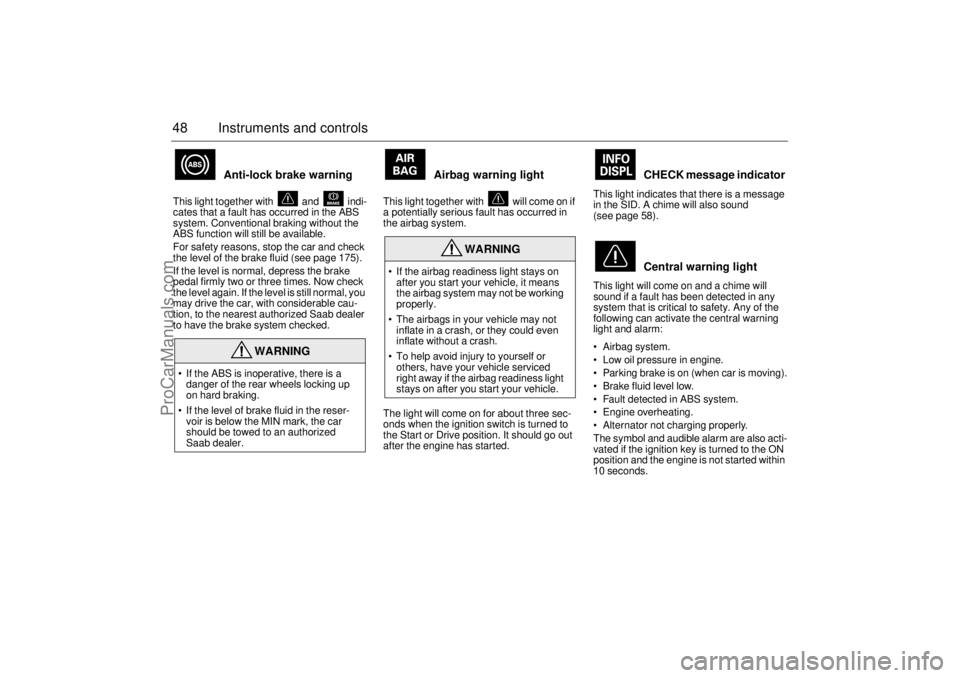
Anti-lock brake warning
This light together with and indi-
cates that a fault has occurred in the ABS
system. Conventional braking without the
ABS function will still be available.
For safety reasons, stop the car and check
the level of the brake fluid (see page 175).
If the level is normal, depress the brake
pedal firmly two or three times. Now check
the level again. If the level is still normal, you
may drive the car, with considerable cau-
tion, to the nearest authorized Saab dealer
to have the brake system checked.
Airbag warning light
This light together with will come on if
a potentially serious fault has occurred in
the airbag system.
The light will come on for about three sec-
onds when the ignition switch is turned to
the Start or Drive position. It should go out
after the engine has started.
CHECK message indicator
This light indicates that there is a message
in the SID. A chime will also sound
(see page 58).
Central warning light
This light will come on and a chime will
sound if a fault has been detected in any
system that is critical to safety. Any of the
following can activate the central warning
light and alarm:
Airbag system.
Low oil pressure in engine.
Parking brake is on (when car is moving).
Brake fluid level low.
Fault detected in ABS system.
Engine overheating.
Alternator not charging properly.
The symbol and audible alarm are also acti-
vated if the ignition key is turned to the ON
position and the engine is not started within
10 seconds.
WARNING
If the ABS is inoperative, there is a
danger of the rear wheels locking up
on hard braking.
If the level of brake fluid in the reser-
voir is below the MIN mark, the car
should be towed to an authorized
Saab dealer.
WARNING
If the airbag readiness light stays on
after you start your vehicle, it means
the airbag system may not be working
properly.
The airbags in your vehicle may not
inflate in a crash, or they could even
inflate without a crash.
To help avoid injury to yourself or
others, have your vehicle serviced
right away if the airbag readiness light
stays on after you start your vehicle.
ProCarManuals.com
Page 52 of 256
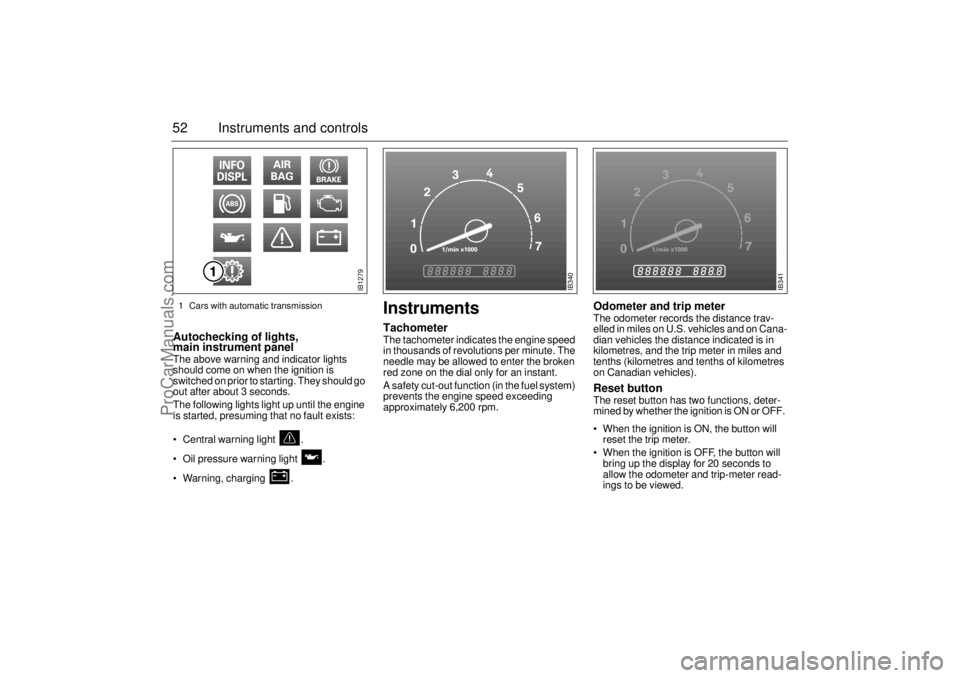
52 Instruments and controlsAutochecking of lights,
main instrument panel The above warning and indicator lights
should come on when the ignition is
switched on prior to starting. They should go
out after about 3 seconds.
The following lights light up until the engine
is started, presuming that no fault exists:
Central warning light .
Oil pressure warning light .
Warning, charging .
InstrumentsTachometerThe tachometer indicates the engine speed
in thousands of revolutions per minute. The
needle may be allowed to enter the broken
red zone on the dial only for an instant.
A safety cut-out function (in the fuel system)
prevents the engine speed exceeding
approximately 6,200 rpm.
Odometer and trip meter The odometer records the distance trav-
elled in miles on U.S. vehicles and on Cana-
dian vehicles the distance indicated is in
kilometres, and the trip meter in miles and
tenths (kilometres and tenths of kilometres
on Canadian vehicles). Reset button The reset button has two functions, deter-
mined by whether the ignition is ON or OFF.
When the ignition is ON, the button will
reset the trip meter.
When the ignition is OFF, the button will
bring up the display for 20 seconds to
allow the odometer and trip-meter read-
ings to be viewed.
IB1279
IB340
IB341
1 Cars with automatic transmission
ProCarManuals.com
Page 131 of 256

131 Starting and driving
If the car does not startIf the text “KEY NOT ACCEPTED” is shown
on the SID, after a failed start attempt, the
cause could be a fault in the transmitter in
the key, or in the receiver in the ignition lock.
The following should be done:
Turn the key back to the LOCK position.
Turn the key to ON.
Press one of the buttons on the remote
control (the LED stops blinking).
Start the engine.
Try another key. If this works, then the fault
is in the first key.
Contact an authorized Saab dealer for
checking and rectification.
Starting the engine Do not run the starter motor for more than
25 seconds at a time. Wait 20-30 seconds
before running the starter again, to give the
battery time to recover.
Avoid racing the engine or putting a heavy
load on it before it has warmed up. Drive
away as soon as the oil warning light has
been extinguished to enable the engine to
attain its normal temperature as quickly as
possible.
It is possible for air to enter the lubricating
system in conjunction with an oil or oil-filter
change, or if the car has been stored for
some time. This air can cause the hydraulic
cam followers to emit a ticking noise, which
can persist for up to 15 minutes after start-
ing. Although this is quite normal and does
not indicate any malfunction, it is advisable
not to exceed 3,000 rpm before the noise
has disappeared.
The hydraulic cam lifters are completely
service free; the valve clearance is set up at the factory and will not need any subse-
quent adjustment.
Starting the engineThe engine has an automatic choke and
should be started as follows:
Cars with manual gearbox
To start the engine the clutch pedal must
be fully depressed.
1 Depress the clutch pedal fully but do not
touch the accelerator.
2 Start the engine. Let the ignition key
spring back as soon as the engine has
started and is running smoothly – at very
low temperatures, you may need to run
the starter for up to 25 seconds.
Let the engine idle for about 10 seconds. Do
not open the throttle wide for at least
2-3 minutes after starting.
Cars with automatic transmission
1 The selector lever must be in the P or N
position.
2 Keep your foot on the brake pedal.
3 Start the engine. Let the ignition key
spring back as soon as the engine has
started and is running smoothly – at very
low temperatures, you may need to run
the starter for up to 25 seconds.
Let the engine idle for about 10 seconds. Do
not open the throttle wide for at least
2–3 minutes after starting.
NOTETake care not to spill drinks or to drop
crumbs over the ignition switch. If dirt or
liquid gets into it, the switch may not
operate properly.
WARNING
Always remove the key before leaving
the car.
Always apply the parking brake before
removing the ignition key.
WARNING
Carbon monoxide (CO) is a colorless,
odorless, poisonous gas. Be alert to
the danger of CO – always open the
garage doors before starting the
engine in the garage.
There is also a danger of CO poison-
ing if the exhaust system is leaking.
ProCarManuals.com
Page 141 of 256

141 Starting and driving
Overheated transmission fluid If the automatic-transmission fluid should
overheat, the following message will appear
on the SID:
”TRANSMISSION OVERHEATING”. If this
happens, stop the car and wait for the mes-
sage to be extinguished. Continue driving in
a locked gear that produces an engine
speed of about 3,000 rpm.
Overheating of the automatic-transmission
fluid can occur when the car is towing a
heavy load, such as a camping trailer in hilly
country, with the wrong gear selected,
resulting in abnormally frequent gear
changing. Try selecting position 1, 2 or 3.
High ambient temperatures can also
increase the temperature of the transmis-
sion fluid or the oil cooler may be faulty.
Contact an authorized Saab dealer (see
also page 152).
Towing Towing of cars with automatic transmission,
see page 158.
NOTEIf the control module has actuated the
Limp-home function for the automatic
transmission, the car will remain in 4th
gear when D is selected, making it very
sluggish. To overcome this, move the
selector lever to position 2.
WARNING
Remember to use engine-braking (selec-
tor position 1, 2, or 3) to spare the brakes
when you are driving on a long or steep
downhill slope. Select the same gear as
you would on the corresponding uphill
slope.
Brake failure can result from overheated
brakes!
ProCarManuals.com
Page 143 of 256

143 Starting and driving
If the gear selector lever is moved from position D to 1, a
change-down to 3rd gear will occur at about 110 mph (180 km/h).
A change-down to 2nd gear will occur at about 75 mph (120 km/h)
and to 1st gear at about 40 mph (65 km/h).
When position 1 is selected, all the other gears will be locked out.
Manual gear-changing is not recommended on slippery roads.
Adaptive gear-change patternsAdaptive gear-change patterns are selected automatically depend-
ing on the engine load and the present temperature of the transmis-
sion. The function is available in Normal and Sport modes.
The changes occur at a higher engine speed and the car remains in
the same gear for longer, if the transmission control module senses
that the load has not decreased. These gear-change patterns pre-
vent unnecessary changing up and down, when for example driving
up long slopes with a trailer or caravan, and to prevent overheating
the transmission oil. The adaptive gear-change function is also
selected automatically when the transmission oil becomes too hot,
to protect the transmission itself from serious damage and to lower
the oil temperature.
The adaptive gear-change pattern function is deselected when:
Winter mode is selected.
The engine is switched off.
The load is reduced so much that the function is no longer
required.
“Fault indicator, automatic transmission” appears on main
instrument panel, see page 140. 1
Position 1 should be used when maximum
engine-braking is required on steep downhill
slopes and to avoid frequent gear-changing on
steep climbs.
Do not move the selector to position 1 at speeds
in excess of 37 mph (60 km/h).
ProCarManuals.com
Page 161 of 256
161 Starting and driving
5 Check that the jumper cables do not
have loose or missing insulation. If they
do, you could get a shock and also the
vehicles could be damaged.
Before you connect the cables, here are
some basic things you should know.
Positive (+) will go to positive (+) and
negative (-) will go to negative (-) or a
major metal engine part with a good
ground. Do not connect (+) to (-) or you
will get a short that could injure you or
would damage the battery and maybe
other parts as well.
6 Connect the red positive (+) cable to the
positive (+) terminal of the vehicle with
the discharged battery.
7 Do not let the other end touch metal.
Connect it to the positive (+) terminal of
the good battery. Use a remote positive
(+) terminal if the vehicle has one.8 Now connect the black negative (-)
cable to the good battery’s negative ter-
minal.
Do not let the other end touch anything
until the next step. The other end of the
negative cable does not go to the dead
battery. It goes to a major metal part with
a good ground on the engine of the vehi-
cle with the discharged battery.
9 Attach the cable at least 18 inches
(45 cm) away from the discharged bat-
tery, but not near engine parts that
move. The electrical connection is just
as good there, but the chance of sparks
getting back to the battery is much less.
10 Start the vehicle with the good battery
and run the engine for a while.
11 Try to start the vehicle with the dis-
charged battery. If it does not start after
a few tries, it probably needs service.
12 Remove the cables in reverse order to
prevent electrical shorting. Take care
that they do not touch each other or any
other metal.
WARNING
An electric fan can start up even when the
engine is not running and can injure you.
Keep hands, clothing and tools away from
any underhood electric fan.
WARNING
Using a match or flame of any kind near a
battery can cause battery gas to explode.
You can suffer burns or be blinded. Use a
flashlight if you need more light.
Be sure the battery has enough water.
The battery installed in your new Saab
has filler caps. Be sure the right amount
of water is there. Add distilled or boiled
water if the level is too low. If you don’t,
explosive gas could be present.
Be sure the electrolyte in the battery is not
frozen. Discharged batteries will freeze.
When connecting jumper cables to a
frozen battery, gas from the chemical
reaction inside the battery can build up
under the ice and cause an explosion.
Battery fluid contains acid that can burn
you. Do not get it on you. If you acciden-
tally get it in your eyes or on your skin,
flush the area with water and get medical
help immediately.
ProCarManuals.com