spare wheel SAAB 9-5 2000 Owners Manual
[x] Cancel search | Manufacturer: SAAB, Model Year: 2000, Model line: 9-5, Model: SAAB 9-5 2000Pages: 256, PDF Size: 14.24 MB
Page 4 of 256
4Exterior
IB580
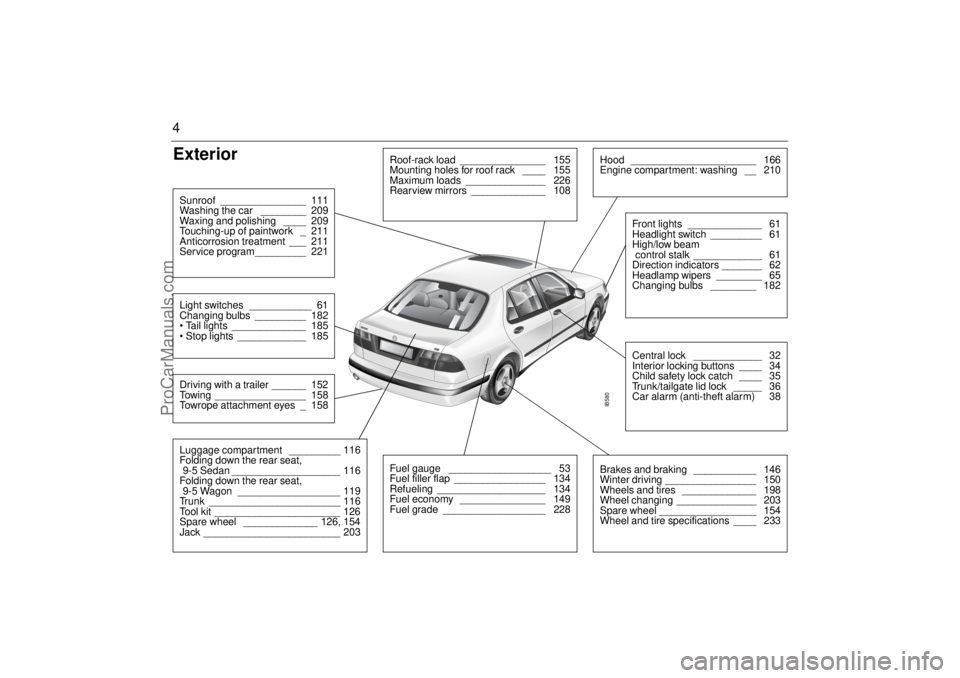
Roof-rack load _______________ 155
Mounting holes for roof rack ____ 155
Maximum loads ______________ 226
Rearview mirrors _____________ 108
Hood ______________________ 166
Engine compartment: washing __ 210
Central lock ____________ 32
Interior locking buttons ____ 34
Child safety lock catch ____ 35
Trunk/tailgate lid lock _____ 36
Car alarm (anti-theft alarm) 38Front lights _____________ 61
Headlight switch _________ 61
High/low beam
control stalk ____________ 61
Direction indicators _______ 62
Headlamp wipers ________ 65
Changing bulbs ________ 182
Fuel gauge __________________ 53
Fuel filler flap ________________ 134
Refueling ___________________ 134
Fuel economy _______________ 149
Fuel grade __________________ 228
Brakes and braking ___________ 146
Winter driving ________________ 150
Wheels and tires _____________ 198
Wheel changing ______________ 203
Spare wheel _________________ 154
Wheel and tire specifications ____ 233
Luggage compartment _________ 116
Folding down the rear seat,
9-5 Sedan ___________________ 116
Folding down the rear seat,
9-5 Wagon __________________ 119
Trunk _______________________ 116
Tool kit ______________________ 126
Spare wheel _____________ 126, 154
Jack ________________________ 203Driving with a trailer ______ 152
Towing ________________ 158
Towrope attachment eyes _ 158Light switches ___________ 61
Changing bulbs _________ 182
Tail lights _____________ 185
Stop lights ____________ 185Sunroof _______________ 111
Washing the car ________ 209
Waxing and polishing ____ 209
Touching-up of paintwork _ 211
Anticorrosion treatment ___ 211
Service program_________ 221
ProCarManuals.com
Page 10 of 256
10
IB336
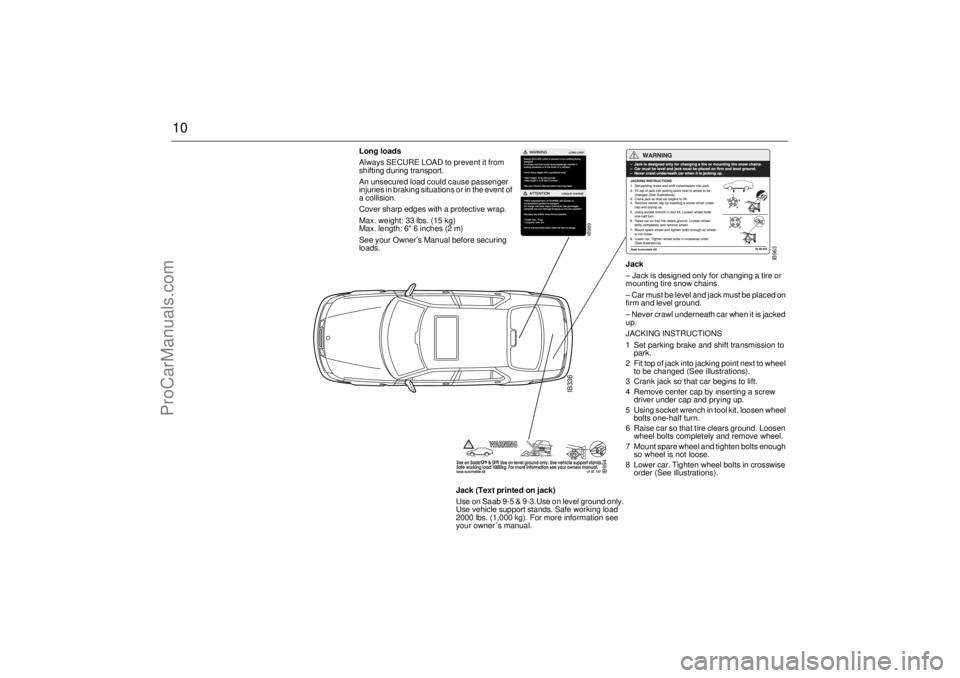
Jack
– Jack is designed only for changing a tire or
mounting tire snow chains.
– Car must be level and jack must be placed on
firm and level ground.
– Never crawl underneath car when it is jacked
up.
JACKING INSTRUCTIONS
1 Set parking brake and shift transmission to
park.
2 Fit top of jack into jacking point next to wheel
to be changed (See illustrations).
3 Crank jack so that car begins to lift.
4 Remove center cap by inserting a screw
driver under cap and prying up.
5 Using socket wrench in tool kit, loosen wheel
bolts one-half turn.
6 Raise car so that tire clears ground. Loosen
wheel bolts completely and remove wheel.
7 Mount spare wheel and tighten bolts enough
so wheel is not loose.
8 Lower car. Tighten wheel bolts in crosswise
order (See illustrations).
IB963
Jack (Text printed on jack)
Use on Saab 9-5 & 9-3.Use on level ground only.
Use vehicle support stands. Safe working load
2000 lbs. (1,000 kg). For more information see
your owner´s manual.
IB994
IB989
Long loads
Always SECURE LOAD to prevent it from
shifting during transport.
An unsecured load could cause passenger
injuries in braking situations or in the event of
a collision.
Cover sharp edges with a protective wrap.
Max. weight: 33 lbs. (15 kg)
Max. length: 6" 6 inches (2 m)
See your Owner’s Manual before securing
loads.
ProCarManuals.com
Page 101 of 256
101 Interior equipment and trunk
Interior equipment
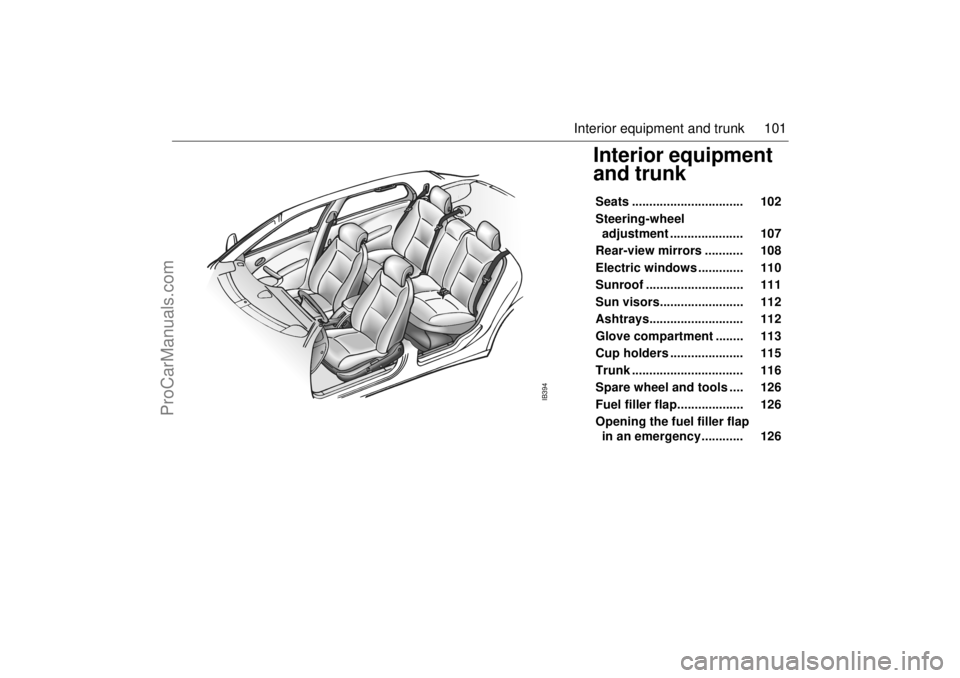
and trunk Seats ................................ 102
Steering-wheel
adjustment ..................... 107
Rear-view mirrors ........... 108
Electric windows ............. 110
Sunroof ............................ 111
Sun visors........................ 112
Ashtrays........................... 112
Glove compartment ........ 113
Cup holders ..................... 115
Trunk ................................ 116
Spare wheel and tools .... 126
Fuel filler flap................... 126
Opening the fuel filler flap
in an emergency............ 126
IB394
ProCarManuals.com
Page 126 of 256

126 Interior equipment and trunkSpare wheel and toolsThe spare wheel, together with the jack and
jack handle, front towrope attachment eye
and toolkit, are stowed away underneath
the trunk.
Driving considerations with compact spare
wheel/tire fitted, see page 154.
Fuel filler flapThe fuel filler flap is opened by means of a
button on the driver’s door. The flap is
spring-loaded, so it opens slightly automat-
ically when released.
Refueling, see page 134.
Opening the fuel filler
flap in an emergencyIf the fuel filler flap fails to open after the
button on the driver’s door has been
pressed, it can be opened manually from
inside the trunk.
9-5 Sedan:
Start by checking fuse 25 (see page 194).
A thin cable on the right-hand side in the
trunk is connected to the catch for the filler
flap. To open the flap, pull the yellow plastic
arrow on the end of the cable.
WARNING
Stow all tools carefully away after use, so
that they cannot get loose and cause
injury in the event of an accident.
IB465
Stowage of spare wheel and tools under
trunk floor
IB466
Button for releasing filler flap
IB467
To open fuel filler flap in an emergency
9-5 Sedan
ProCarManuals.com
Page 129 of 256

129 Starting and driving
Starting and driving
IB597
Ignition switch ................. 130
Starting the engine .......... 131
Important considerations
for driving ....................... 132
Refueling .......................... 134
Engine Break-In Period ... 137
Gear changing ................. 137
Cruise control .................. 145
Braking ............................. 146
Traction Control System . 147
Economical motoring ...... 149
Driving in winter .............. 150 Driving in hot weather .... 151
Towing a trailer ................ 152
Driving considerations
with compact spare
wheel/tire fitted .............. 154
Driving with the trunk
lid/tailgate open ............. 154
Driving with a roof rack
load ................................. 155
Driving with a load .......... 157
Towing the car ................. 158
Jump starting .................. 160 Parking brake ................... 162
Parking .............................. 162
ProCarManuals.com
Page 152 of 256

152 Starting and driving3 As soon as possible, have the cooling
system checked by an authorized Saab
dealer.
Towing a trailerTrailer hitch attachmentTrailer hitch attachments are available as
accessories. These are designed for a max-
imum trailer weight of 2000 lbs. (900 kg).
Use only the electrical trailer hitch socket
provided in the spare wheel area in the lug-
gage compartment for connecting the trailer
electrics.
Trailer weightMaximum recommended trailer weights for
different gradients, with a view to comfort
and drivability for manual and automatic
cars, are shown on the drawing.
Make sure you are familiar with the law
regarding speed limits for towing, maxi-
mum trailer weights, trailer-braking
requirements, and also any special
driving-licence provisions
(see also page 227).
The specified trailer weights and gradients
assume that the journey starts at the hill and
therefore apply only to short periods.
WARNING
Always undo the expansion tank filler cap
carefully, releasing the pressure and any
vapor before removing the cap com-
pletely.
NOTEUse only a genuine Saab trailer hitch,
since other models can damage the car’s
bodywork and electrical system (or in
Canada, a high quality hitch designed to
fit the car, available from a trailer hitch
specialist).
Consult an authorized Saab dealer for
guidance on how to connect the trailer
hitch electrical system.
WARNING
When towing a trailer, do not attempt to
negotiate a hill having a gradient in
excess of 15%. The weight distribution
over the front wheels of the car will be
insufficient to prevent wheelspin, making
further progress impossible.
In addition, the parking brake may not
always be able to hold the car and trailer
securely, with the result that the wheels
can start to slide downhill.
ProCarManuals.com
Page 154 of 256
154 Starting and drivingDriving considerations
with compact spare
wheel/tire fittedThe following should be observed when the
compact spare wheel (T115/70 R16) is
fitted:
The compact spare is light and easy to
handle when changing the wheel. Do not
drive further than necessary with the com-
pact spare fitted – the maximum life of the
wheel is only just over 2000 miles
(3,500 km). Have the standard wheel
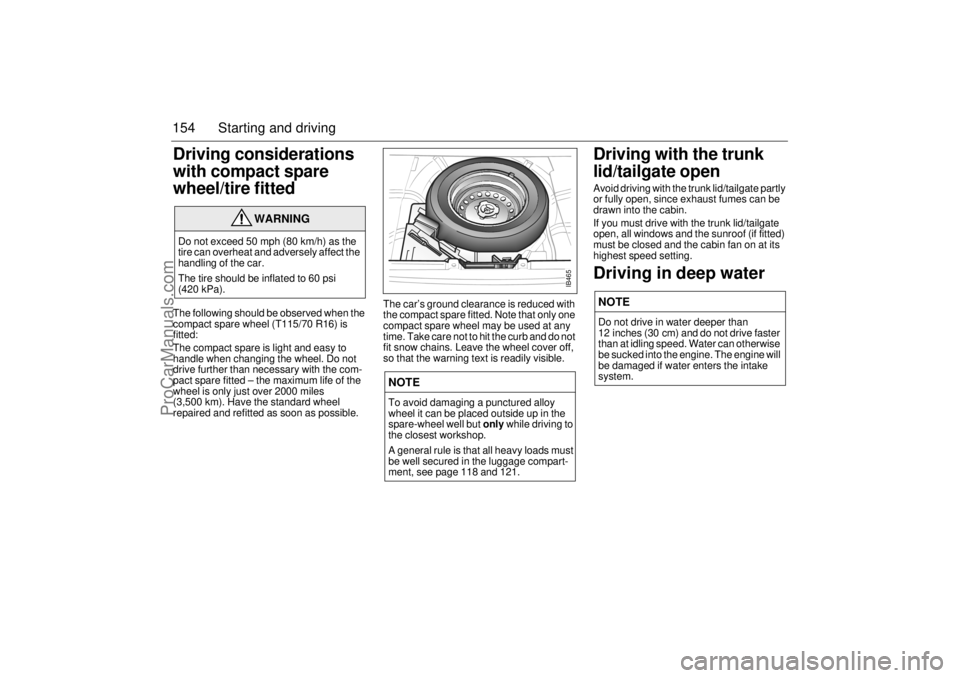
repaired and refitted as soon as possible. The car’s ground clearance is reduced with
the compact spare fitted. Note that only one
compact spare wheel may be used at any
time. Take care not to hit the curb and do not
fit snow chains. Leave the wheel cover off,
so that the warning text is readily visible.
Driving with the trunk
lid/tailgate openAvoid driving with the trunk lid/tailgate partly
or fully open, since exhaust fumes can be
drawn into the cabin.
If you must drive with the trunk lid/tailgate
open, all windows and the sunroof (if fitted)
must be closed and the cabin fan on at its
highest speed setting.Driving in deep water
WARNING
Do not exceed 50 mph (80 km/h) as the
tire can overheat and adversely affect the
handling of the car.
The tire should be inflated to 60 psi
(420 kPa).
NOTETo avoid damaging a punctured alloy
wheel it can be placed outside up in the
spare-wheel well but only while driving to
the closest workshop.
A general rule is that all heavy loads must
be well secured in the luggage compart-
ment, see page 118 and 121.
NOTEDo not drive in water deeper than
12 inches (30 cm) and do not drive faster
than at idling speed. Water can otherwise
be sucked into the engine. The engine will
be damaged if water enters the intake
system.
IB465
ProCarManuals.com
Page 158 of 256
158 Starting and drivingTowing the car
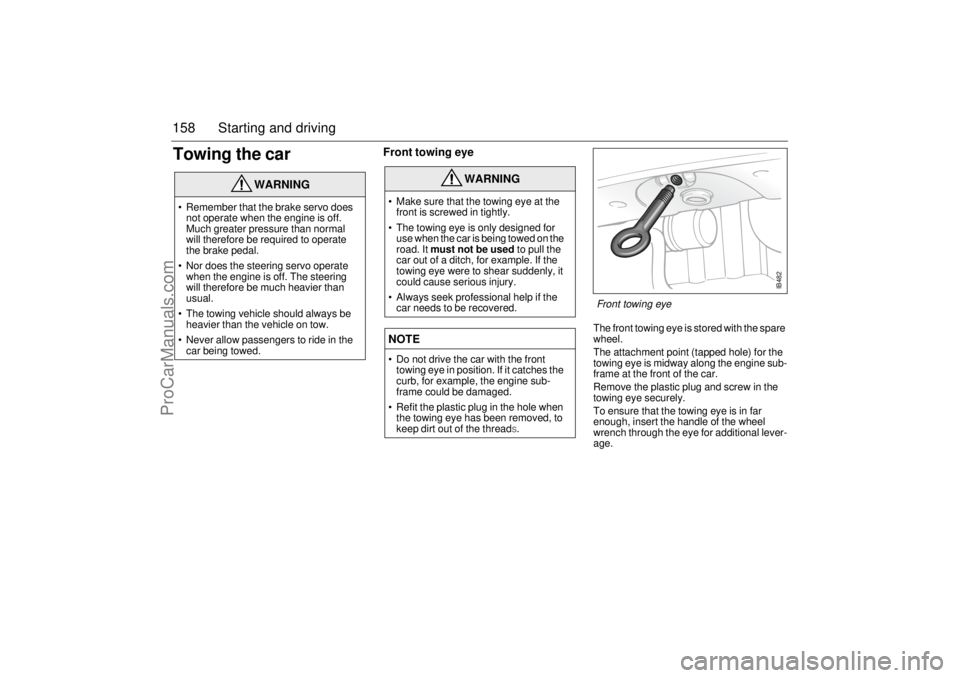
Front towing eye
The front towing eye is stored with the spare
wheel.
The attachment point (tapped hole) for the
towing eye is midway along the engine sub-
frame at the front of the car.
Remove the plastic plug and screw in the
towing eye securely.
To ensure that the towing eye is in far
enough, insert the handle of the wheel
wrench through the eye for additional lever-
age.
WARNING
Remember that the brake servo does
not operate when the engine is off.
Much greater pressure than normal
will therefore be required to operate
the brake pedal.
Nor does the steering servo operate
when the engine is off. The steering
will therefore be much heavier than
usual.
The towing vehicle should always be
heavier than the vehicle on tow.
Never allow passengers to ride in the
car being towed.
WARNING
Make sure that the towing eye at the
front is screwed in tightly.
The towing eye is only designed for
use when the car is being towed on the
road. It must not be used to pull the
car out of a ditch, for example. If the
towing eye were to shear suddenly, it
could cause serious injury.
Always seek professional help if the
car needs to be recovered. NOTE Do not drive the car with the front
towing eye in position. If it catches the
curb, for example, the engine sub-
frame could be damaged.
Refit the plastic plug in the hole when
the towing eye has been removed, to
keep dirt out of the threads.
IB482
Front towing eye
ProCarManuals.com
Page 165 of 256
165 Car care and technical information
Car care and
technical
information
Hood release handle ....... 166
Engine compartment,
4-cyl. engine ................... 167
Engine compartment,
6-cyl. engine ................... 168
Emission control systems 169
Engine............................... 170
Engine oil ......................... 171
Transmission fluid........... 173
Coolant ............................. 174
Brake and clutch fluid ..... 175
Power steering fluid ........ 176
Battery .............................. 177 Drive belts ........................ 179
Wipers and washers ....... 180
Changing bulbs ............... 182
Fuses ................................ 192
Wheels .............................. 198
Compact spare wheel ..... 202
Flat spotting..................... 206
Air conditioning (A/C
system) ........................... 206
Safety belts ...................... 207
Upholstery and trim ........ 208
Textile carpeting.............. 208
Washing the car .............. 209 Waxing and polishing ...... 209
Engine compartment ....... 210
Touching up the paint ..... 210
Anticorrosion treatment .. 211
For long trips .................... 213
Recovery and/or recycling
of automotive materials. 213
Headlamp aiming ............. 214
ProCarManuals.com
Page 199 of 256

199 Car care and technical information
Rotating tiresBecause the car has front-wheel drive, the
front tires tend to wear faster than the rear
ones. New tires should always be fitted in
pairs, so that tires on the same axle have the
same amount of tread.
If swapping the complete set, e.g. winter
tires for summer tires, mark the tires
removed to ensure that they go back in the
same position (e.g. FL for front left, RL rear
left, etc.).
Store wheels lying flat or hanging – never
standing upright.
Tire markingsAn example of the meaning of the different
markings in a tire size is given below for a
tire size of:
205/65 R15 94 V
Winter tiresWinter (snow) tires are recommended for
winter climates where the majority of your
driving will be done on snow and ice. Winter
tires should be fitted to all four wheels to
maintain a proper balance. Your Saab
dealer can advise you as to the correct size
tire for your car (if different from the original
size) and also supply Saab approved winter
tires.Tire quality grading (cars sold in
U.S.)New tires must be graded and labeled in
accordance with new Federal regulations.
Standard tests are conducted to measure
performance in the areas of traction and
temperature resistance. Refer to the tire
sidewall for the specific quality grades of the
tires provided on your new Saab. Compact
spare tires are exempt.
DOT QUALITY GRADES
Treadwear
Traction AA, A, B, C
Temperature A, B, C
All passenger car tires must conform to Fed-
eral safety requirements in addition to these
grades.
WARNING
When fitting just one new pair of tires,
these should be fitted to the rear wheels,
as these are more critical to the direc-
tional stability of the car (e.g. on braking
or in a skid). The existing rear wheels
should therefore be moved to the front.
Always move left rear to left front and right
rear to right front, so that the direction of
rotation remains the same.
205 Tire section width, mm
65 Aspect ratio, i.e. the section height
is 65% of the section width
R Radial ply
15 Wheel rim diameter 15 in at bead
seats
94 Tire load code
V Speed marking
Speed ratings S Tire approved for speeds up to
100 mph (180 km/h)
T Tire approved for speeds up to
118 mph (190 km/h)
H Tire approved for speeds up to
130 mph (210 km/h)
V Tire approved for speeds up to
150 mph (240 km/h)
W Tire approved for speeds up to
167 mph (270 km/h)
Y Tire approved for speeds up to
186 mph (300 km/h)
ProCarManuals.com