warning SAAB 9-5 2001 Owners Manual
[x] Cancel search | Manufacturer: SAAB, Model Year: 2001, Model line: 9-5, Model: SAAB 9-5 2001Pages: 272, PDF Size: 14.83 MB
Page 198 of 272
198 Car care and technical informationBrake and clutch fluid Checking the fluid level The combined brake and clutch-fluid reser-
voir is transparent to facilitate checking of
the fluid level.
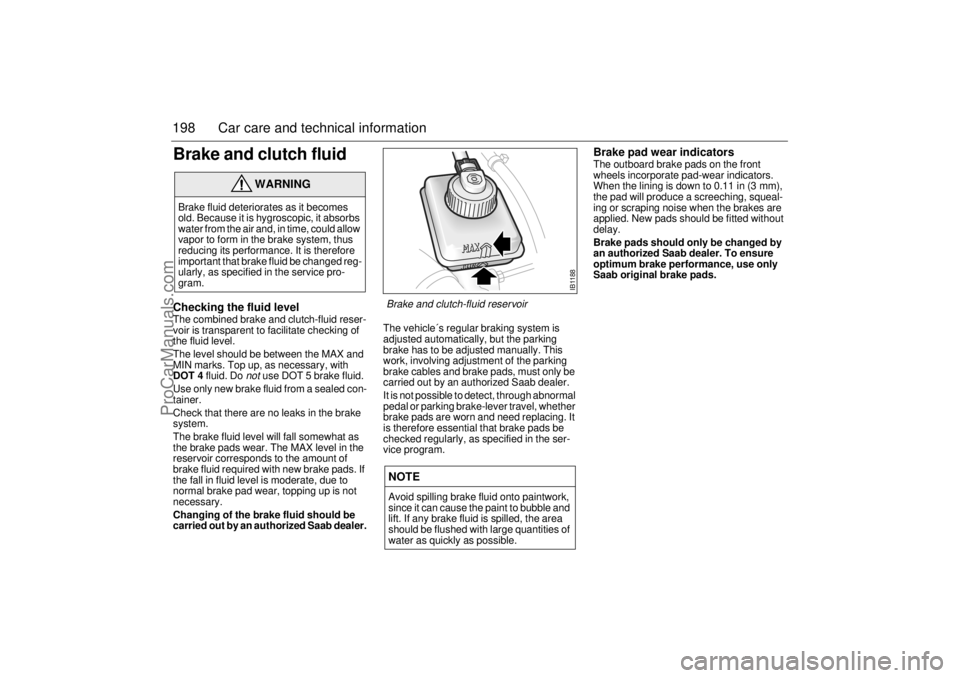
The level should be between the MAX and
MIN marks. Top up, as necessary, with
DOT 4 fluid. Do
not
use DOT 5 brake fluid.
Use only new brake fluid from a sealed con-
tainer.
Check that there are no leaks in the brake
system.
The brake fluid level will fall somewhat as
the brake pads wear. The MAX level in the
reservoir corresponds to the amount of
brake fluid required with new brake pads. If
the fall in fluid level is moderate, due to
normal brake pad wear, topping up is not
necessary.
Changing of the brake fluid should be
carried out by an authorized Saab dealer.The vehicle´s regular braking system is
adjusted automatically, but the parking
brake has to be adjusted manually. This
work, involving adjustment of the parking
brake cables and brake pads, must only be
carried out by an authorized Saab dealer.
It is not possible to detect, through abnormal
pedal or parking brake-lever travel, whether
brake pads are worn and need replacing. It
is therefore essential that brake pads be
checked regularly, as specified in the ser-
vice program.
Brake pad wear indicators The outboard brake pads on the front
wheels incorporate pad-wear indicators.
When the lining is down to 0.11 in (3 mm),
the pad will produce a screeching, squeal-
ing or scraping noise when the brakes are
applied. New pads should be fitted without
delay.
Brake pads should only be changed by
an authorized Saab dealer. To ensure
optimum brake performance, use only
Saab original brake pads.
WARNING
Brake fluid deteriorates as it becomes
old. Because it is hygroscopic, it absorbs
water from the air and, in time, could allow
vapor to form in the brake system, thus
reducing its performance. It is therefore
important that brake fluid be changed reg-
ularly, as specified in the service pro-
gram.
NOTEAvoid spilling brake fluid onto paintwork,
since it can cause the paint to bubble and
lift. If any brake fluid is spilled, the area
should be flushed with large quantities of
water as quickly as possible.
IB1188
Brake and clutch-fluid reservoir
ProCarManuals.com
Page 199 of 272
199 Car care and technical information
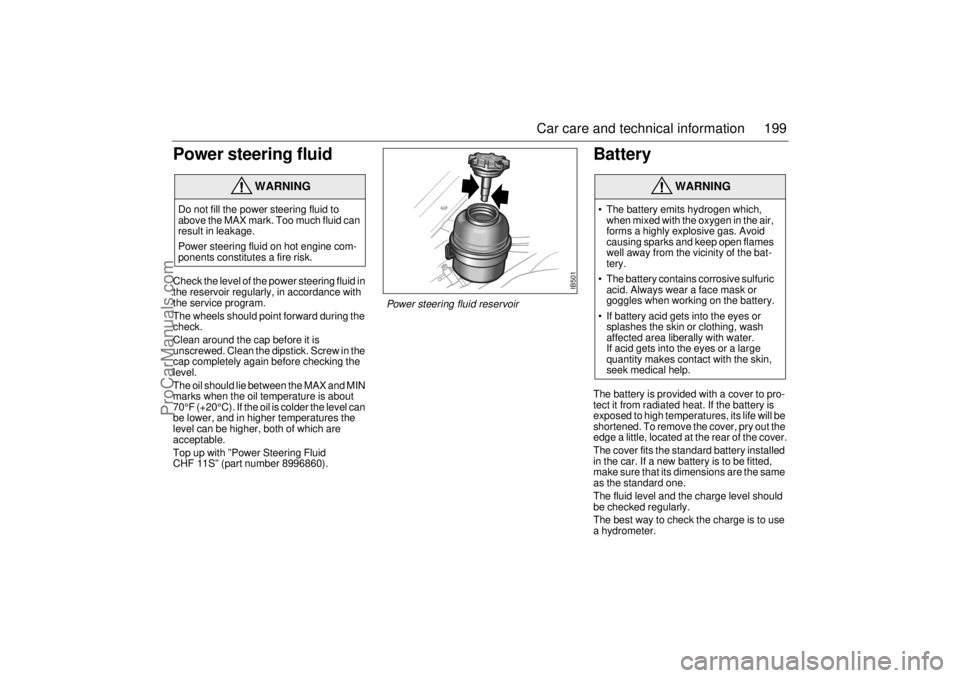
Power steering fluidCheck the level of the power steering fluid in
the reservoir regularly, in accordance with
the service program.
The wheels should point forward during the
check.
Clean around the cap before it is
unscrewed. Clean the dipstick. Screw in the
cap completely again before checking the
level.
The oil should lie between the MAX and MIN
marks when the oil temperature is about
70°F (+20°C). If the oil is colder the level can
be lower, and in higher temperatures the
level can be higher, both of which are
acceptable.
Top up with ”Power Steering Fluid
CHF 11S” (part number 8996860).
BatteryThe battery is provided with a cover to pro-
tect it from radiated heat. If the battery is
exposed to high temperatures, its life will be
shortened. To remove the cover, pry out the
edge a little, located at the rear of the cover.
The cover fits the standard battery installed
in the car. If a new battery is to be fitted,
make sure that its dimensions are the same
as the standard one.
The fluid level and the charge level should
be checked regularly.
The best way to check the charge is to use
a hydrometer.
WARNING
Do not fill the power steering fluid to
above the MAX mark. Too much fluid can
result in leakage.
Power steering fluid on hot engine com-
ponents constitutes a fire risk.
WARNING
The battery emits hydrogen which,
when mixed with the oxygen in the air,
forms a highly explosive gas. Avoid
causing sparks and keep open flames
well away from the vicinity of the bat-
tery.
The battery contains corrosive sulfuric
acid. Always wear a face mask or
goggles when working on the battery.
If battery acid gets into the eyes or
splashes the skin or clothing, wash
affected area liberally with water.
If acid gets into the eyes or a large
quantity makes contact with the skin,
seek medical help.
IB501
Power steering fluid reservoir
ProCarManuals.com
Page 202 of 272
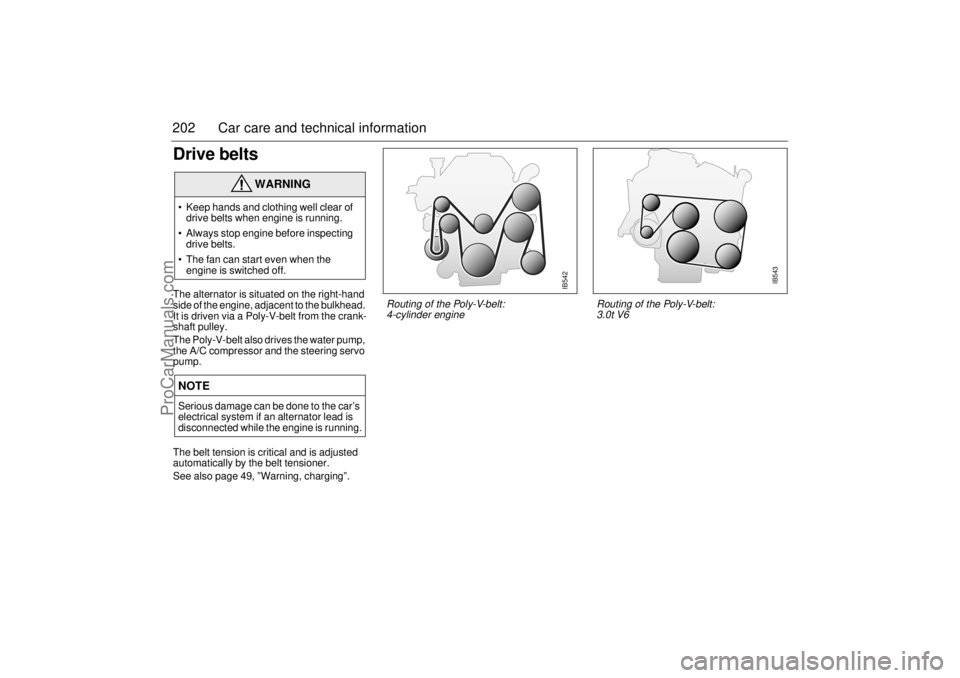
202 Car care and technical informationDrive belts The alternator is situated on the right-hand
side of the engine, adjacent to the bulkhead.
It is driven via a Poly-V-belt from the crank-
shaft pulley.
The Poly-V-belt also drives the water pump,
the A/C compressor and the steering servo
pump.
The belt tension is critical and is adjusted
automatically by the belt tensioner.
See also page 49, ”Warning, charging”.
WARNING
Keep hands and clothing well clear of
drive belts when engine is running.
Always stop engine before inspecting
drive belts.
The fan can start even when the
engine is switched off.NOTESerious damage can be done to the car’s
electrical system if an alternator lead is
disconnected while the engine is running.
IB542
Routing of the Poly-V-belt:
4-cylinder engine
IB543
Routing of the Poly-V-belt:
3.0t V6
ProCarManuals.com
Page 205 of 272
205 Car care and technical information
Changing bulbs Check that the new bulb is working when finished.
Some bulbs are of the ”Long-Life” type. Make sure the same type is
fitted when changing one of these.
Headlight aiming, see page 238.
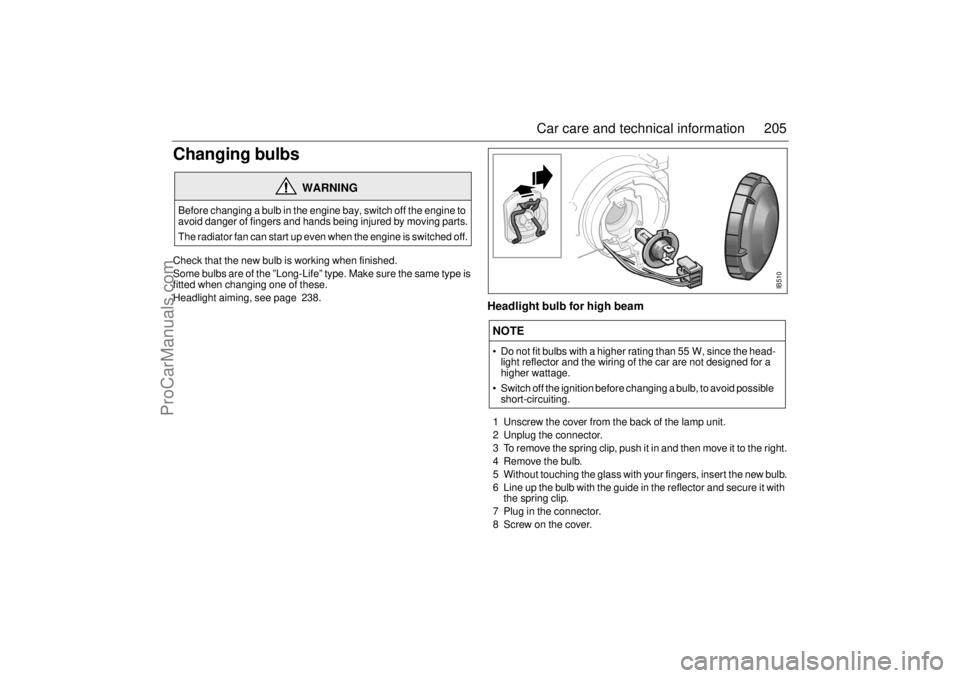
Headlight bulb for high beam1 Unscrew the cover from the back of the lamp unit.
2 Unplug the connector.
3 To remove the spring clip, push it in and then move it to the right.
4 Remove the bulb.
5 Without touching the glass with your fingers, insert the new bulb.
6 Line up the bulb with the guide in the reflector and secure it with
the spring clip.
7 Plug in the connector.
8 Screw on the cover.
WARNING
Before changing a bulb in the engine bay, switch off the engine to
avoid danger of fingers and hands being injured by moving parts.
The radiator fan can start up even when the engine is switched off.
NOTE Do not fit bulbs with a higher rating than 55 W, since the head-
light reflector and the wiring of the car are not designed for a
higher wattage.
Switch off the ignition before changing a bulb, to avoid possible
short-circuiting.
IB510
ProCarManuals.com
Page 207 of 272
207 Car care and technical information
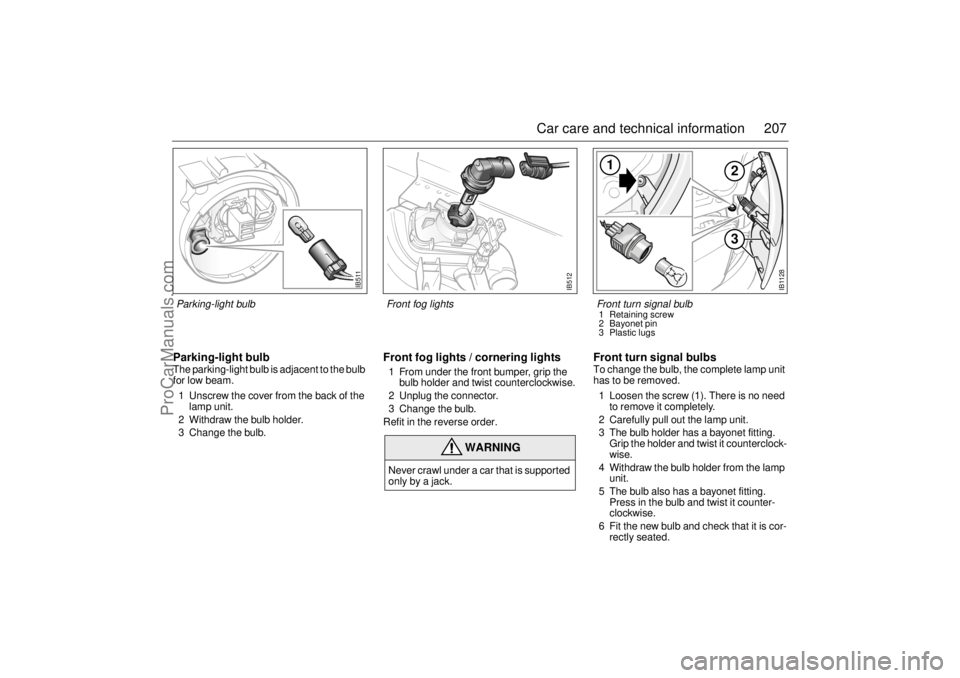
Parking-light bulb The parking-light bulb is adjacent to the bulb
for low beam.
1 Unscrew the cover from the back of the
lamp unit.
2 Withdraw the bulb holder.
3 Change the bulb.
Front fog lights / cornering lights1 From under the front bumper, grip the
bulb holder and twist counterclockwise.
2 Unplug the connector.
3 Change the bulb.
Refit in the reverse order.
Front turn signal bulbsTo change the bulb, the complete lamp unit
has to be removed.
1 Loosen the screw (1). There is no need
to remove it completely.
2 Carefully pull out the lamp unit.
3 The bulb holder has a bayonet fitting.
Grip the holder and twist it counterclock-
wise.
4 Withdraw the bulb holder from the lamp
unit.
5 The bulb also has a bayonet fitting.
Press in the bulb and twist it counter-
clockwise.
6 Fit the new bulb and check that it is cor-
rectly seated.
WARNING
Never crawl under a car that is supported
only by a jack.
IB511
Parking-light bulb
IB512
IB1128
1
23
Front turn signal bulb1 Retaining screw
2 Bayonet pin
3 Plastic lugs
Front fog lights
ProCarManuals.com
Page 215 of 272
215 Car care and technical information
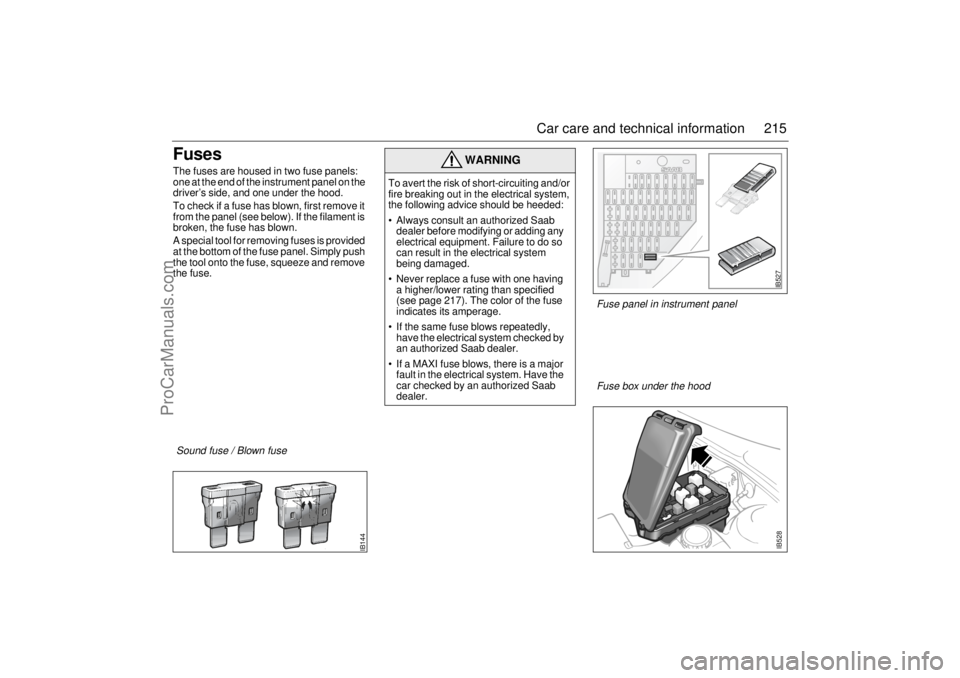
FusesThe fuses are housed in two fuse panels:
one at the end of the instrument panel on the
driver’s side, and one under the hood.
To check if a fuse has blown, first remove it
from the panel (see below). If the filament is
broken, the fuse has blown.
A special tool for removing fuses is provided
at the bottom of the fuse panel. Simply push
the tool onto the fuse, squeeze and remove
the fuse.
WARNING
To avert the risk of short-circuiting and/or
fire breaking out in the electrical system,
the following advice should be heeded:
Always consult an authorized Saab
dealer before modifying or adding any
electrical equipment. Failure to do so
can result in the electrical system
being damaged.
Never replace a fuse with one having
a higher/lower rating than specified
(see page 217). The color of the fuse
indicates its amperage.
If the same fuse blows repeatedly,
have the electrical system checked by
an authorized Saab dealer.
If a MAXI fuse blows, there is a major
fault in the electrical system. Have the
car checked by an authorized Saab
dealer.
IB527
Fuse panel in instrument panel
IB528
Fuse box under the hood
IB144
Sound fuse / Blown fuse
ProCarManuals.com
Page 216 of 272
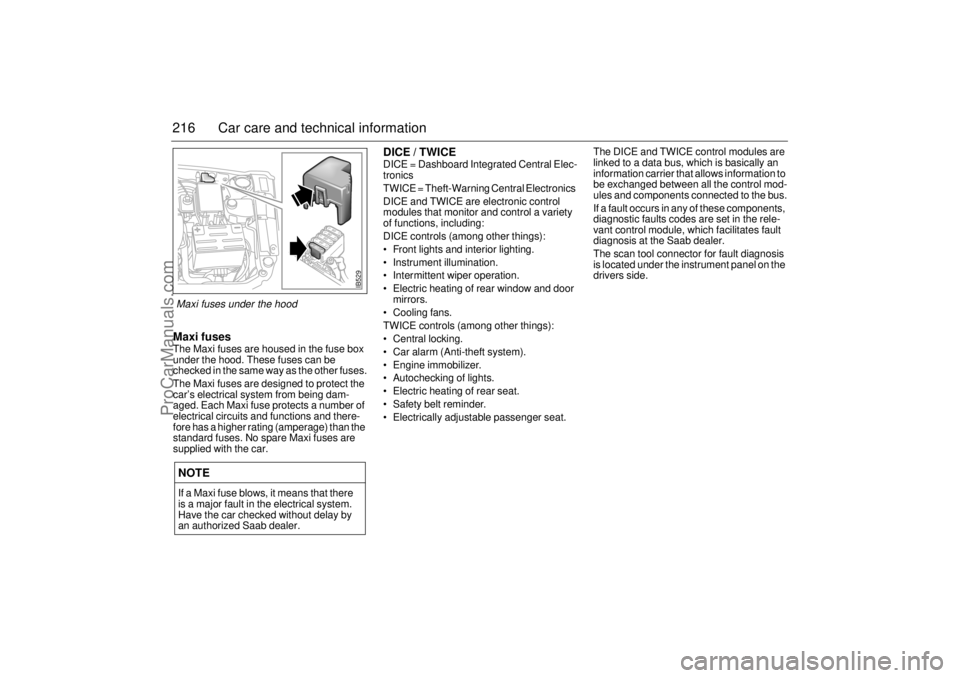
216 Car care and technical informationMaxi fusesThe Maxi fuses are housed in the fuse box
under the hood. These fuses can be
checked in the same way as the other fuses.
The Maxi fuses are designed to protect the
car’s electrical system from being dam-
aged. Each Maxi fuse protects a number of
electrical circuits and functions and there-
fore has a higher rating (amperage) than the
standard fuses. No spare Maxi fuses are
supplied with the car.
DICE / TWICEDICE = Dashboard Integrated Central Elec-
tronics
TWICE = Theft-Warning Central Electronics
DICE and TWICE are electronic control
modules that monitor and control a variety
of functions, including:
DICE controls (among other things):
Front lights and interior lighting.
Instrument illumination.
Intermittent wiper operation.
Electric heating of rear window and door
mirrors.
Cooling fans.
TWICE controls (among other things):
Central locking.
Car alarm (Anti-theft system).
Engine immobilizer.
Autochecking of lights.
Electric heating of rear seat.
Safety belt reminder.
Electrically adjustable passenger seat.The DICE and TWICE control modules are
linked to a data bus, which is basically an
information carrier that allows information to
be exchanged between all the control mod-
ules and components connected to the bus.
If a fault occurs in any of these components,
diagnostic faults codes are set in the rele-
vant control module, which facilitates fault
diagnosis at the Saab dealer.
The scan tool connector for fault diagnosis
is located under the instrument panel on the
drivers side.
NOTEIf a Maxi fuse blows, it means that there
is a major fault in the electrical system.
Have the car checked without delay by
an authorized Saab dealer.
IB529
Maxi fuses under the hood
ProCarManuals.com
Page 222 of 272
222 Car care and technical informationRotating tiresBecause the car has front-wheel drive, the
front tires tend to wear faster than the rear
ones. New tires should always be fitted in
pairs, so that tires on the same axle have the
same amount of tread.
If swapping the complete set, e.g. winter
tires for summer tires, mark the tires
removed to ensure that they go back in the
same position (e.g. FL for front left, RL rear
left, etc.).
Store wheels lying flat or hanging – never
standing upright.
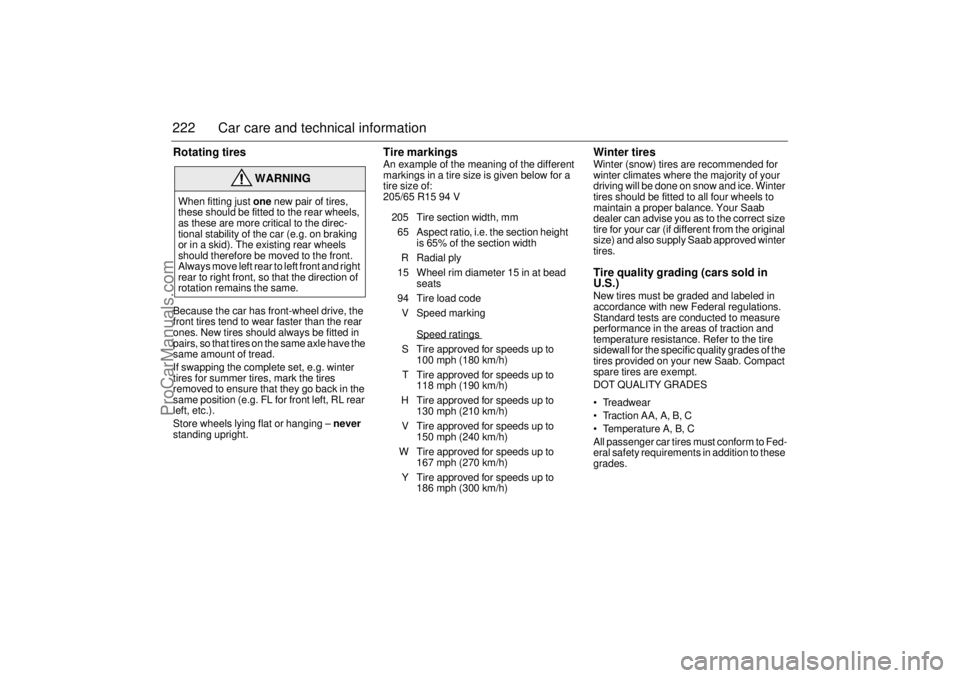
Tire markingsAn example of the meaning of the different
markings in a tire size is given below for a
tire size of:
205/65 R15 94 V
Winter tiresWinter (snow) tires are recommended for
winter climates where the majority of your
driving will be done on snow and ice. Winter
tires should be fitted to all four wheels to
maintain a proper balance. Your Saab
dealer can advise you as to the correct size
tire for your car (if different from the original
size) and also supply Saab approved winter
tires.Tire quality grading (cars sold in
U.S.)New tires must be graded and labeled in
accordance with new Federal regulations.
Standard tests are conducted to measure
performance in the areas of traction and
temperature resistance. Refer to the tire
sidewall for the specific quality grades of the
tires provided on your new Saab. Compact
spare tires are exempt.
DOT QUALITY GRADES
Treadwear
Traction AA, A, B, C
Temperature A, B, C
All passenger car tires must conform to Fed-
eral safety requirements in addition to these
grades.
WARNING
When fitting just one new pair of tires,
these should be fitted to the rear wheels,
as these are more critical to the direc-
tional stability of the car (e.g. on braking
or in a skid). The existing rear wheels
should therefore be moved to the front.
Always move left rear to left front and right
rear to right front, so that the direction of
rotation remains the same.
205 Tire section width, mm
65 Aspect ratio, i.e. the section height
is 65% of the section width
R Radial ply
15 Wheel rim diameter 15 in at bead
seats
94 Tire load code
V Speed marking
Speed ratings S Tire approved for speeds up to
100 mph (180 km/h)
T Tire approved for speeds up to
118 mph (190 km/h)
H Tire approved for speeds up to
130 mph (210 km/h)
V Tire approved for speeds up to
150 mph (240 km/h)
W Tire approved for speeds up to
167 mph (270 km/h)
Y Tire approved for speeds up to
186 mph (300 km/h)
ProCarManuals.com
Page 223 of 272
223 Car care and technical information
Uniform Tire Quality Grading (US)Quality grades can be found where applica-
ble on the tire sidewall between tread shoul-
der and maximum section width. For exam-
ple:
Treadwear 200 Traction AA
Temperature ATreadwearThe treadwear grade is a comparative
rating based on the wear rate of the tire
when tested under controlled conditions on
a specified government test course. For
example, a tire graded 150 would wear one
and one half (1 1/2) times as well on the gov-
ernment course as a tire graded 100. The
relative performance of tires depends upon
the actual conditions of their use, however,
and may depart significantly from the norm
due to variations in driving habits, service
practices and differences in road character-
istics and climate.
TractionThe traction grades, from highest to lowest,
are AA, A, B and C. These grades represent
the tire’s ability to stop on wet pavement as
measured under controlled conditions on
specified government test surfaces of
asphalt and concrete. A tire marked C may
have poor traction performance.
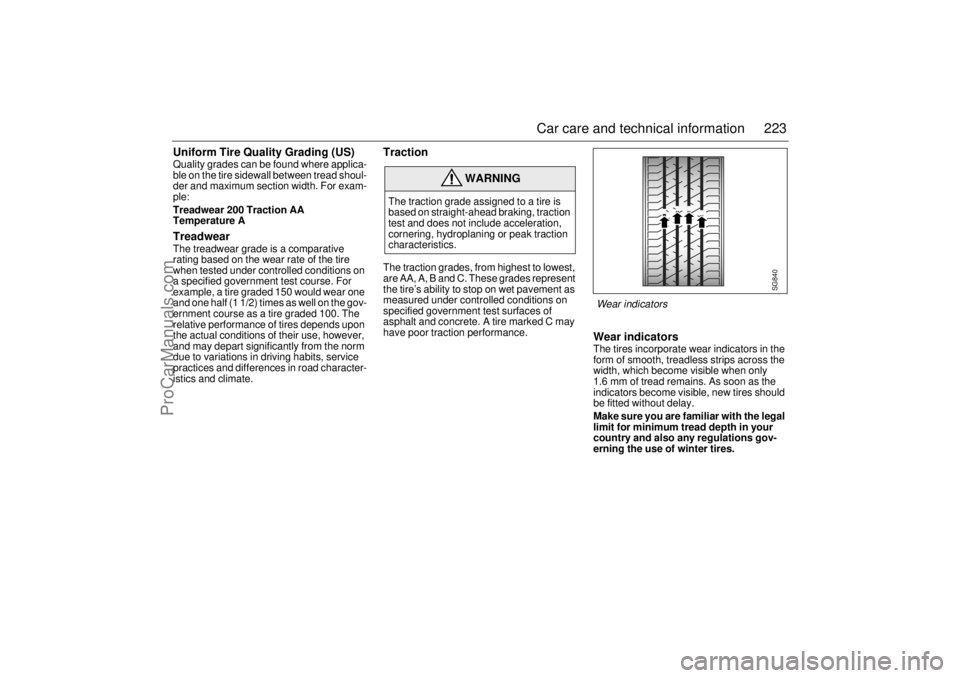
Wear indicatorsThe tires incorporate wear indicators in the
form of smooth, treadless strips across the
width, which become visible when only
1.6 mm of tread remains. As soon as the
indicators become visible, new tires should
be fitted without delay.
Make sure you are familiar with the legal
limit for minimum tread depth in your
country and also any regulations gov-
erning the use of winter tires.
WARNING
The traction grade assigned to a tire is
based on straight-ahead braking, traction
test and does not include acceleration,
cornering, hydroplaning or peak traction
characteristics.
SG840
Wear indicators
ProCarManuals.com
Page 224 of 272
224 Car care and technical informationTemperatureThe temperature grades are A (the highest),
B, and C, representing the tire’s resistance
to the generation of heat and its ability to dis-
sipate heat when tested under controlled
conditions on a specified indoor laboratory
test wheel. Sustained high temperature can
cause the material of the tire to degenerate
and reduce tire life, and excessive temper-
ature can lead to sudden tire failure. The
grade C corresponds to a level of perfor-
mance which all passenger car tires must
meet under the Federal Motor Vehicle
Safety Standard No. 109.
Grades B and A represent higher levels of
performance on the laboratory test wheel
than the minimum required by law.
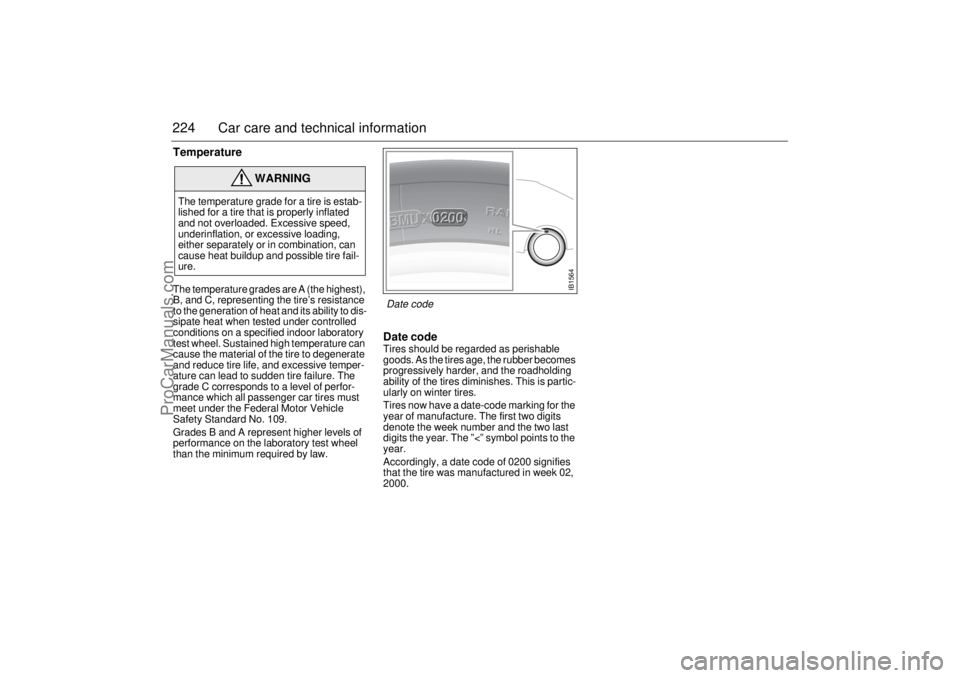
Date codeTires should be regarded as perishable
goods. As the tires age, the rubber becomes
progressively harder, and the roadholding
ability of the tires diminishes. This is partic-
ularly on winter tires.
Tires now have a date-code marking for the
year of manufacture. The first two digits
denote the week number and the two last
digits the year. The ”<” symbol points to the
year.
Accordingly, a date code of 0200 signifies
that the tire was manufactured in week 02,
2000.
WARNING
The temperature grade for a tire is estab-
lished for a tire that is properly inflated
and not overloaded. Excessive speed,
underinflation, or excessive loading,
either separately or in combination, can
cause heat buildup and possible tire fail-
ure.
IB1564
Date code
ProCarManuals.com