brakes SAAB 9-5 2001 User Guide
[x] Cancel search | Manufacturer: SAAB, Model Year: 2001, Model line: 9-5, Model: SAAB 9-5 2001Pages: 272, PDF Size: 14.83 MB
Page 175 of 272
175 Starting and driving
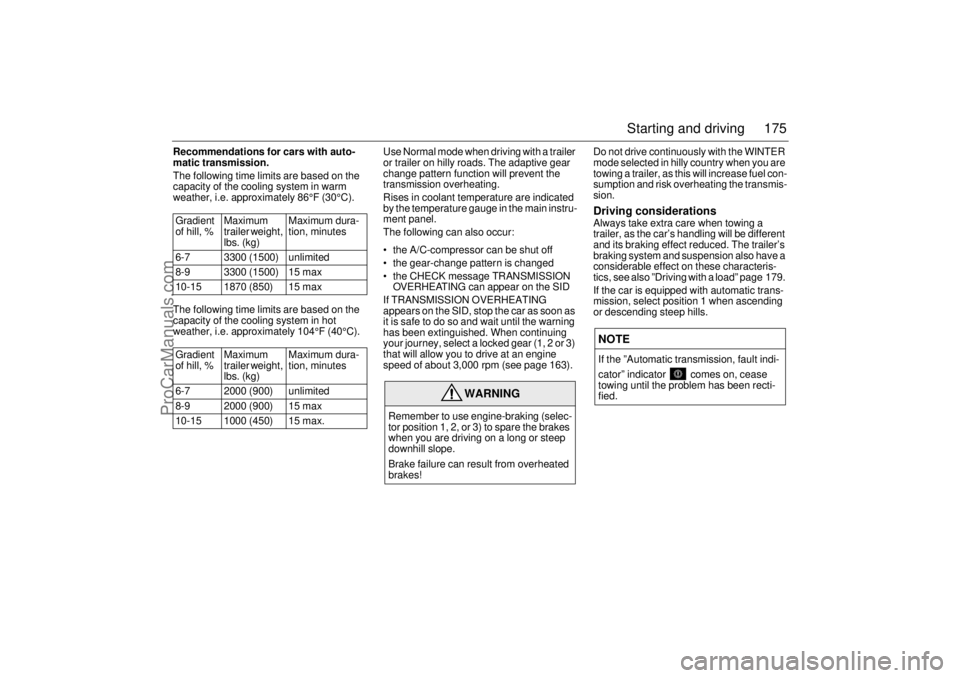
Recommendations for cars with auto-
matic transmission.
The following time limits are based on the
capacity of the cooling system in warm
weather, i.e. approximately 86°F (30°C).
The following time limits are based on the
capacity of the cooling system in hot
weather, i.e. approximately 104°F (40°C).
Use Normal mode when driving with a trailer
or trailer on hilly roads. The adaptive gear
change pattern function will prevent the
transmission overheating.
Rises in coolant temperature are indicated
by the temperature gauge in the main instru-
ment panel.
The following can also occur:
the A/C-compressor can be shut off
the gear-change pattern is changed
the CHECK message TRANSMISSION
OVERHEATING can appear on the SID
If TRANSMISSION OVERHEATING
appears on the SID, stop the car as soon as
it is safe to do so and wait until the warning
has been extinguished. When continuing
your journey, select a locked gear (1, 2 or 3)
that will allow you to drive at an engine
speed of about 3,000 rpm (see page 163). Do not drive continuously with the WINTER
mode selected in hilly country when you are
towing a trailer, as this will increase fuel con-
sumption and risk overheating the transmis-
sion.
Driving considerations Always take extra care when towing a
trailer, as the car’s handling will be different
and its braking effect reduced. The trailer’s
braking system and suspension also have a
considerable effect on these characteris-
tics, see also ”Driving with a load” page 179.
If the car is equipped with automatic trans-
mission, select position 1 when ascending
or descending steep hills. Gradient
of hill, % Maximum
trailer weight,
lbs. (kg)Maximum dura-
tion, minutes
6-7 3300 (1500) unlimited
8-9 3300 (1500) 15 max
10-15 1870 (850) 15 max
Gradient
of hill, % Maximum
trailer weight,
lbs. (kg)Maximum dura-
tion, minutes
6-7 2000 (900) unlimited
8-9 2000 (900) 15 max
10-15 1000 (450) 15 max.
WARNING
Remember to use engine-braking (selec-
tor position 1, 2, or 3) to spare the brakes
when you are driving on a long or steep
downhill slope.
Brake failure can result from overheated
brakes!
NOTEIf the ”Automatic transmission, fault indi-
cator” indicator comes on, cease
towing until the problem has been recti-
fied.
ProCarManuals.com
Page 186 of 272
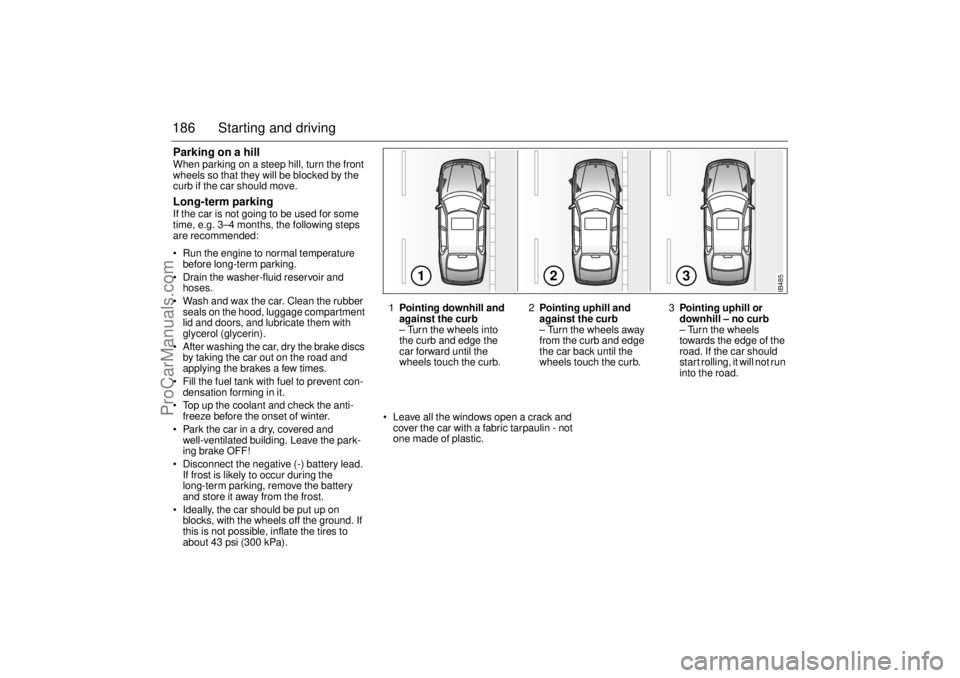
186 Starting and drivingParking on a hillWhen parking on a steep hill, turn the front
wheels so that they will be blocked by the
curb if the car should move. Long-term parkingIf the car is not going to be used for some
time, e.g. 3–4 months, the following steps
are recommended:
Run the engine to normal temperature
before long-term parking.
Drain the washer-fluid reservoir and
hoses.
Wash and wax the car. Clean the rubber
seals on the hood, luggage compartment
lid and doors, and lubricate them with
glycerol (glycerin).
After washing the car, dry the brake discs
by taking the car out on the road and
applying the brakes a few times.
Fill the fuel tank with fuel to prevent con-
densation forming in it.
Top up the coolant and check the anti-
freeze before the onset of winter.
Park the car in a dry, covered and
well-ventilated building. Leave the park-
ing brake OFF!
Disconnect the negative (-) battery lead.
If frost is likely to occur during the
long-term parking, remove the battery
and store it away from the frost.
Ideally, the car should be put up on
blocks, with the wheels off the ground. If
this is not possible, inflate the tires to
about 43 psi (300 kPa). Leave all the windows open a crack and
cover the car with a fabric tar paulin - not
one made of plastic.
123
IB485
1Pointing downhill and
against the curb
– Turn the wheels into
the curb and edge the
car forward until the
wheels touch the curb.2Pointing uphill and
against the curb
– Turn the wheels away
from the curb and edge
the car back until the
wheels touch the curb.3Pointing uphill or
downhill – no curb
– Turn the wheels
towards the edge of the
road. If the car should
start rolling, it will not run
into the road.
ProCarManuals.com
Page 198 of 272
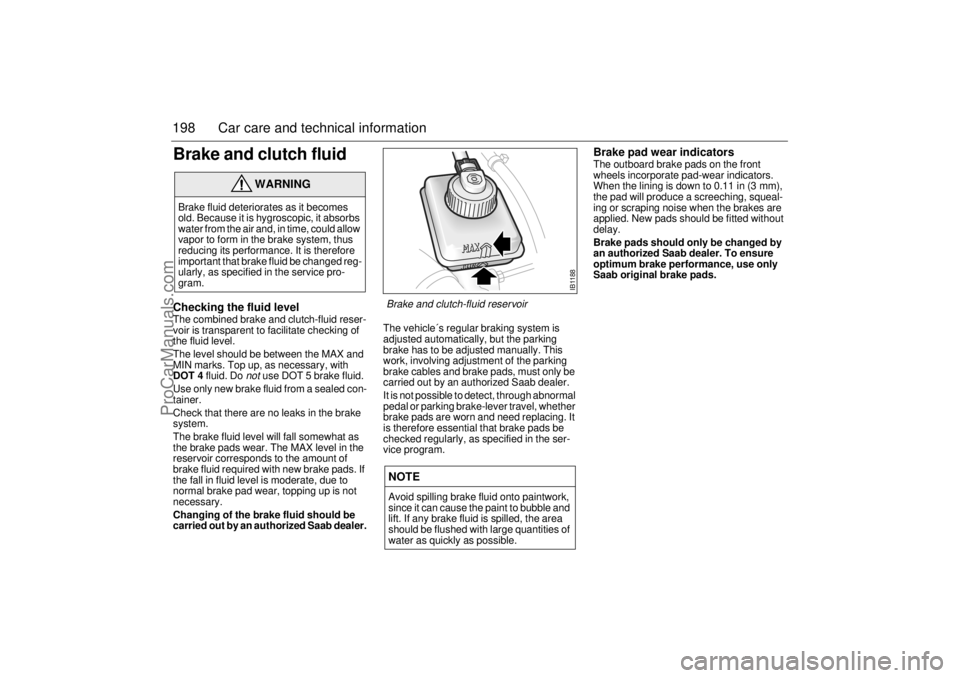
198 Car care and technical informationBrake and clutch fluid Checking the fluid level The combined brake and clutch-fluid reser-
voir is transparent to facilitate checking of
the fluid level.
The level should be between the MAX and
MIN marks. Top up, as necessary, with
DOT 4 fluid. Do
not
use DOT 5 brake fluid.
Use only new brake fluid from a sealed con-
tainer.
Check that there are no leaks in the brake
system.
The brake fluid level will fall somewhat as
the brake pads wear. The MAX level in the
reservoir corresponds to the amount of
brake fluid required with new brake pads. If
the fall in fluid level is moderate, due to
normal brake pad wear, topping up is not
necessary.
Changing of the brake fluid should be
carried out by an authorized Saab dealer.The vehicle´s regular braking system is
adjusted automatically, but the parking
brake has to be adjusted manually. This
work, involving adjustment of the parking
brake cables and brake pads, must only be
carried out by an authorized Saab dealer.
It is not possible to detect, through abnormal
pedal or parking brake-lever travel, whether
brake pads are worn and need replacing. It
is therefore essential that brake pads be
checked regularly, as specified in the ser-
vice program.
Brake pad wear indicators The outboard brake pads on the front
wheels incorporate pad-wear indicators.
When the lining is down to 0.11 in (3 mm),
the pad will produce a screeching, squeal-
ing or scraping noise when the brakes are
applied. New pads should be fitted without
delay.
Brake pads should only be changed by
an authorized Saab dealer. To ensure
optimum brake performance, use only
Saab original brake pads.
WARNING
Brake fluid deteriorates as it becomes
old. Because it is hygroscopic, it absorbs
water from the air and, in time, could allow
vapor to form in the brake system, thus
reducing its performance. It is therefore
important that brake fluid be changed reg-
ularly, as specified in the service pro-
gram.
NOTEAvoid spilling brake fluid onto paintwork,
since it can cause the paint to bubble and
lift. If any brake fluid is spilled, the area
should be flushed with large quantities of
water as quickly as possible.
IB1188
Brake and clutch-fluid reservoir
ProCarManuals.com
Page 217 of 272
217 Car care and technical information
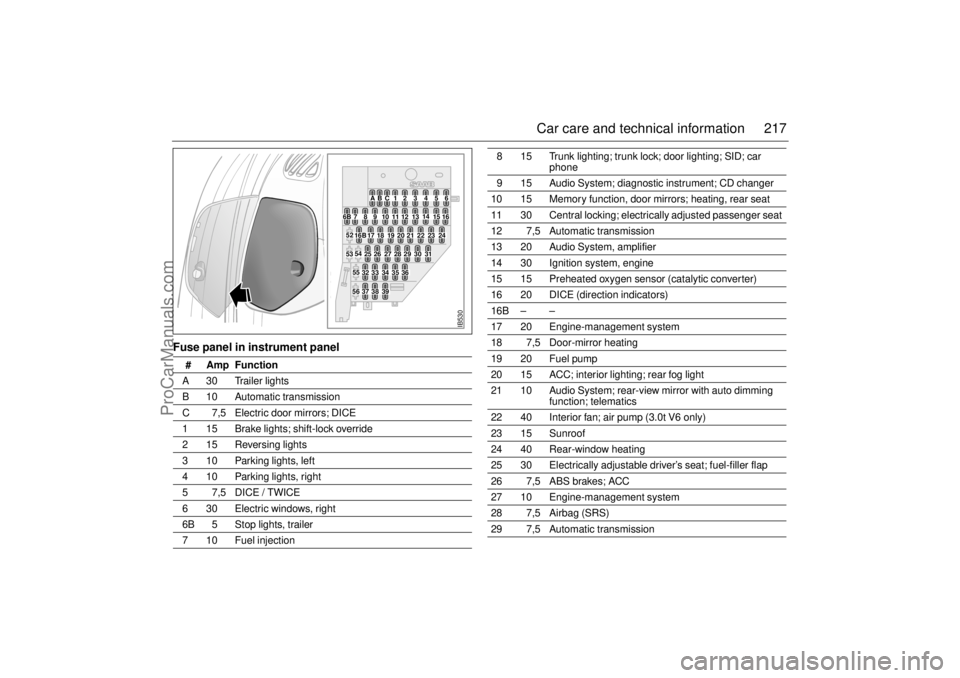
Fuse panel in instrument panel
# Amp Function
A 30 Trailer lights
B 10 Automatic transmission
C 7,5 Electric door mirrors; DICE
1 15 Brake lights; shift-lock override
2 15 Reversing lights
3 10 Parking lights, left
4 10 Parking lights, right
5 7,5 DICE / TWICE
6 30 Electric windows, right
6B 5 Stop lights, trailer
7 10 Fuel injection
8 15 Trunk lighting; trunk lock; door lighting; SID; car
phone
9 15 Audio System; diagnostic instrument; CD changer
10 15 Memory function, door mirrors; heating, rear seat
11 30 Central locking; electrically adjusted passenger seat
12 7,5 Automatic transmission
13 20 Audio System, amplifier
14 30 Ignition system, engine
15 15 Preheated oxygen sensor (catalytic converter)
16 20 DICE (direction indicators)
16B – –
17 20 Engine-management system
18 7,5 Door-mirror heating
19 20 Fuel pump
20 15 ACC; interior lighting; rear fog light
21 10 Audio System; rear-view mirror with auto dimming
function; telematics
22 40 Interior fan; air pump (3.0t V6 only)
23 15 Sunroof
24 40 Rear-window heating
25 30 Electrically adjustable driver’s seat; fuel-filler flap
26 7,5 ABS brakes; ACC
27 10 Engine-management system
28 7,5 Airbag (SRS)
29 7,5 Automatic transmission
IB530
BC123456 A
14
121110987
13
6B
1516
2324
222120191817
16B
5425262728293031
3635343332
39383755525356
ProCarManuals.com
Page 232 of 272

232 Car care and technical informationApply the leather conditioner using a soft
cloth and the same circular movements as
described above. After it has dried, polish
the leather with a soft, dry cloth. Follow the
directions given above. Do not use hot
water, unknown abrasive polishes, sol-
vents, sprays or soaps that might scratch
the leather.Textile carpetingVacuum clean the carpeting regularly. Car-
pets can also be cleaned using a brush, or
carpet shampoo applied with a sponge. Do
not use vacuum cleaners outdoors unless
they are properly grounded.
Washing the carThe bodywork must be washed frequently.
When the car is new, the body should be
washed by hand using plain cold water and
a clean, soft brush, or in a brushless car-
wash that uses mild detergent. Automatic
car washes with brushes should be avoided
when the car is new. Do not use automatic
car washes for the first five or six months,
before the paintwork has hardened prop-
erly. Thereafter, use a high quality car wash
soap added to lukewarm water.
Do not use a pressure washer at close
range on stone chip damage, scratches or
other damage to the paintwork. The paint
can otherwise start to flake.
Remove any bird droppings without delay,
as these can discolor the paintwork and
prove difficult to polish out.
Use a soft cloth moistened with methyl alco-
hol to remove splashes of tar or asphalt. Do
not use strong cleaners, as these can dry
out the paintwork. The underside of the car also needs wash-
ing regularly, and this should be done extra
thoroughly at the end of winter. Clean the
underside of the car by hand if the car is usu-
ally washed in an automatic car wash with-
out special facilities for underbody cleaning.
Never wash or leave the car to dry in the
sun, but wipe it dry with a chamois leather
immediately after washing to avoid smears
and streaks.
Clean the window glass inside and out using
a high quality window cleaner. This is partic-
ularly important when the car is new, as
upholstery and trim have a tendency to
sweat a little at first.
Keep the glass well cleaned, as this helps to
prevent misting. NOTEAvoid using any alcohol-based cleaners
on the front and rear light clusters, as
these can cause cracking of the lenses.
NOTE The door mirrors must be fully
retracted before the car enters an
automatic car wash.
Remove fixed antennas, e.g. for
mobile phone, before putting car
through an automatic car wash.
Try your brakes on leaving a car wash.
Wet brake discs reduce the braking
effect.
ProCarManuals.com
Page 236 of 272

236 Car care and technical information4Inspect the undercoating and touch
up if necessary. Pay particular atten-
tion to the fenders and wheel housings,
which are exposed to abrasion by flying
gravel, etc. If the composition has worn
or flaked off, the steel must be thor-
oughly cleaned and dried before a fresh
coat is applied. The cleaning is best
done with a scraper and a steel wire
brush, followed by washing with solvent.
Apply the new coating thinly, as other-
wise it may run off or fall off when dry.
For long tripsBefore setting off on a long journey, it is
advisable to have your car checked over by
your Saab dealer.
Obtain a few important items to take along
on your journey such as spare bulbs, wiper
blades, fuses, a Poly-V-belt and the like.
You can check some points yourself before-
hand:
Make sure that the engine is in good con-
dition.
Check that no oil or gasoline leaks out of
the engine or gearbox/transmission.
Check the coolant and power steering
fluid levels. Check also for leaks.
Inspect the Poly-V-belt and replace it if it
shows any signs of hard wear.
Check the battery charge.
Check the tires for tread pattern and air
pressure, including the compact spare
wheel.
Check the brakes.
Check all bulbs.
Check for the presence of the tool kit and
the jack in the car.
Recovery and/or
recycling of automotive
materialsA typical car consists of metals (65–75%),
plastics (10–14%), rubber (5%) and small
quantities of glass, wood, paper and tex-
tiles.
Some of these materials can be recycled,
while others can be recovered in chemical
processes for reuse in new products or as a
source of energy.
While the Saab 9-5 was still at the draw-
ing-board stage, Saab engineers were
giving serious consideration to how the
maximum quantity of materials could be
reclaimed from the car on its eventual
scrapping. To facilitate sorting, plastic parts,
for instance, have been marked to identify
the precise nature of the plastic.
Approximately 90% of the materials in the
car can be recycled or recovered, where
facilities exist.
Before the car is scrapped, all the oils and
other fluids that could pollute the environ-
ment should be recovered from the car. It
may be of interest in this context to learn that
the refrigerant used in the Saab 9-5’s ACC
systems (R134a) contains neither CFCs nor
any other chlorine compounds.
ProCarManuals.com
Page 248 of 272

248 Maintenance and owner assistance
Service Intervals **
Miles = U.S. Cars
Kilometers = Canadian Cars
30 day
10,000
(16,000 km)
20,000
(32,000 km)
30,000
(48,000 km)
40,000
(64,000 km)
50,000
(80,000 km)
60,000
(96,000 km)
70,000
(112,000 km)
80,000
(128,000 km)
90,000
(144,000 km)
100,000
(160,000 km)
Service #
1234567891011
Chassis (cont.)
RToe-in"""
R Cabin air filter!!!
R Cabin air absorptive filter!
R Door hinges, stops and locks###
R Airbag system, SRS warning lamps, visual inspection"""""""""""
R Safety belts; operation and visual inspection of belt for
tears and fraying"""""""""""
RWipers"""""""""""
R Washer system: check and top-up"""""""""""
R Reset service indicator""""""""""
Customer programming
R Carry out systems programming per customer request"
Road test
R Check performance of drive train, steering and brakes
and verify tire balance.
Check function of instruments and controls, including
horn, windshield wipers, cruise control and climate sys-
tem.
Note any noises or problems for correction."""""""""""
ProCarManuals.com
Page 251 of 272
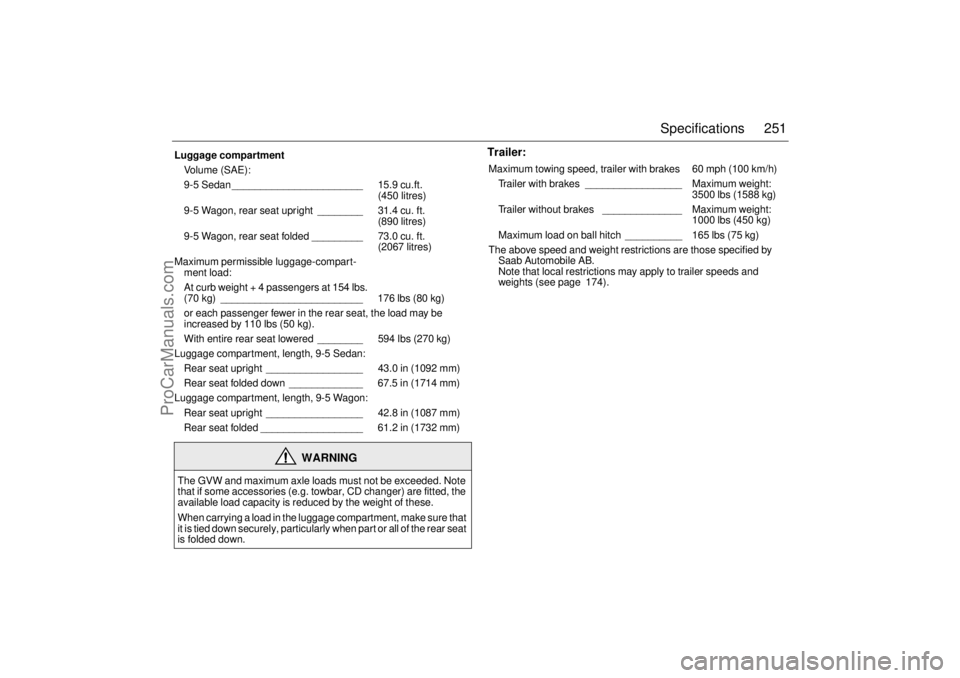
251 Specifications
Trailer:
Luggage compartment
Volume (SAE):
9-5 Sedan _______________________ 15.9 cu.ft.
(450 litres)
9-5 Wagon, rear seat upright ________ 31.4 cu. ft.
(890 litres)
9-5 Wagon, rear seat folded _________ 73.0 cu. ft.
(2067 litres)
Maximum permissible luggage-compart-
ment load:
At curb weight + 4 passengers at 154 lbs.
(70 kg) _________________________ 176 lbs (80 kg)
or each passenger fewer in the rear seat, the load may be
increased by 110 lbs (50 kg).
With entire rear seat lowered ________ 594 lbs (270 kg)
Luggage compartment, length, 9-5 Sedan:
Rear seat upright _________________ 43.0 in (1092 mm)
Rear seat folded down _____________ 67.5 in (1714 mm)
Luggage compartment, length, 9-5 Wagon:
Rear seat upright _________________ 42.8 in (1087 mm)
Rear seat folded __________________ 61.2 in (1732 mm)
WARNING
The GVW and maximum axle loads must not be exceeded. Note
that if some accessories (e.g. towbar, CD changer) are fitted, the
available load capacity is reduced by the weight of these.
When carrying a load in the luggage compartment, make sure that
it is tied down securely, particularly when part or all of the rear seat
is folded down.
Maximum towing speed, trailer with brakes 60 mph (100 km/h)
Trailer with brakes _________________ Maximum weight:
3500 lbs (1588 kg)
Trailer without brakes ______________ Maximum weight:
1000 lbs (450 kg)
Maximum load on ball hitch __________ 165 lbs (75 kg)
The above speed and weight restrictions are those specified by
Saab Automobile AB.
Note that local restrictions may apply to trailer speeds and
weights (see page 174).
ProCarManuals.com
Page 257 of 272

257 Specifications
Brake system Wheels and tiresFootbrake (ABS) ___________________ Hydraulic disc
brakes with vacuum
servo unit. Diago-
nally split circuits;
ventilated discs on
front wheels. EBD
function, see page
167.
Handbrake _______________________ Acts on rear wheels
Brake fluid ________________________ DOT 4
Brake-fluid capacity _________________ 0.925 qts (900 ml)
Disc diameter:
Front __________________________ 11.34 in (288 mm)
Front, 2.3 Turbo Aero ______________ 12.05 in (306 mm)
Rear ___________________________ 11.26 in (286 mm)
Total friction area of brake pads:
Front __________________________ 36.3 in
2 (234 cm
2)
Rear ___________________________ 15.5 in
2 (100 cm
2)Wheel size ________________________ 6.5 x 16 or 7 x 17
2.3 Turbo Aero ______________________ Use 6.5 x 16 or
7 x 17 only
Contact an authorized Saab dealer if you
wish to fit other wheels than those fitted
as standard.
Tire size (summer tires):
6.5 x 16 wheels ___________________ 215/55 R16
7 x 17 wheels _____________________ 225/45 R17
Tire size (winter tires):
6 x 15 wheels (not 2.3 Turbo Aero) _____ 195/65 R15 M+S
6.5 x 16 wheels ___________________ 205/55 R16 M+S
Recommended wheels for snow chains _ 6 x 15 (not 9-5 2.3
Turbo Aero) or
6.5 x 16
Compact spare:
Wheel ___________________________ 4 x 16
Tire _____________________________ T115/70 R16
Pressure_________________________ 60 psi (420 kPa)
Maximum life _____________________ 2,200 miles
(3500 km)
Maximum speed __________________ 50 mph (80 km/h)
ProCarManuals.com
Page 263 of 272

263 Index
Index
AA/C system, fault diagnosis
_______ 230
A/C system, maintenance
_________ 230
ABS brakes
____________________ 167
ACC
__________________________ 70
ACC functions
___________________ 73
ACC, automatic climate control
_____ 70
ACC, calibration
_________________ 78
ACC, condensation _______________ 79
ACC, programming _______________ 76
ACC, useful tips
_________________ 78
Adjusting the steering wheel
_______ 124
Adjustment, seats
_______________ 120
Afterheater, V6-engine cars
________ 80
Air conditioning (A/C), fault diagnosis
and maintenance
______________ 230
Air distribution, ACC ______________ 75
Airbag
_________________________ 26
Alarm _________________________ 41
Alarm functions
__________________ 44
Alarm signals
_______________ 41
, 44
Alternator
_____________________ 202
Alternator drive belt
_________ 202
, 255
Alternator rating
________________ 254
Anticorrosion treatment
___________ 234
Antidazzle rear-view mirror
________ 126
Ashtrays
______________________ 130
Audio System
___________________ 81
Audio System, quick guide
_________ 83Autochecking of lights on starting
____54
Automatic climate control (ACC) _____70
Automatic transmission,
technical data
_________________256
BBattery
________________________199
Battery charging/replacing
________201
Battery, boost starting
____________183
Belt guide
______________________12
Boost starting using jump leads
____183
Booster cushion
_________________24
Brake and clutch fluid
____________198
Brake-fluid reservoir
_____________198
Brakes, technical data ____________257
Bulbs, changing
________________205
Bulbs, table of
__________________214
CCD changer
_____________________93
CD player
______________________91
CHECK messages
_______________61
CHECKING
_____________________61
Calibration, ACC
_________________78
Cancelling the programmed settings
_76
Car alarm
______________________41
Car care
______________________187
Car phone, installation
___________103
Cargo net, 9-5 Wagon ____________141
Carpeting, care of
_______________232Cassette player
_________________ 88
Catalytic converter,
important considerations
________ 152
Central locking
__________________ 34
Change language in SID
__________ 62
Change of address notification
____ 244
Changing a wheel
______________ 226
Changing bulbs
________________ 205
Changing the coolant
___________ 197
Changing the wheels round
_______ 222
Changing wiper blades
__________ 203
Chassis number
_______________ 259
Chassis number, key to
__________ 260
Child safety
____________________ 19
Child safety locks, rear doors
______ 37
Child seat, integral
_______________ 24
Cleaning, engine bay ____________ 233
Clock
______________________ 61
, 62
Colour code, body
______________ 259
Colour code, trim _______________ 259
Compact spare wheel
___________ 225
Condensation, ACC
______________ 79
Coolant
______________________ 196
Coolant, changing
______________ 197
Courtesy Headlight Feature
_______ 64
Cruise control
_________________ 166
Cup holder
____________________ 133
DDICE/TWICE
__________________ 216
Dampers
_____________________ 256
ProCarManuals.com