child lock SAAB 9-5 2001 User Guide
[x] Cancel search | Manufacturer: SAAB, Model Year: 2001, Model line: 9-5, Model: SAAB 9-5 2001Pages: 272, PDF Size: 14.83 MB
Page 34 of 272
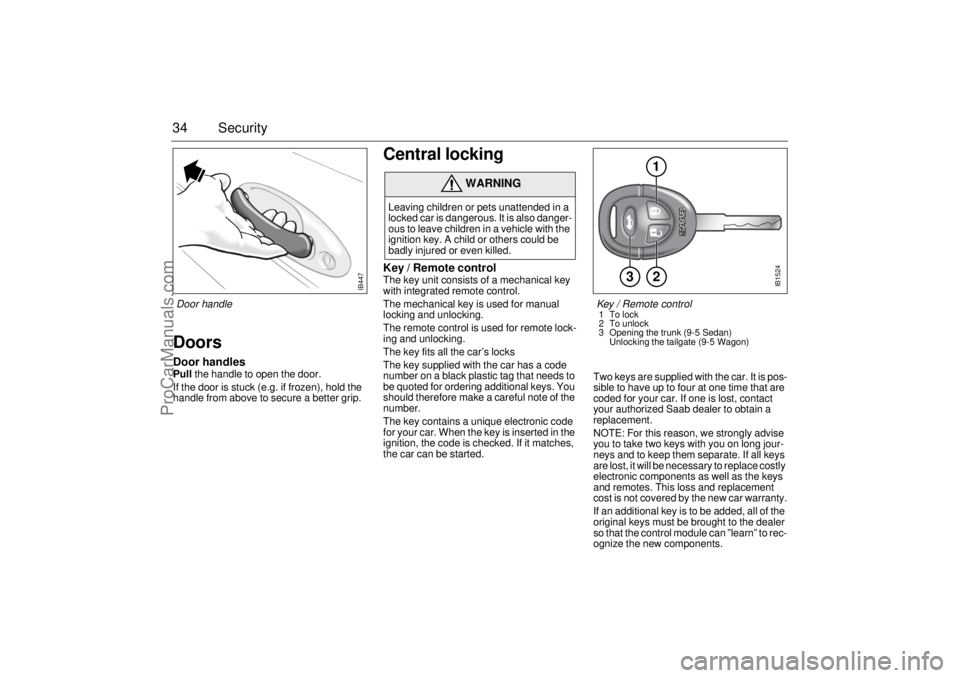
34 SecurityDoorsDoor handlesPull the handle to open the door.
If the door is stuck (e.g. if frozen), hold the
handle from above to secure a better grip.
Central locking
Key / Remote control The key unit consists of a mechanical key
with integrated remote control.
The mechanical key is used for manual
locking and unlocking.
The remote control is used for remote lock-
ing and unlocking.
The key fits all the car’s locks
The key supplied with the car has a code
number on a black plastic tag that needs to
be quoted for ordering additional keys. You
should therefore make a careful note of the
number.
The key contains a unique electronic code
for your car. When the key is inserted in the
ignition, the code is checked. If it matches,
the car can be started. Two keys are supplied with the car. It is pos-
sible to have up to four at one time that are
coded for your car. If one is lost, contact
your authorized Saab dealer to obtain a
replacement.
NOTE: For this reason, we strongly advise
you to take two keys with you on long jour-
neys and to keep them separate. If all keys
are lost, it will be necessary to replace costly
electronic components as well as the keys
and remotes. This loss and replacement
cost is not covered by the new car warranty.
If an additional key is to be added, all of the
original keys must be brought to the dealer
so that the control module can ”learn” to rec-
ognize the new components.
WARNING
Leaving children or pets unattended in a
locked car is dangerous. It is also danger-
ous to leave children in a vehicle with the
ignition key. A child or others could be
badly injured or even killed.
IB447
Door handle Key / Remote control
1To lock
2 To unlock
3 Opening the trunk (9-5 Sedan)
Unlocking the tailgate (9-5 Wagon)
IB1524
3
2 1
ProCarManuals.com
Page 36 of 272
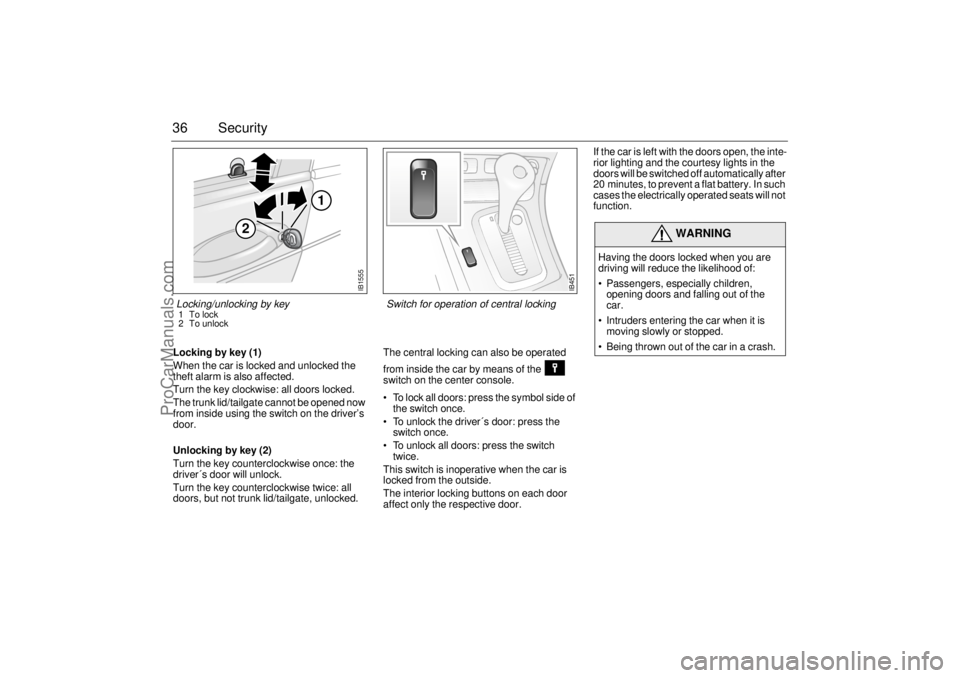
36 SecurityLocking by key (1)
When the car is locked and unlocked the
theft alarm is also affected.
Turn the key clockwise: all doors locked.
The trunk lid/tailgate cannot be opened now
from inside using the switch on the driver’s
door.
Unlocking by key (2)
Turn the key counterclockwise once: the
driver´s door will unlock.
Turn the key counterclockwise twice: all
doors, but not trunk lid/tailgate, unlocked. The central locking can also be operated
from inside the car by means of the
switch on the center console.
To lock all doors: press the symbol side of
the switch once.
To unlock the driver´s door: press the
switch once.
To unlock all doors: press the switch
twice.
This switch is inoperative when the car is
locked from the outside.
The interior locking buttons on each door
affect only the respective door.If the car is left with the doors open, the inte-
rior lighting and the courtesy lights in the
doors will be switched off automatically after
20 minutes, to prevent a flat battery. In such
cases the electrically operated seats will not
function.
WARNING
Having the doors locked when you are
driving will reduce the likelihood of:
Passengers, especially children,
opening doors and falling out of the
car.
Intruders entering the car when it is
moving slowly or stopped.
Being thrown out of the car in a crash.
IB451
Switch for operation of central locking
IB1555
2
1
Locking/unlocking by key1To lock
2 To unlock
ProCarManuals.com
Page 37 of 272
37 Security
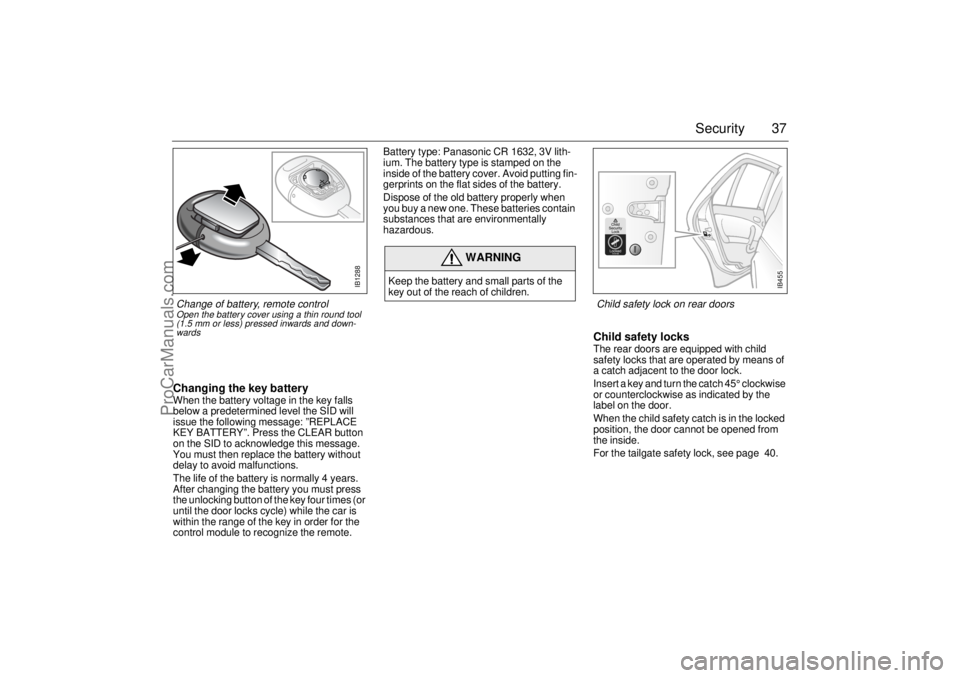
Changing the key batteryWhen the battery voltage in the key falls
below a predetermined level the SID will
issue the following message: ”REPLACE
KEY BATTERY”. Press the CLEAR button
on the SID to acknowledge this message.
You must then replace the battery without
delay to avoid malfunctions.
The life of the battery is normally 4 years.
After changing the battery you must press
the unlocking button of the key four times (or
until the door locks cycle) while the car is
within the range of the key in order for the
control module to recognize the remote. Battery type: Panasonic CR 1632, 3V lith-
ium. The battery type is stamped on the
inside of the battery cover. Avoid putting fin-
gerprints on the flat sides of the battery.
Dispose of the old battery properly when
you buy a new one. These batteries contain
substances that are environmentally
hazardous.
Child safety locksThe rear doors are equipped with child
safety locks that are operated by means of
a catch adjacent to the door lock.
Insert a key and turn the catch 45° clockwise
or counterclockwise as indicated by the
label on the door.
When the child safety catch is in the locked
position, the door cannot be opened from
the inside.
For the tailgate safety lock, see page 40.
WARNING
Keep the battery and small parts of the
key out of the reach of children.
IB1288
Change of battery, remote controlOpen the battery cover using a thin round tool
(1.5 mm or less) pressed inwards and down-
wards
IB455
Child safety lock on rear doors
ProCarManuals.com
Page 40 of 272
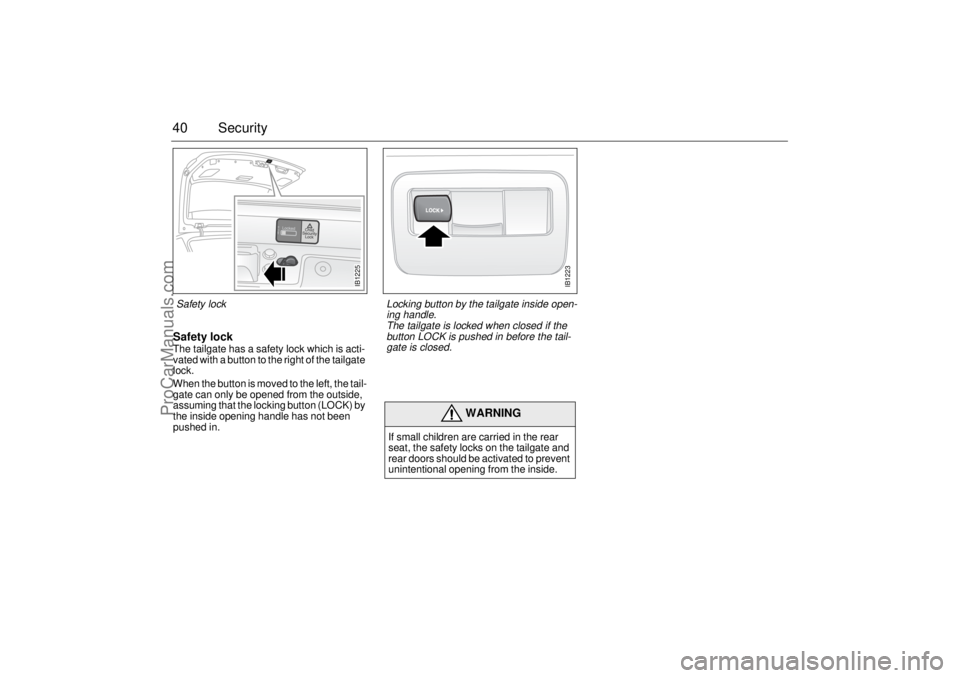
40 SecuritySafety lock The tailgate has a safety lock which is acti-
vated with a button to the right of the tailgate
lock.
When the button is moved to the left, the tail-
gate can only be opened from the outside,
assuming that the locking button (LOCK) by
the inside opening handle has not been
pushed in.
WARNING
If small children are carried in the rear
seat, the safety locks on the tailgate and
rear doors should be activated to prevent
unintentional opening from the inside.
IB1225
Safety lock
IB1223
Locking button by the tailgate inside open-
ing handle.
The tailgate is locked when closed if the
button LOCK is pushed in before the tail-
gate is closed.
ProCarManuals.com
Page 41 of 272

41 Security
Car alarm The car alarm (anti-theft system) is acti-
vated/deactivated when the car is
locked/unlocked by the remote control or by
the key, see page 35.
The antenna for the alarm system is located
in the center console.
All the doors plus trunk lid/tailgate and hood
are monitored by microswitches, and win-
dow-glass sensors will trigger the alarm if
any glass is broken. Your Saab 9-5 is equipped with an Elec-
tronic starting interlock (immobilizer), see
page 42 for details.
The car alarm is armed 10 seconds after the
car has been locked by the remote control.
During this ten-second delay period, the
doors, trunk lid/tailgate and hood may still
be opened without the alarm being trig-
gered.
The LED indicator on the instrument panel
fascia will be on continuously during this
period, at the end of which it will start to flash
(once every other second). If a door or the trunk lid/tailgate or hood has
been left open when the car is locked, the
LED on the fascia will flash (three times per
second) for ten seconds to indicate this.
Check to ensure that all the doors, plus
trunk lid/tailgate and hood, are closed prop-
erly.
If the fault persists (LED flashing when
renewed attempt made to activate the car
alarm by remote control), lock the car using
the key instead. The car alarm will not have
been activated and you should get in touch
with an authorized Saab dealer.
To avert inconvenience caused by the
alarm being triggered inadvertently, make
sure that anyone else using the car is famil-
iar with how both the car alarm and the lock-
ing system work.
If the alarm is tripped (the direction indica-
tors are flashing and the siren is on) it can
be turned off by unlocking the car using the
button.
WARNING
Leaving children or pets unattended in a
locked car is dangerous. It is also danger-
ous to leave children in a vehicle with the
ignition key. A child or others could be
badly injured or even killed.
IB1524
3
2 1
Remote control 1 Activate/lock
2 Deactivate/unlock
3 Unlock trunk/tailgate
ProCarManuals.com
Page 42 of 272

42 SecurityActivating the car alarm The car alarm cannot be activated if the
driver’s door is open or if the ignition switch
is in ON position.
If, on the other hand, one of the other doors
or the trunk or hood is open or opened and
not closed again during the 10-seconds
delay period, it will be excluded from the
alarm function.
If it is then closed, a new delay period of ten
seconds will start, and the door (or trunk or
hood) will once again be secured by the
alarm system.
As usual, the LED will be on continuously
during the new delay period and will start to
flash once every other second after the
10-seconds period has elapsed.
Window-glass sensorThe car-alarm system incorporates a
sensor that monitors the window glass for
the sound of breakage. The sensor is fitted
inside the rear dome light.
To avoid false alarms, such as the alarm
being triggered by noise from passers by
when the windows have been left open, or
when children or petsare left inside the car,
the sensor can be temporarily disabled.
To disable the sensor
To disable the sensor, first ensure that the
ignition has been switched off and key
removed from the switch. Then, press and
hold the NIGHT PANEL button until ”DOOR
ALARM ONLY” appears on the SID and a
chime sounds. The car alarm must now be
activated within three minutes, or the glass
sensor will become active again.
The glass sensor will be enabled again
automatically when the car is next unlocked.
The sensor can also be enabled again by
repeating the procedure for disabling it.
When the sensor has been enabled, ”FULL
THEFT ALARM” will appear on the SID.
If a fault is detected in the glass sensor,
”SERVICE THEFT ALARM” will appear on
the SID.
Electronic starting interlock
(immobilizer) When the key is inserted in the ignition, a
signal is sent to the receiver. If the signal is
verified, the engine can be started.
Each time the key is removed from the igni-
tion, the electronic immobilizer is activated.
This means that the car cannot be started
without the correct key inserted in the igni-
tion and the immobilizer thus deactivated.
If a fault is detected (e.g. in the transmitter)
”KEY NOT ACCEPTED” will appear on the
SID.
In this case, you can still start the car if you
turn the ignition key to ON and press one of
the buttons on the key (providing that the
receiver gets the right signal from the key).
Take the car to an authorized Saab dealer to
have the system checked.
The LED double-flashes when the car is
immobilized.
ProCarManuals.com
Page 185 of 272
185 Starting and driving
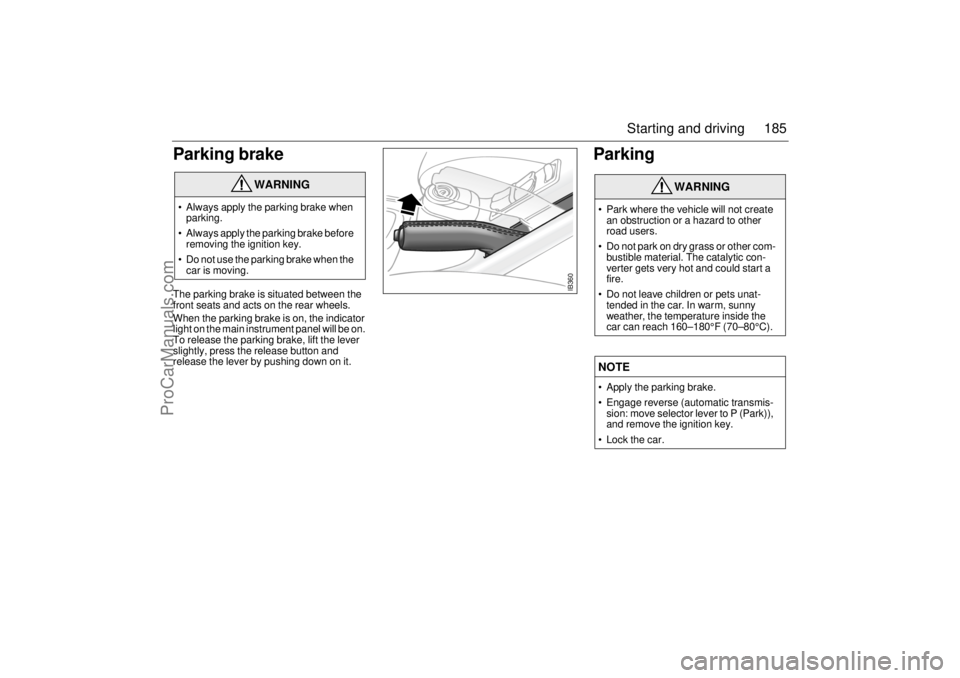
Parking brake The parking brake is situated between the
front seats and acts on the rear wheels.
When the parking brake is on, the indicator
light on the main instrument panel will be on.
To release the parking brake, lift the lever
slightly, press the release button and
release the lever by pushing down on it.
Parking
WARNING
Always apply the parking brake when
parking.
Always apply the parking brake before
removing the ignition key.
Do not use the parking brake when the
car is moving.
WARNING
Park where the vehicle will not create
an obstruction or a hazard to other
road users.
Do not park on dry grass or other com-
bustible material. The catalytic con-
verter gets very hot and could start a
fire.
Do not leave children or pets unat-
tended in the car. In warm, sunny
weather, the temperature inside the
car can reach 160–180°F (70–80°C). NOTE Apply the parking brake.
Engage reverse (automatic transmis-
sion: move selector lever to P (Park)),
and remove the ignition key.
Lock the car.
IB360
ProCarManuals.com
Page 263 of 272

263 Index
Index
AA/C system, fault diagnosis
_______ 230
A/C system, maintenance
_________ 230
ABS brakes
____________________ 167
ACC
__________________________ 70
ACC functions
___________________ 73
ACC, automatic climate control
_____ 70
ACC, calibration
_________________ 78
ACC, condensation _______________ 79
ACC, programming _______________ 76
ACC, useful tips
_________________ 78
Adjusting the steering wheel
_______ 124
Adjustment, seats
_______________ 120
Afterheater, V6-engine cars
________ 80
Air conditioning (A/C), fault diagnosis
and maintenance
______________ 230
Air distribution, ACC ______________ 75
Airbag
_________________________ 26
Alarm _________________________ 41
Alarm functions
__________________ 44
Alarm signals
_______________ 41
, 44
Alternator
_____________________ 202
Alternator drive belt
_________ 202
, 255
Alternator rating
________________ 254
Anticorrosion treatment
___________ 234
Antidazzle rear-view mirror
________ 126
Ashtrays
______________________ 130
Audio System
___________________ 81
Audio System, quick guide
_________ 83Autochecking of lights on starting
____54
Automatic climate control (ACC) _____70
Automatic transmission,
technical data
_________________256
BBattery
________________________199
Battery charging/replacing
________201
Battery, boost starting
____________183
Belt guide
______________________12
Boost starting using jump leads
____183
Booster cushion
_________________24
Brake and clutch fluid
____________198
Brake-fluid reservoir
_____________198
Brakes, technical data ____________257
Bulbs, changing
________________205
Bulbs, table of
__________________214
CCD changer
_____________________93
CD player
______________________91
CHECK messages
_______________61
CHECKING
_____________________61
Calibration, ACC
_________________78
Cancelling the programmed settings
_76
Car alarm
______________________41
Car care
______________________187
Car phone, installation
___________103
Cargo net, 9-5 Wagon ____________141
Carpeting, care of
_______________232Cassette player
_________________ 88
Catalytic converter,
important considerations
________ 152
Central locking
__________________ 34
Change language in SID
__________ 62
Change of address notification
____ 244
Changing a wheel
______________ 226
Changing bulbs
________________ 205
Changing the coolant
___________ 197
Changing the wheels round
_______ 222
Changing wiper blades
__________ 203
Chassis number
_______________ 259
Chassis number, key to
__________ 260
Child safety
____________________ 19
Child safety locks, rear doors
______ 37
Child seat, integral
_______________ 24
Cleaning, engine bay ____________ 233
Clock
______________________ 61
, 62
Colour code, body
______________ 259
Colour code, trim _______________ 259
Compact spare wheel
___________ 225
Condensation, ACC
______________ 79
Coolant
______________________ 196
Coolant, changing
______________ 197
Courtesy Headlight Feature
_______ 64
Cruise control
_________________ 166
Cup holder
____________________ 133
DDICE/TWICE
__________________ 216
Dampers
_____________________ 256
ProCarManuals.com
Page 264 of 272

264 IndexDate code, tires
_________________ 224
Dim-dipped beam ________________ 63
Direction indicators _______________ 65
Door handles
___________________ 34
Door mirrors
___________________ 125
Doors, locks & luggage compartment
_33
Drive belt
______________________ 255
Drive belt, alternator
_____________ 202
Drive belts
_____________________ 255
Drive belts, length
_______________ 255
Driver’s seat, programmable
_______ 122
Driving in hot weather
____________ 173
Driving with a load
______________ 179
EElectric heating seat
_____________ 123
Electric heating, front seats
_______ 123
Electric windows
________________ 127
Electrical system, technical data
____ 254
Electrically heated rear seat
_______ 123
Electronic starting interlock _________ 35
Emergency operation of sunroof
____ 129
Emission control systems
_________ 191
Engine bay, 3.0t V6
_____________ 190
Engine bay, 4-cyl
_______________ 189
Engine bay, cleaning ____________ 233
Engine number
_________________ 259
Engine oil, grade ________________ 253
Engine, description _________ 192
, 193
Engine, technical data
___________ 252
Engine, temperature gauge
________ 55Engine-oil level, checking
_________193
Expansion tank, coolant
__________196
FFault codes, Audio System
________104
Flat spot, tire
___________________229
Fluid level, automatic transmission
__195
Folding the rear seat, 9-5 Sedan
___134
Folding the rear seat, 9-5 Wagon ___137
Frequently asked questions on airbag
30
Front fog lights
__________________66
Frost warning
___________________58
Fuel
__________________________154
Fuel consumption
________________57
Fuel filler flap
___________________145
Fuel gauge
_____________________55
Fuel grade _____________________252
Fuse box under hood
____________219
Fuse panel
____________________215
Fuses
________________________215
GGearbox number
________________259
Gearbox oil, checking
____________195
Gearbox, technical data, __________255
Glove compartment
______________131
HHandbrake
____________________185
Hazard warning lights
_____________66Head restraint
__________________ 18
Headlight flasher ________________ 63
Headlights
_____________________ 63
Holidaying abroad
______________ 236
Hood
________________________ 188
Horn _________________________ 124
IIgnition switch
_________________ 148
Immobilizer
____________________ 35
Indicator and warning lights
________ 48
Indicator lights
__________________ 48
Instrument illumination
___________ 65
Instruments and controls __________ 47
Integral child seat
_______________ 24
Interior equipment ______________ 119
Interior lighting
__________________ 67
Interior rearview mirror
__________ 125
KKey
__________________________ 34
Key to chassis number
__________ 260
Key, remove
__________________ 148
LLabels
_________________________ 8
Leather upholstery, care of
_______ 231
Light horn
_____________________ 63
Light switches __________________ 63
Luggage-compartment lighting
_____ 67
ProCarManuals.com