child seat SAAB 9-5 2001 User Guide
[x] Cancel search | Manufacturer: SAAB, Model Year: 2001, Model line: 9-5, Model: SAAB 9-5 2001Pages: 272, PDF Size: 14.83 MB
Page 24 of 272
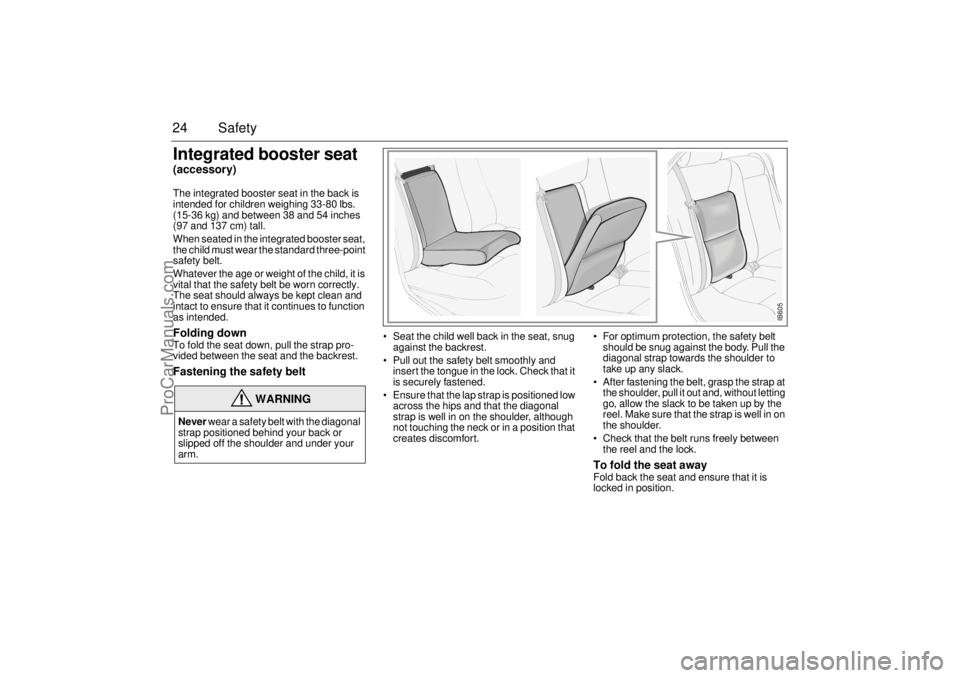
24 SafetyIntegrated booster seat(accessory)The integrated booster seat in the back is
intended for children weighing 33-80 lbs.
(15-36 kg) and between 38 and 54 inches
(97 and 137 cm) tall.
When seated in the integrated booster seat,
the child must wear the standard three-point
safety belt.
Whatever the age or weight of the child, it is
vital that the safety belt be worn correctly.
The seat should always be kept clean and
intact to ensure that it continues to function
as intended. Folding down To fold the seat down, pull the strap pro-
vided between the seat and the backrest. Fastening the safety belt
Seat the child well back in the seat, snug
against the backrest.
Pull out the safety belt smoothly and
insert the tongue in the lock. Check that it
is securely fastened.
Ensure that the lap strap is positioned low
across the hips and that the diagonal
strap is well in on the shoulder, although
not touching the neck or in a position that
creates discomfort. For optimum protection, the safety belt
should be snug against the body. Pull the
diagonal strap towards the shoulder to
take up any slack.
After fastening the belt, grasp the strap at
the shoulder, pull it out and, without letting
go, allow the slack to be taken up by the
reel. Make sure that the strap is well in on
the shoulder.
Check that the belt runs freely between
the reel and the lock.
To fold the seat away Fold back the seat and ensure that it is
locked in position.
WARNING
Never wear a safety belt with the diagonal
strap positioned behind your back or
slipped off the shoulder and under your
arm.
IB605
ProCarManuals.com
Page 25 of 272
25 Safety
WARNING
The standard safety belt must always
be used in conjunction with the inte-
grated booster seat.
The seat must not be modified in any
way.
Never leave a child unattended.
Check to ensure that the belt is not
twisted or rubbing against any sharp
edges.
Adjust the head restraint so that it pro-
vides the best possible support when
there is a passenger in the rear seat.
WARNING
Failure to follow all the manufacturer’s
instructions on the use of this child
restraint system can cause your child to
strike the vehicle´s interior during a
sudden stop or crash.
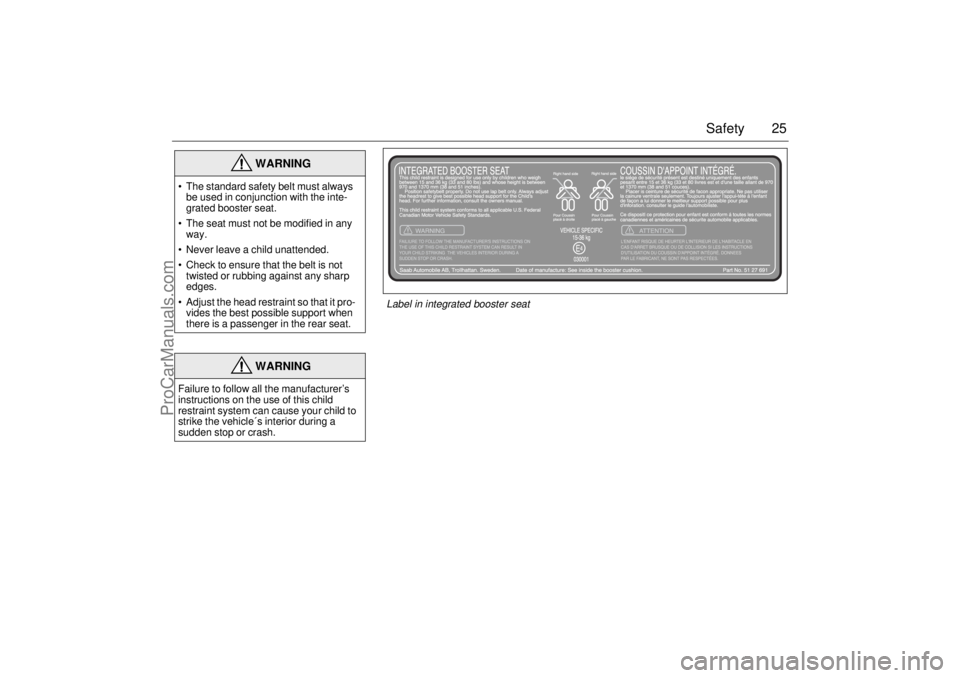
Label in integrated booster seat
ProCarManuals.com
Page 26 of 272
26 SafetyAirbag (Supplemental
Restraint System
"SRS") The supplementary restraint system (SRS)
comprises an airbag in the steering wheel,
a front passenger airbag and side airbags in
the front seats.
The system supplements the protection
provided by the safety belts to further
enhance the safety of the occupants.
If a fault is detected in the SRS, the
AIR BAG warning light on the main instru-
ment panel will come on (see pages 50 and
30). When the system is triggered by impact of a
frontal collision, the airbags in the steering
wheel and passenger side of the dash board
are inflated, after which they deflate through
vents in the back of the bags.
The entire process takes less than
0.1 second – literally, faster than the blink-
ing of an eye.
These airbags are triggered only by moder-
ate to severe frontal or near-frontal colli-
sions. They will not be activated by minor
front-end impacts, rear-end or side impacts,
or by the car rolling over.
WARNING
To reduce risk of injury:
Always wear your safety belt.
Always adjust your seat so that you
are as far back as possible but still
able to reach the steering wheel and
controls comfortably.
Children 12 and under or shorter than
140 cm (55 inches) should always
travel in the rear as the vehicle is
equipped with an airbag on the pas-
senger side.
WARNING
Even if the car is equipped with SRS
(airbag), safety belts must still always
be worn by all occupants.
Note that because an airbag inflates
and deflates extremely rapidly, it will
not provide protection against a
second impact occurring in the same
incident. Always use your safety belt.
Always sit with the whole of your back
in contact with the backrest of the seat,
and with your seat as far back as is
practical. This is to reduce the risk of
injury from contact with the backrest of
the seat when the airbag inflates and
also because the airbag needs space
in which to inflate.
Never attach anything to the steering
wheel or passenger side of the instru-
ment panel, as this could result in
injury if the airbag should inflate. The
same applies to anything you might
have in your mouth, such as a pipe, for
instance.
Some components of the airbag will
be hot for a short time. In some circum-
stances the airbag can cause burns or
abrasions to the body when the airbag
inflates/deflates.
Never rest your hands or forearms on
the steering-wheel center padding.
If the AIR BAG warning light remains
on after the car has been started or
comes on while you are driving, have
the car checked immediately by an
authorized Saab dealer. The warning
light could signify that the airbags may
not inflate in a crash, or they could
even inflate without a crash.
ProCarManuals.com
Page 28 of 272

28 SafetyFront passenger seat The airbags are interconnected and have a
common warning light. The passenger
airbag module is housed in the fascia above
the glove compartment and is marked ”SRS
AIRBAG”.
Both airbags will be inflated in the event of a
moderate to severe frontal, or near-frontal
collision, even if the passenger seat is unoc-
cupied.
Side airbags Side airbags are housed inside the back-
rests of the front seats and are designed to
protect the driver and front passenger in the
event of a side impact.
In a side impact, only the airbag on that side
will be activated, and only then if certain pre-
determined conditions are met such as the
force and angle of the impact, the speed of
the car on impact, and at which point on the
car’s side the impact occurs.
The sensors, which are fitted in the front
doors, sense the rise in pressure caused by
the door panel being pressed in during an
impact condition. The side airbag trigger will
be commanded based on the characteris-
tics of this pressure rise.
WARNING
Never secure a rear-facing child seat in
the right front seat of a car equipped with
a passenger airbag. Inflation of the airbag
in the event of an accident could seriously
injure or kill a child.
WARNING Children 12 and
under can be killed by
the airbag
The back seat is the
safest place for children
Never allow a child to stand in front of
the seat or to sit on the lap of a
front-seat passenger. Serious injury or
death could result if the airbag is
inflated in a collision.
Never place anything on the dash or in
front of the seat as, in addition to being
a hazard to passengers, this could
interfere with the function of the airbag
in the event of an accident. The same
applies to the mounting of accessories
on the dash.
Keep feet on the floor - never put feet
up on the fascia, on the seat or out of
the window.
Do not carry anything in your lap.
IB420
Passenger airbag and driver’s airbag both
inflated
ProCarManuals.com
Page 31 of 272
31 Safety
How do I position the seat to leave room for
the airbag to inflate?Don’t have your seat too far forward.
Recline the seat back to increase the dis-
tance between you and the airbag. For short
drivers, special accessory pedal extensions
are available through your Saab dealer.
Airbags inflate extremely rapidly and with
great force - to be fast enough to protect an
adult in the seat. When do the front airbags inflate? The airbag will only be inflated under certain
predetermined conditions in a moderate to
severe frontal, or near-frontal collision,
depending on such factors as the force and
angle of the impact, the speed of the car on
impact, and the resistance to deformation of
the impacting object.
The airbag can only be activated once in the
same incident.
Do not attempt to drive the car after an
airbag has been inflated, even if it is possi-
ble.
What won’t trigger the front airbags? The airbag will not be activated in all
front-end collisions. For instance, if the car
has hit something relatively soft and yielding
(e.g. a snow drift or a hedge) or a solid
object at a low impact speed, the airbag will
not necessarily be triggered. How loud is the inflation? The noise of the inflation is certainly loud,
but it is very short-lived and will not damage
your hearing. For a short time afterwards
you could experience a buzzing noise in
your ears.
Most people who have experienced it
cannot remember the noise of the inflation
at all - all they remember is the noise of the
crash. Can you still use a child seat in the front if a
passenger airbag is installed? Definitely not!
Children 12 and under can be injured or
killed by the airbag.
The BACK SEAT is the SAFEST place for
children.
NEVER put a child seat in the front.
Are the smoke and fumes given off when the
airbag operates at all harmful? Most people who have remained in a car
with little or no ventilation for several min-
utes complained only of minor irritation of
the throat and eyes. Avoid as far as possible
getting dust on your skin as there is a risk of
skin irritation.
If this trouble persists, you should consult a
doctor.
If you suffer from asthma, the incident may
bring on an attack, in which case you should
follow the normal procedure advised by
your doctor. It is advisable to consult a
doctor afterwards.
WARNING
When an airbag is inflated there is dust in
the air.
Because the dust sometimes contains
particles of a substance resembling dish
detergent, the following precautions
should be taken:
As soon as possible, wash any
exposed skin using a mild soap and
water.
If there is irritation of the eyes, flush
them liberally with clean water for at
least 20 minutes.
ProCarManuals.com
Page 36 of 272
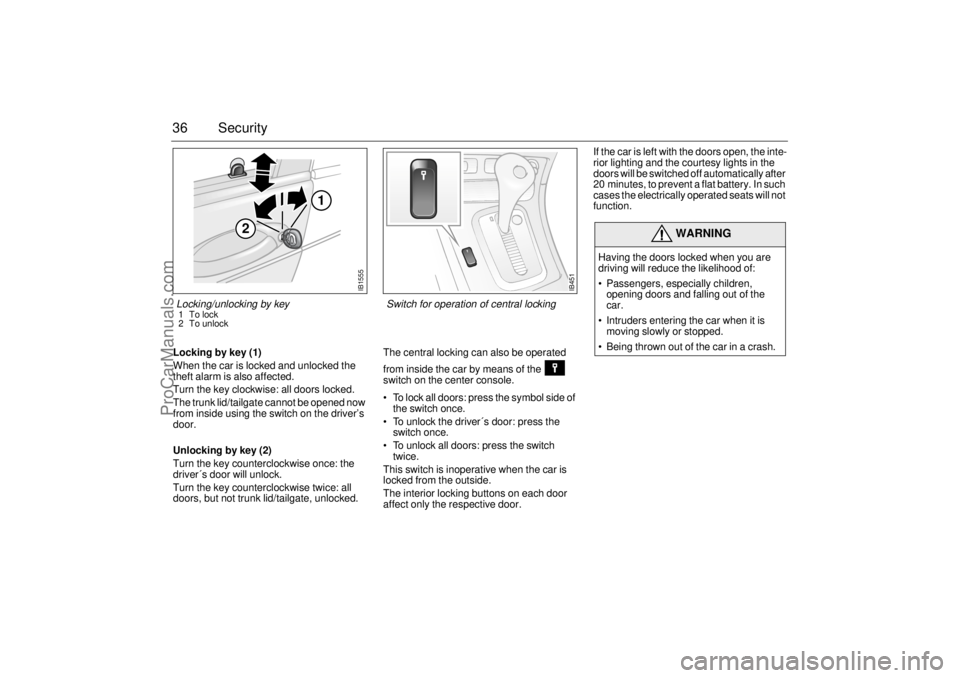
36 SecurityLocking by key (1)
When the car is locked and unlocked the
theft alarm is also affected.
Turn the key clockwise: all doors locked.
The trunk lid/tailgate cannot be opened now
from inside using the switch on the driver’s
door.
Unlocking by key (2)
Turn the key counterclockwise once: the
driver´s door will unlock.
Turn the key counterclockwise twice: all
doors, but not trunk lid/tailgate, unlocked. The central locking can also be operated
from inside the car by means of the
switch on the center console.
To lock all doors: press the symbol side of
the switch once.
To unlock the driver´s door: press the
switch once.
To unlock all doors: press the switch
twice.
This switch is inoperative when the car is
locked from the outside.
The interior locking buttons on each door
affect only the respective door.If the car is left with the doors open, the inte-
rior lighting and the courtesy lights in the
doors will be switched off automatically after
20 minutes, to prevent a flat battery. In such
cases the electrically operated seats will not
function.
WARNING
Having the doors locked when you are
driving will reduce the likelihood of:
Passengers, especially children,
opening doors and falling out of the
car.
Intruders entering the car when it is
moving slowly or stopped.
Being thrown out of the car in a crash.
IB451
Switch for operation of central locking
IB1555
2
1
Locking/unlocking by key1To lock
2 To unlock
ProCarManuals.com
Page 40 of 272
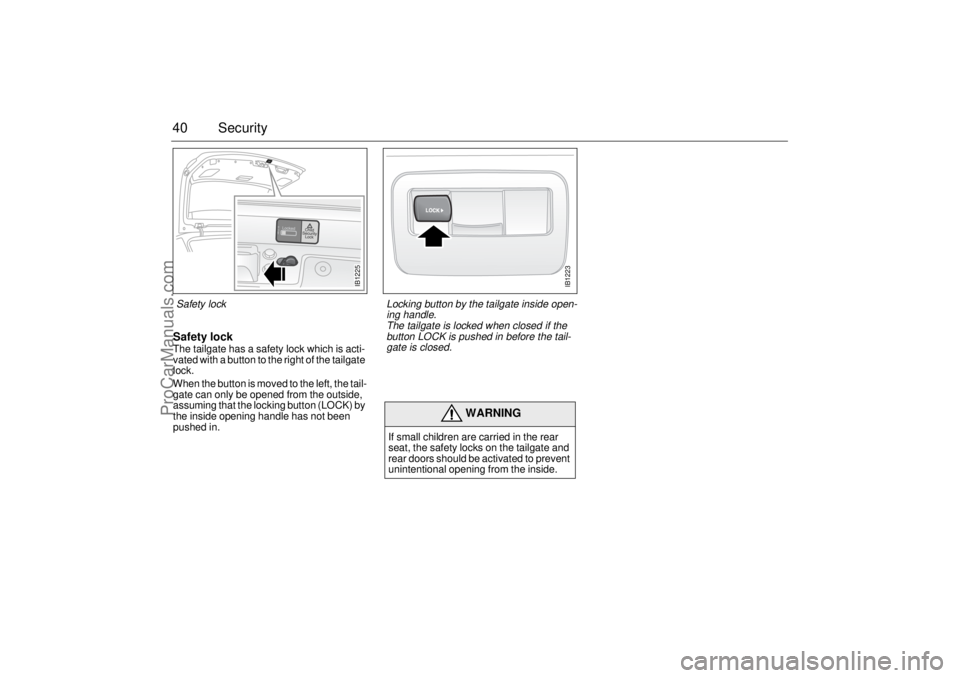
40 SecuritySafety lock The tailgate has a safety lock which is acti-
vated with a button to the right of the tailgate
lock.
When the button is moved to the left, the tail-
gate can only be opened from the outside,
assuming that the locking button (LOCK) by
the inside opening handle has not been
pushed in.
WARNING
If small children are carried in the rear
seat, the safety locks on the tailgate and
rear doors should be activated to prevent
unintentional opening from the inside.
IB1225
Safety lock
IB1223
Locking button by the tailgate inside open-
ing handle.
The tailgate is locked when closed if the
button LOCK is pushed in before the tail-
gate is closed.
ProCarManuals.com
Page 120 of 272
120 Interior equipment and trunkSeats Both front seats are electrically operated.
On certain models the driver´s seat is
equipped with a memory function.
To facilitate getting into the car, both seats
can be adjusted when either of the front
doors is open.
For safety reasons, if the door is closed, the
seat can only be adjusted when the ignition
is ON.
Note, however, that both seats can be
adjusted for 30 seconds after both doors
have been closed. The following seat adjustments can be
made to achieve a comfortable driving
position:
Height.
Legroom.
Backrest rake angle.
Lumbar support.
Head-restraint height.
We recommend that adjustments to the
driver’s seat be performed in the following
order:
1Height.
2 Legroom.
3 Seat tilt angle.
4 Backrest rake angle.
Lastly, adjust the steering wheel (see page
124).
Side airbags (see page 28).Head restraint(see page 18).
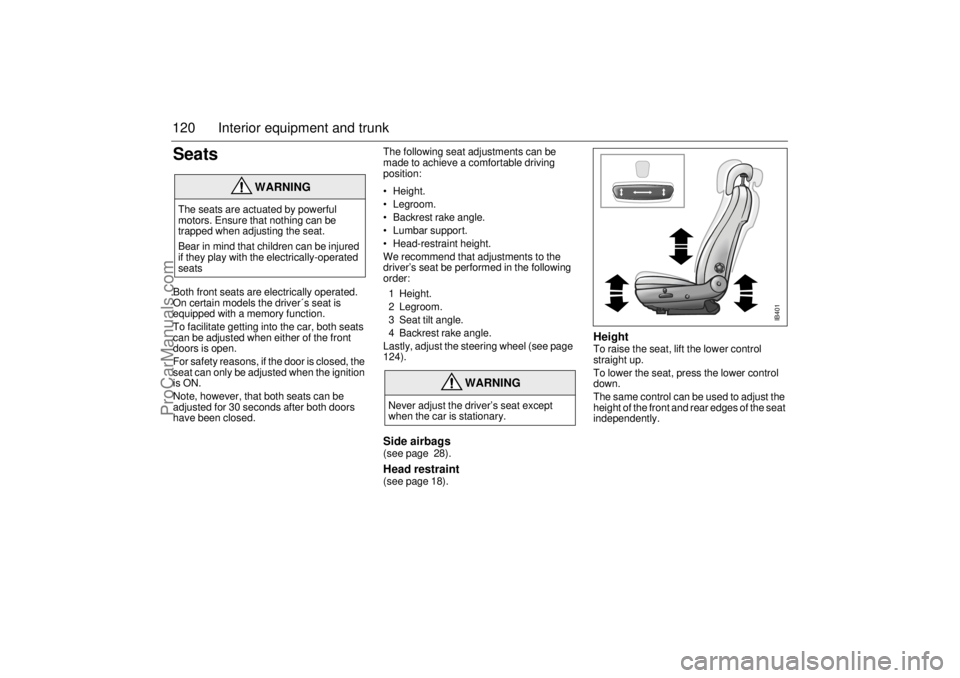
Height To raise the seat, lift the lower control
straight up.
To lower the seat, press the lower control
down.
The same control can be used to adjust the
height of the front and rear edges of the seat
independently.
WARNING
The seats are actuated by powerful
motors. Ensure that nothing can be
trapped when adjusting the seat.
Bear in mind that children can be injured
if they play with the electrically-operated
seats
WARNING
Never adjust the driver’s seat except
when the car is stationary.
IB401
ProCarManuals.com
Page 135 of 272
135 Interior equipment and trunk
WARNING
Place heavy items closest to the backrest and stow smaller
and lighter items on top.
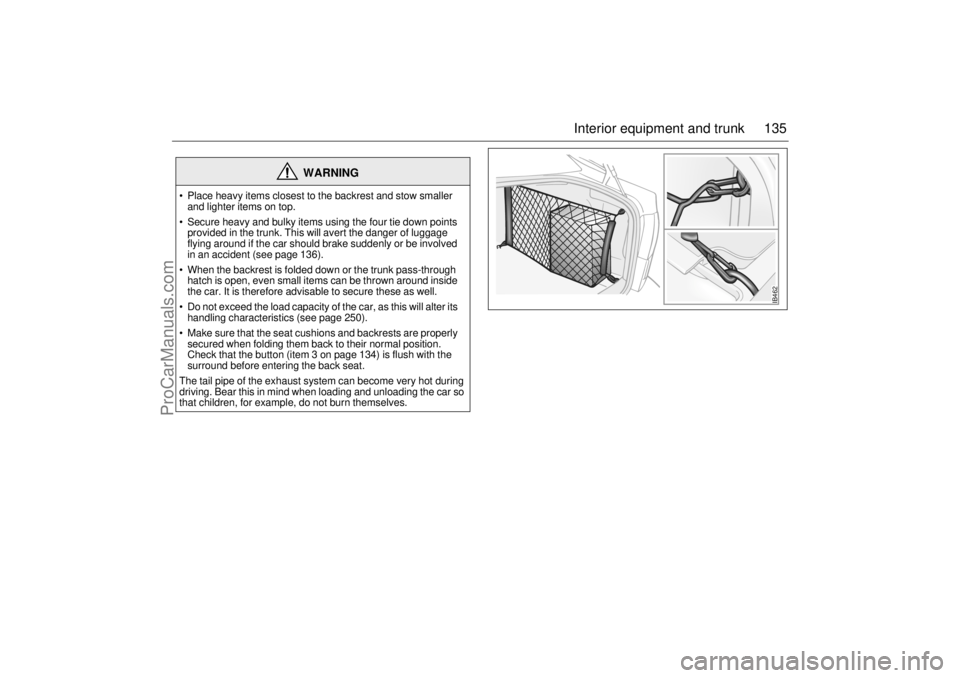
Secure heavy and bulky items using the four tie down points
provided in the trunk. This will avert the danger of luggage
flying around if the car should brake suddenly or be involved
in an accident (see page 136).
When the backrest is folded down or the trunk pass-through
hatch is open, even small items can be thrown around inside
the car. It is therefore advisable to secure these as well.
Do not exceed the load capacity of the car, as this will alter its
handling characteristics (see page 250).
Make sure that the seat cushions and backrests are properly
secured when folding them back to their normal position.
Check that the button (item 3 on page 134) is flush with the
surround before entering the back seat.
The tail pipe of the exhaust system can become very hot during
driving. Bear this in mind when loading and unloading the car so
that children, for example, do not burn themselves.
IB462
ProCarManuals.com
Page 185 of 272
185 Starting and driving
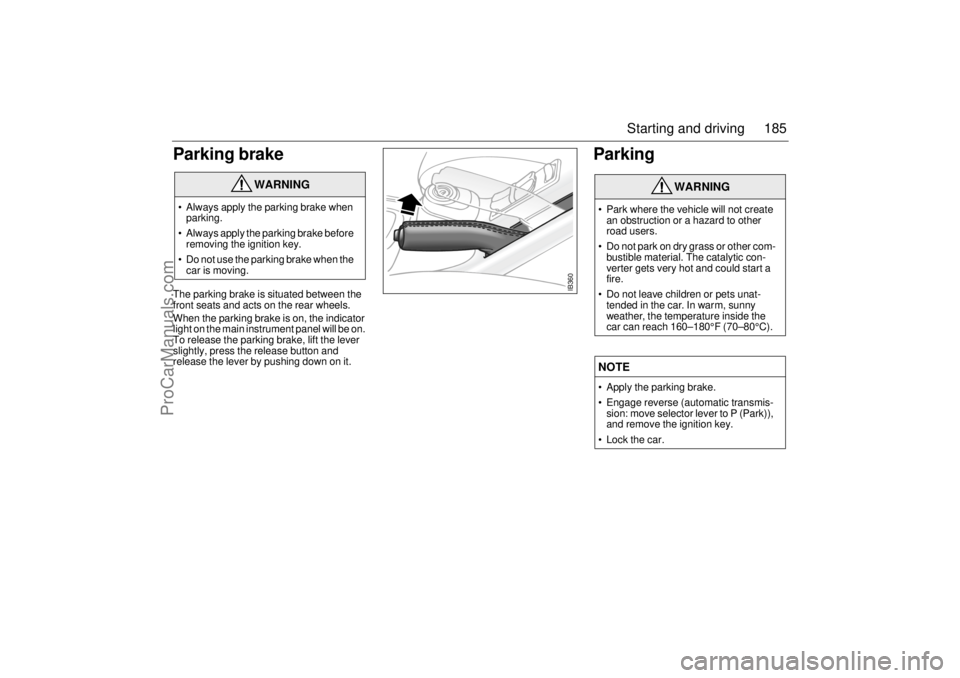
Parking brake The parking brake is situated between the
front seats and acts on the rear wheels.
When the parking brake is on, the indicator
light on the main instrument panel will be on.
To release the parking brake, lift the lever
slightly, press the release button and
release the lever by pushing down on it.
Parking
WARNING
Always apply the parking brake when
parking.
Always apply the parking brake before
removing the ignition key.
Do not use the parking brake when the
car is moving.
WARNING
Park where the vehicle will not create
an obstruction or a hazard to other
road users.
Do not park on dry grass or other com-
bustible material. The catalytic con-
verter gets very hot and could start a
fire.
Do not leave children or pets unat-
tended in the car. In warm, sunny
weather, the temperature inside the
car can reach 160–180°F (70–80°C). NOTE Apply the parking brake.
Engage reverse (automatic transmis-
sion: move selector lever to P (Park)),
and remove the ignition key.
Lock the car.
IB360
ProCarManuals.com