engine oil SAAB 9-5 2001 User Guide
[x] Cancel search | Manufacturer: SAAB, Model Year: 2001, Model line: 9-5, Model: SAAB 9-5 2001Pages: 272, PDF Size: 14.83 MB
Page 181 of 272
181 Starting and driving
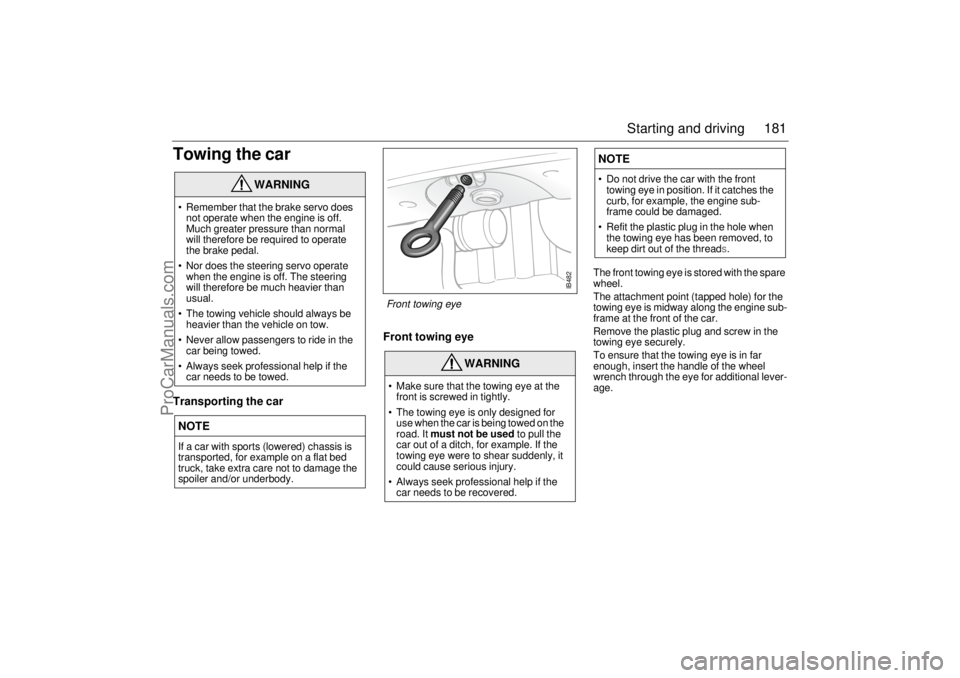
Towing the carTransporting the carFront towing eye
The front towing eye is stored with the spare
wheel.
The attachment point (tapped hole) for the
towing eye is midway along the engine sub-
frame at the front of the car.
Remove the plastic plug and screw in the
towing eye securely.
To ensure that the towing eye is in far
enough, insert the handle of the wheel
wrench through the eye for additional lever-
age.
WARNING
Remember that the brake servo does
not operate when the engine is off.
Much greater pressure than normal
will therefore be required to operate
the brake pedal.
Nor does the steering servo operate
when the engine is off. The steering
will therefore be much heavier than
usual.
The towing vehicle should always be
heavier than the vehicle on tow.
Never allow passengers to ride in the
car being towed.
Always seek professional help if the
car needs to be towed.NOTEIf a car with sports (lowered) chassis is
transported, for example on a flat bed
truck, take extra care not to damage the
spoiler and/or underbody.
WARNING
Make sure that the towing eye at the
front is screwed in tightly.
The towing eye is only designed for
use when the car is being towed on the
road. It must not be used to pull the
car out of a ditch, for example. If the
towing eye were to shear suddenly, it
could cause serious injury.
Always seek professional help if the
car needs to be recovered.
NOTE Do not drive the car with the front
towing eye in position. If it catches the
curb, for example, the engine sub-
frame could be damaged.
Refit the plastic plug in the hole when
the towing eye has been removed, to
keep dirt out of the threads.
IB482
Front towing eye
ProCarManuals.com
Page 182 of 272
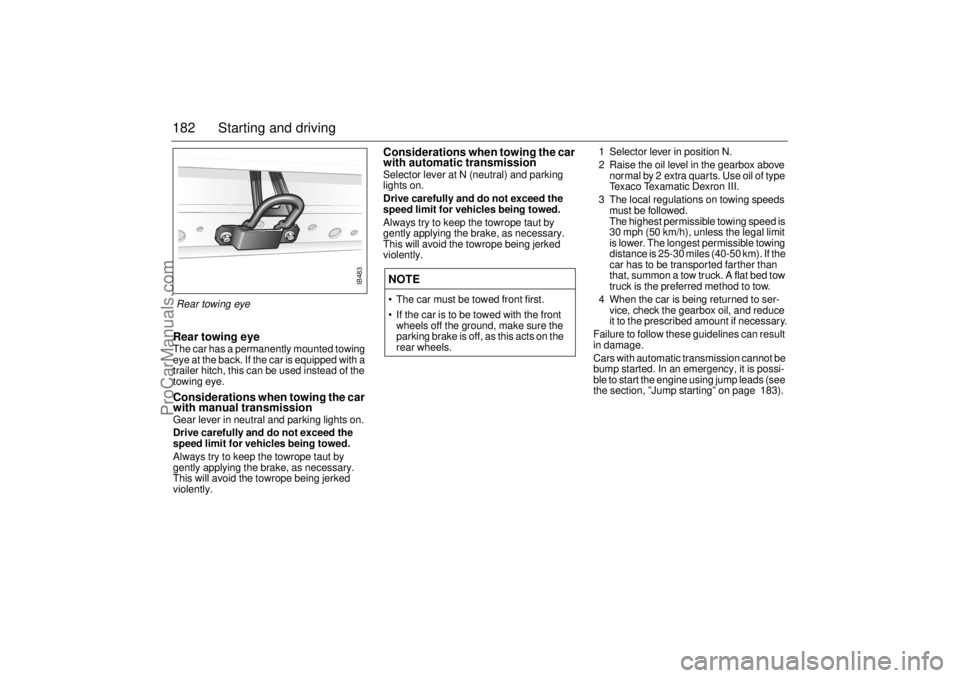
182 Starting and drivingRear towing eyeThe car has a permanently mounted towing
eye at the back. If the car is equipped with a
trailer hitch, this can be used instead of the
towing eye. Considerations when towing the car
with manual transmission Gear lever in neutral and parking lights on.
Drive carefully and do not exceed the
speed limit for vehicles being towed.
Always try to keep the towrope taut by
gently applying the brake, as necessary.
This will avoid the towrope being jerked
violently.
Considerations when towing the car
with automatic transmission Selector lever at N (neutral) and parking
lights on.
Drive carefully and do not exceed the
speed limit for vehicles being towed.
Always try to keep the towrope taut by
gently applying the brake, as necessary.
This will avoid the towrope being jerked
violently. 1 Selector lever in position N.
2 Raise the oil level in the gearbox above
normal by 2 extra quarts. Use oil of type
Texaco Texamatic Dexron III.
3 The local regulations on towing speeds
must be followed.
The highest permissible towing speed is
30 mph (50 km/h), unless the legal limit
is lower. The longest permissible towing
distance is 25-30 miles (40-50 km). If the
car has to be transported farther than
that, summon a tow truck. A flat bed tow
truck is the preferred method to tow.
4 When the car is being returned to ser-
vice, check the gearbox oil, and reduce
it to the prescribed amount if necessary.
Failure to follow these guidelines can result
in damage.
Cars with automatic transmission cannot be
bump started. In an emergency, it is possi-
ble to start the engine using jump leads (see
the section, ”Jump starting” on page 183). NOTE The car must be towed front first.
If the car is to be towed with the front
wheels off the ground, make sure the
parking brake is off, as this acts on the
rear wheels.
IB483
Rear towing eye
ProCarManuals.com
Page 184 of 272
184 Starting and driving
5 Check that the jumper cables do not
have loose or missing insulation. If they
do, you could get a shock and also the
vehicles could be damaged.
Before you connect the cables, here are
some basic things you should know.
Positive (+) will go to positive (+) and
negative (-) will go to negative (-) or a
major metal engine part with a good
ground. Do not connect (+) to (-) or you
will get a short that could injure you or
would damage the battery and maybe
other parts as well.
6 Connect the red positive (+) cable to the
positive (+) terminal of the vehicle with
the discharged battery.
7 Do not let the other end touch metal.
Connect it to the positive (+) terminal of
the good battery. Use a remote positive
(+) terminal if the vehicle has one.8 Now connect the black negative (-)
cable to the good battery’s negative ter-
minal.
Do not let the other end touch anything
until the next step. The other end of the
negative cable does not go to the dead
battery. It goes to a major metal part with
a good ground on the engine of the vehi-
cle with the discharged battery.
9 Attach the cable at least 18 inches
(45 cm) away from the discharged bat-
tery, but not near engine parts that
move. The electrical connection is just
as good there, but the chance of sparks
getting back to the battery is much less.
10 Start the vehicle with the good battery
and run the engine for a while.
11 Try to start the vehicle with the dis-
charged battery. If it does not start after
a few tries, it probably needs service.
12 Remove the cables in reverse order to
prevent electrical shorting. Take care
that they do not touch each other or any
other metal.
WARNING
An electric fan can start up even when the
engine is not running and can injure you.
Keep hands, clothing and tools away from
any underhood electric fan.
WARNING
Using a match or flame of any kind near a
battery can cause battery gas to explode.
You can suffer burns or be blinded. Use a
flashlight if you need more light.
Be sure the battery has enough water.
The battery installed in your new Saab
has filler caps. Be sure the right amount
of water is there. Add distilled or boiled
water if the level is too low. If you don’t,
explosive gas could be present.
Be sure the electrolyte in the battery is not
frozen. Discharged batteries will freeze.
When connecting jumper cables to a
frozen battery, gas from the chemical
reaction inside the battery can build up
under the ice and cause an explosion.
Battery fluid contains acid that can burn
you. Do not get it on you. If you acciden-
tally get it in your eyes or on your skin,
flush the area with water and get medical
help immediately.
ProCarManuals.com
Page 187 of 272
187 Car care and technical information
Car care and
technical
information
Hood release handle ....... 188
Engine compartment,
4-cyl. engine ................... 189
Engine compartment,
6-cyl. (3.0t V6)................. 190
Emission control systems 191
Engine............................... 192
Engine oil ......................... 193
Transmission fluid........... 195
Coolant ............................. 196
Brake and clutch fluid ..... 198
Power steering fluid ........ 199
Battery .............................. 199 Drive belts ........................ 202
Wipers and washers ....... 203
Changing bulbs ............... 205
Fuses ................................ 215
Wheels .............................. 221
Compact spare wheel ..... 225
Flat spotting..................... 229
Air conditioning (ACC) ... 230
Safety belts ...................... 231
Upholstery and trim ........ 231
Textile carpeting.............. 232
Washing the car .............. 232
Waxing and polishing ..... 233 Engine compartment ....... 233
Touching up the paint ..... 233
Anticorrosion treatment .. 234
For long trips .................... 236
Recovery and/or recycling
of automotive materials. 236
Headlight aiming .............. 238
ProCarManuals.com
Page 189 of 272
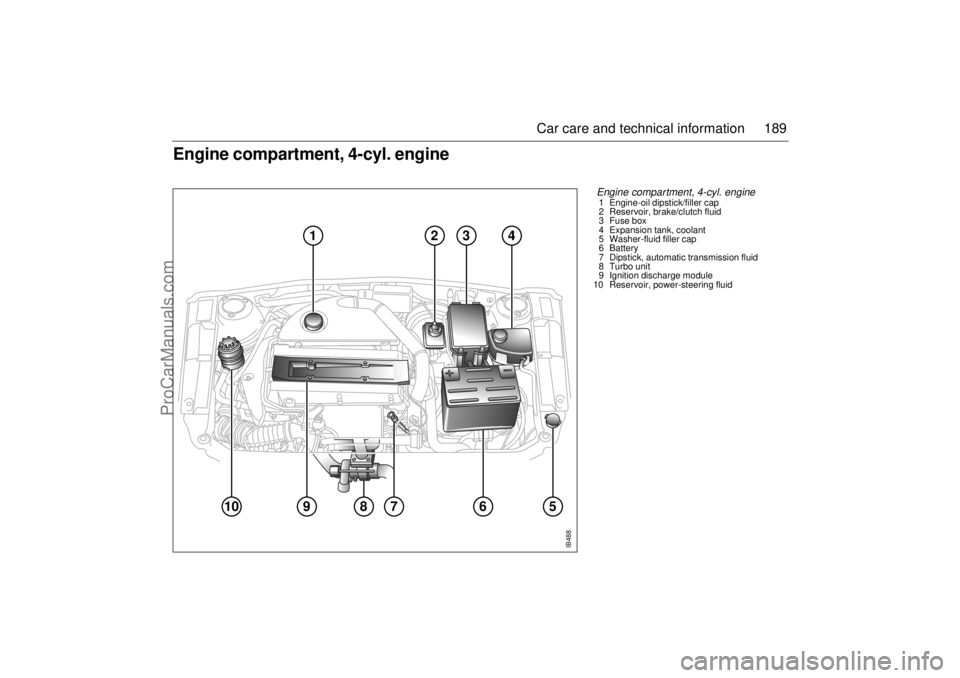
189 Car care and technical information
Engine compartment, 4-cyl. engine
8
7
9
10
6
2
4
3
5
IB488
1
Engine compartment, 4-cyl. engine 1 Engine-oil dipstick/filler cap
2 Reservoir, brake/clutch fluid
3 Fuse box
4 Expansion tank, coolant
5 Washer-fluid filler cap
6Battery
7 Dipstick, automatic transmission fluid
8 Turbo unit
9 Ignition discharge module
10 Reservoir, power-steering fluid
ProCarManuals.com
Page 190 of 272
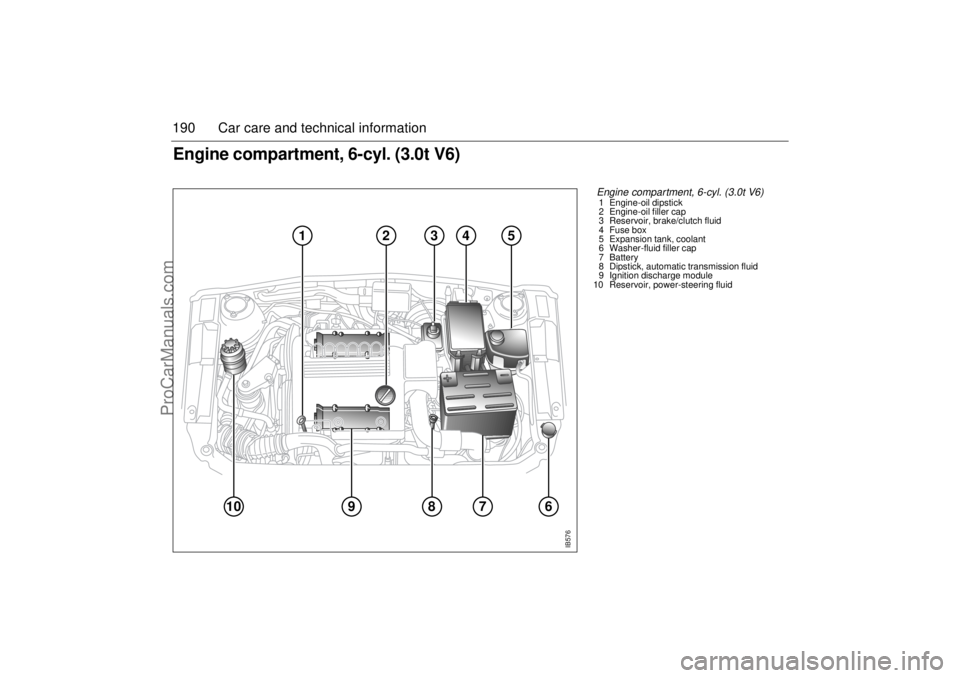
190 Car care and technical informationEngine compartment, 6-cyl. (3.0t V6)
10
7
9
8
1
3
2
5
4
6
IB576
Engine compartment, 6-cyl. (3.0t V6) 1 Engine-oil dipstick
2 Engine-oil filler cap
3 Reservoir, brake/clutch fluid
4 Fuse box
5 Expansion tank, coolant
6 Washer-fluid filler cap
7Battery
8 Dipstick, automatic transmission fluid
9 Ignition discharge module
10 Reservoir, power-steering fluid
ProCarManuals.com
Page 193 of 272
193 Car care and technical information
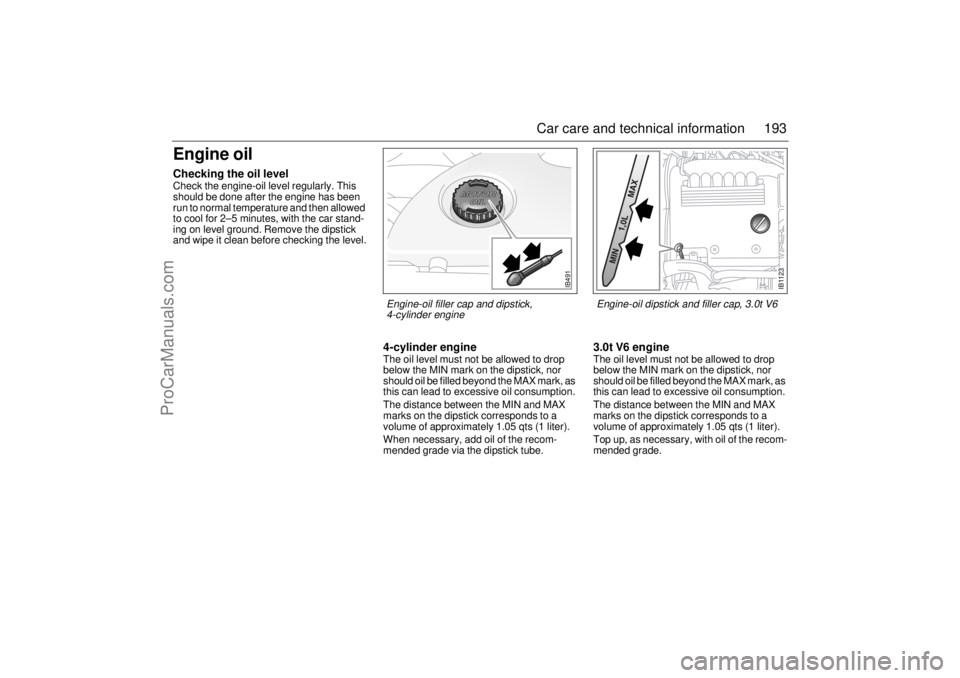
Engine oilChecking the oil level Check the engine-oil level regularly. This
should be done after the engine has been
run to normal temperature and then allowed
to cool for 2–5 minutes, with the car stand-
ing on level ground. Remove the dipstick
and wipe it clean before checking the level.
4-cylinder engine The oil level must not be allowed to drop
below the MIN mark on the dipstick, nor
should oil be filled beyond the MAX mark, as
this can lead to excessive oil consumption.
The distance between the MIN and MAX
marks on the dipstick corresponds to a
volume of approximately 1.05 qts (1 liter).
When necessary, add oil of the recom-
mended grade via the dipstick tube.
3.0t V6 engine The oil level must not be allowed to drop
below the MIN mark on the dipstick, nor
should oil be filled beyond the MAX mark, as
this can lead to excessive oil consumption.
The distance between the MIN and MAX
marks on the dipstick corresponds to a
volume of approximately 1.05 qts (1 liter).
Top up, as necessary, with oil of the recom-
mended grade.
IB491
Engine-oil filler cap and dipstick,
4-cylinder engine
IB1123
Engine-oil dipstick and filler cap, 3.0t V6
ProCarManuals.com
Page 194 of 272
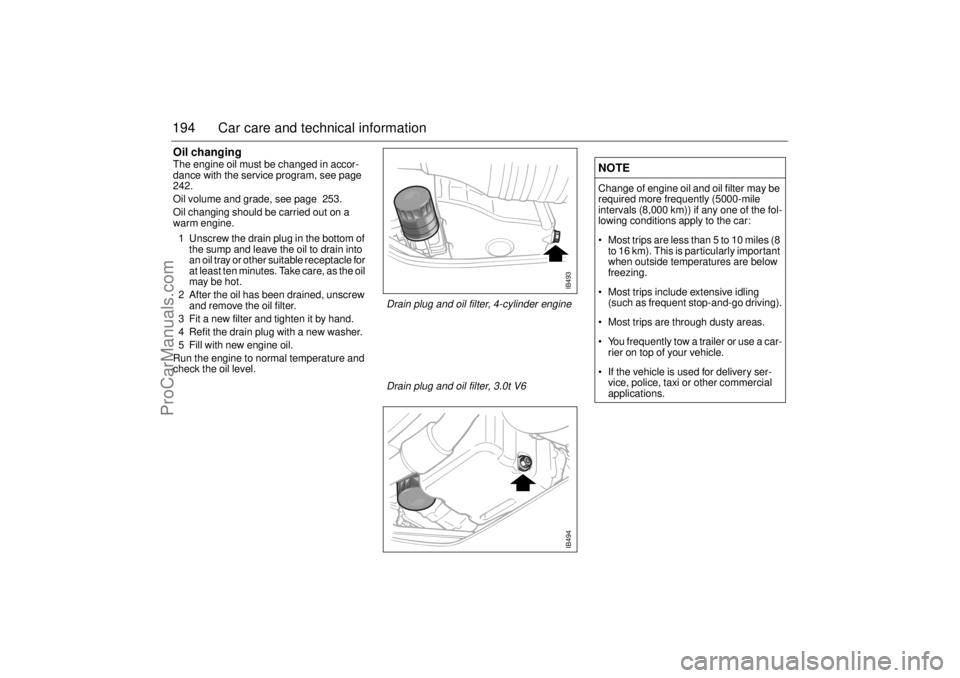
194 Car care and technical informationOil changingThe engine oil must be changed in accor-
dance with the service program, see page
242.
Oil volume and grade, see page 253.
Oil changing should be carried out on a
warm engine.
1 Unscrew the drain plug in the bottom of
the sump and leave the oil to drain into
an oil tray or other suitable receptacle for
at least ten minutes. Take care, as the oil
may be hot.
2 After the oil has been drained, unscrew
and remove the oil filter.
3 Fit a new filter and tighten it by hand.
4 Refit the drain plug with a new washer.
5 Fill with new engine oil.
Run the engine to normal temperature and
check the oil level.
NOTEChange of engine oil and oil filter may be
required more frequently (5000-mile
intervals (8,000 km)) if any one of the fol-
lowing conditions apply to the car:
Most trips are less than 5 to 10 miles (8
to 16 km). This is particularly important
when outside temperatures are below
freezing.
Most trips include extensive idling
(such as frequent stop-and-go driving).
Most trips are through dusty areas.
You frequently tow a trailer or use a car-
rier on top of your vehicle.
If the vehicle is used for delivery ser-
vice, police, taxi or other commercial
applications.
IB493
Drain plug and oil filter, 4-cylinder engine
IB494
Drain plug and oil filter, 3.0t V6
ProCarManuals.com
Page 195 of 272
195 Car care and technical information
Transmission fluidManual transmission Check and top up the fluid in accordance
with the service program.
If original fluid cannot can be obtained for
topping up (see page 255), automatic trans-
mission fluid Dexron III (synthetic fluid) can
be used. If so, the car should be taken to an
authorized Saab dealer as soon as possible
to have the reason for low fluid level cor-
rected and original fluid installed.Automatic transmission Check the fluid level as follows:
1 Stand the car on level ground and apply
the parking brake. The automatic trans-
mission fluid must be at normal running
temperature, approximately 175°F
(80°C). This can be achieved by driving
the car for about 30 min on the open
road.
2 With the engine idling, move the selector
lever to D and wait for at least
15 seconds. Next, move the selector
lever to R and wait for 15 seconds again.
Finally, move the selector lever to P. Let
the engine idle.
3 Wipe the dipstick clean with a lint-free
cloth and put it back.
4 With the fluid at normal temperature, the
level should be between the MAX and
MIN marks on the dipstick. Top up, as
necessary, with Texaco Texamatic
Dexron III automatic transmission fluid
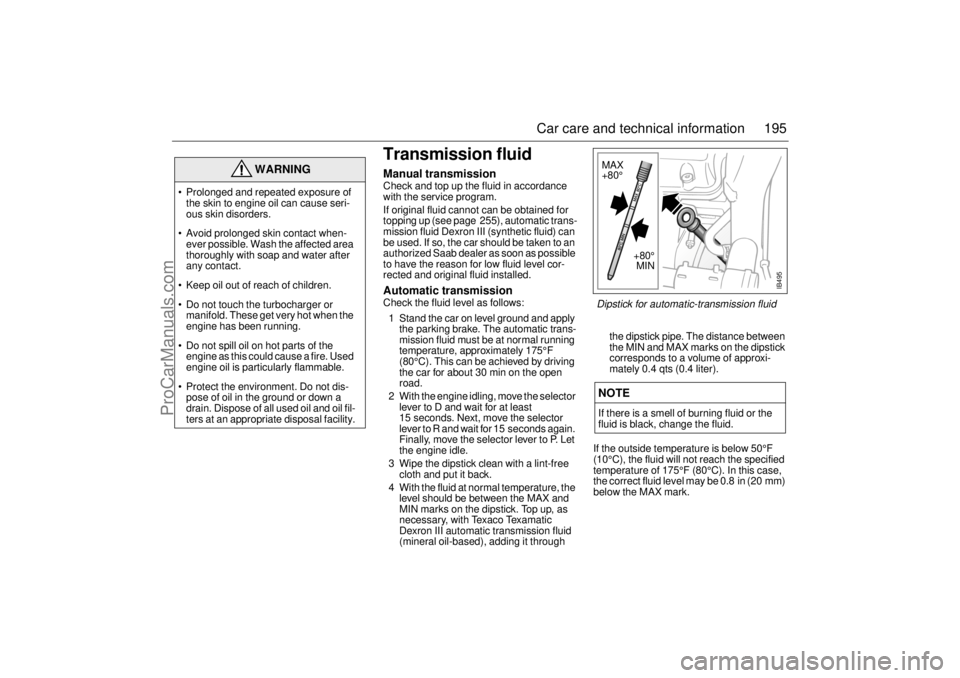
(mineral oil-based), adding it through the dipstick pipe. The distance between
the MIN and MAX marks on the dipstick
corresponds to a volume of approxi-
mately 0.4 qts (0.4 liter).
If the outside temperature is below 50°F
(10°C), the fluid will not reach the specified
temperature of 175°F (80°C). In this case,
the correct fluid level may be 0.8 in (20 mm)
below the MAX mark.
WARNING
Prolonged and repeated exposure of
the skin to engine oil can cause seri-
ous skin disorders.
Avoid prolonged skin contact when-
ever possible. Wash the affected area
thoroughly with soap and water after
any contact.
Keep oil out of reach of children.
Do not touch the turbocharger or
manifold. These get very hot when the
engine has been running.
Do not spill oil on hot parts of the
engine as this could cause a fire. Used
engine oil is particularly flammable.
Protect the environment. Do not dis-
pose of oil in the ground or down a
drain. Dispose of all used oil and oil fil-
ters at an appropriate disposal facility.
NOTEIf there is a smell of burning fluid or the
fluid is black, change the fluid.
+80°
MIN MAX
+80°
IB495
Dipstick for automatic-transmission fluid
ProCarManuals.com
Page 196 of 272
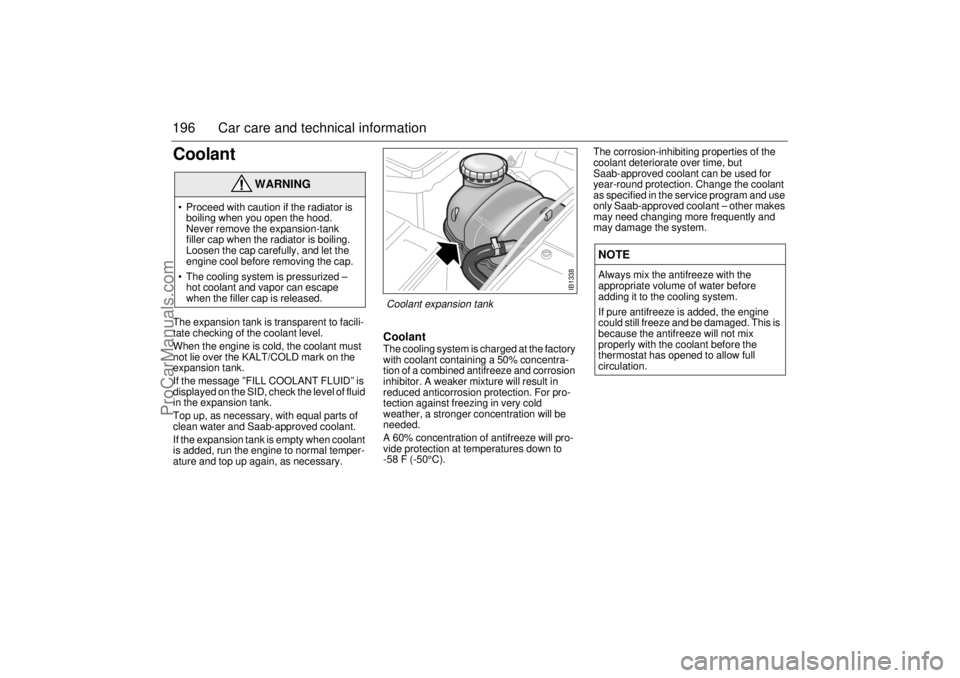
196 Car care and technical informationCoolant The expansion tank is transparent to facili-
tate checking of the coolant level.
When the engine is cold, the coolant must
not lie over the KALT/COLD mark on the
expansion tank.
If the message ”FILL COOLANT FLUID” is
displayed on the SID, check the level of fluid
in the expansion tank.
Top up, as necessary, with equal parts of
clean water and Saab-approved coolant.
If the expansion tank is empty when coolant
is added, run the engine to normal temper-
ature and top up again, as necessary.
Coolant The cooling system is charged at the factory
with coolant containing a 50% concentra-
tion of a combined antifreeze and corrosion
inhibitor. A weaker mixture will result in
reduced anticorrosion protection. For pro-
tection against freezing in very cold
weather, a stronger concentration will be
needed.
A 60% concentration of antifreeze will pro-
vide protection at temperatures down to
-58 F (-50°C).The corrosion-inhibiting properties of the
coolant deteriorate over time, but
Saab-approved coolant can be used for
year-round protection. Change the coolant
as specified in the service program and use
only Saab-approved coolant – other makes
may need changing more frequently and
may damage the system.
WARNING
Proceed with caution if the radiator is
boiling when you open the hood.
Never remove the expansion-tank
filler cap when the radiator is boiling.
Loosen the cap carefully, and let the
engine cool before removing the cap.
The cooling system is pressurized –
hot coolant and vapor can escape
when the filler cap is released.
NOTEAlways mix the antifreeze with the
appropriate volume of water before
adding it to the cooling system.
If pure antifreeze is added, the engine
could still freeze and be damaged. This is
because the antifreeze will not mix
properly with the coolant before the
thermostat has opened to allow full
circulation.
IB1338
Coolant expansion tank
ProCarManuals.com