fuse SAAB 9-5 2001 User Guide
[x] Cancel search | Manufacturer: SAAB, Model Year: 2001, Model line: 9-5, Model: SAAB 9-5 2001Pages: 272, PDF Size: 14.83 MB
Page 215 of 272
215 Car care and technical information
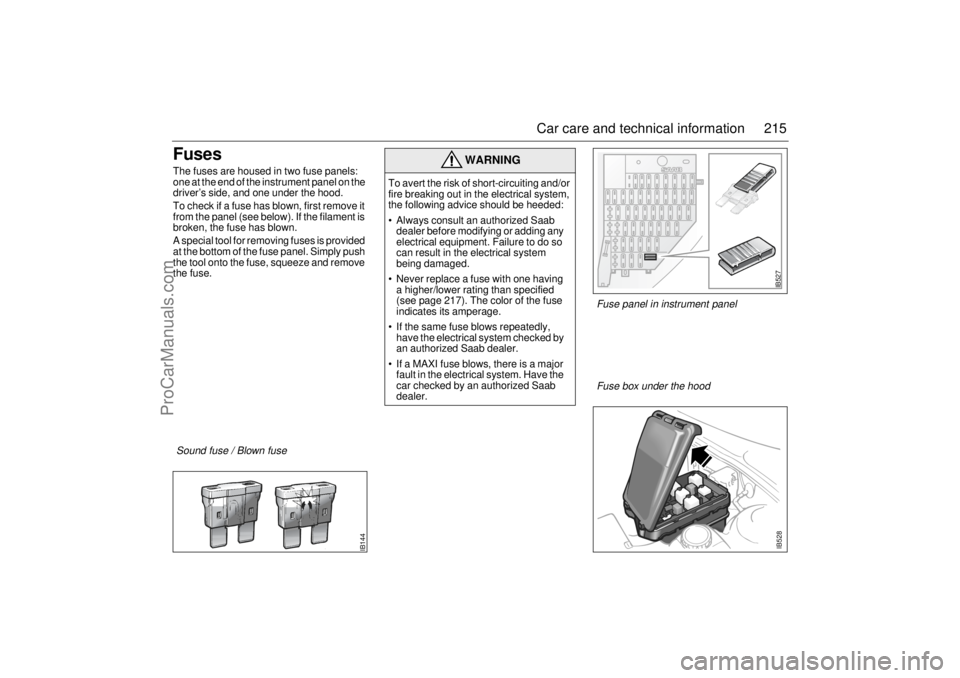
FusesThe fuses are housed in two fuse panels:
one at the end of the instrument panel on the
driver’s side, and one under the hood.
To check if a fuse has blown, first remove it
from the panel (see below). If the filament is
broken, the fuse has blown.
A special tool for removing fuses is provided
at the bottom of the fuse panel. Simply push
the tool onto the fuse, squeeze and remove
the fuse.
WARNING
To avert the risk of short-circuiting and/or
fire breaking out in the electrical system,
the following advice should be heeded:
Always consult an authorized Saab
dealer before modifying or adding any
electrical equipment. Failure to do so
can result in the electrical system
being damaged.
Never replace a fuse with one having
a higher/lower rating than specified
(see page 217). The color of the fuse
indicates its amperage.
If the same fuse blows repeatedly,
have the electrical system checked by
an authorized Saab dealer.
If a MAXI fuse blows, there is a major
fault in the electrical system. Have the
car checked by an authorized Saab
dealer.
IB527
Fuse panel in instrument panel
IB528
Fuse box under the hood
IB144
Sound fuse / Blown fuse
ProCarManuals.com
Page 216 of 272
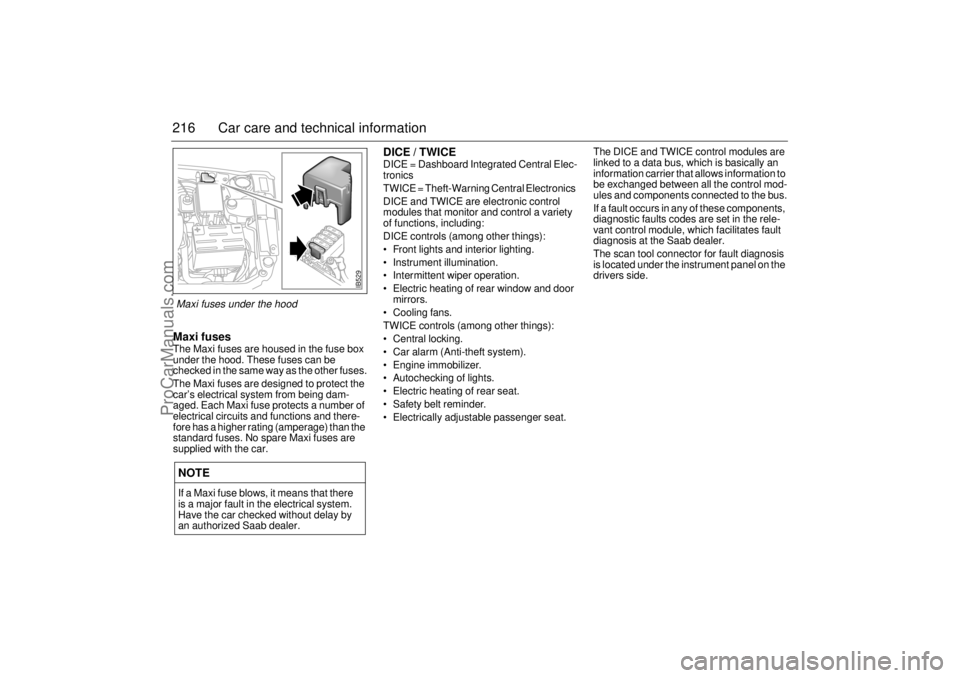
216 Car care and technical informationMaxi fusesThe Maxi fuses are housed in the fuse box
under the hood. These fuses can be
checked in the same way as the other fuses.
The Maxi fuses are designed to protect the
car’s electrical system from being dam-
aged. Each Maxi fuse protects a number of
electrical circuits and functions and there-
fore has a higher rating (amperage) than the
standard fuses. No spare Maxi fuses are
supplied with the car.
DICE / TWICEDICE = Dashboard Integrated Central Elec-
tronics
TWICE = Theft-Warning Central Electronics
DICE and TWICE are electronic control
modules that monitor and control a variety
of functions, including:
DICE controls (among other things):
Front lights and interior lighting.
Instrument illumination.
Intermittent wiper operation.
Electric heating of rear window and door
mirrors.
Cooling fans.
TWICE controls (among other things):
Central locking.
Car alarm (Anti-theft system).
Engine immobilizer.
Autochecking of lights.
Electric heating of rear seat.
Safety belt reminder.
Electrically adjustable passenger seat.The DICE and TWICE control modules are
linked to a data bus, which is basically an
information carrier that allows information to
be exchanged between all the control mod-
ules and components connected to the bus.
If a fault occurs in any of these components,
diagnostic faults codes are set in the rele-
vant control module, which facilitates fault
diagnosis at the Saab dealer.
The scan tool connector for fault diagnosis
is located under the instrument panel on the
drivers side.
NOTEIf a Maxi fuse blows, it means that there
is a major fault in the electrical system.
Have the car checked without delay by
an authorized Saab dealer.
IB529
Maxi fuses under the hood
ProCarManuals.com
Page 217 of 272
217 Car care and technical information
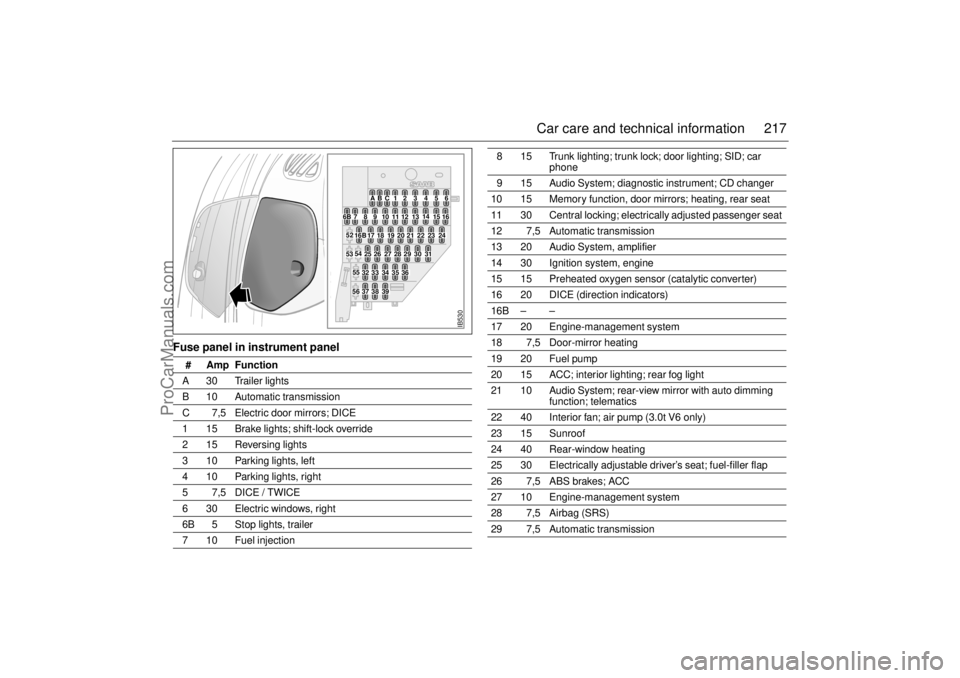
Fuse panel in instrument panel
# Amp Function
A 30 Trailer lights
B 10 Automatic transmission
C 7,5 Electric door mirrors; DICE
1 15 Brake lights; shift-lock override
2 15 Reversing lights
3 10 Parking lights, left
4 10 Parking lights, right
5 7,5 DICE / TWICE
6 30 Electric windows, right
6B 5 Stop lights, trailer
7 10 Fuel injection
8 15 Trunk lighting; trunk lock; door lighting; SID; car
phone
9 15 Audio System; diagnostic instrument; CD changer
10 15 Memory function, door mirrors; heating, rear seat
11 30 Central locking; electrically adjusted passenger seat
12 7,5 Automatic transmission
13 20 Audio System, amplifier
14 30 Ignition system, engine
15 15 Preheated oxygen sensor (catalytic converter)
16 20 DICE (direction indicators)
16B – –
17 20 Engine-management system
18 7,5 Door-mirror heating
19 20 Fuel pump
20 15 ACC; interior lighting; rear fog light
21 10 Audio System; rear-view mirror with auto dimming
function; telematics
22 40 Interior fan; air pump (3.0t V6 only)
23 15 Sunroof
24 40 Rear-window heating
25 30 Electrically adjustable driver’s seat; fuel-filler flap
26 7,5 ABS brakes; ACC
27 10 Engine-management system
28 7,5 Airbag (SRS)
29 7,5 Automatic transmission
IB530
BC123456 A
14
121110987
13
6B
1516
2324
222120191817
16B
5425262728293031
3635343332
39383755525356
ProCarManuals.com
Page 218 of 272
218 Car care and technical informationRelay panel under instrument panel Relay panel under instrument panel (cont.)30 7,5 Starter motor
31 7,5 Cruise control; water valve; fog lights, front
32 15 Ventilated front seats
33 7,5 Direction-indicator switch
34 30 Cigarette lighter
35 15 Daytime running light
36 30 Electric windows, left
37 30 Windshield wipers; rain sensor
38 30 Electric heating, front seats
39 20 Limp-home solenoid (automatic transmission)
52-5
6Spare fuses
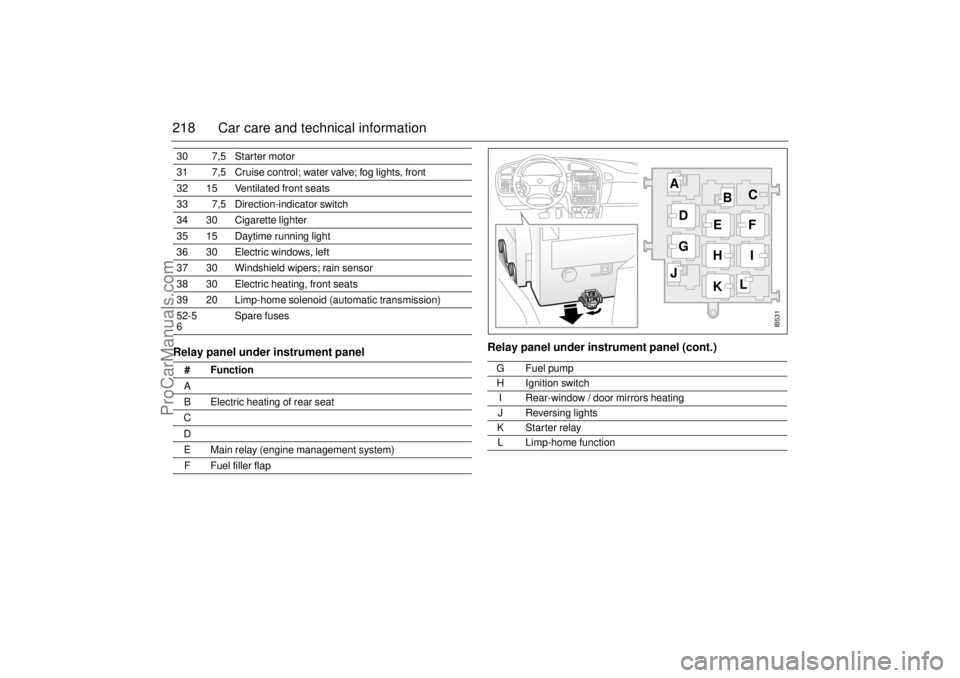
# Function
A
B Electric heating of rear seat
C
D
E Main relay (engine management system)
F Fuel filler flap
G Fuel pump
H Ignition switch
I Rear-window / door mirrors heating
J Reversing lights
KStarter relay
L Limp-home function
IB531
A
BC
D
GEF
HI
KL J
ProCarManuals.com
Page 219 of 272
219 Car care and technical information
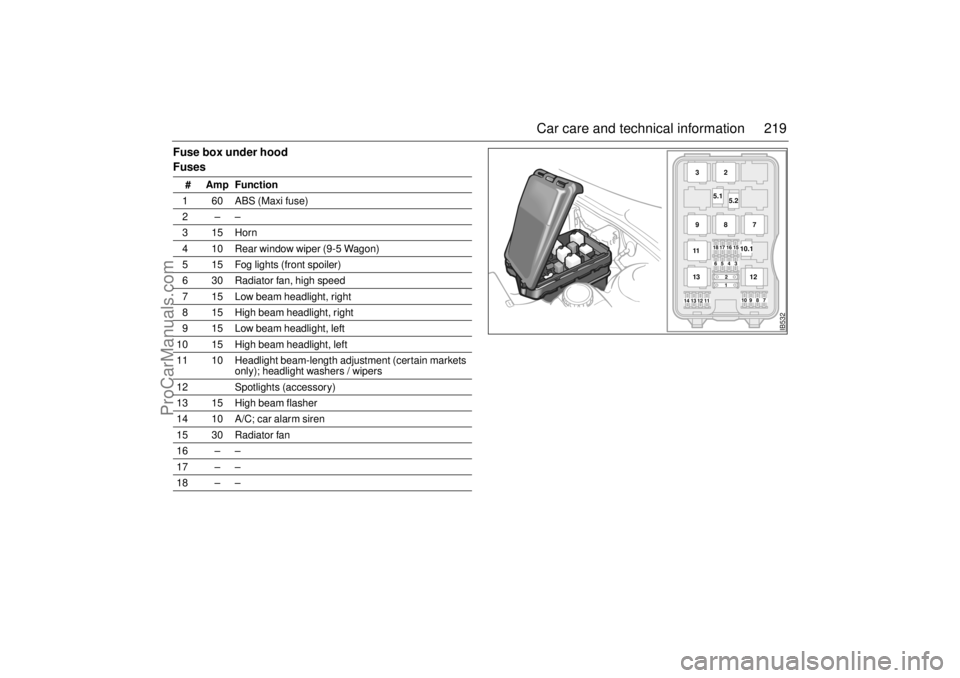
Fuse box under hood
Fuses
# Amp Function
1 60 ABS (Maxi fuse)
2––
315Horn
4 10 Rear window wiper (9-5 Wagon)
5 15 Fog lights (front spoiler)
6 30 Radiator fan, high speed
7 15 Low beam headlight, right
8 15 High beam headlight, right
9 15 Low beam headlight, left
10 15 High beam headlight, left
11 10 Headlight beam-length adjustment (certain markets
only); headlight washers / wipers
12 Spotlights (accessory)
13 15 High beam flasher
14 10 A/C; car alarm siren
15 30 Radiator fan
16 – –
17 – –
18 – –
IB532
18171615
14131211
10987
654312
10.1
3
5.2
5.12
9
8
7
11
12
13
ProCarManuals.com
Page 230 of 272
230 Car care and technical informationAir conditioning
(ACC)
Fault diagnosis If a fault occurs in the A/C system, there are
a number of checks you can perform your-
self. If the fault persists, however, have the
system checked by an authorized Saab
dealer.
Important!
When the A/C system is running, the intake
air is dehumidified, and the resultant con-
densation is drained off through two outlets
underneath the floor of the car in the vicinity
of the front doors. It is therefore perfectly
normal for water to be seen dripping from
these outlets when the car is parked. The
warmer the ambient air and the higher the
humidity, the greater will be the amount of
condensation formed.
Inadequate cooling:
a Check that the condenser (forward of
the radiator) has not become clogged
with dirt and insects.
b Make sure that the drive belt for the com-
pressor is not slipping.
c Check the fuses for the ventilation fans
and compressor.
Maintenance The drive belt for the compressor should
be inspected under the regular service
program.
Clean dirt and insects away from the con-
denser and radiator to prevent clogging.
When washing the car, use the hose to
spray the radiator and condenser (located
forward of the radiator) from both sides
(both from the front of the car and from
inside the engine bay). Do not use a pres-
sure washer.
Caution: Do not use the hose when the
engine is hot.
Other than in extremely cold weather, do not
screen the radiator, e.g. with netting, as this
will greatly diminish its cooling capacity.
Note: The A/C system will only operate
when the outdoor temperature is above the
freezing point (0°C, 32°F).
NOTE The A/C system is designed for use
with R134a refrigerant.
Refrigerant handling requires special
equipment and special procedures for
charging and draining the system.
All repairs and adjustments on the A/C
system must be carried out by a Saab
dealer authorized for this kind of work.
Never mix R134a and R12 refriger-
ants.
WARNING
The A/C system is pressurized. Do not
break any connections or undo A/C
system components.
Escaping gas can cause blindness or
other injury.
ProCarManuals.com
Page 236 of 272

236 Car care and technical information4Inspect the undercoating and touch
up if necessary. Pay particular atten-
tion to the fenders and wheel housings,
which are exposed to abrasion by flying
gravel, etc. If the composition has worn
or flaked off, the steel must be thor-
oughly cleaned and dried before a fresh
coat is applied. The cleaning is best
done with a scraper and a steel wire
brush, followed by washing with solvent.
Apply the new coating thinly, as other-
wise it may run off or fall off when dry.
For long tripsBefore setting off on a long journey, it is
advisable to have your car checked over by
your Saab dealer.
Obtain a few important items to take along
on your journey such as spare bulbs, wiper
blades, fuses, a Poly-V-belt and the like.
You can check some points yourself before-
hand:
Make sure that the engine is in good con-
dition.
Check that no oil or gasoline leaks out of
the engine or gearbox/transmission.
Check the coolant and power steering
fluid levels. Check also for leaks.
Inspect the Poly-V-belt and replace it if it
shows any signs of hard wear.
Check the battery charge.
Check the tires for tread pattern and air
pressure, including the compact spare
wheel.
Check the brakes.
Check all bulbs.
Check for the presence of the tool kit and
the jack in the car.
Recovery and/or
recycling of automotive
materialsA typical car consists of metals (65–75%),
plastics (10–14%), rubber (5%) and small
quantities of glass, wood, paper and tex-
tiles.
Some of these materials can be recycled,
while others can be recovered in chemical
processes for reuse in new products or as a
source of energy.
While the Saab 9-5 was still at the draw-
ing-board stage, Saab engineers were
giving serious consideration to how the
maximum quantity of materials could be
reclaimed from the car on its eventual
scrapping. To facilitate sorting, plastic parts,
for instance, have been marked to identify
the precise nature of the plastic.
Approximately 90% of the materials in the
car can be recycled or recovered, where
facilities exist.
Before the car is scrapped, all the oils and
other fluids that could pollute the environ-
ment should be recovered from the car. It
may be of interest in this context to learn that
the refrigerant used in the Saab 9-5’s ACC
systems (R134a) contains neither CFCs nor
any other chlorine compounds.
ProCarManuals.com
Page 261 of 272

261 Specifications
Several of the systems in your Saab
car can be adjusted to better fit your
individual needsSome functions are governed by legal
requirements and cannot therefore be
reprogrammed.
Consult an authorized Saab dealer for fur-
ther information.
Car alarm/central locking system:
The sound level of the siren when locking/
unlocking, HIGH or LOW.
The number of blinks when locking/
unlocking, 1 to 7.
Automatic locking of the trunk when the
car is driven, 1 to 8 mph (2-14 km/h), YES
or NO.
Preclude the unlocking of the trunk while
the car is driven, YES or NO.
Automatic locking of the trunk after
1 second-4 minutes if it has not been
opened, YES or NO.
Automatic locking of the trunk when it is
closed, YES or NO.Saab Information Display:
Outdoor temperature display can be
adjusted.
Miscellaneous:
Select the on-time for heated rear seat.
Coolant temperature gauge adjustment
can be increased/decreased.
Fuel level gauge adjustment can be
increased/decreased.
Additional sweep of the wipers after wind-
shield washer function (ON or OFF).
Follow me home on-time can vary from 20
to 50 seconds.
Night panel illumination deactivation
speed for the speedometer can be
adjusted.
Following adjustments can be done
by the driver:Automatic Climate Control (ACC):
To alter the preprogrammed ”AUTO” start
up mode with your own preferences you can
manually select the desired settings for:
Temperature.
Fan speed.
Air distribution.
See ”Programming I” on page 76 and ”Pro-
gramming II” on page 77.
Saab 9-5 Audio System (see page 97):
Maximum starting volume (when the
radio is switched on).
Telephone volume (if the car is equipped
with a phone connected to the audio sys-
tem).
Speed dependent volume (volume
increases or decreases with vehicle
speed).
Loudness.
Alarm system:
The glass breakage sensor can be tempo-
rarily disabled, see page 42.
Daytime Running Lights:
To disable, turn off the ignition and pull out
fuse 35, see page 217.
ProCarManuals.com
Page 264 of 272

264 IndexDate code, tires
_________________ 224
Dim-dipped beam ________________ 63
Direction indicators _______________ 65
Door handles
___________________ 34
Door mirrors
___________________ 125
Doors, locks & luggage compartment
_33
Drive belt
______________________ 255
Drive belt, alternator
_____________ 202
Drive belts
_____________________ 255
Drive belts, length
_______________ 255
Driver’s seat, programmable
_______ 122
Driving in hot weather
____________ 173
Driving with a load
______________ 179
EElectric heating seat
_____________ 123
Electric heating, front seats
_______ 123
Electric windows
________________ 127
Electrical system, technical data
____ 254
Electrically heated rear seat
_______ 123
Electronic starting interlock _________ 35
Emergency operation of sunroof
____ 129
Emission control systems
_________ 191
Engine bay, 3.0t V6
_____________ 190
Engine bay, 4-cyl
_______________ 189
Engine bay, cleaning ____________ 233
Engine number
_________________ 259
Engine oil, grade ________________ 253
Engine, description _________ 192
, 193
Engine, technical data
___________ 252
Engine, temperature gauge
________ 55Engine-oil level, checking
_________193
Expansion tank, coolant
__________196
FFault codes, Audio System
________104
Flat spot, tire
___________________229
Fluid level, automatic transmission
__195
Folding the rear seat, 9-5 Sedan
___134
Folding the rear seat, 9-5 Wagon ___137
Frequently asked questions on airbag
30
Front fog lights
__________________66
Frost warning
___________________58
Fuel
__________________________154
Fuel consumption
________________57
Fuel filler flap
___________________145
Fuel gauge
_____________________55
Fuel grade _____________________252
Fuse box under hood
____________219
Fuse panel
____________________215
Fuses
________________________215
GGearbox number
________________259
Gearbox oil, checking
____________195
Gearbox, technical data, __________255
Glove compartment
______________131
HHandbrake
____________________185
Hazard warning lights
_____________66Head restraint
__________________ 18
Headlight flasher ________________ 63
Headlights
_____________________ 63
Holidaying abroad
______________ 236
Hood
________________________ 188
Horn _________________________ 124
IIgnition switch
_________________ 148
Immobilizer
____________________ 35
Indicator and warning lights
________ 48
Indicator lights
__________________ 48
Instrument illumination
___________ 65
Instruments and controls __________ 47
Integral child seat
_______________ 24
Interior equipment ______________ 119
Interior lighting
__________________ 67
Interior rearview mirror
__________ 125
KKey
__________________________ 34
Key to chassis number
__________ 260
Key, remove
__________________ 148
LLabels
_________________________ 8
Leather upholstery, care of
_______ 231
Light horn
_____________________ 63
Light switches __________________ 63
Luggage-compartment lighting
_____ 67
ProCarManuals.com
Page 265 of 272

265 Index
MMain instrument panel
____________ 48
Main/dipped beam
_______________ 63
Maintenance schedule ___________ 242
Manual gearbox, technical data
____ 255
Maxi fuses
_____________________ 216
Milometer ______________________ 54
Motoring abroad
________________ 236
NNight Panel
_____________________ 61
OOil capacity, engine
_____________ 252
Oil change, engine
______________ 194
Oil specification
_________________ 252
OnStar
_______________________ 107
Outdoor temperature
_____________ 57
Owner assistance
_______________ 243
PPaintwork, touching-in
___________ 233
Parking lights
___________________ 63
Plates and labels _______________ 259
Poly-V-belt
____________________ 202
Power steering _________________ 199
Power-steering fluid
_____________ 199
Pressure gauge
_________________ 56
Programming I, ACC
______________ 76Programming II, ACC
_____________77
Programming the ACC ____________76
QQuestions on function of airbag
_____30
Quick guide, Audio System
_________83
RRadio
__________________________86
Rear fog light
____________________64
Rear seat, 9-5 Sedan, folding
______134
Rear seat, 9-5 Wagon, folding _____137
Rear-seat head restraints
__________18
Rear-view mirror, antidazzle _______126
Rearview mirrors
________________125
Reclamation
___________________236
Refuelling
_____________________154
Relay panel ____________________218
Remote control __________________34
Remote-control battery, changing
____37
Remove the key
________________148
Reporting safety defects
__________244
Reprogramming of systems _______261
Reservoir, power-steering fluid _____199
Rev counter
_____________________54
Reversing lights
_________________66
Roof load
______________________176
Running-in _____________________170
SSID
__________________________ 57
SRS (airbag)
___________________ 26
SRS, supplementary restraint system
26
Saab 9-5 Audio System
___________ 81
Saab Information Display (SID)
_____ 57
Safety belts
____________________ 12
Safety belts, care of
_____________ 231
Safety-belt pretensioners
_________ 13
Safety-belt reminder
_____________ 12
Seats
________________________ 120
Securing a load
_________________ 38
Selector lever indication,
automatic transmission
__________ 57
Service costs
__________________ 243
Service information
_____________ 244
Service intervals
_______________ 242
Service record retention
_________ 243
Settings, seats
_________________ 120
Side airbags
___________________ 28
Signalling, horn ________________ 124
Sliding floor, 9-5 Wagon
_________ 142
Snow chains
__________________ 172
Spare wheel __________________ 225
Spare wheel and tools
___________ 144
Spark plugs
___________________ 254
Speed rating __________________ 221
Speedometer ________________ 54
, 55
Starting in cold weather, ACC
______ 76
Starting in hot weather, ACC _______ 76
Steering wheel adjustment
_______ 124
ProCarManuals.com