heating SAAB 9-5 2001 User Guide
[x] Cancel search | Manufacturer: SAAB, Model Year: 2001, Model line: 9-5, Model: SAAB 9-5 2001Pages: 272, PDF Size: 14.83 MB
Page 123 of 272
123 Interior equipment and trunk
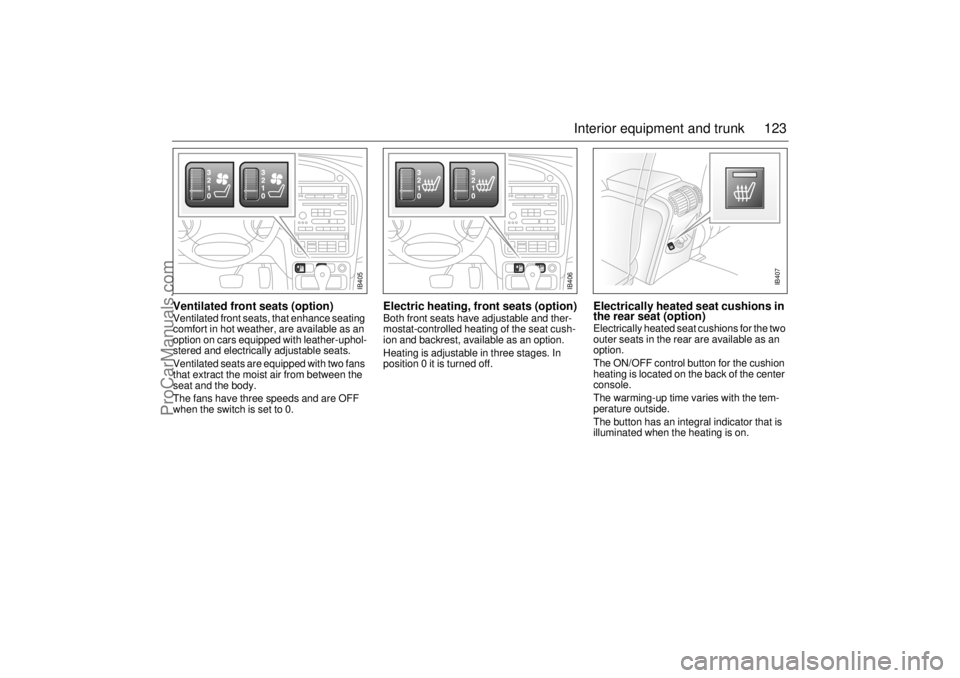
Ventilated front seats (option)Ventilated front seats, that enhance seating
comfort in hot weather, are available as an
option on cars equipped with leather-uphol-
stered and electrically adjustable seats.
Ventilated seats are equipped with two fans
that extract the moist air from between the
seat and the body.
The fans have three speeds and are OFF
when the switch is set to 0.
Electric heating, front seats (option)Both front seats have adjustable and ther-
mostat-controlled heating of the seat cush-
ion and backrest, available as an option.
Heating is adjustable in three stages. In
position 0 it is turned off.
Electrically heated seat cushions in
the rear seat (option)Electrically heated seat cushions for the two
outer seats in the rear are available as an
option.
The ON/OFF control button for the cushion
heating is located on the back of the center
console.
The warming-up time varies with the tem-
perature outside.
The button has an integral indicator that is
illuminated when the heating is on.
IB406
IB407
IB405
ProCarManuals.com
Page 125 of 272
125 Interior equipment and trunk
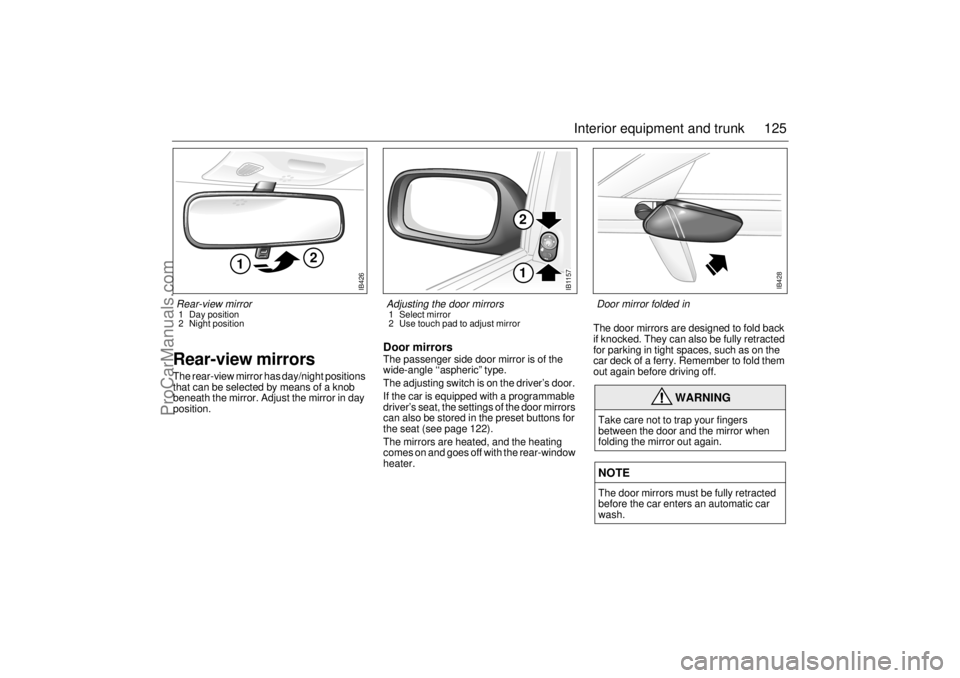
Rear-view mirrorsThe rear-view mirror has day/night positions
that can be selected by means of a knob
beneath the mirror. Adjust the mirror in day
position.
Door mirrorsThe passenger side door mirror is of the
wide-angle ‘‘aspheric” type.
The adjusting switch is on the driver’s door.
If the car is equipped with a programmable
driver’s seat, the settings of the door mirrors
can also be stored in the preset buttons for
the seat (see page 122).
The mirrors are heated, and the heating
comes on and goes off with the rear-window
heater. The door mirrors are designed to fold back
if knocked. They can also be fully retracted
for parking in tight spaces, such as on the
car deck of a ferry. Remember to fold them
out again before driving off.
WARNING
Take care not to trap your fingers
between the door and the mirror when
folding the mirror out again. NOTEThe door mirrors must be fully retracted
before the car enters an automatic car
wash.
IB426
2
1
Rear-view mirror 1 Day position
2 Night position
IB1157
12
Adjusting the door mirrors 1 Select mirror
2 Use touch pad to adjust mirror
IB428
Door mirror folded in
ProCarManuals.com
Page 162 of 272
162 Starting and driving
Overheated transmission fluid If the automatic-transmission fluid should
overheat, the following message will appear
on the SID:
”TRANSMISSION OVERHEATING”. If this
happens, stop the car and wait for the mes-
sage to be extinguished. Continue driving in
a locked gear that produces an engine
speed of about 3,000 rpm.
Overheating of the automatic-transmission
fluid can occur when the car is towing a
heavy load, such as a camping trailer in hilly
country, with the wrong gear selected,
resulting in abnormally frequent gear
changing. Try selecting position 1, 2 or 3.
High ambient temperatures can also
increase the temperature of the transmis-
sion fluid or the oil cooler may be faulty.
Contact an authorized Saab dealer (see
also page 174).
Driving on hilly roads with a heavy
loadThe transmission fluid can overheat when
the gearbox is strained, for example, when
driving with a trailer on hilly roads with the
wrong gear is selected, resulting in many
extra gear changes. To avoid the transmis-
sion fluid overheating, always drive in
Normal mode. The adaptive gear change
patterns are then active.
High air temperatures or a faulty oil cooler
can also cause the transmission fluid to
overheat. Overheating reduces the service
life of the fluid. Contact an authorized Saab
dealer (see also page 174. Towing Towing of cars with automatic transmission,
see page 181.
NOTEIf the control module has actuated the
Limp-home function for the automatic
transmission, the car will remain in 4th
gear when D is selected, making it very
sluggish. To overcome this, move the
selector lever to position 2.
WARNING
Remember to use engine-braking (selec-
tor position 1, 2, or 3) to spare the brakes
when you are driving on a long or steep
downhill slope.
Brake failure can result from overheated
brakes!
ProCarManuals.com
Page 164 of 272
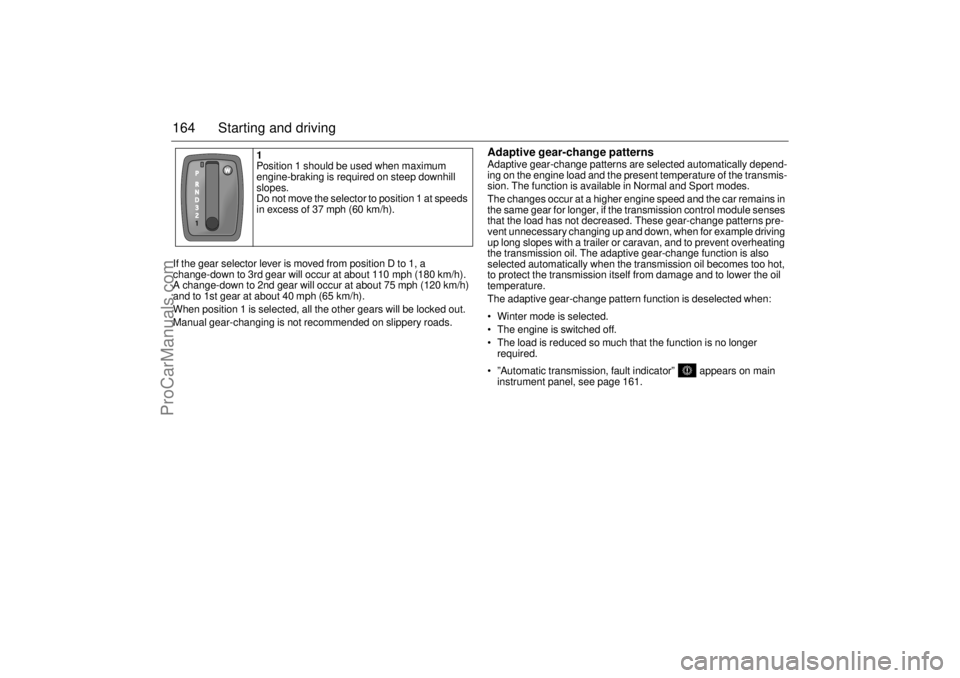
164 Starting and drivingIf the gear selector lever is moved from position D to 1, a
change-down to 3rd gear will occur at about 110 mph (180 km/h).
A change-down to 2nd gear will occur at about 75 mph (120 km/h)
and to 1st gear at about 40 mph (65 km/h).
When position 1 is selected, all the other gears will be locked out.
Manual gear-changing is not recommended on slippery roads.
Adaptive gear-change patternsAdaptive gear-change patterns are selected automatically depend-
ing on the engine load and the present temperature of the transmis-
sion. The function is available in Normal and Sport modes.
The changes occur at a higher engine speed and the car remains in
the same gear for longer, if the transmission control module senses
that the load has not decreased. These gear-change patterns pre-
vent unnecessary changing up and down, when for example driving
up long slopes with a trailer or caravan, and to prevent overheating
the transmission oil. The adaptive gear-change function is also
selected automatically when the transmission oil becomes too hot,
to protect the transmission itself from damage and to lower the oil
temperature.
The adaptive gear-change pattern function is deselected when:
Winter mode is selected.
The engine is switched off.
The load is reduced so much that the function is no longer
required.
”Automatic transmission, fault indicator” appears on main
instrument panel, see page 161. 1
Position 1 should be used when maximum
engine-braking is required on steep downhill
slopes.
Do not move the selector to position 1 at speeds
in excess of 37 mph (60 km/h).
ProCarManuals.com
Page 175 of 272
175 Starting and driving
Recommendations for cars with auto-
matic transmission.
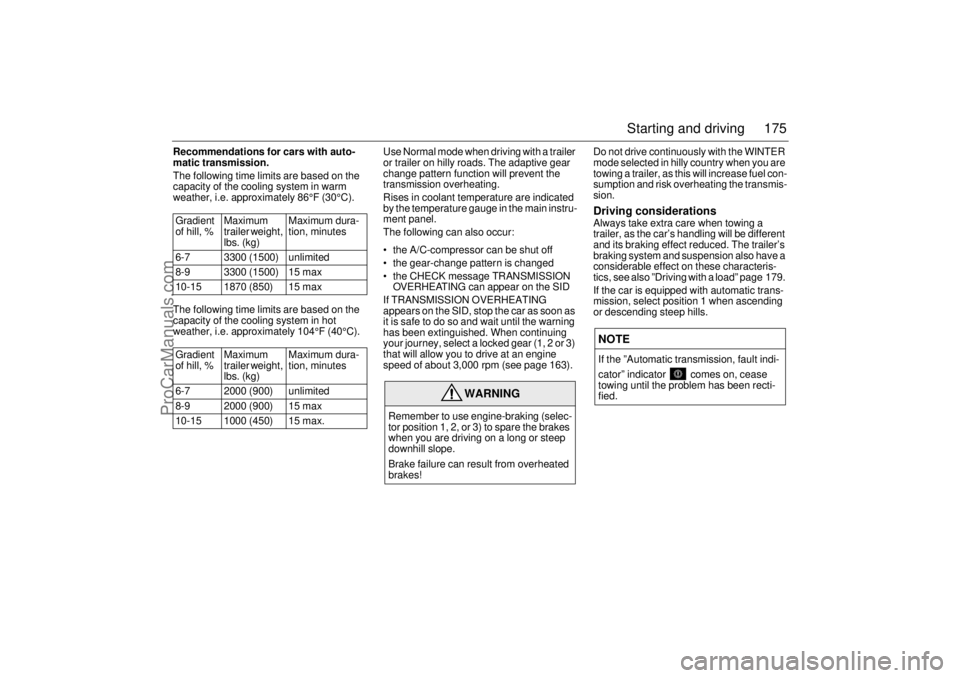
The following time limits are based on the
capacity of the cooling system in warm
weather, i.e. approximately 86°F (30°C).
The following time limits are based on the
capacity of the cooling system in hot
weather, i.e. approximately 104°F (40°C).
Use Normal mode when driving with a trailer
or trailer on hilly roads. The adaptive gear
change pattern function will prevent the
transmission overheating.
Rises in coolant temperature are indicated
by the temperature gauge in the main instru-
ment panel.
The following can also occur:
the A/C-compressor can be shut off
the gear-change pattern is changed
the CHECK message TRANSMISSION
OVERHEATING can appear on the SID
If TRANSMISSION OVERHEATING
appears on the SID, stop the car as soon as
it is safe to do so and wait until the warning
has been extinguished. When continuing
your journey, select a locked gear (1, 2 or 3)
that will allow you to drive at an engine
speed of about 3,000 rpm (see page 163). Do not drive continuously with the WINTER
mode selected in hilly country when you are
towing a trailer, as this will increase fuel con-
sumption and risk overheating the transmis-
sion.
Driving considerations Always take extra care when towing a
trailer, as the car’s handling will be different
and its braking effect reduced. The trailer’s
braking system and suspension also have a
considerable effect on these characteris-
tics, see also ”Driving with a load” page 179.
If the car is equipped with automatic trans-
mission, select position 1 when ascending
or descending steep hills. Gradient
of hill, % Maximum
trailer weight,
lbs. (kg)Maximum dura-
tion, minutes
6-7 3300 (1500) unlimited
8-9 3300 (1500) 15 max
10-15 1870 (850) 15 max
Gradient
of hill, % Maximum
trailer weight,
lbs. (kg)Maximum dura-
tion, minutes
6-7 2000 (900) unlimited
8-9 2000 (900) 15 max
10-15 1000 (450) 15 max.
WARNING
Remember to use engine-braking (selec-
tor position 1, 2, or 3) to spare the brakes
when you are driving on a long or steep
downhill slope.
Brake failure can result from overheated
brakes!
NOTEIf the ”Automatic transmission, fault indi-
cator” indicator comes on, cease
towing until the problem has been recti-
fied.
ProCarManuals.com
Page 216 of 272
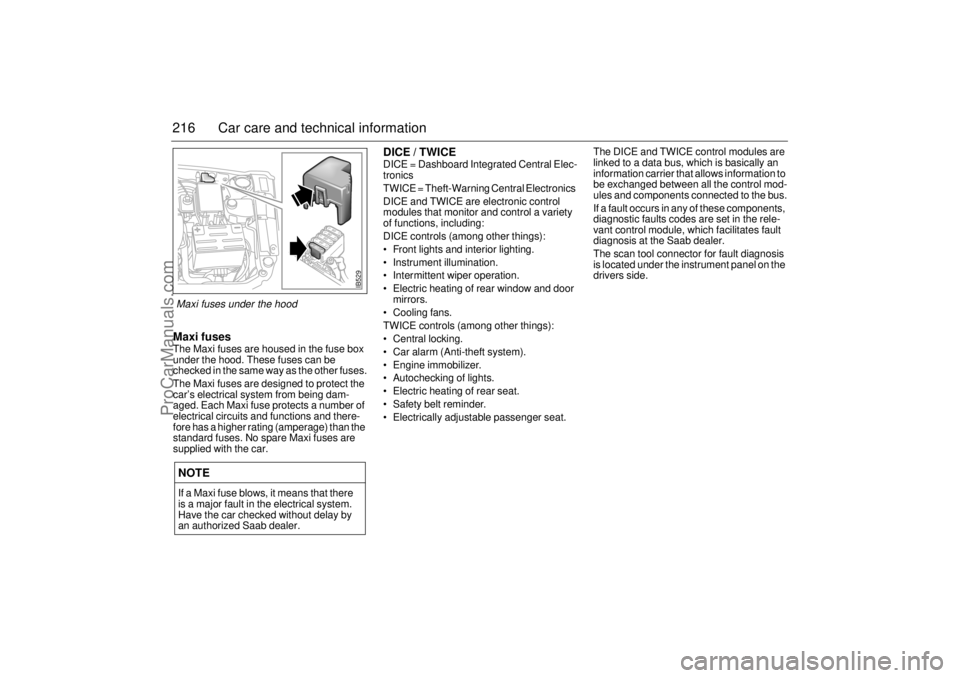
216 Car care and technical informationMaxi fusesThe Maxi fuses are housed in the fuse box
under the hood. These fuses can be
checked in the same way as the other fuses.
The Maxi fuses are designed to protect the
car’s electrical system from being dam-
aged. Each Maxi fuse protects a number of
electrical circuits and functions and there-
fore has a higher rating (amperage) than the
standard fuses. No spare Maxi fuses are
supplied with the car.
DICE / TWICEDICE = Dashboard Integrated Central Elec-
tronics
TWICE = Theft-Warning Central Electronics
DICE and TWICE are electronic control
modules that monitor and control a variety
of functions, including:
DICE controls (among other things):
Front lights and interior lighting.
Instrument illumination.
Intermittent wiper operation.
Electric heating of rear window and door
mirrors.
Cooling fans.
TWICE controls (among other things):
Central locking.
Car alarm (Anti-theft system).
Engine immobilizer.
Autochecking of lights.
Electric heating of rear seat.
Safety belt reminder.
Electrically adjustable passenger seat.The DICE and TWICE control modules are
linked to a data bus, which is basically an
information carrier that allows information to
be exchanged between all the control mod-
ules and components connected to the bus.
If a fault occurs in any of these components,
diagnostic faults codes are set in the rele-
vant control module, which facilitates fault
diagnosis at the Saab dealer.
The scan tool connector for fault diagnosis
is located under the instrument panel on the
drivers side.
NOTEIf a Maxi fuse blows, it means that there
is a major fault in the electrical system.
Have the car checked without delay by
an authorized Saab dealer.
IB529
Maxi fuses under the hood
ProCarManuals.com
Page 217 of 272
217 Car care and technical information
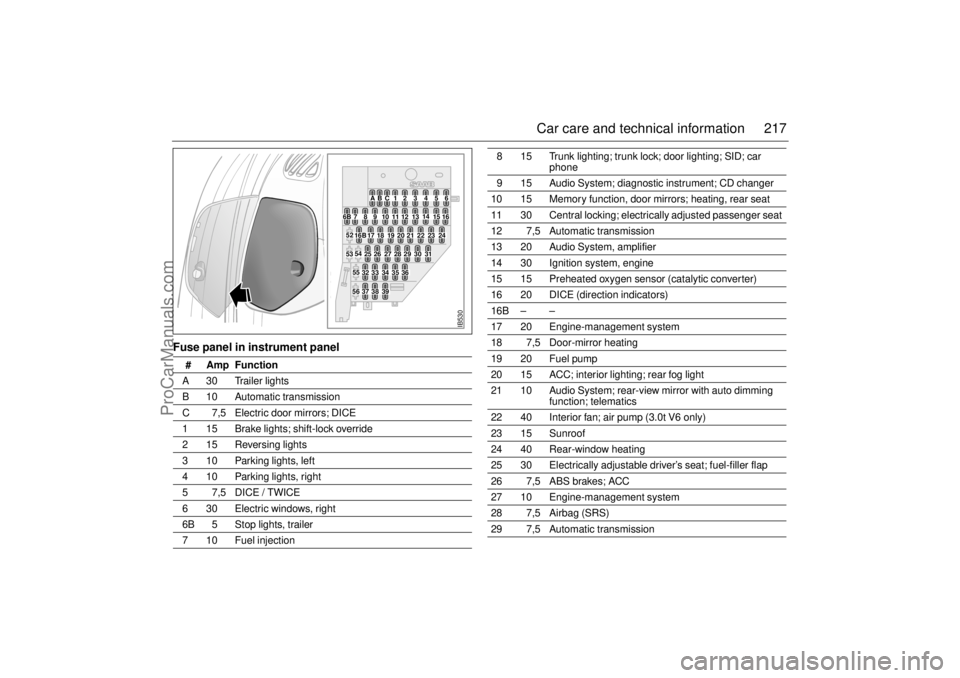
Fuse panel in instrument panel
# Amp Function
A 30 Trailer lights
B 10 Automatic transmission
C 7,5 Electric door mirrors; DICE
1 15 Brake lights; shift-lock override
2 15 Reversing lights
3 10 Parking lights, left
4 10 Parking lights, right
5 7,5 DICE / TWICE
6 30 Electric windows, right
6B 5 Stop lights, trailer
7 10 Fuel injection
8 15 Trunk lighting; trunk lock; door lighting; SID; car
phone
9 15 Audio System; diagnostic instrument; CD changer
10 15 Memory function, door mirrors; heating, rear seat
11 30 Central locking; electrically adjusted passenger seat
12 7,5 Automatic transmission
13 20 Audio System, amplifier
14 30 Ignition system, engine
15 15 Preheated oxygen sensor (catalytic converter)
16 20 DICE (direction indicators)
16B – –
17 20 Engine-management system
18 7,5 Door-mirror heating
19 20 Fuel pump
20 15 ACC; interior lighting; rear fog light
21 10 Audio System; rear-view mirror with auto dimming
function; telematics
22 40 Interior fan; air pump (3.0t V6 only)
23 15 Sunroof
24 40 Rear-window heating
25 30 Electrically adjustable driver’s seat; fuel-filler flap
26 7,5 ABS brakes; ACC
27 10 Engine-management system
28 7,5 Airbag (SRS)
29 7,5 Automatic transmission
IB530
BC123456 A
14
121110987
13
6B
1516
2324
222120191817
16B
5425262728293031
3635343332
39383755525356
ProCarManuals.com
Page 218 of 272
218 Car care and technical informationRelay panel under instrument panel Relay panel under instrument panel (cont.)30 7,5 Starter motor
31 7,5 Cruise control; water valve; fog lights, front
32 15 Ventilated front seats
33 7,5 Direction-indicator switch
34 30 Cigarette lighter
35 15 Daytime running light
36 30 Electric windows, left
37 30 Windshield wipers; rain sensor
38 30 Electric heating, front seats
39 20 Limp-home solenoid (automatic transmission)
52-5
6Spare fuses
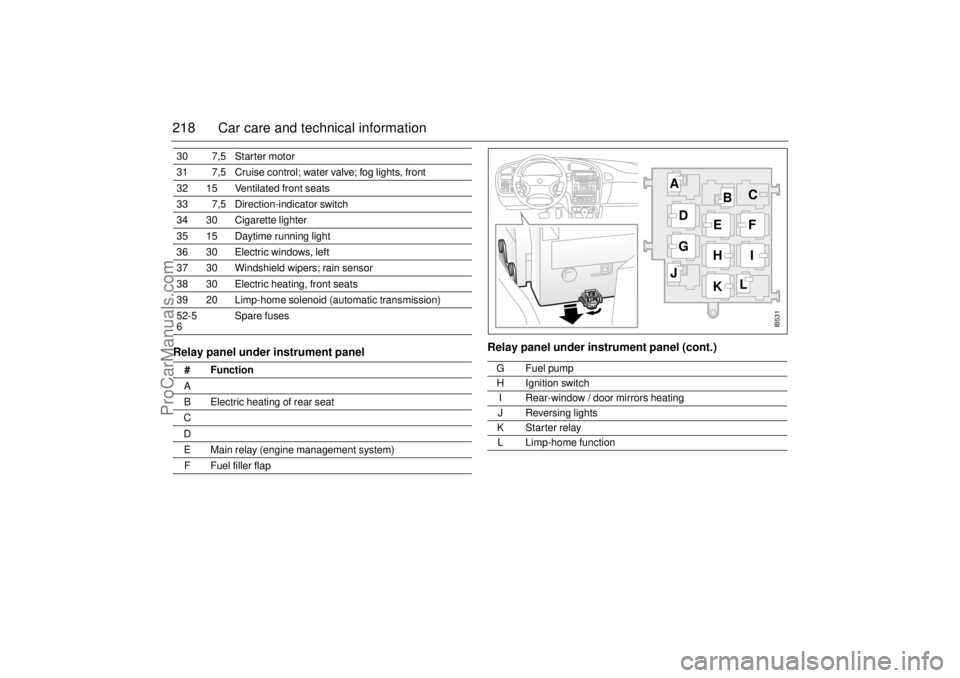
# Function
A
B Electric heating of rear seat
C
D
E Main relay (engine management system)
F Fuel filler flap
G Fuel pump
H Ignition switch
I Rear-window / door mirrors heating
J Reversing lights
KStarter relay
L Limp-home function
IB531
A
BC
D
GEF
HI
KL J
ProCarManuals.com
Page 264 of 272

264 IndexDate code, tires
_________________ 224
Dim-dipped beam ________________ 63
Direction indicators _______________ 65
Door handles
___________________ 34
Door mirrors
___________________ 125
Doors, locks & luggage compartment
_33
Drive belt
______________________ 255
Drive belt, alternator
_____________ 202
Drive belts
_____________________ 255
Drive belts, length
_______________ 255
Driver’s seat, programmable
_______ 122
Driving in hot weather
____________ 173
Driving with a load
______________ 179
EElectric heating seat
_____________ 123
Electric heating, front seats
_______ 123
Electric windows
________________ 127
Electrical system, technical data
____ 254
Electrically heated rear seat
_______ 123
Electronic starting interlock _________ 35
Emergency operation of sunroof
____ 129
Emission control systems
_________ 191
Engine bay, 3.0t V6
_____________ 190
Engine bay, 4-cyl
_______________ 189
Engine bay, cleaning ____________ 233
Engine number
_________________ 259
Engine oil, grade ________________ 253
Engine, description _________ 192
, 193
Engine, technical data
___________ 252
Engine, temperature gauge
________ 55Engine-oil level, checking
_________193
Expansion tank, coolant
__________196
FFault codes, Audio System
________104
Flat spot, tire
___________________229
Fluid level, automatic transmission
__195
Folding the rear seat, 9-5 Sedan
___134
Folding the rear seat, 9-5 Wagon ___137
Frequently asked questions on airbag
30
Front fog lights
__________________66
Frost warning
___________________58
Fuel
__________________________154
Fuel consumption
________________57
Fuel filler flap
___________________145
Fuel gauge
_____________________55
Fuel grade _____________________252
Fuse box under hood
____________219
Fuse panel
____________________215
Fuses
________________________215
GGearbox number
________________259
Gearbox oil, checking
____________195
Gearbox, technical data, __________255
Glove compartment
______________131
HHandbrake
____________________185
Hazard warning lights
_____________66Head restraint
__________________ 18
Headlight flasher ________________ 63
Headlights
_____________________ 63
Holidaying abroad
______________ 236
Hood
________________________ 188
Horn _________________________ 124
IIgnition switch
_________________ 148
Immobilizer
____________________ 35
Indicator and warning lights
________ 48
Indicator lights
__________________ 48
Instrument illumination
___________ 65
Instruments and controls __________ 47
Integral child seat
_______________ 24
Interior equipment ______________ 119
Interior lighting
__________________ 67
Interior rearview mirror
__________ 125
KKey
__________________________ 34
Key to chassis number
__________ 260
Key, remove
__________________ 148
LLabels
_________________________ 8
Leather upholstery, care of
_______ 231
Light horn
_____________________ 63
Light switches __________________ 63
Luggage-compartment lighting
_____ 67
ProCarManuals.com