light SAAB 9-5 2001 User Guide
[x] Cancel search | Manufacturer: SAAB, Model Year: 2001, Model line: 9-5, Model: SAAB 9-5 2001Pages: 272, PDF Size: 14.83 MB
Page 42 of 272

42 SecurityActivating the car alarm The car alarm cannot be activated if the
driver’s door is open or if the ignition switch
is in ON position.
If, on the other hand, one of the other doors
or the trunk or hood is open or opened and
not closed again during the 10-seconds
delay period, it will be excluded from the
alarm function.
If it is then closed, a new delay period of ten
seconds will start, and the door (or trunk or
hood) will once again be secured by the
alarm system.
As usual, the LED will be on continuously
during the new delay period and will start to
flash once every other second after the
10-seconds period has elapsed.
Window-glass sensorThe car-alarm system incorporates a
sensor that monitors the window glass for
the sound of breakage. The sensor is fitted
inside the rear dome light.
To avoid false alarms, such as the alarm
being triggered by noise from passers by
when the windows have been left open, or
when children or petsare left inside the car,
the sensor can be temporarily disabled.
To disable the sensor
To disable the sensor, first ensure that the
ignition has been switched off and key
removed from the switch. Then, press and
hold the NIGHT PANEL button until ”DOOR
ALARM ONLY” appears on the SID and a
chime sounds. The car alarm must now be
activated within three minutes, or the glass
sensor will become active again.
The glass sensor will be enabled again
automatically when the car is next unlocked.
The sensor can also be enabled again by
repeating the procedure for disabling it.
When the sensor has been enabled, ”FULL
THEFT ALARM” will appear on the SID.
If a fault is detected in the glass sensor,
”SERVICE THEFT ALARM” will appear on
the SID.
Electronic starting interlock
(immobilizer) When the key is inserted in the ignition, a
signal is sent to the receiver. If the signal is
verified, the engine can be started.
Each time the key is removed from the igni-
tion, the electronic immobilizer is activated.
This means that the car cannot be started
without the correct key inserted in the igni-
tion and the immobilizer thus deactivated.
If a fault is detected (e.g. in the transmitter)
”KEY NOT ACCEPTED” will appear on the
SID.
In this case, you can still start the car if you
turn the ignition key to ON and press one of
the buttons on the key (providing that the
receiver gets the right signal from the key).
Take the car to an authorized Saab dealer to
have the system checked.
The LED double-flashes when the car is
immobilized.
ProCarManuals.com
Page 43 of 272

43 Security
Alarm signals When the car alarm is armed, it will be trig-
gered if any door, or the trunk lid or hood, is
opened or if a window is broken.
The alarm will also be triggered if an attempt
is made to bypass or short-circuit the igni-
tion switch, or to disconnect the battery.
If the alarm is triggered, the following alarm
signals will be set off:
Flashing of hazard warning lights for five
minutes.
Siren wailing for 30 seconds.
The alarm signals will stop if the alarm is
deactivated (car unlocked) during the alarm
period.
The alarm siren has a long-life battery
(approx. 10 years), see ”SERVICE THEFT
ALARM”, on page 45. When the battery
goes dead, the siren must be replaced: it is
not possible to change the batteries.
Panic-functionIn the car alarm system is a function called
"Panic-function".
To activate panic function:
Push and hold one of the buttons on the
key for 2 seconds. Or, if you are sitting
inside the car, push the LOCK-switch on
the center console for 2 seconds.
These actions will trigger the alarm (hazard
warning lights and siren).
To deactivate panic function:
Push one of the buttons on the key, push
the LOCK-switch in the center console,
turn the key in the driver´s door or turn the
ignition to ON.
When the panic-function is activated the car
will be locked/unlocked depending upon
which button was pushed.
When the ignition is ON the panic-function
cannot be activated.
NOTE It is possible to inadvertently deacti-
vate the car alarm and at the same
time unlock the car, if the button on the
key is pressed by mistake when the
car is still within its range.
When locking the car by remote con-
trol in extremely cold weather, it is
advisable to check that the lock
system has operated properly. To do
so, check that the interior locking but-
tons are all down.
If not, unlock and relock the car again.
ProCarManuals.com
Page 44 of 272

44 SecurityOverview of functions
Alarm signals may differ between model variants for different coun-
tries.
Some of the car-alarm functions can be reprogrammed – con-
sult your Saab dealer for further details (see page 261). Locking/
activation Hazard warning lights flash once and the horn
chirps once.
The LED will come on for 10 seconds.
Unlocking/
deactivation Hazard warning lights flash twice and the horn
chirps twice.
The LED will come on for two seconds.
Unlocking/
deactivation of
trunk lid/tailgate
alarm Hazard warning lights flash three times and the
horn chirps three times.
The LED will flash three times per second for 10
seconds.
Alarm triggered Hazard warning lights flash for 5 min.
Siren wails for 30 seconds.
To switch off the alarm, deactivate the system in
the normal way (unlocking).
Window-glass
sensor The sensor detects if any window is broken and
triggers the alarm.
To disable the sensor, see page 42.
Key TThe range of the key is normally 5-10 yds.
(5-10 metres), although it can be substantially
more than this in ideal conditions.
If the key is not working, it may be because the
code signal has not been synchronized with that
in the control module for the car alarm. To rectify
this, press the unlock button on the key at least
four times in quick succession. When it is recog-
nized, the door locks will cycle.
If a key is lost, the new one will have to be pro-
grammed (all keys must be present) to match the
car’s unique security code. Get in touch with an
authorized Saab dealer.Battery for key The battery for the key will normally have a life of
4 years. When the battery needs changing,
”REPLACE KEY BATTERY” will appear on the
SID.
After fitting a new battery, press the unlock but-
ton on the key at least four times (when the car
is in its range) in succession, so that the car
alarm can recognize the signals from the trans-
mitter.
Car-battery
voltage If the battery is disconnected while the alarm is
active (car is locked), for example during an
attempt to steal the car, the alarm will be trig-
gered.
ProCarManuals.com
Page 47 of 272
47 Instruments and controls
Instruments and
controls Indicator and warning
lights ................................. 48
Instruments ........................ 54
Trip computer SID .............. 57
Switches ............................. 63
Automatic climate control
(ACC) ................................. 70
ECON OFF
ºF
ºC
ECON OFF
CLEAR
SET
IB1082
VOL
TREBAL ON
FA D BAS
PULL PUSH
RADIO BAND
WB AS
SEARCH
2 13
5 46
DOLBY B NR
ProCarManuals.com
Page 48 of 272
48 Instruments and controls
Indicator and warning
lights A number of indicator and warning lights will
come on when the ignition is switched on
prior to starting. Under normal conditions,
these should go out a few seconds after the
engine has started (see page 54).
Warning, oil pressure
(engine oil)
This light will come on together with if
the engine oil pressure is dangerously low.
If the light flashes or comes on while you are
driving, stop the car, switch off the engine
and check the engine oil level (see page
193). NOTEUnder no circumstances must the car be
driven when the warning light is on. Low
oil pressure can result in serious engine
damage.
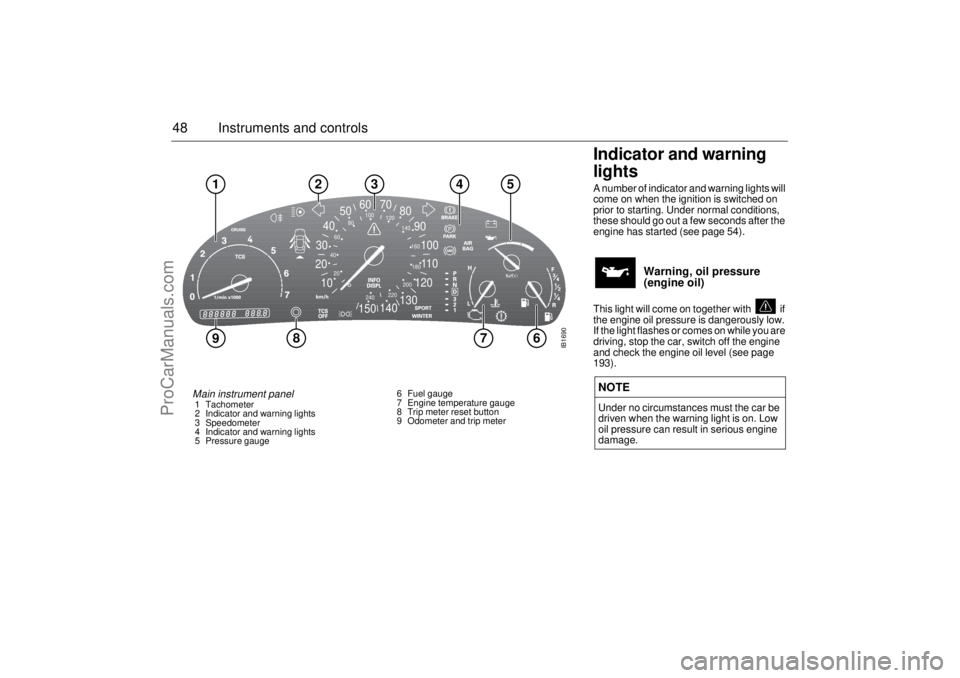
Main instrument panel 1 Tachometer
2 Indicator and warning lights
3 Speedometer
4 Indicator and warning lights
5 Pressure gauge6 Fuel gauge
7 Engine temperature gauge
8 Trip meter reset button
9 Odometer and trip meter
2030405060 70
80
90
100
11 0
120
130
140
150
240220200180 160 140 120 100
80
60
40
20
10
9
4
5
3
2
7
8
6
1
IB1690
ProCarManuals.com
Page 49 of 272
49 Instruments and controls
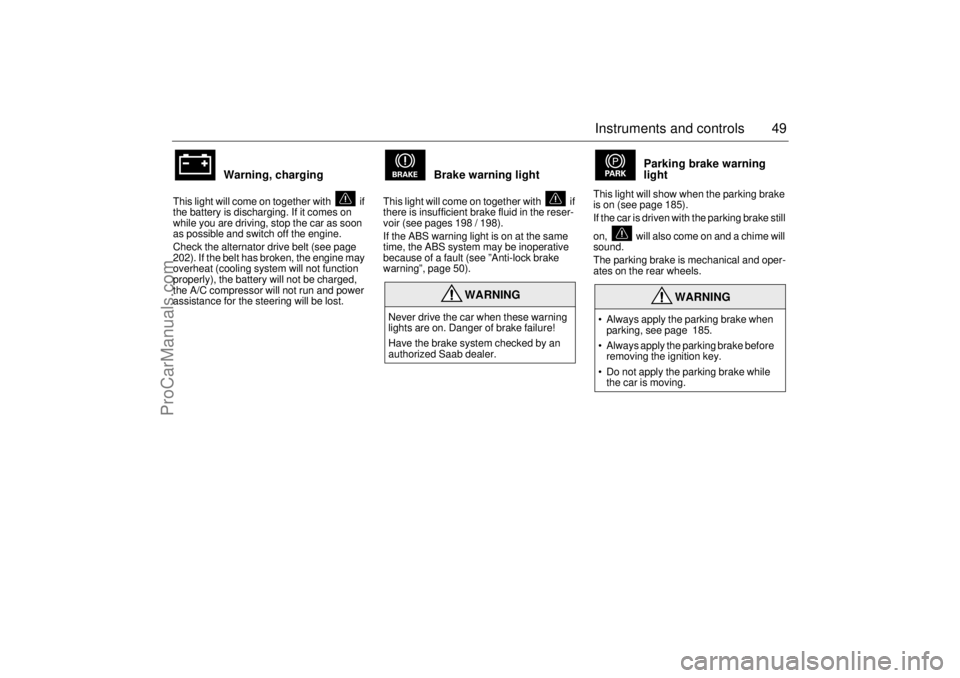
Warning, charging
This light will come on together with if
the battery is discharging. If it comes on
while you are driving, stop the car as soon
as possible and switch off the engine.
Check the alternator drive belt (see page
202). If the belt has broken, the engine may
overheat (cooling system will not function
properly), the battery will not be charged,
the A/C compressor will not run and power
assistance for the steering will be lost.
Brake warning light
This light will come on together with if
there is insufficient brake fluid in the reser-
voir (see pages 198 / 198).
If the ABS warning light is on at the same
time, the ABS system may be inoperative
because of a fault (see ”Anti-lock brake
warning”, page 50).
Parking brake warning
light
This light will show when the parking brake
is on (see page 185).
If the car is driven with the parking brake still
on, will also come on and a chime will
sound.
The parking brake is mechanical and oper-
ates on the rear wheels.
WARNING
Never drive the car when these warning
lights are on. Danger of brake failure!
Have the brake system checked by an
authorized Saab dealer.
WARNING
Always apply the parking brake when
parking, see page 185.
Always apply the parking brake before
removing the ignition key.
Do not apply the parking brake while
the car is moving.
ProCarManuals.com
Page 50 of 272
50 Instruments and controls
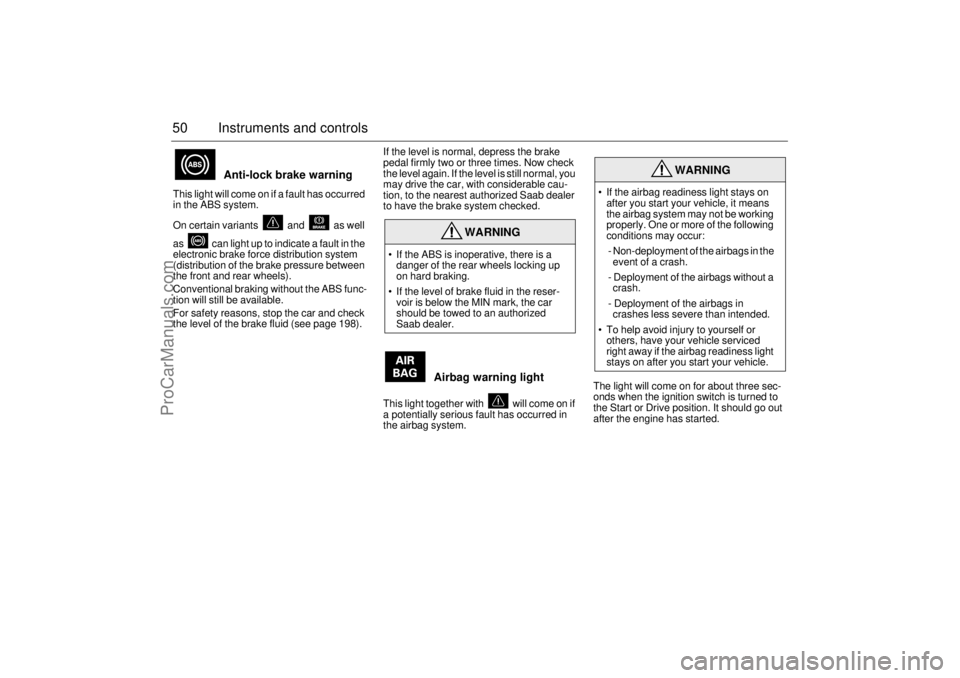
Anti-lock brake warning
This light will come on if a fault has occurred
in the ABS system.
On certain variants and as well
as can light up to indicate a fault in the
electronic brake force distribution system
(distribution of the brake pressure between
the front and rear wheels).
Conventional braking without the ABS func-
tion will still be available.
For safety reasons, stop the car and check
the level of the brake fluid (see page 198).If the level is normal, depress the brake
pedal firmly two or three times. Now check
the level again. If the level is still normal, you
may drive the car, with considerable cau-
tion, to the nearest authorized Saab dealer
to have the brake system checked.
Airbag warning light
This light together with will come on if
a potentially serious fault has occurred in
the airbag system.
The light will come on for about three sec-
onds when the ignition switch is turned to
the Start or Drive position. It should go out
after the engine has started.
WARNING
If the ABS is inoperative, there is a
danger of the rear wheels locking up
on hard braking.
If the level of brake fluid in the reser-
voir is below the MIN mark, the car
should be towed to an authorized
Saab dealer.
WARNING
If the airbag readiness light stays on
after you start your vehicle, it means
the airbag system may not be working
properly. One or more of the following
conditions may occur:
- Non-deployment of the airbags in the
event of a crash.
- Deployment of the airbags without a
crash.
- Deployment of the airbags in
crashes less severe than intended.
To help avoid injury to yourself or
others, have your vehicle serviced
right away if the airbag readiness light
stays on after you start your vehicle.
ProCarManuals.com
Page 51 of 272
51 Instruments and controls
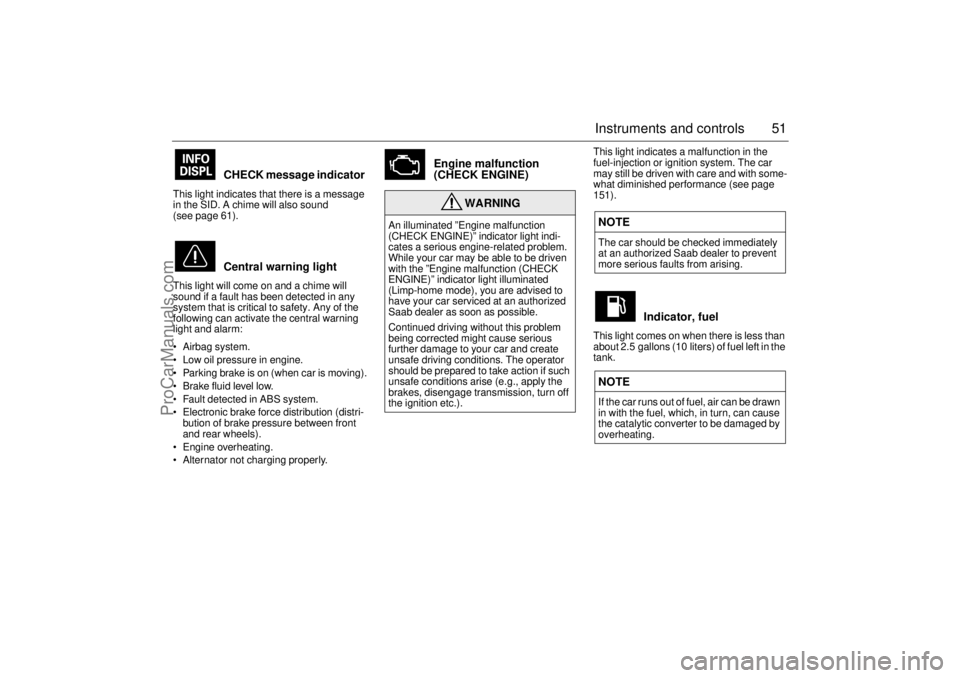
CHECK message indicator
This light indicates that there is a message
in the SID. A chime will also sound
(see page 61).
Central warning light
This light will come on and a chime will
sound if a fault has been detected in any
system that is critical to safety. Any of the
following can activate the central warning
light and alarm:
Airbag system.
Low oil pressure in engine.
Parking brake is on (when car is moving).
Brake fluid level low.
Fault detected in ABS system.
Electronic brake force distribution (distri-
bution of brake pressure between front
and rear wheels).
Engine overheating.
Alternator not charging properly.
Engine malfunction
(CHECK ENGINE)
This light indicates a malfunction in the
fuel-injection or ignition system. The car
may still be driven with care and with some-
what diminished performance (see page
151).
Indicator, fuel
This light comes on when there is less than
about 2.5 gallons (10 liters) of fuel left in the
tank.
WARNING
An illuminated ”Engine malfunction
(CHECK ENGINE)” indicator light indi-
cates a serious engine-related problem.
While your car may be able to be driven
with the ”Engine malfunction (CHECK
ENGINE)” indicator light illuminated
(Limp-home mode), you are advised to
have your car serviced at an authorized
Saab dealer as soon as possible.
Continued driving without this problem
being corrected might cause serious
further damage to your car and create
unsafe driving conditions. The operator
should be prepared to take action if such
unsafe conditions arise (e.g., apply the
brakes, disengage transmission, turn off
the ignition etc.).
NOTEThe car should be checked immediately
at an authorized Saab dealer to prevent
more serious faults from arising.NOTEIf the car runs out of fuel, air can be drawn
in with the fuel, which, in turn, can cause
the catalytic converter to be damaged by
overheating.
ProCarManuals.com
Page 52 of 272
52 Instruments and controls
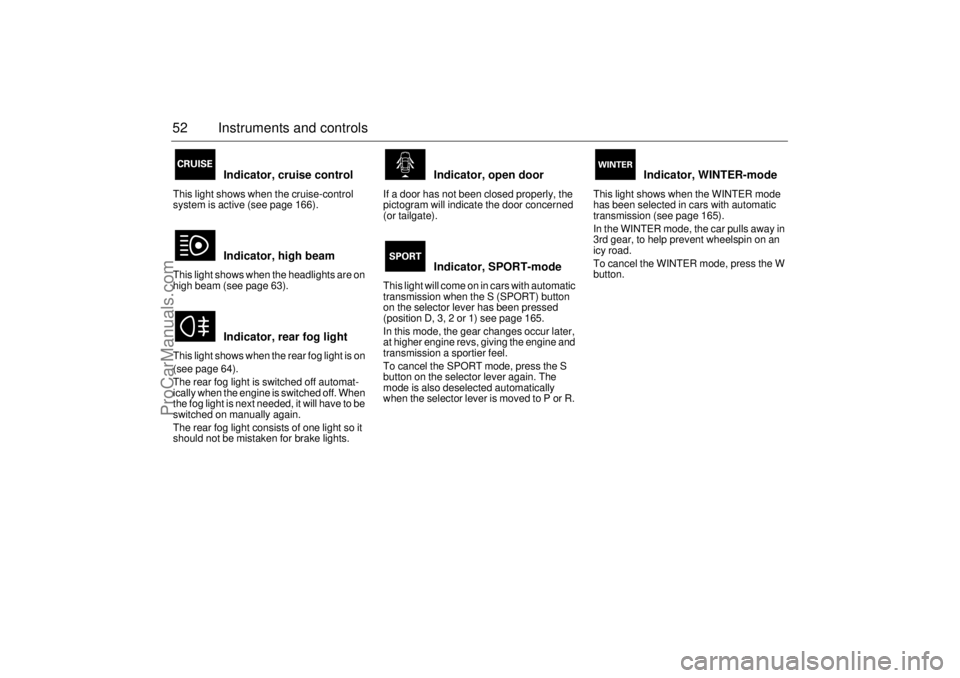
Indicator, cruise control
This light shows when the cruise-control
system is active (see page 166).
Indicator, high beam
This light shows when the headlights are on
high beam (see page 63).
Indicator, rear fog light
This light shows when the rear fog light is on
(see page 64).
The rear fog light is switched off automat-
ically when the engine is switched off. When
the fog light is next needed, it will have to be
switched on manually again.
The rear fog light consists of one light so it
should not be mistaken for brake lights.
Indicator, open door
If a door has not been closed properly, the
pictogram will indicate the door concerned
(or tailgate).
Indicator, SPORT-mode
This light will come on in cars with automatic
transmission when the S (SPORT) button
on the selector lever has been pressed
(position D, 3, 2 or 1) see page 165.
In this mode, the gear changes occur later,
at higher engine revs, giving the engine and
transmission a sportier feel.
To cancel the SPORT mode, press the S
button on the selector lever again. The
mode is also deselected automatically
when the selector lever is moved to P or R.
Indicator, WINTER-mode
This light shows when the WINTER mode
has been selected in cars with automatic
transmission (see page 165).
In the WINTER mode, the car pulls away in
3rd gear, to help prevent wheelspin on an
icy road.
To cancel the WINTER mode, press the W
button.
ProCarManuals.com
Page 53 of 272
53 Instruments and controls
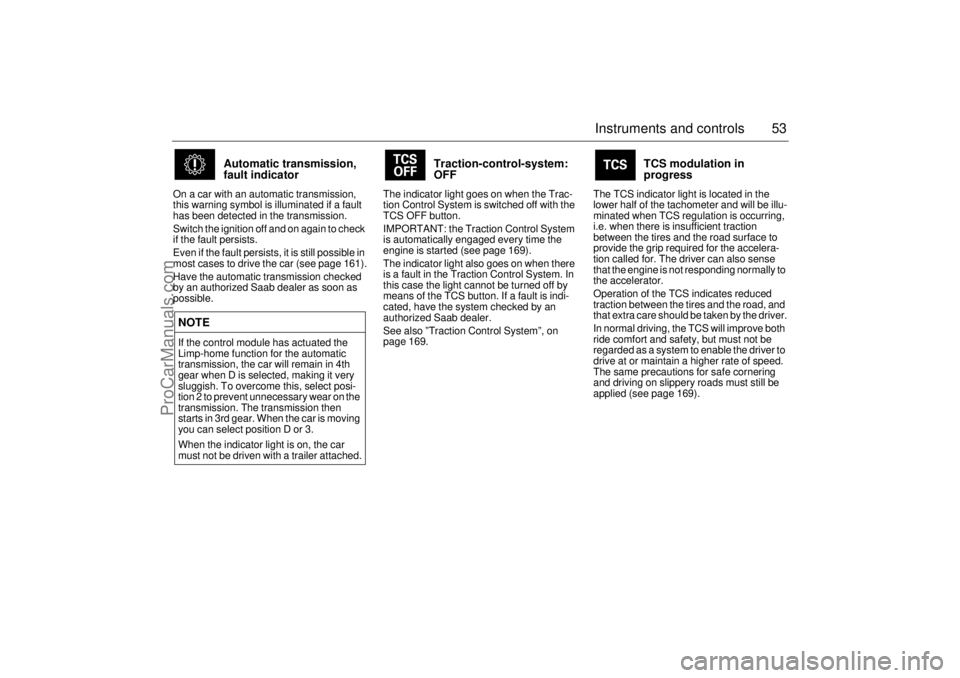
Automatic transmission,
fault indicator
On a car with an automatic transmission,
this warning symbol is illuminated if a fault
has been detected in the transmission.
Switch the ignition off and on again to check
if the fault persists.
Even if the fault persists, it is still possible in
most cases to drive the car (see page 161).
Have the automatic transmission checked
by an authorized Saab dealer as soon as
possible.
Traction-control-system:
OFF
The indicator light goes on when the Trac-
tion Control System is switched off with the
TCS OFF button.
IMPORTANT: the Traction Control System
is automatically engaged every time the
engine is started (see page 169).
The indicator light also goes on when there
is a fault in the Traction Control System. In
this case the light cannot be turned off by
means of the TCS button. If a fault is indi-
cated, have the system checked by an
authorized Saab dealer.
See also ”Traction Control System”, on
page 169.
TCS modulation in
progress
The TCS indicator light is located in the
lower half of the tachometer and will be illu-
minated when TCS regulation is occurring,
i.e. when there is insufficient traction
between the tires and the road surface to
provide the grip required for the accelera-
tion called for. The driver can also sense
that the engine is not responding normally to
the accelerator.
Operation of the TCS indicates reduced
traction between the tires and the road, and
that extra care should be taken by the driver.
In normal driving, the TCS will improve both
ride comfort and safety, but must not be
regarded as a system to enable the driver to
drive at or maintain a higher rate of speed.
The same precautions for safe cornering
and driving on slippery roads must still be
applied (see page 169).
NOTEIf the control module has actuated the
Limp-home function for the automatic
transmission, the car will remain in 4th
gear when D is selected, making it very
sluggish. To overcome this, select posi-
tion 2 to prevent unnecessary wear on the
transmission. The transmission then
starts in 3rd gear. When the car is moving
you can select position D or 3.
When the indicator light is on, the car
must not be driven with a trailer attached.
ProCarManuals.com