steering SAAB 9-5 2001 Owner's Manual
[x] Cancel search | Manufacturer: SAAB, Model Year: 2001, Model line: 9-5, Model: SAAB 9-5 2001Pages: 272, PDF Size: 14.83 MB
Page 187 of 272
187 Car care and technical information
Car care and
technical
information
Hood release handle ....... 188
Engine compartment,
4-cyl. engine ................... 189
Engine compartment,
6-cyl. (3.0t V6)................. 190
Emission control systems 191
Engine............................... 192
Engine oil ......................... 193
Transmission fluid........... 195
Coolant ............................. 196
Brake and clutch fluid ..... 198
Power steering fluid ........ 199
Battery .............................. 199 Drive belts ........................ 202
Wipers and washers ....... 203
Changing bulbs ............... 205
Fuses ................................ 215
Wheels .............................. 221
Compact spare wheel ..... 225
Flat spotting..................... 229
Air conditioning (ACC) ... 230
Safety belts ...................... 231
Upholstery and trim ........ 231
Textile carpeting.............. 232
Washing the car .............. 232
Waxing and polishing ..... 233 Engine compartment ....... 233
Touching up the paint ..... 233
Anticorrosion treatment .. 234
For long trips .................... 236
Recovery and/or recycling
of automotive materials. 236
Headlight aiming .............. 238
ProCarManuals.com
Page 189 of 272
189 Car care and technical information
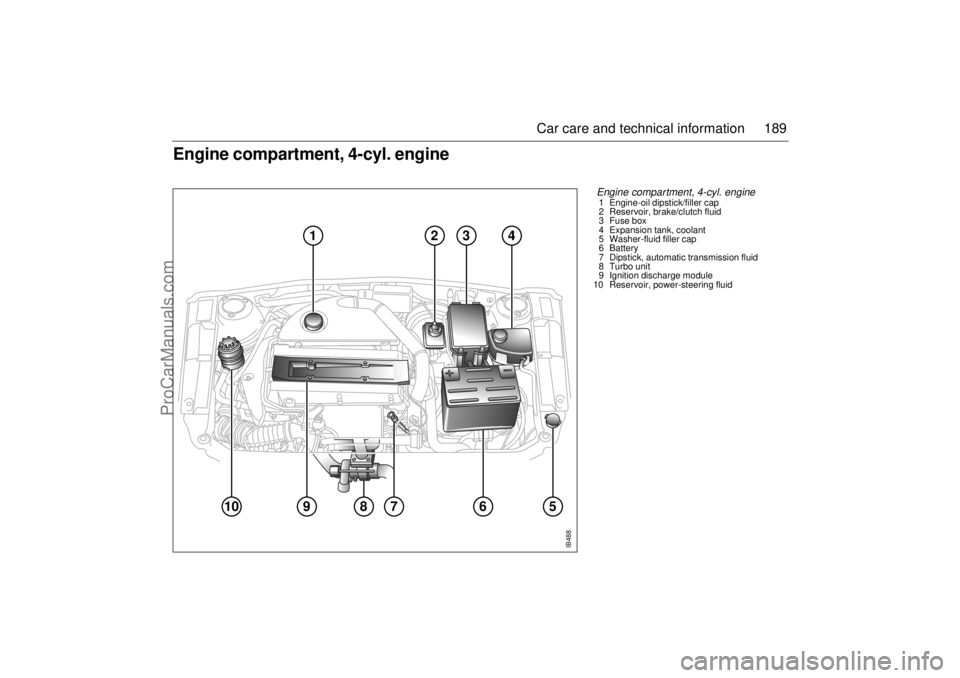
Engine compartment, 4-cyl. engine
8
7
9
10
6
2
4
3
5
IB488
1
Engine compartment, 4-cyl. engine 1 Engine-oil dipstick/filler cap
2 Reservoir, brake/clutch fluid
3 Fuse box
4 Expansion tank, coolant
5 Washer-fluid filler cap
6Battery
7 Dipstick, automatic transmission fluid
8 Turbo unit
9 Ignition discharge module
10 Reservoir, power-steering fluid
ProCarManuals.com
Page 190 of 272
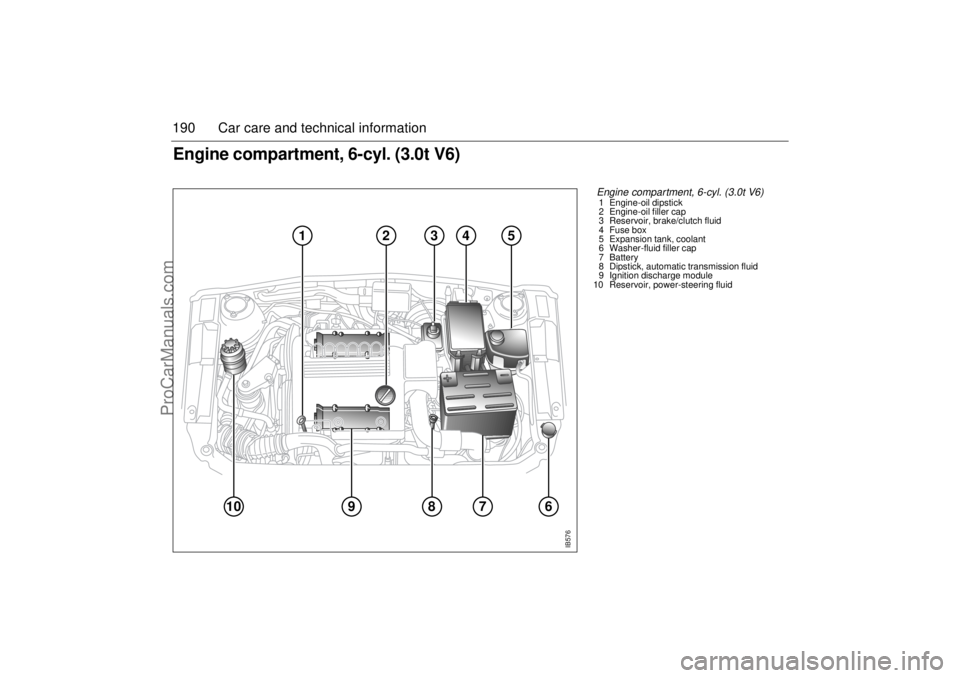
190 Car care and technical informationEngine compartment, 6-cyl. (3.0t V6)
10
7
9
8
1
3
2
5
4
6
IB576
Engine compartment, 6-cyl. (3.0t V6) 1 Engine-oil dipstick
2 Engine-oil filler cap
3 Reservoir, brake/clutch fluid
4 Fuse box
5 Expansion tank, coolant
6 Washer-fluid filler cap
7Battery
8 Dipstick, automatic transmission fluid
9 Ignition discharge module
10 Reservoir, power-steering fluid
ProCarManuals.com
Page 199 of 272
199 Car care and technical information
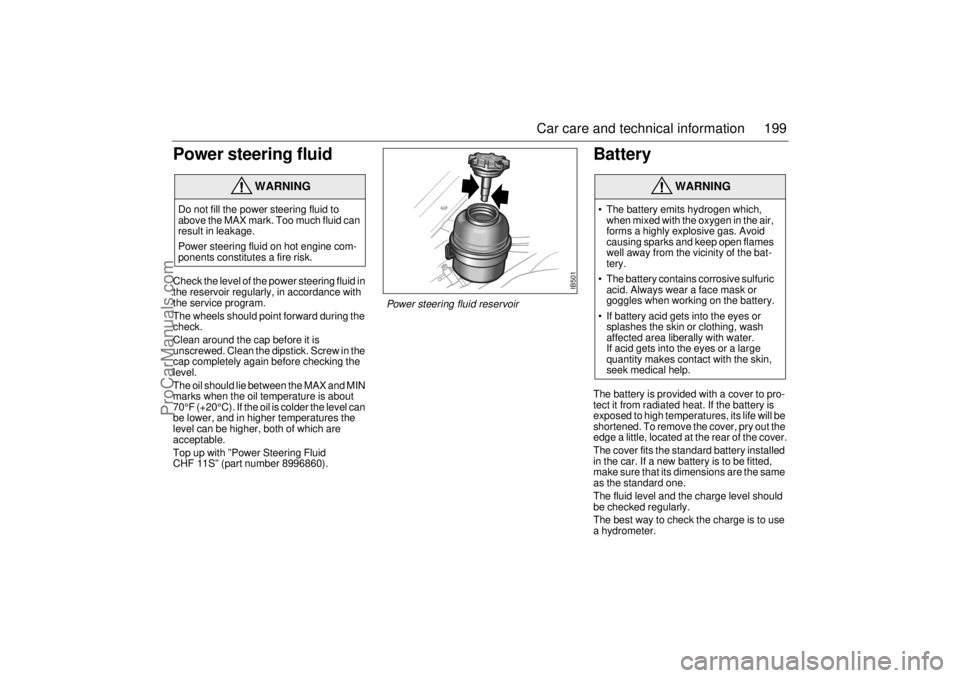
Power steering fluidCheck the level of the power steering fluid in
the reservoir regularly, in accordance with
the service program.
The wheels should point forward during the
check.
Clean around the cap before it is
unscrewed. Clean the dipstick. Screw in the
cap completely again before checking the
level.
The oil should lie between the MAX and MIN
marks when the oil temperature is about
70°F (+20°C). If the oil is colder the level can
be lower, and in higher temperatures the
level can be higher, both of which are
acceptable.
Top up with ”Power Steering Fluid
CHF 11S” (part number 8996860).
BatteryThe battery is provided with a cover to pro-
tect it from radiated heat. If the battery is
exposed to high temperatures, its life will be
shortened. To remove the cover, pry out the
edge a little, located at the rear of the cover.
The cover fits the standard battery installed
in the car. If a new battery is to be fitted,
make sure that its dimensions are the same
as the standard one.
The fluid level and the charge level should
be checked regularly.
The best way to check the charge is to use
a hydrometer.
WARNING
Do not fill the power steering fluid to
above the MAX mark. Too much fluid can
result in leakage.
Power steering fluid on hot engine com-
ponents constitutes a fire risk.
WARNING
The battery emits hydrogen which,
when mixed with the oxygen in the air,
forms a highly explosive gas. Avoid
causing sparks and keep open flames
well away from the vicinity of the bat-
tery.
The battery contains corrosive sulfuric
acid. Always wear a face mask or
goggles when working on the battery.
If battery acid gets into the eyes or
splashes the skin or clothing, wash
affected area liberally with water.
If acid gets into the eyes or a large
quantity makes contact with the skin,
seek medical help.
IB501
Power steering fluid reservoir
ProCarManuals.com
Page 202 of 272
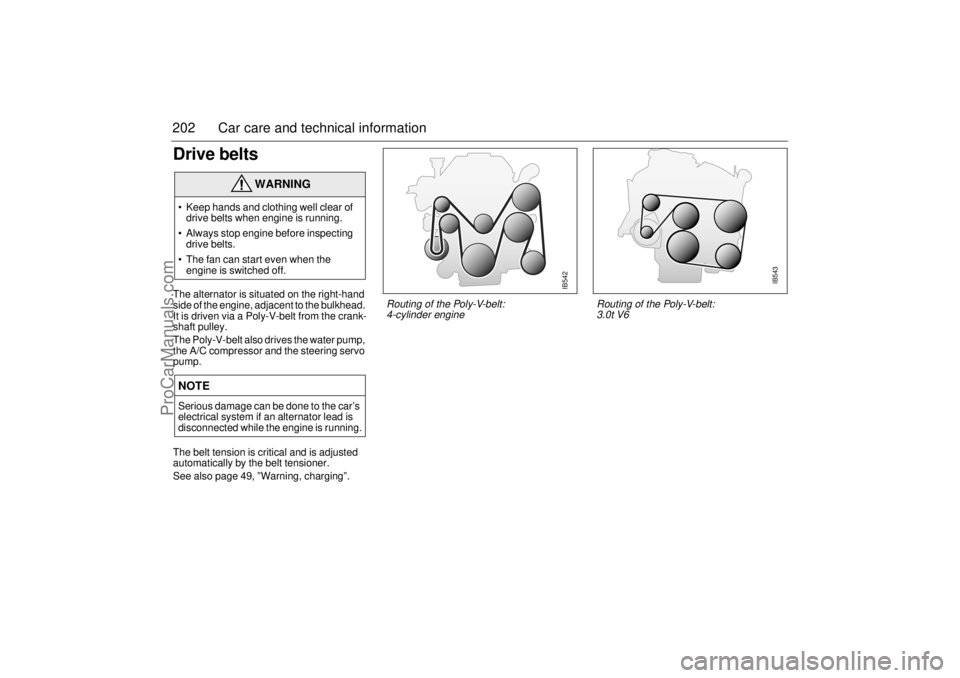
202 Car care and technical informationDrive belts The alternator is situated on the right-hand
side of the engine, adjacent to the bulkhead.
It is driven via a Poly-V-belt from the crank-
shaft pulley.
The Poly-V-belt also drives the water pump,
the A/C compressor and the steering servo
pump.
The belt tension is critical and is adjusted
automatically by the belt tensioner.
See also page 49, ”Warning, charging”.
WARNING
Keep hands and clothing well clear of
drive belts when engine is running.
Always stop engine before inspecting
drive belts.
The fan can start even when the
engine is switched off.NOTESerious damage can be done to the car’s
electrical system if an alternator lead is
disconnected while the engine is running.
IB542
Routing of the Poly-V-belt:
4-cylinder engine
IB543
Routing of the Poly-V-belt:
3.0t V6
ProCarManuals.com
Page 221 of 272

221 Car care and technical information
Wheels Alternative wheels and tiresIf you wish to fit other tires or wheels than
those supplied with the car, consult your
Saab dealer first as to the possibilities avail-
able.
Wheels/tires combinations that are not
approved by Saab can negatively affect the
car´s directional stability, steering and brak-
ing in both wet and dry conditions.
Do not assume that a wheel/tire combina-
tion will function properly just because it will
bolt on.The wheels and tires have been carefully
matched to the characteristics of the car and
play a key role in its outstanding roadhold-
ing and handling.
Tire pressureTires need to be inflated to suit the load car-
ried and the maximum speed the car will be
driven (see the recommended tire pres-
sures on the back cover). Note that all
values apply to cold tires. For tires with an
aspect ratio less than /60, increase the tire
pressure by 3 psi (20 kPa) for rough roads
with potholes to minimize the risk of rim
damage.Never reduce the pressure of a hot tire. If the
tires are hot when you check them, only
increase the pressure, if necessary.
Soft tires will cause faster wear than
over-pressurized tires. They also increase
fuel consumption.
If a valve is leaking, simply unscrew it and fit
a new one.
Important! Remember to adjust the tire
pressures if you change the load in the car
or intend to cruise at a substantially higher
or lower speed than normal.
NOTEFor wide wheels and/or low-profile tires,
bear in mind the following:
Tires and wheels can be damaged in
potholes etc.
Springs, shock absorbers and wheel
bearings can be overloaded.
The wheels can come into contact with
chassis and body components.
The speed and load limits for the tires
must not be exceeded; see page 222.
Wheels larger than 17” must not be fit-
ted. The maximum permissible offset
is 49 mm.
NOTECheck the tire pressures at least once
per month.
Underinflation is the main cause of:
Tires wearing out prematurely.
Damage to the sidewalls.
Damage to the wheels.
ProCarManuals.com
Page 229 of 272
229 Car care and technical information
Flat spottingAll tires get hot, especially on long journeys
or when the car is driven hard. After the car
has been parked with hot tires and the tires
have cooled down, a flat spot can appear in
the tire, where it is in contact with the
ground. The same can occur if the car has
not been moved for a long time.
Flat spots can give rise to vibration that can
be felt through the steering wheel, similar to
that experienced when the wheels need bal-
ancing. Flat spots of this type disappear
once the tires get hot again, usually after
10–15 miles (20–25 km) of driving at cruis-
ing speed.
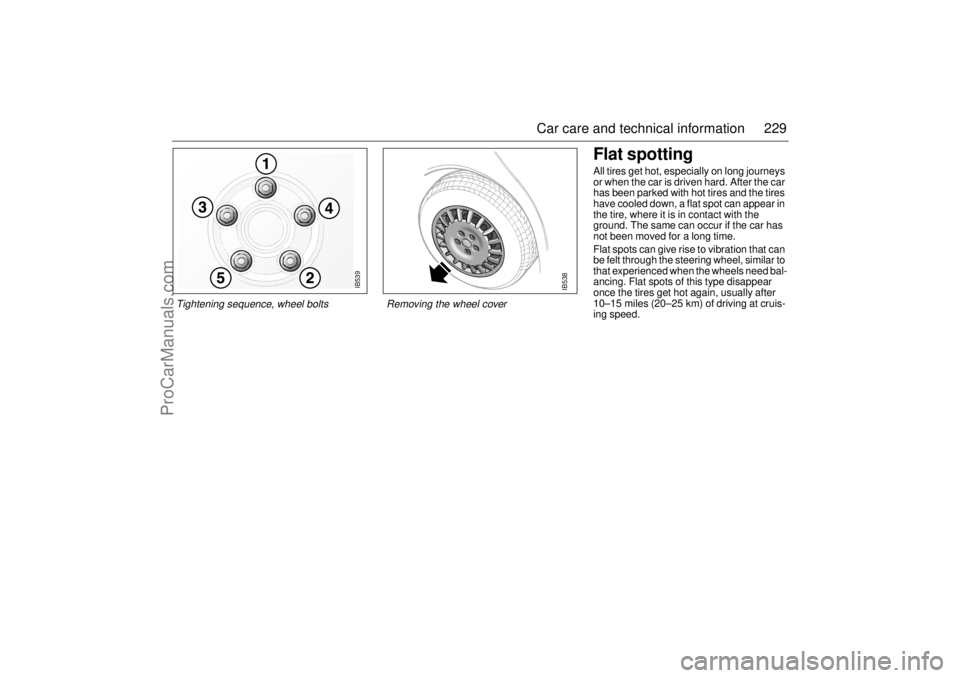
IB539
Tightening sequence, wheel bolts
IB538
Removing the wheel cover
ProCarManuals.com
Page 236 of 272

236 Car care and technical information4Inspect the undercoating and touch
up if necessary. Pay particular atten-
tion to the fenders and wheel housings,
which are exposed to abrasion by flying
gravel, etc. If the composition has worn
or flaked off, the steel must be thor-
oughly cleaned and dried before a fresh
coat is applied. The cleaning is best
done with a scraper and a steel wire
brush, followed by washing with solvent.
Apply the new coating thinly, as other-
wise it may run off or fall off when dry.
For long tripsBefore setting off on a long journey, it is
advisable to have your car checked over by
your Saab dealer.
Obtain a few important items to take along
on your journey such as spare bulbs, wiper
blades, fuses, a Poly-V-belt and the like.
You can check some points yourself before-
hand:
Make sure that the engine is in good con-
dition.
Check that no oil or gasoline leaks out of
the engine or gearbox/transmission.
Check the coolant and power steering
fluid levels. Check also for leaks.
Inspect the Poly-V-belt and replace it if it
shows any signs of hard wear.
Check the battery charge.
Check the tires for tread pattern and air
pressure, including the compact spare
wheel.
Check the brakes.
Check all bulbs.
Check for the presence of the tool kit and
the jack in the car.
Recovery and/or
recycling of automotive
materialsA typical car consists of metals (65–75%),
plastics (10–14%), rubber (5%) and small
quantities of glass, wood, paper and tex-
tiles.
Some of these materials can be recycled,
while others can be recovered in chemical
processes for reuse in new products or as a
source of energy.
While the Saab 9-5 was still at the draw-
ing-board stage, Saab engineers were
giving serious consideration to how the
maximum quantity of materials could be
reclaimed from the car on its eventual
scrapping. To facilitate sorting, plastic parts,
for instance, have been marked to identify
the precise nature of the plastic.
Approximately 90% of the materials in the
car can be recycled or recovered, where
facilities exist.
Before the car is scrapped, all the oils and
other fluids that could pollute the environ-
ment should be recovered from the car. It
may be of interest in this context to learn that
the refrigerant used in the Saab 9-5’s ACC
systems (R134a) contains neither CFCs nor
any other chlorine compounds.
ProCarManuals.com
Page 247 of 272

247 Maintenance and owner assistance
(c.) Check wheel alignment if irregular or premature tire wear is apparent.
Service Intervals **
Miles = U.S. Cars
Kilometers = Canadian Cars
30 day
10,000
(16,000 km)
20,000
(32,000 km)
30,000
(48,000 km)
40,000
(64,000 km)
50,000
(80,000 km)
60,000
(96,000 km)
70,000
(112,000 km)
80,000
(128,000 km)
90,000
(144,000 km)
100,000
(160,000 km)
Service #
1234567891011
Chassis
R Ball joint clearance, outer and inner steering joints and
rubber boots""""""""""
R Shock absorbers and bushes; tightness and condition"""
R Tire pressure, tread depth and wear (c.)"""""""""""
R Rotate tires, front to rear""""""""""
R Brake pads and discs; wear and condition""""""""""
R Brake lines and hoses"""""""""""
R Brake fluid level and renewal (max. 2-year intervals)""" ! "" ! "" ! "
R Check handbrake function"""""""""""
R Power steering fluid level"""""""""""
ProCarManuals.com
Page 248 of 272

248 Maintenance and owner assistance
Service Intervals **
Miles = U.S. Cars
Kilometers = Canadian Cars
30 day
10,000
(16,000 km)
20,000
(32,000 km)
30,000
(48,000 km)
40,000
(64,000 km)
50,000
(80,000 km)
60,000
(96,000 km)
70,000
(112,000 km)
80,000
(128,000 km)
90,000
(144,000 km)
100,000
(160,000 km)
Service #
1234567891011
Chassis (cont.)
RToe-in"""
R Cabin air filter!!!
R Cabin air absorptive filter!
R Door hinges, stops and locks###
R Airbag system, SRS warning lamps, visual inspection"""""""""""
R Safety belts; operation and visual inspection of belt for
tears and fraying"""""""""""
RWipers"""""""""""
R Washer system: check and top-up"""""""""""
R Reset service indicator""""""""""
Customer programming
R Carry out systems programming per customer request"
Road test
R Check performance of drive train, steering and brakes
and verify tire balance.
Check function of instruments and controls, including
horn, windshield wipers, cruise control and climate sys-
tem.
Note any noises or problems for correction."""""""""""
ProCarManuals.com