warning light SAAB 9-5 2001 Service Manual
[x] Cancel search | Manufacturer: SAAB, Model Year: 2001, Model line: 9-5, Model: SAAB 9-5 2001Pages: 272, PDF Size: 14.83 MB
Page 225 of 272
225 Car care and technical information
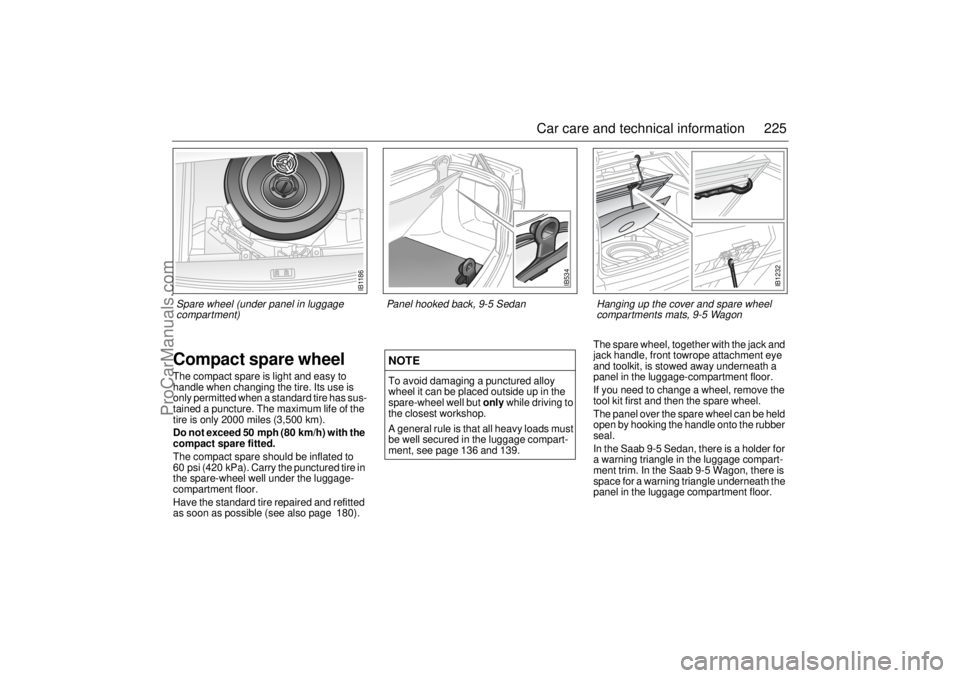
Compact spare wheelThe compact spare is light and easy to
handle when changing the tire. Its use is
only permitted when a standard tire has sus-
tained a puncture. The maximum life of the
tire is only 2000 miles (3,500 km).
Do not exceed 50 mph (80 km/h) with the
compact spare fitted.
The compact spare should be inflated to
60 psi (420 kPa). Carry the punctured tire in
the spare-wheel well under the luggage-
compartment floor.
Have the standard tire repaired and refitted
as soon as possible (see also page 180).The spare wheel, together with the jack and
jack handle, front towrope attachment eye
and toolkit, is stowed away underneath a
panel in the luggage-compartment floor.
If you need to change a wheel, remove the
tool kit first and then the spare wheel.
The panel over the spare wheel can be held
open by hooking the handle onto the rubber
seal.
In the Saab 9-5 Sedan, there is a holder for
a warning triangle in the luggage compart-
ment trim. In the Saab 9-5 Wagon, there is
space for a warning triangle underneath the
panel in the luggage compartment floor.
NOTETo avoid damaging a punctured alloy
wheel it can be placed outside up in the
spare-wheel well but only while driving to
the closest workshop.
A general rule is that all heavy loads must
be well secured in the luggage compart-
ment, see page 136 and 139.
IB534
Panel hooked back, 9-5 Sedan
IB1232
Hanging up the cover and spare wheel
compartments mats, 9-5 Wagon
IB1186
Spare wheel (under panel in luggage
compartment)
ProCarManuals.com
Page 226 of 272

226 Car care and technical informationChanging a wheel
WARNING
The car jack is designed solely for use
in changing a wheel or fitting snow
chains. It must not be used to support
the car during repair work or servicing.
Never crawl under a car that is
supported only by a jack.
Special care must be taken if the car is
on a slope – use wheel chocks!
Position chocks, one ahead and one
behind, the wheel that is diagonally
opposite to the one to be changed.
Switch on the hazard warning lights if
the car is on a road.
Apply the parking brake and leave the
car in gear (1st or reverse). Automatic
transmission: move selector to the
P position.
Ensure that everybody is out of the car
before jacking it up.
Never start the engine while the car is
jacked up.
The jack must stand on a firm, level
surface.
Stow the jack in the place provided for
it under the panel in the floor of the lug-
gage compartment. Secure it properly
to avert injury to passengers in the
event of an accident.
Do not use the jack for any purpose
other than for jacking up the car.
ProCarManuals.com
Page 231 of 272

231 Car care and technical information
Safety beltsRegularly check the function of the safety
belts as follows:
Hold the diagonal strap and pull it sharply.
The safety belt should lock and it should
not be possible to withdraw it further.
Check the anchorage points in the floor.
They must not have suffered rust damage.
There must be no frayed threads in the web-
bing.
Safety belts must not come into contact with
substances such as polishes, oils or other
chemicals. If the straps are dirty, wash them
with warm water and a detergent or have
them replaced.
Upholstery and trimTo remove fluff or hairs from the seat uphol-
stery or headlining, use a moist, lint-free
cloth or a special lint remover (brush or
roller). Remove any dirty marks using a
cloth moistened with lukewarm soapy
water.
When using a stain remover, always work
from the outside towards the center to avoid
leaving a ring. If a soiled ring or spot should
remain, it can usually be removed using
lukewarm soapy water or water alone.
Wet patches left by spilt soft drinks or thin oil
must be wiped off immediately using an
absorbent material, such as kitchen paper,
and treated with stain remover.
Alcohol is recommended for removing
grease or oil stains, and a semi-stiff brush
may also be used.
Cleaning and caring for leather
upholsteryThe principal reason for treating leather
upholstery is to maintain its elegant appear-
ance and to provide it with a protective film.
Discoloration caused by dust and wear
mainly affects the lighter shades, although
this is not detrimental to the leather –
indeed, the patina resulting from use is often
considered desirable in leather. But if the
leather is allowed to become too grubby, it
can start to look shabby.
It is a good idea to clean and recondition the
leather twice a year – in conjunction with a
general spring-cleaning of the car – after the
winter and in the autumn, for instance. In
hot, dry climates, the leather will need to be
treated more frequently.
Moisten a soft cloth in a mild soap solution.
Carefully apply this damp (not wet) cloth to
the leather, working in light, circular move-
ments until the leather is clean. Repeat the
procedure using clean water and then leave
the leather to dry thoroughly. Finally, treat
the leather with a leather conditioner.
WARNING
If the car is involved in a collision, the
safety belts, belt pretensioners and other
components must be inspected by an
authorized Saab dealer.
Never make any alterations or repairs to
the safety belt yourself but visit an autho-
rized Saab dealer.
ProCarManuals.com
Page 238 of 272
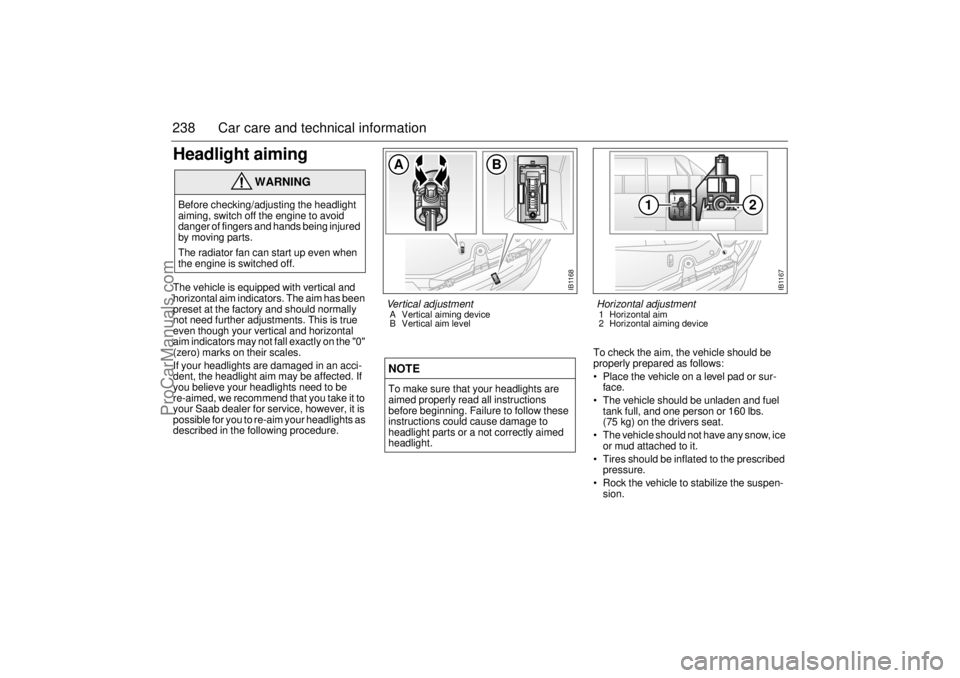
238 Car care and technical informationHeadlight aimingThe vehicle is equipped with vertical and
horizontal aim indicators. The aim has been
preset at the factory and should normally
not need further adjustments. This is true
even though your vertical and horizontal
aim indicators may not fall exactly on the "0"
(zero) marks on their scales.
If your headlights are damaged in an acci-
dent, the headlight aim may be affected. If
you believe your headlights need to be
re-aimed, we recommend that you take it to
your Saab dealer for service, however, it is
possible for you to re-aim your headlights as
described in the following procedure.To check the aim, the vehicle should be
properly prepared as follows:
Place the vehicle on a level pad or sur-
face.
The vehicle should be unladen and fuel
tank full, and one person or 160 lbs.
(75 kg) on the drivers seat.
The vehicle should not have any snow, ice
or mud attached to it.
Tires should be inflated to the prescribed
pressure.
Rock the vehicle to stabilize the suspen-
sion.
WARNING
Before checking/adjusting the headlight
aiming, switch off the engine to avoid
danger of fingers and hands being injured
by moving parts.
The radiator fan can start up even when
the engine is switched off.
NOTETo make sure that your headlights are
aimed properly read all instructions
before beginning. Failure to follow these
instructions could cause damage to
headlight parts or a not correctly aimed
headlight.
IB1168
A
B
Vertical adjustmentA Vertical aiming device
B Vertical aim level
IB1167
1
2
Horizontal adjustment1 Horizontal aim
2 Horizontal aiming device
ProCarManuals.com
Page 246 of 272

246 Maintenance and owner assistance* These are the minimum required Emission Control System maintenance steps. Saab urges that all recommended maintenance procedures be performed
according to this program.
(b.) Change automatic transmission fluid at more frequent intervals (20,000; 50,000; 80,000 miles, etc.) if car is driven in dense city traffic where the outside
temperature regularly reach 90°F or higher, or if car is used in a mountainous/high altitude area or for trailer towing.
Service Intervals **
Miles = U.S. Cars
Kilometers = Canadian Cars
30 day
10,000
(16,000 km)
20,000
(32,000 km)
30,000
(48,000 km)
40,000
(64,000 km)
50,000
(80,000 km)
60,000
(96,000 km)
70,000
(112,000 km)
80,000
(128,000 km)
90,000
(144,000 km)
100,000
(160,000 km)
Service #
1234567891011
Engine and engine compartment (cont.)
E Evaporative emission system including filler cap, vapor
lines, EVAP canister and canister purge valve"
R Fuel system: leaks and damage""""""""""
E Fuel filter!
E Engine air cleaner element!
*
!*
!*
R Exhaust system and mountings; leaks and condition""""""""""
Electrical
R Battery: state of charge and electrolyte level; clean termi-
nals if necessary"""""""""""
R Head, fog, brake, tail, turn signal, warning lights instru-
ment panel, backup and marker lamps"""""""""""
Transmission
R Automatic transmission fluid change (b.)!!!
R Automatic transmission oil level"""""""""""
R Manual transmission oil level"""
R Outer and inner driver joint boots""""""""""
ProCarManuals.com
Page 264 of 272

264 IndexDate code, tires
_________________ 224
Dim-dipped beam ________________ 63
Direction indicators _______________ 65
Door handles
___________________ 34
Door mirrors
___________________ 125
Doors, locks & luggage compartment
_33
Drive belt
______________________ 255
Drive belt, alternator
_____________ 202
Drive belts
_____________________ 255
Drive belts, length
_______________ 255
Driver’s seat, programmable
_______ 122
Driving in hot weather
____________ 173
Driving with a load
______________ 179
EElectric heating seat
_____________ 123
Electric heating, front seats
_______ 123
Electric windows
________________ 127
Electrical system, technical data
____ 254
Electrically heated rear seat
_______ 123
Electronic starting interlock _________ 35
Emergency operation of sunroof
____ 129
Emission control systems
_________ 191
Engine bay, 3.0t V6
_____________ 190
Engine bay, 4-cyl
_______________ 189
Engine bay, cleaning ____________ 233
Engine number
_________________ 259
Engine oil, grade ________________ 253
Engine, description _________ 192
, 193
Engine, technical data
___________ 252
Engine, temperature gauge
________ 55Engine-oil level, checking
_________193
Expansion tank, coolant
__________196
FFault codes, Audio System
________104
Flat spot, tire
___________________229
Fluid level, automatic transmission
__195
Folding the rear seat, 9-5 Sedan
___134
Folding the rear seat, 9-5 Wagon ___137
Frequently asked questions on airbag
30
Front fog lights
__________________66
Frost warning
___________________58
Fuel
__________________________154
Fuel consumption
________________57
Fuel filler flap
___________________145
Fuel gauge
_____________________55
Fuel grade _____________________252
Fuse box under hood
____________219
Fuse panel
____________________215
Fuses
________________________215
GGearbox number
________________259
Gearbox oil, checking
____________195
Gearbox, technical data, __________255
Glove compartment
______________131
HHandbrake
____________________185
Hazard warning lights
_____________66Head restraint
__________________ 18
Headlight flasher ________________ 63
Headlights
_____________________ 63
Holidaying abroad
______________ 236
Hood
________________________ 188
Horn _________________________ 124
IIgnition switch
_________________ 148
Immobilizer
____________________ 35
Indicator and warning lights
________ 48
Indicator lights
__________________ 48
Instrument illumination
___________ 65
Instruments and controls __________ 47
Integral child seat
_______________ 24
Interior equipment ______________ 119
Interior lighting
__________________ 67
Interior rearview mirror
__________ 125
KKey
__________________________ 34
Key to chassis number
__________ 260
Key, remove
__________________ 148
LLabels
_________________________ 8
Leather upholstery, care of
_______ 231
Light horn
_____________________ 63
Light switches __________________ 63
Luggage-compartment lighting
_____ 67
ProCarManuals.com
Page 266 of 272

266 IndexSteering, technical data
__________ 256
Stone-chip damage, repairing
______ 233
Storage compartments
___________ 131
Sun visors
_____________________ 130
Sunroof
_______________________ 128
Suspension
____________________ 256
Suspension, technical data
________ 256
Switches
_______________________ 63
Systems, adjustment
____________ 261
TTCS OFF
______________________ 53
Table of fuses __________________ 217
Tachometer
_____________________ 54
Tailgate, opening
________________ 38
Tank gauge
_____________________ 55
Technical data _________________ 249
Telematics
____________________ 107
Temperature control, ACC
_________ 72
Temperature gauge, engine ________ 55
Temperature zones, ACC
__________ 72
Textile carpeting
________________ 232
Through-load hatch ______________ 136
Tie Downs
_____________________ 136
Tightening torque, wheel studs
_____ 226
Tire markings
_____________ 221
, 222
Tire pressure
______________ 179
, 221
Tires
____________________ 221
, 257
Tools
_________________________ 144
Touching-in the paintwork
_________ 233
Towbar attachment
______________ 174Towbar load
___________________176
Towing the car _________________181
Towing, automatics
______________181
Traction
_______________________169
Trailer weights
__________________251
Trionic
________________________191
Trip computer
___________________57
Trip meter
______________________54
Trunk
_________________________134
Trunk lid, opening
________________38
Turbo gauge
____________________56
Turbo, points to note
_____________151
UUnder the hood, 3.0t V6
__________190
Under the hood, 4-cyl
____________189
Upholstery and trim
______________231
Upholstery and trim, care of
_______231
Useful tips, ACC
_________________78
VVanity mirrors
__________________130
Ventilated front seats
____________123
Viscosity, engine oil
_____________252
WWarning labels
___________________8
Warning light, AIR BAG
___________30
Warning lights
___________________48
Warning triangle ________________144Washers
_____________________ 203
Washers, windshield
____________ 204
Washing the car
_______________ 232
Waxing and polishing
___________ 233
Wear indicators, tires ____________ 223
Wheels and tires
___________ 221
, 257
Wheels and tires, sizes
__________ 257
Window-glass sensor, car alarm
____ 42
Windshield washers
_____________ 68
Windshield wipers
_______________ 68
Wiper blades, headlamp
_________ 203
Wiper blades, replacing __________ 203
Wipers and washers
_________ 68
, 203
ProCarManuals.com