light SAAB 9-5 2001 Repair Manual
[x] Cancel search | Manufacturer: SAAB, Model Year: 2001, Model line: 9-5, Model: SAAB 9-5 2001Pages: 272, PDF Size: 14.83 MB
Page 179 of 272

179 Starting and driving
Driving with a loadThe driving characteristics of the car are
affected by the way it is loaded.
Place heavy loads as far forward and as
low as possible in the trunk.
Secure the load to the tie downs, see
page 136.
The load should be such that the car´s
total weight or axle weight are not
exceeded, see page 250.
Heavy loads mean that the car’s center of
gravity is further back. As a result, the car
will sway more during evasive steering.
Never exceed the permissible load in the
roof box, even if there is room for more.
Ensure that the tire pressure is correct –
slight overinflation is preferable to under-
inflation.
The braking distance of a loaded car is
always greater. Keep your distance from
the vehicle in front.
Roof loads can negatively affect tele-
communication.
Tire pressure, see page 259 and back
cover.
TiresThe tire pressure should match the current
load and speed of the car; see the back
cover or the tire pressure label on
page 259.
The tire pressures given apply to cold tires,
that is tires that are the same temperature
as the outside air temperature.
The tire pressure increases as the tires
become warm (e.g. during highway driving)
with approximately 0.3 bar (4 psi). When
the temperature of the tires changes by 50°
(10°C), the tire pressure will change 0.1 bar
(2 psi).Never reduce the pressure of a hot tire. If the
tires are hot when you check them, only
increase the pressure, if necessary.
Underinflated tires wear more quickly than
slightly overinflated tires.
If a valve is leaking, simply unscrew it and fit
a new one.
Important! Remember to adjust the tire
pressures if you change the load in the car
or intend to drive at substantially lower or
higher speeds than normal.NOTECheck the tire pressure at least once a
month. Underinflation is the main cause
of:
Damage to the wheels.
Premature tire wear.
Damage to the sidewalls.
ProCarManuals.com
Page 180 of 272
180 Starting and drivingDriving considerations
with compact spare
wheel/tire fittedThe following should be observed when the
compact spare wheel (T115/70 R16) is
fitted:
The compact spare is light and easy to
handle when changing the wheel. Do not
drive further than necessary with the com-
pact spare fitted – the maximum life of the
wheel is only just over 2000 miles
(3,500 km). Have the standard wheel
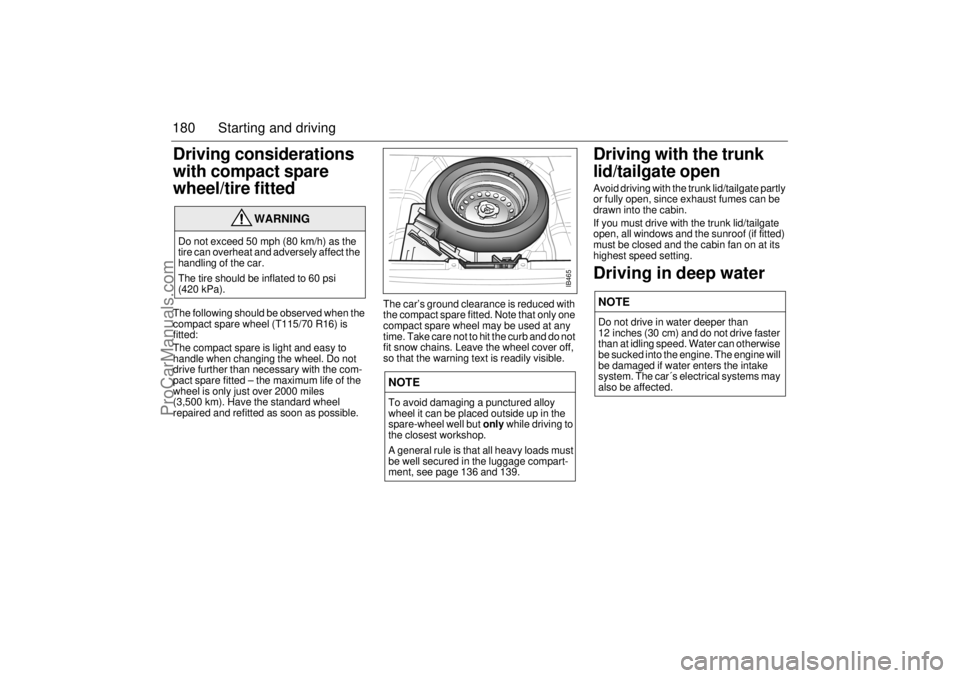
repaired and refitted as soon as possible. The car’s ground clearance is reduced with
the compact spare fitted. Note that only one
compact spare wheel may be used at any
time. Take care not to hit the curb and do not
fit snow chains. Leave the wheel cover off,
so that the warning text is readily visible.
Driving with the trunk
lid/tailgate openAvoid driving with the trunk lid/tailgate partly
or fully open, since exhaust fumes can be
drawn into the cabin.
If you must drive with the trunk lid/tailgate
open, all windows and the sunroof (if fitted)
must be closed and the cabin fan on at its
highest speed setting.Driving in deep water
WARNING
Do not exceed 50 mph (80 km/h) as the
tire can overheat and adversely affect the
handling of the car.
The tire should be inflated to 60 psi
(420 kPa).
NOTETo avoid damaging a punctured alloy
wheel it can be placed outside up in the
spare-wheel well but only while driving to
the closest workshop.
A general rule is that all heavy loads must
be well secured in the luggage compart-
ment, see page 136 and 139.
NOTEDo not drive in water deeper than
12 inches (30 cm) and do not drive faster
than at idling speed. Water can otherwise
be sucked into the engine. The engine will
be damaged if water enters the intake
system. The car´s electrical systems may
also be affected.
IB465
ProCarManuals.com
Page 182 of 272
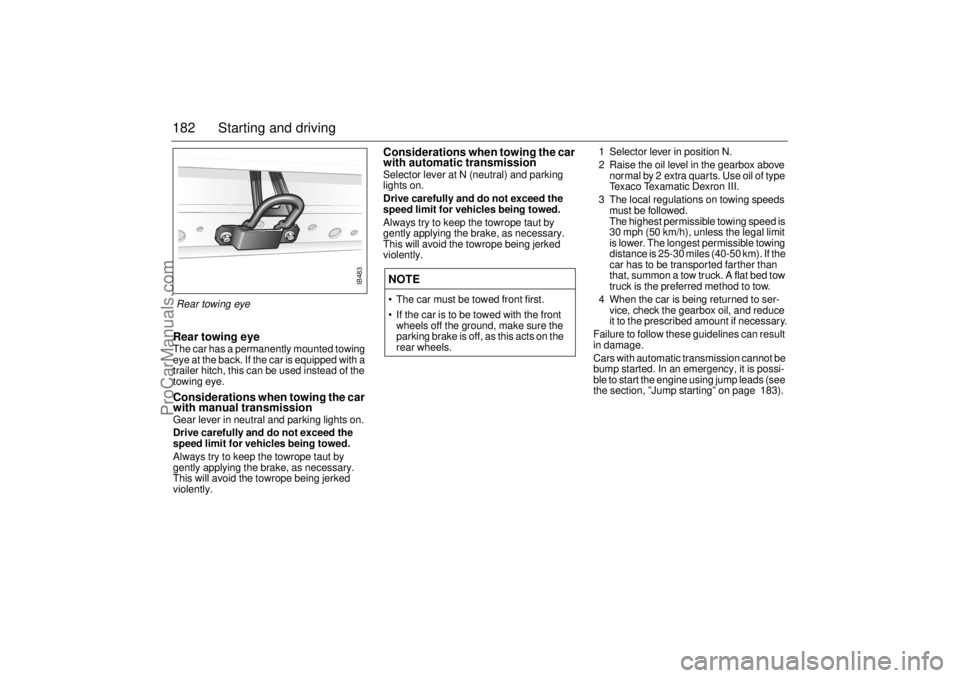
182 Starting and drivingRear towing eyeThe car has a permanently mounted towing
eye at the back. If the car is equipped with a
trailer hitch, this can be used instead of the
towing eye. Considerations when towing the car
with manual transmission Gear lever in neutral and parking lights on.
Drive carefully and do not exceed the
speed limit for vehicles being towed.
Always try to keep the towrope taut by
gently applying the brake, as necessary.
This will avoid the towrope being jerked
violently.
Considerations when towing the car
with automatic transmission Selector lever at N (neutral) and parking
lights on.
Drive carefully and do not exceed the
speed limit for vehicles being towed.
Always try to keep the towrope taut by
gently applying the brake, as necessary.
This will avoid the towrope being jerked
violently. 1 Selector lever in position N.
2 Raise the oil level in the gearbox above
normal by 2 extra quarts. Use oil of type
Texaco Texamatic Dexron III.
3 The local regulations on towing speeds
must be followed.
The highest permissible towing speed is
30 mph (50 km/h), unless the legal limit
is lower. The longest permissible towing
distance is 25-30 miles (40-50 km). If the
car has to be transported farther than
that, summon a tow truck. A flat bed tow
truck is the preferred method to tow.
4 When the car is being returned to ser-
vice, check the gearbox oil, and reduce
it to the prescribed amount if necessary.
Failure to follow these guidelines can result
in damage.
Cars with automatic transmission cannot be
bump started. In an emergency, it is possi-
ble to start the engine using jump leads (see
the section, ”Jump starting” on page 183). NOTE The car must be towed front first.
If the car is to be towed with the front
wheels off the ground, make sure the
parking brake is off, as this acts on the
rear wheels.
IB483
Rear towing eye
ProCarManuals.com
Page 183 of 272
183 Starting and driving
Jump startingIf your battery has run down, you may want
to use another vehicle and some jumper
cables to start your Saab. Follow the steps
below to do it safely.
To jump start your vehicle:
1 Check the other vehicle. It must have a
12-volt battery with a negative ground
system.
2 Get the vehicles close enough so the
jumper cables can reach, but be sure the
vehicles are not touching each other. If
a poor connection on the negative
jumper cable should exist, it is possible
for damage to be caused to electrical
systems/components of either vehicle
should inadvertent contact be made.
You would not be able to start your car and bad grounding could damage elec-
trical systems.
3 Turn off the ignition on both vehicles.
Turn off all lights that are not needed,
and radios. This will avoid sparks and
help save both batteries and it could
save your radio.
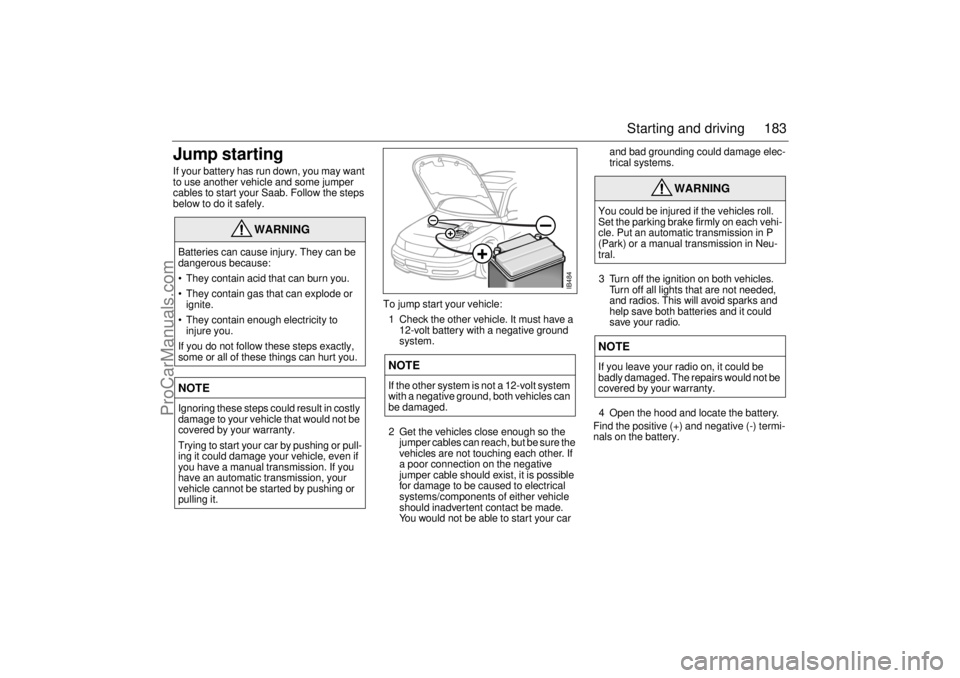
4 Open the hood and locate the battery.
Find the positive (+) and negative (-) termi-
nals on the battery.
WARNING
Batteries can cause injury. They can be
dangerous because:
They contain acid that can burn you.
They contain gas that can explode or
ignite.
They contain enough electricity to
injure you.
If you do not follow these steps exactly,
some or all of these things can hurt you.NOTEIgnoring these steps could result in costly
damage to your vehicle that would not be
covered by your warranty.
Trying to start your car by pushing or pull-
ing it could damage your vehicle, even if
you have a manual transmission. If you
have an automatic transmission, your
vehicle cannot be started by pushing or
pulling it.
NOTEIf the other system is not a 12-volt system
with a negative ground, both vehicles can
be damaged.
WARNING
You could be injured if the vehicles roll.
Set the parking brake firmly on each vehi-
cle. Put an automatic transmission in P
(Park) or a manual transmission in Neu-
tral.NOTEIf you leave your radio on, it could be
badly damaged. The repairs would not be
covered by your warranty.
+
–
+
–
IB484
ProCarManuals.com
Page 184 of 272
184 Starting and driving
5 Check that the jumper cables do not
have loose or missing insulation. If they
do, you could get a shock and also the
vehicles could be damaged.
Before you connect the cables, here are
some basic things you should know.
Positive (+) will go to positive (+) and
negative (-) will go to negative (-) or a
major metal engine part with a good
ground. Do not connect (+) to (-) or you
will get a short that could injure you or
would damage the battery and maybe
other parts as well.
6 Connect the red positive (+) cable to the
positive (+) terminal of the vehicle with
the discharged battery.
7 Do not let the other end touch metal.
Connect it to the positive (+) terminal of
the good battery. Use a remote positive
(+) terminal if the vehicle has one.8 Now connect the black negative (-)
cable to the good battery’s negative ter-
minal.
Do not let the other end touch anything
until the next step. The other end of the
negative cable does not go to the dead
battery. It goes to a major metal part with
a good ground on the engine of the vehi-
cle with the discharged battery.
9 Attach the cable at least 18 inches
(45 cm) away from the discharged bat-
tery, but not near engine parts that
move. The electrical connection is just
as good there, but the chance of sparks
getting back to the battery is much less.
10 Start the vehicle with the good battery
and run the engine for a while.
11 Try to start the vehicle with the dis-
charged battery. If it does not start after
a few tries, it probably needs service.
12 Remove the cables in reverse order to
prevent electrical shorting. Take care
that they do not touch each other or any
other metal.
WARNING
An electric fan can start up even when the
engine is not running and can injure you.
Keep hands, clothing and tools away from
any underhood electric fan.
WARNING
Using a match or flame of any kind near a
battery can cause battery gas to explode.
You can suffer burns or be blinded. Use a
flashlight if you need more light.
Be sure the battery has enough water.
The battery installed in your new Saab
has filler caps. Be sure the right amount
of water is there. Add distilled or boiled
water if the level is too low. If you don’t,
explosive gas could be present.
Be sure the electrolyte in the battery is not
frozen. Discharged batteries will freeze.
When connecting jumper cables to a
frozen battery, gas from the chemical
reaction inside the battery can build up
under the ice and cause an explosion.
Battery fluid contains acid that can burn
you. Do not get it on you. If you acciden-
tally get it in your eyes or on your skin,
flush the area with water and get medical
help immediately.
ProCarManuals.com
Page 185 of 272
185 Starting and driving
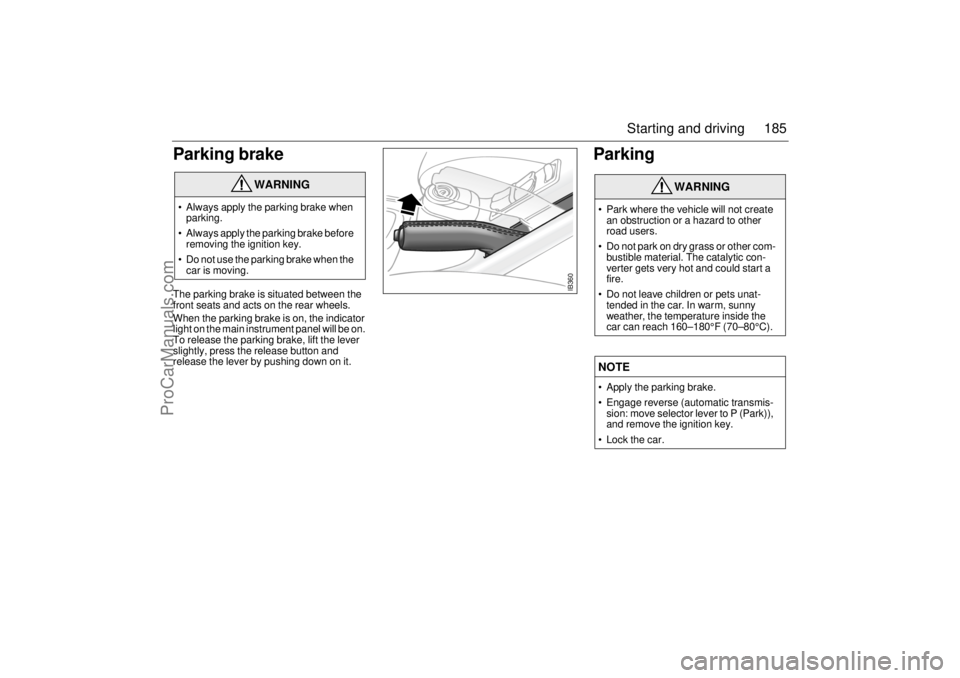
Parking brake The parking brake is situated between the
front seats and acts on the rear wheels.
When the parking brake is on, the indicator
light on the main instrument panel will be on.
To release the parking brake, lift the lever
slightly, press the release button and
release the lever by pushing down on it.
Parking
WARNING
Always apply the parking brake when
parking.
Always apply the parking brake before
removing the ignition key.
Do not use the parking brake when the
car is moving.
WARNING
Park where the vehicle will not create
an obstruction or a hazard to other
road users.
Do not park on dry grass or other com-
bustible material. The catalytic con-
verter gets very hot and could start a
fire.
Do not leave children or pets unat-
tended in the car. In warm, sunny
weather, the temperature inside the
car can reach 160–180°F (70–80°C). NOTE Apply the parking brake.
Engage reverse (automatic transmis-
sion: move selector lever to P (Park)),
and remove the ignition key.
Lock the car.
IB360
ProCarManuals.com
Page 187 of 272
187 Car care and technical information
Car care and
technical
information
Hood release handle ....... 188
Engine compartment,
4-cyl. engine ................... 189
Engine compartment,
6-cyl. (3.0t V6)................. 190
Emission control systems 191
Engine............................... 192
Engine oil ......................... 193
Transmission fluid........... 195
Coolant ............................. 196
Brake and clutch fluid ..... 198
Power steering fluid ........ 199
Battery .............................. 199 Drive belts ........................ 202
Wipers and washers ....... 203
Changing bulbs ............... 205
Fuses ................................ 215
Wheels .............................. 221
Compact spare wheel ..... 225
Flat spotting..................... 229
Air conditioning (ACC) ... 230
Safety belts ...................... 231
Upholstery and trim ........ 231
Textile carpeting.............. 232
Washing the car .............. 232
Waxing and polishing ..... 233 Engine compartment ....... 233
Touching up the paint ..... 233
Anticorrosion treatment .. 234
For long trips .................... 236
Recovery and/or recycling
of automotive materials. 236
Headlight aiming .............. 238
ProCarManuals.com
Page 192 of 272
192 Car care and technical informationORVR (Onboard Refueling Vapor
Recovery)Hydrocarbon vapors formed when refueling
will be recovered by the car and not
released into the atmosphere. The hydro-
carbons are absorbed in a evaporative
emission canister. When the engine is sub-
sequently started, the evaporative emission
canister is gradually purged as air is sucked
into it through a shut-off valve. The hydro-
carbon/air mixture passes through the evap
canister purge valve and into the engine
where it is burned.
When refueling, make sure you screw the
filler cap on and keep turning until it has
clicked at least 3 times. Otherwise, it is pos-
sible for the CHECK ENGINE light to illumi-
nate and a ”TIGHTEN FUEL FILLER CAP”
message to appear on SID.
Refueling, see page 154.
Engine2.3-liter engineThe 2.3-liter model is a transverse, 4-cylin-
der in-line engine with twin overhead cam-
shafts and 4 valves per cylinder.
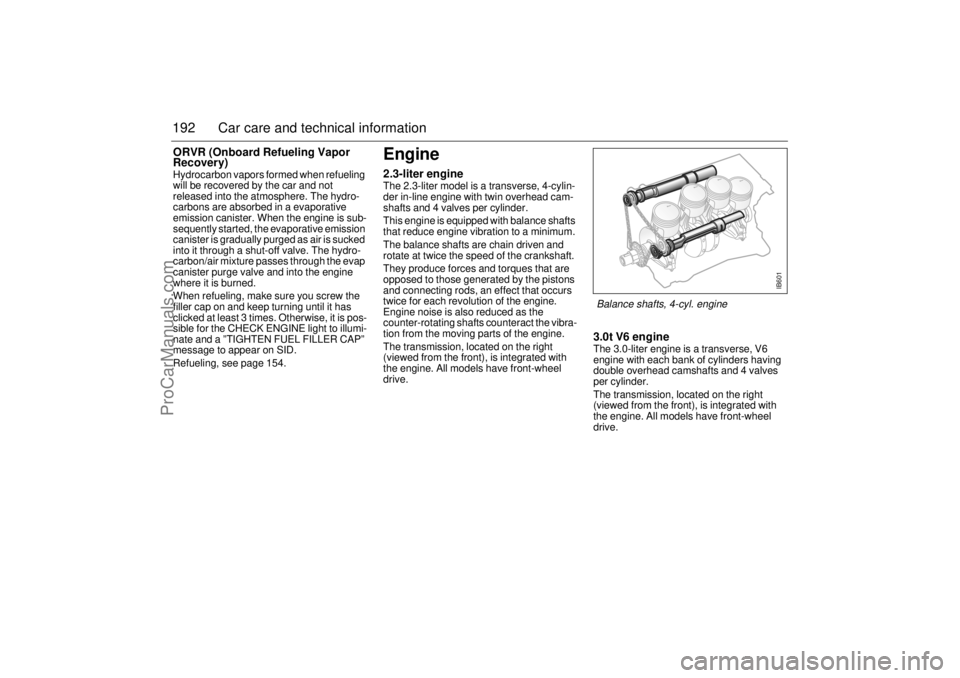
This engine is equipped with balance shafts
that reduce engine vibration to a minimum.
The balance shafts are chain driven and
rotate at twice the speed of the crankshaft.
They produce forces and torques that are
opposed to those generated by the pistons
and connecting rods, an effect that occurs
twice for each revolution of the engine.
Engine noise is also reduced as the
counter-rotating shafts counteract the vibra-
tion from the moving parts of the engine.
The transmission, located on the right
(viewed from the front), is integrated with
the engine. All models have front-wheel
drive.
3.0t V6 engine The 3.0-liter engine is a transverse, V6
engine with each bank of cylinders having
double overhead camshafts and 4 valves
per cylinder.
The transmission, located on the right
(viewed from the front), is integrated with
the engine. All models have front-wheel
drive.
IB601
Balance shafts, 4-cyl. engine
ProCarManuals.com
Page 203 of 272
203 Car care and technical information
Wipers and washersCheck and clean all wiper blades regularly.
We recommend Saab washer fluid for
cleaning.
If poor wiper performance is experienced,
clean the windshield with Saab washer fluid.
This is particularly important if the car has
been through an automatic car wash, as
these sometimes leave a wax coating on the
windshield.
If wiper performance is still unsatisfactory,
fit new blades.
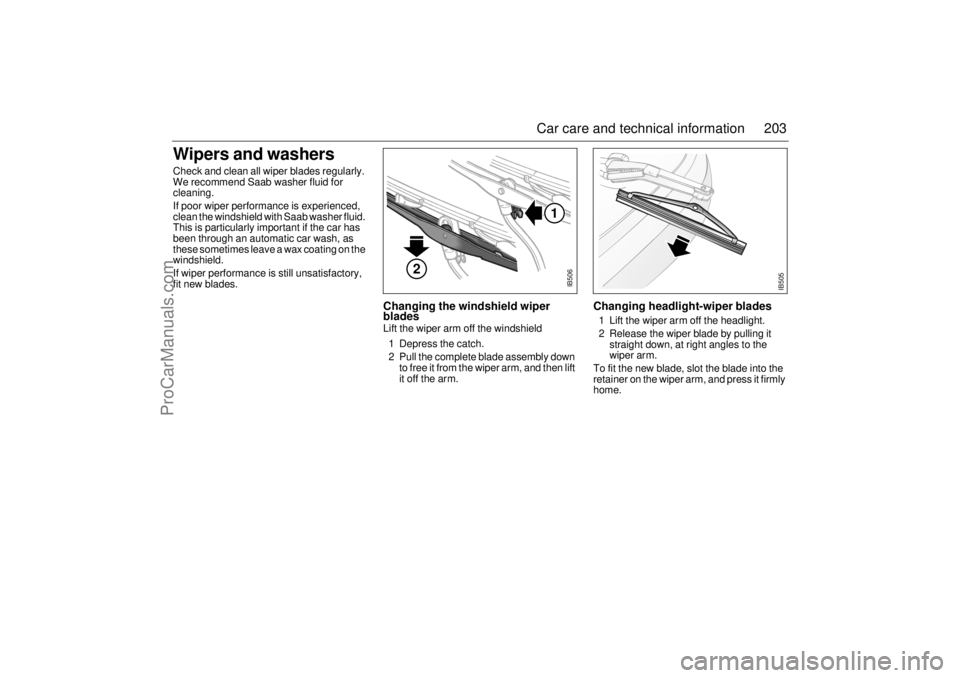
Changing the windshield wiper
bladesLift the wiper arm off the windshield
1 Depress the catch.
2 Pull the complete blade assembly down
to free it from the wiper arm, and then lift
it off the arm.
Changing headlight-wiper blades 1 Lift the wiper arm off the headlight.
2 Release the wiper blade by pulling it
straight down, at right angles to the
wiper arm.
To fit the new blade, slot the blade into the
retainer on the wiper arm, and press it firmly
home.
IB506
2
1
IB505
ProCarManuals.com
Page 205 of 272
205 Car care and technical information
Changing bulbs Check that the new bulb is working when finished.
Some bulbs are of the ”Long-Life” type. Make sure the same type is
fitted when changing one of these.
Headlight aiming, see page 238.
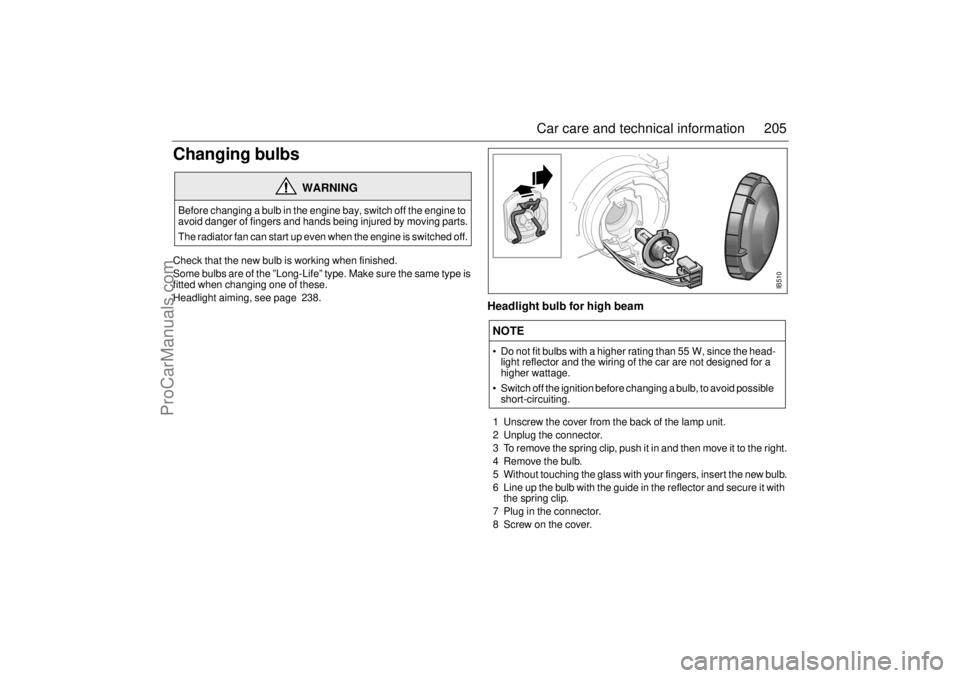
Headlight bulb for high beam1 Unscrew the cover from the back of the lamp unit.
2 Unplug the connector.
3 To remove the spring clip, push it in and then move it to the right.
4 Remove the bulb.
5 Without touching the glass with your fingers, insert the new bulb.
6 Line up the bulb with the guide in the reflector and secure it with
the spring clip.
7 Plug in the connector.
8 Screw on the cover.
WARNING
Before changing a bulb in the engine bay, switch off the engine to
avoid danger of fingers and hands being injured by moving parts.
The radiator fan can start up even when the engine is switched off.
NOTE Do not fit bulbs with a higher rating than 55 W, since the head-
light reflector and the wiring of the car are not designed for a
higher wattage.
Switch off the ignition before changing a bulb, to avoid possible
short-circuiting.
IB510
ProCarManuals.com