automatic transmission SAAB 9-5 2001 Owners Manual
[x] Cancel search | Manufacturer: SAAB, Model Year: 2001, Model line: 9-5, Model: SAAB 9-5 2001Pages: 272, PDF Size: 14.83 MB
Page 5 of 272
5
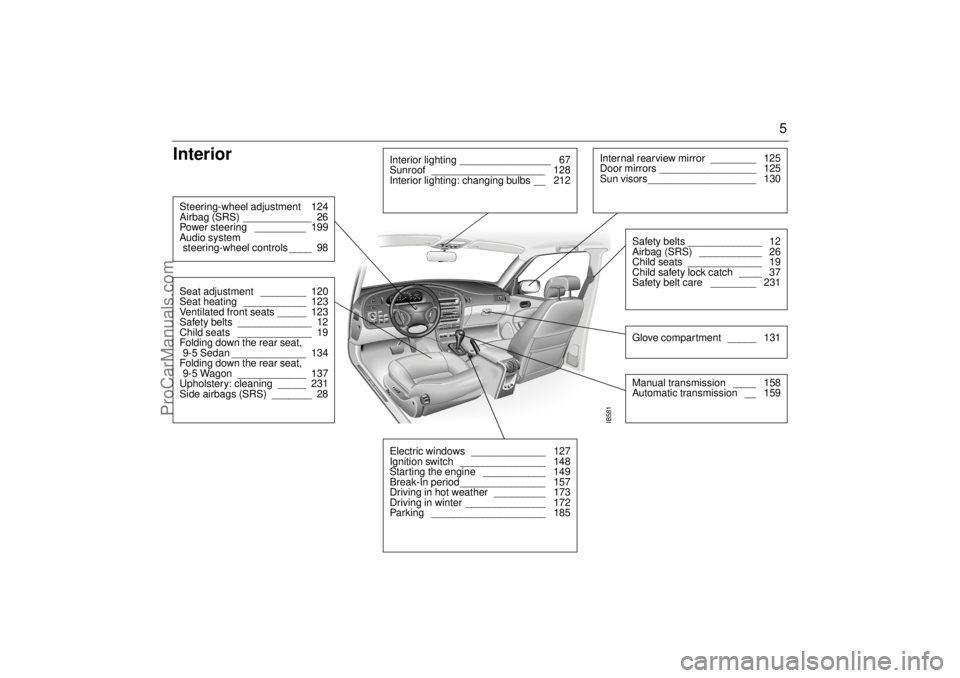
Interior
IB581Internal rearview mirror ________ 125
Door mirrors _________________ 125
Sun visors___________________ 130
Safety belts _____________ 12
Airbag (SRS) ___________ 26
Child seats _____________ 19
Child safety lock catch ____ 37
Safety belt care ________ 231Glove compartment _____ 131Manual transmission ____ 158
Automatic transmission __ 159
Electric windows _____________ 127
Ignition switch _______________ 148
Starting the engine ___________ 149
Break-In period_______________ 157
Driving in hot weather _________ 173
Driving in winter ______________ 172
Parking ____________________ 185
Steering-wheel adjustment 124
Airbag (SRS) ____________ 26
Power steering _________ 199
Audio system
steering-wheel controls ____ 98Seat adjustment ________ 120
Seat heating ___________ 123
Ventilated front seats _____ 123
Safety belts _____________ 12
Child seats _____________ 19
Folding down the rear seat,
9-5 Sedan _____________ 134
Folding down the rear seat,
9-5 Wagon ____________ 137
Upholstery: cleaning _____ 231
Side airbags (SRS) _______ 28
Interior lighting ________________ 67
Sunroof ____________________ 128
Interior lighting: changing bulbs __ 212
ProCarManuals.com
Page 6 of 272
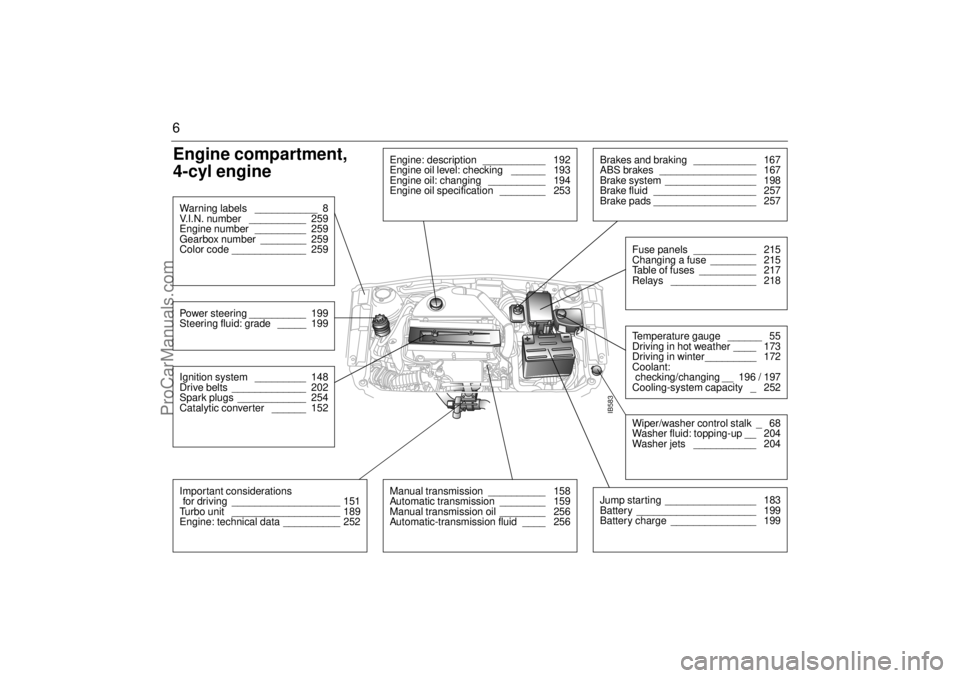
6Engine compartment,
4-cyl engine
IB583
Engine: description ___________ 192
Engine oil level: checking ______ 193
Engine oil: changing __________ 194
Engine oil specification ________ 253
Brakes and braking ___________ 167
ABS brakes _________________ 167
Brake system ________________ 198
Brake fluid __________________ 257
Brake pads __________________ 257
Fuse panels ___________ 215
Changing a fuse ________ 215
Table of fuses __________ 217
Relays _______________ 218Temperature gauge ______ 55
Driving in hot weather ____ 173
Driving in winter_________ 172
Coolant:
checking/changing __ 196 / 197
Cooling-system capacity _ 252
Power steering __________ 199
Steering fluid: grade _____ 199
Wiper/washer control stalk _ 68
Washer fluid: topping-up __ 204
Washer jets ___________ 204
Jump starting ________________ 183
Battery _____________________ 199
Battery charge _______________ 199
Manual transmission __________ 158
Automatic transmission ________ 159
Manual transmission oil ________ 256
Automatic-transmission fluid ____ 256
Important considerations
for driving ___________________ 151
Turbo unit ___________________ 189
Engine: technical data __________ 252Ignition system _________ 148
Drive belts _____________ 202
Spark plugs ____________ 254
Catalytic converter ______ 152Warning labels ___________ 8
V.I.N. number __________ 259
Engine number _________ 259
Gearbox number ________ 259
Color code _____________ 259
ProCarManuals.com
Page 7 of 272
7
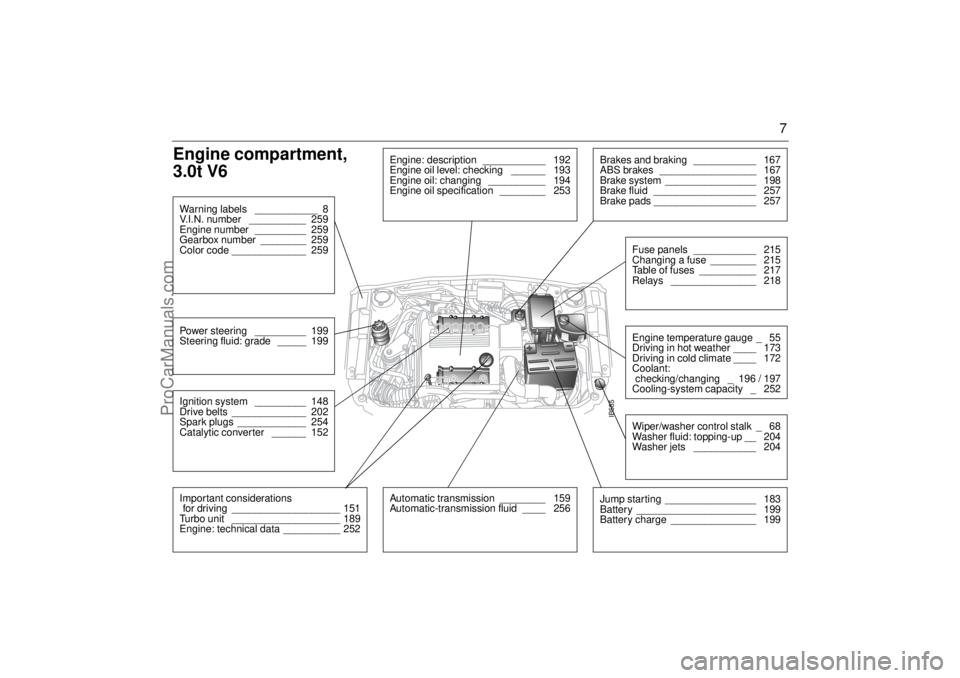
Engine compartment,
3.0t V6
IB585
Warning labels ___________ 8
V.I.N. number __________ 259
Engine number _________ 259
Gearbox number ________ 259
Color code _____________ 259Ignition system _________ 148
Drive belts _____________ 202
Spark plugs ____________ 254
Catalytic converter ______ 152Important considerations
for driving ___________________ 151
Turbo unit ___________________ 189
Engine: technical data __________ 252
Automatic transmission ________ 159
Automatic-transmission fluid ____ 256
Brakes and braking ___________ 167
ABS brakes _________________ 167
Brake system ________________ 198
Brake fluid __________________ 257
Brake pads __________________ 257Jump starting ________________ 183
Battery _____________________ 199
Battery charge _______________ 199
Fuse panels ___________ 215
Changing a fuse ________ 215
Table of fuses __________ 217
Relays _______________ 218Engine temperature gauge _ 55
Driving in hot weather ____ 173
Driving in cold climate ____ 172
Coolant:
checking/changing _ 196 / 197
Cooling-system capacity _ 252
Power steering _________ 199
Steering fluid: grade _____ 199
Wiper/washer control stalk _ 68
Washer fluid: topping-up __ 204
Washer jets ___________ 204
Engine: description ___________ 192
Engine oil level: checking ______ 193
Engine oil: changing __________ 194
Engine oil specification ________ 253
ProCarManuals.com
Page 52 of 272
52 Instruments and controls
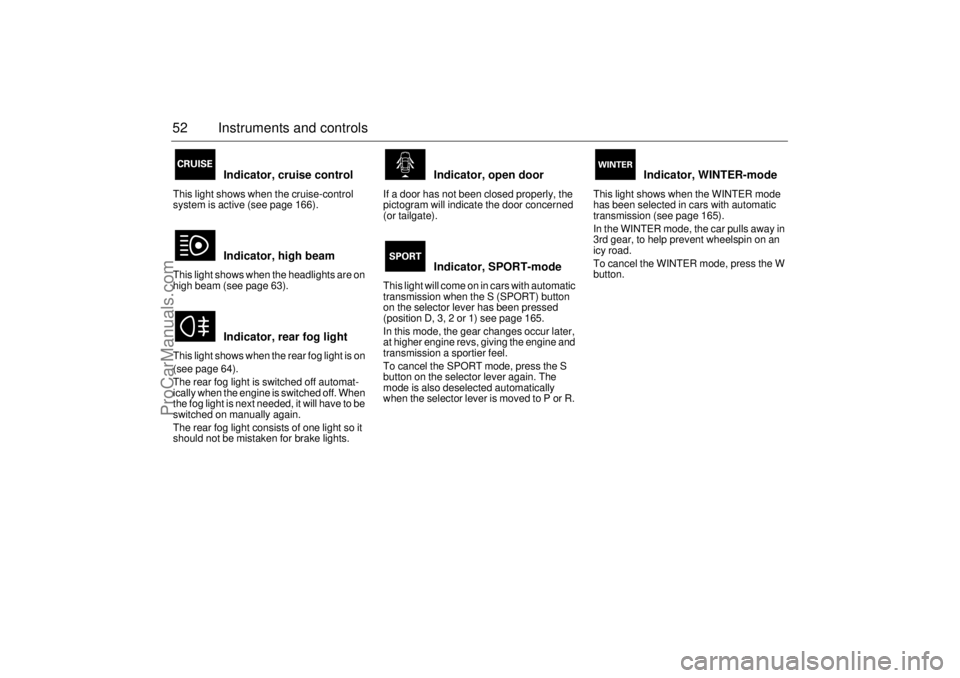
Indicator, cruise control
This light shows when the cruise-control
system is active (see page 166).
Indicator, high beam
This light shows when the headlights are on
high beam (see page 63).
Indicator, rear fog light
This light shows when the rear fog light is on
(see page 64).
The rear fog light is switched off automat-
ically when the engine is switched off. When
the fog light is next needed, it will have to be
switched on manually again.
The rear fog light consists of one light so it
should not be mistaken for brake lights.
Indicator, open door
If a door has not been closed properly, the
pictogram will indicate the door concerned
(or tailgate).
Indicator, SPORT-mode
This light will come on in cars with automatic
transmission when the S (SPORT) button
on the selector lever has been pressed
(position D, 3, 2 or 1) see page 165.
In this mode, the gear changes occur later,
at higher engine revs, giving the engine and
transmission a sportier feel.
To cancel the SPORT mode, press the S
button on the selector lever again. The
mode is also deselected automatically
when the selector lever is moved to P or R.
Indicator, WINTER-mode
This light shows when the WINTER mode
has been selected in cars with automatic
transmission (see page 165).
In the WINTER mode, the car pulls away in
3rd gear, to help prevent wheelspin on an
icy road.
To cancel the WINTER mode, press the W
button.
ProCarManuals.com
Page 53 of 272
53 Instruments and controls
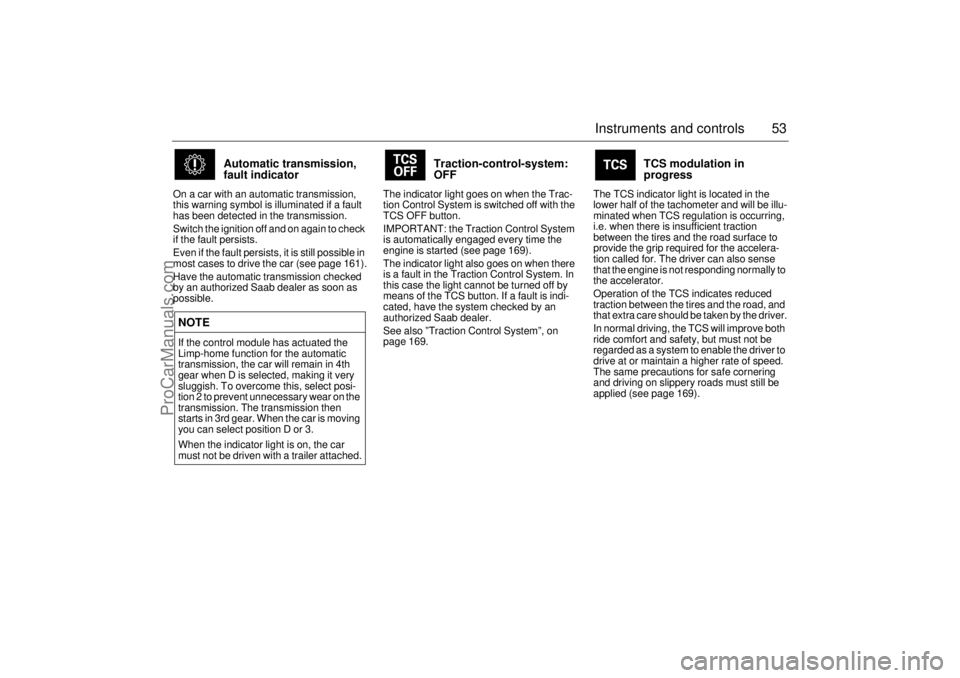
Automatic transmission,
fault indicator
On a car with an automatic transmission,
this warning symbol is illuminated if a fault
has been detected in the transmission.
Switch the ignition off and on again to check
if the fault persists.
Even if the fault persists, it is still possible in
most cases to drive the car (see page 161).
Have the automatic transmission checked
by an authorized Saab dealer as soon as
possible.
Traction-control-system:
OFF
The indicator light goes on when the Trac-
tion Control System is switched off with the
TCS OFF button.
IMPORTANT: the Traction Control System
is automatically engaged every time the
engine is started (see page 169).
The indicator light also goes on when there
is a fault in the Traction Control System. In
this case the light cannot be turned off by
means of the TCS button. If a fault is indi-
cated, have the system checked by an
authorized Saab dealer.
See also ”Traction Control System”, on
page 169.
TCS modulation in
progress
The TCS indicator light is located in the
lower half of the tachometer and will be illu-
minated when TCS regulation is occurring,
i.e. when there is insufficient traction
between the tires and the road surface to
provide the grip required for the accelera-
tion called for. The driver can also sense
that the engine is not responding normally to
the accelerator.
Operation of the TCS indicates reduced
traction between the tires and the road, and
that extra care should be taken by the driver.
In normal driving, the TCS will improve both
ride comfort and safety, but must not be
regarded as a system to enable the driver to
drive at or maintain a higher rate of speed.
The same precautions for safe cornering
and driving on slippery roads must still be
applied (see page 169).
NOTEIf the control module has actuated the
Limp-home function for the automatic
transmission, the car will remain in 4th
gear when D is selected, making it very
sluggish. To overcome this, select posi-
tion 2 to prevent unnecessary wear on the
transmission. The transmission then
starts in 3rd gear. When the car is moving
you can select position D or 3.
When the indicator light is on, the car
must not be driven with a trailer attached.
ProCarManuals.com
Page 54 of 272
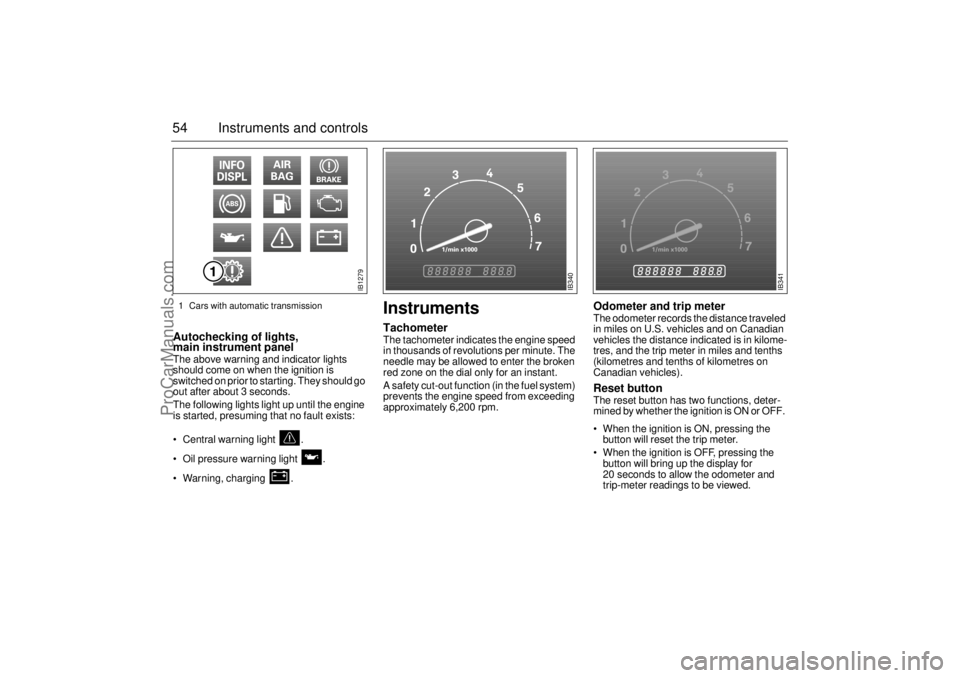
54 Instruments and controlsAutochecking of lights,
main instrument panel The above warning and indicator lights
should come on when the ignition is
switched on prior to starting. They should go
out after about 3 seconds.
The following lights light up until the engine
is started, presuming that no fault exists:
Central warning light .
Oil pressure warning light .
Warning, charging .
InstrumentsTachometerThe tachometer indicates the engine speed
in thousands of revolutions per minute. The
needle may be allowed to enter the broken
red zone on the dial only for an instant.
A safety cut-out function (in the fuel system)
prevents the engine speed from exceeding
approximately 6,200 rpm.
Odometer and trip meter The odometer records the distance traveled
in miles on U.S. vehicles and on Canadian
vehicles the distance indicated is in kilome-
tres, and the trip meter in miles and tenths
(kilometres and tenths of kilometres on
Canadian vehicles). Reset button The reset button has two functions, deter-
mined by whether the ignition is ON or OFF.
When the ignition is ON, pressing the
button will reset the trip meter.
When the ignition is OFF, pressing the
button will bring up the display for
20 seconds to allow the odometer and
trip-meter readings to be viewed.
IB1279
IB340
IB341
1 Cars with automatic transmission
ProCarManuals.com
Page 57 of 272
57 Instruments and controls
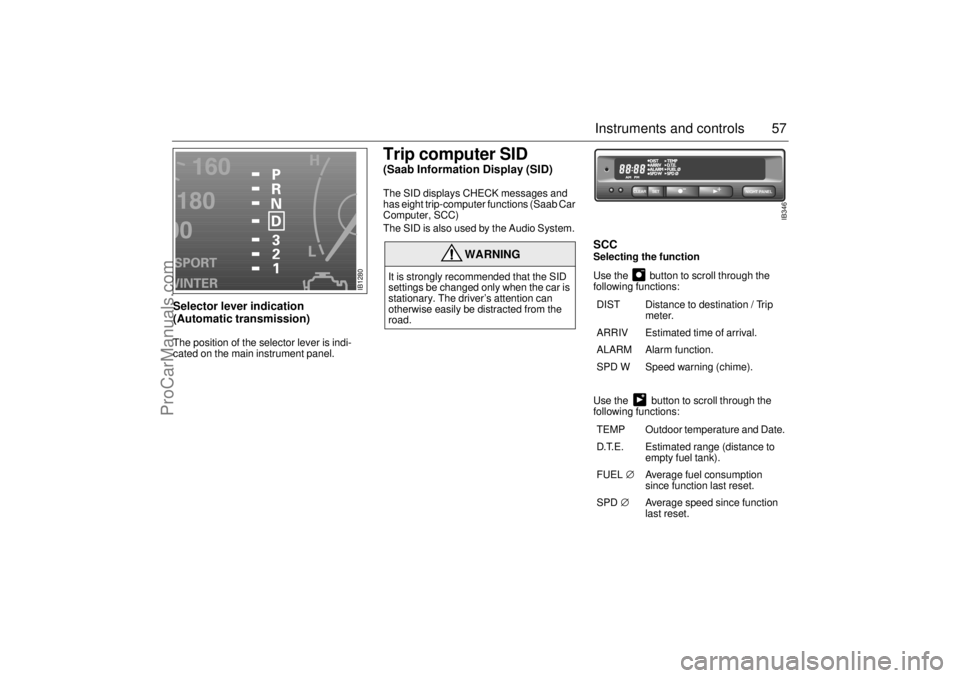
Selector lever indication
(Automatic transmission) The position of the selector lever is indi-
cated on the main instrument panel.
Trip computer SID (Saab Information Display (SID) The SID displays CHECK messages and
has eight trip-computer functions (Saab Car
Computer, SCC)
The SID is also used by the Audio System.
SCCSelecting the function
Use the button to scroll through the
following functions:
Use the button to scroll through the
following functions:
WARNING
It is strongly recommended that the SID
settings be changed only when the car is
stationary. The driver’s attention can
otherwise easily be distracted from the
road.
DIST Distance to destination / Trip
meter.
ARRIV Estimated time of arrival.
ALARM Alarm function.
SPD W Speed warning (chime).
TEMP Outdoor temperature and Date.
D.T.E. Estimated range (distance to
empty fuel tank).
FUEL∅ Average fuel consumption
since function last reset.
SPD∅ Average speed since function
last reset.
NIGHT PANEL
CLEAR
SET
IB346
IB1280
ProCarManuals.com
Page 62 of 272
62 Instruments and controlsThe following conditions will wake up the
respective displays in the Night-Panel
mode:
Setting of the Audio system, SID or ACC
(display comes on for ten seconds).
CHECK message generated in the SID.
High engine revs cause the rev counter to
be illuminated until the engine speed has
fallen again.
If the quantity of fuel remaining falls below
4 gallons (15 liters), the fuel gauge will be
illuminated.
If the engine temperature rises above nor-
mal, the temperature gauge will be illumi-
nated.
If the speed of the car exceeds 84 mph
(135 km/h), the entire speedometer will
be illuminated.
In cars with automatic transmission, if the
selector lever is moved from D to position
3, 2 or 1, the selector indication on the
main instrument panel will be illuminated.
To restore the displays and lighting to the
normal mode, press the Night-Panel button.
Units and language versionsThe SID has four sets of units:
CHECK messages can be displayed in six
language options: English, Swedish,
German, French, Italian and Spanish. Selecting units and language 1 Press CLEAR and SET simultaneously
for four seconds until a chime sounds.
2 Press or to select the required
units.
3 Touch SET.
4 Press or to select the required
language.
5 Touch SET.
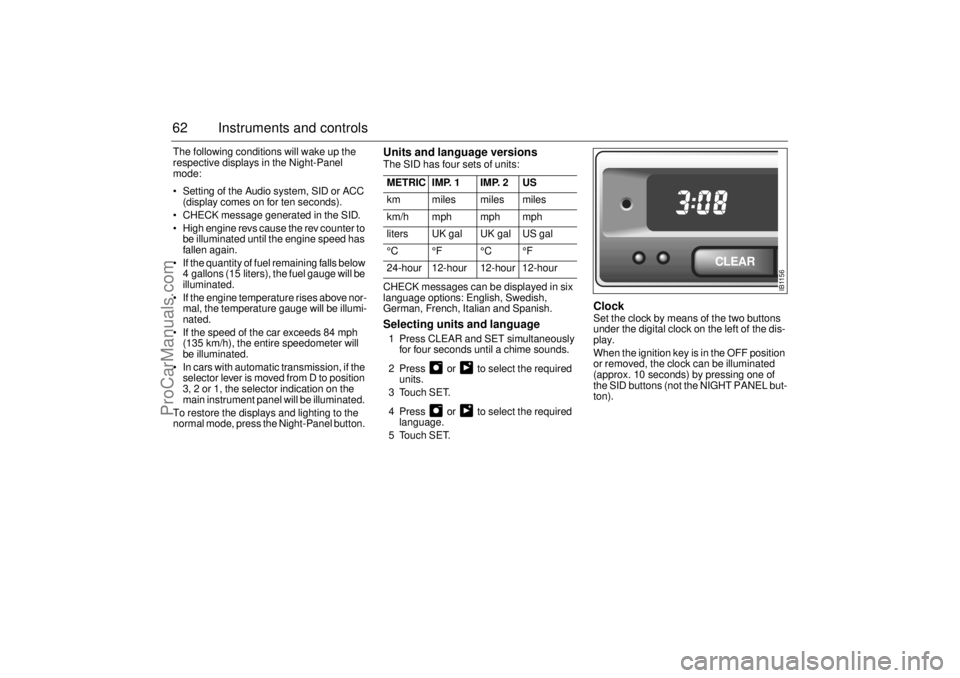
Clock Set the clock by means of the two buttons
under the digital clock on the left of the dis-
play.
When the ignition key is in the OFF position
or removed, the clock can be illuminated
(approx. 10 seconds) by pressing one of
the SID buttons (not the NIGHT PANEL but-
ton). METRIC IMP. 1 IMP. 2 US
km miles miles miles
km/h mph mph mph
liters UK gal UK gal US gal
°C °F °C °F
24-hour 12-hour 12-hour 12-hour
IB1156
CLEAR
ProCarManuals.com
Page 148 of 272
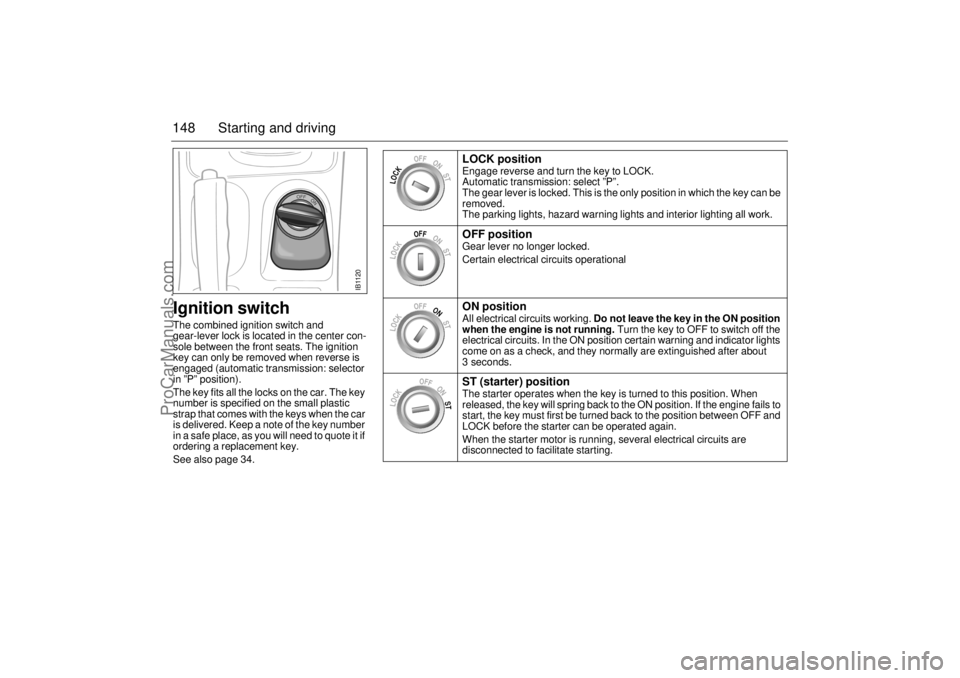
148 Starting and drivingIgnition switchThe combined ignition switch and
gear-lever lock is located in the center con-
sole between the front seats. The ignition
key can only be removed when reverse is
engaged (automatic transmission: selector
in ”P” position).
The key fits all the locks on the car. The key
number is specified on the small plastic
strap that comes with the keys when the car
is delivered. Keep a note of the key number
in a safe place, as you will need to quote it if
ordering a replacement key.
See also page 34.
LOCK position Engage reverse and turn the key to LOCK.
Automatic transmission: select ”P”.
The gear lever is locked. This is the only position in which the key can be
removed.
The parking lights, hazard warning lights and interior lighting all work. OFF position Gear lever no longer locked.
Certain electrical circuits operationalON position All electrical circuits working. Do not leave the key in the ON position
when the engine is not running. Turn the key to OFF to switch off the
electrical circuits. In the ON position certain warning and indicator lights
come on as a check, and they normally are extinguished after about
3 seconds.ST (starter) position The starter operates when the key is turned to this position. When
released, the key will spring back to the ON position. If the engine fails to
start, the key must first be turned back to the position between OFF and
LOCK before the starter can be operated again.
When the starter motor is running, several electrical circuits are
disconnected to facilitate starting.
LOCK
OFFONST
LOCK
OFFONST
LOCK
OFFONST
LOCK
OFFONST
IB1120
ProCarManuals.com
Page 149 of 272
149 Starting and driving
If the car does not startIf the text ”KEY NOT ACCEPTED” is shown
on the SID, after a failed start attempt, the
cause could be a fault in the transmitter in
the key, or in the receiver in the ignition lock.
The following should be done:
Turn the key back to the LOCK position.
Turn the key to ON.
Press one of the buttons on the remote
control (the LED stops blinking).
Start the engine.
Try another key. If this works, then the fault
is in the first key.
Contact an authorized Saab dealer for
checking and rectification.
Starting the engine
NOTETake care not to spill drinks or to drop
crumbs over the ignition switch. If dirt or
liquid gets into it, the switch may not
operate properly.
WARNING
Always remove the key before leaving
the car.
Always apply the parking brake before
removing the ignition key.
WARNING
When starting the engine:
- Sit down in the driver’s seat.
- Depress the clutch pedal fully. If gear
lever is not in the neutral position, the
clutch pedal must be fully depressed
or the car will jump forwards or back-
wards, which may cause an acci-
dent.
- Never start the car from outside the
vehicle, e.g. through a wound down
window. This could lead to serious
personal injury.
Engage reverse (R) (position P for
automatic transmission) to remove the
ignition key. The key can only be
removed in this gear position.
Carbon monoxide (CO) is a colorless,
odorless, poisonous gas. Be alert to
the danger of CO – always open the
garage doors before starting the
engine in the garage.
There is also a danger of CO poison-
ing if the exhaust system is leaking.
ProCarManuals.com