charging SAAB 9-5 2001 Owners Manual
[x] Cancel search | Manufacturer: SAAB, Model Year: 2001, Model line: 9-5, Model: SAAB 9-5 2001Pages: 272, PDF Size: 14.83 MB
Page 8 of 272
8
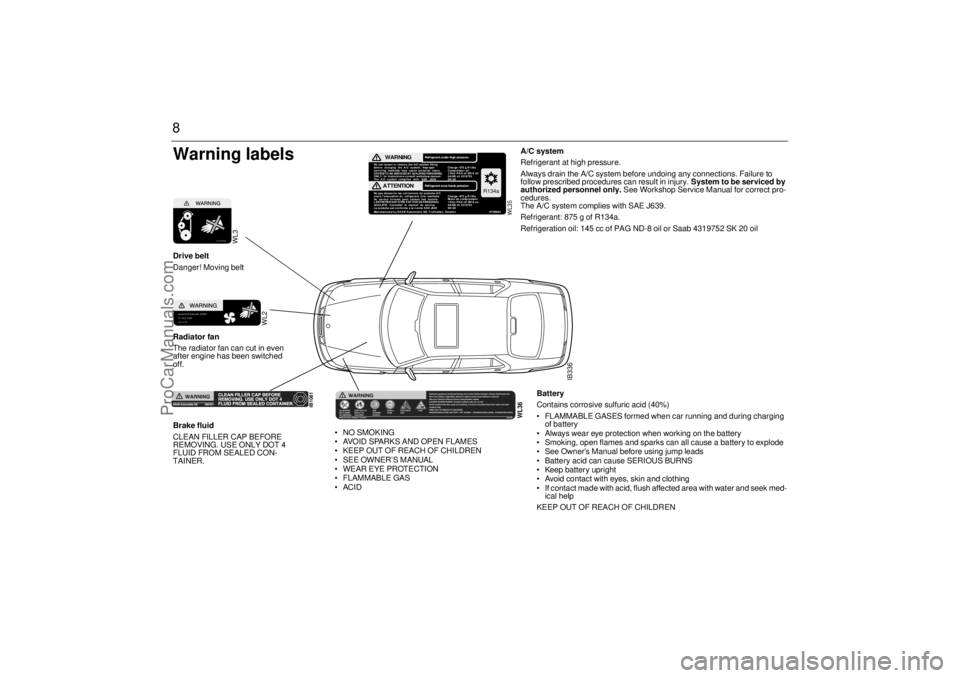
Battery
Contains corrosive sulfuric acid (40%)
FLAMMABLE GASES formed when car running and during charging
of battery
Always wear eye protection when working on the battery
Smoking, open flames and sparks can all cause a battery to explode
See Owner’s Manual before using jump leads
Battery acid can cause SERIOUS BURNS
Keep battery upright
Avoid contact with eyes, skin and clothing
If contact made with acid, flush affected area with water and seek med-
ical help
KEEP OUT OF REACH OF CHILDREN Brake fluid
CLEAN FILLER CAP BEFORE
REMOVING. USE ONLY DOT 4
FLUID FROM SEALED CON-
TAINER. Radiator fan
The radiator fan can cut in even
after engine has been switched
off.
WL2
IB336
Drive belt
Danger! Moving belt
WL3
A/C system
Refrigerant at high pressure.
Always drain the A/C system before undoing any connections. Failure to
follow prescribed procedures can result in injury. System to be serviced by
authorized personnel only. See Workshop Service Manual for correct pro-
cedures.
The A/C system complies with SAE J639.
Refrigerant: 875 g of R134a.
Refrigeration oil: 145 cc of PAG ND-8 oil or Saab 4319752 SK 20 oil
Warning labels
IB1081
WL35
Do not loosen or remove the A/C system fitting
before charging the A/C system. Improper
servicing methods may cause personal injury.SYSTEM TO BE SERVICED BY QUALIFIED PERSONNELONLY. for instructions consult workshop manual.
The A/C system complies with SAE J639
Ne pas desserrer les connexions du systeme A/C
avant l’evacuation du refrigerant. Une methode
de service erronee peut causes des lesions.L’ENTRETIEN DOIT ETRE FAIT PAR UN PERSONNALQUALIFIE. Consulter le manuel de service.
ca systeme eat conforme a la norme SAE J639
Manufactured by SAAB Automobile AB, Trollhatten, Sweden
4756961
Charge: 875 g R134a
Compressor oil:
145cc PAG oil ND-8 alt
SAAB oil 4319752
SK-20
Charge: 875 g R134a
Muile de compresseur
145cc PAG oil ND-8 ou
SAAB oil 4319752
SK-20
R134a
WARNING
Refrigerant under high pressure
ATTENTION
Refrigerant sous haute pression
WL36
NO SMOKING
AVOID SPARKS AND OPEN FLAMES
KEEP OUT OF REACH OF CHILDREN
SEE OWNER’S MANUAL
WEAR EYE PROTECTION
FLAMMABLE GAS
ACID
ProCarManuals.com
Page 49 of 272
49 Instruments and controls
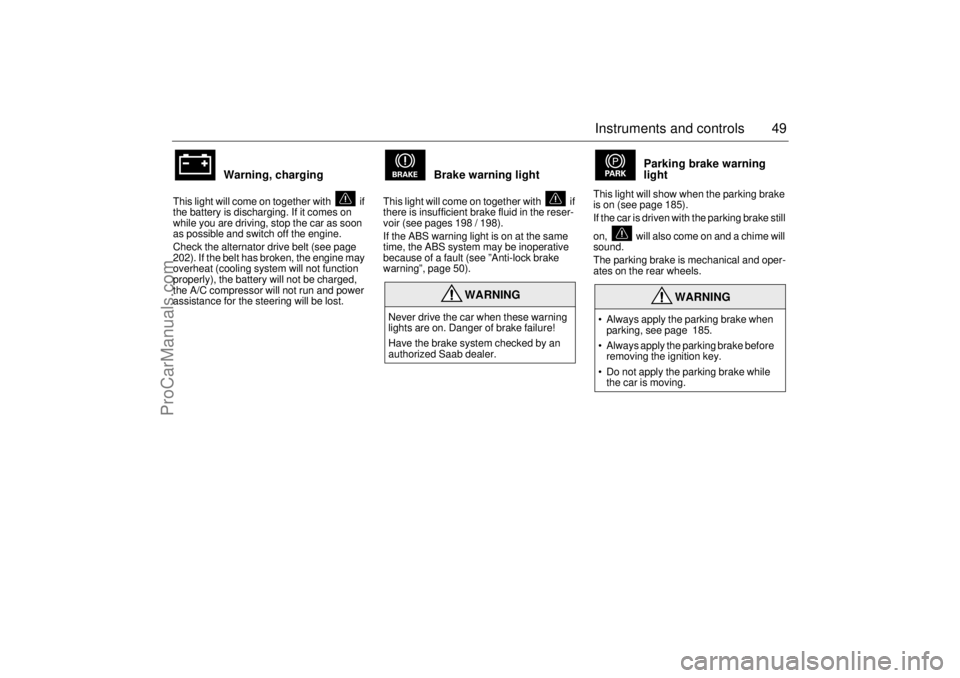
Warning, charging
This light will come on together with if
the battery is discharging. If it comes on
while you are driving, stop the car as soon
as possible and switch off the engine.
Check the alternator drive belt (see page
202). If the belt has broken, the engine may
overheat (cooling system will not function
properly), the battery will not be charged,
the A/C compressor will not run and power
assistance for the steering will be lost.
Brake warning light
This light will come on together with if
there is insufficient brake fluid in the reser-
voir (see pages 198 / 198).
If the ABS warning light is on at the same
time, the ABS system may be inoperative
because of a fault (see ”Anti-lock brake
warning”, page 50).
Parking brake warning
light
This light will show when the parking brake
is on (see page 185).
If the car is driven with the parking brake still
on, will also come on and a chime will
sound.
The parking brake is mechanical and oper-
ates on the rear wheels.
WARNING
Never drive the car when these warning
lights are on. Danger of brake failure!
Have the brake system checked by an
authorized Saab dealer.
WARNING
Always apply the parking brake when
parking, see page 185.
Always apply the parking brake before
removing the ignition key.
Do not apply the parking brake while
the car is moving.
ProCarManuals.com
Page 51 of 272
51 Instruments and controls
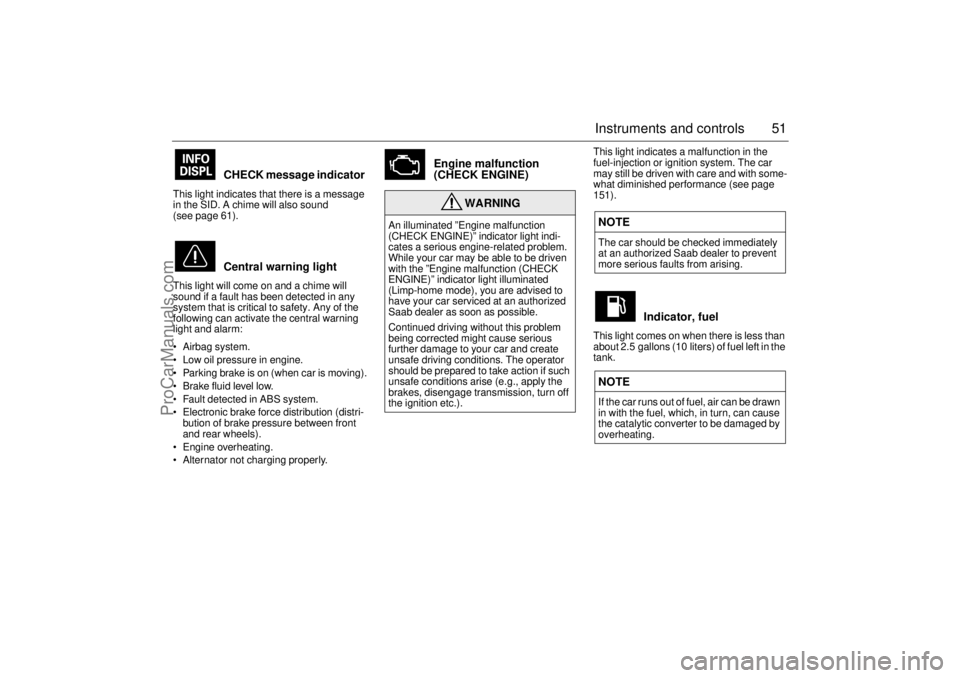
CHECK message indicator
This light indicates that there is a message
in the SID. A chime will also sound
(see page 61).
Central warning light
This light will come on and a chime will
sound if a fault has been detected in any
system that is critical to safety. Any of the
following can activate the central warning
light and alarm:
Airbag system.
Low oil pressure in engine.
Parking brake is on (when car is moving).
Brake fluid level low.
Fault detected in ABS system.
Electronic brake force distribution (distri-
bution of brake pressure between front
and rear wheels).
Engine overheating.
Alternator not charging properly.
Engine malfunction
(CHECK ENGINE)
This light indicates a malfunction in the
fuel-injection or ignition system. The car
may still be driven with care and with some-
what diminished performance (see page
151).
Indicator, fuel
This light comes on when there is less than
about 2.5 gallons (10 liters) of fuel left in the
tank.
WARNING
An illuminated ”Engine malfunction
(CHECK ENGINE)” indicator light indi-
cates a serious engine-related problem.
While your car may be able to be driven
with the ”Engine malfunction (CHECK
ENGINE)” indicator light illuminated
(Limp-home mode), you are advised to
have your car serviced at an authorized
Saab dealer as soon as possible.
Continued driving without this problem
being corrected might cause serious
further damage to your car and create
unsafe driving conditions. The operator
should be prepared to take action if such
unsafe conditions arise (e.g., apply the
brakes, disengage transmission, turn off
the ignition etc.).
NOTEThe car should be checked immediately
at an authorized Saab dealer to prevent
more serious faults from arising.NOTEIf the car runs out of fuel, air can be drawn
in with the fuel, which, in turn, can cause
the catalytic converter to be damaged by
overheating.
ProCarManuals.com
Page 54 of 272
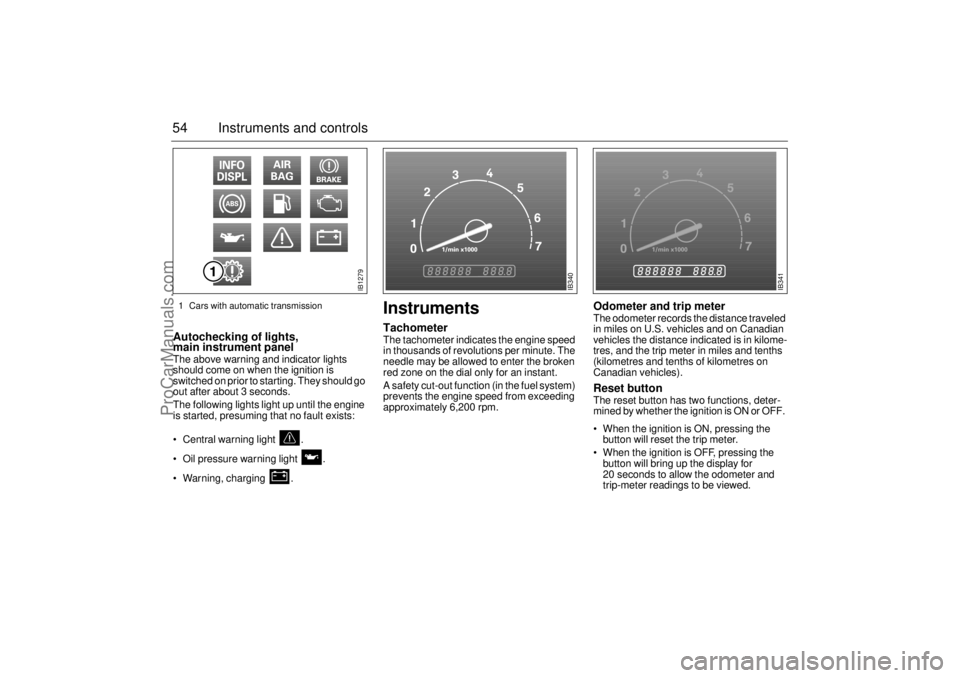
54 Instruments and controlsAutochecking of lights,
main instrument panel The above warning and indicator lights
should come on when the ignition is
switched on prior to starting. They should go
out after about 3 seconds.
The following lights light up until the engine
is started, presuming that no fault exists:
Central warning light .
Oil pressure warning light .
Warning, charging .
InstrumentsTachometerThe tachometer indicates the engine speed
in thousands of revolutions per minute. The
needle may be allowed to enter the broken
red zone on the dial only for an instant.
A safety cut-out function (in the fuel system)
prevents the engine speed from exceeding
approximately 6,200 rpm.
Odometer and trip meter The odometer records the distance traveled
in miles on U.S. vehicles and on Canadian
vehicles the distance indicated is in kilome-
tres, and the trip meter in miles and tenths
(kilometres and tenths of kilometres on
Canadian vehicles). Reset button The reset button has two functions, deter-
mined by whether the ignition is ON or OFF.
When the ignition is ON, pressing the
button will reset the trip meter.
When the ignition is OFF, pressing the
button will bring up the display for
20 seconds to allow the odometer and
trip-meter readings to be viewed.
IB1279
IB340
IB341
1 Cars with automatic transmission
ProCarManuals.com
Page 56 of 272
56 Instruments and controlsCheck fuse 15 (radiator fan) in the fuse
panel under the hood, see page 219.
If the needle repeatedly enters the red zone,
stop the car as soon as it is safe to do so and
check the coolant level by looking at the
level visible through the plastic tank - do not
remove the cap.
If the coolant level falls below the MIN mark,
the SID will display the message ”FILL
COOLANT FLUID”.
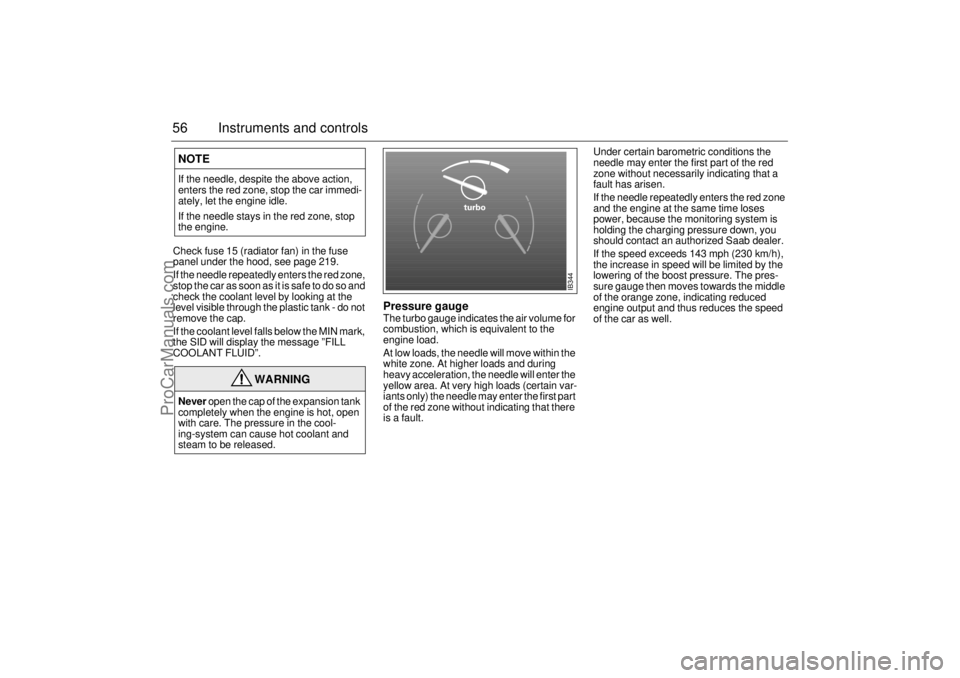
Pressure gaugeThe turbo gauge indicates the air volume for
combustion, which is equivalent to the
engine load.
At low loads, the needle will move within the
white zone. At higher loads and during
heavy acceleration, the needle will enter the
yellow area. At very high loads (certain var-
iants only) the needle may enter the first part
of the red zone without indicating that there
is a fault.Under certain barometric conditions the
needle may enter the first part of the red
zone without necessarily indicating that a
fault has arisen.
If the needle repeatedly enters the red zone
and the engine at the same time loses
power, because the monitoring system is
holding the charging pressure down, you
should contact an authorized Saab dealer.
If the speed exceeds 143 mph (230 km/h),
the increase in speed will be limited by the
lowering of the boost pressure. The pres-
sure gauge then moves towards the middle
of the orange zone, indicating reduced
engine output and thus reduces the speed
of the car as well.
NOTEIf the needle, despite the above action,
enters the red zone, stop the car immedi-
ately, let the engine idle.
If the needle stays in the red zone, stop
the engine.
WARNING
Never open the cap of the expansion tank
completely when the engine is hot, open
with care. The pressure in the cool-
ing-system can cause hot coolant and
steam to be released.
IB344
ProCarManuals.com
Page 103 of 272
103 Saab 9-5 Audio System
Installation of car phone
(option)Provision has been made on the Saab 9-5
for the installation of a hands-free car
phone.
A car-phone mount is available as an acces-
sory.
Your Saab dealer has details of proper
phone installation procedures. Roof loads can negatively affect tele-
communication.
Provision for hands-free phone
Car phone connects to car’s circuitry.
External antenna is fitted.
Microphone for hands-free phone use
incorporated in overhead panel at front.
Audio System mute function when phone
activated.
Phone conversation amplified through
Audio System speakers.
TELEPHONE appears on the SID when
phone in use. Volume level for ongoing conversation
can be adjusted by volume controls on
steering wheel or on Audio System
module (see also ”Volume-preset mode”,
page 97).
If the sound is distorted, adjust by means
of the volume control on
telephone set
.
Phone battery charging when phone is in
its cradle.
Please refer to the instructions supplied with
the phone for details of how to make and
receive calls. In order to fully utilize the
hands-free function, certain circuits must be
available from the telephone to be installed.
Your authorized Saab dealer has this infor-
mation available.
WARNING
To prevent crashes while using a cell
phone:
Don’t use the phone in distracting traf-
fic situations. Turn it off if traffic is
heavy.
Dial sensibly, at a stoplight or safely off
the road.
Consider installing hands-free or
speaker phone.
Avoid stressful and intense phone
conversations.
Acquaint yourself with the legal provi-
sions governing the use of car phones
while driving.
Do not use the phone when refueling
the vehicle. Gasoline fumes are highly
explosive.
NOTEThe A-pillar area (area beside the wind-
shield) and the headlining of your Saab
contain padding designed to reduce head
injuries. No modifications to these areas
should be made unless done by your
authorized Saab dealer.
ProCarManuals.com
Page 201 of 272
201 Car care and technical information
Charging/replacing the batteryConnect the positive lead to the positive (+)
battery terminal (red), and the negative lead
to a good ground point, e.g. the lifting lug at
the front of the engine.
To remove the battery, always disconnect
the negative (black) lead first and reconnect
it last when fitting the new battery.
The battery size must comply with DIN
53735 MFI 230/2.16. NOTETo avert the danger of short-circuiting
between the positive (+) terminal on the
battery and the inlet manifold on the
engine, always disconnect the negative
(-) battery lead first and reconnect it last.NOTE Never reverse the polarity of the bat-
tery by connecting the leads to the
wrong terminals. The red, positive
lead connects to the positive (+) termi-
nal, and the black, negative lead to the
negative (-) terminal.
Serious damage can be done to the
car’s electrical system if a battery or
alternator lead is disconnected while
the engine is running.
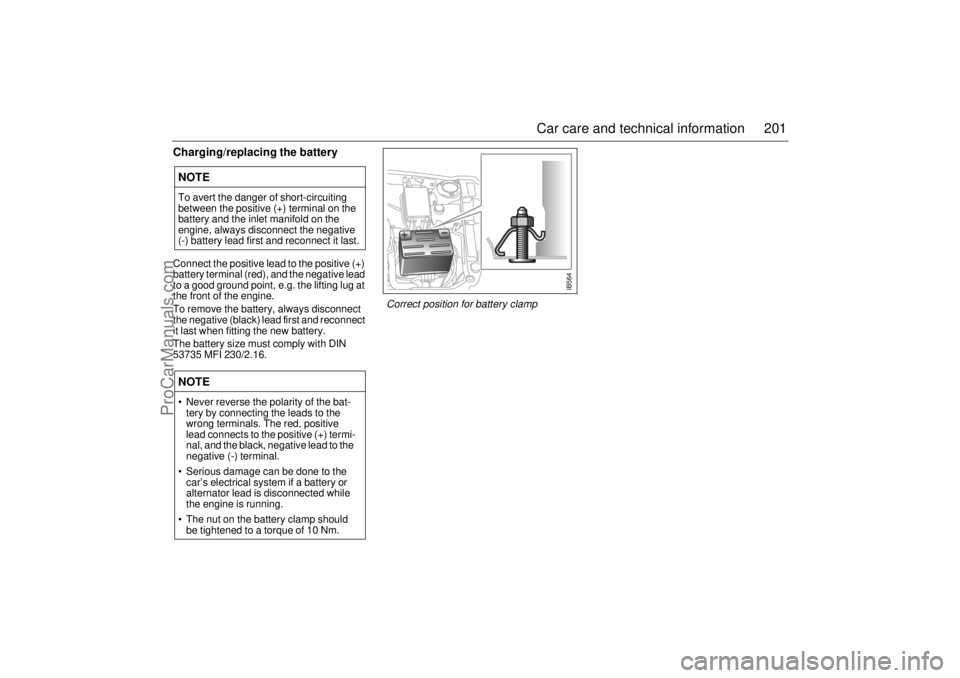
The nut on the battery clamp should
be tightened to a torque of 10 Nm.
IB564
Correct position for battery clamp
ProCarManuals.com
Page 202 of 272
202 Car care and technical informationDrive belts The alternator is situated on the right-hand
side of the engine, adjacent to the bulkhead.
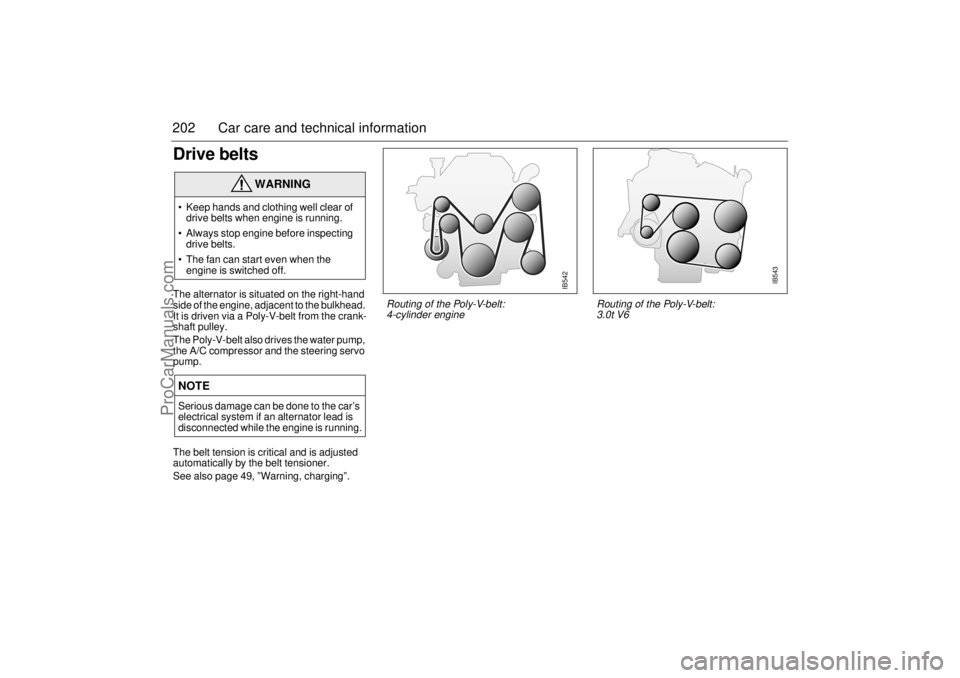
It is driven via a Poly-V-belt from the crank-
shaft pulley.
The Poly-V-belt also drives the water pump,
the A/C compressor and the steering servo
pump.
The belt tension is critical and is adjusted
automatically by the belt tensioner.
See also page 49, ”Warning, charging”.
WARNING
Keep hands and clothing well clear of
drive belts when engine is running.
Always stop engine before inspecting
drive belts.
The fan can start even when the
engine is switched off.NOTESerious damage can be done to the car’s
electrical system if an alternator lead is
disconnected while the engine is running.
IB542
Routing of the Poly-V-belt:
4-cylinder engine
IB543
Routing of the Poly-V-belt:
3.0t V6
ProCarManuals.com
Page 230 of 272
230 Car care and technical informationAir conditioning
(ACC)
Fault diagnosis If a fault occurs in the A/C system, there are
a number of checks you can perform your-
self. If the fault persists, however, have the
system checked by an authorized Saab
dealer.
Important!
When the A/C system is running, the intake
air is dehumidified, and the resultant con-
densation is drained off through two outlets
underneath the floor of the car in the vicinity
of the front doors. It is therefore perfectly
normal for water to be seen dripping from
these outlets when the car is parked. The
warmer the ambient air and the higher the
humidity, the greater will be the amount of
condensation formed.
Inadequate cooling:
a Check that the condenser (forward of
the radiator) has not become clogged
with dirt and insects.
b Make sure that the drive belt for the com-
pressor is not slipping.
c Check the fuses for the ventilation fans
and compressor.
Maintenance The drive belt for the compressor should
be inspected under the regular service
program.
Clean dirt and insects away from the con-
denser and radiator to prevent clogging.
When washing the car, use the hose to
spray the radiator and condenser (located
forward of the radiator) from both sides
(both from the front of the car and from
inside the engine bay). Do not use a pres-
sure washer.
Caution: Do not use the hose when the
engine is hot.
Other than in extremely cold weather, do not
screen the radiator, e.g. with netting, as this
will greatly diminish its cooling capacity.
Note: The A/C system will only operate
when the outdoor temperature is above the
freezing point (0°C, 32°F).
NOTE The A/C system is designed for use
with R134a refrigerant.
Refrigerant handling requires special
equipment and special procedures for
charging and draining the system.
All repairs and adjustments on the A/C
system must be carried out by a Saab
dealer authorized for this kind of work.
Never mix R134a and R12 refriger-
ants.
WARNING
The A/C system is pressurized. Do not
break any connections or undo A/C
system components.
Escaping gas can cause blindness or
other injury.
ProCarManuals.com
Page 263 of 272

263 Index
Index
AA/C system, fault diagnosis
_______ 230
A/C system, maintenance
_________ 230
ABS brakes
____________________ 167
ACC
__________________________ 70
ACC functions
___________________ 73
ACC, automatic climate control
_____ 70
ACC, calibration
_________________ 78
ACC, condensation _______________ 79
ACC, programming _______________ 76
ACC, useful tips
_________________ 78
Adjusting the steering wheel
_______ 124
Adjustment, seats
_______________ 120
Afterheater, V6-engine cars
________ 80
Air conditioning (A/C), fault diagnosis
and maintenance
______________ 230
Air distribution, ACC ______________ 75
Airbag
_________________________ 26
Alarm _________________________ 41
Alarm functions
__________________ 44
Alarm signals
_______________ 41
, 44
Alternator
_____________________ 202
Alternator drive belt
_________ 202
, 255
Alternator rating
________________ 254
Anticorrosion treatment
___________ 234
Antidazzle rear-view mirror
________ 126
Ashtrays
______________________ 130
Audio System
___________________ 81
Audio System, quick guide
_________ 83Autochecking of lights on starting
____54
Automatic climate control (ACC) _____70
Automatic transmission,
technical data
_________________256
BBattery
________________________199
Battery charging/replacing
________201
Battery, boost starting
____________183
Belt guide
______________________12
Boost starting using jump leads
____183
Booster cushion
_________________24
Brake and clutch fluid
____________198
Brake-fluid reservoir
_____________198
Brakes, technical data ____________257
Bulbs, changing
________________205
Bulbs, table of
__________________214
CCD changer
_____________________93
CD player
______________________91
CHECK messages
_______________61
CHECKING
_____________________61
Calibration, ACC
_________________78
Cancelling the programmed settings
_76
Car alarm
______________________41
Car care
______________________187
Car phone, installation
___________103
Cargo net, 9-5 Wagon ____________141
Carpeting, care of
_______________232Cassette player
_________________ 88
Catalytic converter,
important considerations
________ 152
Central locking
__________________ 34
Change language in SID
__________ 62
Change of address notification
____ 244
Changing a wheel
______________ 226
Changing bulbs
________________ 205
Changing the coolant
___________ 197
Changing the wheels round
_______ 222
Changing wiper blades
__________ 203
Chassis number
_______________ 259
Chassis number, key to
__________ 260
Child safety
____________________ 19
Child safety locks, rear doors
______ 37
Child seat, integral
_______________ 24
Cleaning, engine bay ____________ 233
Clock
______________________ 61
, 62
Colour code, body
______________ 259
Colour code, trim _______________ 259
Compact spare wheel
___________ 225
Condensation, ACC
______________ 79
Coolant
______________________ 196
Coolant, changing
______________ 197
Courtesy Headlight Feature
_______ 64
Cruise control
_________________ 166
Cup holder
____________________ 133
DDICE/TWICE
__________________ 216
Dampers
_____________________ 256
ProCarManuals.com