power steering SAAB 9-5 2001 Owners Manual
[x] Cancel search | Manufacturer: SAAB, Model Year: 2001, Model line: 9-5, Model: SAAB 9-5 2001Pages: 272, PDF Size: 14.83 MB
Page 5 of 272
5
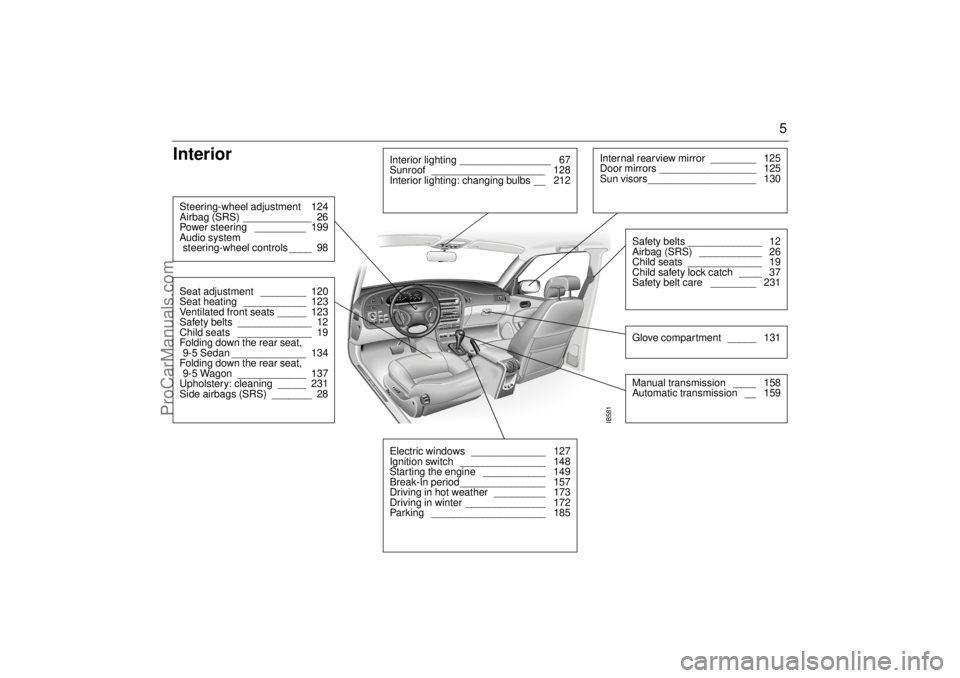
Interior
IB581Internal rearview mirror ________ 125
Door mirrors _________________ 125
Sun visors___________________ 130
Safety belts _____________ 12
Airbag (SRS) ___________ 26
Child seats _____________ 19
Child safety lock catch ____ 37
Safety belt care ________ 231Glove compartment _____ 131Manual transmission ____ 158
Automatic transmission __ 159
Electric windows _____________ 127
Ignition switch _______________ 148
Starting the engine ___________ 149
Break-In period_______________ 157
Driving in hot weather _________ 173
Driving in winter ______________ 172
Parking ____________________ 185
Steering-wheel adjustment 124
Airbag (SRS) ____________ 26
Power steering _________ 199
Audio system
steering-wheel controls ____ 98Seat adjustment ________ 120
Seat heating ___________ 123
Ventilated front seats _____ 123
Safety belts _____________ 12
Child seats _____________ 19
Folding down the rear seat,
9-5 Sedan _____________ 134
Folding down the rear seat,
9-5 Wagon ____________ 137
Upholstery: cleaning _____ 231
Side airbags (SRS) _______ 28
Interior lighting ________________ 67
Sunroof ____________________ 128
Interior lighting: changing bulbs __ 212
ProCarManuals.com
Page 6 of 272
6Engine compartment,
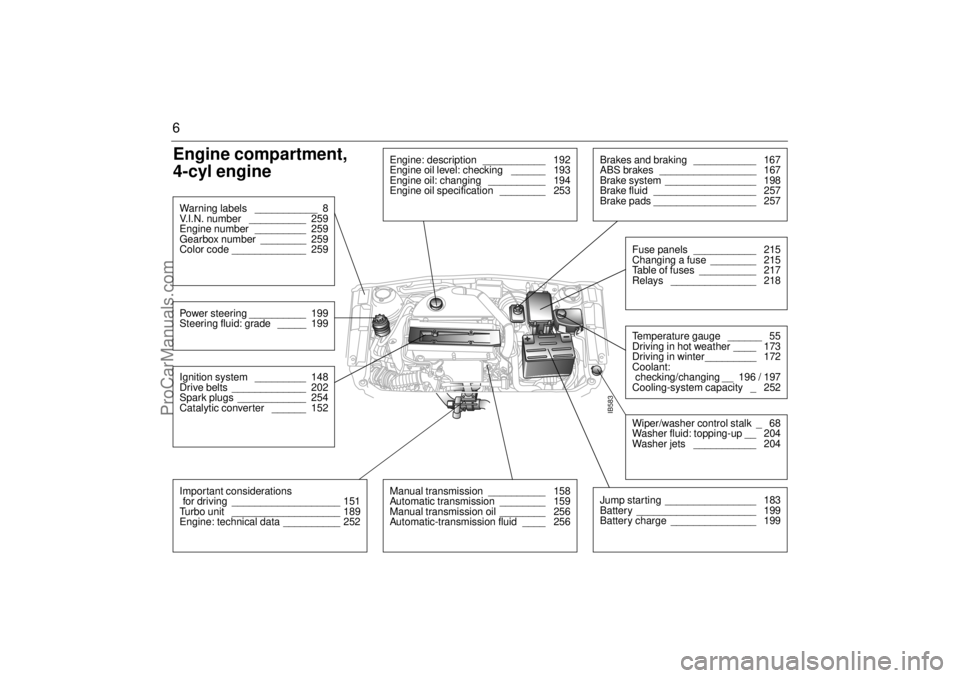
4-cyl engine
IB583
Engine: description ___________ 192
Engine oil level: checking ______ 193
Engine oil: changing __________ 194
Engine oil specification ________ 253
Brakes and braking ___________ 167
ABS brakes _________________ 167
Brake system ________________ 198
Brake fluid __________________ 257
Brake pads __________________ 257
Fuse panels ___________ 215
Changing a fuse ________ 215
Table of fuses __________ 217
Relays _______________ 218Temperature gauge ______ 55
Driving in hot weather ____ 173
Driving in winter_________ 172
Coolant:
checking/changing __ 196 / 197
Cooling-system capacity _ 252
Power steering __________ 199
Steering fluid: grade _____ 199
Wiper/washer control stalk _ 68
Washer fluid: topping-up __ 204
Washer jets ___________ 204
Jump starting ________________ 183
Battery _____________________ 199
Battery charge _______________ 199
Manual transmission __________ 158
Automatic transmission ________ 159
Manual transmission oil ________ 256
Automatic-transmission fluid ____ 256
Important considerations
for driving ___________________ 151
Turbo unit ___________________ 189
Engine: technical data __________ 252Ignition system _________ 148
Drive belts _____________ 202
Spark plugs ____________ 254
Catalytic converter ______ 152Warning labels ___________ 8
V.I.N. number __________ 259
Engine number _________ 259
Gearbox number ________ 259
Color code _____________ 259
ProCarManuals.com
Page 7 of 272
7
Engine compartment,
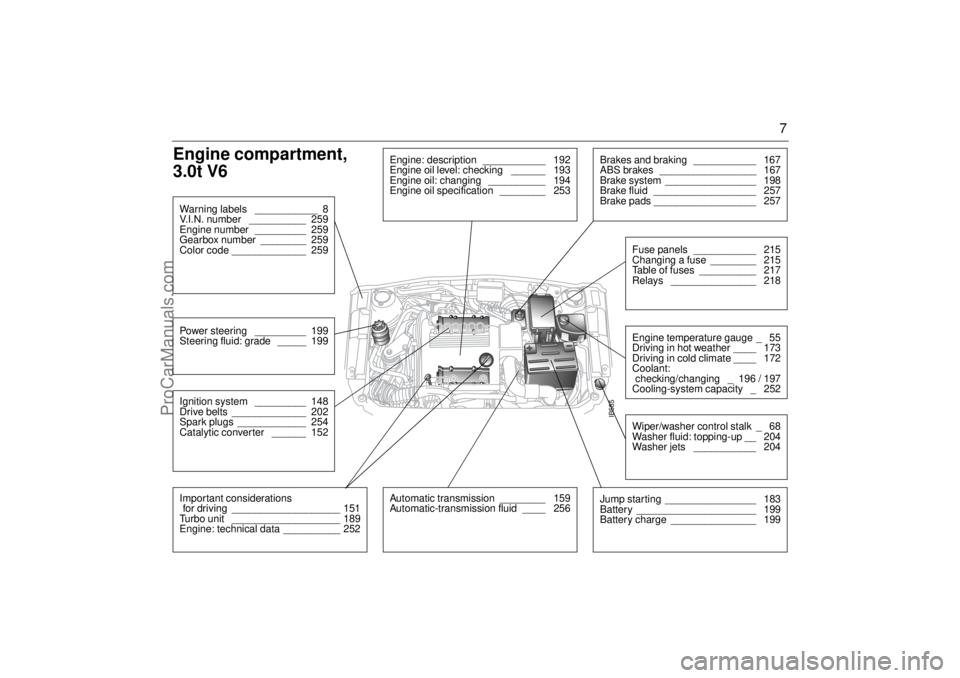
3.0t V6
IB585
Warning labels ___________ 8
V.I.N. number __________ 259
Engine number _________ 259
Gearbox number ________ 259
Color code _____________ 259Ignition system _________ 148
Drive belts _____________ 202
Spark plugs ____________ 254
Catalytic converter ______ 152Important considerations
for driving ___________________ 151
Turbo unit ___________________ 189
Engine: technical data __________ 252
Automatic transmission ________ 159
Automatic-transmission fluid ____ 256
Brakes and braking ___________ 167
ABS brakes _________________ 167
Brake system ________________ 198
Brake fluid __________________ 257
Brake pads __________________ 257Jump starting ________________ 183
Battery _____________________ 199
Battery charge _______________ 199
Fuse panels ___________ 215
Changing a fuse ________ 215
Table of fuses __________ 217
Relays _______________ 218Engine temperature gauge _ 55
Driving in hot weather ____ 173
Driving in cold climate ____ 172
Coolant:
checking/changing _ 196 / 197
Cooling-system capacity _ 252
Power steering _________ 199
Steering fluid: grade _____ 199
Wiper/washer control stalk _ 68
Washer fluid: topping-up __ 204
Washer jets ___________ 204
Engine: description ___________ 192
Engine oil level: checking ______ 193
Engine oil: changing __________ 194
Engine oil specification ________ 253
ProCarManuals.com
Page 30 of 272
30 SafetyAIR BAG warning light
SRS servicingThe SRS must be inspected as part of the
normal service program but otherwise may
be regarded as maintenance-free.
Scrapping or working on airbags
and belt pretensioners Frequently asked questions on func-
tion of airbags
Do you still need to wear a
safety b
elt if air-
bags are fitted?
Yes, always! The airbag merely supple-
ments the car’s normal safety system.
Moreover, the airbag will only be actuated in
a moderate to severe frontal, or near-frontal
collision, which means, of course, that it pro-
vides no protection in minor frontal colli-
sions, major rear-end or side-on collisions
or if the car rolls over.
The safety belts help reduce the chance of
the car occupants from being thrown around
and injured inside the car.
But they also ensure that, if a collision
occurs in which the airbags are inflated, the
airbag will make the optimum contact with
the occupant, i.e. square on from the front.
If the occupant meets the airbag in an offset
position, the protection afforded will be
reduced.
In addition, airbags provide no protection
against a secondary impact occurring in the
same incident. So there is no doubt about
the benefit of wearing safety belts at all
times.
Do not sit too close to the airbag: it needs
room to inflate.
The airbag inflates very quickly and power-
fully in order to protect an adult person in a
serious frontal collision.
WARNING
If the air bag readiness light stays on
after you start your vehicle, it means
the air bag system may not be working
properly.
The air bags in your vehicle may not
inflate in a crash, or they could even
inflate without a crash.
To help avoid injury to yourself or oth-
ers, have your vehicle serviced right
away if the air bag readiness light
stays on after you start your vehicle.
WARNING
Under no circumstances may any
modifications be made that affect the
steering wheel or the airbag’s electri-
cal circuitry.
Before starting any welding work on
the car, always disconnect the nega-
tive (–) battery lead and cover the con-
ductor.
Airbags and belt pretensioners must
be deployed under controlled condi-
tions before the car is scrapped or any
of the system’s components are
removed. Airbags or belt pretension-
ers that have been deployed as a
result of an accident must be replaced
by new ones.
Airbag-system components must
never be transferred for use in another
vehicle.
All work involving the scrapping or
replacement of airbags or belt preten-
sioners must only be carried out by
knowledgeable personnel.
ProCarManuals.com
Page 49 of 272
49 Instruments and controls
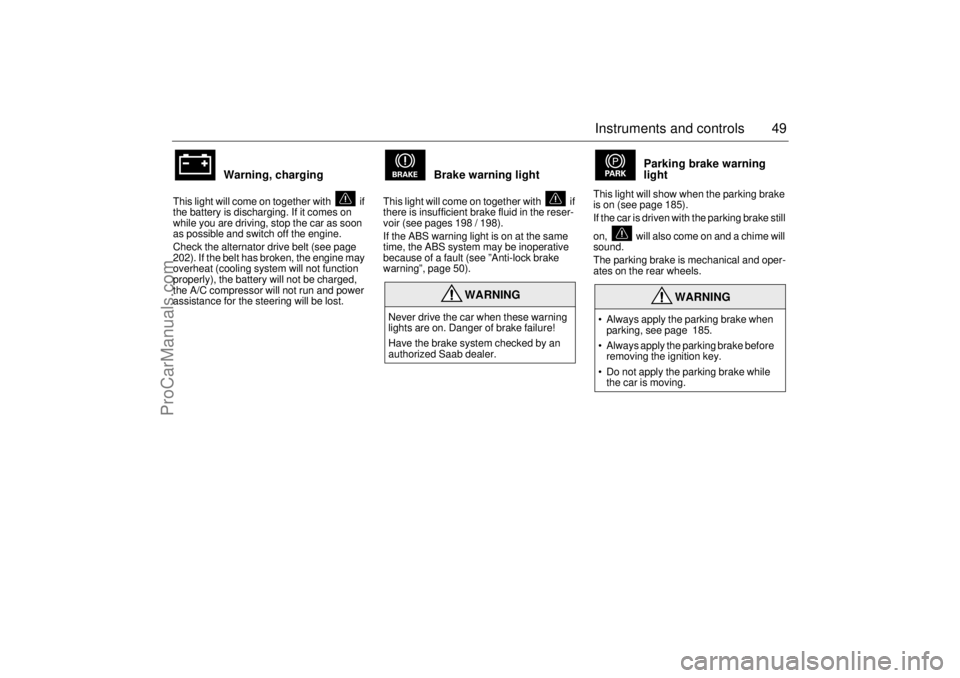
Warning, charging
This light will come on together with if
the battery is discharging. If it comes on
while you are driving, stop the car as soon
as possible and switch off the engine.
Check the alternator drive belt (see page
202). If the belt has broken, the engine may
overheat (cooling system will not function
properly), the battery will not be charged,
the A/C compressor will not run and power
assistance for the steering will be lost.
Brake warning light
This light will come on together with if
there is insufficient brake fluid in the reser-
voir (see pages 198 / 198).
If the ABS warning light is on at the same
time, the ABS system may be inoperative
because of a fault (see ”Anti-lock brake
warning”, page 50).
Parking brake warning
light
This light will show when the parking brake
is on (see page 185).
If the car is driven with the parking brake still
on, will also come on and a chime will
sound.
The parking brake is mechanical and oper-
ates on the rear wheels.
WARNING
Never drive the car when these warning
lights are on. Danger of brake failure!
Have the brake system checked by an
authorized Saab dealer.
WARNING
Always apply the parking brake when
parking, see page 185.
Always apply the parking brake before
removing the ignition key.
Do not apply the parking brake while
the car is moving.
ProCarManuals.com
Page 120 of 272
120 Interior equipment and trunkSeats Both front seats are electrically operated.
On certain models the driver´s seat is
equipped with a memory function.
To facilitate getting into the car, both seats
can be adjusted when either of the front
doors is open.
For safety reasons, if the door is closed, the
seat can only be adjusted when the ignition
is ON.
Note, however, that both seats can be
adjusted for 30 seconds after both doors
have been closed. The following seat adjustments can be
made to achieve a comfortable driving
position:
Height.
Legroom.
Backrest rake angle.
Lumbar support.
Head-restraint height.
We recommend that adjustments to the
driver’s seat be performed in the following
order:
1Height.
2 Legroom.
3 Seat tilt angle.
4 Backrest rake angle.
Lastly, adjust the steering wheel (see page
124).
Side airbags (see page 28).Head restraint(see page 18).
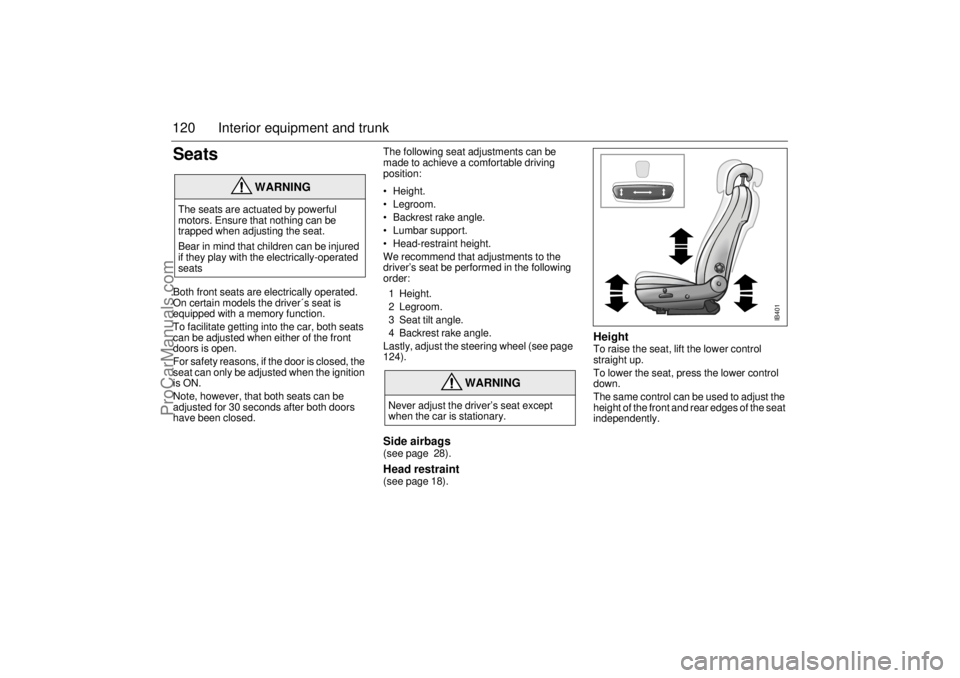
Height To raise the seat, lift the lower control
straight up.
To lower the seat, press the lower control
down.
The same control can be used to adjust the
height of the front and rear edges of the seat
independently.
WARNING
The seats are actuated by powerful
motors. Ensure that nothing can be
trapped when adjusting the seat.
Bear in mind that children can be injured
if they play with the electrically-operated
seats
WARNING
Never adjust the driver’s seat except
when the car is stationary.
IB401
ProCarManuals.com
Page 187 of 272
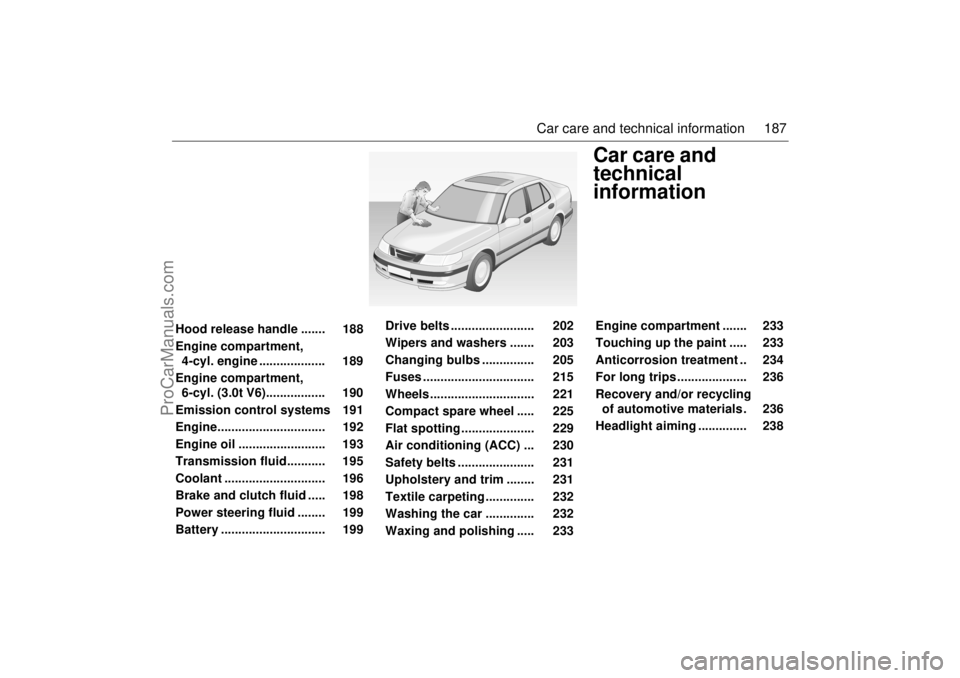
187 Car care and technical information
Car care and
technical
information
Hood release handle ....... 188
Engine compartment,
4-cyl. engine ................... 189
Engine compartment,
6-cyl. (3.0t V6)................. 190
Emission control systems 191
Engine............................... 192
Engine oil ......................... 193
Transmission fluid........... 195
Coolant ............................. 196
Brake and clutch fluid ..... 198
Power steering fluid ........ 199
Battery .............................. 199 Drive belts ........................ 202
Wipers and washers ....... 203
Changing bulbs ............... 205
Fuses ................................ 215
Wheels .............................. 221
Compact spare wheel ..... 225
Flat spotting..................... 229
Air conditioning (ACC) ... 230
Safety belts ...................... 231
Upholstery and trim ........ 231
Textile carpeting.............. 232
Washing the car .............. 232
Waxing and polishing ..... 233 Engine compartment ....... 233
Touching up the paint ..... 233
Anticorrosion treatment .. 234
For long trips .................... 236
Recovery and/or recycling
of automotive materials. 236
Headlight aiming .............. 238
ProCarManuals.com
Page 189 of 272
189 Car care and technical information
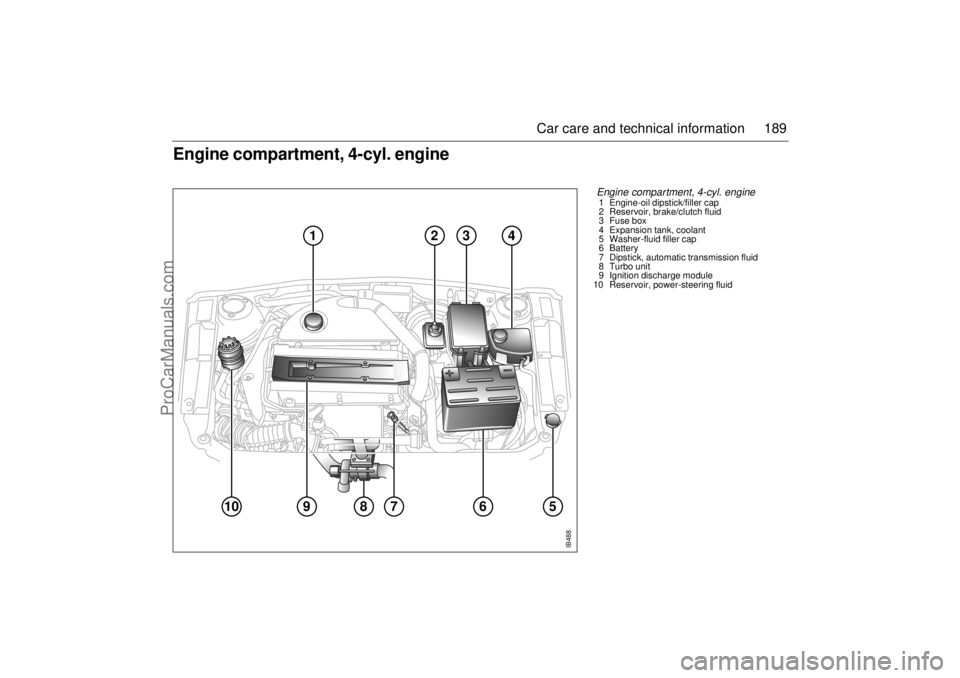
Engine compartment, 4-cyl. engine
8
7
9
10
6
2
4
3
5
IB488
1
Engine compartment, 4-cyl. engine 1 Engine-oil dipstick/filler cap
2 Reservoir, brake/clutch fluid
3 Fuse box
4 Expansion tank, coolant
5 Washer-fluid filler cap
6Battery
7 Dipstick, automatic transmission fluid
8 Turbo unit
9 Ignition discharge module
10 Reservoir, power-steering fluid
ProCarManuals.com
Page 190 of 272
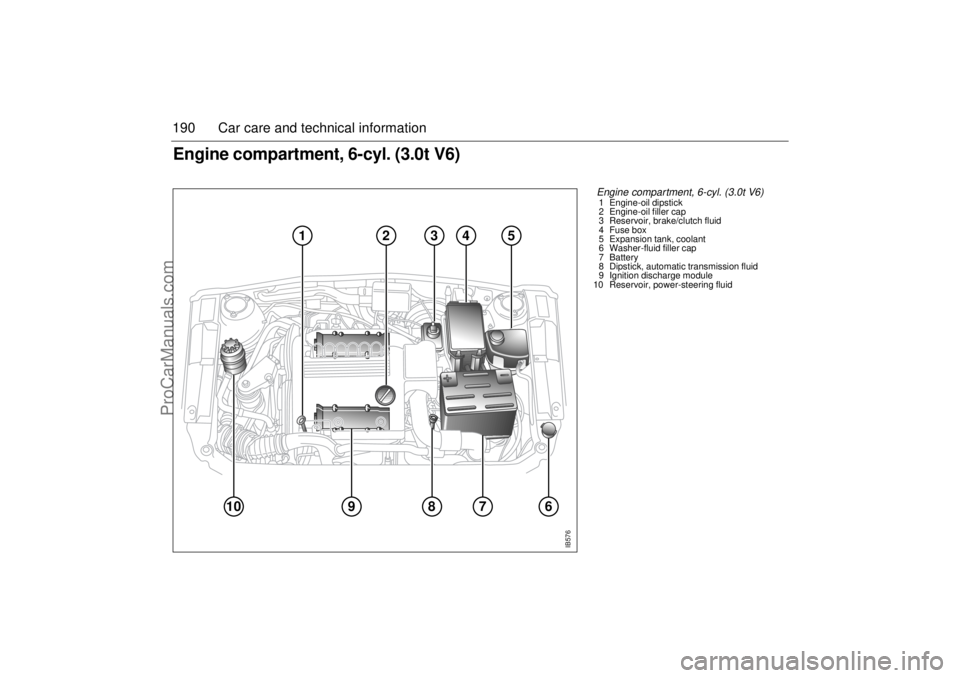
190 Car care and technical informationEngine compartment, 6-cyl. (3.0t V6)
10
7
9
8
1
3
2
5
4
6
IB576
Engine compartment, 6-cyl. (3.0t V6) 1 Engine-oil dipstick
2 Engine-oil filler cap
3 Reservoir, brake/clutch fluid
4 Fuse box
5 Expansion tank, coolant
6 Washer-fluid filler cap
7Battery
8 Dipstick, automatic transmission fluid
9 Ignition discharge module
10 Reservoir, power-steering fluid
ProCarManuals.com
Page 199 of 272
199 Car care and technical information
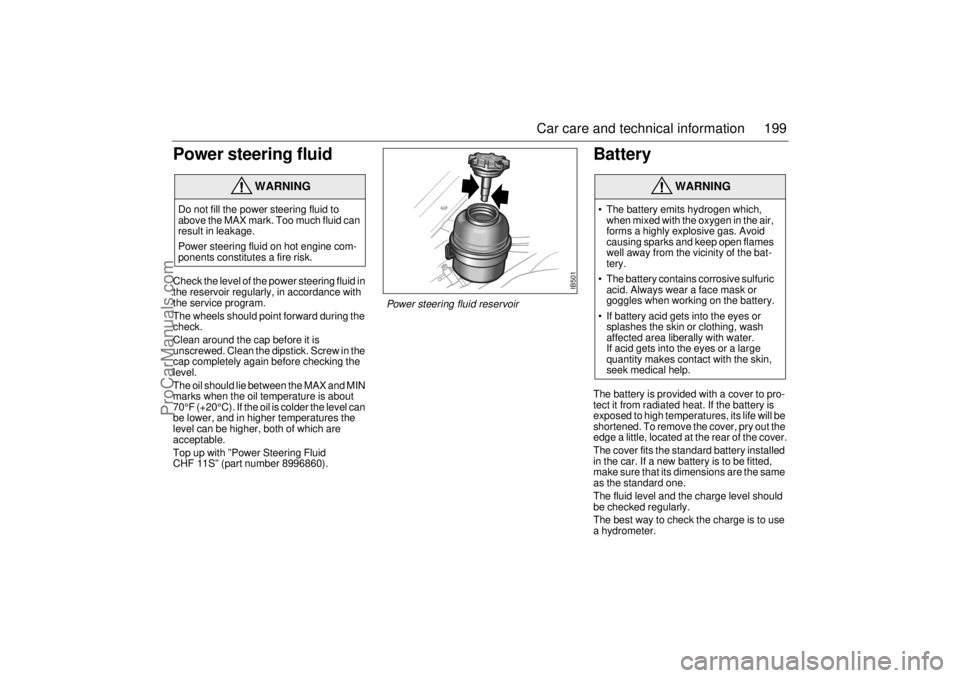
Power steering fluidCheck the level of the power steering fluid in
the reservoir regularly, in accordance with
the service program.
The wheels should point forward during the
check.
Clean around the cap before it is
unscrewed. Clean the dipstick. Screw in the
cap completely again before checking the
level.
The oil should lie between the MAX and MIN
marks when the oil temperature is about
70°F (+20°C). If the oil is colder the level can
be lower, and in higher temperatures the
level can be higher, both of which are
acceptable.
Top up with ”Power Steering Fluid
CHF 11S” (part number 8996860).
BatteryThe battery is provided with a cover to pro-
tect it from radiated heat. If the battery is
exposed to high temperatures, its life will be
shortened. To remove the cover, pry out the
edge a little, located at the rear of the cover.
The cover fits the standard battery installed
in the car. If a new battery is to be fitted,
make sure that its dimensions are the same
as the standard one.
The fluid level and the charge level should
be checked regularly.
The best way to check the charge is to use
a hydrometer.
WARNING
Do not fill the power steering fluid to
above the MAX mark. Too much fluid can
result in leakage.
Power steering fluid on hot engine com-
ponents constitutes a fire risk.
WARNING
The battery emits hydrogen which,
when mixed with the oxygen in the air,
forms a highly explosive gas. Avoid
causing sparks and keep open flames
well away from the vicinity of the bat-
tery.
The battery contains corrosive sulfuric
acid. Always wear a face mask or
goggles when working on the battery.
If battery acid gets into the eyes or
splashes the skin or clothing, wash
affected area liberally with water.
If acid gets into the eyes or a large
quantity makes contact with the skin,
seek medical help.
IB501
Power steering fluid reservoir
ProCarManuals.com