change wheel SAAB 9-5 2002 User Guide
[x] Cancel search | Manufacturer: SAAB, Model Year: 2002, Model line: 9-5, Model: SAAB 9-5 2002Pages: 272, PDF Size: 16.26 MB
Page 175 of 272

175 Starting and driving
Use Normal mode when driving with a trailer
or trailer on hilly roads. The adaptive gear
change pattern function will prevent the
transmission from overheating.
Rises in coolant temperature are indicated
by the temperature gauge in the main instru-
ment panel.
The following can also occur:
the A/C-compressor can be shut off
the gear-change pattern is changed
the CHECK message TRANSMISSION
OVERHEATING can appear on the SID
If TRANSMISSION OVERHEATING
appears on the SID, stop the car as soon as
it is safe to do so and wait until the warning
has been extinguished. When continuing
your journey, select a locked gear (1, 2 or 3)
that will allow you to drive at an engine
speed of about 3,000 rpm (see page 161). Do not drive continuously with the WINTER
mode selected in hilly country when you are
towing a trailer, as this will increase fuel con-
sumption and risk overheating the transmis-
sion.
Driving considerations Always take extra care when towing a
trailer, as the car’s handling will be different
and its braking effect reduced. The trailer’s
braking system and suspension also have a
considerable effect on these characteris-
tics, see also ”Driving with a load” page 178.
If the car is equipped with automatic trans-
mission, select position L when ascending
or descending steep hills.
Trailer hitch loadThe weight distribution on the trailer makes
a lot of difference to the handling properties
of the car and trailer combination. As
regards single-axle trailers, whenever pos-
sible, concentrate the load over the wheels
and keep it as low as possible.
The trailer should be loaded so that the
maximum load on the towbar ball is 5% to
7% of the trailer weight with a maximum per-
missible tongue weight of 165 lbs. (75 kg).
Note that this load must be added to the total
load for the car. If this now exceeds the
specified load capacity, the load in the lug-
gage compartment will have to be reduced
by a corresponding amount.
WARNING
Remember to use engine-braking (selec-
tor position L, 3, or 4) to spare the brakes
when you are driving on a long or steep
downhill slope.
Brake failure can result from overheated
brakes!
NOTEIf the ”Automatic transmission, fault indi-
cator” indicator comes on, cease
towing until the problem has been recti-
fied.
IB106
Distribution of load in trailer a Light
b Moderate
cHeavy
ProCarManuals.com
Page 178 of 272

178 Starting and drivingDriving with a loadThe driving characteristics of the car are
affected by the way it is loaded.
Place heavy loads as far forward and as
low as possible in the trunk.
Secure the load to the tie downs, see
page 134.
The load should be such that the car´s
total weight or axle weight are not
exceeded, see page 248.
Heavy loads mean that the car’s center of
gravity is further back. As a result, the car
will sway more during evasive steering.
Never exceed the permissible load in the
roof box, even if there is room for more.
Ensure that the tire pressure is correct –
slight overinflation is preferable to under-
inflation.
The braking distance of a loaded car is
always greater. Keep your distance from
the vehicle in front.
Roof loads can negatively affect tele-
communication.
Tire pressure, see page 257 and back
cover.
TiresThe tire pressure should match the current
load and speed of the car; see the back
cover or the tire pressure label on
page 257.
The tire pressures given apply to cold tires,
that is tires that are the same temperature
as the outside air temperature.
The tire pressure increases as the tires
become warm (e.g. during highway driving)
with approximately 0.3 bar (4 psi). When
the temperature of the tires changes by 50°
(10°C), the tire pressure will change 0.1 bar
(2 psi).Never reduce the pressure of a hot tire. If the
tires are hot when you check them, only
increase the pressure, if necessary.
Underinflated tires wear more quickly than
slightly overinflated tires.
If a valve is leaking, simply unscrew it and fit
a new one.
Important! Remember to adjust the tire
pressures if you change the load in the car
or intend to drive at substantially lower or
higher speeds than normal.NOTECheck the tire pressure at least once a
month. Underinflation is the main cause
of:
Damage to the wheels.
Premature tire wear.
Damage to the sidewalls.
ProCarManuals.com
Page 197 of 272
197 Car care and technical information
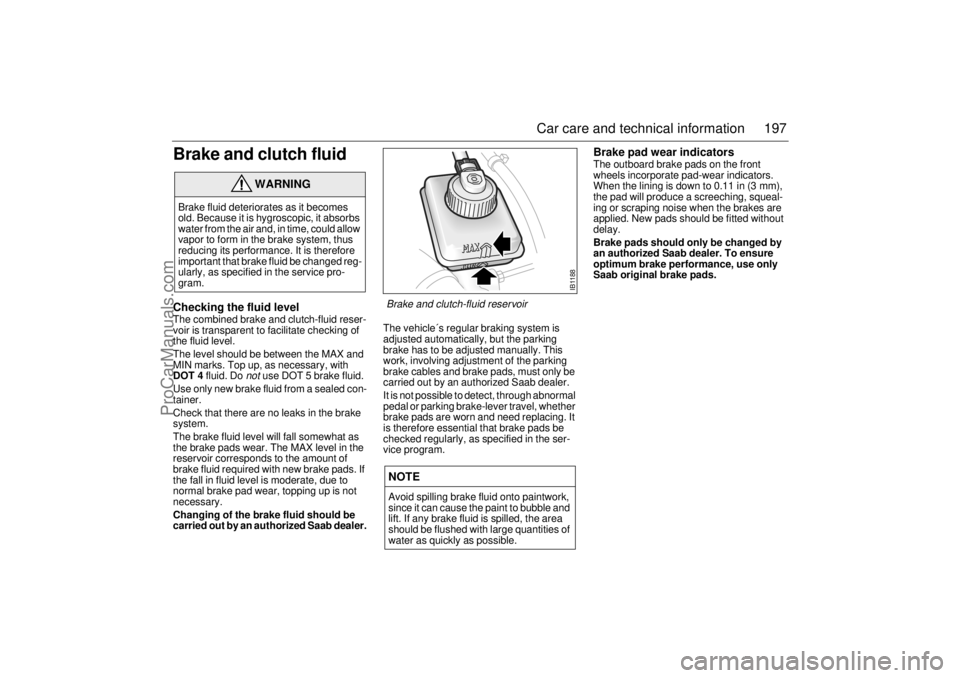
Brake and clutch fluid Checking the fluid level The combined brake and clutch-fluid reser-
voir is transparent to facilitate checking of
the fluid level.
The level should be between the MAX and
MIN marks. Top up, as necessary, with
DOT 4 fluid. Do
not
use DOT 5 brake fluid.
Use only new brake fluid from a sealed con-
tainer.
Check that there are no leaks in the brake
system.
The brake fluid level will fall somewhat as
the brake pads wear. The MAX level in the
reservoir corresponds to the amount of
brake fluid required with new brake pads. If
the fall in fluid level is moderate, due to
normal brake pad wear, topping up is not
necessary.
Changing of the brake fluid should be
carried out by an authorized Saab dealer.The vehicle´s regular braking system is
adjusted automatically, but the parking
brake has to be adjusted manually. This
work, involving adjustment of the parking
brake cables and brake pads, must only be
carried out by an authorized Saab dealer.
It is not possible to detect, through abnormal
pedal or parking brake-lever travel, whether
brake pads are worn and need replacing. It
is therefore essential that brake pads be
checked regularly, as specified in the ser-
vice program.
Brake pad wear indicators The outboard brake pads on the front
wheels incorporate pad-wear indicators.
When the lining is down to 0.11 in (3 mm),
the pad will produce a screeching, squeal-
ing or scraping noise when the brakes are
applied. New pads should be fitted without
delay.
Brake pads should only be changed by
an authorized Saab dealer. To ensure
optimum brake performance, use only
Saab original brake pads.
WARNING
Brake fluid deteriorates as it becomes
old. Because it is hygroscopic, it absorbs
water from the air and, in time, could allow
vapor to form in the brake system, thus
reducing its performance. It is therefore
important that brake fluid be changed reg-
ularly, as specified in the service pro-
gram.
NOTEAvoid spilling brake fluid onto paintwork,
since it can cause the paint to bubble and
lift. If any brake fluid is spilled, the area
should be flushed with large quantities of
water as quickly as possible.
IB1188
Brake and clutch-fluid reservoir
ProCarManuals.com
Page 222 of 272

222 Car care and technical informationWheels Alternative wheels and tiresIf you wish to fit other tires or wheels than
those supplied with the car, consult your
Saab dealer first as to the possibilities avail-
able.
Wheels/tires combinations that are not
approved by Saab can negatively affect the
car´s directional stability, steering and brak-
ing in both wet and dry conditions.
Do not assume that a wheel/tire combina-
tion will function properly just because it will
bolt on.
The wheels and tires have been carefully
matched to the characteristics of the car and
play a key role in its outstanding roadhold-
ing and handling.
To ensure that the speedometer is as accu-
rate as possible it should be reprogrammed
if wheels of a different dimension are fitted.
Contact an authorized Saab workshop.
Tire pressureTires need to be inflated to suit the load car-
ried and the maximum speed the car will be
driven (see the recommended tire pres-
sures on the back cover). Note that all
values apply to cold tires. For tires with an
aspect ratio less than /60, increase the tire
pressure by 3 psi (20 kPa) for rough roads
with potholes to minimize the risk of rim
damage.
Never reduce the pressure of a hot tire. If the
tires are hot when you check them, only
increase the pressure, if necessary.
Soft tires will cause faster wear than
over-pressurized tires. They also increase
fuel consumption.
If a valve is leaking, simply unscrew it and fit
a new one.
Important! Remember to adjust the tire
pressures if you change the load in the car
or intend to cruise at a substantially higher
or lower speed than normal.
NOTEAlways consult your Saab dealer before
changing the wheels and tires on your
Saab.
For wide wheels and/or low-profile tires,
bear in mind the following:
Tires and wheels can be damaged in
potholes etc.
Springs, shock absorbers and wheel
bearings and body mountings can be
overloaded.
The wheels can come into contact with
chassis and body components.
The speed and load limits for the tires
must not be exceeded; see page 223.
Wheels larger than 17” must not be fit-
ted. The maximum permissible offset
is 49 mm.
Tire and wheel size can affect the
function of the Electronic Stability
Program (ESP).
NOTECheck the tire pressures at least once
per month.
Underinflation is the main cause of:
Tires wearing out prematurely.
Damage to the sidewalls.
Damage to the wheels.
ProCarManuals.com
Page 226 of 272

226 Car care and technical informationCompact spare wheelThe compact spare is light and easy to
handle when changing the tire. Its use is
only permitted when a standard tire has sus-
tained a puncture. The maximum life of the
tire is only 2000 miles (3,500 km).
Do not exceed 50 mph (80 km/h) with the
compact spare fitted.
The compact spare should be inflated to
60 psi (420 kPa). Carry the punctured tire in
the spare-wheel well under the luggage-
compartment floor.
Have the standard tire repaired and refitted
as soon as possible (see also page 179).The spare wheel, together with the jack ,
front towrope attachment eye and toolkit, is
stowed away underneath a panel in the lug-
gage-compartment floor. The jack handle is
kept in a cover beside the spare wheel.
If you need to change a wheel, remove the
tool kit first and then the spare wheel.
The panel over the spare wheel can be held
open by hooking the handle onto the rubber
seal.
NOTETo avoid damaging a punctured alloy
wheel it can be placed outside up in the
spare-wheel well but only while driving to
the closest workshop.
A general rule is that all heavy loads must
be well secured in the luggage compart-
ment, see page 134 and 137.
IB534
Panel hooked back, 9-5 Sedan
IB1232
Hanging up the cover and spare wheel
compartments mats, 9-5 Wagon
IB1186
Spare wheel (under panel in luggage
compartment)
ProCarManuals.com
Page 227 of 272

227 Car care and technical information
Changing a wheel
WARNING
The car jack is designed solely for use
in changing a wheel or fitting snow
chains. It must not be used to support
the car during repair work or servicing.
Never crawl under a car that is
supported only by a jack.
Special care must be taken if the car is
on a slope – use wheel chocks!
Position chocks, one ahead and one
behind, the wheel that is diagonally
opposite to the one to be changed.
Switch on the hazard warning lights if
the car is on a road.
Apply the parking brake and leave the
car in gear (1st or reverse). Automatic
transmission: move selector to the
P position.
Ensure that everybody is out of the car
before jacking it up.
Never start the engine while the car is
jacked up.
The jack must stand on a firm, level
surface.
Stow the jack in the place provided for
it under the panel in the floor of the lug-
gage compartment. Secure it properly
to avert injury to passengers in the
event of a crash.
Do not use the jack for any purpose
other than for jacking up the car.
ProCarManuals.com
Page 261 of 272

261 Index
IndexAA/C system, fault diagnosis
________ 231
A/C system, maintenance _________ 231
ABS brakes
____________________ 165
ACC
__________________________ 72
ACC functions
___________________ 75
ACC, automatic climate control
______ 72
ACC, calibration
_________________ 80
ACC, condensation _______________ 81
ACC, programming _______________ 78
ACC, useful tips
_________________ 80
Adjusting the steering wheel
_______ 122
Adjustment, seats
_______________ 118
Afterheater, V6-engine cars
________ 82
Air conditioning (A/C), fault diagnosis
and maintenance
______________ 231
Air distribution, ACC ______________ 77
Airbag
_________________________ 29
Alarm __________________________ 43
Alarm functions
__________________ 46
Alarm signals
_______________ 43
, 46
Alternator
_____________________ 201
Alternator drive belt
_________ 201
, 253
Alternator rating
________________ 253
Anticorrosion treatment
___________ 235
Antidazzle rear-view mirror
________ 124
Ashtrays
______________________ 128
Audio System
___________________ 83
Audio System, quick guide
_________ 85Autochecking of lights on starting
____56
Automatic climate control (ACC) _____72
Automatic transmission,
technical data
_________________254
BBattery
________________________199
Battery charging/replacing
________200
Battery, boost starting
____________182
Belt guide
______________________12
Boost starting using jump leads
____182
Booster cushion
_________________27
Brake and clutch fluid
____________197
Brake-fluid reservoir
_____________197
Brakes, technical data ____________255
Bulbs, changing
_________________204
Bulbs, table of
__________________215
CCD changer
_____________________95
CD player
______________________93
CHECK messages
_______________63
CHECKING
_____________________63
Calibration, ACC
_________________80
Cancelling the programmed settings
__78
Car alarm
______________________43
Car care
______________________187
Cargo net, 9-5 Wagon
____________139
Carpeting, care of
_______________232
Cassette player
__________________90Catalytic converter,
important considerations
________ 150
Central locking
__________________ 38
Change language in SID
__________ 64
Change of address notification
____ 246
Changing a wheel
______________ 227
Changing bulbs
________________ 204
Changing the wheels round
_______ 223
Changing wiper blades
__________ 202
Chassis number
_______________ 257
Chassis number, key to
__________ 258
Child safety
____________________ 19
Child safety locks, rear doors
______ 41
Child seat, integral
_______________ 27
Cleaning, engine bay ____________ 233
Clock
______________________ 63
, 64
Color code, body
_______________ 257
Color code, trim ________________ 257
Compact spare wheel
___________ 226
Condensation, ACC
______________ 81
Coolant
______________________ 196
Courtesy Headlight Feature
_______ 66
Cruise control
_________________ 164
Cup holder
____________________ 131
DDICE/TWICE
__________________ 217
Dampers
_____________________ 255
Date code, tires
________________ 225
Dim-dipped beam _______________ 65
Direction indicators ______________ 67
ProCarManuals.com
Page 264 of 272

264 IndexSpare wheel
___________________ 226
Spare wheel and tools
___________ 142
Spark plugs
____________________ 253
Speed rating ___________________ 222
Speedometer _______________ 56
, 57
Starting in cold weather, ACC
_______ 78
Starting in hot weather, ACC _______ 78
Steering wheel adjustment
________ 122
Steering, technical data
__________ 255
Stone-chip damage, repairing
______ 234
Storage compartments
___________ 129
Sun visors
_____________________ 128
Sunroof
_______________________ 126
Suspension
____________________ 255
Suspension, technical data
________ 255
Switches
_______________________ 65
Systems, adjustment
_____________ 259
TTCS OFF
_______________________ 55
Table of fuses
__________________ 218
Tachometer
_____________________ 56
Tailgate, opening
________________ 41
Tank gauge
_____________________ 57
Technical data __________________ 247
Telematics
_____________________ 105
Temperature control, ACC
_________ 74
Temperature gauge, engine ________ 57
Temperature zones, ACC
__________ 74
Textile carpeting
________________ 232
Through-load hatch ______________ 134Tie Downs
_____________________134
Tightening torque, wheel studs
_____227
Tire markings
_____________ 222
, 223
Tire pressure
______________ 178
, 222
Tires
____________________ 222
, 256
Tools
_________________________142
Touching-in the paintwork
_________234
Towbar attachment
______________173
Towbar load
___________________175
Towing the car __________________180
Towing, automatics
______________180
Traction
_______________________167
Trailer weights
__________________249
Trionic
________________________191
Trip computer
___________________59
Trip meter
______________________56
Trunk
_________________________132
Trunk lid, opening
________________41
Turbo gauge
____________________58
Turbo, points to note
_____________149
UUnder the hood, 3.0t V6
__________190
Under the hood, 4-cyl
____________189
Upholstery and trim
______________232
Upholstery and trim, care of
_______232
Useful tips, ACC
_________________80
VVanity mirrors
__________________128Ventilated front seats
____________ 121
Viscosity, engine oil _____________ 250
WWarning labels
___________________ 8
Warning light, AIR BAG
___________ 34
Warning lights
__________________ 50
Washers
_____________________ 202
Washers, windshield
____________ 203
Washing the car
_______________ 233
Waxing and polishing
___________ 233
Wear indicators, tires ____________ 224
Wheel, change
________________ 227
Wheels and tires ___________ 222
, 256
Wheels and tires, sizes
__________ 256
Window glass sensor, car alarm
____ 44
Windshield washers
_____________ 70
Windshield wipers
_______________ 70
Wiper blades, replacing
__________ 202
Wipers and washers
_________ 70
, 202
ProCarManuals.com