oil SAAB 9-5 2002 Owner's Manual
[x] Cancel search | Manufacturer: SAAB, Model Year: 2002, Model line: 9-5, Model: SAAB 9-5 2002Pages: 272, PDF Size: 16.26 MB
Page 198 of 272

198 Car care and technical informationPower steering fluidCheck the level of the power steering fluid in
the reservoir regularly, in accordance with
the service program.
The wheels should point forward during the
check.
Clean around the cap before it is
unscrewed. Clean the dipstick. Screw in the
cap completely again before checking the
level.
The oil should lie between the MAX and MIN
marks when the oil temperature is about
70°F (+20°C). If the oil is colder the level can
be lower, and in higher temperatures the
level can be higher, both of which are
acceptable.
Top up with ”Power Steering Fluid
CHF 11S” (part number 8996860).
Air filter
WARNING
Do not fill the power steering fluid to
above the MAX mark. Too much fluid can
result in leakage.
Power steering fluid on hot engine com-
ponents constitutes a fire risk.
WARNING
For Service and Repair, parts equivalent
to those used by Saab should be used.
Be aware that some non standard
replacement parts may put you in an
unsafe condition, even if they might fit.
IB501
Power steering fluid reservoir
ProCarManuals.com
Page 220 of 272

220 Car care and technical informationFuse box under hood
Fuses
Relays
# Amp Function
1 40 Radiator fan, high speed
2 60 ABS/TCS/ESP
3– –
4 7,5 Load angle sensor (cars with xenon headlights)
5 15 Heater
6 10 A/C; car alarm siren
7 15 Bulb test
8––
9––
10 15 High beam headlight, left
11 15 Low beam headlight left
12 15 High beam headlight, right
13 15 Low beam headlight, right
14 30 Radiator fan, high speed
15 15 Fog lights (front spoiler)
16 30 Wiper, rear ; headlight washers
17 15 Horn
18 – –
# Function
1 Bulb test; head light; high beam flasher
2 Headlight washer
3 Front fog lights
4 Wiper, rear (9-5 Wagon)
5–
6–
7 Rain sensor
8 Radiator fan, low speed
9 Radiator fan, high speed
10 A/C-compressor
11 Radiator fan, high speed, right fan
43
2
IB1797
2 1
14 1312 7 6
5 1
15 168
11
10 9
178 5
17 14 11 7 4
16 13 69
10 3
15 12
ProCarManuals.com
Page 232 of 272

232 Car care and technical informationSafety beltsRegularly check the function of the safety
belts as follows:
Hold the diagonal strap and pull it sharply.
The safety belt should
lock
and it should
not be possible to withdraw it further.
Check the anchorage points in the floor.
They must not have suffered rust damage.
There must be no frayed threads in the web-
bing.
Safety belts must not come into contact with
substances such as polishes, oils or other
chemicals. If the straps are dirty, wash them
with warm water and a detergent or have
them replaced.
Upholstery and trimTo remove fluff or hairs from the seat uphol-
stery or headlining, use a moist, lint-free
cloth or a special lint remover (brush or
roller). Remove any dirty marks using a
cloth moistened with lukewarm soapy
water.
When using a stain remover, always work
from the outside towards the center to avoid
leaving a ring. If a soiled ring or spot should
remain, it can usually be removed using
lukewarm soapy water or water alone.
Wet patches left by spilt soft drinks or thin oil
must be wiped off immediately using an
absorbent material, such as kitchen paper,
and treated with stain remover.
Alcohol is recommended for removing
grease or oil stains, and a semi-stiff brush
may also be used.
Cleaning and caring for leather
upholsteryThe principal reason for treating leather
upholstery is to maintain its elegant appear-
ance and to provide it with a protective film.
Discoloration caused by dust and wear
mainly affects the lighter shades, although
this is not detrimental to the leather –
indeed, the patina resulting from use is often
considered desirable in leather. But if the
leather is allowed to become too grubby, it
can start to look shabby.
It is a good idea to clean and recondition the
leather twice a year – in conjunction with a
general spring-cleaning of the car – after the
winter and in the autumn, for instance. In
hot, dry climates, the leather will need to be
treated more frequently. Recommended
conditioner – Saab Leather Care Lotion.
Do not use unknown harsh polishing
agents, cleaning agents, sprays, coarse
soap or hot water.Textile carpetingVacuum clean the carpeting regularly. Car-
pets can also be cleaned using a brush, or
carpet shampoo applied with a sponge. Do
not use vacuum cleaners outdoors unless
they are properly grounded.
WARNING
If the car is involved in a crash, the safety
belts, belt pretensioners and other com-
ponents must be inspected by an autho-
rized Saab dealer.
Never make any alterations or repairs to
the safety belt yourself but visit an autho-
rized Saab dealer.
ProCarManuals.com
Page 235 of 272
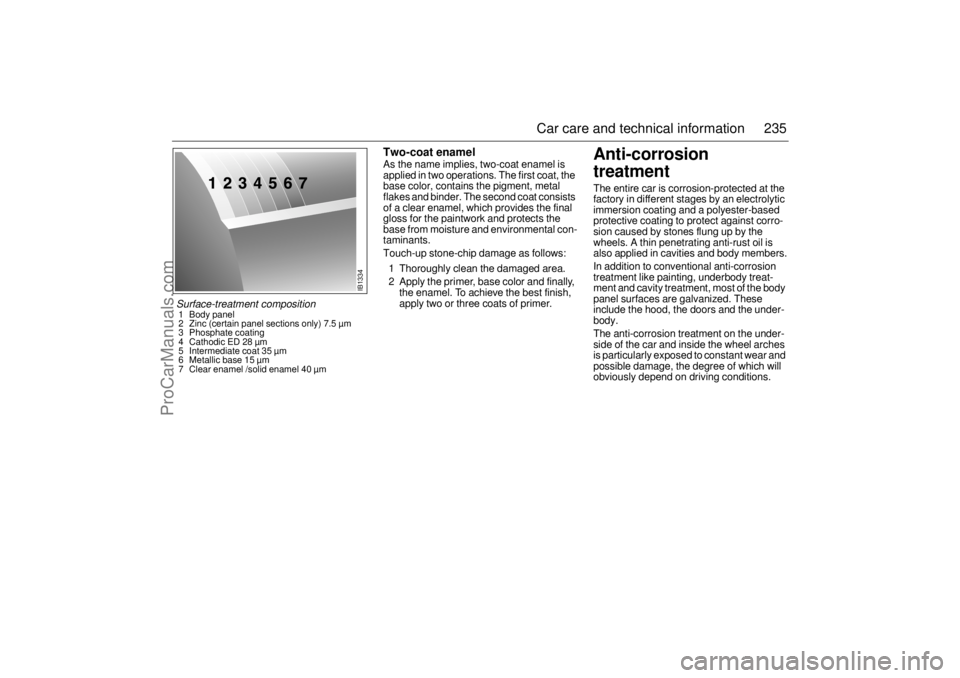
235 Car care and technical information
Two-coat enamel As the name implies, two-coat enamel is
applied in two operations. The first coat, the
base color, contains the pigment, metal
flakes and binder. The second coat consists
of a clear enamel, which provides the final
gloss for the paintwork and protects the
base from moisture and environmental con-
taminants.
Touch-up stone-chip damage as follows:
1 Thoroughly clean the damaged area.
2 Apply the primer, base color and finally,
the enamel. To achieve the best finish,
apply two or three coats of primer.
Anti-corrosion
treatmentThe entire car is corrosion-protected at the
factory in different stages by an electrolytic
immersion coating and a polyester-based
protective coating to protect against corro-
sion caused by stones flung up by the
wheels. A thin penetrating anti-rust oil is
also applied in cavities and body members.
In addition to conventional anti-corrosion
treatment like painting, underbody treat-
ment and cavity treatment, most of the body
panel surfaces are galvanized. These
include the hood, the doors and the under-
body.
The anti-corrosion treatment on the under-
side of the car and inside the wheel arches
is particularly exposed to constant wear and
possible damage, the degree of which will
obviously depend on driving conditions.
IB1334
Surface-treatment composition 1 Body panel
2 Zinc (certain panel sections only) 7.5 µm
3 Phosphate coating
4 Cathodic ED 28 µm
5 Intermediate coat 35 µm
6 Metallic base 15 µm
7 Clear enamel /solid enamel 40 µm
ProCarManuals.com
Page 237 of 272

237 Car care and technical information
4Inspect the undercoating and touch
up if necessary.
Pay particular atten-
tion to the fenders and wheel housings,
which are exposed to abrasion by flying
gravel, etc. If the composition has worn
or flaked off, the steel must be thor-
oughly cleaned and dried before a fresh
coat is applied. The cleaning is best
done with a scraper and a steel wire
brush, followed by washing with solvent.
Apply the new coating thinly, as other-
wise it may run off or fall off when dry.
For long tripsBefore setting off on a long journey, it is
advisable to have your car checked over by
your Saab dealer.
Obtain a few important items to take along
on your journey such as spare bulbs, wiper
blades, fuses, a Poly-V-belt and the like.
You can check some points yourself before-
hand:
Make sure that the engine is in good con-
dition.
Check that no oil or gasoline leaks out of
the engine or gearbox/transmission.
Check the coolant and power steering
fluid levels. Check also for leaks.
Inspect the Poly-V-belt and replace it if it
shows any signs of hard wear.
Check the battery charge.
Check the tires for tread pattern and air
pressure, including the compact spare
wheel.
Check the brakes.
Check all bulbs.
Check for the presence of the tool kit and
the jack in the car.
Recovery and/or
recycling of automotive
materialsA typical car consists of metals (65–75%),
plastics (10–14%), rubber (5%) and small
quantities of glass, wood, paper and tex-
tiles.
Some of these materials can be recycled,
while others can be recovered in chemical
processes for reuse in new products or as a
source of energy.
While the Saab 9-5 was still at the draw-
ing-board stage, Saab engineers were
giving serious consideration to how the
maximum quantity of materials could be
reclaimed from the car on its eventual
scrapping. To facilitate sorting, plastic parts,
for instance, have been marked to identify
the precise nature of the plastic.
Approximately 90% of the materials in the
car can be recycled or recovered, where
facilities exist.
Before the car is scrapped, all the oils and
other fluids that could pollute the environ-
ment should be recovered from the car. It
may be of interest in this context to learn that
the refrigerant used in the Saab 9-5’s ACC
systems (R134a) contains neither CFCs nor
any other chlorine compounds.
ProCarManuals.com
Page 238 of 272

238 Car care and technical information1 A-pillar trim: PP, PP/EPDM
2 Windshield trim: PP, PP/EPDM
3 Seals: EPDM
4 C-pillar trim: ABS
5 Rear light cluster: PMMA
6 Rear bumper, cellular core: expanded PP;
sheathing: PP/EPDM
7 Side-window casing: PP/EPDM
8 Fuel tank: PE
9 Side trim: PVC
10 A-pillar upholstery trim: PC/ABS, textile
11 Rearview mirror: ABS
12 Sill scuff plate: PP/EPDM
13 Wheel-arch liner: PP
14 Wheel cover: PA
15 Direction-indicator lamp lens: PMMA
16 Washer-fluid reservoir: PE
17 Front spoiler: PP/EPDM
18 Front bumper, cellular core: expanded PP;
sheathing, grille: PP/EPDM
19 Fan shroud: PP
20 Scuttle panel finisher: PC/ASA
IB1801
ABS Acrylonitrile-butadiene-styrene
ASA Acrylonitrile-styrene (acrylic
plastic)
EPDM Ethylene-propylene rubber
PA Polyamide (plastic)
PC Polycarbonate (plastic)
PE Polyethylene
PMMA Polymethyl methacrylate
POM Acetal plastic
PPO Polyphenylene oxide (plastic)
PP Polypropylene
PUR Polyurethane
PVC Polyvinyl chloride 1234
5
6
87
9
10
11
12 13 14 15 18
1719
1620
ProCarManuals.com
Page 244 of 272

244 Maintenance and owner assistanceMaintenance scheduleThe Maintenance Schedule prescribes a
service program to the purchaser/operator
of a Saab that is reasonable and necessary
to ensure the proper emission control sys-
tems function, safety and reliability of the
Saab automobile in normal use. Additional
maintenance is recommended for specific
components when the car is operated under
certain severe conditions. Proper mainte-
nance is always good advice!
Authorized Saab dealers are equipped and
trained to meet your Saab’s service needs.
They regularly receive up-to-date Saab ser-
vice manuals and parts and technical ser-
vice bulletins from Saab and are able,
through their franchise agreement, to attend
Saab service schools, obtain Saab special
tools and technical assistance and pur-
chase original equipment service and
replacement parts.
Today’s complex automobiles should only
be entrusted to the most knowledgeable
service professionals. A Saab dealer is your
best choice.
Service intervalsThe maintenance schedule is comprised of
a Check -up 30 days after retail delivery, fol-
lowed by services at every 10,000 miles
(16,000 km) thereafter (10,000, 20,000,
30,000 miles/16,000 32,000, 48,000 km
etc.).
Engine oil and filter changesChanging the engine oil and filter is required
at every service point. Use only a Saab
approved long-life oil filter and engine oils
meeting the SAE viscosity ratings and API
service classifications stated in the Specifi-
cation section of this Owner’s Manual. The
use of extra additives in the oil is not neces-
sary and is not recommended, and may be
harmful to turbochargers.
More frequent oil changes are recom-
mended if your vehicle is operated under
the following conditions:
Most trips are less than 5 to 10 miles (8 to
16 km). This is particularly important
when outside temperatures are below
freezing.
Most trips include extensive idling (such
as frequent stop-and-go driving).
Most trips are through dusty areas.
You frequently tow a trailer or use a car-
rier on top of your vehicle.
If the vehicle is used for delivery service,
police, taxi or other commercial applica-
tions.
If your driving habits match this description,
have the engine oil and filter changed in-
between normal services at 5,000 mile
(8,000 km) intervals. The Warranties and
Service Record Booklet has provisions to
record extra oil changes.
NOTEThe Check-up will be done by your Saab
dealer at no charge and should be done
as close as possible to the scheduled 30
days.
ProCarManuals.com
Page 245 of 272

245 Maintenance and owner assistance
Service record retentionService instruction coupons and record
stubs are provided in the Saab Warranties
and Service Record Booklet which accom-
panies this Owner’s Manual. The coupons
are arranged in the order that normal ser-
vice should be performed. The edge of each
coupon is shaded to correspond to the type
of service point:
Striped - "Check Up"
Blue - Oil change/inspection service
Black - Major service
Note that in Canada a combined service
and warranty book is used, but not service
coupons.
When scheduled services are performed,
your dealer will tear out the applicable
coupon and use it to check off the opera-
tions performed and enter it into the service
file at the dealership. The servicing dealer’s
stamp, along with the date and mileage at
which the service was done, should be
entered on the corresponding stub which
remains in your booklet. The booklet is your
permanent record of the services per-
formed. It also includes a log sheet for
unscheduled repairs.
It is advisable to retain receipts and, if pos-
sible, copies of shop work orders for all ser-
vice and repair work, wherever performed.
Service costsDealer pricing practices and labor for ser-
vice work vary. Saab’s recommended ser-
vice times for each service point do not
include the labor required to replace wear
items, such as wiper blades, brake pads or
tires. Nor is labor to perform other service or
repairs found to be necessary as a result of
the inspections included in these times.
Additional labor and parts will be charged
for such work when necessary, except as
covered under an applicable Saab warranty
or any optional extended service contract.
Transmission fluid changes or suspension
alignment, when necessary, are also addi-
tional.
Dealer charges for general shop material,
regulated hazardous waste removal, recy-
cling expenses or other operation costs may
also be applied to service and repair
invoices and are apt to vary by dealer and
locality.
Owner assistanceWarranties and service problem
assistanceFor complete information about all applica-
ble warranties, including the New Car War-
ranty, Perforation Warranty, Vehicle Emis-
sion Warranty and Emission Perforation
Warranty, consult the Warranties and Ser-
vice Record Booklet which accompanies
this Owner’s Manual. It also contains owner
assistance information including Saab
Roadside Assistance. If the booklet is lost or
misplaced, a new one may be ordered
through a Saab dealer or by contacting
Saab.
In the U.S. there is a national Customer
Assistance Center at Saab Cars USA, Inc.
The toll-free number to call from all 50 states
is 1-800-955-9007.
In Canada, please call the Saab Customer
Assistance Centre at 1-800-263-1999.
A list of authorized Saab sales and service
dealers is available for those planning to
travel in the United States and Canada.
Canadian or U.S. travelers may call the
Customer Assistance Center in the country
in which they are traveling.
ProCarManuals.com
Page 247 of 272

247 Specifications
Specifications General.............................. 248
Engine ............................... 250
Fuel.................................... 250
Engine oil .......................... 251
Engine variants ................ 252
Electrical system.............. 253
Drive belts......................... 253
Manual gearbox................ 254
Automatic transmission .. 254
Suspension....................... 255
Steering............................. 255
Brake system.................... 255
Wheels and tires .............. 256
Plates and labels .............. 257
IB603
ProCarManuals.com
Page 251 of 272

251 Specifications
Engine oilOil recommendation:
We recommend the use of oils that are available from your
Saab dealer, for regular oil changes. These oils fulfill the most
stringent requirements set by API and ACEA classifications.
Basic recommendations for Saab engines:
SAE 5W-30 or 0W-30, 5W-40.
The oil should be semi or fully synthetic and fulfill grade require-
ments for ACEA A3/B3, API SJ or higher. In addition to API and
ACEA the ILSAC GF-3 specification is approved for use in appli-
cable markets.
Fully synthetic oils with viscosity’s 0W-40/50 of well known
brands and fulfilling minimum ACEA A3/B3 are also recom-
mended, especially for extreme driving conditions.Oil specification.
Oil for gasoline engines is classified by the API (American Petro-
leum Institute) and ACEA (European Automobile Manufacturers
Associations) standards.
API classifies engine oil into grade classes SH (since 1993) and
SJ (since 1996). The SJ class fulfils more stringent requirements
and has lower phosphorous level. A new grade API SL, intro-
duced 2001, fulfils even higher requirements.
These grade classes are most often combined with correspond-
ing classes for diesel engines. The class designations for diesel
engines begins with the letter "C" (Commercial). For example a
grade combination suitable for both types of engine could be API
SH/CD, SJ/CF or SL/CF.
Under the ACEA nomenclature, oils are divided into Class A for
gasoline engines and Class B for diesel engine passenger cars.
There is a further class for heavy diesel engines. Each class is
divided into grades: 1,2 and 3 where grades 2 and 3 normally
encompass semi- and fully synthetic oils. The diesel class also
has a fourth grade, B4, which encompasses tests and regula-
tions aimed at improving the performance of direct injection die-
sel engines.
In the same way as in the API system, gasoline and diesel
engine specifications are combined for products that can be
used in both types of engine. For example, a grade designation
could be ACEA A2/B2 or ACEA A3/B3, B4.
ProCarManuals.com