lock SAAB 9-5 2002 Workshop Manual
[x] Cancel search | Manufacturer: SAAB, Model Year: 2002, Model line: 9-5, Model: SAAB 9-5 2002Pages: 272, PDF Size: 16.26 MB
Page 167 of 272

167 Starting and driving
Traction Control SystemHow the system works The traction control system (TCS) is
designed to prevent wheelspin. This
enables the car to achieve the best possible
grip and, hence, maximum tractive effort,
together with greater stability.
The TCS system uses information from the
ABS system’s wheel sensors to detect
when the front (driving) wheels are rotating
faster then the rear wheels. It then monitors
whether one driving wheel is rotating faster
than the other. If so, the faster wheel is
retarded until both wheels are rotating at the
same speed.
If the two front wheels are rotating at the
same speed but are turning faster than the
rear wheels, the torque from the engine is
reduced to eliminate the difference.
The process continues until all the wheels
are rotating at the same speed.
The advantages of the TCS system become
most apparent when the cohesion between
the front wheels and the road surface is so
low that one or both of the wheels would
lose their grip were the car not equipped
with the TCS, e.g.: When the car is pulling away or accelerat-
ing with the front wheels on different sur-
faces (e.g. one slippery and one dry). The
TCS then functions like an electronic dif-
ferential lock.
When the car is pulling away or accelerat-
ing on a slippery road, in which case the
TCS eliminates wheelspin. The same
applies when the car is reversing.
On cornering, if there is a tendency for the
inner front wheel to rotate faster than the
other wheels.
On overtaking.
TCS OFF The indicator on the main instrument
panel will come on:
If a fault has been detected and the
system has therefore been switched off.
If there is a fault in the ABS system.
If the system has been switched off man-
ually.
The indicator light will also come on for
4 seconds when the ignition key is turned to
ON, while an internal system check is per-
formed. TCS indicator The indicator light will come on for
4 seconds when the ignition key is turned to
ON, while an internal system check is per-
formed.
The light in the tachometer comes on
when the system is operative, i.e. when the
wheels are not rotating at the same speed.
The fact that the TCS system is operative
indicates that the limit for grip has been
exceeded and that the driver must exert
greater care.
WARNING
In normal driving, the TCS system will
help to improve the safety of the car, but
it does not mean that the car can be
driven faster. The same care and pru-
dence normally applied should be dis-
played on cornering and when driving on
slippery roads.
ProCarManuals.com
Page 168 of 272

168 Starting and drivingTurning the TCS off The TCS is switched on automatically when
the engine is started.
The system can be switched off manually by
the TCS button, whereupon on the
main instrument panel will come on. The
TCS system cannot be switched off if the car
is travelling faster than 35 mph (60 km/h).
It may be necessary to switch off the system
if the car has become bogged down, for
instance. Press TCS to switch it on again.
If a fault is detected in the ABS system, the
TCS will be switched off automatically.
The cruise-control system will automatically
be disengaged after one second if it is active
when the TCS starts to operate.
Electronic Stability
Program (ESP)(option/certain models only)The Electronic Stability Program employs
both the antilock braking system (ABS) and
the traction control system (TCS). It is a
safety system that helps the driver to stabi-
lize the car in unusual circumstances that
can otherwise be difficult to handle.How the ESP system worksThe Electronic Stability Program can help to
prevent the car from skidding by braking
one or several wheels independently of the
driver. The engine output is then also
reduced to prevent the driving wheels from
spinning. The car has sensors that measure
wheel speed, yaw acceleration, lateral
acceleration, steering wheel position and
braking pressure. The values provided by
these sensors are used to calculate the
actual direction of the car. If this direction
does not agree with that intended by the
driver, calculated from the steering wheel
position, the ESP is engaged.
ESP improves the driver’s chances of
retaining control over the car in critical situ-
ations.
ESP OFFThe light in the rev counter comes on
if:
A fault has been detected and the system
has therefore been switched off.
The system has been switched off manu-
ally.
When the ignition key is turned to the ON
position, the lamp is lit for about four sec-
onds while the system undergoes a
self-test.
IB478
IB1847
ProCarManuals.com
Page 171 of 272

171 Starting and driving
Driving in a low gear results in higher fuel
consumption than in a high gear because
of the higher engine speed for a given
road speed. Always change up to a higher
gear as soon as traffic conditions allow
and use the highest gear as much as pos-
sible.
Check the air pressure in the tires once a
month. Incorrect pressures increase tire
wear. It is better to have slightly higher
pressure than lower.
Check fuel consumption regularly.
Increased consumption can indicate that
something is wrong and that the car
needs to be checked by an authorized
Saab dealer.
Practical trials on the roads have demon-
strated that substantial savings in fuel con-
sumption can be made if the above advice
is heeded.Road conditions Wet roads increase fuel consumption, as do
unpaved roads and driving in hilly country
(the amount of fuel saved driving downhill is
less than the additional amount required to
climb the hill).
Engine block heater (standard
equipment in Canada, accessory in
U.S.)The following are just some of the benefits
to the car and the environment of using an
engine block heater:
Lower fuel consumption.
Reduced wear on the engine.
Inside of car warms up faster.
Exhaust emissions substantially reduced
over short runs.
The engine heater is effective at outside
temperatures up to +15-20°C. The warmer
it is outside, the shorter the time the engine
heater needs to be connected. Longer than
1.5 hours is unnecessary.
If the car is equipped with a removable,
electrical cabin heater that is not in use, this
should be stored in the luggage compart-
ment.
Driving in cold weatherBefore starting a journey in cold weather
you should check the following:
That the wiper blades have not become
frozen to the windshield/glass.
Brush any snow away from the air intake
for the heater system (opening between
hood and windshield).
It may be advisable to lubricate the
door-lock cylinder (use molybdenum
disulphide, MoS
2) to prevent its freezing.
If the lock has frozen, take care not to
break the key (or use the remote control)
– heat it first or spray it with de-icer.
Periodically during the winter, add gaso-
line anti-freeze to the fuel to dispel any
condensation in the fuel tank which could
freeze and cause problems in the system.
Keep the tank well filled to reduce the risk
of condensation forming.
If the car is parked outside in freezing
weather, fuel additives (gasoline
anti-freeze) will not do any good as it
cannot remove water that has already fro-
zen. Park the car in a warm place so that
any ice that may have built up melts, then
add gasoline anti-freeze when filling up
the tank. Condensation is caused by
changes in the outdoor temperature or by
the car being parked alternately in a
garage and outside.
It is particularly important when the roads
are slippery that the brakes and tires be in
good condition.
WARNING
Never switch the engine off while driving
as the effect of the brakes and power
steering will be greatly reduced.
ProCarManuals.com
Page 172 of 272

172 Starting and driving Check the anti-freeze in the engine cool-
ant, see page 196.
The car´s trip computer will warn you when
there is a risk of slippery conditions. For fur-
ther information on this function, see page
60.
The car is equipped with tires designed to
provide optimum grip on both wet and dry
roads, although this has been achieved at
the expense of somewhat reduced grip on
snow and ice. For regular driving on snow
and ice, we therefore recommend that
winter (snow) tires be fitted.
Winter (snow) tires, particularly studded
tires (where use is legally permitted), gener-
ally make driving safer on snow and ice.
Acquaint yourself with the legal provi-
sions governing the use of different
types of winter tires and snow chains.
Studded tires are not allowed in some
countries.If winter tires are fitted, the same type must
be fitted on all wheels. Your Saab dealer will
be pleased to advise you on the best tires for
your car.
Remember that tires age. It may therefore
be necessary to change them before they
reach the legal wear limit, as they gradually
lose their friction properties.
The best response if the car gets into a
front-wheel skid is to freewheel (manual
gearbox only), i.e. disengage the clutch (so
that the wheels are neither driven or
retarded by the engine.
If the car has automatic transmission, ease
up on the accelerator and steer carefully in
the desired direction.
In a rear-wheel skid, steer in the same direc-
tion that the rear of the car is moving.
Tire chainsIf you want to fit tire chains (where legally
permitted) they should only be fitted to the
tires recommended under ”Specifications”
(see page 256).
Consult your Saab dealer for details of
approved tire chains.
WARNING
Do not exceed 30 mph (50 km/h)
when tire chains are fitted.
Tire chains can reduce the directional
stability of the car.
Tire chains must not be used on the
rear wheels. NOTE Check the links frequently for wear.
Check that the chains do not contact
the wheel-arch liner at full lock.
See section ”Specifications”, page
256, for information on allowable
wheel dimensions for the fitting of tire
chains.
ProCarManuals.com
Page 175 of 272

175 Starting and driving
Use Normal mode when driving with a trailer
or trailer on hilly roads. The adaptive gear
change pattern function will prevent the
transmission from overheating.
Rises in coolant temperature are indicated
by the temperature gauge in the main instru-
ment panel.
The following can also occur:
the A/C-compressor can be shut off
the gear-change pattern is changed
the CHECK message TRANSMISSION
OVERHEATING can appear on the SID
If TRANSMISSION OVERHEATING
appears on the SID, stop the car as soon as
it is safe to do so and wait until the warning
has been extinguished. When continuing
your journey, select a locked gear (1, 2 or 3)
that will allow you to drive at an engine
speed of about 3,000 rpm (see page 161). Do not drive continuously with the WINTER
mode selected in hilly country when you are
towing a trailer, as this will increase fuel con-
sumption and risk overheating the transmis-
sion.
Driving considerations Always take extra care when towing a
trailer, as the car’s handling will be different
and its braking effect reduced. The trailer’s
braking system and suspension also have a
considerable effect on these characteris-
tics, see also ”Driving with a load” page 178.
If the car is equipped with automatic trans-
mission, select position L when ascending
or descending steep hills.
Trailer hitch loadThe weight distribution on the trailer makes
a lot of difference to the handling properties
of the car and trailer combination. As
regards single-axle trailers, whenever pos-
sible, concentrate the load over the wheels
and keep it as low as possible.
The trailer should be loaded so that the
maximum load on the towbar ball is 5% to
7% of the trailer weight with a maximum per-
missible tongue weight of 165 lbs. (75 kg).
Note that this load must be added to the total
load for the car. If this now exceeds the
specified load capacity, the load in the lug-
gage compartment will have to be reduced
by a corresponding amount.
WARNING
Remember to use engine-braking (selec-
tor position L, 3, or 4) to spare the brakes
when you are driving on a long or steep
downhill slope.
Brake failure can result from overheated
brakes!
NOTEIf the ”Automatic transmission, fault indi-
cator” indicator comes on, cease
towing until the problem has been recti-
fied.
IB106
Distribution of load in trailer a Light
b Moderate
cHeavy
ProCarManuals.com
Page 176 of 272
176 Starting and drivingDriving with a roof rack
loadThe maximum permissible roof load is
220 lbs. (100 kg).
Note that the roof load is included in the
car’s maximum permissible load (see page
248).
Strong, sturdy roof carriers designed spe-
cially for the car are available from your
Saab dealer. Always secure the roof load
safely.
Fitting the roof carriers (accessory)
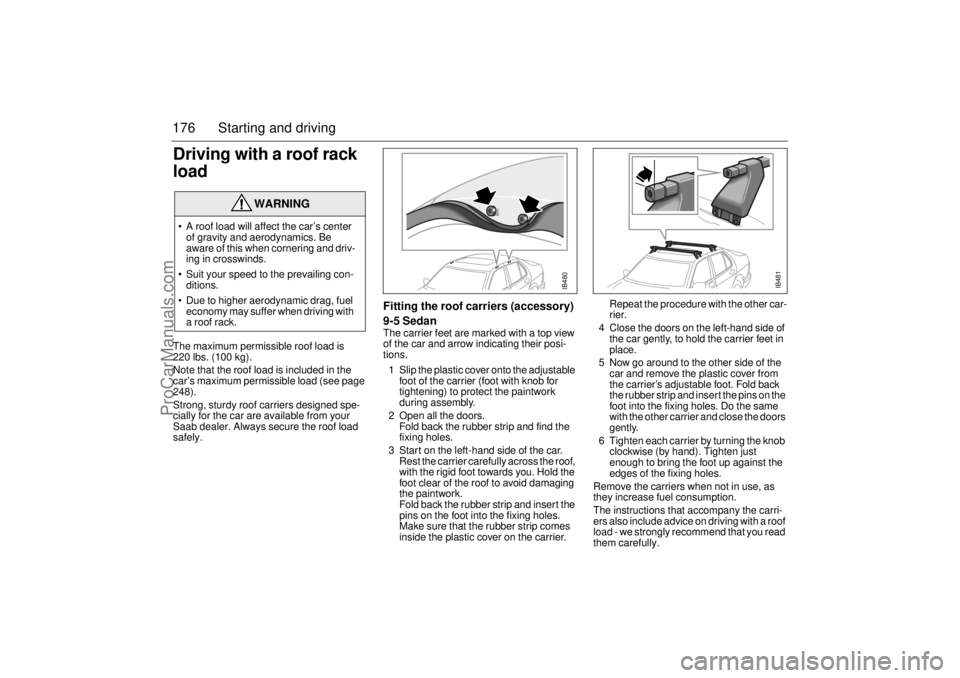
9-5 SedanThe carrier feet are marked with a top view
of the car and arrow indicating their posi-
tions.
1 Slip the plastic cover onto the adjustable
foot of the carrier (foot with knob for
tightening) to protect the paintwork
during assembly.
2 Open all the doors.
Fold back the rubber strip and find the
fixing holes.
3 Start on the left-hand side of the car.
Rest the carrier carefully across the roof,
with the rigid foot towards you. Hold the
foot clear of the roof to avoid damaging
the paintwork.
Fold back the rubber strip and insert the
pins on the foot into the fixing holes.
Make sure that the rubber strip comes
inside the plastic cover on the carrier. Repeat the procedure with the other car-
rier.
4 Close the doors on the left-hand side of
the car gently, to hold the carrier feet in
place.
5 Now go around to the other side of the
car and remove the plastic cover from
the carrier’s adjustable foot. Fold back
the rubber strip and insert the pins on the
foot into the fixing holes. Do the same
with the other carrier and close the doors
gently.
6 Tighten each carrier by turning the knob
clockwise (by hand). Tighten just
enough to bring the foot up against the
edges of the fixing holes.
Remove the carriers when not in use, as
they increase fuel consumption.
The instructions that accompany the carri-
ers also include advice on driving with a roof
load - we strongly recommend that you read
them carefully.
WARNING
A roof load will affect the car’s center
of gravity and aerodynamics. Be
aware of this when cornering and driv-
ing in crosswinds.
Suit your speed to the prevailing con-
ditions.
Due to higher aerodynamic drag, fuel
economy may suffer when driving with
a roof rack.
IB480
IB481
ProCarManuals.com
Page 185 of 272

185 Starting and driving
Pressing a SID button briefly will not disen-
gage the system, the display will simply
show the previously selected function.
Ice, snow and dirt can affect the sensitivity
of the sensors. In such cases a continuous
tone will sound warning the driver that the
system cannot measure the distance to an
object. You can turn the system off by press-
ing and holding the CLEAR button for
1.5 seconds.
If the text "PARK ASSIST FAILURE" is dis-
played on the SID, have the system
checked by an authorized Saab dealer.
Parking brake The parking brake is situated between the
front seats and acts on the rear wheels.
When the parking brake is on, the indicator
light on the main instrument panel will be on.
To release the parking brake, lift the lever
slightly, press the release button and
release the lever by pushing down on it.
Parking
NOTETo function well, the sensors must be kept
clean. Ice snow and dirt can affect their
sensitivity.
Do not spray the sensors or closer than
8 in. (20 cm) to the sensors with a pres-
sure washer, as this could damage them.
WARNING
Always apply the parking brake when
parking.
Always apply the parking brake
before removing the ignition key.
Do not use the parking brake when the
car is moving.
WARNING
Park where the vehicle will not create
an obstruction or a hazard to other
road users.
Do not park on dry grass or other com-
bustible material. The catalytic con-
verter gets very hot and could start a
fire.
Do not leave children or pets unat-
tended in the car. In warm, sunny
weather, the temperature inside the
car can reach 160–180°F (70–80°C).
Apply the parking brake.
Engage reverse (automatic transmis-
sion: move selector lever to P (Park)),
and remove the ignition key and lock
the car.
IB360
ProCarManuals.com
Page 186 of 272
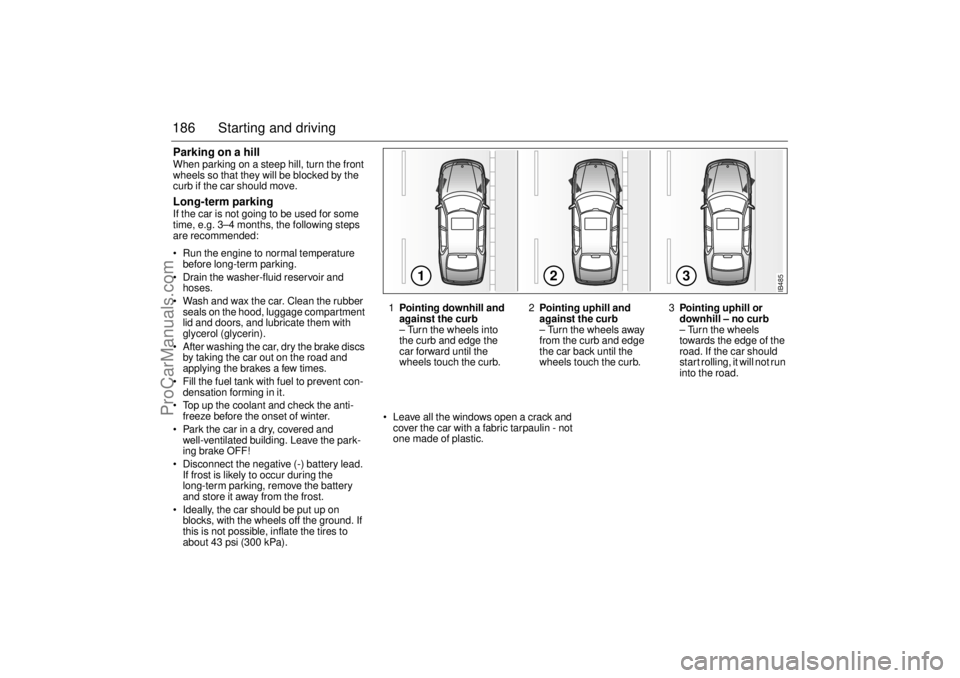
186 Starting and drivingParking on a hillWhen parking on a steep hill, turn the front
wheels so that they will be blocked by the
curb if the car should move. Long-term parkingIf the car is not going to be used for some
time, e.g. 3–4 months, the following steps
are recommended:
Run the engine to normal temperature
before long-term parking.
Drain the washer-fluid reservoir and
hoses.
Wash and wax the car. Clean the rubber
seals on the hood, luggage compartment
lid and doors, and lubricate them with
glycerol (glycerin).
After washing the car, dry the brake discs
by taking the car out on the road and
applying the brakes a few times.
Fill the fuel tank with fuel to prevent con-
densation forming in it.
Top up the coolant and check the anti-
freeze before the onset of winter.
Park the car in a dry, covered and
well-ventilated building. Leave the park-
ing brake OFF!
Disconnect the negative (-) battery lead.
If frost is likely to occur during the
long-term parking, remove the battery
and store it away from the frost.
Ideally, the car should be put up on
blocks, with the wheels off the ground. If
this is not possible, inflate the tires to
about 43 psi (300 kPa). Leave all the windows open a crack and
cover the car with a fabric tar paulin - not
one made of plastic.
123
IB485
1Pointing downhill and
against the curb
– Turn the wheels into
the curb and edge the
car forward until the
wheels touch the curb.2Pointing uphill and
against the curb
– Turn the wheels away
from the curb and edge
the car back until the
wheels touch the curb.3Pointing uphill or
downhill – no curb
– Turn the wheels
towards the edge of the
road. If the car should
start rolling, it will not run
into the road.
ProCarManuals.com
Page 188 of 272

188 Car care and technical informationHood release handleThe hood release handle is located under-
neath the instrument panel. To open the
hood:
1 Pull the release handle.
2 The front of the hood will now spring up,
providing access to the secondary
safety catch.
3 Push the catch upwards, lifting the hood
at the same time. The hood can now be
lifted right up.
To close the hood, release it from a height
of about 8 in (20 cm). Do not press down on
it.
In cold weather, when the mechanism is
stiff, the hood might need to be released
from twice the height to lock properly.
Check that the hood is now closed securely.
WARNING
Make sure not to hold your fingers
between the hood and the hood safety
catch if you lay the hood down but not
closing it.
IB487
IB486
Hood release handle Hood secondary safety catch
ProCarManuals.com
Page 205 of 272
205 Car care and technical information
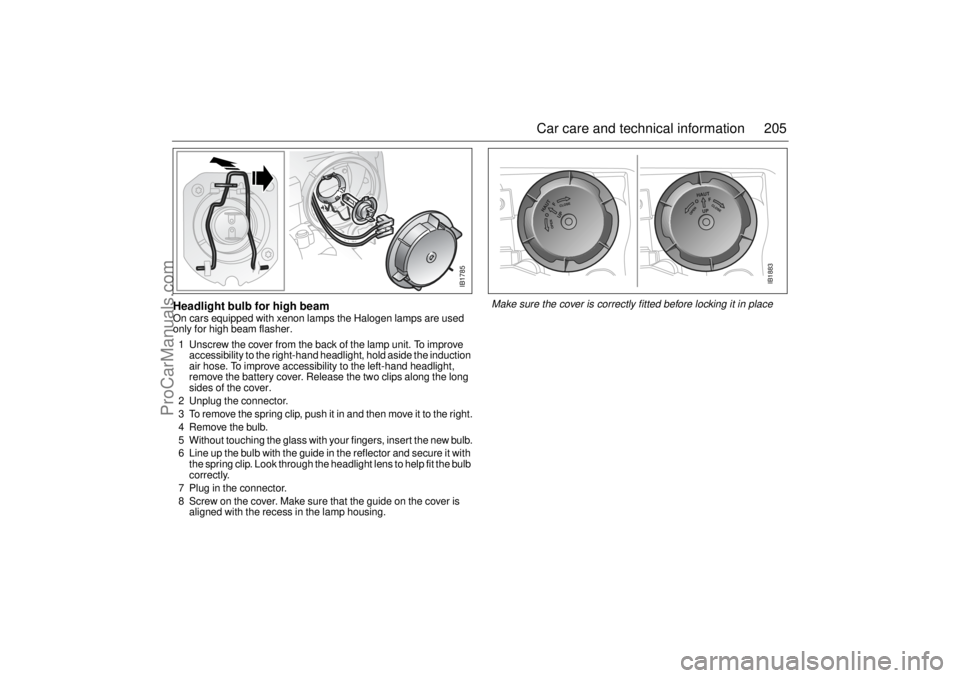
Headlight bulb for high beamOn cars equipped with xenon lamps the Halogen lamps are used
only for high beam flasher.
1 Unscrew the cover from the back of the lamp unit. To improve
accessibility to the right-hand headlight, hold aside the induction
air hose. To improve accessibility to the left-hand headlight,
remove the battery cover. Release the two clips along the long
sides of the cover.
2 Unplug the connector.
3 To remove the spring clip, push it in and then move it to the right.
4 Remove the bulb.
5 Without touching the glass with your fingers, insert the new bulb.
6 Line up the bulb with the guide in the reflector and secure it with
the spring clip. Look through the headlight lens to help fit the bulb
correctly.
7 Plug in the connector.
8 Screw on the cover. Make sure that the guide on the cover is
aligned with the recess in the lamp housing.
IB1785
IB1883
Make sure the cover is correctly fitted before locking it in place
ProCarManuals.com