wheel SAAB 9-5 2002 Workshop Manual
[x] Cancel search | Manufacturer: SAAB, Model Year: 2002, Model line: 9-5, Model: SAAB 9-5 2002Pages: 272, PDF Size: 16.26 MB
Page 226 of 272

226 Car care and technical informationCompact spare wheelThe compact spare is light and easy to
handle when changing the tire. Its use is
only permitted when a standard tire has sus-
tained a puncture. The maximum life of the
tire is only 2000 miles (3,500 km).
Do not exceed 50 mph (80 km/h) with the
compact spare fitted.
The compact spare should be inflated to
60 psi (420 kPa). Carry the punctured tire in
the spare-wheel well under the luggage-
compartment floor.
Have the standard tire repaired and refitted
as soon as possible (see also page 179).The spare wheel, together with the jack ,
front towrope attachment eye and toolkit, is
stowed away underneath a panel in the lug-
gage-compartment floor. The jack handle is
kept in a cover beside the spare wheel.
If you need to change a wheel, remove the
tool kit first and then the spare wheel.
The panel over the spare wheel can be held
open by hooking the handle onto the rubber
seal.
NOTETo avoid damaging a punctured alloy
wheel it can be placed outside up in the
spare-wheel well but only while driving to
the closest workshop.
A general rule is that all heavy loads must
be well secured in the luggage compart-
ment, see page 134 and 137.
IB534
Panel hooked back, 9-5 Sedan
IB1232
Hanging up the cover and spare wheel
compartments mats, 9-5 Wagon
IB1186
Spare wheel (under panel in luggage
compartment)
ProCarManuals.com
Page 227 of 272

227 Car care and technical information
Changing a wheel
WARNING
The car jack is designed solely for use
in changing a wheel or fitting snow
chains. It must not be used to support
the car during repair work or servicing.
Never crawl under a car that is
supported only by a jack.
Special care must be taken if the car is
on a slope – use wheel chocks!
Position chocks, one ahead and one
behind, the wheel that is diagonally
opposite to the one to be changed.
Switch on the hazard warning lights if
the car is on a road.
Apply the parking brake and leave the
car in gear (1st or reverse). Automatic
transmission: move selector to the
P position.
Ensure that everybody is out of the car
before jacking it up.
Never start the engine while the car is
jacked up.
The jack must stand on a firm, level
surface.
Stow the jack in the place provided for
it under the panel in the floor of the lug-
gage compartment. Secure it properly
to avert injury to passengers in the
event of a crash.
Do not use the jack for any purpose
other than for jacking up the car.
ProCarManuals.com
Page 228 of 272

228 Car care and technical informationTo jack up the car, apply the jack to one of
the special jacking points under the sills.Pos i ti o n for j ack
IB1838
IB1553
Positioning the jack
IB1554
Jack location, between spare wheel and
sill
IB1704
The collapsible jack handle is stowed in a cloth bag by the spare wheel. With the help of
your foot, extend the handle as illustrated
ProCarManuals.com
Page 229 of 272

229 Car care and technical information
If a floor jack is used, it can be applied to the
standard jacking points used by the dealer.
A floor jack can lift both front wheels or both
rear wheels off the ground simultaneously.
A jack stand must then be applied under-
neath the front of the engine subframe (at
the fixing point for the towrope-attachment
eye) or to the rear towrope-attachment eye
(or under the trailer hitch, if fitted).
1 Put the car in 1st gear (automatic trans-
mission: move selector to the P position)
and apply the parking brake.2 Wind the jack up to a suitable height
before placing it under the recess in the
sill.
Make sure that the jack fully engages
the recess in the sill and that the base of
the jack is steady and flat on the ground.
3 Remove the wheel cover (where appli-
cable).
Loosen the wheel bolts by half a turn.
4 Wind the jack to raise the wheel clear of
the ground. Remove the wheel bolts and
lift off the wheel.
5 Clean the contact surfaces between the
wheel and brake disc.
6 Fit the wheel and screw in the bolts in the
sequence shown (opposite pairs).
Tighten the bolts enough for the bolts
and wheel to be seated correctly.
7 Lower the car and tighten the wheel
bolts to the correct torque in the
sequence shown (opposite pairs).
Tightening torqueLight-alloy wheels: 80 ft.lbs. (110 Nm)
Steel wheels: 80 ft.lbs. (110 Nm)
Do not overtighten the bolts using a per-
cussion nut tightener: not only can this
damage the wheels but it can also make it impossible to undo the bolts using the
wheel wrench in the car’s toolkit.
8 Check-tighten the wheel bolts after a
few miles.
Tightening torqueLight-alloy wheels: 80 ft.lbs. (110 Nm)
Steel wheels: 80 ft.lbs. (110 Nm)
NOTEApply the jack only to the jacking points
indicated.
NOTEWhen refitting wheel covers (where
applicable), make sure that the valve
protrudes through the hole in the wheel
cover.
IB1130
Jacking points for a trolley jack
ProCarManuals.com
Page 230 of 272

230 Car care and technical information
Flat spottingAll tires get hot, especially on long journeys
or when the car is driven hard. After the car
has been parked with hot tires and the tires
have cooled down, a flat spot can appear in
the tire, where it is in contact with the
ground. The same can occur if the car has
not been moved for a long time.
Flat spots can give rise to vibration that can
be felt through the steering wheel, similar to
that experienced when the wheels need bal-
ancing. Flat spots of this type disappear
once the tires get hot again, usually after
10–15 miles (20–25 km) of driving at cruis-
ing speed.
WARNING
If the car has been driven for several
years exclusively with alloy wheels and
steel wheels are now fitted, the bolt hole
threads in the brake hubs should be
cleaned before the thinner steel wheels
are fitted. Grit, salt and rust can clog the
inner threads making it impossible to
achieve the correct tightening torque.
IB539
Tightening sequence, wheel bolts
IB1800IB1800
Removing the wheel cover
ProCarManuals.com
Page 235 of 272
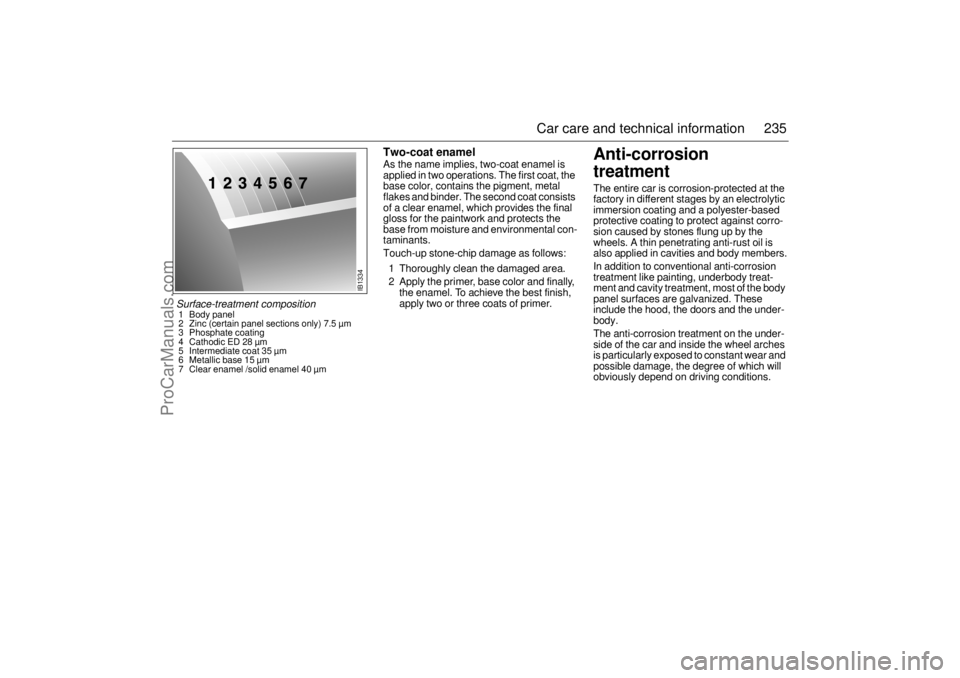
235 Car care and technical information
Two-coat enamel As the name implies, two-coat enamel is
applied in two operations. The first coat, the
base color, contains the pigment, metal
flakes and binder. The second coat consists
of a clear enamel, which provides the final
gloss for the paintwork and protects the
base from moisture and environmental con-
taminants.
Touch-up stone-chip damage as follows:
1 Thoroughly clean the damaged area.
2 Apply the primer, base color and finally,
the enamel. To achieve the best finish,
apply two or three coats of primer.
Anti-corrosion
treatmentThe entire car is corrosion-protected at the
factory in different stages by an electrolytic
immersion coating and a polyester-based
protective coating to protect against corro-
sion caused by stones flung up by the
wheels. A thin penetrating anti-rust oil is
also applied in cavities and body members.
In addition to conventional anti-corrosion
treatment like painting, underbody treat-
ment and cavity treatment, most of the body
panel surfaces are galvanized. These
include the hood, the doors and the under-
body.
The anti-corrosion treatment on the under-
side of the car and inside the wheel arches
is particularly exposed to constant wear and
possible damage, the degree of which will
obviously depend on driving conditions.
IB1334
Surface-treatment composition 1 Body panel
2 Zinc (certain panel sections only) 7.5 µm
3 Phosphate coating
4 Cathodic ED 28 µm
5 Intermediate coat 35 µm
6 Metallic base 15 µm
7 Clear enamel /solid enamel 40 µm
ProCarManuals.com
Page 236 of 272

236 Car care and technical informationWhat causes rust?Steel body panels of automobiles are sub-
ject to rusting whenever air and moisture
manage to penetrate the protective finish,
and body panels may rust through if the pro-
cess is unchecked. Rusting can occur wher-
ever water is trapped or where the car’s
panels are continuously damp. Damage to
paint and undercoating by stones, gravel
and minor crashes immediately exposes
metal to air and moisture. Road salts used
for de-icing will collect on the bottom of the
car and promote rusting. Areas of the coun-
try with high humidity have great potential
for rust problems, especially where salt is
used on roads or there is moist sea air.
Industrial pollution (fallout) may also
damage paint and promote rusting.
Preventive maintenanceThe following procedures are necessary to
help protect against rusting. Refer also to
the terms and conditions of the Sheet Metal
Coverage described in the warranty book-
let.
1
Wash the car frequently, and wax at
least twice a year.
Under adverse con-
ditions, where there is a rapid buildup of
dirt, sand or road salt, wash your car at
least once a week. After extreme expo-
sure to salted snow or slush, evidenced
by a white film on the car, wash the car
immediately. Frequent washing will pre-
vent paint damage from acid rain and
other airborne contaminants such as
tree sap and bird droppings. If any of
these contaminants are noticed on the
car the finish should be washed immedi-
ately.
Begin washing by rinsing the entire car
with water to loosen and flush off heavy
concentrations of dirt (include the
underbody).
Sponge the car with a solution of either
a good quality car soap or mild general
purpose (dish washing) detergent and
water.
Rinse car thoroughly with clean water.
After washing, check and clear all
drains in doors and body panels.
Wipe the car dry, preferably using a
chamois.2
Clean the underside of the car during
the winter.
Use high pressure water to
clean the car’s underside (floor panels,
wheel wells) at least at mid- winter and
in the spring.
3
Inspect the car frequently for leaks or
damage, and arrange for needed
repairs promptly.
After washing or
after heavy rain, check for leaks. When
washing the car inspect body surfaces
for paint damage. While checking for
leaks, lift the floor mats and check
beneath them. Water can collect in
these areas and remain for prolonged
periods. Dry any wet areas including the
floor mats. Have leaks repaired as soon
as possible.
Use touch-up paint to repair small
scratches or minor finish damage. Areas
where metal is exposed will rust quickly
and MUST be repaired immediately by
touch-up or professional repainting.
Rust must be removed, the bare metal
primed and painted. Major body
damage should be repaired immediately
and new panels or exposed areas
should be undercoated with anti- corro-
sion material.
Repairs of this type are the owner’s
responsibility and are not covered under
warranty.
ProCarManuals.com
Page 237 of 272

237 Car care and technical information
4Inspect the undercoating and touch
up if necessary.
Pay particular atten-
tion to the fenders and wheel housings,
which are exposed to abrasion by flying
gravel, etc. If the composition has worn
or flaked off, the steel must be thor-
oughly cleaned and dried before a fresh
coat is applied. The cleaning is best
done with a scraper and a steel wire
brush, followed by washing with solvent.
Apply the new coating thinly, as other-
wise it may run off or fall off when dry.
For long tripsBefore setting off on a long journey, it is
advisable to have your car checked over by
your Saab dealer.
Obtain a few important items to take along
on your journey such as spare bulbs, wiper
blades, fuses, a Poly-V-belt and the like.
You can check some points yourself before-
hand:
Make sure that the engine is in good con-
dition.
Check that no oil or gasoline leaks out of
the engine or gearbox/transmission.
Check the coolant and power steering
fluid levels. Check also for leaks.
Inspect the Poly-V-belt and replace it if it
shows any signs of hard wear.
Check the battery charge.
Check the tires for tread pattern and air
pressure, including the compact spare
wheel.
Check the brakes.
Check all bulbs.
Check for the presence of the tool kit and
the jack in the car.
Recovery and/or
recycling of automotive
materialsA typical car consists of metals (65–75%),
plastics (10–14%), rubber (5%) and small
quantities of glass, wood, paper and tex-
tiles.
Some of these materials can be recycled,
while others can be recovered in chemical
processes for reuse in new products or as a
source of energy.
While the Saab 9-5 was still at the draw-
ing-board stage, Saab engineers were
giving serious consideration to how the
maximum quantity of materials could be
reclaimed from the car on its eventual
scrapping. To facilitate sorting, plastic parts,
for instance, have been marked to identify
the precise nature of the plastic.
Approximately 90% of the materials in the
car can be recycled or recovered, where
facilities exist.
Before the car is scrapped, all the oils and
other fluids that could pollute the environ-
ment should be recovered from the car. It
may be of interest in this context to learn that
the refrigerant used in the Saab 9-5’s ACC
systems (R134a) contains neither CFCs nor
any other chlorine compounds.
ProCarManuals.com
Page 238 of 272

238 Car care and technical information1 A-pillar trim: PP, PP/EPDM
2 Windshield trim: PP, PP/EPDM
3 Seals: EPDM
4 C-pillar trim: ABS
5 Rear light cluster: PMMA
6 Rear bumper, cellular core: expanded PP;
sheathing: PP/EPDM
7 Side-window casing: PP/EPDM
8 Fuel tank: PE
9 Side trim: PVC
10 A-pillar upholstery trim: PC/ABS, textile
11 Rearview mirror: ABS
12 Sill scuff plate: PP/EPDM
13 Wheel-arch liner: PP
14 Wheel cover: PA
15 Direction-indicator lamp lens: PMMA
16 Washer-fluid reservoir: PE
17 Front spoiler: PP/EPDM
18 Front bumper, cellular core: expanded PP;
sheathing, grille: PP/EPDM
19 Fan shroud: PP
20 Scuttle panel finisher: PC/ASA
IB1801
ABS Acrylonitrile-butadiene-styrene
ASA Acrylonitrile-styrene (acrylic
plastic)
EPDM Ethylene-propylene rubber
PA Polyamide (plastic)
PC Polycarbonate (plastic)
PE Polyethylene
PMMA Polymethyl methacrylate
POM Acetal plastic
PPO Polyphenylene oxide (plastic)
PP Polypropylene
PUR Polyurethane
PVC Polyvinyl chloride 1234
5
6
87
9
10
11
12 13 14 15 18
1719
1620
ProCarManuals.com
Page 239 of 272

239 Car care and technical information
Headlight aimingThe vehicle has a visual optical headlight
aiming system equipped with vertical
aiming device. The aim has been preset at
the factory and should normally not need
further adjustments.
If your headlights are damaged in a crash,
the headlight aim may be affected. If you
believe your headlights need to be
re-aimed, we recommend that you take it to
your Saab dealer for service, however, it is
possible for you to re-aim your headlights as
described in the following procedure.To check the aim, the vehicle should be
properly prepared as follows:
The vehicle shall be placed so that the
headlights are 25 ft (7.6 m) from a light
colored wall or other flat surface. The
aiming area should be darkened, this will
improve your ability to see the beam of the
low beam headlight being aimed.
The vehicle must have all four wheels on
a perfectly level surface which is level all
the way to the wall or other flat surface.
The vehicle should be placed so it is
perpendicular to the wall or other flat
surface.
The vehicle should be unloaded and fuel
tank full, and one person or 160 lbs.
(75 kg) on the drivers seat. The vehicle should be fully assembled
and all other work stopped while headlight
aiming is being done.
The vehicle should not have any snow, ice
or mud attached to it.
Tires should be inflated to the prescribed
pressure.
Close all doors.
Rock the vehicle to stabilize the suspen-
sion.
Headlight aiming is done with the vehicle
low beam lamps. The high beam lamps will
be correctly aimed if the low beam lamps
are aimed properly.
WARNING
Before checking/adjusting the headlight
aiming, switch off the engine to avoid
danger of fingers and hands being injured
by moving parts.
The radiator fan can start up even when
the engine is switched off.NOTETo make sure that your headlights are
aimed properly read all instructions
before beginning. Failure to follow these
instructions could cause damage to
headlight parts or a not correctly aimed
headlight.
ProCarManuals.com