child seat SAAB 9-5 2003 User Guide
[x] Cancel search | Manufacturer: SAAB, Model Year: 2003, Model line: 9-5, Model: SAAB 9-5 2003Pages: 288, PDF Size: 16.78 MB
Page 24 of 288
24 SafetyThe same attention must be given to child
safety in the car as is given to adults.
Saab recommends rearward facing child
restraints.
Children travel most safely when properly
restrained, but restraints must be suitable
for the size of the child. Always follow the
child seat/booster cushion manufacturer´s
instructions when installing these devices in
your vehicle.
Make sure you are acquainted with the
legal requirements for seating children
in the car.
Make sure that it is possible to fit a child
restraint in accordance with the manufac-
turer’s child seat instructions.
When fitting child seats in cars you must
always read the instructions supplied by
the manufacturer.
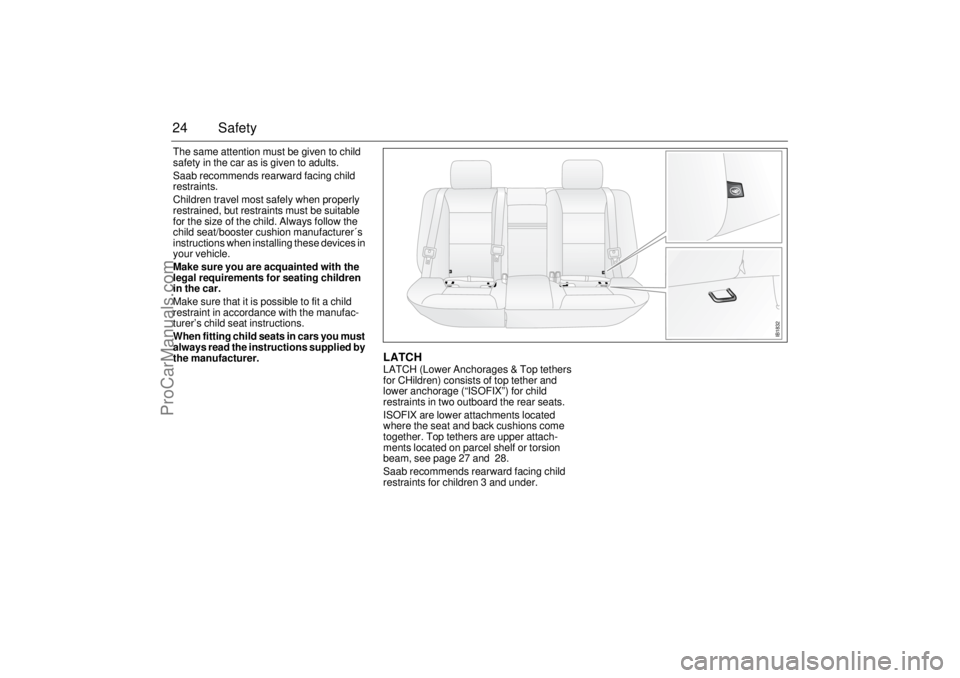
LATCHLATCH (Lower Anchorages & Top tethers
for CHildren) consists of top tether and
lower anchorage (“ISOFIX”) for child
restraints in two outboard the rear seats.
ISOFIX are lower attachments located
where the seat and back cushions come
together. Top tethers are upper attach-
ments located on parcel shelf or torsion
beam, see page 27 and 28.
Saab recommends rearward facing child
restraints for children 3 and under.
IB1832
ProCarManuals.com
Page 25 of 288
25 Safety
LATCH installationTo facilitate the proper fitting of new
specially-designed child restraints, rigid
lower anchorages (ISOFIX) have been
installed to the vehicle that shall be used
with the top tether anchorages in the two
outboard rear seating positions. There is an
additional top tether anchorage for the
center rear seating position that is to be
used together with the safety belt.
LATCH is a U.S./Canadian government
standard for an uniform method of fitting
child restraints without using the standard
safety belts. Only certain child restraints are
equipped to utilize these rigid lower anchor-
ages behind where the seat cushion and
seat back come together. LATCH child
seats also utilize a top tether strap that is
found on some newer child seats that still
require installation with the standard safety
belts.
There are two bars attached to the car body
for each specially designed LATCH child
restraint. A small label is located on the seat
back just above the outer attachment bars
to facilitate installing the child restraint. The
label contains a circle and a rearward facing
child restraint.
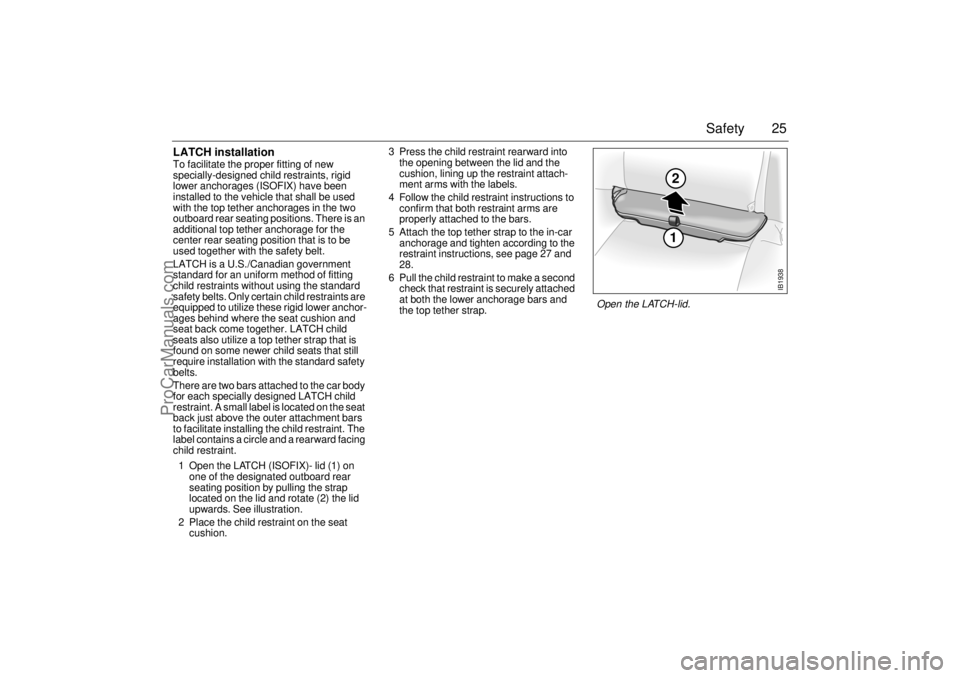
1 Open the LATCH (ISOFIX)- lid (1) on
one of the designated outboard rear
seating position by pulling the strap
located on the lid and rotate (2) the lid
upwards. See illustration.
2 Place the child restraint on the seat
cushion.3 Press the child restraint rearward into
the opening between the lid and the
cushion, lining up the restraint attach-
ment arms with the labels.
4 Follow the child restraint instructions to
confirm that both restraint arms are
properly attached to the bars.
5 Attach the top tether strap to the in-car
anchorage and tighten according to the
restraint instructions, see page 27 and
28.
6 Pull the child restraint to make a second
check that restraint is securely attached
at both the lower anchorage bars and
the top tether strap.
IB1938
12
Open the LATCH-lid.
ProCarManuals.com
Page 26 of 288
26 SafetyFor the top tether, only use the strap
supplied with the child restraint.
Always follow the installation instructions
supplied with the child restraint.
The availability of LATCH child restraints
may be limited.
When fitting child seats in cars you must
always read the instructions supplied by
the car seat manufacturer.
IB1684
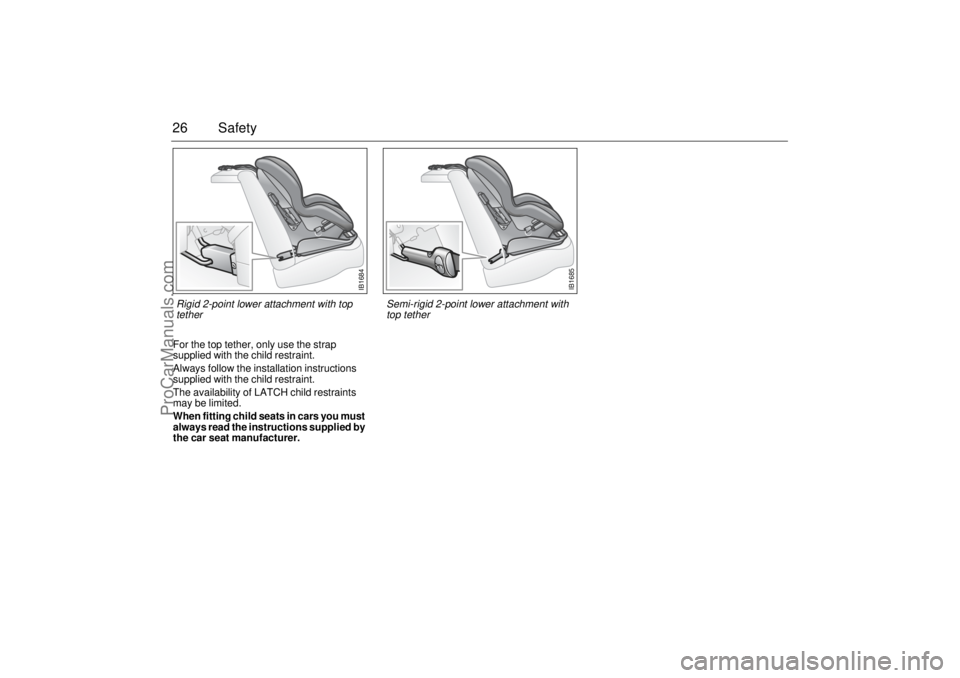
Rigid 2-point lower attachment with top
tether
IB1685
Semi-rigid 2-point lower attachment with
top tether
ProCarManuals.com
Page 27 of 288
27 Safety
Child tether anchorages for forward
facing child car seatsChild restraints with a tether strap must be
anchored according to Canadian and USA
laws.
If you have any questions regarding child
tether anchorages please contact your
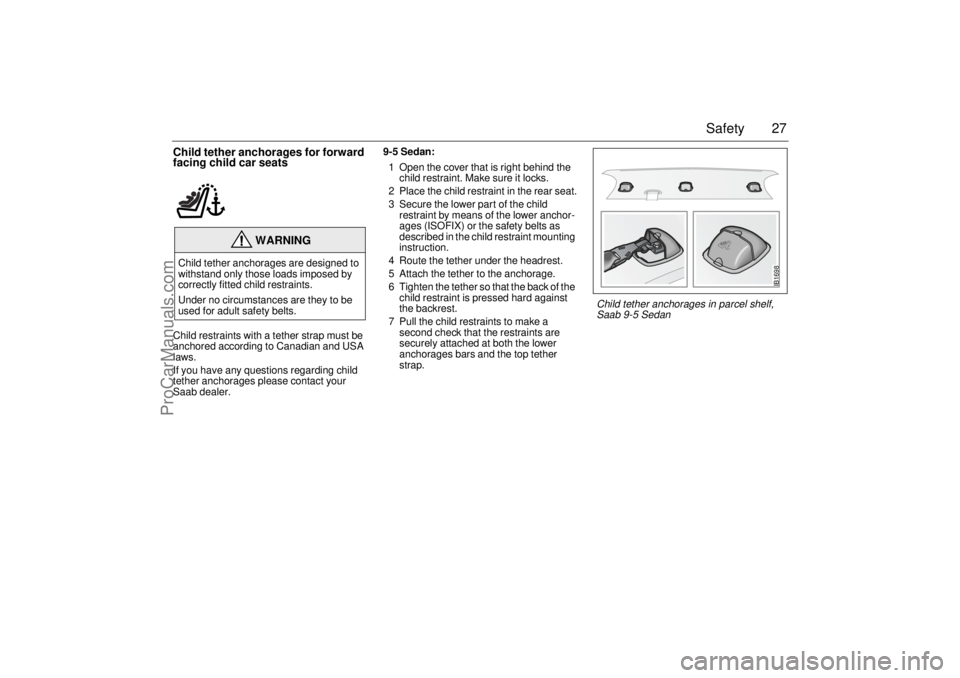
Saab dealer.9-5 Sedan:
1 Open the cover that is right behind the
child restraint. Make sure it locks.
2 Place the child restraint in the rear seat.
3 Secure the lower part of the child
restraint by means of the lower anchor-
ages (ISOFIX) or the safety belts as
described in the child restraint mounting
instruction.
4 Route the tether under the headrest.
5 Attach the tether to the anchorage.
6 Tighten the tether so that the back of the
child restraint is pressed hard against
the backrest.
7 Pull the child restraints to make a
second check that the restraints are
securely attached at both the lower
anchorages bars and the top tether
strap.
WARNING
Child tether anchorages are designed to
withstand only those loads imposed by
correctly fitted child restraints.
Under no circumstances are they to be
used for adult safety belts.
IB1698
Child tether anchorages in parcel shelf,
Saab 9-5 Sedan
ProCarManuals.com
Page 28 of 288
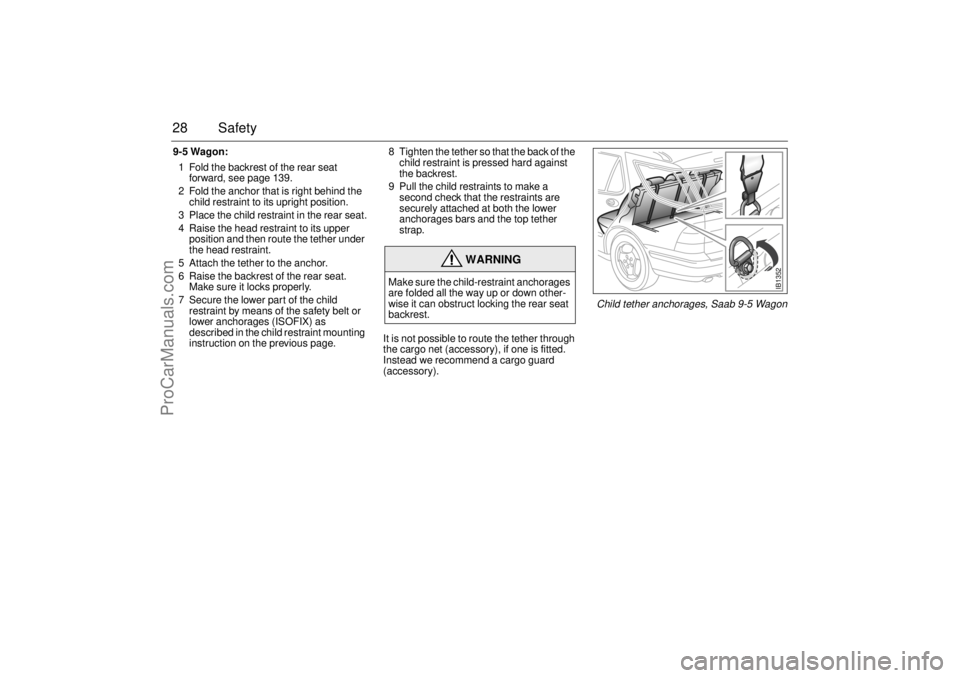
28 Safety9-5 Wagon:
1 Fold the backrest of the rear seat
forward, see page 139.
2 Fold the anchor that is right behind the
child restraint to its upright position.
3 Place the child restraint in the rear seat.
4 Raise the head restraint to its upper
position and then route the tether under
the head restraint.
5 Attach the tether to the anchor.
6 Raise the backrest of the rear seat.
Make sure it locks properly.
7 Secure the lower part of the child
restraint by means of the safety belt or
lower anchorages (ISOFIX) as
described in the child restraint mounting
instruction on the previous page.8 Tighten the tether so that the back of the
child restraint is pressed hard against
the backrest.
9 Pull the child restraints to make a
second check that the restraints are
securely attached at both the lower
anchorages bars and the top tether
strap.
It is not possible to route the tether through
the cargo net (accessory), if one is fitted.
Instead we recommend a cargo guard
(accessory).
WARNING
Make sure the child-restraint anchorages
are folded all the way up or down other-
wise it can obstruct locking the rear seat
backrest.
IB1352
Child tether anchorages, Saab 9-5 Wagon
ProCarManuals.com
Page 29 of 288
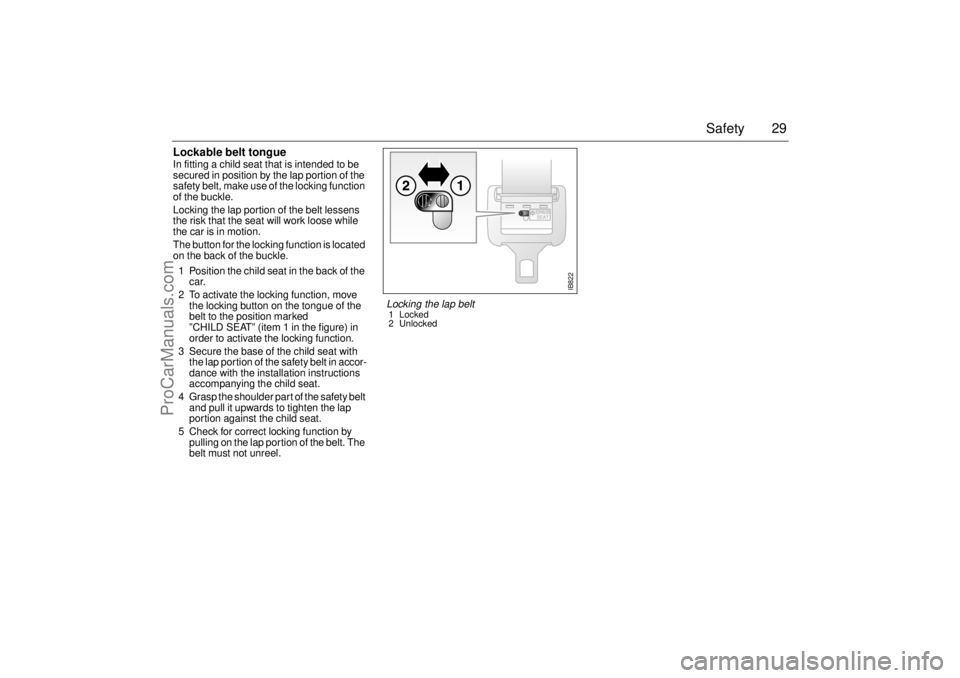
29 Safety
Lockable belt tongue In fitting a child seat that is intended to be
secured in position by the lap portion of the
safety belt, make use of the locking function
of the buckle.
Locking the lap portion of the belt lessens
the risk that the seat will work loose while
the car is in motion.
The button for the locking function is located
on the back of the buckle.
1 Position the child seat in the back of the
car.
2 To activate the locking function, move
the locking button on the tongue of the
belt to the position marked
”CHILD SEAT” (item 1 in the figure) in
order to activate the locking function.
3 Secure the base of the child seat with
the lap portion of the safety belt in accor-
dance with the installation instructions
accompanying the child seat.
4 Grasp the shoulder part of the safety belt
and pull it upwards to tighten the lap
portion against the child seat.
5 Check for correct locking function by
pulling on the lap portion of the belt. The
belt must not unreel.
IB822
Locking the lap belt1 Locked
2 Unlocked
ProCarManuals.com
Page 30 of 288
30 SafetyInstallation of child restraint using the
standard safety belt
Child restraints that are approved for rear-
ward facing installation in the rear seat can
be positioned in any of the three rear places.
If you intend to install another make of child
restraint make sure that it is possible to fit it
in accordance with the manufacturer’s
instructions.
Saab recommends rearward facing child
restraints up to 3 years.
WARNING
Failure to follow all the manufacturer’s
instructions on the use of this child
restraint system can cause your child to
strike the vehicle´s interior during a
sudden stop or crash.
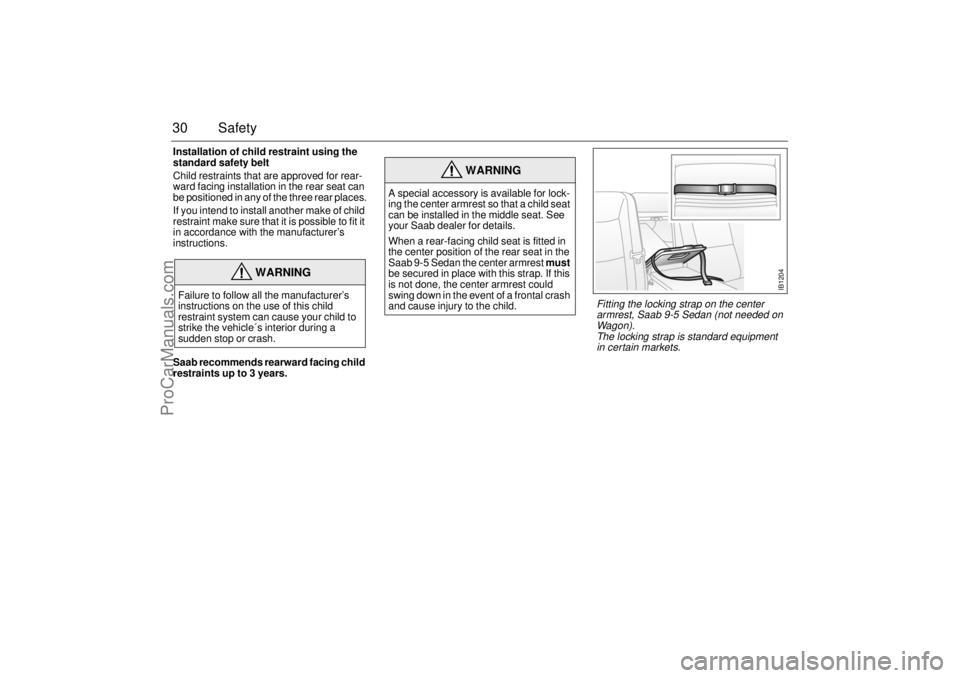
WARNING
A special accessory is available for lock-
ing the center armrest so that a child seat
can be installed in the middle seat. See
your Saab dealer for details.
When a rear-facing child seat is fitted in
the center position of the rear seat in the
Saab 9-5 Sedan the center armrest must
be secured in place with this strap. If this
is not done, the center armrest could
swing down in the event of a frontal crash
and cause injury to the child.
IB1204
Fitting the locking strap on the center
armrest, Saab 9-5 Sedan (not needed on
Wagon).
The locking strap is standard equipment
in certain markets.
ProCarManuals.com
Page 31 of 288
31 Safety
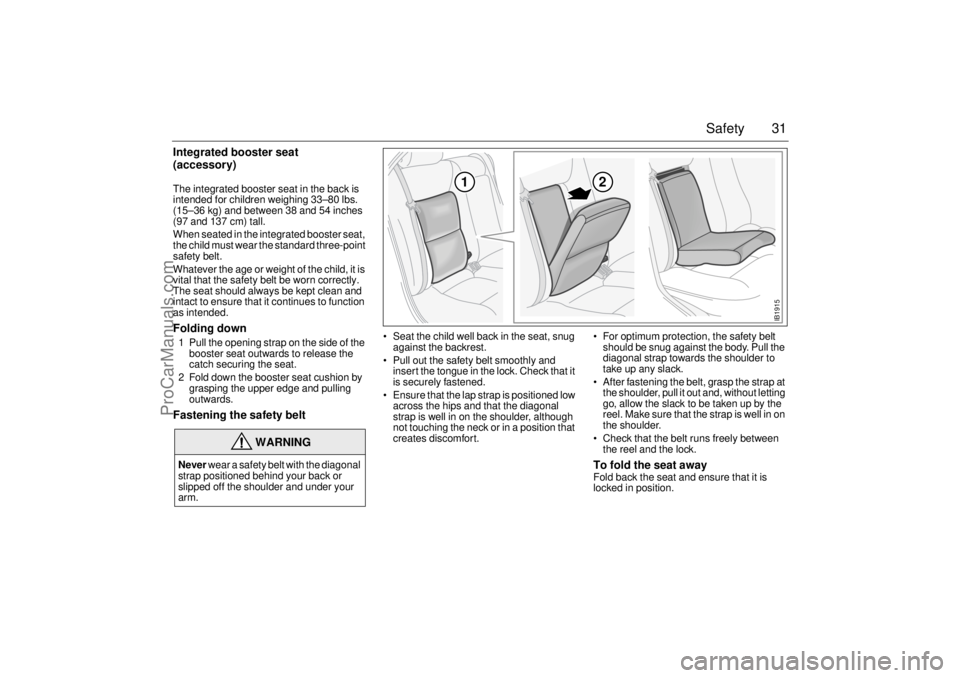
Integrated booster seat
(accessory)The integrated booster seat in the back is
intended for children weighing 33–80 lbs.
(15–36 kg) and between 38 and 54 inches
(97 and 137 cm) tall.
When seated in the integrated booster seat,
the child must wear the standard three-point
safety belt.
Whatever the age or weight of the child, it is
vital that the safety belt be worn correctly.
The seat should always be kept clean and
intact to ensure that it continues to function
as intended. Folding down 1 Pull the opening strap on the side of the
booster seat outwards to release the
catch securing the seat.
2 Fold down the booster seat cushion by
grasping the upper edge and pulling
outwards.Fastening the safety belt
Seat the child well back in the seat, snug
against the backrest.
Pull out the safety belt smoothly and
insert the tongue in the lock. Check that it
is securely fastened.
Ensure that the lap strap is positioned low
across the hips and that the diagonal
strap is well in on the shoulder, although
not touching the neck or in a position that
creates discomfort. For optimum protection, the safety belt
should be snug against the body. Pull the
diagonal strap towards the shoulder to
take up any slack.
After fastening the belt, grasp the strap at
the shoulder, pull it out and, without letting
go, allow the slack to be taken up by the
reel. Make sure that the strap is well in on
the shoulder.
Check that the belt runs freely between
the reel and the lock.
To fold the seat away Fold back the seat and ensure that it is
locked in position.
WARNING
Never wear a safety belt with the diagonal
strap positioned behind your back or
slipped off the shoulder and under your
arm.
IB1915
1
2
ProCarManuals.com
Page 32 of 288
32 Safety
WARNING
Use only the vehicle’s lap and shoul-
der belt system when restraining the
child in the booster seat.
The seat must not be modified or
changed in any way.
Never leave a child unattended in the
car.
The car’s regular head restraint must
always be turned 180° back to its orig-
inal position after the integrated
booster seat is folded away.
Check to ensure that the belt is not
twisted or rubbing against any sharp
edges.
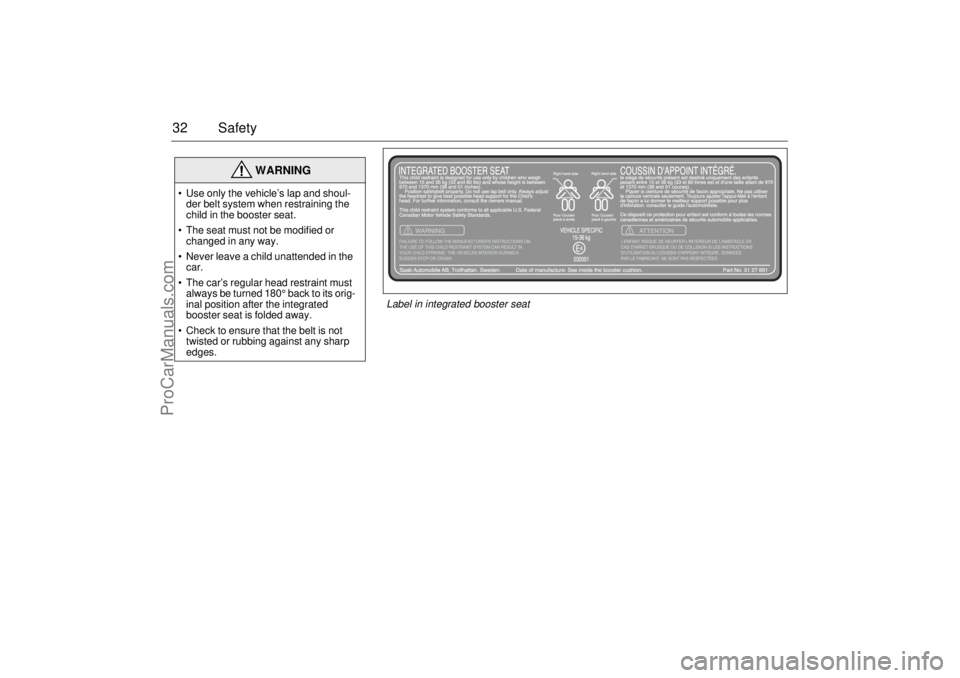
Label in integrated booster seat
ProCarManuals.com
Page 33 of 288
33 Safety
Airbag The AIRBAG system comprises an airbag in
the steering wheel, a front passenger airbag
and side airbags in the front seats.
The system supplements the protection
provided by the safety belts to further
enhance the safety of the occupants.
If a fault is detected in the AIRBAG, the
AIR BAG warning light on the main instru-
ment panel will come on (see pages 58 and
38).
When the system is triggered by impact of a
frontal crash, the airbags in the steering
wheel and passenger side of the dash board are inflated, after which they deflate through
vents in the back of the bags.
The front airbags are inflated in two stages.
Stage 1: process is a less severe, softer
inflation of the airbag. This stage is used in
lower force crashes, or if the seat is posi-
tioned close to the steering wheel or dash-
board.
Stage 2: process is a more forceful and
quicker inflation of the airbag. This stage is
used in more severe crashes and/or when
the seat adjustment is back a significant
distance from the steering wheel or dash-
board.
Note:
The sensor reacts differently depending on
whether or not the front seatbelts on the
driver’s and passenger sides are used. Situ-
ations can therefore arise where only one of
the airbags inflates.
The entire process takes less than
0.1 second – literally, faster than the blink-
ing of an eye.
These airbags are triggered only by moder-
ate to severe frontal or near-frontal crashes.
They will not be activated by minor front-end
impacts, rear-end or side impacts, or by the
car rolling over.
WARNING
To reduce risk of injury:
Always wear your safety belt.
Always adjust your seat so that you
are as far back as possible but still
able to reach the steering wheel and
controls comfortably.
Children 12 and under or shorter than
55 inches (140 cm) should always
travel in the rear as the vehicle is
equipped with an airbag on the
passenger side.
WARNING
Even if the car is equipped with
AIRBAG, safety belts must still
always be worn by all occupants.
Note that because an airbag inflates
and deflates extremely rapidly, it will
not provide protection against a
second impact occurring in the same
incident. Always use your safety belt.
Always sit with the whole of your back
in contact with the backrest of the seat,
and with your seat as far back as is
practical. Otherwise you will be thrown
back against the backrest when the
airbag inflates which could cause you
injury or death. The airbag needs
room in which to inflate.
Never attach anything to the steering
wheel or passenger side of the instru-
ment panel, as this could result in
injury if the airbag should inflate. The
same applies to anything you might
have in your mouth, such as a pipe, for
instance.
Some components of the airbag will
be warm for a short time. In some
circumstances the airbag can cause
minor burns or abrasions to the body
when the airbag inflates/deflates.
ProCarManuals.com