coolant SAAB 9-5 2003 User Guide
[x] Cancel search | Manufacturer: SAAB, Model Year: 2003, Model line: 9-5, Model: SAAB 9-5 2003Pages: 288, PDF Size: 16.78 MB
Page 196 of 288
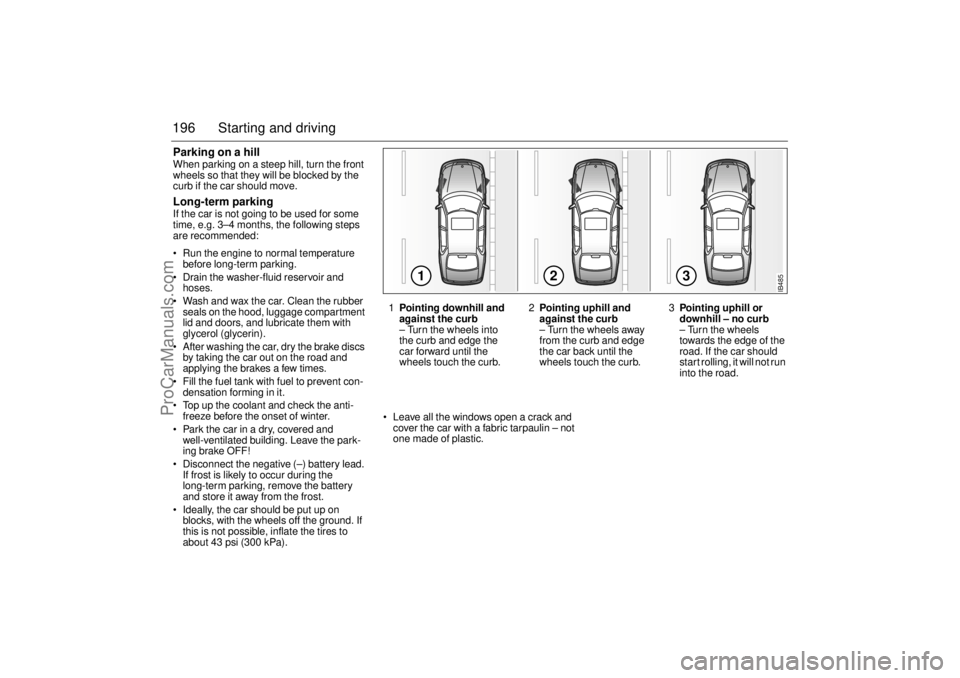
196 Starting and drivingParking on a hillWhen parking on a steep hill, turn the front
wheels so that they will be blocked by the
curb if the car should move. Long-term parkingIf the car is not going to be used for some
time, e.g. 3–4 months, the following steps
are recommended:
Run the engine to normal temperature
before long-term parking.
Drain the washer-fluid reservoir and
hoses.
Wash and wax the car. Clean the rubber
seals on the hood, luggage compartment
lid and doors, and lubricate them with
glycerol (glycerin).
After washing the car, dry the brake discs
by taking the car out on the road and
applying the brakes a few times.
Fill the fuel tank with fuel to prevent con-
densation forming in it.
Top up the coolant and check the anti-
freeze before the onset of winter.
Park the car in a dry, covered and
well-ventilated building. Leave the park-
ing brake OFF!
Disconnect the negative (–) battery lead.
If frost is likely to occur during the
long-term parking, remove the battery
and store it away from the frost.
Ideally, the car should be put up on
blocks, with the wheels off the ground. If
this is not possible, inflate the tires to
about 43 psi (300 kPa). Leave all the windows open a crack and
cover the car with a fabric tarpaulin – not
one made of plastic.
123
IB485
1Pointing downhill and
against the curb
– Turn the wheels into
the curb and edge the
car forward until the
wheels touch the curb.2Pointing uphill and
against the curb
– Turn the wheels away
from the curb and edge
the car back until the
wheels touch the curb.3Pointing uphill or
downhill – no curb
– Turn the wheels
towards the edge of the
road. If the car should
start rolling, it will not run
into the road.
ProCarManuals.com
Page 197 of 288
197 Car care and technical information
Car care and
technical
information
772
Hood ................................. 198
Engine compartment,
4-cyl. engine ................... 199
Engine compartment,
6-cyl. (3.0t V6)................. 200
Emission control systems 201
Engine............................... 202
Engine oil ......................... 203
Transmission fluid........... 205
Coolant ............................. 206
Brake and clutch fluid ..... 207
Power steering fluid ........ 208
Air filter ............................. 208 Battery .............................. 209
Drive belts ........................ 211
Wipers and washers ....... 212
Changing bulbs ............... 214
Fuses ................................ 226
Wheels .............................. 232
Compact spare wheel ..... 236
Flat spotting..................... 241
Air conditioning (ACC) ... 242
Safety belts ...................... 243
Upholstery and trim ........ 243
Textile carpeting.............. 243
Washing the car .............. 244 Waxing and polishing ...... 245
Engine compartment ....... 245
Touching up the paint ..... 245
Anti-corrosion treatment . 246
For long trips .................... 248
Recovery and/or recycling
of automotive materials. 248
Headlight aiming .............. 250
ProCarManuals.com
Page 199 of 288
199 Car care and technical information
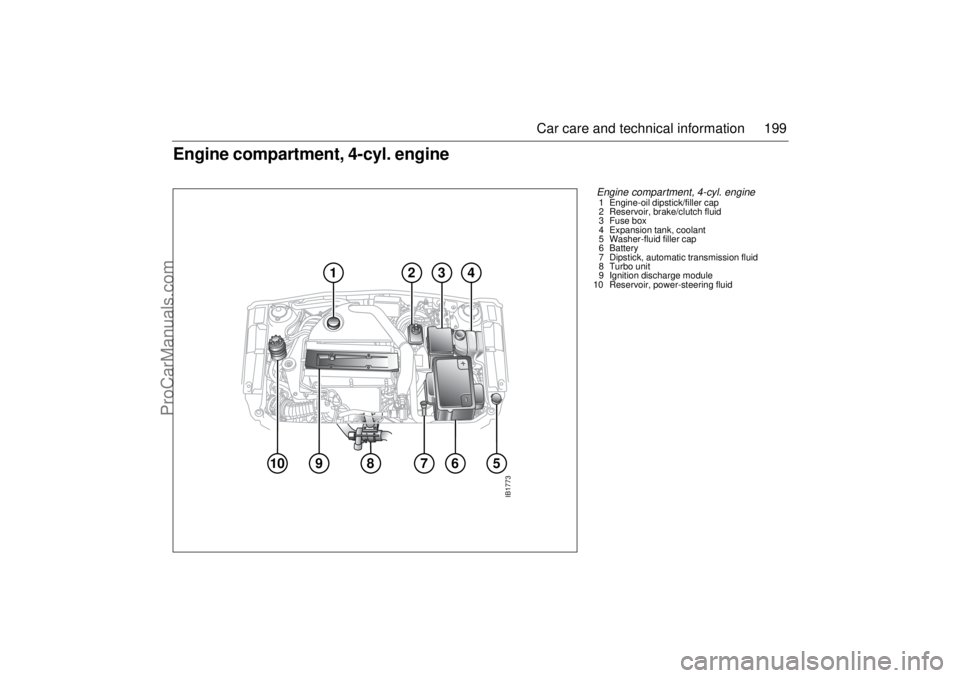
Engine compartment, 4-cyl. engine
10
9
6
7
8
1
2
4
3
5
IB1773
Engine compartment, 4-cyl. engine 1 Engine-oil dipstick/filler cap
2 Reservoir, brake/clutch fluid
3 Fuse box
4 Expansion tank, coolant
5 Washer-fluid filler cap
6Battery
7 Dipstick, automatic transmission fluid
8 Turbo unit
9 Ignition discharge module
10 Reservoir, power-steering fluid
ProCarManuals.com
Page 200 of 288
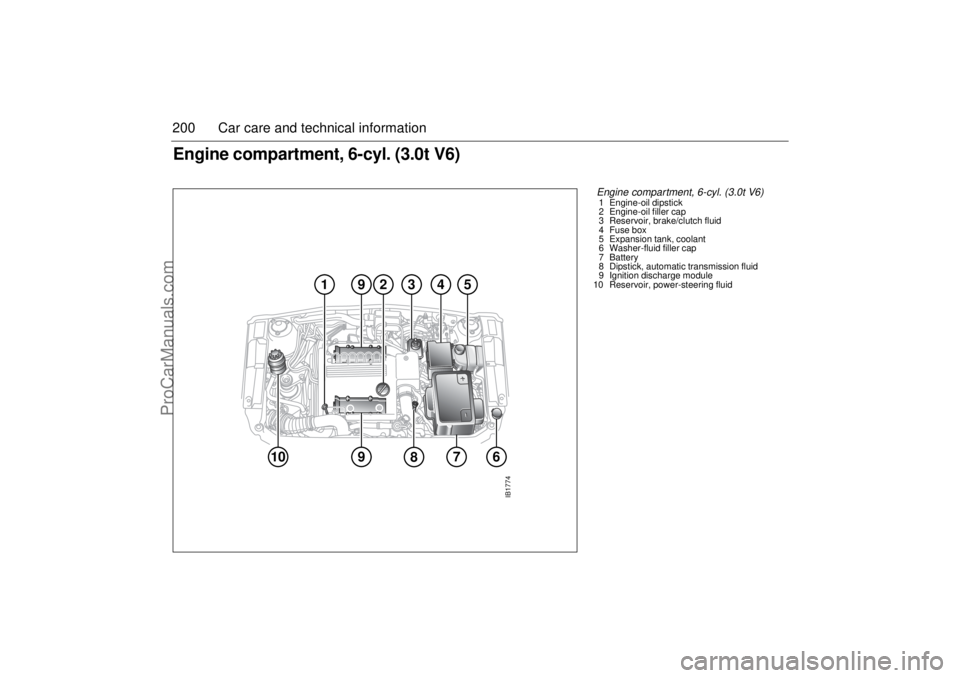
200 Car care and technical informationEngine compartment, 6-cyl. (3.0t V6)
99
2
1
4
57
6
10
83
IB1774
Engine compartment, 6-cyl. (3.0t V6) 1 Engine-oil dipstick
2 Engine-oil filler cap
3 Reservoir, brake/clutch fluid
4 Fuse box
5 Expansion tank, coolant
6 Washer-fluid filler cap
7Battery
8 Dipstick, automatic transmission fluid
9 Ignition discharge module
10 Reservoir, power-steering fluid
ProCarManuals.com
Page 201 of 288

201 Car care and technical information
Engine familiesSaab cars imported into the United States
and Canada meet all applicable emission
control standards. The engine family and
appropriate tune-up specifications are iden-
tified on a label affixed to the left front inner
fender.
These engine families meet applicable EPA
Federal Standards, California State Stan-
dards and Canadian Federal Standards and
are equipped with the following systems:
• Sequential multiport fuel injection system.
Three way catalytic converter.
Crankcase emissions control system.
Evaporative emission control system.
On-Board diagnostic (OBD II) system.
Emission control
systemsThe systems for controlling emissions to the
atmosphere require regular checking and
adjustment at the intervals specified in the
service program.
In addition to meeting the exhaust emission
regulations and thereby helping to keep the
environment clean, a correctly tuned engine
will also give maximum fuel economy.Saab Trionic engine management
systemThe Saab Trionic engine management
system is a unique Saab development that
combines sequential multiport fuel injection,
electronic distributorless ignition and turbo-
charger boost pressure control into one sys-
tem.
The Trionic engine control module (ECM)
monitors many different engine parameters
such as:
Intake manifold pressure.
Intake air temperature.
Crankshaft position.
Engine coolant temperature.
Throttle position and
The oxygen content of the exhaust gases.
The ECM receives information regarding
engine knocking from a sophisticated feed-
back function in the ignition discharge unit.
By processing all of this information, the Tri-
onic system can control fuel injector open-ing duration, ignition timing and turbo-
charger boost pressure to provide excellent
engine performance while maintaining low
emissions and fuel consumption.
NOTICEThe Trionic engine management systems
continuously monitors the operation of
these systems and have on-board diag-
nostic capabilities (OBD II).
If the ”Engine malfunction (CHECK
ENGINE)” lamp in the main instru-
ment illuminates, this indicates that the
Trionic ECM has detected a problem. The
car will continue to operate, but perfor-
mance may be diminished. You should
have your car checked by a Saab dealer
as soon as possible.
ProCarManuals.com
Page 206 of 288
206 Car care and technical informationCoolant The expansion tank is transparent to facili-
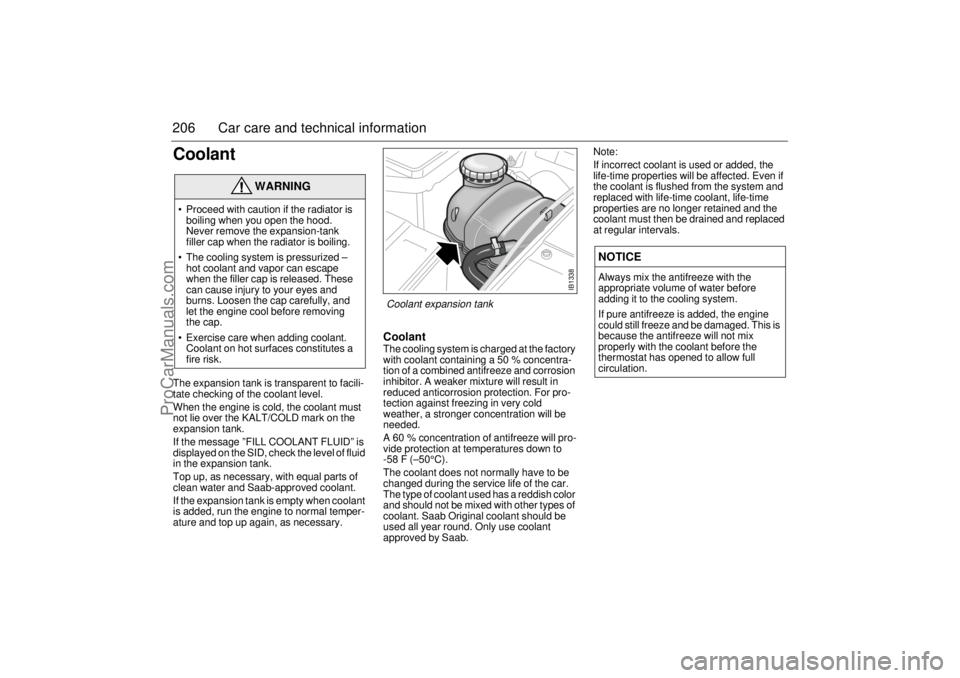
tate checking of the coolant level.
When the engine is cold, the coolant must
not lie over the KALT/COLD mark on the
expansion tank.
If the message ”FILL COOLANT FLUID” is
displayed on the SID, check the level of fluid
in the expansion tank.
Top up, as necessary, with equal parts of
clean water and Saab-approved coolant.
If the expansion tank is empty when coolant
is added, run the engine to normal temper-
ature and top up again, as necessary.
Coolant The cooling system is charged at the factory
with coolant containing a 50 % concentra-
tion of a combined antifreeze and corrosion
inhibitor. A weaker mixture will result in
reduced anticorrosion protection. For pro-
tection against freezing in very cold
weather, a stronger concentration will be
needed.
A 60 % concentration of antifreeze will pro-
vide protection at temperatures down to
-58 F (–50°C).
The coolant does not normally have to be
changed during the service life of the car.
The type of coolant used has a reddish color
and should not be mixed with other types of
coolant. Saab Original coolant should be
used all year round. Only use coolant
approved by Saab. Note:
If incorrect coolant is used or added, the
life-time properties will be affected. Even if
the coolant is flushed from the system and
replaced with life-time coolant, life-time
properties are no longer retained and the
coolant must then be drained and replaced
at regular intervals.
WARNING
Proceed with caution if the radiator is
boiling when you open the hood.
Never remove the expansion-tank
filler cap when the radiator is boiling.
The cooling system is pressurized –
hot coolant and vapor can escape
when the filler cap is released. These
can cause injury to your eyes and
burns. Loosen the cap carefully, and
let the engine cool before removing
the cap.
Exercise care when adding coolant.
Coolant on hot surfaces constitutes a
fire risk.
NOTICEAlways mix the antifreeze with the
appropriate volume of water before
adding it to the cooling system.
If pure antifreeze is added, the engine
could still freeze and be damaged. This is
because the antifreeze will not mix
properly with the coolant before the
thermostat has opened to allow full
circulation.
IB1338
Coolant expansion tank
ProCarManuals.com
Page 248 of 288

248 Car care and technical information4Inspect the undercoating and touch
up if necessary.
Pay particular atten-
tion to the fenders and wheel housings,
which are exposed to abrasion by flying
gravel, etc. If the composition has worn
or flaked off, the steel must be thor-
oughly cleaned and dried before a fresh
coat is applied. The cleaning is best
done with a scraper and a steel wire
brush, followed by washing with solvent.
Apply the new coating thinly, as other-
wise it may run off or fall off when dry.
For long tripsBefore setting off on a long journey, it is
advisable to have your car checked over by
your Saab dealer.
Obtain a few important items to take along
on your journey such as spare bulbs, wiper
blades, fuses, a Poly-V-belt and the like.
You can check some points yourself before-
hand:
Make sure that the engine is in good con-
dition.
Check that no oil or gasoline leaks out of
the engine or gearbox/transmission.
Check the coolant and power steering
fluid levels. Check also for leaks.
Inspect the Poly-V-belt and replace it if it
shows any signs of hard wear.
Check the battery charge.
Check the tires for tread pattern and air
pressure, including the compact spare
wheel.
Check the brakes.
Check all bulbs.
Check for the presence of the tool kit and
the jack in the car.
Recovery and/or
recycling of automotive
materialsA typical car consists of metals (65–75 %),
plastics (10–15 %), rubber (5 %) and small
quantities of glass, wood, paper and tex-
tiles. The recycling of metals has been com-
monplace for a long time now.
To facilitate sorting of other materials for
recycling, plastic parts, for instance, have
been marked to identify the precise nature
of the plastic.
The quantity of materials in the car that can
be recycled or recovered depends on the
scrapping facilities in different countries. EU
legislation that comes into force in 2006 will
require a minimum of 85 % of the total
weight of materials to be recycled. How-
ever, every major car salvage yard in each
market will receive details from Saab of how
the highest percentage of materials can be
reclaimed.
ProCarManuals.com
Page 260 of 288

260 SpecificationsEngine Fuel4-cylinder ________________________ Four cylinders, twin
overhead cam-
shafts, 16 valves
and two balancer
shafts.
3.0t V6 ___________________________ V-6 engine, double
overhead cam-
shafts on each cyl-
inder bank,
24 valves
Cylinder bores ___________________ 3.54 in (90 mm)
Stroke:
4-cylinder engine _________________ 3.54 in (90 mm)
3.0t V6 _________________________ 3.34 in (85 mm)
Swept volume
4-cylinder engine _________________ 139.7 cu.in
(2.290 litres)
3.0t V6 _________________________ 180.6 cu.in
(2.962 litres)
Idling speed
4-cylinder _______________________ 825 rpm
3.0t V6 _________________________ 700 rpm
Antifreeze ________________________ Saab-approved
antifreeze
Coolant capacity
4-cylinder _______________________ 7.6 qts (7.4 litres)
3.0t V6 _________________________ 7.4 qts (7.2 litres) Fuel grade ________________________ Unleaded gasoline
AON 87–93.
The use of fuel with an octane rating lower than that
recommended can cause serious engine damage.
For optimum performance Saab recom-
mend the following fuel grades:
2.3t _____________________________ AON 90
2.3 Turbo Aero and 3.0t V6 __________ AON 93 *)
*) If AON 90 is used and the ambient temperature is above
77 – 86°F (25– 30°C) some decrease in engine power can occur
to some extent.
Fuel-tank capacity __________________ 18.5 gal. (70 litres)
ProCarManuals.com
Page 271 of 288

271 Specifications
Several of the systems in your Saab
car can be adjusted to better fit your
individual needsSome functions are governed by legal
requirements and cannot therefore be
reprogrammed.
Consult an authorized Saab dealer for fur-
ther information.
Car alarm/central locking system:
The sound level of the siren when locking/
unlocking, HIGH or LOW.
The number of blinks when locking/
unlocking, 1 to 7.
Automatic locking of the trunk when the
car is driven, 1 to 8 mph (2–14 km/h), YES
or NO.
Preclude the unlocking of the trunk while
the car is driven, YES or NO.
Automatic locking of the trunk after
1 second–4 minutes if it has not been
opened, YES or NO.
Automatic locking of the trunk when it is
closed, YES or NO.
Automatic locking of all doors when the
car is driven above 7.5 mph (12 km/h),
YES or NO.Saab Information Display:
Outdoor temperature display can be
adjusted.
Miscellaneous:
Select the on-time for heated rear seat.
Coolant temperature gauge adjustment
can be increased/decreased.
Fuel level gauge adjustment can be
increased/decreased.
Additional sweep of the wipers after wind-
shield washer function (ON or OFF).
Follow me home on-time can vary from 20
to 50 seconds.
Night panel illumination deactivation
speed for the speedometer can be
adjusted.
Following adjustments can be done
by the driver:Automatic Climate Control (ACC):
To alter the preprogrammed ”AUTO” start
up mode with your own preferences you can
manually select the desired settings for:
Temperature.
Fan speed.
Air distribution.
See ”Programming I” on page 83 and ”Pro-
gramming II” on page 84.
Saab 9-5 Audio System (see page 105):
Maximum starting volume (when the
radio is switched on).
Telephone volume (if the car is equipped
with a phone connected to the audio sys-
tem).
Speed dependent volume (volume
increases or decreases with vehicle
speed).
Loudness.
Alarm system:
The glass breakage sensor can be tempo-
rarily disabled, see page 49.
Daytime Running Lights:
To disable, turn off the ignition and pull out
fuse 35, see page 228.
ProCarManuals.com
Page 273 of 288

273 Index
IndexAA/C system, fault diagnosis
________ 242
A/C system, maintenance _________ 242
ABS brakes
____________________ 172
ACC
__________________________ 77
ACC functions
___________________ 80
ACC, automatic climate control
______ 77
ACC, calibration
_________________ 85
ACC, condensation _______________ 86
ACC, programming _______________ 83
ACC, useful tips
_________________ 85
Adjusting the steering wheel
_______ 124
Adjustment, seats
________________ 12
Afterheater, V6-engine cars
________ 87
Air conditioning (A/C), fault diagnosis
and maintenance
______________ 242
Air distribution, ACC ______________ 82
Airbag
_________________________ 33
Alarm __________________________ 48
Alarm functions
__________________ 51
Alarm signals
_______________ 48
, 51
Alternator
_____________________ 211
Alternator drive belt
_________ 211
, 263
Alternator rating
________________ 263
Anticorrosion treatment
___________ 246
Antidazzle rear-view mirror
________ 129
Ashtrays
______________________ 135
Audio System
___________________ 89
Audio System, quick guide
_________ 91Autochecking of lights on starting
____62
Automatic climate control (ACC) _____77
Automatic transmission,
technical data
_________________264
Aviod theft, tip
__________________195
BBattery
________________________209
Battery charging/replacing
________210
Battery, boost starting
____________191
Belt guide
______________________17
Boost starting using jump leads
____191
Booster cushion
_________________31
Brake and clutch fluid
____________207
Brake-fluid reservoir
_____________207
Brakes, technical data ____________265
Bulbs, changing
_________________214
Bulbs, table of
__________________225
CCD changer
____________________101
CD player
______________________99
CHECK messages
_______________69
CHECKING
_____________________69
Calibration, ACC
_________________85
Cancelling the programmed settings
__83
Car alarm
______________________48
Car care
______________________197
Cargo net, 9-5 Wagon
____________146
Carpeting, care of
_______________243
Cassette player
__________________96Catalytic converter,
important considerations
________ 156
Central locking
__________________ 42
Change language in SID
__________ 70
Change of address notification
____ 256
Changing a wheel
______________ 237
Changing bulbs
________________ 214
Changing the wheels round
_______ 233
Changing wiper blades
__________ 212
Chassis number
_______________ 269
Chassis number, key to
__________ 270
Child safety
____________________ 23
Child safety locks, rear doors
______ 45
Child seat, integral
_______________ 31
Cleaning, engine bay ____________ 245
Clock
______________________ 69
, 70
Color code, body
_______________ 269
Color code, trim ________________ 269
Compact spare wheel
___________ 236
Compass
_____________________ 130
Condensation, ACC
______________ 86
Coolant
______________________ 206
Courtesy Headlight Feature
_______ 72
Cruise control
_________________ 171
Cup holder
____________________ 138
DDICE/TWICE
__________________ 227
Dampers
_____________________ 265
Date code, tires
________________ 235
Dim-dipped beam _______________ 71
Direction indicators ______________ 73
ProCarManuals.com