engine oil SAAB 9-5 2003 User Guide
[x] Cancel search | Manufacturer: SAAB, Model Year: 2003, Model line: 9-5, Model: SAAB 9-5 2003Pages: 288, PDF Size: 16.78 MB
Page 169 of 288

169 Starting and driving
If you move the selector lever from D to L, downchanges will follow
a set pattern to avoid damaging the engine or transmission.
Manual gear-changing is not recommended on slippery roads.
If one of the drive wheels spins excessively, the engine torque will
be reduced to avoid damaging the transmission.
Adaptive gear-change patternsAdaptive gear-change patterns are selected automatically depend-
ing on the engine load and the present temperature of the transmis-
sion. The function is available in Normal and Sport modes.
The changes occur at a higher engine speed and the car remains in
the same gear for longer, if the transmission control module senses
that the load has not decreased. These gear-change patterns pre-
vent unnecessary changing up and down, when for example driving
up or down long slopes with a trailer or caravan, and to prevent over-
heating the transmission oil. The adaptive gear-change function is
also selected automatically when the transmission oil becomes too
hot, to protect the transmission itself from damage and to lower the
oil temperature.
The adaptive gear-change pattern function is deselected when:
Winter mode is selected.
The engine is switched off.
The load is reduced so much that the function is no longer
required.
”Automatic transmission, fault indicator” appears on main
instrument panel, see page 165.
ProCarManuals.com
Page 189 of 288
189 Starting and driving
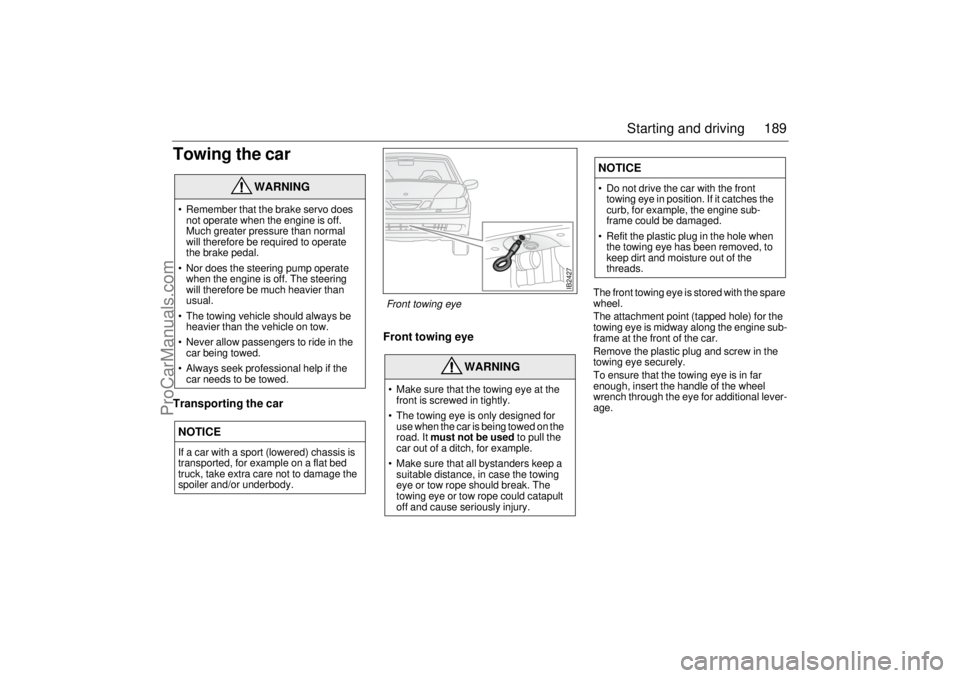
Towing the carTransporting the car Front towing eye
The front towing eye is stored with the spare
wheel.
The attachment point (tapped hole) for the
towing eye is midway along the engine sub-
frame at the front of the car.
Remove the plastic plug and screw in the
towing eye securely.
To ensure that the towing eye is in far
enough, insert the handle of the wheel
wrench through the eye for additional lever-
age.
WARNING
Remember that the brake servo does
not operate when the engine is off.
Much greater pressure than normal
will therefore be required to operate
the brake pedal.
Nor does the steering pump operate
when the engine is off. The steering
will therefore be much heavier than
usual.
The towing vehicle should always be
heavier than the vehicle on tow.
Never allow passengers to ride in the
car being towed.
Always seek professional help if the
car needs to be towed.NOTICEIf a car with a sport (lowered) chassis is
transported, for example on a flat bed
truck, take extra care not to damage the
spoiler and/or underbody.
WARNING
Make sure that the towing eye at the
front is screwed in tightly.
The towing eye is only designed for
use when the car is being towed on the
road. It must not be used to pull the
car out of a ditch, for example.
Make sure that all bystanders keep a
suitable distance, in case the towing
eye or tow rope should break. The
towing eye or tow rope could catapult
off and cause seriously injury.
NOTICE Do not drive the car with the front
towing eye in position. If it catches the
curb, for example, the engine sub-
frame could be damaged.
Refit the plastic plug in the hole when
the towing eye has been removed, to
keep dirt and moisture out of the
threads.
IB2427
Front towing eye
ProCarManuals.com
Page 192 of 288
192 Starting and driving
5 Check that the jumper cables do not
have loose or missing insulation. If they
do, you could get a shock and also the
vehicles could be damaged.
Before you connect the cables, here are
some basic things you should know.
Positive (+) will go to positive (+) and
negative (–) will go to a major metal
engine part with a good ground. Do not
connect (+) to (–) or you will get a short
that could injure you or would damage
the battery and maybe other parts as
well.
6 Connect the red positive (+) cable to the
positive (+) terminal of the vehicle with
the discharged battery.
7 Do not let the other end touch metal.
Connect it to the positive (+) terminal of
the good battery. Use a remote positive
(+) terminal if the vehicle has one.
8 Now connect the black negative (–)
cable to the good battery’s negative ter-
minal.9 Attach the cable at least 18 inches
(45 cm) away from the discharged bat-
tery, but not near engine parts that
move. To avoid an arc which could det-
onate the hydrogen gas around the bat-
tery, the final connection must be at least
18” from the battery.
10 Start the vehicle with the good battery
and run the engine for a while.
11 Try to start the vehicle with the dis-
charged battery. If it does not start after
a few tries, it probably needs service.
12 Remove the cables in reverse order to
prevent electrical shorting. Take care
that they do not touch each other or any
other metal.
WARNING
An electric fan can start up even when the
engine is not running and can injure you.
Keep hands, clothing and tools away from
any underhood electric fan.
WARNING
Using a match or flame of any kind near a
battery can cause battery gas to explode.
You can suffer burns or be blinded. Use a
flashlight if you need more light.
Be sure the battery has enough water.
The battery installed in your new Saab
has filler caps. Be sure the right amount
of water is there. Add distilled or boiled
water if the level is too low. If you don’t,
explosive gas could be present.
Be sure the electrolyte in the battery is not
frozen. Discharged batteries will freeze.
When connecting jumper cables to a
frozen battery, gas from the chemical
reaction inside the battery can build up
under the ice and cause an explosion.
Battery fluid contains acid that can burn
you. Do not get it on you. If you acciden-
tally get it in your eyes or on your skin,
flush the area with water and get medical
help immediately.
WARNING
Do not let the other end touch anything
until the next step. The other end of the
negative cable does not go to the dead
battery. It goes to a major metal part with
a good ground on the engine of the vehi-
cle with the discharged battery.
ProCarManuals.com
Page 197 of 288
197 Car care and technical information
Car care and
technical
information
772
Hood ................................. 198
Engine compartment,
4-cyl. engine ................... 199
Engine compartment,
6-cyl. (3.0t V6)................. 200
Emission control systems 201
Engine............................... 202
Engine oil ......................... 203
Transmission fluid........... 205
Coolant ............................. 206
Brake and clutch fluid ..... 207
Power steering fluid ........ 208
Air filter ............................. 208 Battery .............................. 209
Drive belts ........................ 211
Wipers and washers ....... 212
Changing bulbs ............... 214
Fuses ................................ 226
Wheels .............................. 232
Compact spare wheel ..... 236
Flat spotting..................... 241
Air conditioning (ACC) ... 242
Safety belts ...................... 243
Upholstery and trim ........ 243
Textile carpeting.............. 243
Washing the car .............. 244 Waxing and polishing ...... 245
Engine compartment ....... 245
Touching up the paint ..... 245
Anti-corrosion treatment . 246
For long trips .................... 248
Recovery and/or recycling
of automotive materials. 248
Headlight aiming .............. 250
ProCarManuals.com
Page 199 of 288
199 Car care and technical information
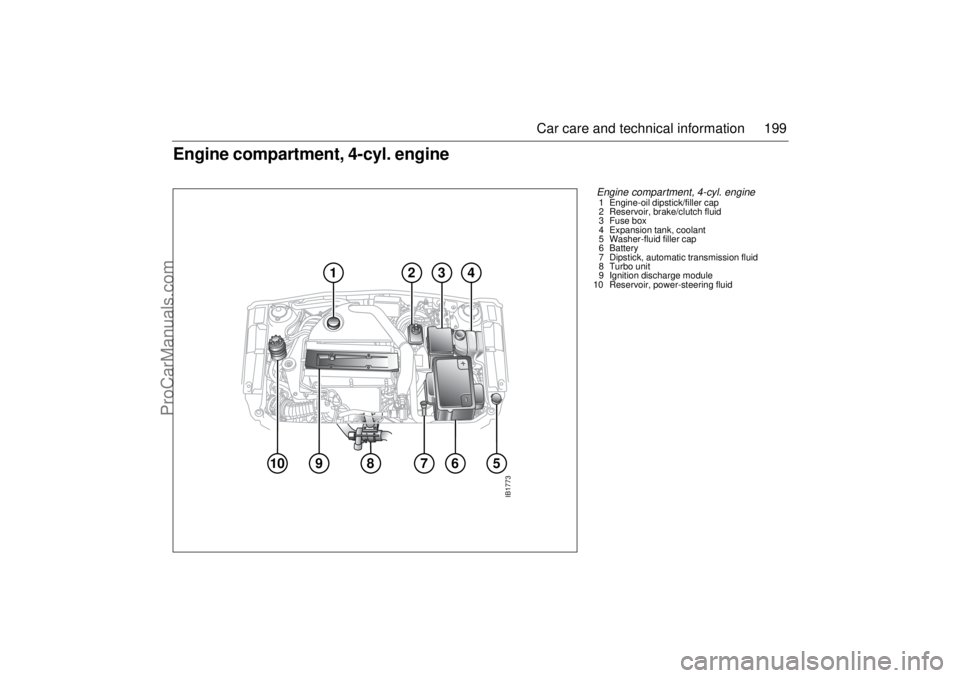
Engine compartment, 4-cyl. engine
10
9
6
7
8
1
2
4
3
5
IB1773
Engine compartment, 4-cyl. engine 1 Engine-oil dipstick/filler cap
2 Reservoir, brake/clutch fluid
3 Fuse box
4 Expansion tank, coolant
5 Washer-fluid filler cap
6Battery
7 Dipstick, automatic transmission fluid
8 Turbo unit
9 Ignition discharge module
10 Reservoir, power-steering fluid
ProCarManuals.com
Page 200 of 288
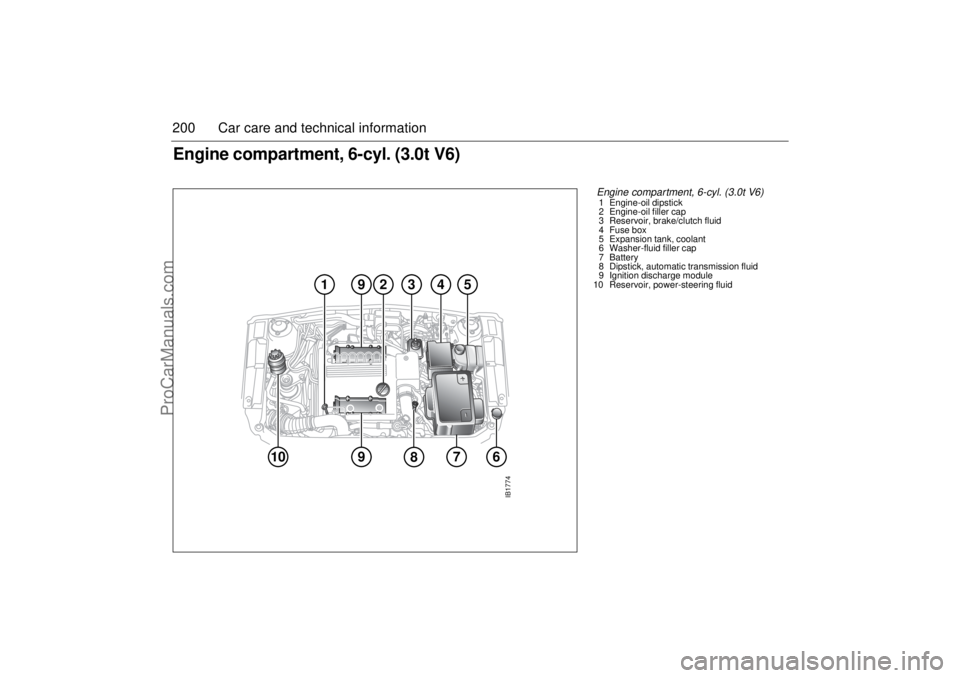
200 Car care and technical informationEngine compartment, 6-cyl. (3.0t V6)
99
2
1
4
57
6
10
83
IB1774
Engine compartment, 6-cyl. (3.0t V6) 1 Engine-oil dipstick
2 Engine-oil filler cap
3 Reservoir, brake/clutch fluid
4 Fuse box
5 Expansion tank, coolant
6 Washer-fluid filler cap
7Battery
8 Dipstick, automatic transmission fluid
9 Ignition discharge module
10 Reservoir, power-steering fluid
ProCarManuals.com
Page 203 of 288
203 Car care and technical information
Engine oilChecking the oil level Check the engine-oil level regularly. This
should be done after the engine has been
run to normal temperature and then allowed
to cool for 2–5 minutes, with the car stand-
ing on level ground. Remove the dipstick
and wipe it clean before checking the level.
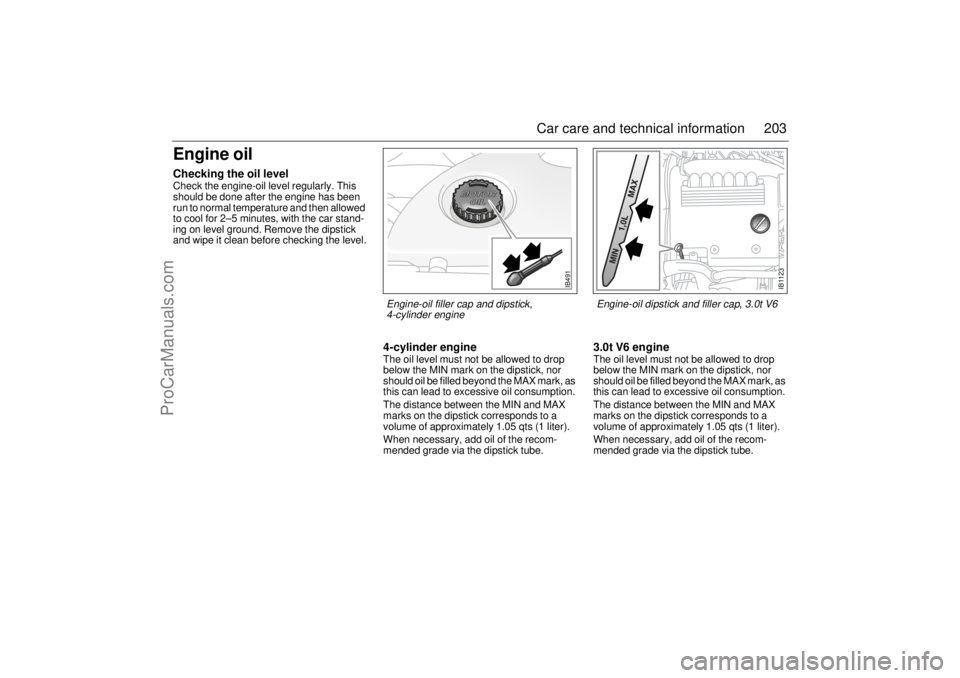
4-cylinder engine The oil level must not be allowed to drop
below the MIN mark on the dipstick, nor
should oil be filled beyond the MAX mark, as
this can lead to excessive oil consumption.
The distance between the MIN and MAX
marks on the dipstick corresponds to a
volume of approximately 1.05 qts (1 liter).
When necessary, add oil of the recom-
mended grade via the dipstick tube.
3.0t V6 engine The oil level must not be allowed to drop
below the MIN mark on the dipstick, nor
should oil be filled beyond the MAX mark, as
this can lead to excessive oil consumption.
The distance between the MIN and MAX
marks on the dipstick corresponds to a
volume of approximately 1.05 qts (1 liter).
When necessary, add oil of the recom-
mended grade via the dipstick tube.
IB491
Engine-oil filler cap and dipstick,
4-cylinder engine
IB1123
Engine-oil dipstick and filler cap, 3.0t V6
ProCarManuals.com
Page 204 of 288
204 Car care and technical informationOil changingThe engine oil must be changed in accor-
dance with the service program, see page
254.
Oil volume and grade, see page 261.
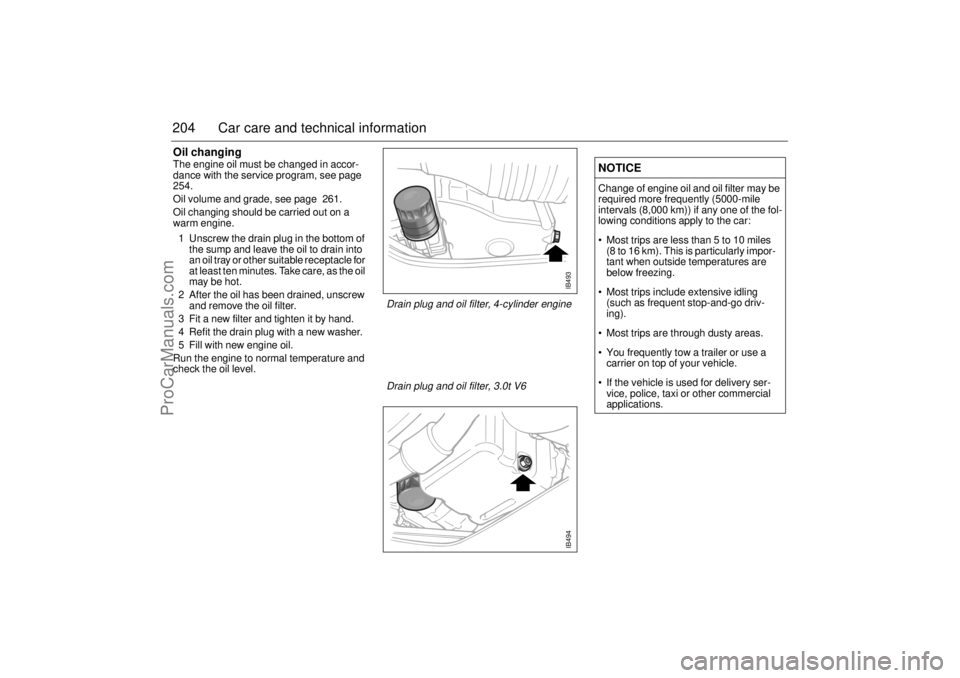
Oil changing should be carried out on a
warm engine.
1 Unscrew the drain plug in the bottom of
the sump and leave the oil to drain into
an oil tray or other suitable receptacle for
at least ten minutes. Take care, as the oil
may be hot.
2 After the oil has been drained, unscrew
and remove the oil filter.
3 Fit a new filter and tighten it by hand.
4 Refit the drain plug with a new washer.
5 Fill with new engine oil.
Run the engine to normal temperature and
check the oil level.
NOTICEChange of engine oil and oil filter may be
required more frequently (5000-mile
intervals (8,000 km)) if any one of the fol-
lowing conditions apply to the car:
Most trips are less than 5 to 10 miles
(8 to 16 km). This is particularly impor-
tant when outside temperatures are
below freezing.
Most trips include extensive idling
(such as frequent stop-and-go driv-
ing).
Most trips are through dusty areas.
You frequently tow a trailer or use a
carrier on top of your vehicle.
If the vehicle is used for delivery ser-
vice, police, taxi or other commercial
applications.
IB493
Drain plug and oil filter, 4-cylinder engine
IB494
Drain plug and oil filter, 3.0t V6
ProCarManuals.com
Page 205 of 288
205 Car care and technical information
Transmission fluidManual transmission Check and top up the fluid in accordance
with the service program.
If original fluid cannot be obtained for top-
ping up (see page 264), automatic trans-
mission fluid Dexron III (synthetic oil) can be
used. If so, the car should be taken to an
authorized Saab dealer immediately to
have the reason for low fluid level corrected
and original fluid installed.Automatic transmission Check the fluid level as follows:
1 Stand the car on level ground and apply
the parking brake. The automatic trans-
mission fluid must be at normal running
temperature, approximately 175°F
(80°C). This can be achieved by driving
the car for about 30 min on the open
road.
2 With the engine idling, move the selector
lever to D and wait for at least
15 seconds. Next, move the selector
lever to R and wait for 15 seconds again.
Finally, move the selector lever to P. Let
the engine idle.
3 Wipe the dipstick clean with a lint-free
cloth and put it back.
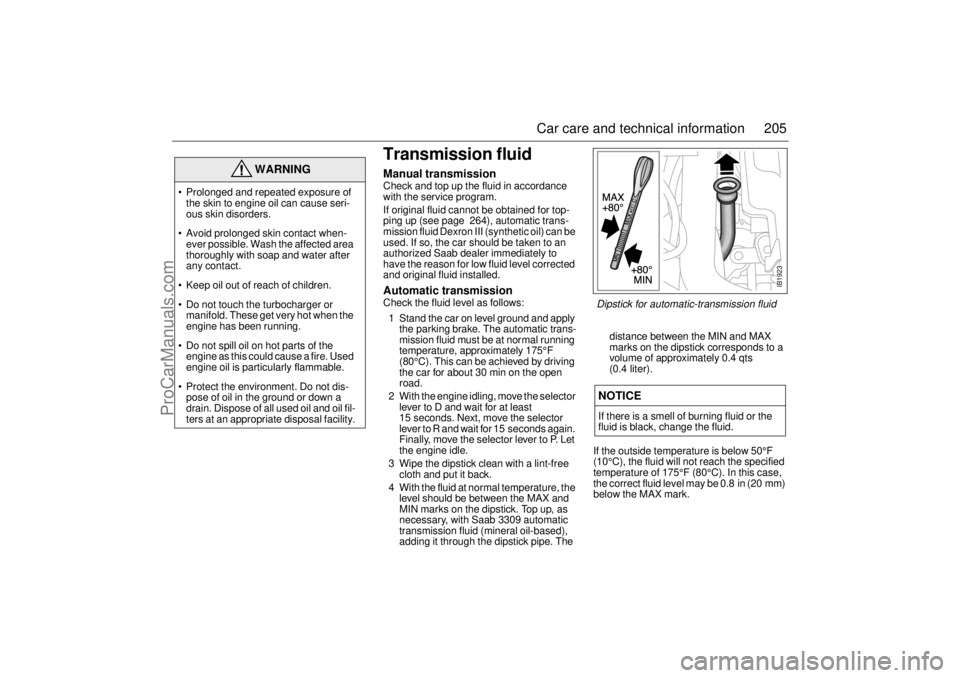
4 With the fluid at normal temperature, the
level should be between the MAX and
MIN marks on the dipstick. Top up, as
necessary, with Saab 3309 automatic
transmission fluid (mineral oil-based),
adding it through the dipstick pipe. The distance between the MIN and MAX
marks on the dipstick corresponds to a
volume of approximately 0.4 qts
(0.4 liter).
If the outside temperature is below 50°F
(10°C), the fluid will not reach the specified
temperature of 175°F (80°C). In this case,
the correct fluid level may be 0.8 in (20 mm)
below the MAX mark.
WARNING
Prolonged and repeated exposure of
the skin to engine oil can cause seri-
ous skin disorders.
Avoid prolonged skin contact when-
ever possible. Wash the affected area
thoroughly with soap and water after
any contact.
Keep oil out of reach of children.
Do not touch the turbocharger or
manifold. These get very hot when the
engine has been running.
Do not spill oil on hot parts of the
engine as this could cause a fire. Used
engine oil is particularly flammable.
Protect the environment. Do not dis-
pose of oil in the ground or down a
drain. Dispose of all used oil and oil fil-
ters at an appropriate disposal facility.
NOTICEIf there is a smell of burning fluid or the
fluid is black, change the fluid.
IB1923
Dipstick for automatic-transmission fluid
ProCarManuals.com
Page 206 of 288
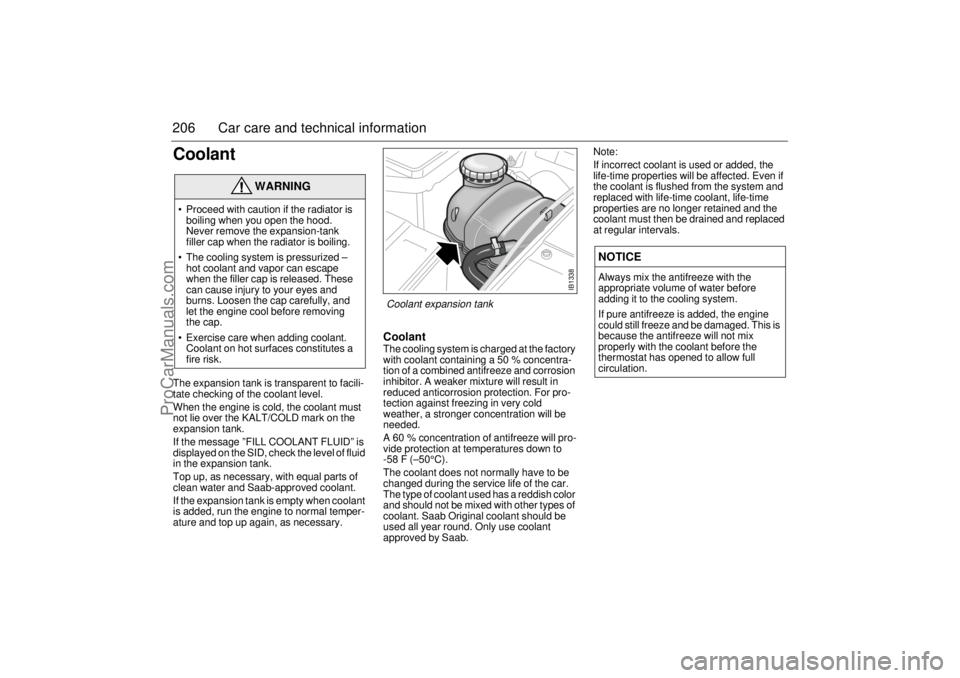
206 Car care and technical informationCoolant The expansion tank is transparent to facili-
tate checking of the coolant level.
When the engine is cold, the coolant must
not lie over the KALT/COLD mark on the
expansion tank.
If the message ”FILL COOLANT FLUID” is
displayed on the SID, check the level of fluid
in the expansion tank.
Top up, as necessary, with equal parts of
clean water and Saab-approved coolant.
If the expansion tank is empty when coolant
is added, run the engine to normal temper-
ature and top up again, as necessary.
Coolant The cooling system is charged at the factory
with coolant containing a 50 % concentra-
tion of a combined antifreeze and corrosion
inhibitor. A weaker mixture will result in
reduced anticorrosion protection. For pro-
tection against freezing in very cold
weather, a stronger concentration will be
needed.
A 60 % concentration of antifreeze will pro-
vide protection at temperatures down to
-58 F (–50°C).
The coolant does not normally have to be
changed during the service life of the car.
The type of coolant used has a reddish color
and should not be mixed with other types of
coolant. Saab Original coolant should be
used all year round. Only use coolant
approved by Saab. Note:
If incorrect coolant is used or added, the
life-time properties will be affected. Even if
the coolant is flushed from the system and
replaced with life-time coolant, life-time
properties are no longer retained and the
coolant must then be drained and replaced
at regular intervals.
WARNING
Proceed with caution if the radiator is
boiling when you open the hood.
Never remove the expansion-tank
filler cap when the radiator is boiling.
The cooling system is pressurized –
hot coolant and vapor can escape
when the filler cap is released. These
can cause injury to your eyes and
burns. Loosen the cap carefully, and
let the engine cool before removing
the cap.
Exercise care when adding coolant.
Coolant on hot surfaces constitutes a
fire risk.
NOTICEAlways mix the antifreeze with the
appropriate volume of water before
adding it to the cooling system.
If pure antifreeze is added, the engine
could still freeze and be damaged. This is
because the antifreeze will not mix
properly with the coolant before the
thermostat has opened to allow full
circulation.
IB1338
Coolant expansion tank
ProCarManuals.com