open hood SAAB 9-5 2003 User Guide
[x] Cancel search | Manufacturer: SAAB, Model Year: 2003, Model line: 9-5, Model: SAAB 9-5 2003Pages: 288, PDF Size: 16.78 MB
Page 181 of 288

181 Starting and driving
Driving in hot weather Always check the coolant level before
starting a journey. The level should be just
below the MAX mark.
At the end of a journey, if the engine has
worked hard, allow it to idle for two or
three minutes before switching it off.
If the needle on the temperature gauge
enters the red zone:
1 Bring the car to a standstill but leave the
engine running. Do not remove the cap
on the expansion tank even if the tank is
empty. If the needle on the temperature
gauge continues to rise while the engine
is idling, switch off the engine. 2 Wait until the needle has dropped back
to indicate normal temperature (roughly
midway, in the white zone) before stop-
ping the engine. If the coolant needs top-
ping up, unscrew the cap on expansion
tank carefully.
Top up, as necessary, ideally with a
50/50 mixture of Saab-approved coolant
and water. If only water is available, use
that, but remember to have the coolant
mixture checked as soon as possible.
3 As soon as possible, have the cooling
system checked by an authorized Saab
dealer.
Towing a trailerTrailer hitch attachmentTrailer hitch attachments are available as
accessories. These are designed for a max-
imum trailer weight of 3500 lbs. (1588 kg),
see also page 259.
Use only the electrical trailer hitch socket
provided in the trailer hitch kit.
Saab recommends:
Use a Saab original hitch kit attachment
which is designed and tested by Saab.
Consult your Saab dealer regarding the
appropriate hitch kit for your car.
WARNING
Exercise care when opening the hood
if the engine is overheated. Never
remove the expansion tank cap com-
pletely when the engine is hot.
The cooling system is pressurized -
hot coolant and vapor can escape.
These can cause injury to your eyes
and burns. Open the cap slowly to
release the pressure before
removing it.
NOTICEUse only a genuine Saab trailer hitch and
wiring, since other wiring methods can
cause expensive damage to the car’s
body and electrical system.
Consult an authorized Saab dealer for
guidance on how to connect the trailer
hitch electrical system.
ProCarManuals.com
Page 183 of 288
183 Starting and driving
Use Normal mode when driving with a trailer
or trailer on hilly roads. The adaptive gear
change pattern function will prevent the
transmission from overheating.
Rises in coolant temperature are indicated
by the temperature gauge in the main instru-
ment panel.
The following can also occur:
the A/C-compressor can be shut off
the gear-change pattern is changed
the CHECK message TRANSMISSION
OVERHEATING can appear on the SID
If TRANSMISSION OVERHEATING
appears on the SID, stop the car as soon as
it is safe to do so, switch off the engine and
open the hood. Wait several minutes and
then turn on the ignition to check that the
message has been extinguished. When
continuing your journey, select manual
mode (M) and a gear in which the engine
speed is about 3,000 rpm (see page 168). Do not drive continuously with the WINTER
mode selected in hilly country when you are
towing a trailer, as this will increase fuel con-
sumption and risk overheating the transmis-
sion.
Driving considerations Always take extra care when towing a
trailer, as the car’s handling will be different
and its braking effect reduced. The trailer’s
braking system and suspension also have a
considerable effect on these characteris-
tics, see also ”Driving with a load” page 187.
If the car has automatic transmission, select
position D when ascending steep hills. This
ensures that the adaptive gear change pat-
terns are operational, see page 169. Use
position D or L for steep descents.
WARNING
Remember to use engine-braking (selec-
tor position D or L) to spare the brakes
when you are driving on a long or steep
downhill slope.
Brake failure can result from overheated
brakes!
NOTICEIf the ”Automatic transmission, fault indi-
cator” indicator comes on, cease
towing until the problem has been recti-
fied.
ProCarManuals.com
Page 191 of 288
191 Starting and driving
Jump startingIf your battery has run down, you may want
to use another vehicle and some jumper
cables to start your Saab. Follow the steps
below to do it safely.
To jump start your vehicle:
1 Check the other vehicle. It must have a
12-volt battery with a negative ground
system.
2 Get the vehicles close enough so the
jumper cables can reach, but be sure the
vehicles are not touching each other. If
a poor connection on the negative
jumper cable should exist, it is possible
for damage to be caused to electrical
systems/components of either vehicle
should inadvertent contact be made.
You would not be able to start your car
and bad grounding could damage elec-
trical systems.3 Turn off the ignition on both vehicles.
Turn off all lights that are not needed,
and radios. This will avoid sparks and
help save both batteries and it could
save your radio.
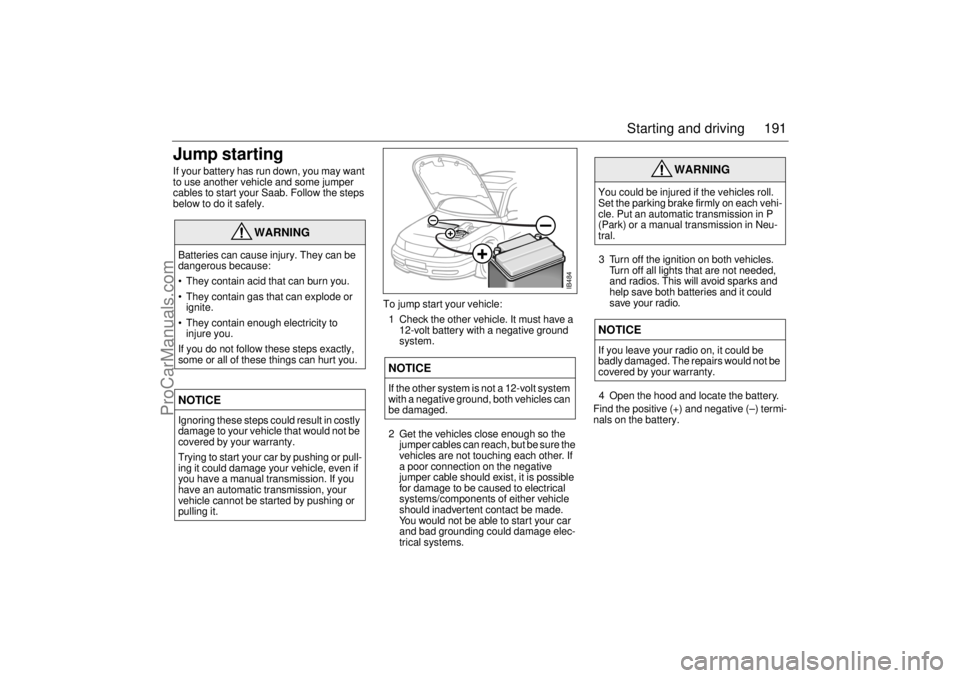
4 Open the hood and locate the battery.
Find the positive (+) and negative (–) termi-
nals on the battery.
WARNING
Batteries can cause injury. They can be
dangerous because:
They contain acid that can burn you.
They contain gas that can explode or
ignite.
They contain enough electricity to
injure you.
If you do not follow these steps exactly,
some or all of these things can hurt you.NOTICEIgnoring these steps could result in costly
damage to your vehicle that would not be
covered by your warranty.
Trying to start your car by pushing or pull-
ing it could damage your vehicle, even if
you have a manual transmission. If you
have an automatic transmission, your
vehicle cannot be started by pushing or
pulling it.
NOTICEIf the other system is not a 12-volt system
with a negative ground, both vehicles can
be damaged.
WARNING
You could be injured if the vehicles roll.
Set the parking brake firmly on each vehi-
cle. Put an automatic transmission in P
(Park) or a manual transmission in Neu-
tral.NOTICEIf you leave your radio on, it could be
badly damaged. The repairs would not be
covered by your warranty.
+
–
+
–
IB484
ProCarManuals.com
Page 196 of 288
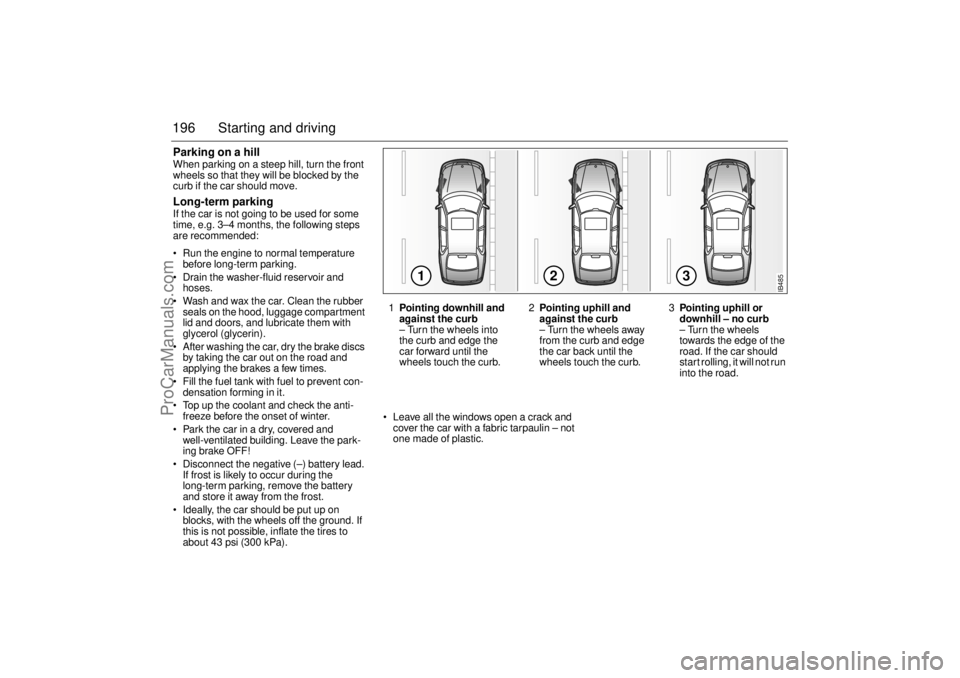
196 Starting and drivingParking on a hillWhen parking on a steep hill, turn the front
wheels so that they will be blocked by the
curb if the car should move. Long-term parkingIf the car is not going to be used for some
time, e.g. 3–4 months, the following steps
are recommended:
Run the engine to normal temperature
before long-term parking.
Drain the washer-fluid reservoir and
hoses.
Wash and wax the car. Clean the rubber
seals on the hood, luggage compartment
lid and doors, and lubricate them with
glycerol (glycerin).
After washing the car, dry the brake discs
by taking the car out on the road and
applying the brakes a few times.
Fill the fuel tank with fuel to prevent con-
densation forming in it.
Top up the coolant and check the anti-
freeze before the onset of winter.
Park the car in a dry, covered and
well-ventilated building. Leave the park-
ing brake OFF!
Disconnect the negative (–) battery lead.
If frost is likely to occur during the
long-term parking, remove the battery
and store it away from the frost.
Ideally, the car should be put up on
blocks, with the wheels off the ground. If
this is not possible, inflate the tires to
about 43 psi (300 kPa). Leave all the windows open a crack and
cover the car with a fabric tarpaulin – not
one made of plastic.
123
IB485
1Pointing downhill and
against the curb
– Turn the wheels into
the curb and edge the
car forward until the
wheels touch the curb.2Pointing uphill and
against the curb
– Turn the wheels away
from the curb and edge
the car back until the
wheels touch the curb.3Pointing uphill or
downhill – no curb
– Turn the wheels
towards the edge of the
road. If the car should
start rolling, it will not run
into the road.
ProCarManuals.com
Page 198 of 288
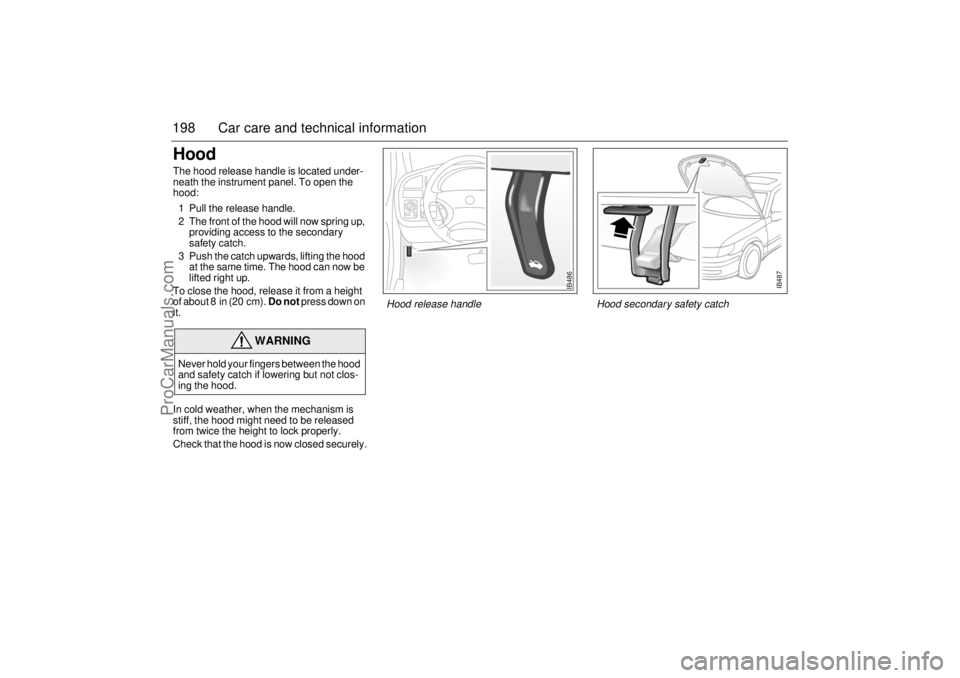
198 Car care and technical informationHood The hood release handle is located under-
neath the instrument panel. To open the
hood:
1 Pull the release handle.
2 The front of the hood will now spring up,
providing access to the secondary
safety catch.
3 Push the catch upwards, lifting the hood
at the same time. The hood can now be
lifted right up.
To close the hood, release it from a height
of about 8 in (20 cm). Do not press down on
it.
In cold weather, when the mechanism is
stiff, the hood might need to be released
from twice the height to lock properly.
Check that the hood is now closed securely.
WARNING
Never hold your fingers between the hood
and safety catch if lowering but not clos-
ing the hood.
IB487
IB486
Hood release handle Hood secondary safety catch
ProCarManuals.com
Page 206 of 288
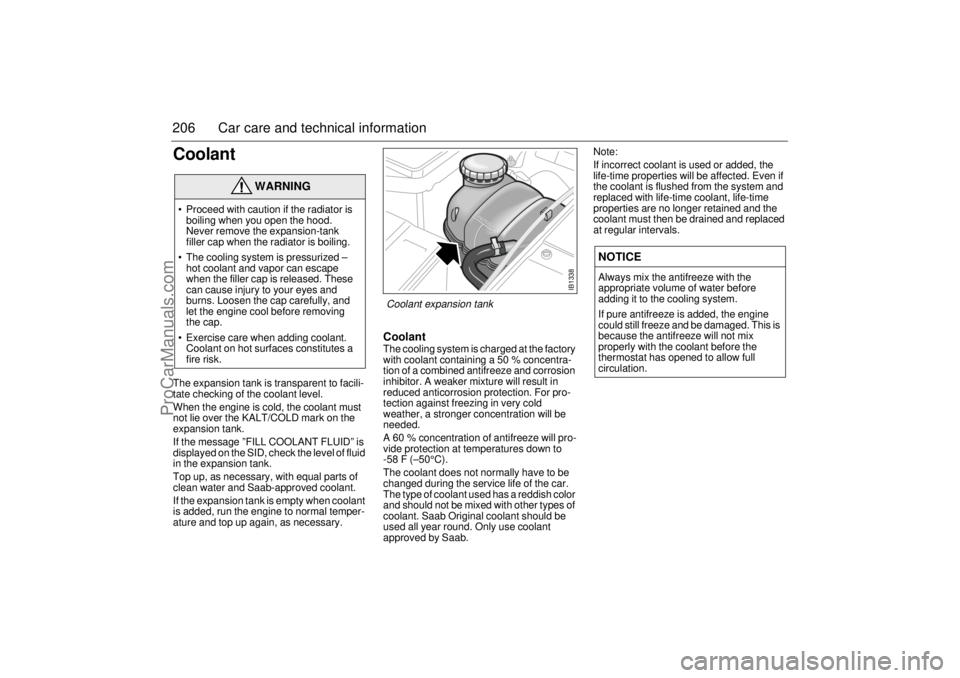
206 Car care and technical informationCoolant The expansion tank is transparent to facili-
tate checking of the coolant level.
When the engine is cold, the coolant must
not lie over the KALT/COLD mark on the
expansion tank.
If the message ”FILL COOLANT FLUID” is
displayed on the SID, check the level of fluid
in the expansion tank.
Top up, as necessary, with equal parts of
clean water and Saab-approved coolant.
If the expansion tank is empty when coolant
is added, run the engine to normal temper-
ature and top up again, as necessary.
Coolant The cooling system is charged at the factory
with coolant containing a 50 % concentra-
tion of a combined antifreeze and corrosion
inhibitor. A weaker mixture will result in
reduced anticorrosion protection. For pro-
tection against freezing in very cold
weather, a stronger concentration will be
needed.
A 60 % concentration of antifreeze will pro-
vide protection at temperatures down to
-58 F (–50°C).
The coolant does not normally have to be
changed during the service life of the car.
The type of coolant used has a reddish color
and should not be mixed with other types of
coolant. Saab Original coolant should be
used all year round. Only use coolant
approved by Saab. Note:
If incorrect coolant is used or added, the
life-time properties will be affected. Even if
the coolant is flushed from the system and
replaced with life-time coolant, life-time
properties are no longer retained and the
coolant must then be drained and replaced
at regular intervals.
WARNING
Proceed with caution if the radiator is
boiling when you open the hood.
Never remove the expansion-tank
filler cap when the radiator is boiling.
The cooling system is pressurized –
hot coolant and vapor can escape
when the filler cap is released. These
can cause injury to your eyes and
burns. Loosen the cap carefully, and
let the engine cool before removing
the cap.
Exercise care when adding coolant.
Coolant on hot surfaces constitutes a
fire risk.
NOTICEAlways mix the antifreeze with the
appropriate volume of water before
adding it to the cooling system.
If pure antifreeze is added, the engine
could still freeze and be damaged. This is
because the antifreeze will not mix
properly with the coolant before the
thermostat has opened to allow full
circulation.
IB1338
Coolant expansion tank
ProCarManuals.com
Page 251 of 288
251 Car care and technical information
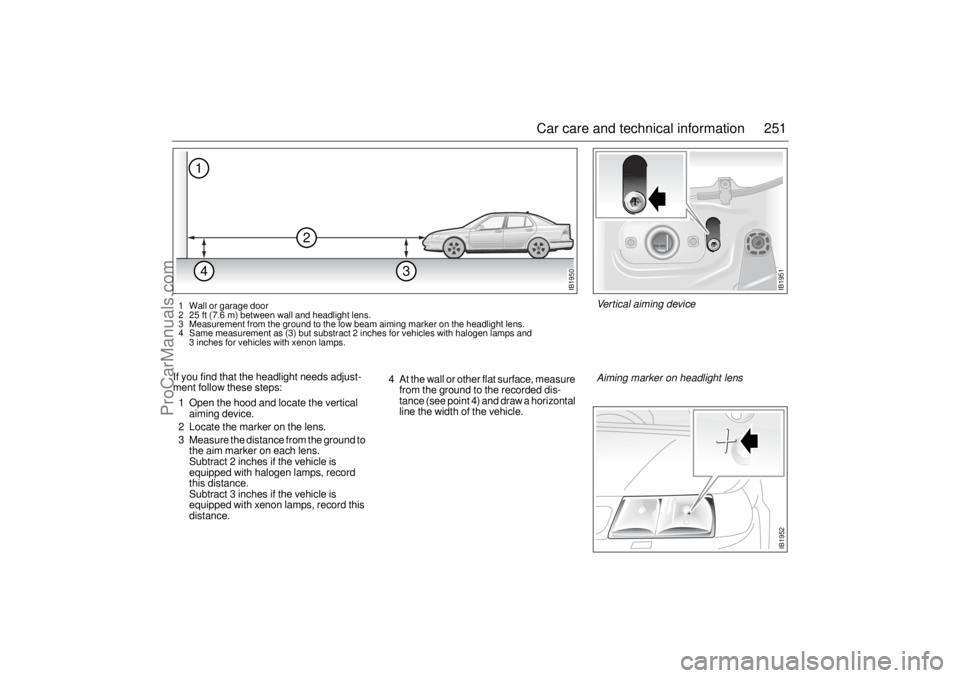
If you find that the headlight needs adjust-
ment follow these steps:
1 Open the hood and locate the vertical
aiming device.
2 Locate the marker on the lens.
3 Measure the distance from the ground to
the aim marker on each lens.
Subtract 2 inches if the vehicle is
equipped with halogen lamps, record
this distance.
Subtract 3 inches if the vehicle is
equipped with xenon lamps, record this
distance.4 At the wall or other flat surface, measure
from the ground to the recorded dis-
tance (see point 4) and draw a horizontal
line the width of the vehicle.
IB1950
2
14
3
1 Wall or garage door
2 25 ft (7.6 m) between wall and headlight lens.
3 Measurement from the ground to the low beam aiming marker on the headlight lens.
4 Same measurement as (3) but substract 2 inches for vehicles with halogen lamps and
3 inches for vehicles with xenon lamps.
IB1951
Vertical aiming device
IB1952
Aiming marker on headlight lens
ProCarManuals.com
Page 274 of 288

274 IndexDoor handles
____________________ 42
Door mirrors ___________________ 125
Doors, locks & luggage compartment
_41
Drive belt
______________________ 263
Drive belt, alternator
_____________ 211
Drive belts, length
_______________ 263
Driver’s seat, programmable
________ 14
Driving at night
_________________ 186
Driving in hot weather
____________ 181
Driving with a load
_______________ 187
EESP
__________________________ 176
Electric heating seat
______________ 15
Electric heating, front seats
_________ 15
Electric windows
________________ 131
Electrical system, technical data
____ 263
Electrically heated rear seat
________ 15
Electronic Stability Program, ESP
___ 176
Electronic starting interlock
_________ 43
Emergency operation of sunroof
____ 133
Emission control systems
_________ 201
Engine bay, 3.0t V6
______________ 200
Engine bay, 4-cyl
_______________ 199
Engine bay, cleaning _____________ 245
Engine number
_________________ 269
Engine oil, grade ________________ 261
Engine, description _________ 202
, 203
Engine, technical data
____________ 260
Engine, temperature gauge
________ 63
Engine-oil level, checking
_________ 203
Expansion tank, coolant
__________ 206
FFault codes, Audio System
________109
Flat spot, tire
___________________241
Fluid level, automatic transmission
__205
Folding the rear seat, 9-5 Sedan
____139
Folding the rear seat, 9-5 Wagon ___142
Frequently asked questions on airbag
39
Front fog lights
__________________74
Frost warning
___________________66
Fuel
__________________________158
Fuel consumption
________________65
Fuel filler door
__________________150
Fuel gauge
_____________________63
Fuel grade _____________________260
Fuse box under hood
____________230
Fuse panel
____________________226
Fuses
________________________226
GGarage door opener
_____________126
Gearbox number
________________269
Gearbox oil, checking
____________205
Gearbox, technical data, __________264
Glove compartment
______________136
HHandbrake
_____________________195
Hazard warning lights
_____________74
Head restraint
___________________16
Headlight flasher _________________71Headlights
_____________________ 71
Holidaying abroad
______________ 248
Hood
________________________ 198
Horn _________________________ 124
IIgnition switch
_________________ 152
Immobilizer
____________________ 43
Indicator and warning lights
________ 56
Indicator lights
__________________ 56
Instrument illumination
___________ 73
Instruments and controls __________ 55
Integral child seat
_______________ 31
Interior equipment ______________ 123
Interior lighting
_________________ 134
Interior rearview mirror
__________ 125
JJack
_________________________ 239
KKey
__________________________ 42
Key to chassis number
__________ 270
Key, remove
__________________ 152
LLATCH (child safety)
_____________ 24
Labels
_________________________ 8
Leather upholstery, care of
_______ 243
Light horn
_____________________ 71
ProCarManuals.com
Page 276 of 288

276 IndexSpeed rating
___________________ 232
Speedometer _______________ 62
, 63
Starting in cold weather, ACC
_______ 83
Starting in hot weather, ACC _______ 83
Steering wheel adjustment
________ 124
Steering, technical data
__________ 265
Stone-chip damage, repairing
______ 245
Storage compartments
___________ 136
Sun visors
_____________________ 135
Sunroof
_______________________ 132
Suspension
____________________ 265
Suspension, technical data
________ 265
Switches
_______________________ 71
Symbols _______________________ 10
Systems, adjustment
_____________ 271
TTCS OFF
_______________________ 61
Table of fuses
__________________ 228
Tachometer
_____________________ 62
Tailgate, opening
________________ 46
Tank gauge
_____________________ 63
Technical data __________________ 257
Telematics
_____________________ 111
Temperature control, ACC
_________ 79
Temperature gauge, engine ________ 63
Temperature zones, ACC
__________ 79
Textile carpeting
________________ 243
Through-load hatch ______________ 141
Tie Downs
_____________________ 141
Tightening torque, wheel studs
_____ 237
Tip, driving at night
______________ 186Tip, to avoid theft
________________195
Tire markings
_____________ 232
, 233
Tire pressure
______________ 187
, 232
Tires
____________________ 232
, 267
Tires, winter
____________________266
Tools
_________________________149
Touching-in the paintwork
_________245
Towbar attachment
______________181
Towbar load
___________________184
Towing the car __________________189
Towing, automatics
______________189
Traction
_______________________175
Trailer weights
__________________259
Trionic
________________________201
Trip computer
___________________65
Trip meter
______________________62
Trunk
_________________________139
Trunk lid, opening
________________46
Turbo gauge
____________________64
Turbo, points to note
_____________155
UUnder the hood, 3.0t V6
__________200
Under the hood, 4-cyl
____________199
Upholstery and trim
______________243
Upholstery and trim, care of
_______243
Useful tips, ACC
_________________85
VVanity mirrors
__________________135
Ventilated front seats
_____________15
Viscosity, engine oil
______________260
WWarning labels
___________________ 8
Warning light, AIR BAG
___________ 38
Warning lights
__________________ 56
Washers
_____________________ 212
Washers, windshield
____________ 213
Washing the car
_______________ 244
Waxing and polishing
___________ 245
Wear indicators, tires ____________ 234
Wheel, change
________________ 237
Wheels and tires ___________ 232
, 267
Wheels and tires, sizes
__________ 266
Window glass sensor, car alarm
____ 49
Windshield washers
_____________ 75
Windshield wipers
_______________ 75
Winter tires
___________________ 266
Wiper blades, replacing
__________ 212
Wipers and washers
_________ 75
, 212
ProCarManuals.com