change time SAAB 9-5 2003 Owner's Manual
[x] Cancel search | Manufacturer: SAAB, Model Year: 2003, Model line: 9-5, Model: SAAB 9-5 2003Pages: 288, PDF Size: 16.78 MB
Page 154 of 288

154 Starting and drivingIt is possible for air to enter the lubricating
system in conjunction with an oil or oil-filter
change, or if the car has been stored for
some time. This air can cause the hydraulic
cam followers to emit a ticking noise, which
can persist for up to 15 minutes after start-
ing. Although this is quite normal and does
not indicate any malfunction, it is advisable
not to exceed 3,000 rpm before the noise
has disappeared.
The hydraulic cam lifters are completely
service free; the valve clearance is set up at
the factory and will not need any subse-
quent adjustment.
Starting the engineAvoid racing the engine or putting a heavy
load on it before it has warmed up. Drive
away as soon as the oil warning light has
been extinguished to enable the engine to
attain its normal temperature as quickly as
possible.
The engine has an automatic choke and
should be started as follows:
Cars with manual transmission
To start the engine the clutch pedal must
be fully depressed.
1 Depress the clutch pedal fully but do not
touch the accelerator.
2 Start the engine. Let the ignition key
spring back as soon as the engine has
started and is running smoothly – at very
low temperatures, you may need to run
the starter for up to 25 seconds. Wait
20–30 seconds before running the
starter again, to give the battery time to
recover.
Note:
On cars with manual transmission, if the
starter fails to engage when the ignition key
is turned to the start position, make sure the
clutch pedal is full depressed. Misposi-
tioned floor mats or other obstructions
under the clutch pedal may affect starting.
Let the engine idle for about 10 seconds. Do
not open the throttle wide for at least 2–
3 minutes after starting. Cars with automatic transmission
1 The selector lever must be in the P or N
position.
2 Keep your foot on the brake pedal.
3 Start the engine. Let the ignition key
spring back as soon as the engine has
started and is running smoothly – at very
low temperatures, you may need to run
the starter for up to 25 seconds. Wait
20–30 seconds before running the
starter again, to give the battery time to
recover.
Let the engine idle for about 10 seconds. Do
not open the throttle wide for at least
2–3 minutes after starting.
Useful tips on cold climate starting If the engine has failed to start after several
attempts in very cold weather, press and
hold the accelerator down to the floor and
run the starter for 5–10 seconds. This will
prevent the engine being flooded (exces-
sively rich fuel-air mixture).
Now start the engine in the normal way – do
not touch the accelerator.
If the engine stalls immediately after starting
(e.g. if the clutch was released too quickly),
do not touch the accelerator when restarting
the engine. The tail pipe of the exhaust system
can become very hot during driving.
Bear this in mind when loading and
unloading the car.
Do not rest or sleep in the car when
parked with the engine running. There
is a risk of depressing the accelerator
which could lead to engine damage.
ProCarManuals.com
Page 165 of 288

165 Starting and driving
Park Brake Shift lockThe transmission has a security function
known as Park Brake Shift Lock. To move
the gear selector out of the P position, the
brake pedal must be depressed at the same
time as the gear selector catch (detente) is
pressed in.
Shift Lock overrideCheck fuse No. 1 (see page 228). If the
problem was cured by changing the fuse or
battery, you do not have to contact a Saab
dealer.
If the fuse blows again as soon as the Shift
Lock feature is activated you should contact
your Saab dealer.
If the fuse is OK, check the battery regarding
the voltage.
1 Apply the parking brake
2 Make sure the key is in position ON
3 Use a small tool such as a screwdriver
and push the lever (see picture) down-
wards so that the detent button can be
pressed approx. 10 mm
4 Move the selector out of position P to N
5 Remove the tool
6 Release the parking brake if the car is to
be moved immediately; otherwise keep
it applied
Automatic transmission,
fault indicator
If ”Automatic transmission, fault indicator”
light appears on the main instrument panel,
the system has detected a fault in the auto-
matic transmission or its control module
(see page 61).
This also means that the Limp-home mode
has been selected, to guard against further
damage being done to the transmission. In
this mode, the automatic transmission
starts in 5th gear, and gear changes (if nec-
essary) will have to be made manually.
Stop the car in a safe place. Switch off then
restart the engine. If the fault is intermittent,
the transmission will operate as normal
despite the fault indicator being on. Have
the car checked at an authorized Saab
dealer.
It is not possible to select the SPORT,
WINTER or Sentronic mode when the
Limp-home mode is active.
Gear changes must be made manually.
The following gears will be engaged in the
respective selector positions when the auto-
matic transmission is in Limp-home mode:
NOTICEDue to electrical problems it may not be
possible to move the selector out of the
park position, even if the ignition is ON. If
for some reason the selector has to be
moved out of the park position (i.e. to tow
the car a short distance) do as described
below.
Position R D M L
Gear Reverse 5th 5th 2nd
ProCarManuals.com
Page 167 of 288

167 Starting and driving
Descending hillsIf the speed of the car increases while
descending a steep hill, despite the acceler-
ator being released, the control module will
change down a gear when you brake. If you
desire more powerful engine braking, man-
ually select a lower gear.
Sentronic, manual modeMove the selector lever to the M position.
Select a higher gear by flicking the
right-hand paddle towards you. Select
a lower gear by flicking the left-hand paddle
towards you.
An example of when you may wish to make
manual gear changes is when overtaking, to
enable you to remain in a low gear for an
extended period of time.
Changes from 3rd to 4th and from 4th to 5th
can be made when the engine speed is
above roughly 2,000 rpm.
If the road surface is slippery, you may wish
to pull off in 2nd or 3rd to reduce the risk of
wheel spin.
When descending hills you should select a
low gear to increase the braking effect of the
engine and thus spare the brakes.
Manual gear selections are shown on the
main instrument panel. The selector posi-
tion and the current gear are displayed.When the selector lever is in the M position,
as opposed to the D position, gas engines
are much more responsive to changes in
accelerator position. The accelerator has a
different feel.
When in manual mode, kick-down operates
for 4th and 5th gears (below 2,000 rpm).
Kick-down cannot be activated in 1st, 2nd or
3rd gears.
For optimum performance, gear changes
should be made before reaching 6,000 rpm.
To avoid damaging the engine and trans-
mission, the transmission will shift up a gear
if the engine is in danger of overrevving. You
may feel a slight jolt before this gear change
is effected.
Paddles on the steering wheel for
changing gear manually
ProCarManuals.com
Page 168 of 288

168 Starting and drivingSelector positions
P
To shift out of the P position you must
depress the brake pedal and the ignition
must be ON.
The parking position (P) must only be selected
when the car is at a complete standstill. The
selector lever is locked and the transmission is
mechanically immobilized. Always apply the
parking brake after parking the car.
The engine can be started. The key can be
removed.
R
The reverse (R) position must only be selected
when the car is at a complete standstill. The
detent-release button must be pressed before
the selector lever can be moved to R. Wait until
reverse gear has engaged (car starts to creep)
before touching the accelerator.
N
In the Neutral position (N), the transmission is
disengaged from the engine. The engine can be
started, but first ensure that the parking brake is
on, to prevent the car from moving off unexpect-
edly.
To prevent the engine and transmission from
becoming hotter than necessary, select N for
stops other than brief ones, e.g. if stuck in a traf-
fic jam.
The normal drive position (D) is recommended
for waiting at traffic lights.
D
The Drive position (D) is the position for normal
motoring. Gear changes between 1st and 5th
will take place automatically, the timing of which
is determined by the throttle (accelerator) posi-
tion and the speed of the car.
After moving the selector lever to D, pause to
give the gear time to engage (car starts to pull).
M
Move the selector lever from position D to M to
allow you to change gear manually. Refer to
page 167.
L
Select position L if you wish to drive in 1st gear.
No upchanges will be made if you pull off in posi-
tion L. If you move the selector lever from posi-
tion D or M to L at a high vehicle speed, the
transmission will automatically shift down
through 4th, 3rd and 2nd gears to 1st gear,
depending on the car’s speed. Use this position
for descending steep hills if the car is heavily
loaded to spare the brakes.
ProCarManuals.com
Page 179 of 288
179 Starting and driving
Driving in a low gear results in higher fuel
consumption than in a high gear because
of the higher engine speed for a given
road speed. Always change up to a higher
gear as soon as traffic conditions allow
and use the highest gear as much as pos-
sible.
Check the air pressure in the tires once a
month. Incorrect pressures increase tire
wear. It is better to have slightly higher
pressure than lower.
Check fuel consumption regularly.
Increased consumption can indicate that
something is wrong and that the car
needs to be checked by an authorized
Saab dealer.
Practical trials on the roads have demon-
strated that substantial savings in fuel con-
sumption can be made if the above advice
is heeded.Road conditions Wet roads increase fuel consumption, as do
unpaved roads and driving in hilly country
(the amount of fuel saved driving downhill is
less than the additional amount required to
climb the hill).
Engine block heater (standard
equipment in Canada, accessory in
U.S.)The following are just some of the benefits
to the car and the environment of using an
engine block heater:
Lower fuel consumption.
Exhaust emissions substantially reduced
over short runs.
Reduced wear on the engine.
Inside of car warms up faster.
The engine heater is effective at outside
temperatures up to +15–20°C. The warmer
it is outside, the shorter the time the engine
heater needs to be connected. Longer than
1.5 hours is unnecessary.
If the car is equipped with a removable,
electrical cabin heater that is not in use, this
should be stored in the luggage compart-
ment.
Driving in cold weatherBefore starting a journey in cold weather
you should check the following:
That the wiper blades have not become
frozen to the windshield/glass.
Brush any snow away from the air intake
for the heater system (opening between
hood and windshield).
It may be advisable to lubricate the
door-lock cylinder (use molybdenum
disulphide, MoS
2) to prevent its freezing.
If the lock has frozen, take care not to
break the key (or use the remote control)
– heat it first or spray it with de-icer.
Periodically during the winter, add gaso-
line anti-freeze to the fuel to dispel any
condensation in the fuel tank which could
freeze and cause problems in the system.
Keep the tank well filled to reduce the risk
of condensation forming.
If the car is parked outside in freezing
weather, fuel additives (gasoline
anti-freeze) will not do any good as it
cannot remove water that has already fro-
zen. Park the car in a warm place so that
any ice that may have built up melts, then
add gasoline anti-freeze when filling up
the tank. Condensation is caused by
changes in the outdoor temperature or by
the car being parked alternately in a
garage and outside.
It is particularly important when the roads
are slippery that the brakes and tires be in
good condition.
WARNING
Never switch the engine off while driving
as the effect of the brakes and power
steering will be greatly reduced.
ProCarManuals.com
Page 193 of 288
193 Starting and driving
Saab Parking
Assistance(Option)The parking aid system facilitates parking
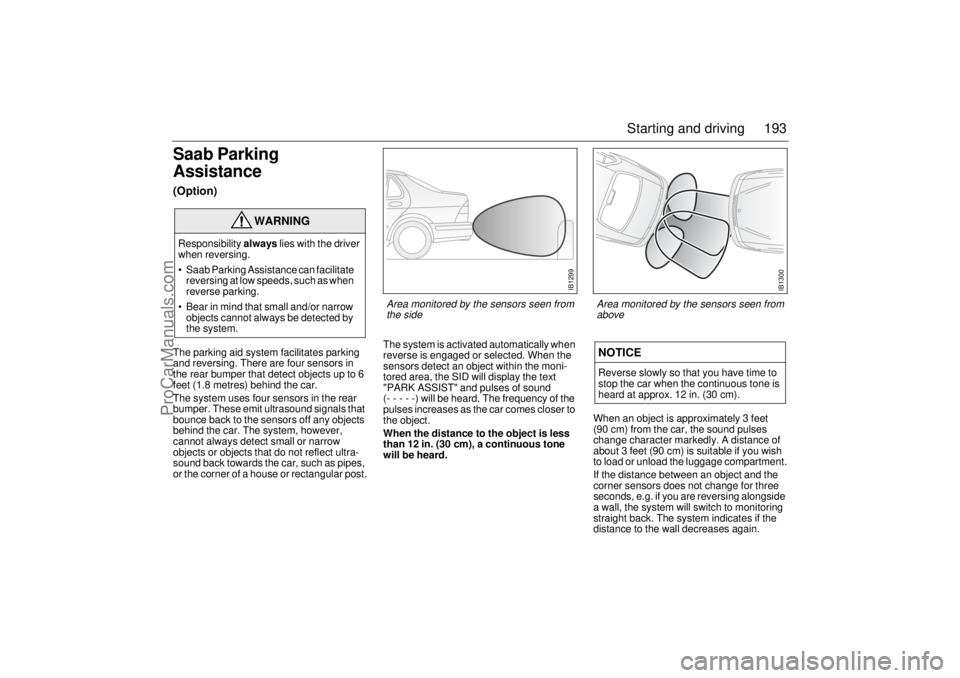
and reversing. There are four sensors in
the rear bumper that detect objects up to 6
feet (1.8 metres) behind the car.
The system uses four sensors in the rear
bumper. These emit ultrasound signals that
bounce back to the sensors off any objects
behind the car. The system, however,
cannot always detect small or narrow
objects or objects that do not reflect ultra-
sound back towards the car, such as pipes,
or the corner of a house or rectangular post.The system is activated automatically when
reverse is engaged or selected. When the
sensors detect an object within the moni-
tored area, the SID will display the text
"PARK ASSIST" and pulses of sound
(-----) will be heard. The frequency of the
pulses increases as the car comes closer to
the object.
When the distance to the object is less
than 12 in. (30 cm), a continuous tone
will be heard.When an object is approximately 3 feet
(90 cm) from the car, the sound pulses
change character markedly. A distance of
about 3 feet (90 cm) is suitable if you wish
to load or unload the luggage compartment.
If the distance between an object and the
corner sensors does not change for three
seconds, e.g. if you are reversing alongside
a wall, the system will switch to monitoring
straight back. The system indicates if the
distance to the wall decreases again.
WARNING
Responsibility always lies with the driver
when reversing.
Saab Parking Assistance can facilitate
reversing at low speeds, such as when
reverse parking.
Bear in mind that small and/or narrow
objects cannot always be detected by
the system.
NOTICEReverse slowly so that you have time to
stop the car when the continuous tone is
heard at approx. 12 in. (30 cm).
IB1299
Area monitored by the sensors seen from
the side
IB1300
Area monitored by the sensors seen from
above
ProCarManuals.com
Page 206 of 288
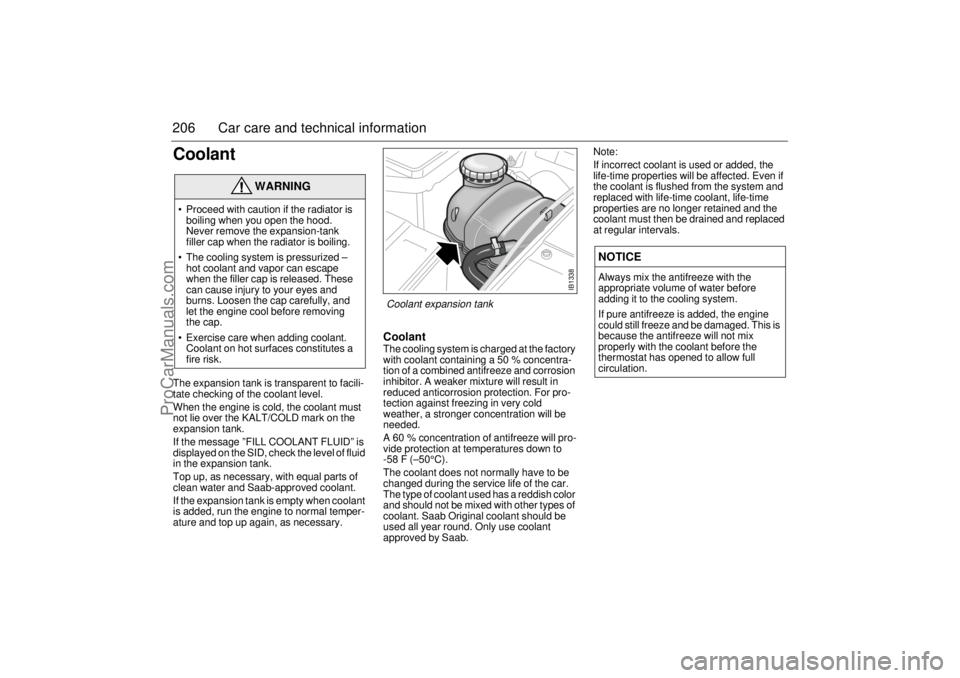
206 Car care and technical informationCoolant The expansion tank is transparent to facili-
tate checking of the coolant level.
When the engine is cold, the coolant must
not lie over the KALT/COLD mark on the
expansion tank.
If the message ”FILL COOLANT FLUID” is
displayed on the SID, check the level of fluid
in the expansion tank.
Top up, as necessary, with equal parts of
clean water and Saab-approved coolant.
If the expansion tank is empty when coolant
is added, run the engine to normal temper-
ature and top up again, as necessary.
Coolant The cooling system is charged at the factory
with coolant containing a 50 % concentra-
tion of a combined antifreeze and corrosion
inhibitor. A weaker mixture will result in
reduced anticorrosion protection. For pro-
tection against freezing in very cold
weather, a stronger concentration will be
needed.
A 60 % concentration of antifreeze will pro-
vide protection at temperatures down to
-58 F (–50°C).
The coolant does not normally have to be
changed during the service life of the car.
The type of coolant used has a reddish color
and should not be mixed with other types of
coolant. Saab Original coolant should be
used all year round. Only use coolant
approved by Saab. Note:
If incorrect coolant is used or added, the
life-time properties will be affected. Even if
the coolant is flushed from the system and
replaced with life-time coolant, life-time
properties are no longer retained and the
coolant must then be drained and replaced
at regular intervals.
WARNING
Proceed with caution if the radiator is
boiling when you open the hood.
Never remove the expansion-tank
filler cap when the radiator is boiling.
The cooling system is pressurized –
hot coolant and vapor can escape
when the filler cap is released. These
can cause injury to your eyes and
burns. Loosen the cap carefully, and
let the engine cool before removing
the cap.
Exercise care when adding coolant.
Coolant on hot surfaces constitutes a
fire risk.
NOTICEAlways mix the antifreeze with the
appropriate volume of water before
adding it to the cooling system.
If pure antifreeze is added, the engine
could still freeze and be damaged. This is
because the antifreeze will not mix
properly with the coolant before the
thermostat has opened to allow full
circulation.
IB1338
Coolant expansion tank
ProCarManuals.com
Page 207 of 288
207 Car care and technical information
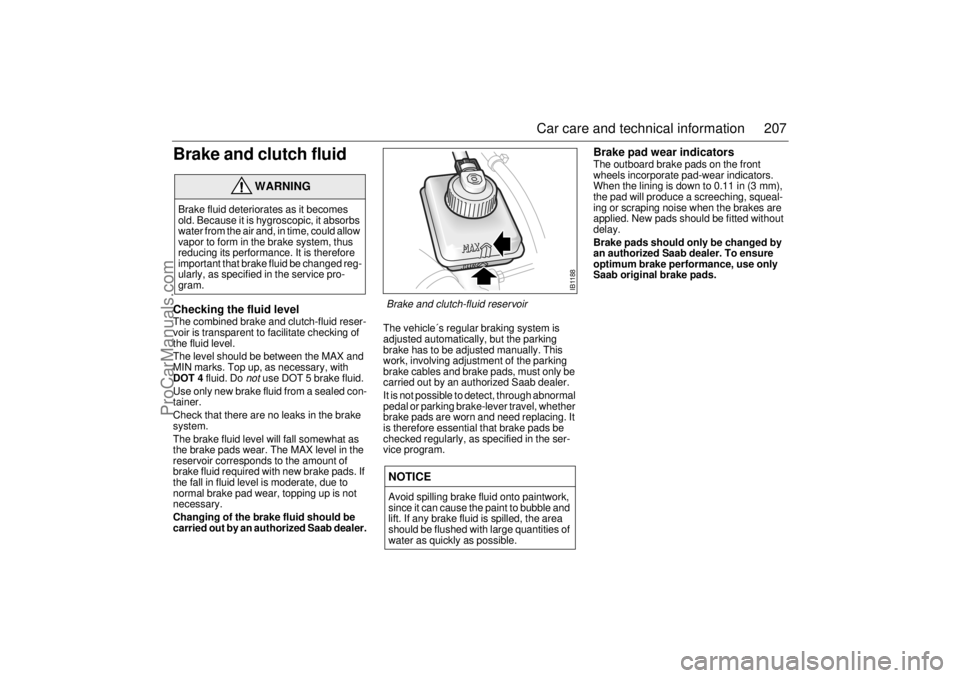
Brake and clutch fluid Checking the fluid level The combined brake and clutch-fluid reser-
voir is transparent to facilitate checking of
the fluid level.
The level should be between the MAX and
MIN marks. Top up, as necessary, with
DOT 4 fluid. Do
not
use DOT 5 brake fluid.
Use only new brake fluid from a sealed con-
tainer.
Check that there are no leaks in the brake
system.
The brake fluid level will fall somewhat as
the brake pads wear. The MAX level in the
reservoir corresponds to the amount of
brake fluid required with new brake pads. If
the fall in fluid level is moderate, due to
normal brake pad wear, topping up is not
necessary.
Changing of the brake fluid should be
carried out by an authorized Saab dealer.The vehicle´s regular braking system is
adjusted automatically, but the parking
brake has to be adjusted manually. This
work, involving adjustment of the parking
brake cables and brake pads, must only be
carried out by an authorized Saab dealer.
It is not possible to detect, through abnormal
pedal or parking brake-lever travel, whether
brake pads are worn and need replacing. It
is therefore essential that brake pads be
checked regularly, as specified in the ser-
vice program.
Brake pad wear indicators The outboard brake pads on the front
wheels incorporate pad-wear indicators.
When the lining is down to 0.11 in (3 mm),
the pad will produce a screeching, squeal-
ing or scraping noise when the brakes are
applied. New pads should be fitted without
delay.
Brake pads should only be changed by
an authorized Saab dealer. To ensure
optimum brake performance, use only
Saab original brake pads.
WARNING
Brake fluid deteriorates as it becomes
old. Because it is hygroscopic, it absorbs
water from the air and, in time, could allow
vapor to form in the brake system, thus
reducing its performance. It is therefore
important that brake fluid be changed reg-
ularly, as specified in the service pro-
gram.
NOTICEAvoid spilling brake fluid onto paintwork,
since it can cause the paint to bubble and
lift. If any brake fluid is spilled, the area
should be flushed with large quantities of
water as quickly as possible.
IB1188
Brake and clutch-fluid reservoir
ProCarManuals.com
Page 214 of 288
214 Car care and technical informationChanging bulbsCheck that the new bulb is working when finished.
Use only "Long Life" bulbs.
Headlight aiming, see page 250.
Bi-Xenon headlight (certain models only)Bi-Xenon headlights produce roughly twice as much light as halo-
gen bulbs and have a significantly longer service life.
The lamp units consist of a gas discharge lamp containing xenon.
When the lights are switched on a very high voltage activates the
xenon gas. The lamps soon reach full intensity.
Cars with xenon headlights have automatic levelling. The levelling
system comprises two sensors on the front axle, one on the rear axle
and a control unit under the headlight housing. Headlight alignment
is regulated automatically to prevent dazzling oncoming traffic.
Alignment is also adjusted during braking.
WARNING
Before changing a bulb in the engine bay, switch off the engine to
avoid danger of fingers and hands being injured by moving parts.
The radiator fan can start up even when the engine is switched off.
Bi-Xenon headlights are high voltage and must therefore be
changed at an authorized Saab workshop. Work involving
high-voltage components is potentially lethal.NOTICE Since the headlight lenses are made of plastic, rinse dried-on
dirt with water and allow it time to soften up before cleaning
the lenses. Avoid rubbing the lenses when dry and never use
solvents.
Use de-icer spray instead of scraping the ice off.
NOTICE Do not fit bulbs with a higher rating than 55 W, since the head-
light reflector and the wiring of the car are not designed for a
higher wattage.
Switch off the ignition before changing a bulb, to avoid possi-
ble short-circuiting.
Do not touch the glass of the bulbs with your fingers. The oil
on your skin can shorten the life of the bulb.
ProCarManuals.com
Page 220 of 288
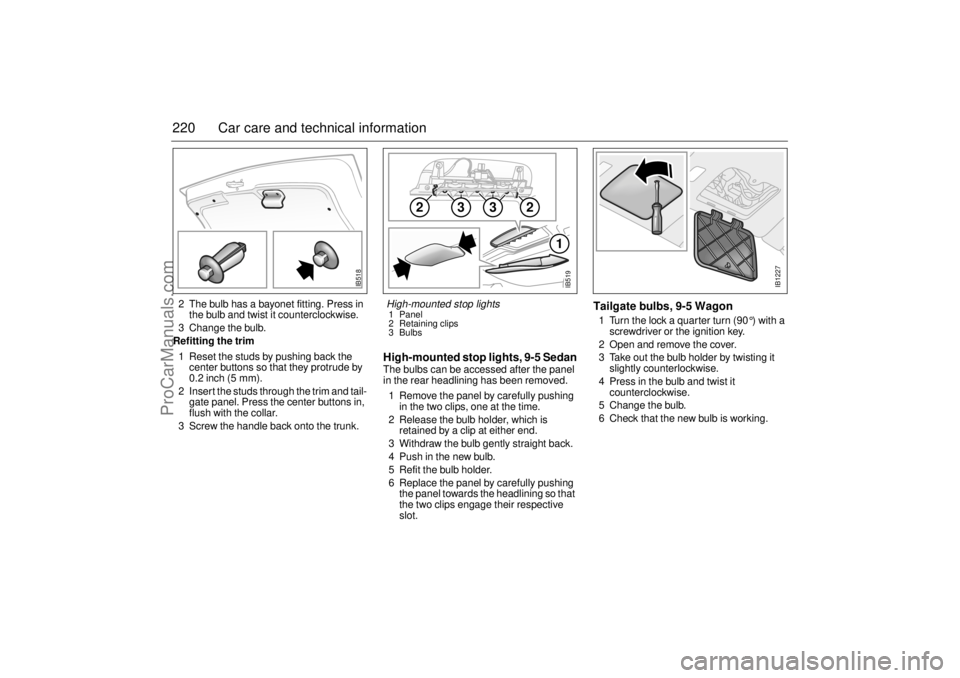
220 Car care and technical information2 The bulb has a bayonet fitting. Press in
the bulb and twist it counterclockwise.
3 Change the bulb.
Refitting the trim
1 Reset the studs by pushing back the
center buttons so that they protrude by
0.2 inch (5 mm).
2 Insert the studs through the trim and tail-
gate panel. Press the center buttons in,
flush with the collar.
3 Screw the handle back onto the trunk.
High-mounted stop lights, 9-5 SedanThe bulbs can be accessed after the panel
in the rear headlining has been removed.
1 Remove the panel by carefully pushing
in the two clips, one at the time.
2 Release the bulb holder, which is
retained by a clip at either end.
3 Withdraw the bulb gently straight back.
4 Push in the new bulb.
5 Refit the bulb holder.
6 Replace the panel by carefully pushing
the panel towards the headlining so that
the two clips engage their respective
slot.
Tailgate bulbs, 9-5 Wagon1 Turn the lock a quarter turn (90 °) with a
screwdriver or the ignition key.
2 Open and remove the cover.
3 Take out the bulb holder by twisting it
slightly counterlockwise.
4 Press in the bulb and twist it
counterclockwise.
5 Change the bulb.
6 Check that the new bulb is working.
IB518
3
2
2
3
1
IB519
High-mounted stop lights1 Panel
2 Retaining clips
3 Bulbs
IB1227
ProCarManuals.com