warning light SAAB 9-5 2003 Service Manual
[x] Cancel search | Manufacturer: SAAB, Model Year: 2003, Model line: 9-5, Model: SAAB 9-5 2003Pages: 288, PDF Size: 16.78 MB
Page 187 of 288

187 Starting and driving
Driving with a loadThe driving characteristics of the car are
affected by the way it is loaded.
Place heavy loads as far forward and as
low as possible in the trunk.
Secure the load to the tie downs, see
page 141.
The load should be such that the car´s
total weight or axle weight are not
exceeded, see page 258.
Heavy loads mean that the car’s center of
gravity is further back. As a result, the car
will sway more during evasive steering.
Never exceed the permissible load in the
roof box, even if there is room for more.
Ensure that the tire pressure is correct –
slight overinflation is preferable to under-
inflation.
The braking distance of a loaded car is
always greater. Keep your distance from
the vehicle in front.
Roof loads can negatively affect tele-
communication.
Tire pressure, see page 269 and back
cover.
Tires The tire pressure should match the current
load and speed of the car; see page 268 or
the tire pressure label on
page 269.
The tire pressures given apply to cold tires,
that is tires that are the same temperature
as the outside air temperature.
The tire pressure increases as the tires
become warm (e.g. during highway driving)
with approximately 0.3 bar (4 psi). When
the temperature of the tires changes by 50°
(10°C), the tire pressure will change 0.1 bar
(2 psi).Never reduce the pressure of a hot tire. If the
tires are hot when you check them, only
increase the pressure, if necessary.
Underinflated tires wear more quickly than
slightly overinflated tires.
If a valve is leaking, simply unscrew it and fit
a new one.
Important! Remember to adjust the tire
pressures if you change the load in the car
or intend to drive at substantially lower or
higher speeds than normal.
WARNING
Check the tire pressure at least once a
month and before long journeys. Under-
inflation can result in:
Punctures
Separation of the tire and tread
Damage to the sidewalls
Damage to the rims on poor roads
Poor handling characteristics
Premature tire wear
Increased fuel consumption.
ProCarManuals.com
Page 188 of 288
188 Starting and drivingDriving considerations
with compact spare
wheel/tire fittedThe following should be observed when the
compact spare wheel (T115/70 R16) is
fitted:
The compact spare is light and easy to
handle when changing the wheel. Do not
drive further than necessary with the com-
pact spare fitted – the maximum life of the
wheel is only just over 2000 miles
(3,500 km). Have the standard wheel
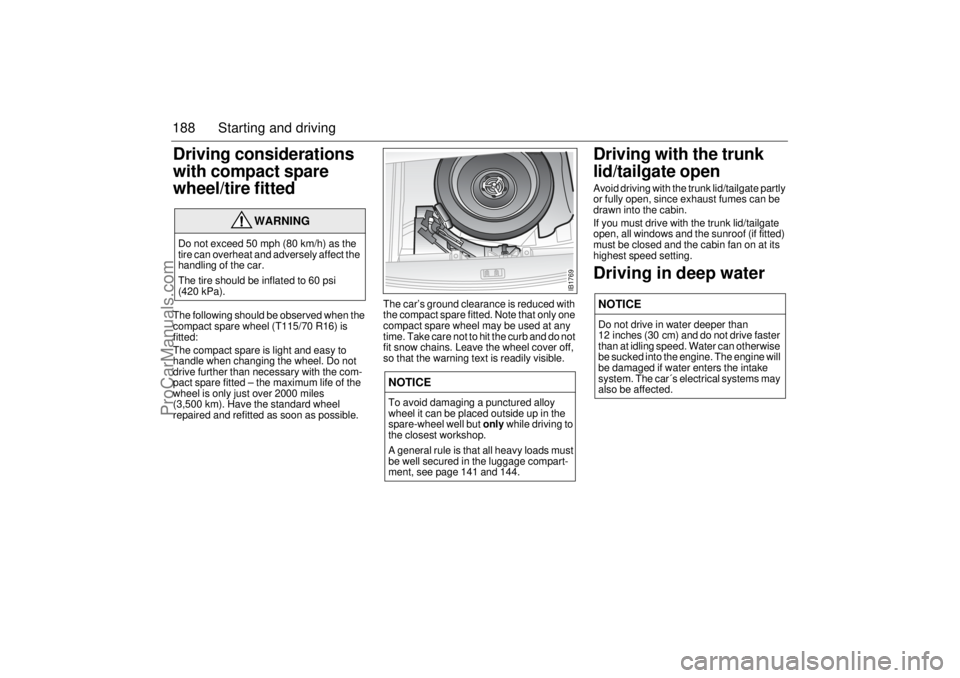
repaired and refitted as soon as possible. The car’s ground clearance is reduced with
the compact spare fitted. Note that only one
compact spare wheel may be used at any
time. Take care not to hit the curb and do not
fit snow chains. Leave the wheel cover off,
so that the warning text is readily visible.
Driving with the trunk
lid/tailgate openAvoid driving with the trunk lid/tailgate partly
or fully open, since exhaust fumes can be
drawn into the cabin.
If you must drive with the trunk lid/tailgate
open, all windows and the sunroof (if fitted)
must be closed and the cabin fan on at its
highest speed setting.Driving in deep water
WARNING
Do not exceed 50 mph (80 km/h) as the
tire can overheat and adversely affect the
handling of the car.
The tire should be inflated to 60 psi
(420 kPa).
NOTICETo avoid damaging a punctured alloy
wheel it can be placed outside up in the
spare-wheel well but only while driving to
the closest workshop.
A general rule is that all heavy loads must
be well secured in the luggage compart-
ment, see page 141 and 144.
NOTICEDo not drive in water deeper than
12 inches (30 cm) and do not drive faster
than at idling speed. Water can otherwise
be sucked into the engine. The engine will
be damaged if water enters the intake
system. The car´s electrical systems may
also be affected.
IB1769
ProCarManuals.com
Page 191 of 288
191 Starting and driving
Jump startingIf your battery has run down, you may want
to use another vehicle and some jumper
cables to start your Saab. Follow the steps
below to do it safely.
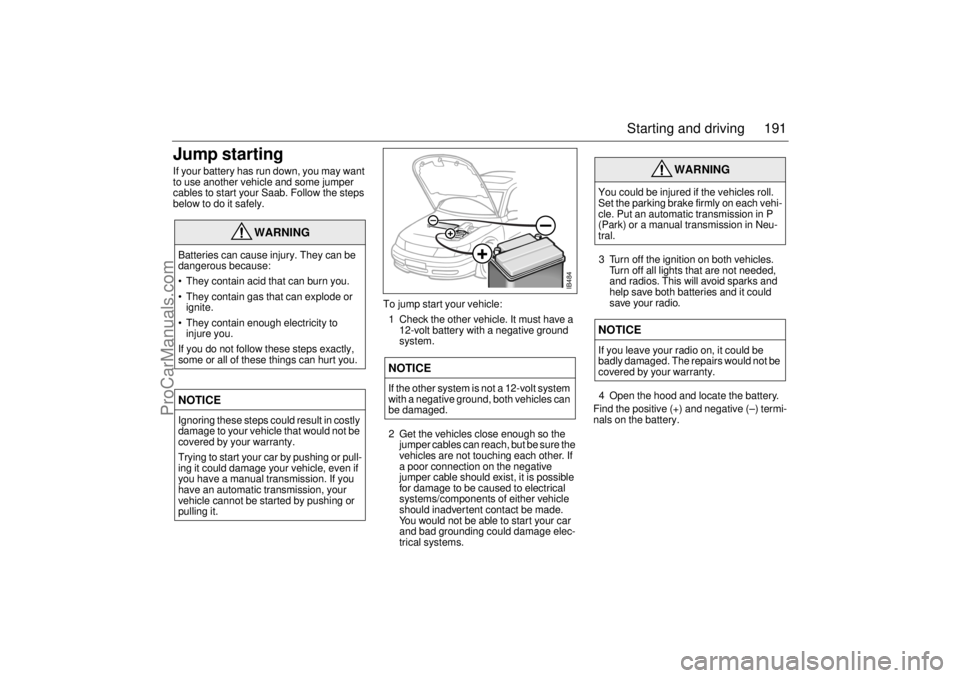
To jump start your vehicle:
1 Check the other vehicle. It must have a
12-volt battery with a negative ground
system.
2 Get the vehicles close enough so the
jumper cables can reach, but be sure the
vehicles are not touching each other. If
a poor connection on the negative
jumper cable should exist, it is possible
for damage to be caused to electrical
systems/components of either vehicle
should inadvertent contact be made.
You would not be able to start your car
and bad grounding could damage elec-
trical systems.3 Turn off the ignition on both vehicles.
Turn off all lights that are not needed,
and radios. This will avoid sparks and
help save both batteries and it could
save your radio.
4 Open the hood and locate the battery.
Find the positive (+) and negative (–) termi-
nals on the battery.
WARNING
Batteries can cause injury. They can be
dangerous because:
They contain acid that can burn you.
They contain gas that can explode or
ignite.
They contain enough electricity to
injure you.
If you do not follow these steps exactly,
some or all of these things can hurt you.NOTICEIgnoring these steps could result in costly
damage to your vehicle that would not be
covered by your warranty.
Trying to start your car by pushing or pull-
ing it could damage your vehicle, even if
you have a manual transmission. If you
have an automatic transmission, your
vehicle cannot be started by pushing or
pulling it.
NOTICEIf the other system is not a 12-volt system
with a negative ground, both vehicles can
be damaged.
WARNING
You could be injured if the vehicles roll.
Set the parking brake firmly on each vehi-
cle. Put an automatic transmission in P
(Park) or a manual transmission in Neu-
tral.NOTICEIf you leave your radio on, it could be
badly damaged. The repairs would not be
covered by your warranty.
+
–
+
–
IB484
ProCarManuals.com
Page 192 of 288

192 Starting and driving
5 Check that the jumper cables do not
have loose or missing insulation. If they
do, you could get a shock and also the
vehicles could be damaged.
Before you connect the cables, here are
some basic things you should know.
Positive (+) will go to positive (+) and
negative (–) will go to a major metal
engine part with a good ground. Do not
connect (+) to (–) or you will get a short
that could injure you or would damage
the battery and maybe other parts as
well.
6 Connect the red positive (+) cable to the
positive (+) terminal of the vehicle with
the discharged battery.
7 Do not let the other end touch metal.
Connect it to the positive (+) terminal of
the good battery. Use a remote positive
(+) terminal if the vehicle has one.
8 Now connect the black negative (–)
cable to the good battery’s negative ter-
minal.9 Attach the cable at least 18 inches
(45 cm) away from the discharged bat-
tery, but not near engine parts that
move. To avoid an arc which could det-
onate the hydrogen gas around the bat-
tery, the final connection must be at least
18” from the battery.
10 Start the vehicle with the good battery
and run the engine for a while.
11 Try to start the vehicle with the dis-
charged battery. If it does not start after
a few tries, it probably needs service.
12 Remove the cables in reverse order to
prevent electrical shorting. Take care
that they do not touch each other or any
other metal.
WARNING
An electric fan can start up even when the
engine is not running and can injure you.
Keep hands, clothing and tools away from
any underhood electric fan.
WARNING
Using a match or flame of any kind near a
battery can cause battery gas to explode.
You can suffer burns or be blinded. Use a
flashlight if you need more light.
Be sure the battery has enough water.
The battery installed in your new Saab
has filler caps. Be sure the right amount
of water is there. Add distilled or boiled
water if the level is too low. If you don’t,
explosive gas could be present.
Be sure the electrolyte in the battery is not
frozen. Discharged batteries will freeze.
When connecting jumper cables to a
frozen battery, gas from the chemical
reaction inside the battery can build up
under the ice and cause an explosion.
Battery fluid contains acid that can burn
you. Do not get it on you. If you acciden-
tally get it in your eyes or on your skin,
flush the area with water and get medical
help immediately.
WARNING
Do not let the other end touch anything
until the next step. The other end of the
negative cable does not go to the dead
battery. It goes to a major metal part with
a good ground on the engine of the vehi-
cle with the discharged battery.
ProCarManuals.com
Page 195 of 288

195 Starting and driving
Parking brake
The parking brake is situated between the
front seats and acts on the rear wheels.
When the parking brake is on, the indicator
light on the main instrument panel will be on.
To release the parking brake, lift the lever
slightly, press the release button and
release the lever by pushing down on it.
Parking
WARNING
Always apply the parking brake when
the car is parked.
Always apply the parking brake
before removing the ignition key.
Never use the parking brake when the
car is moving.
WARNING
Do not leave children or pets unat-
tended in the car. In warm, sunny
weather, the temperature inside the
car can reach 160–180°F (70–80°C).
Park where the vehicle will not create
an obstruction or a hazard to other
road users.
Do not park on dry grass or other com-
bustible material. The catalytic con-
verter gets very hot and could start a
fire.
Apply the parking brake.
Shift to Reverse for manual transmis-
sion (automatic transmission: move
selector lever to P (Park)), and remove
the ignition key. Lock the car.
NOTICEEmpty the car yourself and bear in mind:
never leave a mobile phone, computer
or similar object visible in your car.
clothing, packages and bags attract
thieves.
do not leave small objects such as
CDs, sunglasses and coins visible.
if possible, park in a well-lit,
conspicuous parking space.
thieves strike whenever and wherever
they are given the opportunity.
IB360
ProCarManuals.com
Page 213 of 288
213 Car care and technical information
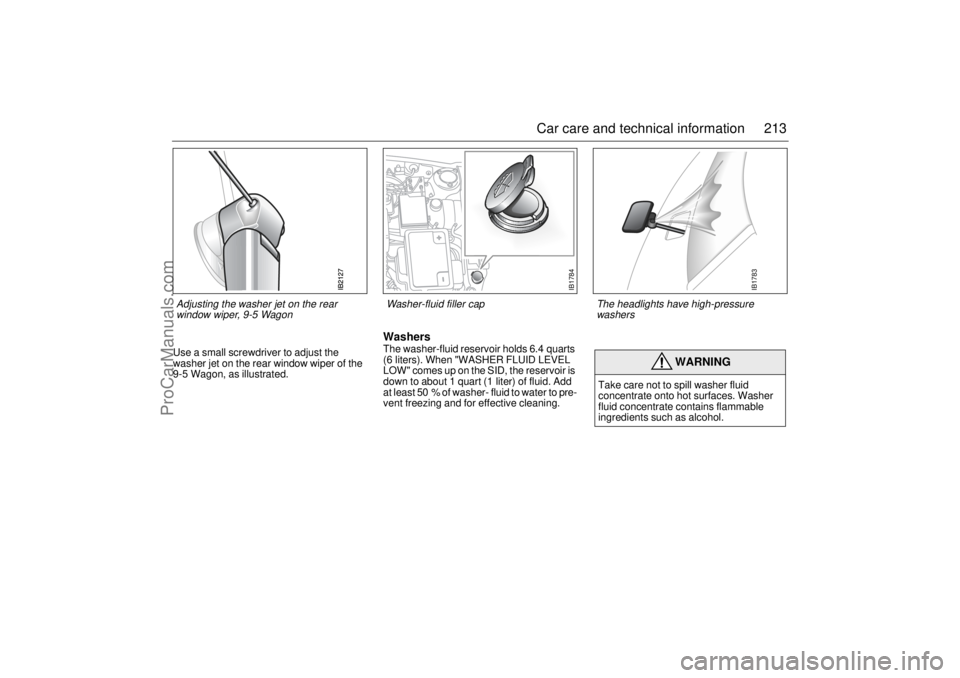
Use a small screwdriver to adjust the
washer jet on the rear window wiper of the
9-5 Wagon, as illustrated.
WashersThe washer-fluid reservoir holds 6.4 quarts
(6 liters). When "WASHER FLUID LEVEL
LOW" comes up on the SID, the reservoir is
down to about 1 quart (1 liter) of fluid. Add
at least 50 % of washer- fluid to water to pre-
vent freezing and for effective cleaning.
WARNING
Take care not to spill washer fluid
concentrate onto hot surfaces. Washer
fluid concentrate contains flammable
ingredients such as alcohol.
IB1784
Washer-fluid filler cap
IB1783
The headlights have high-pressure
washers
Adjusting the washer jet on the rear
window wiper, 9-5 Wagon
ProCarManuals.com
Page 214 of 288

214 Car care and technical informationChanging bulbsCheck that the new bulb is working when finished.
Use only "Long Life" bulbs.
Headlight aiming, see page 250.
Bi-Xenon headlight (certain models only)Bi-Xenon headlights produce roughly twice as much light as halo-
gen bulbs and have a significantly longer service life.
The lamp units consist of a gas discharge lamp containing xenon.
When the lights are switched on a very high voltage activates the
xenon gas. The lamps soon reach full intensity.
Cars with xenon headlights have automatic levelling. The levelling
system comprises two sensors on the front axle, one on the rear axle
and a control unit under the headlight housing. Headlight alignment
is regulated automatically to prevent dazzling oncoming traffic.
Alignment is also adjusted during braking.
WARNING
Before changing a bulb in the engine bay, switch off the engine to
avoid danger of fingers and hands being injured by moving parts.
The radiator fan can start up even when the engine is switched off.
Bi-Xenon headlights are high voltage and must therefore be
changed at an authorized Saab workshop. Work involving
high-voltage components is potentially lethal.NOTICE Since the headlight lenses are made of plastic, rinse dried-on
dirt with water and allow it time to soften up before cleaning
the lenses. Avoid rubbing the lenses when dry and never use
solvents.
Use de-icer spray instead of scraping the ice off.
NOTICE Do not fit bulbs with a higher rating than 55 W, since the head-
light reflector and the wiring of the car are not designed for a
higher wattage.
Switch off the ignition before changing a bulb, to avoid possi-
ble short-circuiting.
Do not touch the glass of the bulbs with your fingers. The oil
on your skin can shorten the life of the bulb.
ProCarManuals.com
Page 217 of 288
217 Car care and technical information
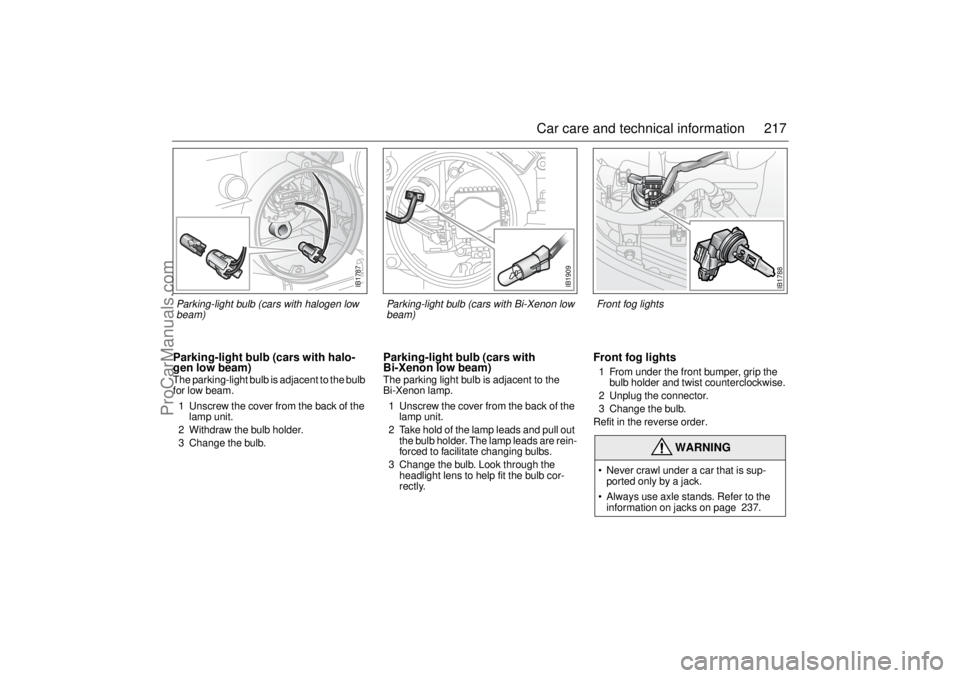
Parking-light bulb (cars with halo-
gen low beam)The parking-light bulb is adjacent to the bulb
for low beam.
1 Unscrew the cover from the back of the
lamp unit.
2 Withdraw the bulb holder.
3 Change the bulb.
Parking-light bulb (cars with
Bi-Xenon low beam)The parking light bulb is adjacent to the
Bi-Xenon lamp.
1 Unscrew the cover from the back of the
lamp unit.
2 Take hold of the lamp leads and pull out
the bulb holder. The lamp leads are rein-
forced to facilitate changing bulbs.
3 Change the bulb. Look through the
headlight lens to help fit the bulb cor-
rectly.
Front fog lights 1 From under the front bumper, grip the
bulb holder and twist counterclockwise.
2 Unplug the connector.
3 Change the bulb.
Refit in the reverse order.
WARNING
Never crawl under a car that is sup-
ported only by a jack.
Always use axle stands. Refer to the
information on jacks on page 237.
IB1787
Parking-light bulb (cars with halogen low
beam)
IB1788
Front fog lights
IB1909
Parking-light bulb (cars with Bi-Xenon low
beam)
ProCarManuals.com
Page 227 of 288
227 Car care and technical information
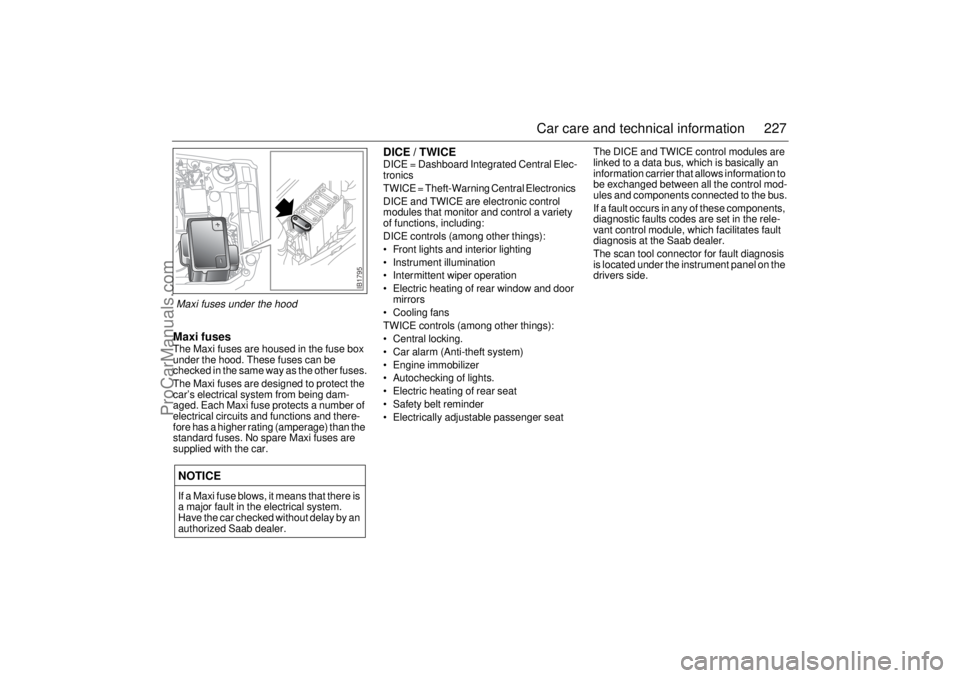
Maxi fusesThe Maxi fuses are housed in the fuse box
under the hood. These fuses can be
checked in the same way as the other fuses.
The Maxi fuses are designed to protect the
car’s electrical system from being dam-
aged. Each Maxi fuse protects a number of
electrical circuits and functions and there-
fore has a higher rating (amperage) than the
standard fuses. No spare Maxi fuses are
supplied with the car.
DICE / TWICEDICE = Dashboard Integrated Central Elec-
tronics
TWICE = Theft-Warning Central Electronics
DICE and TWICE are electronic control
modules that monitor and control a variety
of functions, including:
DICE controls (among other things):
Front lights and interior lighting
Instrument illumination
Intermittent wiper operation
Electric heating of rear window and door
mirrors
Cooling fans
TWICE controls (among other things):
Central locking.
Car alarm (Anti-theft system)
Engine immobilizer
Autochecking of lights.
Electric heating of rear seat
Safety belt reminder
Electrically adjustable passenger seatThe DICE and TWICE control modules are
linked to a data bus, which is basically an
information carrier that allows information to
be exchanged between all the control mod-
ules and components connected to the bus.
If a fault occurs in any of these components,
diagnostic faults codes are set in the rele-
vant control module, which facilitates fault
diagnosis at the Saab dealer.
The scan tool connector for fault diagnosis
is located under the instrument panel on the
drivers side.
NOTICEIf a Maxi fuse blows, it means that there is
a major fault in the electrical system.
Have the car checked without delay by an
authorized Saab dealer.
IB1795
Maxi fuses under the hood
ProCarManuals.com
Page 237 of 288

237 Car care and technical information
Changing a wheel
WARNING
The car jack is designed solely for use
in changing a wheel or fitting snow
chains. It must not be used to sup-
port the car during repair work or
servicing.
Never crawl under a car that is
supported only by a jack.
Special care must be taken if the car is
on a slope – use wheel chocks!
Position chocks, one ahead and one
behind, the wheel that is diagonally
opposite to the one to be changed.
Switch on the hazard warning lights if
the car is on a road.
Apply the parking brake and leave the
car in gear (1st or reverse). Automatic
transmission: move selector to the
P position.
Ensure that everybody is out of the car
before jacking it up.
Never start the engine while the car is
jacked up.
The jack must stand on a firm, level
surface.
Stow the jack in the place provided for
it under the panel in the floor of the
trunk. Secure it properly to avoid injury
to passengers in the event of a crash.
Do not use the jack for any purpose
other than for jacking up the car.
Grit, salt and rust can clog the inner
threads of the wheel bolts if the car has
been driven for several years exclu-
sively with alloy wheels.
If steel wheels are now fitted, the bolt
hole threads in the brake hubs should
be cleaned before the thinner steel
wheels are fitted. It may otherwise not
be possible to achieve the required
clamping force despite tightening the
bolts to the correct torque.
ProCarManuals.com