check SAAB 9-5 2003 Owners Manual
[x] Cancel search | Manufacturer: SAAB, Model Year: 2003, Model line: 9-5, Model: SAAB 9-5 2003Pages: 288, PDF Size: 16.78 MB
Page 6 of 288
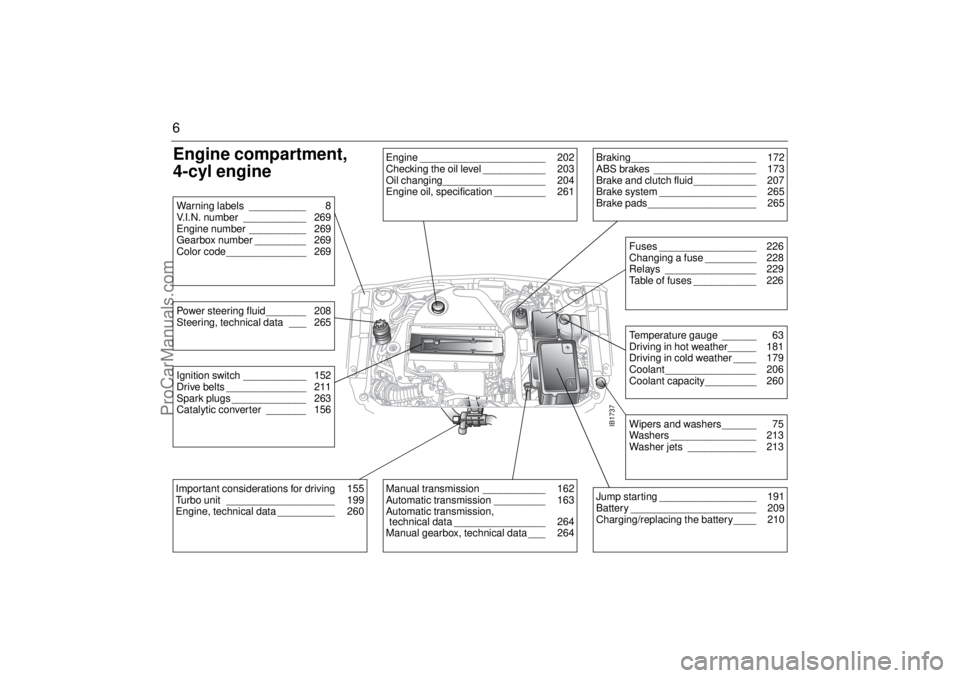
6Engine compartment,
4-cyl engine
IB1737
Engine ______________________ 202
Checking the oil level ___________ 203
Oil changing__________________ 204
Engine oil, specification _________ 261
Braking______________________ 172
ABS brakes __________________ 173
Brake and clutch fluid ___________ 207
Brake system _________________ 265
Brake pads ___________________ 265
Fuses _________________ 226
Changing a fuse _________ 228
Relays ________________ 229
Table of fuses ___________ 226Temperature gauge ______ 63
Driving in hot weather_____ 181
Driving in cold weather ____ 179
Coolant________________ 206
Coolant capacity_________ 260
Power steering fluid _______ 208
Steering, technical data ___ 265
Wipers and washers ______ 75
Washers _______________ 213
Washer jets ____________ 213
Jump starting _________________ 191
Battery ______________________ 209
Charging/replacing the battery____ 210
Manual transmission ___________ 162
Automatic transmission _________ 163
Automatic transmission,
technical data ________________ 264
Manual gearbox, technical data ___ 264
Important considerations for driving 155
Turbo unit ___________________ 199
Engine, technical data __________ 260Ignition switch ___________ 152
Drive belts ______________ 211
Spark plugs _____________ 263
Catalytic converter _______ 156Warning labels __________ 8
V.I.N. number ___________ 269
Engine number __________ 269
Gearbox number _________ 269
Color code______________ 269
ProCarManuals.com
Page 7 of 288
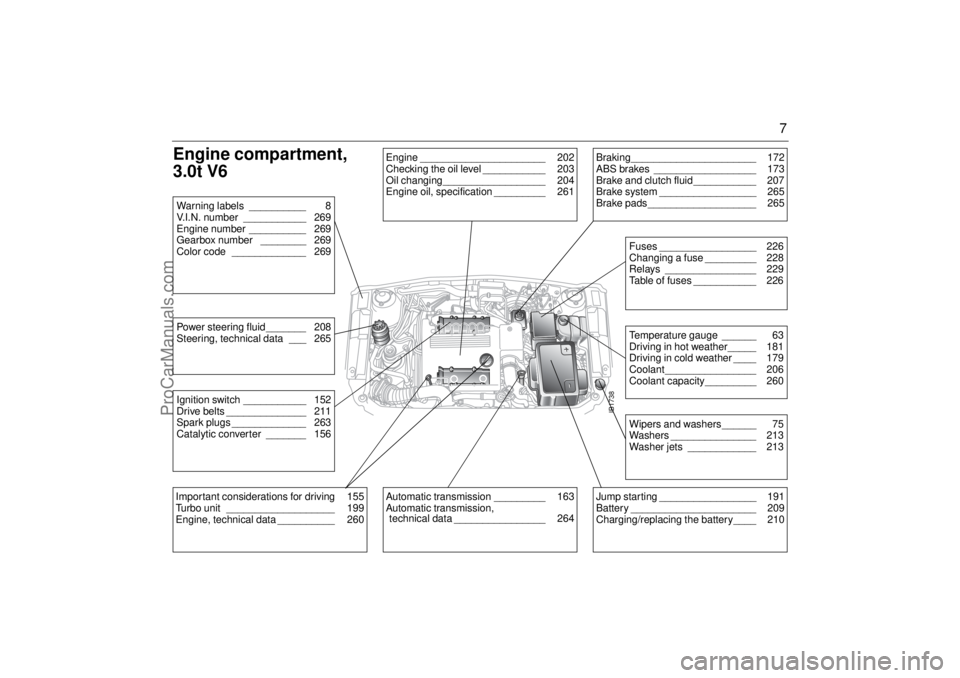
7
Engine compartment,
3.0t V6
IB1738
Warning labels __________ 8
V.I.N. number ___________ 269
Engine number __________ 269
Gearbox number ________ 269
Color code _____________ 269Ignition switch ___________ 152
Drive belts ______________ 211
Spark plugs _____________ 263
Catalytic converter _______ 156Important considerations for driving 155
Turbo unit ___________________ 199
Engine, technical data __________ 260
Automatic transmission _________ 163
Automatic transmission,
technical data ________________ 264
Braking______________________ 172
ABS brakes __________________ 173
Brake and clutch fluid ___________ 207
Brake system _________________ 265
Brake pads ___________________ 265Jump starting _________________ 191
Battery ______________________ 209
Charging/replacing the battery____ 210
Fuses _________________ 226
Changing a fuse _________ 228
Relays ________________ 229
Table of fuses ___________ 226Temperature gauge ______ 63
Driving in hot weather_____ 181
Driving in cold weather ____ 179
Coolant________________ 206
Coolant capacity_________ 260
Power steering fluid _______ 208
Steering, technical data ___ 265
Wipers and washers ______ 75
Washers _______________ 213
Washer jets ____________ 213
Engine ______________________ 202
Checking the oil level ___________ 203
Oil changing__________________ 204
Engine oil, specification _________ 261
ProCarManuals.com
Page 17 of 288
17 Safety
Safety belts Three-point inertia-reel safety belts are
provided for all seats.
Research has established that it is just as
dangerous for rear seat passengers not to
wear their safety belts as it is for front seat
passengers.
Bear in mind that in certain states it is a legal
requirement for all occupants of the car to
wear a safety belt.
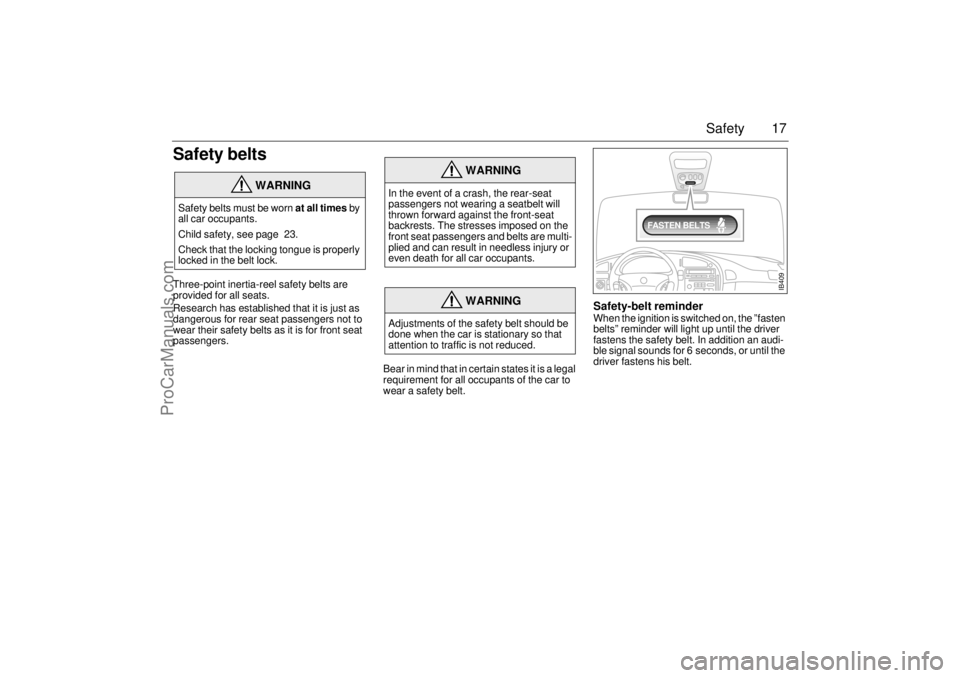
Safety-belt reminderWhen the ignition is switched on, the ”fasten
belts” reminder will light up until the driver
fastens the safety belt. In addition an audi-
ble signal sounds for 6 seconds, or until the
driver fastens his belt.
WARNING
Safety belts must be worn at all times by
all car occupants.
Child safety, see page 23.
Check that the locking tongue is properly
locked in the belt lock.
WARNING
In the event of a crash, the rear-seat
passengers not wearing a seatbelt will
thrown forward against the front-seat
backrests. The stresses imposed on the
front seat passengers and belts are multi-
plied and can result in needless injury or
even death for all car occupants.
WARNING
Adjustments of the safety belt should be
done when the car is stationary so that
attention to traffic is not reduced.
IB409
FASTEN BELTS
ProCarManuals.com
Page 18 of 288
18 SafetySafety belt pretensionersThe belts of the front seats are fitted with
automatic pretensioners and force limiters.
These are activated in the event of a severe
frontal or rear-end crash and a side-on colli-
sion, provided that the safety belts are being
worn.
The pretensioners serve to reduce the
forward movement of the body by tension-
ing the belt. The force limiters reduce belt
loads on the body by "slackening" the safety
belt to absorb the body’s kinetic energy as
gradually as possible.
The safety belt pretensioners are not acti-
vated by vehicle rollover.
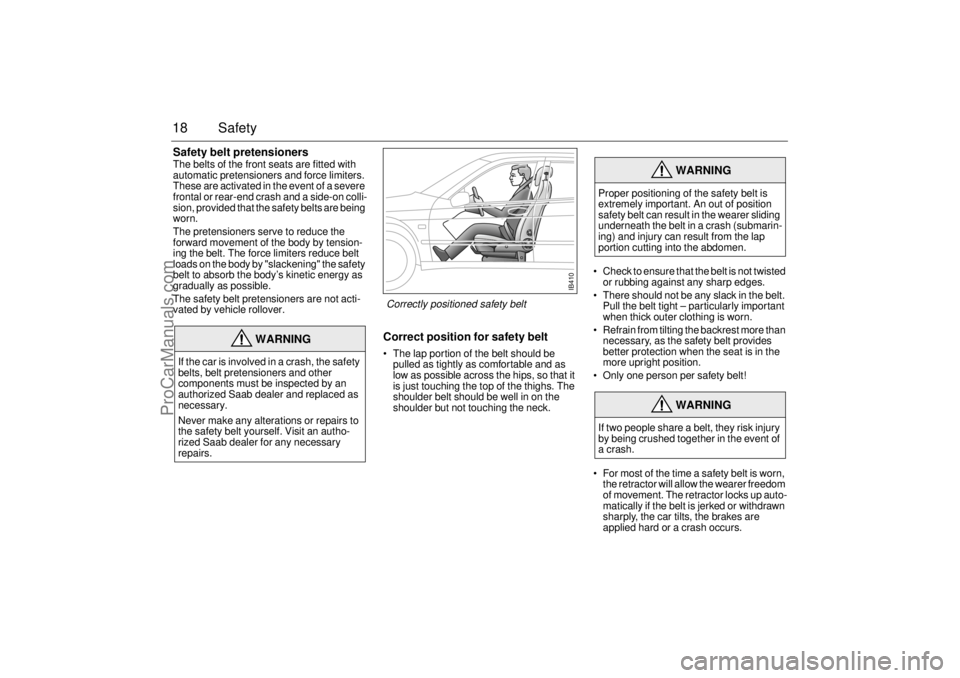
Correct position for safety belt The lap portion of the belt should be
pulled as tightly as comfortable and as
low as possible across the hips, so that it
is just touching the top of the thighs. The
shoulder belt should be well in on the
shoulder but not touching the neck.
Check to ensure that the belt is not twisted
or rubbing against any sharp edges.
There should not be any slack in the belt.
Pull the belt tight – particularly important
when thick outer clothing is worn.
Refrain from tilting the backrest more than
necessary, as the safety belt provides
better protection when the seat is in the
more upright position.
Only one person per safety belt!
For most of the time a safety belt is worn,
the retractor will allow the wearer freedom
of movement. The retractor locks up auto-
matically if the belt is jerked or withdrawn
sharply, the car tilts, the brakes are
applied hard or a crash occurs.
WARNING
If the car is involved in a crash, the safety
belts, belt pretensioners and other
components must be inspected by an
authorized Saab dealer and replaced as
necessary.
Never make any alterations or repairs to
the safety belt yourself. Visit an autho-
rized Saab dealer for any necessary
repairs.
WARNING
Proper positioning of the safety belt is
extremely important. An out of position
safety belt can result in the wearer sliding
underneath the belt in a crash (submarin-
ing) and injury can result from the lap
portion cutting into the abdomen.
WARNING
If two people share a belt, they risk injury
by being crushed together in the event of
a crash.
IB410
Correctly positioned safety belt
ProCarManuals.com
Page 19 of 288
19 Safety
Children who have grown out of a child
seat should be restrained by the car’s
standard three-point belts. Make sure that
the shoulder belt is not in contact with the
neck or throat. If it is, a booster seat/cush-
ion may be necessary.
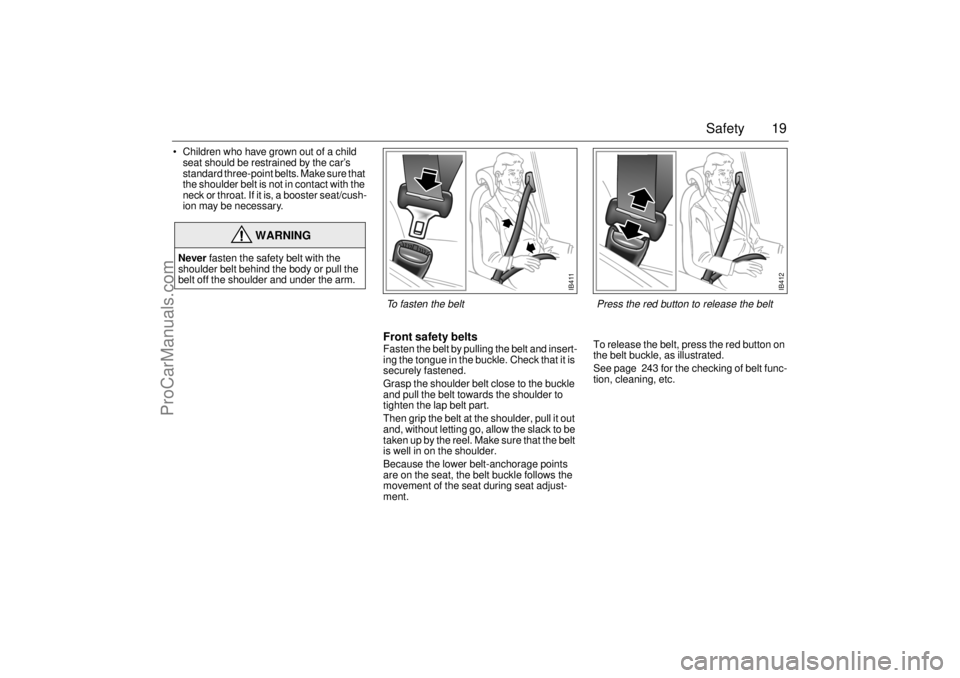
Front safety belts Fasten the belt by pulling the belt and insert-
ing the tongue in the buckle. Check that it is
securely fastened.
Grasp the shoulder belt close to the buckle
and pull the belt towards the shoulder to
tighten the lap belt part.
Then grip the belt at the shoulder, pull it out
and, without letting go, allow the slack to be
taken up by the reel. Make sure that the belt
is well in on the shoulder.
Because the lower belt-anchorage points
are on the seat, the belt buckle follows the
movement of the seat during seat adjust-
ment.To release the belt, press the red button on
the belt buckle, as illustrated.
See page 243 for the checking of belt func-
tion, cleaning, etc.
WARNING
Never fasten the safety belt with the
shoulder belt behind the body or pull the
belt off the shoulder and under the arm.
IB411
To fasten the belt
IB412
Press the red button to release the belt
ProCarManuals.com
Page 21 of 288
21 Safety
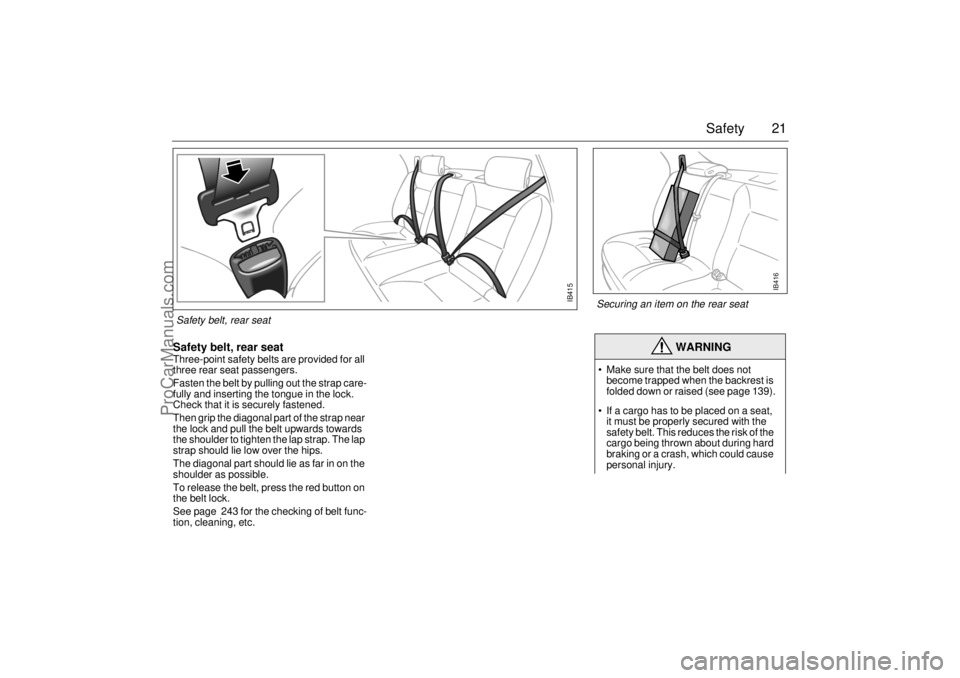
Safety belt, rear seat Three-point safety belts are provided for all
three rear seat passengers.
Fasten the belt by pulling out the strap care-
fully and inserting the tongue in the lock.
Check that it is securely fastened.
Then grip the diagonal part of the strap near
the lock and pull the belt upwards towards
the shoulder to tighten the lap strap. The lap
strap should lie low over the hips.
The diagonal part should lie as far in on the
shoulder as possible.
To release the belt, press the red button on
the belt lock.
See page 243 for the checking of belt func-
tion, cleaning, etc.
WARNING
Make sure that the belt does not
become trapped when the backrest is
folded down or raised (see page 139).
If a cargo has to be placed on a seat,
it must be properly secured with the
safety belt. This reduces the risk of the
cargo being thrown about during hard
braking or a crash, which could cause
personal injury.
IB???IB415
Safety belt, rear seat
IB416
Securing an item on the rear seat
ProCarManuals.com
Page 22 of 288
22 Safety Check that the belt is not twisted or
lying against sharp edges.
Make sure you use the correct safety
belt buckle. The buckles for the center
and left-hand rear seats are close
together.
WARNING
Safety belts are designed to bear upon
the bony structure of the body, and should
be worn low across the front of the pelvis
or the pelvis, chest and shoulders, as
applicable; wearing the lap section of the
belt across the abdominal area must be
avoided.
Safety belts should be adjusted as firmly
as possible, consistent with comfort, to
provide the protection for which they have
been designed. A loose belt will greatly
reduce the protection afforded to the
wearer.
Care should be taken to avoid contamina-
tion of the webbing with polishes, oils and
chemicals, and particularly battery acid.
Cleaning may safely be carried out using
mild soap and water. The belt should be
replaced if webbing becomes frayed,
contaminated or damaged.
It is essential to replace the entire assem-
bly after it has been worn in a severe
impact even if damage to the assembly is
not obvious.
Belts should not be worn with straps
twisted.
Each belt assembly must only be used by
one occupant; it is dangerous to put a belt
around a child being carried on the occu-
pant´s lap.
No modifications or additions should be
made by the user which will either prevent
the safety belt adjusting device from oper-
ating to remove slack, or prevent the
safety belt assembly from being adjusted
to remove slack.
ProCarManuals.com
Page 25 of 288
25 Safety
LATCH installationTo facilitate the proper fitting of new
specially-designed child restraints, rigid
lower anchorages (ISOFIX) have been
installed to the vehicle that shall be used
with the top tether anchorages in the two
outboard rear seating positions. There is an
additional top tether anchorage for the
center rear seating position that is to be
used together with the safety belt.
LATCH is a U.S./Canadian government
standard for an uniform method of fitting
child restraints without using the standard
safety belts. Only certain child restraints are
equipped to utilize these rigid lower anchor-
ages behind where the seat cushion and
seat back come together. LATCH child
seats also utilize a top tether strap that is
found on some newer child seats that still
require installation with the standard safety
belts.
There are two bars attached to the car body
for each specially designed LATCH child
restraint. A small label is located on the seat
back just above the outer attachment bars
to facilitate installing the child restraint. The
label contains a circle and a rearward facing
child restraint.
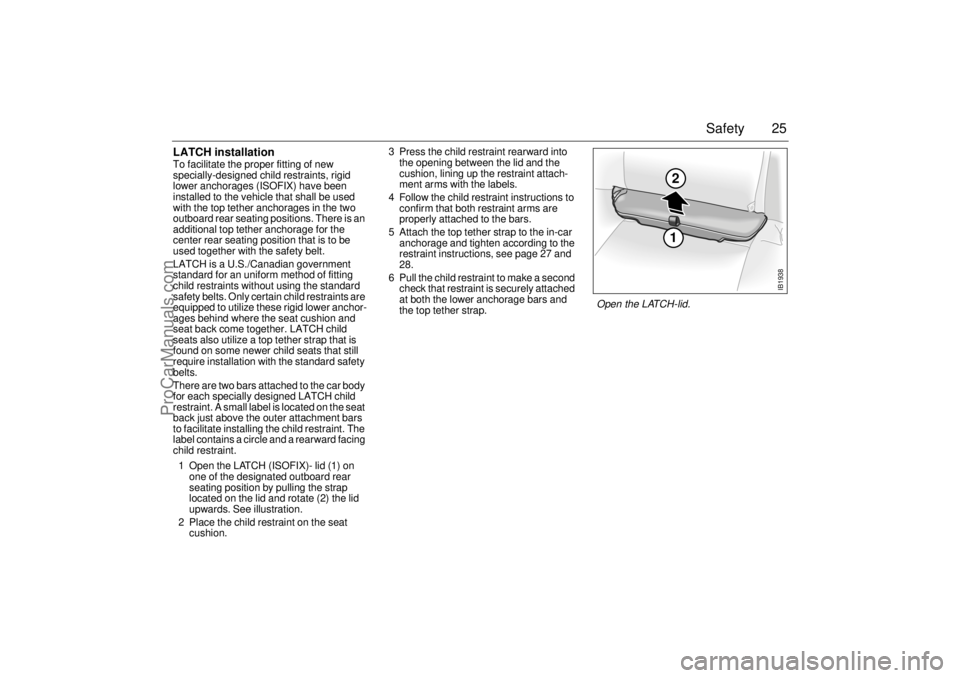
1 Open the LATCH (ISOFIX)- lid (1) on
one of the designated outboard rear
seating position by pulling the strap
located on the lid and rotate (2) the lid
upwards. See illustration.
2 Place the child restraint on the seat
cushion.3 Press the child restraint rearward into
the opening between the lid and the
cushion, lining up the restraint attach-
ment arms with the labels.
4 Follow the child restraint instructions to
confirm that both restraint arms are
properly attached to the bars.
5 Attach the top tether strap to the in-car
anchorage and tighten according to the
restraint instructions, see page 27 and
28.
6 Pull the child restraint to make a second
check that restraint is securely attached
at both the lower anchorage bars and
the top tether strap.
IB1938
12
Open the LATCH-lid.
ProCarManuals.com
Page 27 of 288
27 Safety
Child tether anchorages for forward
facing child car seatsChild restraints with a tether strap must be
anchored according to Canadian and USA
laws.
If you have any questions regarding child
tether anchorages please contact your
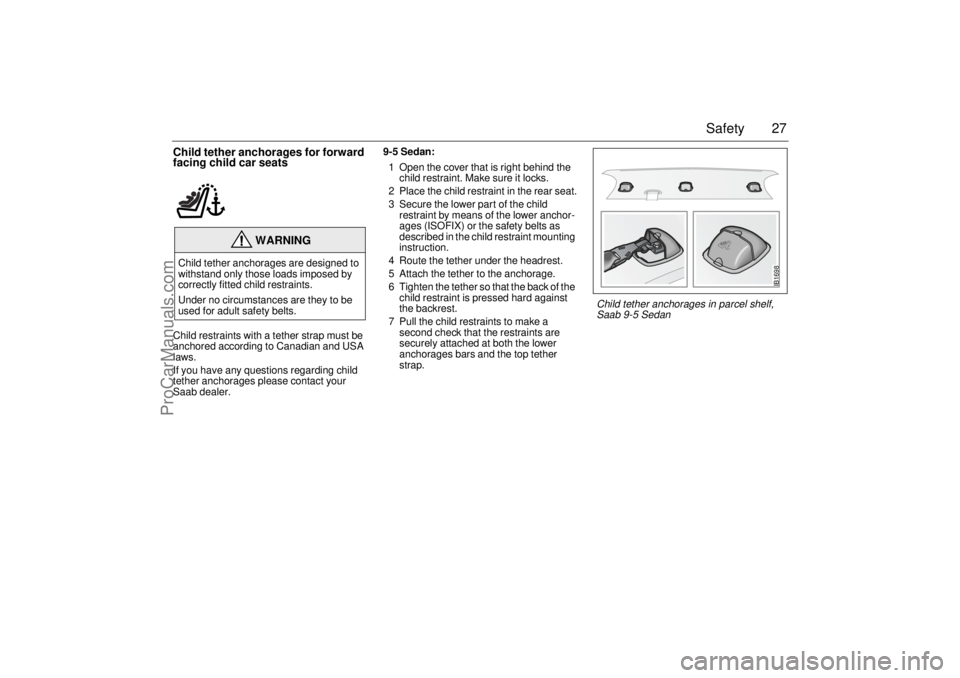
Saab dealer.9-5 Sedan:
1 Open the cover that is right behind the
child restraint. Make sure it locks.
2 Place the child restraint in the rear seat.
3 Secure the lower part of the child
restraint by means of the lower anchor-
ages (ISOFIX) or the safety belts as
described in the child restraint mounting
instruction.
4 Route the tether under the headrest.
5 Attach the tether to the anchorage.
6 Tighten the tether so that the back of the
child restraint is pressed hard against
the backrest.
7 Pull the child restraints to make a
second check that the restraints are
securely attached at both the lower
anchorages bars and the top tether
strap.
WARNING
Child tether anchorages are designed to
withstand only those loads imposed by
correctly fitted child restraints.
Under no circumstances are they to be
used for adult safety belts.
IB1698
Child tether anchorages in parcel shelf,
Saab 9-5 Sedan
ProCarManuals.com
Page 28 of 288
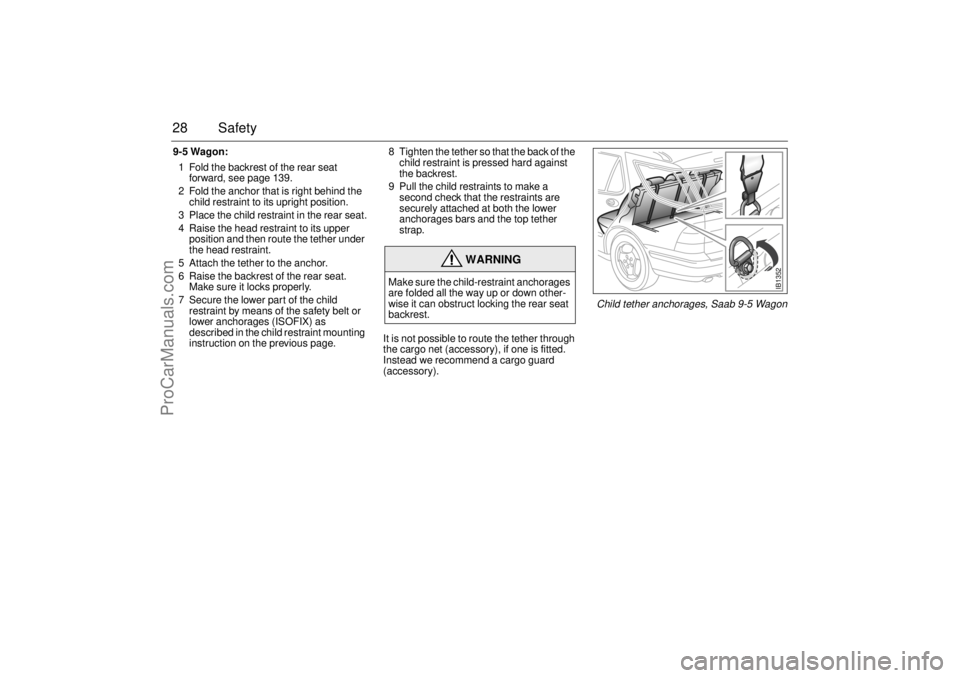
28 Safety9-5 Wagon:
1 Fold the backrest of the rear seat
forward, see page 139.
2 Fold the anchor that is right behind the
child restraint to its upright position.
3 Place the child restraint in the rear seat.
4 Raise the head restraint to its upper
position and then route the tether under
the head restraint.
5 Attach the tether to the anchor.
6 Raise the backrest of the rear seat.
Make sure it locks properly.
7 Secure the lower part of the child
restraint by means of the safety belt or
lower anchorages (ISOFIX) as
described in the child restraint mounting
instruction on the previous page.8 Tighten the tether so that the back of the
child restraint is pressed hard against
the backrest.
9 Pull the child restraints to make a
second check that the restraints are
securely attached at both the lower
anchorages bars and the top tether
strap.
It is not possible to route the tether through
the cargo net (accessory), if one is fitted.
Instead we recommend a cargo guard
(accessory).
WARNING
Make sure the child-restraint anchorages
are folded all the way up or down other-
wise it can obstruct locking the rear seat
backrest.
IB1352
Child tether anchorages, Saab 9-5 Wagon
ProCarManuals.com