fuel pressure SAAB 9-5 2003 Owners Manual
[x] Cancel search | Manufacturer: SAAB, Model Year: 2003, Model line: 9-5, Model: SAAB 9-5 2003Pages: 288, PDF Size: 16.78 MB
Page 4 of 288
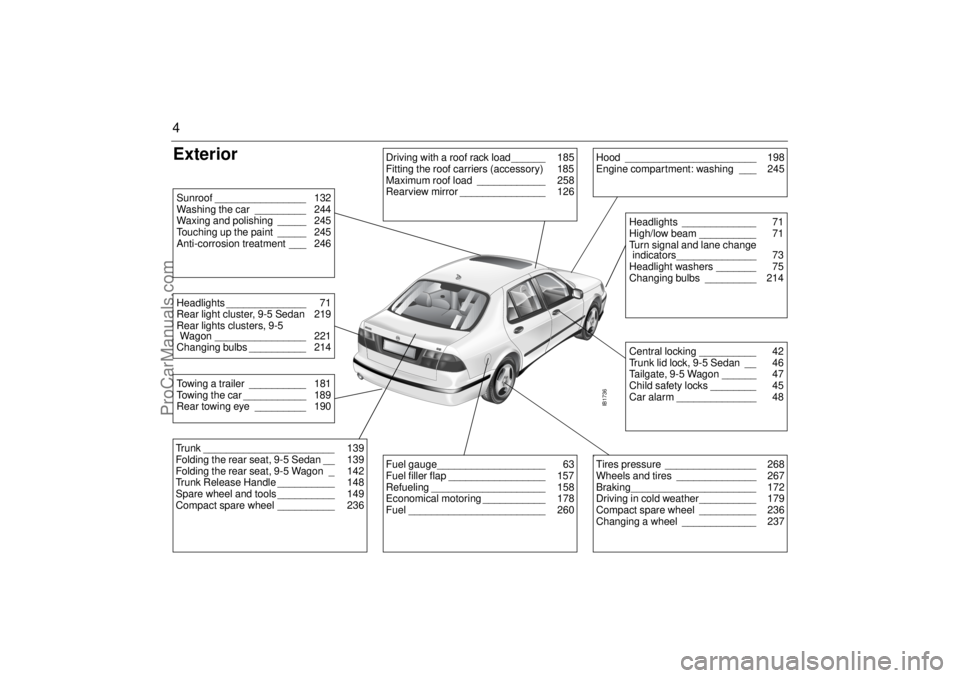
4Exterior
IB1736
Driving with a roof rack load______ 185
Fitting the roof carriers (accessory) 185
Maximum roof load ____________ 258
Rearview mirror _______________ 126
Hood _______________________ 198
Engine compartment: washing ___ 245
Central locking __________ 42
Trunk lid lock, 9-5 Sedan __ 46
Tailgate, 9-5 Wagon ______ 47
Child safety locks ________ 45
Car alarm ______________ 48Headlights _____________ 71
High/low beam __________ 71
Turn signal and lane change
indicators______________ 73
Headlight washers _______ 75
Changing bulbs _________ 214
Fuel gauge___________________ 63
Fuel filler flap _________________ 157
Refueling ____________________ 158
Economical motoring ___________ 178
Fuel ________________________ 260
b Tires pressure ________________ 268
Wheels and tires ______________ 267
Braking______________________ 172
Driving in cold weather__________ 179
Compact spare wheel __________ 236
Changing a wheel _____________ 237
Trunk _______________________ 139
Folding the rear seat, 9-5 Sedan __ 139
Folding the rear seat, 9-5 Wagon _ 142
Trunk Release Handle __________ 148
Spare wheel and tools __________ 149
Compact spare wheel __________ 236Towing a trailer __________ 181
Towing the car ___________ 189
Rear towing eye _________ 190Headlights ______________ 71
Rear light cluster, 9-5 Sedan 219
Rear lights clusters, 9-5
Wagon ________________ 221
Changing bulbs __________ 214Sunroof ________________ 132
Washing the car _________ 244
Waxing and polishing _____ 245
Touching up the paint _____ 245
Anti-corrosion treatment ___ 246
ProCarManuals.com
Page 10 of 288
10
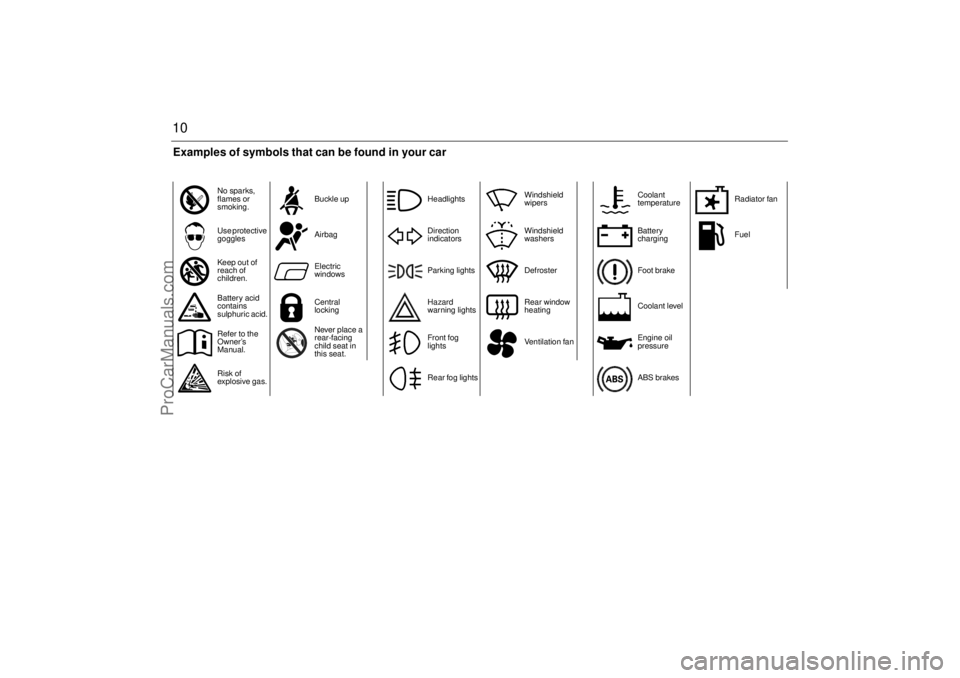
No sparks,
flames or
smoking.Buckle up
Use protective
gogglesAirbag
Keep out of
reach of
children.Electric
windows
Battery acid
contains
sulphuric acid.Central
locking
Refer to the
Owner’s
Manual.Never place a
rear-facing
child seat in
this seat.
Risk of
explosive gas.
HeadlightsWindshield
wipers
Direction
indicatorsWindshield
washers
Parking lights Defroster
Hazard
warning lightsRear window
heating
Front fog
lightsVentilation fan
Rear fog lights
Coolant
temperatureRadiator fan
Battery
chargingFuel
Foot brake
Coolant level
Engine oil
pressure
ABS brakes
Examples of symbols that can be found in your car
ProCarManuals.com
Page 56 of 288
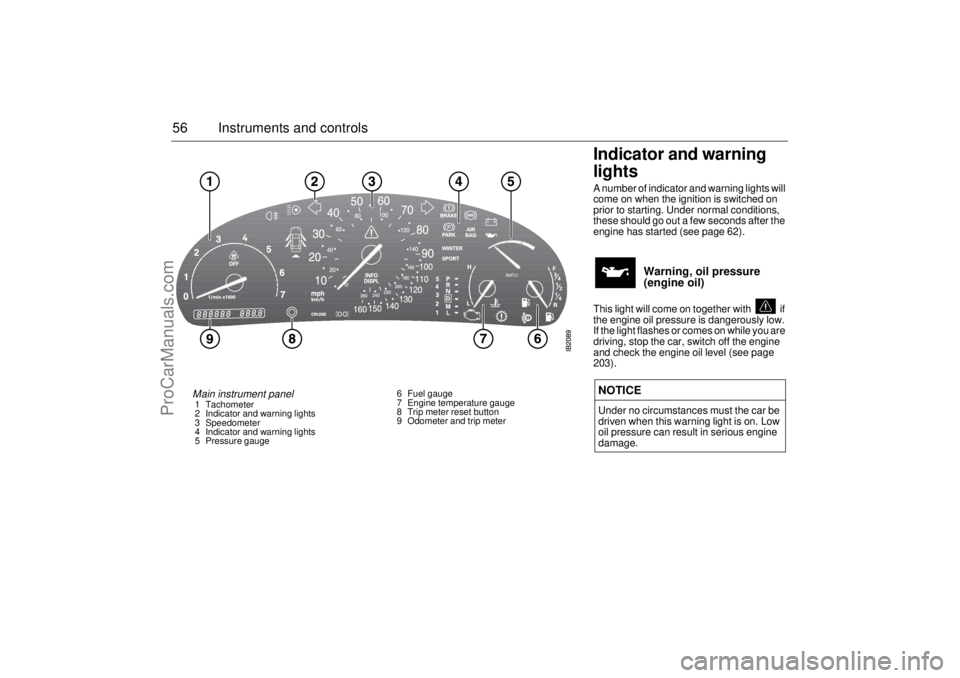
56 Instruments and controls
Indicator and warning
lights A number of indicator and warning lights will
come on when the ignition is switched on
prior to starting. Under normal conditions,
these should go out a few seconds after the
engine has started (see page 62).
Warning, oil pressure
(engine oil)
This light will come on together with if
the engine oil pressure is dangerously low.
If the light flashes or comes on while you are
driving, stop the car, switch off the engine
and check the engine oil level (see page
203). NOTICEUnder no circumstances must the car be
driven when this warning light is on. Low
oil pressure can result in serious engine
damage.
Main instrument panel 1 Tachometer
2 Indicator and warning lights
3 Speedometer
4 Indicator and warning lights
5 Pressure gauge6 Fuel gauge
7 Engine temperature gauge
8 Trip meter reset button
9 Odometer and trip meter
ProCarManuals.com
Page 59 of 288
59 Instruments and controls
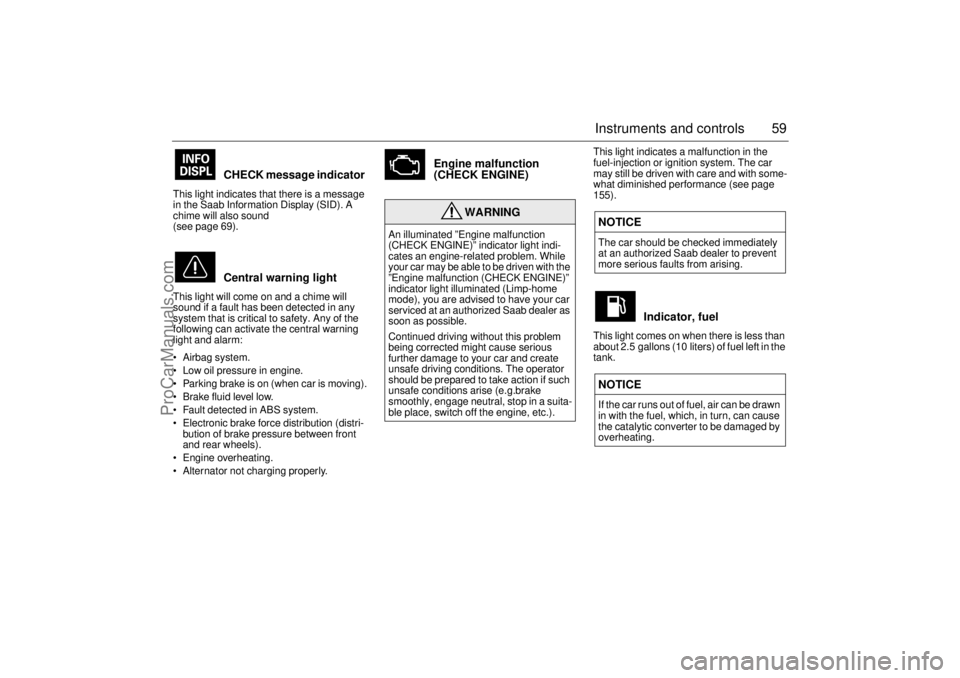
CHECK message indicator
This light indicates that there is a message
in the Saab Information Display (SID). A
chime will also sound
(see page 69).
Central warning light
This light will come on and a chime will
sound if a fault has been detected in any
system that is critical to safety. Any of the
following can activate the central warning
light and alarm:
Airbag system.
Low oil pressure in engine.
Parking brake is on (when car is moving).
Brake fluid level low.
Fault detected in ABS system.
Electronic brake force distribution (distri-
bution of brake pressure between front
and rear wheels).
Engine overheating.
Alternator not charging properly.
Engine malfunction
(CHECK ENGINE)
This light indicates a malfunction in the
fuel-injection or ignition system. The car
may still be driven with care and with some-
what diminished performance (see page
155).
Indicator, fuel
This light comes on when there is less than
about 2.5 gallons (10 liters) of fuel left in the
tank.
WARNING
An illuminated ”Engine malfunction
(CHECK ENGINE)” indicator light indi-
cates an engine-related problem. While
your car may be able to be driven with the
”Engine malfunction (CHECK ENGINE)”
indicator light illuminated (Limp-home
mode), you are advised to have your car
serviced at an authorized Saab dealer as
soon as possible.
Continued driving without this problem
being corrected might cause serious
further damage to your car and create
unsafe driving conditions. The operator
should be prepared to take action if such
unsafe conditions arise (e.g.brake
smoothly, engage neutral, stop in a suita-
ble place, switch off the engine, etc.).
NOTICEThe car should be checked immediately
at an authorized Saab dealer to prevent
more serious faults from arising.NOTICEIf the car runs out of fuel, air can be drawn
in with the fuel, which, in turn, can cause
the catalytic converter to be damaged by
overheating.
ProCarManuals.com
Page 62 of 288
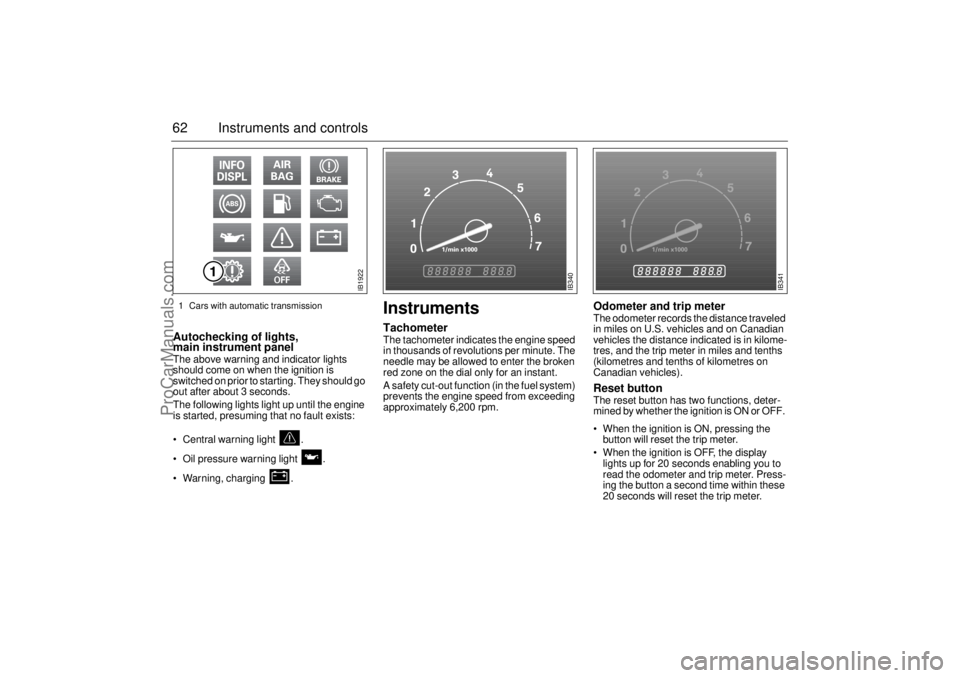
62 Instruments and controlsAutochecking of lights,
main instrument panel The above warning and indicator lights
should come on when the ignition is
switched on prior to starting. They should go
out after about 3 seconds.
The following lights light up until the engine
is started, presuming that no fault exists:
Central warning light .
Oil pressure warning light .
Warning, charging .
InstrumentsTachometerThe tachometer indicates the engine speed
in thousands of revolutions per minute. The
needle may be allowed to enter the broken
red zone on the dial only for an instant.
A safety cut-out function (in the fuel system)
prevents the engine speed from exceeding
approximately 6,200 rpm.
Odometer and trip meter The odometer records the distance traveled
in miles on U.S. vehicles and on Canadian
vehicles the distance indicated is in kilome-
tres, and the trip meter in miles and tenths
(kilometres and tenths of kilometres on
Canadian vehicles). Reset button The reset button has two functions, deter-
mined by whether the ignition is ON or OFF.
When the ignition is ON, pressing the
button will reset the trip meter.
When the ignition is OFF, the display
lights up for 20 seconds enabling you to
read the odometer and trip meter. Press-
ing the button a second time within these
20 seconds will reset the trip meter.
IB1922
IB340
IB341
1 Cars with automatic transmission
ProCarManuals.com
Page 155 of 288

155 Starting and driving
Limp-home modeThe car’s engine-management system
includes a diagnostic function that checks
numerous internal functions after the
engine has been shut off. If a fault is
detected in the throttle system, the
engine-management system puts the throt-
tle system into the limp-home mode. This
limits idling control, disables the cruise-con-
trol system and limits the capacity of the A/C
compressor.
If the limp-home mode is in operation
(”Engine malfunction (CHECK ENGINE)”
light on, see below) and the outside temper-
ature is close to or below freezing, you may
need to use some throttle on starting (some
pressure on the accelerator).
If the diagnostic system has detected a fault
in the engine-management system, the
”Engine malfunction (CHECK ENGINE)”
light on the main instrument panel will
come on (see page 59), indicating that you
should have the car checked as soon as
possible by an authorized Saab dealer.
Important
considerations for
drivingThe engine-management system in the
Saab 9-5 is called Saab Trionic T7. The
system manages the ignition, fuel injection
and turbo boost pressure.
The Trionic T7 system developed by Saab
is an intelligent engine-management
system designed to achieve optimum driv-
ability under differing driving conditions.
The system makes adjustments automati-
cally, for instance, if the car is being driven
at altitude (oxygen-deficient air), for differ-
ent grades of fuel (AON 87–93) and for dif-
ferent load conditions.
1 Starting and driving
Refrain from using full throttle before
the engine has warmed up (before
needle in mid-range on temperature
gauge).
A safety function prevents the engine
from revving faster than 6,000 rpm by
limiting the induction air.
2 Stopping the engine
Do not rev the engine immediately
before switching it off – stop the engine
when it is idling.
3 Regulating the boost pressure
The system is optimized for fuel with an
octane rating of AON 90. The 2.3 T
(Aero) and 3.0t V6 are optimized for
NOTICEIf the CHECK ENGINE warning light
starts to flash, ease off the accelerator
slightly. If the light does not cease to flash
within 5 seconds, stop the car in a suit-
able place as soon as possible and turn
off the engine. The car must be towed to
an authorized Saab dealer.
If the CHECK ENGINE warning light
flashes, it indicates that the engine is mis-
firing which can result in damage to the
catalytic converter.
ProCarManuals.com
Page 156 of 288

156 Starting and driving
AON 93. One of the advantages of the
system is that it enables the engine to
be run safely on lower-grade fuel,
although not lower than AON 87.
The maximum boost pressure is
adjusted automatically to the knocking
or pinging tendency of the engine.
Occasional, short-lived knocking when
the engine is under a heavy load is per-
fectly normal; the extent will depend on
the grade of fuel in the tank.
Isolated instances of knocking are
more likely to occur with low-octane
fuel. This controlled form of knocking,
followed by a reduction in the boost
pressure, is a sign that the wastegate is
functioning and is perfectly safe for the
engine.
Important considerations with cata-
lytic convertersThe catalytic converter is an emission-con-
trol device incorporated in the car’s exhaust
system. It consists of a metal canister with a
honeycomb insert, the cells of which have
walls coated in a catalytic layer (mixture of
precious metals).
To ensure that the catalytic converter con-
tinues to function properly, and also to avoid
damage to the converter and its associated
components, the following points must be
observed:
Have the car serviced regularly in accor-
dance with the service program. The fuel
and ignition systems are particularly
important in this context.
Always be alert to any misfiring of the
engine (not running on all cylinders) and
any loss of power or performance. At the
first sign of a malfunction, reduce speed
and take the car to an authorized Saab
dealer as soon as possible.
If the engine fails to start (in very cold
weather or if the battery is flat), the car can
be push started (manual gearbox only) or
started using jumper cables to a donor
NOTICE If the engine sounds strange there is a
fault in the system. Have the car
checked without delay by an autho-
rized Saab dealer.
The use of fuel with too low an octane
rating can cause serious engine dam-
age.
WARNING
If the engine is being run with the car on a
rolling road or dynamometer, longer than
for a standard state emission inspection,
to ensure adequate cooling, air must be
blown into the engine compartment and
under the car at a rate equivalent to the
ram-air effect that would be obtained at
the corresponding road speed.
NOTICEUse only unleaded gasoline. Leaded gas-
oline is detrimental to the catalyst and
oxygen sensor and will seriously impair
the function of the catalytic converter.
ProCarManuals.com
Page 162 of 288

162 Starting and drivingGear changingManual transmissionTo start the engine the clutch pedal must
be fully depressed.
The gear positions are marked on the gear
lever. Before reverse (R) can be engaged,
you must lift the ring underneath the
gear-lever knob.
To change gear, fully depress the clutch
pedal and then release it smoothly. It is
inadvisable to drive with your hand resting
on the gear lever, as this can increase the
wear on the transmission.
When changing down from 5th to 4th gear,
ease the gear lever straight back, without
applying any lateral pressure. This will pre-
vent 2nd gear being engaged by mistake,
which can result in overreving and possible
damage to the engine.
Before engaging reverse, wait till the car is
at a standstill, release the accelerator and
fully depress the clutch. From neutral, press
the gear lever firmly to the right before
easing it back into reverse.
Shift-up indicator for improved fuel
economy (U.S. models only)Cars equipped with a manual transmission
have a "Shift-up" light on the instrument
panel. The light begins to work after the
vehicle is warmed up and provides you with
a good indication when to shift to a higher
gear.
It is not necessary or recommended to
follow the shift-up recommendations in all
driving conditions, for example, when driv-
ing in heavy urban traffic or steep downhill
grades.
However, shifting with the light should result
in improved fuel economy. Therefore, for
reduced fuel consumption and better
energy conservation, you should make a
habit of shifting before or when the shift-up
light comes on.Towing Towing of cars with manual transmission,
see page 189.
NOTICEWhen the reverse gear is to be engaged
the car must be at a standstill with the
accelerator fully released. Lift the reverse
lock-out collar and push the gear lever
firmly to the right in neutral before easing
it into reverse.
IB471
13
25
R
4
ProCarManuals.com
Page 179 of 288
179 Starting and driving
Driving in a low gear results in higher fuel
consumption than in a high gear because
of the higher engine speed for a given
road speed. Always change up to a higher
gear as soon as traffic conditions allow
and use the highest gear as much as pos-
sible.
Check the air pressure in the tires once a
month. Incorrect pressures increase tire
wear. It is better to have slightly higher
pressure than lower.
Check fuel consumption regularly.
Increased consumption can indicate that
something is wrong and that the car
needs to be checked by an authorized
Saab dealer.
Practical trials on the roads have demon-
strated that substantial savings in fuel con-
sumption can be made if the above advice
is heeded.Road conditions Wet roads increase fuel consumption, as do
unpaved roads and driving in hilly country
(the amount of fuel saved driving downhill is
less than the additional amount required to
climb the hill).
Engine block heater (standard
equipment in Canada, accessory in
U.S.)The following are just some of the benefits
to the car and the environment of using an
engine block heater:
Lower fuel consumption.
Exhaust emissions substantially reduced
over short runs.
Reduced wear on the engine.
Inside of car warms up faster.
The engine heater is effective at outside
temperatures up to +15–20°C. The warmer
it is outside, the shorter the time the engine
heater needs to be connected. Longer than
1.5 hours is unnecessary.
If the car is equipped with a removable,
electrical cabin heater that is not in use, this
should be stored in the luggage compart-
ment.
Driving in cold weatherBefore starting a journey in cold weather
you should check the following:
That the wiper blades have not become
frozen to the windshield/glass.
Brush any snow away from the air intake
for the heater system (opening between
hood and windshield).
It may be advisable to lubricate the
door-lock cylinder (use molybdenum
disulphide, MoS
2) to prevent its freezing.
If the lock has frozen, take care not to
break the key (or use the remote control)
– heat it first or spray it with de-icer.
Periodically during the winter, add gaso-
line anti-freeze to the fuel to dispel any
condensation in the fuel tank which could
freeze and cause problems in the system.
Keep the tank well filled to reduce the risk
of condensation forming.
If the car is parked outside in freezing
weather, fuel additives (gasoline
anti-freeze) will not do any good as it
cannot remove water that has already fro-
zen. Park the car in a warm place so that
any ice that may have built up melts, then
add gasoline anti-freeze when filling up
the tank. Condensation is caused by
changes in the outdoor temperature or by
the car being parked alternately in a
garage and outside.
It is particularly important when the roads
are slippery that the brakes and tires be in
good condition.
WARNING
Never switch the engine off while driving
as the effect of the brakes and power
steering will be greatly reduced.
ProCarManuals.com
Page 187 of 288

187 Starting and driving
Driving with a loadThe driving characteristics of the car are
affected by the way it is loaded.
Place heavy loads as far forward and as
low as possible in the trunk.
Secure the load to the tie downs, see
page 141.
The load should be such that the car´s
total weight or axle weight are not
exceeded, see page 258.
Heavy loads mean that the car’s center of
gravity is further back. As a result, the car
will sway more during evasive steering.
Never exceed the permissible load in the
roof box, even if there is room for more.
Ensure that the tire pressure is correct –
slight overinflation is preferable to under-
inflation.
The braking distance of a loaded car is
always greater. Keep your distance from
the vehicle in front.
Roof loads can negatively affect tele-
communication.
Tire pressure, see page 269 and back
cover.
Tires The tire pressure should match the current
load and speed of the car; see page 268 or
the tire pressure label on
page 269.
The tire pressures given apply to cold tires,
that is tires that are the same temperature
as the outside air temperature.
The tire pressure increases as the tires
become warm (e.g. during highway driving)
with approximately 0.3 bar (4 psi). When
the temperature of the tires changes by 50°
(10°C), the tire pressure will change 0.1 bar
(2 psi).Never reduce the pressure of a hot tire. If the
tires are hot when you check them, only
increase the pressure, if necessary.
Underinflated tires wear more quickly than
slightly overinflated tires.
If a valve is leaking, simply unscrew it and fit
a new one.
Important! Remember to adjust the tire
pressures if you change the load in the car
or intend to drive at substantially lower or
higher speeds than normal.
WARNING
Check the tire pressure at least once a
month and before long journeys. Under-
inflation can result in:
Punctures
Separation of the tire and tread
Damage to the sidewalls
Damage to the rims on poor roads
Poor handling characteristics
Premature tire wear
Increased fuel consumption.
ProCarManuals.com